Best Hall-Effect Keyboards in 2026
We may earn a commission from links on this page, at no extra cost to you. Learn more.
Hall-effect keyboards have gone from a niche curiosity to the weapon of choice for competitive gamers in just a few years. By using magnetic switches instead of metal contacts, they let you adjust actuation depth on every key and enable game-changing features like rapid trigger. In this roundup we tested seven of the best Hall-effect keyboards in 2026, spanning compact 60 percent boards to feature-loaded full layouts. Each pick balances analog precision, software depth, build quality, and value.
Quick comparison
| Keyboard | Best for | Rating | Price | |
|---|---|---|---|---|
| 1Wooting 80HEWooting | Best Overall | 4.8 | $$$ | Check Price |
| 2Wooting 60HEWooting | Best Compact | 4.7 | $$$ | Check Price |
| 3SteelSeries Apex Pro TKL Gen 3SteelSeries | Best Premium TKL | 4.6 | $$$ | Check Price |
| 4Keychron Q1 HEKeychron | Best Hot-Swap | 4.6 | $$$ | Check Price |
| 5Razer Huntsman V3 Pro TKLRazer | Best for Esports | 4.5 | $$$ | Check Price |
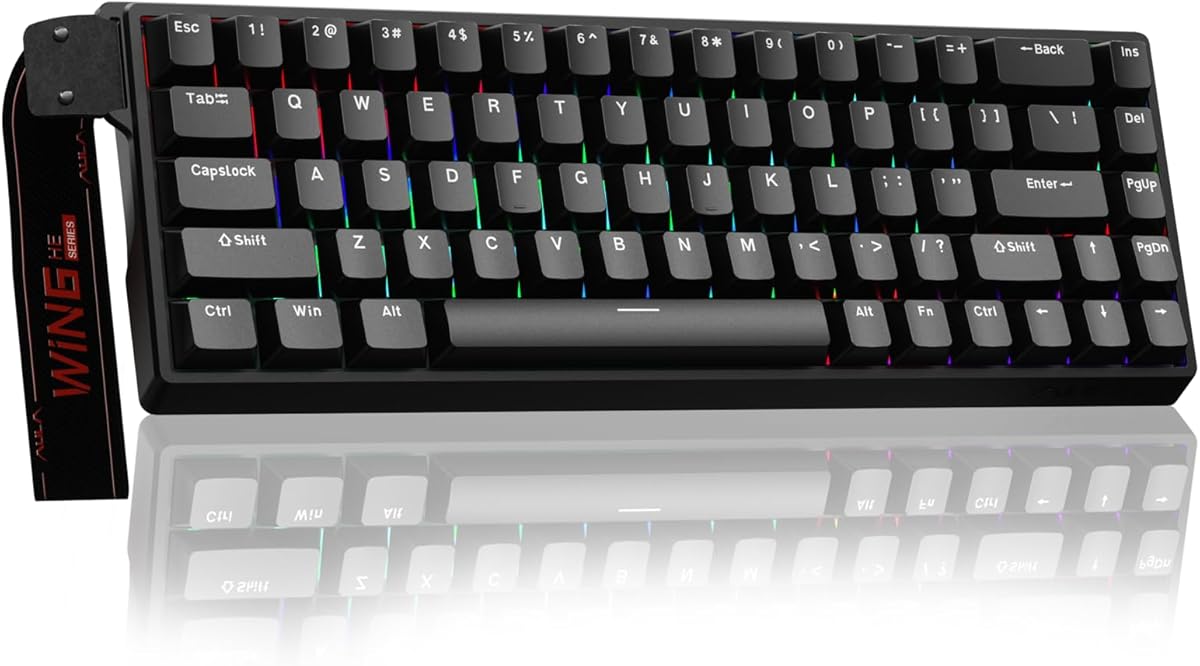
| 6DrunkDeer A75DrunkDeer | Best Value | 4.4 | $$$ | Check Price |
| 7Akko MOD007B HEAkko | Best Enthusiast Build | 4.4 | $$$ | Check Price |
Our top 7 picks, reviewed
Wooting 80HE
Wooting essentially defined the modern Hall-effect category, and the 80HE is its most refined board yet. The Lekker magnetic switches deliver smooth, consistent analog input, and the Wootility software exposes more granular control than anything else on the market. Rapid trigger here feels instantaneous, which is why so many top players swear by it. Add a gasket-mounted typing feel and it is the complete package.
- Type
- Hall-effect magnetic
- Switches
- Lekker analog
- Layout
- TKL with arrows
- Connection
- USB-C wired
What we liked
- Industry-leading rapid trigger responsiveness
- Per-key adjustable actuation down to fractions of a millimeter
- Excellent Wootility software with analog mapping
- Refined gasket-mounted feel and sound
Worth noting
- Premium price
- High demand can mean wait times
Wooting 60HE
The Wooting 60HE is the board that put Hall-effect keyboards on the competitive map. Its compact layout frees up desk space for big mouse sweeps, while the Lekker switches and rapid trigger give you a real edge in shooters. Analog input even lets you steer in driving games with keyboard keys. It remains the benchmark compact magnetic board years after release.
- Type
- Hall-effect magnetic
- Switches
- Lekker analog
- Layout
- 60 percent
- Connection
- USB-C wired
What we liked
- Compact 60 percent footprint for low-sens gaming
- Best-in-class rapid trigger
- Deep per-key actuation tuning
- Analog input for racing and movement
Worth noting
- No dedicated arrow keys
- Wired only
SteelSeries Apex Pro TKL Gen 3
SteelSeries was an early Hall-effect pioneer, and the Apex Pro TKL Gen 3 shows how far it has come. OmniPoint 3.0 switches offer adjustable actuation and rapid trigger with an enormous polling rate for ultra-low latency. The aluminum build, OLED screen, and refined acoustics make it feel premium beyond just performance. It is a top-tier choice for players who want polish alongside speed.
- Type
- Hall-effect magnetic
- Switches
- OmniPoint 3.0
- Layout
- Tenkeyless
- Connection
- USB-C wired
What we liked
- Blazing 8000 Hz polling rate
- Per-key adjustable actuation via GG software
- Premium aluminum top plate and OLED screen
- Excellent stock stabilizers and sound
Worth noting
- Software footprint is large
- Premium pricing
Keychron Q1 HE
The Keychron Q1 HE merges enthusiast build quality with Hall-effect performance, which few boards manage. You get a dense aluminum case, gasket mount, and hot-swap magnetic sockets alongside adjustable actuation and rapid trigger. Crucially, it offers wireless modes that most Hall-effect boards lack. For typists who also game, it is the most well-rounded magnetic board here.
- Type
- Hall-effect magnetic
- Switches
- Gateron Nebula HE
- Layout
- 75 percent
- Connection
- Bluetooth, 2.4GHz, USB-C
What we liked
- Magnetic switches in a premium aluminum case
- Wireless plus rapid trigger is a rare combo
- Hot-swap magnetic sockets for switch changes
- Excellent gasket-mounted typing feel
Worth noting
- Heavy and not portable
- Software less mature than Wootility
Razer Huntsman V3 Pro TKL
Razer aimed the Huntsman V3 Pro squarely at esports, and it shows. Its analog optical magnetic switches support adjustable actuation and rapid trigger, paired with an 8000 Hz polling rate for razor-thin latency. The aluminum frame and PBT keycaps give it a solid, premium feel. If you are deep in the Razer ecosystem and want competitive Hall-effect performance, this is the pick.
- Type
- Hall-effect magnetic
- Switches
- Razer Analog Optical
- Layout
- Tenkeyless
- Connection
- USB-C wired
What we liked
- Rapid trigger with adjustable sensitivity
- 8000 Hz polling for minimal latency
- Sturdy aluminum build and doubleshot caps
- Mature Synapse customization
Worth noting
- Synapse software can feel heavy
- Premium price point
DrunkDeer A75
The DrunkDeer A75 made Hall-effect gaming affordable, and it remains a standout value. It offers adjustable actuation and a responsive rapid trigger that punch well above its price. The 75 percent layout keeps arrow keys while staying compact. The build and software are not as polished as the premium boards, but for the money, the performance is remarkable.
- Type
- Hall-effect magnetic
- Switches
- Magnetic linear
- Layout
- 75 percent
- Connection
- USB-C wired
What we liked
- Strong rapid trigger at a low price
- Adjustable actuation across all keys
- Compact 75 percent layout with arrows
- Great entry point into magnetic switches
Worth noting
- Build feels less premium than rivals
- Web-based software is basic
Akko MOD007B HE
Akko brings its custom keyboard pedigree to the Hall-effect space with the MOD007B HE. It pairs a gasket-mounted, well-damped build with magnetic switches that support adjustable actuation and rapid trigger. The result sounds and feels closer to a custom board than a gaming peripheral. Enthusiasts who want analog performance without giving up typing quality should give it a serious look.
- Type
- Hall-effect magnetic
- Switches
- Akko magnetic
- Layout
- 75 percent
- Connection
- USB-C wired
What we liked
- Enthusiast-grade gasket build with Hall-effect
- Adjustable actuation and rapid trigger
- Excellent stock sound and dampening
- Attractive keycap sets and finish
Worth noting
- Software is less refined than top brands
- Limited wireless options
Why Hall-Effect Keyboards Took Over Competitive Gaming
A few years ago, the idea of a magnetic keyboard sounded like a marketing gimmick. Today, walk into any competitive gaming setup and there is a strong chance the player is using a Hall-effect board. The shift happened fast, and for good reason. These keyboards do something traditional mechanical boards simply cannot: they read the exact position of every key in real time, opening the door to features that give players a measurable edge.
The core technology is not new. The Hall effect, named after physicist Edwin Hall, describes how a magnetic field can be measured by a sensor. What is new is applying it at scale and at a price gamers can afford. Instead of a metal leaf snapping shut to register a keystroke, a Hall-effect switch contains a tiny magnet. As you press the key, a sensor reads how close the magnet is and translates that into a precise depth measurement. The keyboard always knows whether a key is barely touched, halfway down, or fully bottomed out.
That continuous awareness unlocks two killer features. The first is adjustable actuation, letting you decide exactly how far a key must travel before it registers. The second, and more transformative, is rapid trigger, which resets and reactivates keys based on movement rather than fixed points. Together they make a Hall-effect board feel faster and more responsive than anything mechanical. In this guide we break down the technology, explain what to look for, and walk through the seven best Hall-effect keyboards you can buy in 2026.
How We Evaluated Each Board
Testing analog keyboards requires looking beyond the usual checklist. We spent time in competitive shooters where rapid trigger matters most, paying close attention to how cleanly each board handled rapid counter-strafing and direction changes. We also used every keyboard for extended typing sessions, because a growing number of these boards are built to double as enthusiast typing tools.
We assessed how granular the actuation adjustment was, since the best boards let you tune depth in tiny increments across every key. Polling rate factored in too, because the high-end boards now reach 8000 Hz for ultra-low latency. Software quality mattered a great deal, as the experience of adjusting your keyboard is only as good as the app that controls it. Finally we weighed build quality, sound, connectivity, and price to arrive at the final rankings.
Understanding the Key Features
If you are new to Hall-effect keyboards, a few concepts are worth understanding before you buy.
Adjustable Actuation
On a normal mechanical keyboard, every key registers at the same fixed depth, usually around two millimeters. A Hall-effect board lets you set that depth yourself, often anywhere from a fraction of a millimeter to nearly the full travel. A shallow actuation point means keys register almost instantly with the lightest touch, ideal for fast-paced shooters. A deeper point reduces accidental presses, which can help with typing or with keys you do not want to trigger by accident. The ability to set this per key is one of the biggest advantages of the technology.
Rapid Trigger
Rapid trigger is the feature that truly separates these boards from the pack. Normally a key has to travel back up past a set release point before it can fire again. Rapid trigger throws that out. Instead, the moment you begin lifting the key, it resets, and the moment you press down again, it fires. The result is that you can repeat inputs or change movement directions far faster than a fixed switch allows. In games where counter-strafing or quick repositioning matters, this is a genuine competitive advantage.
Analog Input
Because Hall-effect switches read continuous position, they can output analog signals like a controller joystick. This means you can press a movement key gently to walk and firmly to run, or steer smoothly in a racing game using keyboard keys. Not every player will use this, but for those who do, it is a unique capability that mechanical boards cannot replicate.
Polling Rate and Latency
The polling rate determines how often the keyboard reports its state to your computer. Standard boards poll at 1000 Hz. Several boards in this roundup, including the SteelSeries Apex Pro TKL Gen 3 and Razer Huntsman V3 Pro, reach 8000 Hz, dramatically reducing the time between your keypress and the on-screen result. At the top level of competition, that reduced latency can matter.
Matching a Board to Your Needs
With seven excellent options, choosing comes down to your priorities and budget.
If you want the best overall Hall-effect experience and do not mind paying for it, the Wooting 80HE is our top recommendation. Wooting pioneered the modern category, and its Wootility software remains the gold standard for granular control. The 80HE adds a refined gasket-mounted feel to the class-leading rapid trigger that made the brand famous.
If you play low-sensitivity shooters and want maximum desk space for your mouse, the compact Wooting 60HE is the obvious pick. It delivers the same exceptional rapid trigger in a 60 percent footprint, though you do give up dedicated arrow keys.
Players who want a premium, polished package with the latest tech should look at the SteelSeries Apex Pro TKL Gen 3 or the Razer Huntsman V3 Pro. Both offer 8000 Hz polling, adjustable actuation, and rapid trigger inside high-quality aluminum builds. Your choice between them may come down to which software ecosystem you already use.
For the rare combination of Hall-effect performance and wireless flexibility, the Keychron Q1 HE stands alone. It also brings hot-swap magnetic sockets and an enthusiast-grade aluminum case, making it the best choice for someone who types as much as they game.
On a tighter budget, the DrunkDeer A75 delivers a responsive rapid trigger and adjustable actuation at a fraction of the cost of the premium boards. And if you care deeply about typing feel and sound, the Akko MOD007B HE pairs a well-damped gasket build with full magnetic functionality.
Software Makes or Breaks the Experience
It is worth emphasizing that with Hall-effect keyboards, the software is not an afterthought, it is central to the experience. Adjusting actuation, configuring rapid trigger, mapping analog input, and saving per-game profiles all happen in the companion app. A board with great hardware and poor software will frustrate you every time you want to make a change.
This is where the established players shine. Wooting's Wootility is widely regarded as the most capable and intuitive option, exposing deep control without overwhelming you. SteelSeries GG and Razer Synapse are powerful and mature, though both carry a larger software footprint. The budget and enthusiast boards like the DrunkDeer A75 and Akko MOD007B HE offer functional but less polished tools, which is part of the trade-off for their lower prices. If you expect to tinker frequently, weigh the software as heavily as the hardware.
Are Hall-Effect Keyboards Right for You?
Not everyone needs a Hall-effect keyboard. If you mainly type or play slower-paced games, a great mechanical board may serve you just as well for less money. But if you play competitive shooters, value the lowest possible latency, or simply love being able to tune every key to your exact preference, the advantages are real and noticeable.
The technology has also matured to the point where you no longer sacrifice typing quality to get it. Boards like the Keychron Q1 HE and Akko MOD007B HE feel as good to type on as dedicated enthusiast keyboards while still offering full analog functionality. That convergence is what makes 2026 such a strong year for the category.
How to Set Up a Hall-Effect Keyboard for Competitive Play
Buying the right board is only the first step; configuring it well is where the real advantage comes from. The first setting most players adjust is the global actuation point. For competitive shooters, many top players set movement keys to a shallow actuation, sometimes well under a millimeter, so that the lightest touch registers instantly. The trade-off is that a shallow point can lead to accidental presses if you rest your fingers heavily, so finding your personal balance takes a little experimentation.
Rapid trigger is the next setting to dial in, and it has its own sensitivity adjustment. A high sensitivity means the smallest upward movement resets the key, which is ideal for counter-strafing in tactical shooters where you need to stop precisely and fire accurately. A lower sensitivity is more forgiving and reduces unintended resets if your fingers are not perfectly steady. Spend time in a practice range adjusting this until your stops feel crisp and reliable.
Per-key configuration is where Hall-effect boards truly separate from the pack. You might set your movement keys for fast, shallow actuation while keeping keys like crouch, reload, or ability binds at a deeper point to avoid fat-fingering them in the heat of a match. Saving these as game-specific profiles means your keyboard automatically adapts as you switch titles, which is invaluable if you play several different games.
Finally, do not neglect the basics. Set your polling rate to the highest your board supports for the lowest latency, update your firmware regularly since manufacturers actively refine these features, and disable any features you do not use to keep the experience clean. A well-configured Hall-effect board can feel like a genuine extension of your reflexes.
Hall-Effect Versus Traditional Mechanical
It is worth directly comparing Hall-effect boards to the mechanical keyboards most gamers grew up with, because the differences shape who should buy one. A traditional mechanical switch has a single fixed actuation point and a fixed reset point. It feels great and works wonderfully for typing and casual gaming, but it cannot adapt. Every press behaves identically, and the keyboard has no idea how far down the key is at any moment.
A Hall-effect switch knows the exact position continuously, which is what enables adjustable actuation, rapid trigger, and analog input. For competitive players, these are not minor perks; they translate into faster direction changes and quicker repeated inputs that can decide close fights. The downside historically was that magnetic boards felt clinical compared to a well-built mechanical board, but that gap has closed. Boards like the Keychron Q1 HE and Akko MOD007B HE now deliver enthusiast-grade typing feel alongside the analog features.
Durability also tilts toward Hall-effect. Because there is no metal contact physically touching to register a press, magnetic switches sidestep the contact wear that can eventually cause chatter in mechanical switches. That can mean a longer effective lifespan, especially on keys you hammer constantly.
The honest takeaway is that if you do not play fast competitive games, a great mechanical board may serve you perfectly well and cost less. But if you want every possible edge, or simply love tuning your gear, Hall-effect is the more capable technology, and in 2026 it no longer asks you to sacrifice feel to get it.
Final Verdict
Hall-effect keyboards represent the most meaningful innovation in keyboards in years, and the options have never been better. Our overall pick is the Wooting 80HE for its unmatched combination of rapid trigger performance, granular software, and refined build. But the right board for you depends on your layout preference, your budget, and whether you value wireless, typing feel, or pure esports speed.
Whichever you choose from this list, you are getting a keyboard that does something a traditional board fundamentally cannot. Once you experience adjustable actuation and rapid trigger, it is genuinely hard to go back. For competitive gamers in 2026, a Hall-effect keyboard is no longer a luxury, it is fast becoming the standard.
How we picked
We judged each board on actuation adjustability, rapid trigger performance, polling rate, build quality, software, and price. Every keyboard was used for competitive shooters and everyday typing to test both speed and comfort. Magnetic switch consistency and the depth of per-key customization carried the most weight in our scoring.
Frequently asked questions
What is a Hall-effect keyboard?
A Hall-effect keyboard uses magnetic switches that sense the position of a magnet as you press a key, rather than physical metal contacts. This lets the keyboard read exactly how far down a key is, enabling adjustable actuation depth and features like rapid trigger.
What is rapid trigger and why does it matter?
Rapid trigger resets a key the instant you start lifting it and reactivates as soon as you press again, rather than waiting for a fixed release point. In fast games this lets you change directions or repeat inputs far quicker, which is the main reason competitive players choose Hall-effect boards.
Are Hall-effect switches more durable than mechanical ones?
Generally yes. Because magnetic switches have no physical electrical contact to wear out, they avoid the contact degradation that can cause chatter in traditional mechanical switches, often leading to a longer effective lifespan.
Can I customize the actuation point on every key?
On most Hall-effect boards, yes. Software lets you set a different actuation depth per key, so you can make movement keys trigger early for speed while keeping others deeper to avoid accidental presses.
Are Hall-effect keyboards good for typing too?
Absolutely. Many, like the Keychron Q1 HE and Akko MOD007B HE, are built with enthusiast cases and gasket mounts that feel excellent for typing while still offering analog gaming features.