Best Powered Speakers in 2026
We may earn a commission from links on this page, at no extra cost to you. Learn more.
Powered speakers, also called active speakers, contain their own amplifiers, so you never need a separate amp or receiver to make them sing. Plug in a source, connect power, and you have sound. That built-in amplification is what makes them the simplest route to great audio, whether you want desktop studio monitors for music production, a tidy bookshelf pair for a turntable, or a portable PA for events. But the category spans wildly different designs, from 42-watt near-field monitors to 2000-watt live speakers. This guide ranks nine of the best powered speakers you can buy in 2026, spanning studio monitors, hi-fi bookshelf pairs and PA systems, so there is a right pick whether you are mixing tracks, filling a living room or running a gig.
Top 9 Best Powered Speakers
Our top 9 picks, reviewed
Bose S1 Pro+ All-in-One PA Speaker
The Bose S1 Pro+ is the most versatile powered speaker here, folding amplification, a 3-channel mixer and an 11-hour battery into a 14-pound package you can take anywhere. Four positioning options with Auto EQ mean it sounds right vertical, tilted or on a stand, and the integrated mixer handles mics, instruments and music. It is equally at home busking, presenting or providing party sound, and the Bose name backs it up.
- Type
- Portable powered PA
- Battery
- Up to 11 hours
- Mixer
- 3-channel built-in
- Positioning
- 4 orientations, Auto EQ
What we liked
- Fully self-contained with built-in mixer
- Up to 11 hours of battery playtime
- Auto EQ adapts to any orientation
- Trusted Bose sound and support
Worth noting
- Single-speaker mono unless paired
- Wireless transmitters sold separately
JBL 305P MkII Studio Monitors (Pair)
The JBL 305P MkII pair is the pick for anyone making music, delivering the flat, honest response you need to mix and master accurately. Each cabinet packs dual 41W Class-D amps behind a 5-inch woofer, and JBL's Image Control Waveguide gives a wide, precise stereo image with a generous sweet spot. Boundary EQ and HF Trim let you tune to your room, and the XLR and TRS inputs suit any serious desktop or studio rig.
- Type
- Active studio monitors
- Driver
- 5in woofer, 2-way
- Power
- Dual 41W Class-D each
- Inputs
- XLR/TRS balanced
What we liked
- Accurate, revealing studio-reference sound
- Image Control Waveguide widens sweet spot
- Boundary EQ and HF Trim tune to your room
- Balanced XLR and TRS professional inputs
Worth noting
- Needs balanced sources for best results
- Neutral tuning is unflattering to poor recordings
Edifier R1280T Powered Bookshelf Speakers
The Edifier R1280T is the value darling of active bookshelf speakers, a long-time best-seller that gives beginners real hi-fi sound for very little. Its 42W of built-in amplification drives a warm, balanced 2.0 presentation, and dual AUX inputs let you keep a computer and a turntable connected at once. The remote and side-panel bass and treble knobs make tweaking easy. There is no Bluetooth here, but wired it is hard to beat.
- Type
- Active bookshelf, 2.0
- Power
- 42W RMS
- Inputs
- Dual AUX, RCA
- Extras
- Remote, side EQ knobs
What we liked
- Warm, easygoing sound for the price
- Two AUX inputs play two sources at once
- Handy remote and side-panel EQ controls
- Classic wood finish suits any room
Worth noting
- No Bluetooth on this model
- 42W limits volume in large rooms
Edifier R1280DBs Active Bluetooth Speakers
The Edifier R1280DBs takes the beloved R1280 formula and loads it with inputs, adding Bluetooth 5.0, optical and coaxial digital connections plus a subwoofer output. That makes it a superb all-rounder for a TV, computer and phone, all switchable from the remote, and the sub-out means you can add bass later without replacing the speakers. The 42W of active power drives the same warm silk-dome sound Edifier fans love, wired or wireless.
- Type
- Active bookshelf, 2.0
- Power
- 42W RMS
- Wireless
- Bluetooth 5.0
- Inputs
- Optical, coax, sub out
What we liked
- Bluetooth 5.0 plus optical and coaxial
- Subwoofer output for easy bass expansion
- 42W with silk-dome tweeters
- Full remote and side EQ controls
Worth noting
- Same 42W output as the cheaper R1280T
- Bass needs a sub for true low-end depth
PreSonus Eris 3.5 Studio Monitors (Pair)
The PreSonus Eris 3.5 is the pick when desk space is tight but you still want honest sound. These compact active monitors pack 50W of Class AB amplification behind woven-composite woofers, delivering surprisingly tight bass and a wide listening sweet spot from their silk-dome tweeters. Balanced TRS and RCA inputs handle serious gear, while a front-panel aux jack makes plugging in a phone effortless. For a small studio or hi-fi desktop, they are ideal.
- Type
- Active near-field monitors
- Driver
- 3.5in woven woofer
- Power
- 50W Class AB total
- Inputs
- TRS, RCA, front AUX
What we liked
- Accurate sound in a tiny footprint
- Front-panel aux for quick phone hookup
- Balanced TRS plus RCA inputs
- Wide sweet spot from silk-dome tweeters
Worth noting
- Small 3.5in woofers limit deep bass
- Not loud enough for big rooms
ALTO TS410 2000W 10in Powered PA Speaker
The ALTO TS410 is a serious live-sound powered speaker, wrapping a 10-inch driver and 2000W of active power into a self-contained PA box. A built-in 3-channel mixer with combo XLR inputs handles mics and instruments, Bluetooth streams backing tracks, and true stereo wireless linking pairs two units without cables. The ALTO app tailors EQ and speaker modes to the venue. It is far more than a home needs, but for gigs and events it delivers commanding output.
- Type
- Active PA speaker
- Power
- 2000W peak
- Driver
- 10in LF, 1.4in HF
- Extras
- 3-ch mixer, Bluetooth, DSP app
What we liked
- Huge headroom for live events
- 10in driver adds low-end punch
- Bluetooth streaming and stereo linking
- 3-channel mixer and DSP app onboard
Worth noting
- Overkill for home listening
- Heavy and large for a single unit
Saiyin Bluetooth Bookshelf Speakers
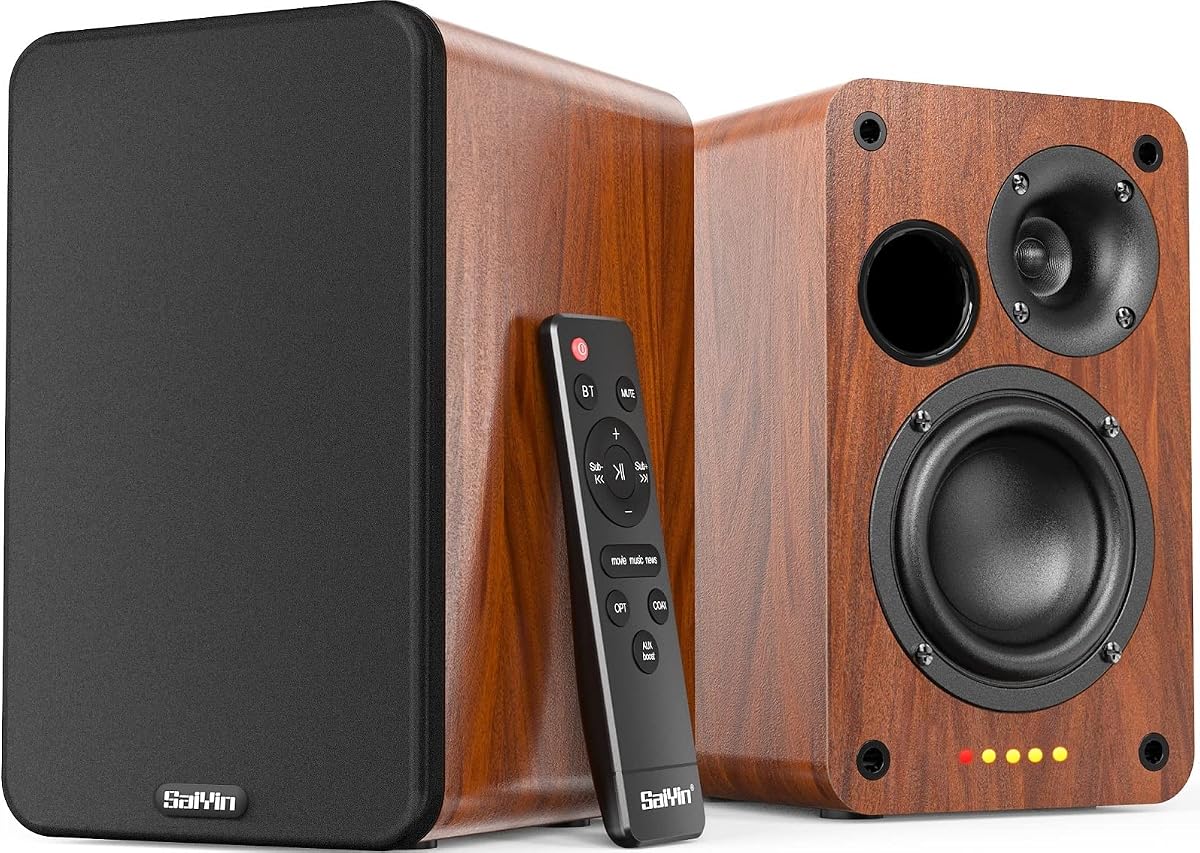
The Saiyin Bluetooth Bookshelf Speakers are a tidy, affordable active pair aimed at turntables, TVs and computers. Built-in 30W-per-channel amplification means no separate amp or preamp, and the wide input set of optical, AUX, RCA and Bluetooth 5.3 connects to almost anything, with a remote that even works alongside a Fire TV stick. They are compact and easy to place, though a record player will need its own phono preamp to connect through the line input.
- Type
- Active bookshelf, 2.0
- Power
- 30W x 2
- Driver
- 3.75in woofer
- Inputs
- Optical/AUX/RCA/Bluetooth
What we liked
- No amp or preamp needed
- Optical, AUX, RCA and Bluetooth 5.3
- Compact size fits any shelf
- Remote works with Fire TV stick
Worth noting
- Modest 30W-per-side output
- Turntable needs a built-in preamp
ALTO TS408 2000W 8in Powered PA Speaker
The ALTO TS408 is the more portable sibling to the TS410, swapping the 10-inch driver for an 8-inch one in a lighter, easier-to-transport cabinet while keeping the same 2000W rating and feature set. Its built-in mixer, Bluetooth streaming, stereo wireless linking and DSP app make it a flexible active PA for smaller venues, DJs and presenters. You lose a little low-end weight versus the TS410, but it remains a capable, self-powered live speaker.
- Type
- Active PA speaker
- Power
- 2000W peak
- Driver
- 8in LF, 1.4in HF
- Extras
- 3-ch mixer, Bluetooth, DSP app
What we liked
- Lighter 8in cabinet is easy to carry
- Bluetooth streaming and stereo linking
- 3-channel mixer with combo inputs
- ALTO app for EQ and speaker modes
Worth noting
- Smaller driver means less deep bass
- Peak wattage overstates real output
Pyle PPHP849KT Active + Passive PA System
The Pyle PPHP849KT is a budget route into live sound, bundling an active 8-inch speaker with a passive partner it drives, plus stands and cables for a complete kit out of the box. Bluetooth streaming and USB, SD and AUX playback cover music sources, and the titanium-diaphragm tweeters keep highs crisp. Only one cabinet is powered and 700W max suits smaller rooms, but as an all-in-one entry PA it is remarkable value.
- Type
- Active + passive PA pair
- Power
- 700W max
- Driver
- Dual 8in
- Extras
- Bluetooth, USB/SD/AUX, stands
What we liked
- Complete pair with speaker stands included
- Bluetooth plus USB, SD and AUX playback
- Titanium-diaphragm compression tweeters
- Ready-to-gig kit at a low price
Worth noting
- Only one cabinet is powered
- 700W max is modest for large venues
How We Chose the Best Powered Speakers

The defining feature of a powered speaker is that the amplifier lives inside the cabinet, so choosing well means thinking about the job first and the specs second. An active speaker built to mix music has very different priorities from one built to fill a bar with sound, even though both plug in the same way. We started by grouping the field into its natural uses: studio monitors for production and critical listening, bookshelf pairs for hi-fi and desktop enjoyment, and PA speakers for live events and presentations. Each category has its own idea of what good sounds like.
Within those groups we weighed the things that actually matter day to day. Sound quality and tonal balance came first, judged against the speaker's purpose, because a flat monitor and a warm consumer speaker are both doing their job correctly. We then looked at the built-in amplification, how much power it provides and whether it is well matched to the drivers, followed by connectivity, since the right inputs make a speaker far more useful. Build quality and value rounded out the picture. Finally, we kept the list deliberately broad, from the tiny PreSonus Eris 3.5 to the 2000-watt ALTO TS410, so there is a genuine best pick for every use.
Studio Monitors vs Consumer Powered Speakers
The biggest divide among powered speakers is between studio monitors and consumer models, and it comes down to how they are tuned. Studio monitors such as the JBL 305P MkII and PreSonus Eris 3.5 aim for a flat, uncolored response. The goal is accuracy: they reveal exactly what is in a recording, warts and all, so you can make good mixing decisions. That honesty is invaluable for producers but can sound clinical if you just want to relax with music, because nothing is being flattered or warmed up.
Consumer powered speakers take the opposite approach. The Edifier R1280T and R1280DBs deliberately add a touch of warmth and a gentle bass lift that makes everyday listening more pleasant, if less faithful to the source. Neither philosophy is wrong; they simply serve different ears. If you edit podcasts, produce tracks or want reference-grade honesty, choose monitors. If you want speakers that make your favorite songs sound rich and inviting straight out of the box, the consumer bookshelf pairs are the friendlier choice.
Built-In Amplification Explained
Because the amplifier is integrated, a powered speaker's electronics are matched to its drivers at the factory, which is one of the format's real advantages. There is no guesswork about pairing an amp with speakers, no risk of underpowering or overdriving, and no extra box on your shelf. In a stereo active pair like the Edifier R1280DBs, one cabinet, the powered one, contains the amplification and controls, and it feeds the second passive cabinet through a speaker cable. That is why the volume and EQ knobs live on only one of the two speakers.
The amount of amplification you need scales with the task. A desktop or small-room setup is comfortably served by the 30 to 50 watts found in the Saiyin, PreSonus and Edifier models, which is plenty for near-field listening. Live sound is a different world, where the ALTO TS408 and TS410 quote 2000-watt peak ratings to fill large spaces with headroom to spare. Remember that peak figures describe brief maximums rather than sustained output, so treat them as a rough indication of scale and judge a speaker mainly by its intended use and driver size.
Connectivity and Inputs
One of the quiet joys of powered speakers is how many ways you can feed them, and the right inputs make a speaker dramatically more useful. For desktop and hi-fi duty, look at what the Edifier R1280DBs offers: Bluetooth 5.0 for phones, plus optical and coaxial digital inputs for a TV or computer, and even a subwoofer output for adding bass later. The Saiyin similarly covers optical, AUX, RCA and Bluetooth 5.3, making it a flexible hub for a small setup. If you use a turntable, remember the line versus phono distinction and add a preamp where needed.
Studio and live speakers prioritize different connections. Monitors like the JBL 305P MkII and PreSonus Eris 3.5 include balanced XLR or TRS inputs, which reject noise over longer cable runs and suit professional interfaces, alongside RCA for consumer gear. PA speakers such as the ALTO pair build in a small mixer with combo XLR inputs for microphones and instruments, plus Bluetooth for backing tracks and wireless stereo linking between two cabinets. Matching the input set to your sources is just as important as the sound itself, because a great speaker you cannot easily connect is a frustrating one.
Matching Powered Speakers to Your Space and Use
The best powered speaker is the one suited to your room and your purpose, so start there rather than with a spec sheet. For a desk or small studio, compact near-field designs like the PreSonus Eris 3.5 sit close and sound accurate without overwhelming the space, and their front-panel aux jack makes casual listening easy. For a living room or a turntable setup, the Edifier R1280T and R1280DBs deliver satisfying hi-fi sound at a friendly price, with the DBs adding the connectivity to double as a TV speaker.
For anything involving an audience, the picture changes entirely. The portable Bose S1 Pro+ is the most flexible, with its battery and built-in mixer making it ideal for buskers, presenters and small gatherings, while the ALTO TS408 and TS410 provide the raw output larger venues demand. The Pyle PPHP849KT bundles a complete kit with stands for a low-cost entry into live sound. Think about the size of the space, whether you need portability, and how many sources you must connect, and the right category becomes obvious.
Sound Quality and Driver Design
Beyond category and power, the drivers and tuning inside a powered speaker decide how it actually sounds. The tweeter shapes the highs and their clarity, and the materials vary from the silk domes in the Edifier and PreSonus models, which give smooth, easygoing treble, to the compression drivers with titanium diaphragms in the Pyle PA speaker, built to project crisp highs across a crowded room. The woofer governs bass and midrange, so the 5-inch driver in the JBL 305P MkII reaches deeper and louder than the 3.5-inch cones in the PreSonus Eris 3.5, which trade ultimate low-end for a smaller footprint.
Tuning matters just as much as hardware. A studio monitor like the JBL is engineered for a flat response so nothing is exaggerated, while consumer speakers such as the Edifier R1280T add a pleasing warmth that flatters everyday listening. Features like the JBL's Image Control Waveguide and the PreSonus silk-dome tweeters widen the sweet spot, so the sound stays balanced even when you are not perfectly centered. When comparing powered speakers, listen for how natural voices and instruments sound rather than fixating on driver size alone, because clever engineering often matters more than raw dimensions.
A Closer Look at the Top Picks
The Bose S1 Pro+ takes the top spot for its sheer versatility. Few powered speakers do so many jobs so well, thanks to a self-contained design that packs amplification, a 3-channel mixer and an 11-hour battery into a bag-friendly package, with Auto EQ keeping it sounding right in any orientation. For music makers, the JBL 305P MkII pair is the standout, delivering the accurate, revealing sound production demands with room-tuning controls to match. And for value, the Edifier R1280T remains the easy recommendation, giving newcomers real hi-fi enjoyment for very little outlay.
Beyond those, the Edifier R1280DBs is the connectivity champion for anyone juggling a TV, computer and phone, while the PreSonus Eris 3.5 brings monitor accuracy to the tightest desks. The ALTO TS410 and TS408 cover serious live sound at two driver sizes, the Saiyin is the affordable turntable and TV pick, and the Pyle PPHP849KT rounds things out as a complete, budget-friendly PA kit. Each earns its place by being the best answer to a specific need.
Final Recommendation
For most buyers, the Bose S1 Pro+ is the best powered speaker in 2026, combining built-in amplification, a mixer and long battery life into a package that adapts to almost any situation. If you make music, the JBL 305P MkII studio monitors are the accurate choice, while the Edifier R1280T is the value pick for everyday hi-fi and the R1280DBs the best-connected option for a TV and desktop. Live-sound users should look to the ALTO TS410 or TS408, turntable owners to the Saiyin, and anyone wanting a complete gig kit to the Pyle PPHP849KT. Decide what you need the speaker to do, match its amplification and inputs to that job, and a powered speaker will reward you with great sound and refreshingly simple setup.
How we picked
We judged each powered speaker on sound quality and tonal balance, the strength and matching of its built-in amplification, connectivity and input options, build quality, and value at its price. Because active speakers range from near-field monitors to full PA units, we grouped them by intended use and noted amplifier power alongside driver size, then mixed studio, hi-fi and live-sound designs so the list reflects the many jobs a powered speaker can do.
Frequently asked questions
What is the difference between powered and passive speakers?
Powered, or active, speakers have amplifiers built in, so they need only a source and power to play. Every speaker on this list, from the Edifier R1280T bookshelf pair to the Bose S1 Pro+ PA, is self-amplified. Passive speakers contain no electronics and require a separate amplifier or receiver. Powered speakers are simpler and take up less space, which is why they suit desktops, PA use and beginners.
Are powered speakers good for a turntable?
Yes, provided the phono signal is handled. Active speakers like the Saiyin and Edifier R1280T connect straight to a turntable's line output. But a record player produces a very quiet phono signal, so it needs a built-in phono preamp, or you must add one between the turntable and the speakers. Check whether your turntable has a line-level output before connecting it to any powered speaker.
Do I need studio monitors or regular powered speakers?
Studio monitors like the JBL 305P MkII and PreSonus Eris 3.5 are tuned for flat, accurate sound so you hear recordings honestly, which is essential for mixing and production. Consumer active speakers like the Edifier R1280DBs add a warmer, more pleasant coloration for casual listening. Choose monitors if you make music, and regular powered bookshelf speakers if you just want enjoyable everyday sound.
How much amplifier power do powered speakers need?
It depends entirely on the job. Desktop and bookshelf use is well served by 30 to 50 watts, as in the Saiyin, Edifier and PreSonus models. Live sound needs far more headroom, which is why the ALTO TS408 and TS410 quote 2000W peak figures. Note that peak ratings overstate continuous output, so compare speakers by intended use and driver size rather than by headline wattage alone.
Can I connect powered speakers to a TV?
Yes. Powered speakers with digital inputs are ideal for TVs. The Edifier R1280DBs offers optical and coaxial inputs, and the Saiyin includes optical alongside AUX and Bluetooth, both connecting cleanly to modern televisions. If your speakers have only analog inputs, use the TV's headphone or RCA output. A pair of active bookshelf speakers is a simple, great-sounding upgrade over built-in TV audio.