Best Overall Clearance
Lian Li V100-ATX Mid-Tower (Black)

- 420mm GPU room for flagship cards
- Four PWM ARGB fans pre-installed
- Tool-less panels and back-connect board support
Expert Review & Guide
Long graphics cards are no longer a niche problem. Modern gaming and creator GPUs often stretch well past 300mm, and the thickest coolers can erase the safety margin that older mid-towers assumed. If you are hunting for the best PC cases for GPU clearance, you need more than a marketing checkbox that says a chassis supports high-end cards. You need honest length limits, a plan for front fans or radiators that steal space, and a clear sense of whether you want a compact Micro-ATX box or a dual-chamber ATX tower that simply gets out of the card’s way.
This ReviewConsensus roundup sticks to ten current pack options and ranks them around real clearance needs: flagship-length ATX towers like the Lian Li V100, maximum-length dual-chamber space from the HYXN H2, compact long-card specialists like the Lian Li Vector V100 Mini, and smaller cases that only make sense when your GPU is genuinely short. You will see tradeoffs on fans included, glass versus mesh, storage capacity, and modular ecosystems — without dollar prices — so you can match the chassis to the card you already chose.
Use the top picks if you want a fast answer, then scan the comparison table for length and cooling specs before reading the deeper reviews. The buying guide at the end explains how to measure GPU length correctly, how radiators affect usable clearance, and when a 280mm mini tower is the right tool instead of a 455mm showcase.
Ratings and product details below reflect the pack listings, including pre-installed fan counts and stated GPU length limits. Where two cases share a family — especially the black and white Lian Li V100 — we keep the clearance analysis aligned and separate them mainly by finish and theme. Where a compact case cannot clear modern flagships, we say so plainly so you do not discover the limit after the glass panel is already on.


As an Amazon Associate we earn from qualifying purchases. We may earn a commission at no additional cost to you.
Every case below comes from the same product pack. Specs focus on GPU length, cooling support, and build features that affect whether a long card actually fits once fans, cables, and glass panels are in place.
Lian Li V100-ATX Mid-Tower (Black)
If you are shopping specifically for GPU clearance, the Lian Li V100-ATX in black is the easiest all-round recommendation in this pack. The headline number is 420mm of graphics card length, which is the difference between buying a case that theoretically fits a modern high-end GPU and actually leaving breathing room for power cables, shrouds, and thick cooler stacks. Many mid-towers advertise support for current-generation cards while still forcing you to measure twice; the V100 gives you a clearer margin for long, dense cards without immediately jumping to a full tower.
Out of the box, four 120mm ARGB PWM fans are already mounted, and Lian Li adds a 26-LED ARGB strip for accent lighting. That matters for GPU-clearance builds because long cards often sit close to front intakes. Having PWM-controlled fans ready means you can set a quiet curve for idle and ramp intake when the GPU heats the lower chamber. Fan specs list roughly 1800 RPM peaks, about 60 CFM class airflow, and hydraulic bearings — not silent-lab numbers, but sensible for a gaming ATX box that prioritizes cooling over whisper noise.
Motherboard support is broader than a typical mid-tower checklist: ATX, Micro-ATX, Mini-ITX, plus back-connect ATX or Micro-ATX boards. If your plan is a panoramic glass side with a long GPU as the visual hero, back-connect routing keeps power and USB clutter behind the tray so the card’s cooler and PCB stay the focus. Tool-less side panels make that routing less painful on the first build and during later GPU swaps — which is where clearance-focused cases earn their keep.
Cooling headroom extends beyond the GPU path. A top radiator up to 360mm is listed, and CPU cooler height goes to 178mm. That combination suits builders who want a 360mm AIO on the CPU while still seating a long dual- or triple-slot GPU without radiator-to-card interference at the front. Always dry-fit the GPU before locking the AIO tubes; thick front intakes plus a 360mm stack can still eat into advertised length if fans are mounted as push-pull.
Who should skip it? Anyone who needs a desk-width mini tower, or who already owns a tall dual-tower cooler that exceeds the 178mm limit. Everyone else building a 2026 gaming PC around a long GPU will find the black V100 hits the useful middle: enough length, enough fans included, and enough glass-and-ARGB presence that the case does not feel like a temporary chassis you will replace in six months.
In day-to-day use, the V100’s value shows up during upgrades. Swapping a 320mm card for a 390mm card is less stressful when the chassis already assumed flagship length, and the pre-installed intake bank means you are not discovering dead airflow after the first stress test. For ReviewConsensus readers comparing only clearance, this is the default ATX answer unless you need the HYXN’s extra millimeters or the Mini’s smaller board format.
Choose the black V100 if you want one ATX case that clears flagship-length GPUs, arrives with a usable fan kit, and still looks finished once the tempered glass is on. It is especially strong for first high-end upgrades where you do not want to buy four aftermarket fans before the PC even POSTs.
It is also a smart pick if you are standardizing on back-connect motherboards and want cable-free glass views of a long card without improvising custom trays.
Measure your card including the power connector bulge and any factory anti-sag bracket. Seat the GPU before finalizing front radiator fan orientation so you do not lose the last centimeters of advertised clearance. Use the tool-less panels to route the GPU power cables behind the shroud early — once a 400mm-class card is installed, rear access is harder.
Compared with the DARKROCK EC2, you gain substantial length and a full fan kit. Compared with the HYXN H2, you give up absolute maximum clearance and dual-chamber volume for a more conventional mid-tower footprint and ARGB presentation.
We may earn a commission at no additional cost to you.

The DARKROCK EC2 is the value-oriented airflow mid-tower in this roundup: mesh front, tempered glass side, Type-C ready, and marketed specifically around fitting current-generation 50-series graphics cards. The important clearance number is 340mm of GPU length. That is enough for many mid-range and some higher cards, but it is not the same safety net as 415–455mm options elsewhere on this list. If your GPU’s published length is already near 330mm, treat the EC2 as a measured fit, not a guaranteed one.
Airflow intent is clear. The meshed front panel is there to feed cool air into the GPU and CPU zones instead of relying on a solid face. Magnetic dust filters on the top and bottom help keep that mesh strategy from turning into a dust sponge. For GPU thermals, front mesh still wins over sealed fishbowl designs — provided you actually install enough intake fans. The case supports up to eight 120mm fans and a 360mm radiator on the front, but only one fan ships pre-installed.
That single included fan is the trade you accept at this tier. Plan for at least two more front intakes if you are seating a hot long card. The chassis also lists PSU length support up to 200mm, which is adequate for most ATX units but worth checking if you own a very long modular PSU with thick cable clusters. Motherboard support covers ATX, Micro-ATX, and ITX, so the EC2 can host a conventional gaming board without forcing a downsize.
Tempered glass gives you a side view of the GPU once it is installed, which is nice for RGB cards but means you should keep cable tails short so they do not drape across the cooler fins. Type-C on the front panel is a practical quality-of-life feature for external SSDs and phones during long gaming sessions. Nothing about the EC2 feels boutique, and that is fine — it is trying to be a straightforward mesh ATX box for builders who want modern I/O without paying for modular frame systems.
Buy the EC2 when your GPU is comfortably under the 340mm mark and you want mesh airflow without a dual-chamber footprint. Skip it if you already ordered a 360mm-plus triple-fan flagship card or if you refuse to buy additional fans. For clearance-first shopping, think of it as a mid-length specialist rather than a maximum-length specialist.
If you later upgrade to a longer GPU, the EC2 may become the bottleneck before your PSU or motherboard does. That is acceptable if you knowingly bought a mid-length card; it is painful if you hoped generation marketing meant every factory cooler shape. Read the millimeter rating, not only the support slogan.
Compare your GPU’s official length to 340mm, then subtract a buffer for the power cable bend and any front radiator thickness. Cards around 300–320mm are the sweet spot. Cards approaching 340mm need a dry-fit before you commit permanently.
Builders prioritizing mesh cooling and Type-C on a simpler ATX shell, especially with mid-length current-generation or previous-gen cards that do not need 400mm-plus tunnels.
Budget three front intakes and one rear exhaust as a baseline for a long GPU. The case can take more, but that starter layout already transforms the single included fan into a real cooling setup.
We may earn a commission at no additional cost to you.

Lian Li V100-ATX Mid-Tower (White)
The Lian Li V100-ATX White is not a different clearance story from the black model — and that is the point. You get the same up-to-420mm GPU support, the same four pre-installed 120mm ARGB PWM fans, the same integrated 26-LED ARGB strip, and the same motherboard flexibility including back-connect boards. If you already decided the V100’s dimensions work for your card, the white SKU is simply the finish that matches white coolers, white GPUs, and light-colored desks without forcing a different chassis family.
From a GPU-clearance perspective, that consistency is valuable. Too many white-edition cases quietly shrink radiator mounts or change fan layouts. Here, the long-card path remains the selling point. You can still aim a top 360mm radiator at a hot CPU while seating a long triple-slot GPU, and tool-less side panels still make the inevitable cable rework less annoying when a white theme exposes every messy leftover cable.
Lighting synchronization matters more in a white case because dark interiors hide wiring better than bright ones. Daisy-chain ARGB and motherboard software control help keep the fans and LED strip coherent with a white GPU shroud. PWM control still lets you keep intake calm until the card loads. Fan noise and airflow figures match the black unit’s hydraulic-bearing 120mm set, so thermal expectations should be nearly identical if your fan curves match.
Practical caveats are aesthetic and maintenance related. White panels show dust sooner, and tempered glass fingerprints are more visible against a bright interior. If you open the case often for GPU swaps, keep microfiber cloths nearby. Also remember the 178mm CPU cooler ceiling — a towering dual-tower cooler that barely fits in a larger case may still be too tall here regardless of color.
Pick white when the theme is non-negotiable and you still need flagship-length GPU room. Pick black if you want the same clearance with less visible dust. Either way, you are buying one of the stronger GPU-length mid-towers in this pack, not a compromised cosmetic SKU.
Builders often underestimate how much a long white-themed GPU changes cable color choices. If you go white V100, plan sleeved extensions or clean routing early so the 420mm card does not highlight a tangle of black stock cables under the glass.
Pair the white V100 with white or silver GPU shrouds and sleeved cables if you want the long card to look intentional rather than like a dark brick floating in a bright box. Back-connect boards amplify that effect by hiding motherboard cables.
Specs for GPU length, fans, radiators, and board support align. Choose based on desk aesthetic and dust tolerance. There is no clearance advantage to either color.
We may earn a commission at no additional cost to you.
HYXN H2 (2026) Dual-Chamber ATX
When the only metric that matters is raw GPU length, the HYXN H2 (2026) dual-chamber case leads this pack with support up to 455mm. That is the number you want if you are looking at the longest custom-cooled or factory triple-fan cards, or if you simply hate builds where the GPU almost kisses the front fans. In a category full of mid-300mm to low-400mm claims, 455mm is a genuine outlier and the reason the H2 earns the maximum-clearance badge.
The dual-chamber design is not just a showpiece layout. By separating the PSU and drive hardware into a secondary bay, the primary chamber stays clearer for a long GPU and for air moving across the card. HYXN includes eight non-ARGB fans: six 140mm reverse blades and two 120mm forward fans. That is an unusually complete stock cooling kit for builders who care more about moving air past a hot GPU than about rainbow synchronization. If you prefer a quieter, darker look without LED distraction, the lack of ARGB is a feature, not a bug.
Radiator support is aggressive: 420mm radiator capability with dual-layer fan configurations, and claims of accommodating either two 420mm or three 360mm radiators depending on layout. You do not need that much liquid cooling for every build, but it signals that the chassis was designed around high heat density rather than minimal dimensions. Motherboard support stretches to E-ATX as well as ATX, Micro-ATX, and ITX, and the case is listed as compatible with back-mounted boards. PSU length goes to 220mm, which helps if your modular unit is long.
Storage and cable management match the oversized theme: two HDD and three SSD mounts, plus a large rear compartment with Velcro straps and tie points. Front I/O includes Type-C 3.2, USB 3.0, USB 2.0, and audio. Tempered glass is high-visibility, so a 455mm GPU will dominate the window — which is the point if you bought a card that long. Just remember the exterior size: about 500 by 285 by 485mm. This is not a small case pretending to be spacious; it is a large mid-tower that uses volume to buy clearance.
Choose the H2 when your GPU length is the primary constraint and you want fans included without ARGB upcharge. Skip it if desk space is tight or if you specifically want an RGB showcase ecosystem like Corsair iCUE LINK. For clearance-first shopping in 2026, this is the stop-measuring-and-fit-it option in the pack.
One more practical note: a case this large invites cable laziness. Use the dual-chamber straps. A 455mm GPU looks worse, not better, when the secondary bay spills unused adapters into the primary airstream. Treat the extra volume as organized space, not as permission to ignore routing.
Most mainstream cards never need 455mm. You need it for the longest factory coolers, thick custom loops nearby, or simply to keep front intakes from choking a 400mm-plus card. If your GPU is 320mm, the H2 is still excellent — just oversized relative to need.
Install the long GPU early to confirm vertical alignment and anti-sag needs, then populate the dual chamber with PSU and drives so cable bundles do not migrate into the GPU airstream. Use the rear Velcro points aggressively; dual-chamber cases look messy fast if the secondary bay becomes a cable landfill.
We may earn a commission at no additional cost to you.

Corsair’s 4000D RS ARGB Frame is the modular thinker in a clearance-focused roundup. Instead of competing only on a single maximum GPU millimeter number, it sells a chassis you can reshape: swap motherboard trays, change front I/O density, and reconfigure fan rails as your hardware changes. For builders who upgrade GPUs every generation, that flexibility can matter as much as the initial clearance claim, because cable covers, side fan mounts, and intake geometry can be tuned when a thicker card arrives.
Cooling hardware starts with three pre-installed Corsair RS ARGB PWM fans up front. They daisy-chain on 4-pin PWM connections and support Zero RPM behavior at low load, which is ideal when a long GPU is idle but still visually present behind glass. Eight LEDs per fan sync through a motherboard ARGB header. The InfiniRail system lets you slide mounting points to place fans — including larger sizes up to 200mm in front and 140mm in the roof — where your GPU actually dumps heat rather than where a fixed bracket forces them.
Airflow hardware is purposeful. The three-dimensional Y-pattern steel front panel is perforated for low restriction, which is what you want when a long GPU sits close to the front intake plane. Internally, the side panel near the motherboard tray can stay as a cable cover for a clean look or come off so you can mount side fans for extra cooling. That optional side airflow path is useful if your GPU is thick enough to heat-soak the chamber during long synthetic loads or content creation.
Back-connect motherboard support keeps the showcase side cleaner, which pairs well with a long RGB GPU. The FRAME modular story is the differentiator versus Lian Li’s V100: you may start with a standard layout and later upgrade structural pieces instead of replacing the entire case when your I/O or tray preferences change. That is overkill for a one-and-done budget build, but compelling for enthusiasts who treat the case as a platform.
Buy the 4000D RS ARGB Frame if you value Corsair’s mounting ecosystem, ARGB PWM fans included, and a clear high-airflow front for GPU intake. Measure your specific card against Corsair’s published clearance for the exact configuration you choose — modular parts can change usable length slightly depending on front fan and radiator choices. Skip it only if you want maximum millimeters above all else; the HYXN H2 still wins pure length.
Think of this case as clearance insurance across upgrade cycles. Even if your current GPU fits easily, InfiniRail and optional side cooling give you levers when the next card is thicker, hotter, or both. That longevity angle is why it stays in a GPU-clearance guide despite not topping the millimeter chart.
Decide early whether the internal side panel stays as a cable cover or becomes a fan mount. That choice affects both GPU aesthetics and chamber temperatures. If you run a hot long card, test with the panel removed before permanently dressing cables for the covered look.
It beats simpler mesh towers when you want upgradeable structure and InfiniRail flexibility. It does not beat the HYXN H2 on absolute GPU length or the Lian Li V100 on out-of-box fan quantity.
We may earn a commission at no additional cost to you.

The Corsair 3500X LX RGB Link is the showcase-first mid-tower for people who bought a long GPU partly to look at it. Wraparound tempered glass on the front and side creates a panoramic view of the card, and Corsair includes GPU anti-sag support so a heavy triple-slot cooler does not droop after months of sitting horizontal. If clearance shopping is really about whether your long card will fit and still look intentional, this case answers both halves of that question.
Cooling is not an afterthought despite the glass. Corsair notes high cooling capacity with side, roof, and PSU fan mounting points that can accommodate up to ten 120mm fans. Three LX120-R reverse rotor RGB fans ship pre-installed along with an iCUE LINK System Hub, which simplifies fan wiring compared with a nest of individual ARGB and PWM leads. Reverse rotor fans are useful in glass-adjacent mounts because the visual face and airflow direction can be optimized for the view you want.
Motherboard support runs from Mini-ITX to E-ATX, and the case is validated for reverse-connection boards from ASUS, MSI, and Gigabyte. That combination is excellent for long-GPU showcases: the card stays the hero while board cables disappear. Removable glass panels make the first install less stressful — important when you are dry-fitting a long card and need to re-seat it after discovering a cable is trapped.
Corsair is explicit that the product includes the three fans rather than a full demo machine’s worth of components. Treat marketing photos as inspiration, not packing lists. Thermally, glass fronts always ask more of your fan plan than mesh fronts. Use the available side and roof mounts so the GPU is not relying on stagnant air behind a pretty window. The anti-sag bracket should be adjusted after the card is fully seated and PCIe power cables are connected.
Choose the 3500X LX when presentation and Corsair’s LINK ecosystem matter as much as fit. Choose a mesh-first case like the DARKROCK EC2 or a length-max case like the HYXN H2 when thermals or millimeters dominate and you do not care about panoramic glass. For many 2026 gaming desks, this is the long-GPU-as-furniture pick.
If you are coming from a plain steel mid-tower, the panoramic layout changes how you judge clearance. You will notice every millimeter of the card, including any sag or uneven seating. Take the extra minute with the anti-sag hardware; showcase cases punish laziness visually even when temperatures are fine.
Do not assume the three included fans are enough for a power-hungry flagship in a sealed-looking layout. Add roof exhaust and consider side intake if temperatures climb in stress tests. Panoramic glass rewards airflow discipline more than mesh towers do.
The 3500X LX emphasizes panoramic display and iCUE LINK simplicity. The 4000D RS Frame emphasizes modular structure and InfiniRail airflow tuning. Pick LX for the view; pick 4000D RS for the platform you can reconfigure.
We may earn a commission at no additional cost to you.

The Cooler Master Q300L V1 is the compact wild card for GPU clearance. It is a Micro-ATX / Mini-ITX case, not a full ATX mid-tower, yet it still lists graphics card support up to 360mm. That combination is rare: many mini towers choke long cards at 280–300mm, while many ATX towers waste desk space you may not have. If your board is Micro-ATX and your GPU is long but not absurd, the Q300L can deliver surprisingly serious clearance in a small footprint.
Open thermal design is the personality. Perforations on multiple sides promote airflow and heat dissipation, which helps when a long GPU occupies a larger fraction of a small interior. You will hear more of the system than you would in a heavily damped mid-tower, and dust management becomes part of ownership — magnetic dust filters are included for a reason. The transparent side panel still lets you show the card, but the overall look is utilitarian-cool rather than panoramic luxury.
Cooling support tops out around a 240mm AIO and up to five fans, which is enough for many mATX gaming builds but not a 360mm radiator playground like the Lian Li or HYXN cases. CPU cooler height maxes at 159mm, and PSU length at 160mm. Those limits matter: a chunky ATX PSU or a tall dual-tower air cooler can veto the case even when the GPU length looks fine on paper. Plan the whole stack, not just the graphics card.
The modular I/O panel is a clever quality-of-life feature. You can reposition it to the front, top, or bottom on either side depending on whether the case sits on a desk, on a shelf, or in a vertical orientation that changes which face is accessible. For LAN-party or dorm builds where the PC moves often, that flexibility reduces cable strain on USB devices.
Buy the Q300L when you need compact desk volume and still want roughly 360mm GPU room on a Micro-ATX board. Skip it for E-ATX ambitions, large AIO dreams, or the longest 400mm-plus cards — those belong in the V100, V100 Mini, or HYXN H2. As a clearance case, it is the small-room, long-card specialist.
Compared with the Zalman CUBIX-G, the Q300L is the more clearance-credible compact option. Compared with the Lian Li V100 Mini, it trades panoramic polish and extreme 415mm length for a more open, perforated cooling personality and a longer track record as a simple mATX box.
Pair with a Micro-ATX board, a short or mid-length PSU, a low-profile or 240mm AIO cooler, and a GPU in the 300–350mm range. That stack uses the Q300L’s strengths without fighting its height and depth limits.
Open perforated panels cool well and collect dust. Schedule filter cleaning if the PC sits on carpet. Fan curves can stay moderate because the case vents heat readily, but do not expect silent living-room behavior.
We may earn a commission at no additional cost to you.
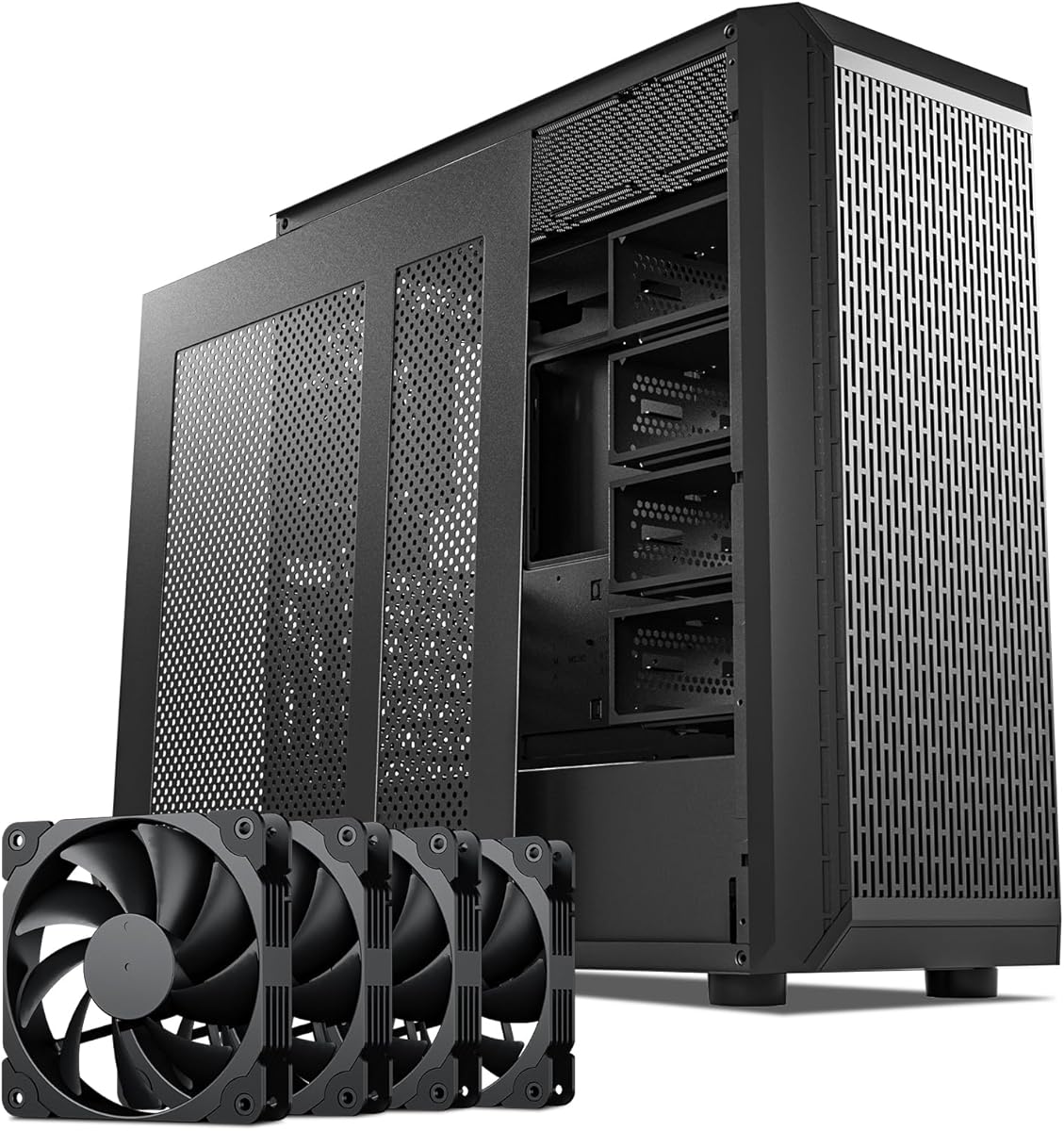
DARKROCK Classico Storage Master
The DARKROCK Classico Storage Master exists for a different clearance conversation: what if you need a serious GPU and a serious disk farm in the same chassis? It supports vertical GPU mounting, ships with four 120mm fans, offers 360mm radiator support on top and front, and claims room for ten 3.5-inch drives plus three 2.5-inch SSDs. That is NAS-adjacent capacity with gaming hardware ambitions, and it is the only pack product that frames GPU mounting as a vertical showcase feature by default.
Vertical mounting helps in two ways. Visually, the card becomes a display piece through the mesh and window orientation. Mechanically, a well-supported vertical mount can reduce classic horizontal sag on heavy coolers. You should still budget for a reputable PCIe riser if one is required for your orientation, and you should confirm that vertical mounting does not steal length or thickness clearance you assumed from horizontal specs. Always check the case’s vertical GPU limits separately from horizontal length claims.
Mesh front and side panels exist because storage arrays produce heat even when the GPU is idle. Four included fans give you a head start on moving air across both the card and the drive cages. If you populate most of the 3.5-inch bays, treat drive temperatures as a first-class monitoring target alongside GPU junction temps. A 360mm radiator option on top or front helps if your CPU is also working during transcodes or virtualization while games run.
This is not the case you buy for a minimalist RGB fishbowl on a vanity desk. It is the case you buy when your gaming PC is also a media library, editing scratch space, or home lab node. USB 3.0 readiness and the general ATX layout keep it usable as a daily machine, but the industrial storage-first proportions are honest about priorities.
Choose the Classico Storage Master if vertical GPU presentation plus deep storage is the brief. Choose Lian Li or Corsair if you want a cleaner gaming showcase with fewer drive bays. For GPU clearance specifically, the vertical mount path is the unique selling point — just validate riser and thickness compatibility for your exact card.
If your storage needs are modest, do not buy this case only because vertical GPUs look cool in photos. A Corsair 3500X LX or Lian Li V100 will present a horizontal card more cleanly with less bulk. Save the Classico for builds that will actually fill those drive trays.
Do not bury intake paths behind dense drive stacks without testing. Leave airflow channels to the GPU, and consider leaving a few drive bays empty as ventilation gaps if temperatures climb under mixed gaming and disk loads.
Hybrid builders, LAN-party archivists, and anyone who refuses to run a separate NAS box but still wants a modern GPU mounted prominently.
We may earn a commission at no additional cost to you.

The Zalman CUBIX-G is included as the honesty check of this roundup. It is a compact Micro-ATX mini tower with panoramic tempered glass, three preinstalled 120mm FRGB fans, and modern Type-C front I/O — but GPU support tops out around 280mm. If you arrived here searching for the best PC cases for GPU clearance, treat 280mm as a hard filter: many current dual-fan cards fit, many triple-fan and high-end cards do not. This is the small-desk option, not the long-card champion.
Within that shorter-card lane, the CUBIX-G is appealing. Compact cases often ship empty; Zalman includes three FRGB fans so the mini build looks finished immediately. Panoramic glass panels give a surprisingly premium view for the size class, and the front I/O mix of Type-C plus USB 3.0 matches how people actually plug devices into a living-room or dorm PC. Storage is modest — up to three 2.5-inch drives and one 3.5-inch in the supported configurations — which fits the compact mission.
Component limits are consistent with the mini tower brief. CPU air coolers up to about 155mm and ATX PSUs up to about 140mm mean you should shop shorter power supplies and compact coolers. A 280mm GPU that is also very thick can still feel cramped next to glass and fan mounts, so check slot thickness and cooler shroud width, not only length. Fixed FRGB lighting is simpler than addressable ecosystems; if you want per-LED motherboard sync, look to the Lian Li or Corsair ARGB options instead.
Why keep it on a clearance list? Because best for GPU clearance also means matching clearance to real needs. If your card is 250–270mm, buying a 455mm dual-chamber tower wastes space. The CUBIX-G shows the correct-sized answer for short GPUs and small rooms. It also clarifies why the Lian Li V100 Mini is special: that case stays compact-ish while jumping to 415mm GPU support — a different engineering choice than Zalman’s smaller 280mm envelope.
Buy the CUBIX-G for compact mATX gaming with shorter cards and included FRGB flair. Skip it for any build centered on a long triple-fan GPU. Use it as a calibration tool when reading the rest of this guide: if 280mm feels tight, you belong in the 360mm-plus group.
Student desks, shelf PCs, and secondary machines are the natural habitat. If this is your only gaming PC and you already carted a long GPU home, step up immediately — returning a case is easier than fighting clearance with modified brackets.
Short dual-fan GPUs, older mid-range cards, and compact modern designs under roughly 270mm with a little cable bend margin. Always confirm the manufacturer length including the power end of the card.
If your GPU is longer than 280mm, move to the Cooler Master Q300L for about 360mm, the Lian Li V100 Mini for 415mm, or full ATX V100 and HYXN options. Do not force a flagship into the CUBIX-G.
We may earn a commission at no additional cost to you.
The Lian Li Vector V100 Mini is the standout compact answer for long GPUs. It is a Micro-ATX case — ATX boards are not supported — yet it lists maximum GPU length up to 415mm, plus an anti-sag bracket with height adjustment for horizontal cards. That is the rare combination people actually want when they say they need clearance without a refrigerator-sized tower: keep the board form factor smaller, keep the graphics card long.
Four ARGB PWM fans come pre-installed, described as side intake and rear exhaust in Lian Li’s materials, which helps feed a long card that stretches toward the front of a compact interior. Panoramic tempered glass on the front and side creates a wide view so the GPU remains the visual centerpiece. Cable management channels and tie points are called out specifically, which matters because compact long-GPU builds leave less improvised space behind the tray.
Cooling flexibility includes support for up to nine 120mm fans and a 360mm AIO, with an important caveat: 280mm AIOs are not recommended due to motherboard clearance issues. That kind of specific warning is useful — it prevents a common parts-picker mistake where a supported radiator size list is treated as universally safe. Stick to the 360mm path Lian Li endorses for this chassis, or use air cooling within the case’s limits.
Lian Li also notes that dual-GPU setups are not recommended because of a five-slot limit, and points builders who need dual cards toward the full-size V100. For nearly everyone buying a single modern gaming GPU, that restriction is irrelevant. What is relevant is measuring the card at 415mm including connectors, then using the anti-sag bracket after the PCIe power cables are locked so the card sits flat without stressing the slot.
Choose the V100 Mini when you are committed to Micro-ATX and still want flagship-length GPU room with included ARGB fans. Choose the full ATX V100 when you need a larger board. Choose the HYXN H2 when you need even more length and dual-chamber volume. Among compact options in this pack, nothing else offers this much GPU runway.
This is also the case that best demonstrates why clearance shopping should start with motherboard form factor. If you already bought ATX, the Mini is not a compromise — it is the wrong product. If you planned mATX from the start, it can replace a full tower on the desk without replacing your long GPU ambitions.
Confirm Micro-ATX motherboard, single GPU, preferred 360mm AIO or compatible air cooler, and GPU length under 415mm with cable margin. Route GPU power through the PSU shroud paths before you lock the glass panels.
The Mini sacrifices ATX board support and some dual-GPU practicality to shrink the footprint while keeping about 415mm GPU capability. The full V100 adds ATX flexibility and 420mm clearance. Pick based on motherboard form factor first, then color and desk space.
Few compact cases clear past 400mm while shipping a real fan kit and anti-sag hardware. That combination is why the V100 Mini sits beside the full-size V100 and HYXN H2 in our top picks instead of being treated as a niche curiosity.
We may earn a commission at no additional cost to you.

Start with the manufacturer’s published GPU length, then add reality: power connector overhang, factory anti-sag brackets, and any aftermarket backplates. Compare that number to the case’s maximum GPU length and leave a buffer if you plan front intake fans or a front-mounted radiator. A case rated for 340mm can become a much tighter fit the moment you add a thick 360mm AIO as front intake.
Also check thickness and slot span. Clearance lists are usually about length, but a triple-slot cooler can interfere with drive cages, vertical mount brackets, or side glass hardware even when the millimeter length looks fine. If your card uses an end-exit power connector, dry-fit with the cable attached before you celebrate a near-limit fit.
ATX mid-towers such as the Lian Li V100, Corsair 4000D RS, Corsair 3500X LX, DARKROCK EC2, and HYXN H2 give the widest board and cooler flexibility. Micro-ATX specialists such as the Lian Li V100 Mini, Cooler Master Q300L, and Zalman CUBIX-G only make sense if your motherboard is already mATX or Mini-ITX. The V100 Mini proves compact cases can still clear 415mm cards; the CUBIX-G proves compact cases can also stop at 280mm. Form factor first, clearance second.
E-ATX builders should narrow to cases that explicitly list oversized boards. In this pack, the HYXN H2 and Corsair 3500X LX are the clearer E-ATX-friendly names. An ATX-only clearance champ can still fail you if the board does not fit.
Mesh fronts such as the DARKROCK EC2 and Classico Storage Master usually make it easier to keep a long GPU cool because intake air is less restricted. Panoramic glass such as the Corsair 3500X LX, Lian Li V100 Mini, and Zalman CUBIX-G looks better and often needs more deliberate fan placement. Cases that include three or four fans out of the box reduce the chance you will mount a front radiator later and accidentally kill your length margin.
If maximum length is the only goal, the HYXN H2’s 455mm dual-chamber path is the pack leader. If you want balance — long card room, included ARGB PWM fans, and ATX flexibility — the Lian Li V100 remains the default recommendation. Corsair’s modular and panoramic options sit between those poles for builders who care about ecosystem features as much as raw fit.
Vertical GPU mounts and dense drive capacity point to the DARKROCK Classico Storage Master. Modular upgrade paths and InfiniRail fan placement point to the Corsair 4000D RS Frame. Short dual-fan GPUs on tiny desks point to the Zalman CUBIX-G. None of those are wrong — they are simply optimized for different constraints than pure horizontal length.
Whatever you choose, dry-fit the GPU before dressing every cable. Long cards are awkward to remove once cable combs, glass panels, and radiator tubes are locked in place. A ten-minute test fit saves a one-hour teardown.
If your GPU is longer than 400mm and your board is ATX or E-ATX, start with the HYXN H2 for maximum length or the Lian Li V100 for a more conventional mid-tower with ARGB fans included. If your board is Micro-ATX and the GPU is still very long, start with the Lian Li Vector V100 Mini. If your GPU is under about 330mm and you want mesh value, the DARKROCK EC2 is enough. If your GPU is under 280mm and the desk is tiny, the Zalman CUBIX-G can work. If you care about panoramic glass and Corsair’s ecosystem, shortlist the 3500X LX; if you care about modular rails and FRAME upgrades, shortlist the 4000D RS.
Storage hybrids should look at the Classico Storage Master before any of the showcase towers. Open compact airflow fans of the Cooler Master Q300L should look there when 360mm is enough and perforated panels are welcome. This tree will not replace measuring, but it prevents most mismatched carts.
Finally, remember that clearance is a system property. The same GPU can fit in two cases on paper and only one in practice once your radiator, PSU cables, and drive cage are installed. Use the checklist, then use the dry-fit. That is the entire method behind this guide.
Match the case rating to your card’s published length plus a buffer. If your GPU is 320mm, a 340mm case can work with careful front fan choices, while a 400mm-plus case is more comfortable. If your GPU is 380–410mm, prioritize the Lian Li V100 at 420mm, Lian Li V100 Mini at 415mm, or HYXN H2 at 455mm instead of 280–340mm chassis. The goal is not the biggest number on the internet; it is a fit that still leaves room for cables and intake fans.
Often yes. Front radiators and their fans occupy depth that horizontal GPUs need. Top-mounted AIOs usually preserve more GPU length than front-mounted ones. If you must run a front 360mm radiator, compare the case’s GPU clearance with that radiator installed — not the empty-chassis marketing number alone. Push-pull fan stacks on a front radiator are especially hungry for depth.
It can be enough for many dual-fan and compact cards, which is why the Zalman CUBIX-G still has a role. It is not enough for numerous triple-fan high-end cards. Always check your exact model. When in doubt for 2026 flagship coolers, assume you want 360mm or more, and look at the Q300L, V100 Mini, or full ATX options instead.
The Lian Li Vector V100 Mini is the clear compact long-GPU pick here, with up to 415mm clearance, four ARGB PWM fans, and an anti-sag bracket — provided you are building on Micro-ATX. The Cooler Master Q300L is the alternative if you need open airflow and about 360mm on mATX without the panoramic Lian Li aesthetic. The CUBIX-G is compact too, but it is not a long-GPU case.
Only if you want the extra volume, cable separation, and radiator options that come with it. The HYXN H2’s 455mm clearance is excellent, but a well-designed single-chamber mid-tower like the Lian Li V100 already covers most long cards at 420mm. Dual-chamber makes more sense when you also want cleaner PSU and drive separation or extreme cooling layouts, not merely because the millimeter number is higher.
Not for length. Vertical mounts are about presentation and sometimes sag management. The DARKROCK Classico Storage Master highlights vertical mounting, but a horizontal mount in a longer case is usually simpler and thermally more predictable. If you go vertical, factor in riser cable quality and any reduction in thickness clearance before you assume it solves a length problem.
Yes, because long cards sit closer to front intakes and benefit from immediate airflow. Cases like the Lian Li V100, V100 Mini, Corsair 4000D RS, Corsair 3500X LX, HYXN H2, and Zalman CUBIX-G include multiple fans. The DARKROCK EC2 includes only one, so you should plan purchases before the GPU idles in still air. Included fans also reduce the urge to bolt a thick front radiator on day one just to fill empty mounts.
Look at cases that explicitly list E-ATX support, such as the HYXN H2 and Corsair 3500X LX in this pack. E-ATX width can change cable routing and drive placement even when GPU length is generous, so verify both board format and GPU length rather than assuming mid-tower ATX clearance automatically extends to E-ATX. When both constraints are extreme, the HYXN H2’s volume is the safer starting point.
Not on the Lian Li V100 pair in this guide. The black and white V100 share the same 420mm GPU support and fan kit. Choose color for theme and dust visibility. Spend your scrutiny on radiators, cooler height, and motherboard form factor instead of finish. If you want white without changing clearance math, the white V100 is the straightforward path.
Install the motherboard standoffs and PSU first if needed, then slide the GPU in with power cables attached and any front fans or radiator temporarily mounted in their planned positions. Confirm the card locks in the PCIe slot without pressing against fan frames. Only after that dry-fit should you dress cables and install tempered glass. This sequence catches almost every clearance surprise that a spreadsheet misses.
For most builders who want the best PC case for GPU clearance without oversizing the desk, the Lian Li V100-ATX in black or white is the balanced answer: 420mm of card room, four PWM ARGB fans included, and enough radiator and board flexibility for a modern high-end gaming PC. If your card is extreme, the HYXN H2’s 455mm dual-chamber layout is the pack’s maximum-length escape hatch. If you need that length in a Micro-ATX footprint, the Lian Li Vector V100 Mini is the clever compact solution.
Elsewhere, match the tool to the job. Corsair’s 4000D RS Frame and 3500X LX serve modular and panoramic priorities. The DARKROCK EC2 covers mesh value for mid-length cards. The Cooler Master Q300L and Zalman CUBIX-G handle small desks with very different length ceilings. The Classico Storage Master uniquely combines vertical GPU mounting with deep drive capacity.
Measure twice, dry-fit once, and do not let a front radiator silently cancel the clearance you thought you bought. Choose the case that fits the GPU you have — not the longest number on the page for its own sake — and your next upgrade will be a card swap, not another chassis return.