Best Mini-ITX Motherboards in 2026
We may earn a commission from links on this page, at no extra cost to you. Learn more.
A Mini-ITX motherboard is the heart of any small form factor PC, packing a full desktop platform into a 170mm square. That tiny footprint is what makes a console-sized gaming rig, a tidy home server or a living-room PC possible, but it also forces trade-offs the bigger boards never face. You get two DIMM slots instead of four, a single expansion slot, and a VRM squeezed into a fraction of the space, so power delivery and cooling design matter enormously. Choosing well means matching the socket to your CPU, whether that is AMD's AM5, Intel's LGA 1700 or 1851, or the older AM4, then checking the memory, storage and networking you actually need. This guide ranks nine of the best Mini-ITX motherboards you can buy in 2026, spanning gaming, budget and server-focused builds.
Top 9 Best Mini-ITX Motherboards
Our top 9 picks, reviewed
ASRock H610M-ITX/eDP
The ASRock H610M-ITX/eDP is the best all-round small form factor pick, delivering a capable LGA1700 platform for 12th, 13th and 14th Gen Intel chips at a genuinely low price. Its 6-phase Dr.MOS power keeps things stable and cool in tight enclosures, and PCIe 4.0 plus an Ultra M.2 slot cover graphics and fast storage. A rare eDP connector even suits all-in-one and embedded projects. Superb value for most SFF builds.
- Socket
- Intel LGA1700 (12/13/14th Gen)
- FormFactor
- Mini-ITX
- Memory
- DDR4 up to 3200MHz
- Storage
- PCIe 4.0, Ultra M.2
What we liked
- Excellent value LGA1700 platform
- Efficient 6-phase Dr.MOS power
- PCIe 4.0 slot and Ultra M.2
- eDP connector for all-in-one builds
Worth noting
- DDR4 only, no DDR5 support
- WiFi 5 rather than WiFi 6
ASUS ROG STRIX B860-I GAMING WIFI
The ROG STRIX B860-I GAMING WIFI is the flagship Intel choice here, built for Core Ultra Series 2 chips on the latest LGA 1851 socket. It brings serious power delivery, WiFi 7, Thunderbolt 4 and USB-C to a 17cm board, with big heatsinks and an L-shaped heatpipe to tame the heat. DDR5 and ASUS AI memory tuning round it out. It commands a premium, but it is a genuinely high-end SFF platform.
- Socket
- Intel LGA 1851 (Core Ultra 2)
- FormFactor
- Mini-ITX
- Networking
- WiFi 7, 2.5G LAN
- Ports
- Thunderbolt 4, USB-C
What we liked
- Powerful 10+1+2+1 power stages
- WiFi 7 and Thunderbolt 4 onboard
- DDR5 with AEMP III tuning
- Massive heatsinks with heatpipe
Worth noting
- Premium price
- Newest LGA 1851 CPUs cost more
Gigabyte A520I AC
The Gigabyte A520I AC is the pick for a compact AM4 build on a budget, pairing a surprisingly strong direct 6-phase 55A DrMOS VRM with Intel WiFi and Bluetooth. Three display interfaces make it a natural fit for a Ryzen APU media box or small home PC. The A520 chipset means PCIe 3.0 rather than 4.0, but for a value-focused Ryzen 3000 build in a tiny case, it covers the essentials neatly.
- Socket
- AMD AM4 (Ryzen 3000)
- FormFactor
- Mini-ITX
- Power
- Direct 6-Phase 55A DrMOS
- Storage
- PCIe 3.0 x4 M.2
What we liked
- Strong 6-phase 55A DrMOS power
- Intel WiFi and Bluetooth onboard
- Three display outputs for APUs
- Q-Flash Plus for easy BIOS updates
Worth noting
- A520 chipset lacks PCIe 4.0
- Only two DIMM slots
GIGABYTE B550I AORUS PRO AX
The B550I AORUS PRO AX is the AM4 board to reach for when you want gaming performance in a tiny case. Its pure digital 8-phase VRM and 8-layer PCB deliver power delivery that shames many larger boards, and you get PCIe 4.0, dual M.2, WiFi 6, 2.5GbE and USB-C. Paired with a cheap Ryzen 5000 chip and DDR4, it makes a fast, affordable small form factor rig with room only for the essentials.
- Socket
- AMD AM4 (Ryzen 3000/4000/5000)
- FormFactor
- Mini-ITX
- Power
- 8-Phase Digital
- Networking
- WiFi 6, 2.5GbE
What we liked
- Strong 8-phase VRM with 8-layer PCB
- WiFi 6 and 2.5GbE networking
- PCIe 4.0 with dual M.2 slots
- USB-C and aluminium backplate
Worth noting
- Only two DIMM slots
- DDR4-only AM4 platform
ASUS PRIME H610I-PLUS D4
The ASUS PRIME H610I-PLUS D4 is a tidy, low-cost LGA 1700 board that suits compact home servers and lightweight desktops. It offers PCIe 4.0, a fast 32Gbps M.2 slot and Intel vPro support for remote management, with multiple display outputs for headless or media use. It ships without WiFi but includes a V-M.2 Key E slot so you can add a module later. A sensible, no-frills SFF foundation.
- Socket
- Intel LGA 1700 (12th Gen)
- FormFactor
- Mini-ITX
- Memory
- DDR4
- Storage
- 32Gbps M.2, PCIe 4.0
What we liked
- Affordable LGA 1700 platform
- PCIe 4.0 and 32Gbps M.2 slot
- Intel vPro support for management
- V-M.2 Key E slot for WiFi module
Worth noting
- Gigabit LAN, no 2.5GbE
- No WiFi included out of the box
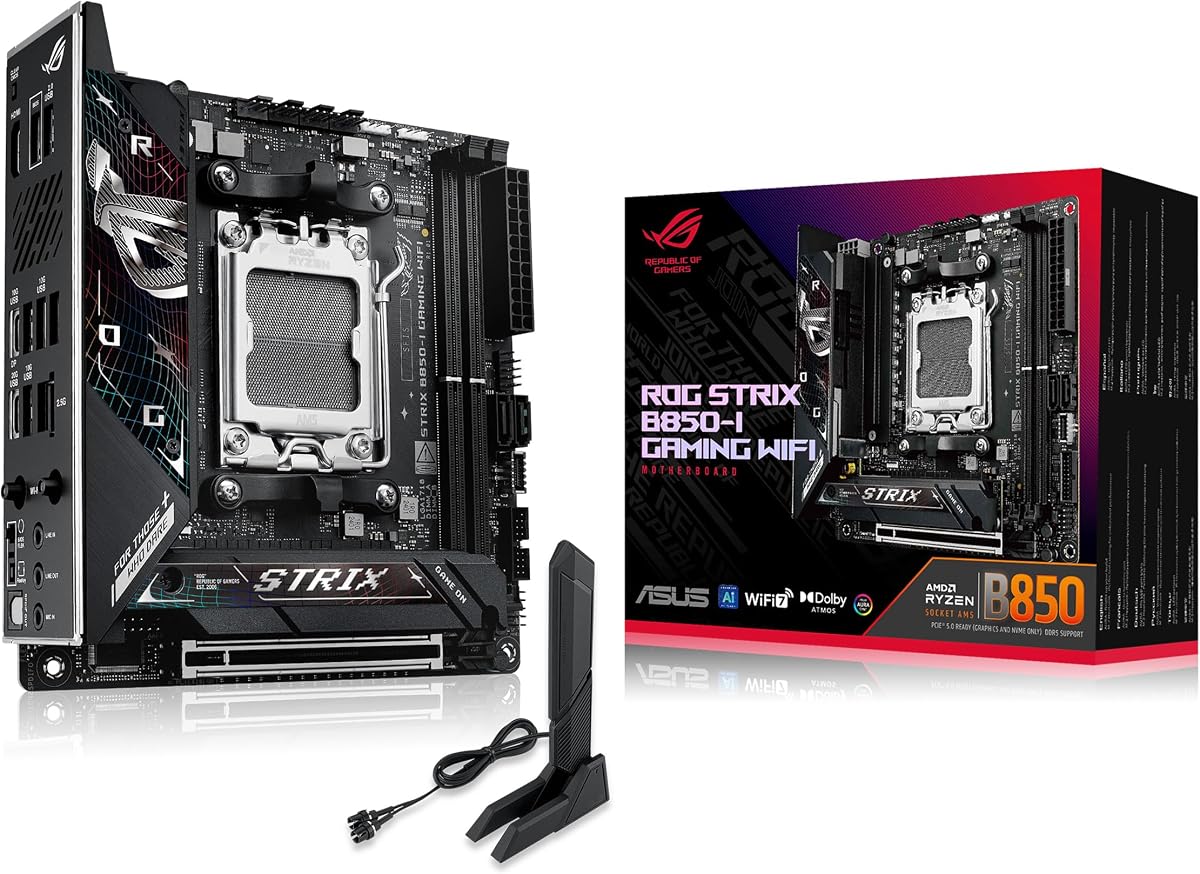
ASUS ROG Strix B850-I Gaming WiFi
The ROG Strix B850-I Gaming WiFi brings AMD's current AM5 platform to Mini-ITX at a keen price, supporting Ryzen 7000 through 9000 chips with DDR5 memory. Two PCIe 5.0 M.2 slots and WiFi 7 make it genuinely future-facing, and a 10+2+1 power solution keeps a Ryzen 7 or 9 fed. As with all ITX, you get just two DIMM slots, but this is a strong, upgrade-ready foundation for a modern compact build.
- Socket
- AMD AM5 (Ryzen 9000/8000/7000)
- FormFactor
- Mini-ITX
- Networking
- WiFi 7, 2.5G LAN
- Storage
- Dual PCIe 5.0 M.2
What we liked
- Modern AM5 platform with DDR5
- Two PCIe 5.0 M.2 slots
- WiFi 7 and 2.5G LAN
- Strong 10+2+1 power stages
Worth noting
- Only two DIMM slots
- PCIe 5.0 SSDs run hot in tiny cases
ASRock B650I Lightning WiFi
The ASRock B650I Lightning WiFi is an AM5 board built for enthusiasts who want to push DDR5, supporting overclocked speeds up to 7200+ MHz in its two DIMM slots. An 8+2+1 phase Dr.MOS design and PCIe 5.0 M.2 keep a Ryzen 9000 chip and fast NVMe drive well supplied, and WiFi 6E and 2.5G LAN handle networking. It is a focused, memory-forward Mini-ITX option for a modern high-speed compact gaming PC.
- Socket
- AMD AM5 (Ryzen 9000/8000/7000)
- FormFactor
- Mini-ITX
- Memory
- DDR5 7200+ (OC)
- Storage
- PCIe 5.0 M.2
What we liked
- High DDR5 overclocking to 7200+
- 8+2+1 phase Dr.MOS power
- PCIe 5.0 M.2 for fast NVMe
- WiFi 6E and 2.5G LAN
Worth noting
- Two DIMM slots limit capacity
- Rated below the top AM5 picks
ASRock B850i Lightning WiFi 6E
The ASRock B850i Lightning WiFi 6E is a storage-focused AM5 board, offering both a Blazing PCIe 5.0 M.2 and a Hyper PCIe 4.0 M.2 slot for two fast NVMe drives in a tiny footprint. Its 110A Smart Power Stage VRM and DDR5 support to 8200+ MHz make it capable well beyond its size, and BIOS Flashback simplifies new-CPU setup. A great compact pick when you want maximum SSD speed and capacity.
- Socket
- AMD AM5 (Ryzen 9000/8000/7000)
- FormFactor
- Mini-ITX
- Memory
- DDR5 8200+ (OC)
- Storage
- PCIe 5.0 + PCIe 4.0 M.2
What we liked
- Dual M.2 with a PCIe 5.0 slot
- Very high DDR5 OC to 8200+
- Strong 110A Smart Power Stage VRM
- WiFi 6E and BIOS Flashback
Worth noting
- Two DIMM slots cap capacity
- Runs warm in the smallest cases
Mini-ITX Quad-Core NAS Motherboard
This purpose-built Mini-ITX board is aimed squarely at NAS, firewall and virtualization projects rather than gaming. Its onboard quad-core 8-thread 15W CPU sips power, while eight SATA ports and dual 2.5GbE make it a compact storage powerhouse. Two M.2 NVMe slots and VT-x/VT-d support add flexibility. A noted sleep-mode bug and the fixed CPU are drawbacks, but for an always-on home server it is a tidy, efficient base.
- CPU
- Quad-Core 8-Thread (onboard)
- FormFactor
- Mini-ITX
- Networking
- Dual 2.5G LAN
- Storage
- 8x SATA, 2x M.2 NVMe
What we liked
- Eight SATA ports for NAS storage
- Dual 2.5GbE for fast networking
- Low-power 15W onboard CPU
- Supports virtualization (VT-x/VT-d)
Worth noting
- Known sleep-mode bug on this version
- No CPU socket, chip is fixed
How We Chose the Best Mini-ITX Motherboards

Building a small form factor PC is one of the most rewarding projects in the hobby, but Mini-ITX is also the least forgiving category of motherboard. Every one of these boards squeezes a complete desktop platform into a 170mm square, which means engineers make hard choices about power delivery, cooling and features that larger boards never have to. Our aim was to find the boards that handle those constraints gracefully, so your compact build is fast and stable rather than hot and throttled.
We began with the socket and CPU support, because that determines the entire platform and the CPUs you can fit. The list spans AMD's current AM5, Intel's newest LGA 1851 and value LGA 1700, the older AM4, and a purpose-built server board, so there is a match for every kind of build. From there we scrutinised the VRM, since a weak or poorly cooled power stage is far more damaging in a cramped ITX case than in an airy ATX one. We then weighed memory support, PCIe 5.0 and M.2 storage, networking, rear I/O and price. Throughout, we favoured boards with generous heatsinks, because thermal headroom is what keeps a small system reliable. The result is nine boards covering gaming, budget and server needs.
Why Go Mini-ITX in the First Place
The appeal of Mini-ITX is simple: a genuinely small computer that still delivers full desktop performance. A well-built ITX rig can be the size of a games console yet run a Ryzen 9 and a powerful graphics card, slide neatly under a monitor or into a living room, and travel to a LAN party without a trolley. Boards like the ASUS ROG Strix B850-I Gaming WiFi and GIGABYTE B550I AORUS PRO AX prove you no longer sacrifice gaming muscle to go small.
But the format is a commitment, not a free lunch. You trade expansion for size. Where an ATX board gives you four RAM slots and several PCIe and M.2 slots, an ITX board gives you two DIMM slots, one expansion slot and usually one or two M.2 slots. Cooling is tighter, cable routing is fiddlier, and component clearances demand careful planning. The payoff is a machine with a footprint no larger board can match. If a small, tidy, portable PC is your goal, and you are willing to plan the build carefully, Mini-ITX is deeply satisfying. If you want maximum expandability or the easiest possible build, a larger board is the more relaxed choice.
Power Delivery in a Tiny Footprint
VRM quality matters more on Mini-ITX than anywhere else, because the same power stages that sit in open air on an ATX board are packed into a fraction of the space, often right next to a hot CPU and starved of airflow. A board that runs a Ryzen 9 flawlessly at full size can throttle in a cramped case if its power design and heatsinks are inadequate. That is why we paid close attention to phase counts and cooling here.
The standouts are impressive for their size. The ASUS ROG STRIX B860-I GAMING WIFI uses a 10+1+2+1 stage design with massive heatsinks and an L-shaped heatpipe, while the ASRock B850i Lightning WiFi 6E pairs a 110A Smart Power Stage VRM with a compact but effective cooling setup. Even the older GIGABYTE B550I AORUS PRO AX brings a pure digital 8-phase VRM and 8-layer PCB. For lighter builds, efficient designs like the 6-phase Dr.MOS on the ASRock H610M-ITX/eDP are plenty. The rule of thumb: the hotter your CPU and the smaller your case, the more you should prioritise a strong VRM with real heatsinks.
Memory and Storage Trade-offs
Two DIMM slots is the defining limitation of Mini-ITX, and every AM5, AM4 and Intel board here follows that rule. It means you must buy the memory capacity you want up front as a two-stick kit, because there is no room to add more sticks later. The upside is that dual-channel two-DIMM configurations actually make it easier to hit high memory speeds, which is why boards like the ASRock B650I Lightning WiFi and B850i Lightning support aggressive DDR5 overclocks to 7200+ and 8200+ MHz respectively. AM5 boards use DDR5, while AM4 and the value Intel boards use more affordable DDR4.
Storage is where ITX boards punch above their weight. Despite their size, the AM5 boards here offer dual M.2 slots, often with a PCIe 5.0 slot for the fastest NVMe drives, as on the ROG Strix B850-I and B850i Lightning. The catch in a small case is heat: PCIe 5.0 SSDs run hot, so a board with an M.2 heatsink and a case with decent airflow matter. The server-focused board takes a different path entirely, adding eight SATA ports for a stack of storage drives. Match your storage plan to the build, whether that is one fast game drive or a wall of NAS disks.
Networking, Ports and Expansion
Because a Mini-ITX board has only one expansion slot, onboard connectivity carries more weight than on a larger board. You cannot simply add a WiFi card or a 2.5GbE card and still fit a graphics card, so what the board includes is what you get. Happily, the modern boards here are well equipped: the ROG STRIX B860-I and ROG Strix B850-I offer WiFi 7 and 2.5G LAN, while the AM4 B550I AORUS PRO AX brings WiFi 6 and 2.5GbE. The value ASRock H610M-ITX/eDP includes WiFi 5, and the ASUS PRIME H610I-PLUS D4 ships without WiFi but leaves a Key E slot for a module.
Rear I/O deserves scrutiny too. The premium boards add fast USB-C and even Thunderbolt 4 on the ROG STRIX B860-I, which is invaluable for docks and external drives when your single PCIe slot is taken by a GPU. For server and media builds, display outputs and networking matter more than USB speed: the NAS-focused board leans on dual 2.5GbE, and the Gigabyte A520I AC offers three display outputs for an APU media box. Since you cannot expand later, choose a board whose built-in ports already cover everything you need.
Matching the Board to Your Build
The right Mini-ITX board depends entirely on what you are building, and the picks here divide cleanly. For a modern AMD gaming rig with room to upgrade, the AM5 boards are the target: the ASUS ROG Strix B850-I Gaming WiFi for balanced value, the ASRock B650I Lightning WiFi for memory overclocking, or the ASRock B850i Lightning WiFi 6E for dual fast SSDs. All three take Ryzen 7000 to 9000 chips with DDR5 and PCIe 5.0.
For Intel gamers, the ASUS ROG STRIX B860-I GAMING WIFI is the flagship on the newest LGA 1851 socket, while budget-minded Intel builders should look at the ASRock H610M-ITX/eDP for cheap 12th to 14th Gen builds. AMD value seekers can save with the AM4 GIGABYTE B550I AORUS PRO AX for gaming or the Gigabyte A520I AC for a media box. Finally, if you are building a home server or NAS rather than a gaming PC, the dedicated dual-2.5GbE, eight-SATA board or the ASUS PRIME H610I-PLUS D4 are the practical choices. Pick the board whose strengths align with your build's single main purpose.
A Closer Look at the Top Picks
The ASRock H610M-ITX/eDP takes the top spot on value and versatility. It delivers a capable LGA1700 platform for a wide range of Intel chips at a very low price, with a cool-running 6-phase Dr.MOS VRM, PCIe 4.0 and an Ultra M.2 slot, plus a rare eDP connector that opens the door to all-in-one and embedded projects. It is the board we would recommend to most people building an affordable, sensible SFF machine.
Above it in capability, the ASUS ROG STRIX B860-I GAMING WIFI is the no-compromise Intel gaming platform with WiFi 7 and Thunderbolt 4, and the AM5 trio led by the ROG Strix B850-I bring modern DDR5 and PCIe 5.0 to compact AMD builds. The AM4 Gigabyte A520I AC and B550I AORUS PRO AX offer excellent value for budget and gaming builds respectively, and for anyone building storage or infrastructure rather than a gaming PC, the NAS-focused board and ASUS PRIME H610I-PLUS D4 close out the list with the right mix of SATA, networking and efficiency.
Final Recommendation
For most small form factor builders, the ASRock H610M-ITX/eDP is the best Mini-ITX motherboard in 2026, combining a flexible Intel platform, efficient power and strong storage support at an unbeatable price. If you are building a high-end gaming rig, choose the ASUS ROG STRIX B860-I GAMING WIFI for Intel or the ASUS ROG Strix B850-I Gaming WiFi for AMD's modern AM5 platform. Budget AMD builders are well served by the AM4 GIGABYTE B550I AORUS PRO AX, and anyone building a NAS or home server should look at the dedicated dual-2.5GbE board. Whatever you choose, plan your memory and clearances up front, prioritise a strong cooled VRM, and Mini-ITX rewards you with a powerful PC in a remarkably small package.
How we picked
We ranked each Mini-ITX board on socket and CPU support, VRM power design and thermals inside a compact footprint, DDR5 or DDR4 memory support, PCIe 5.0 and M.2 storage, networking and rear I/O, and price. Because small form factor builds live or die on power and cooling, we weighed VRM strength and heatsink design heavily and included AM5, LGA 1700, LGA 1851, AM4 and server-focused boards.
Frequently asked questions
What size case does a Mini-ITX motherboard need?
Mini-ITX boards measure 170mm by 170mm and fit dedicated Mini-ITX cases, which range from tiny console-sized enclosures to slightly larger cubes. They also fit in Micro-ATX and full ATX cases if you want more room for cooling. Always check your case's motherboard support and, crucially, its graphics card and CPU cooler clearance, since space is the main constraint in small form factor builds.
How many RAM slots do Mini-ITX boards have?
Almost all Mini-ITX motherboards, including every AM5 and AM4 board here, have just two DIMM slots. That limits you to two memory modules, so buy a two-stick kit at the capacity you want, such as a 32GB or 64GB DDR5 kit for the ROG Strix B850-I. You cannot add a third or fourth stick later, so plan your memory capacity up front.
Can I use a full-size graphics card in a Mini-ITX build?
Yes, if your case supports it. Mini-ITX boards have one full PCIe x16 slot, and the AM5 boards here even offer PCIe 5.0. The limit is physical case clearance rather than the board itself. Many SFF cases fit two- or three-slot cards, but always match the GPU's length and thickness to your specific case before buying, since compact enclosures vary widely.
Should I choose AMD AM5 or Intel for a Mini-ITX build?
Choose AM5 boards like the ROG Strix B850-I or ASRock B650I Lightning for AMD Ryzen 7000 to 9000 chips, DDR5 and PCIe 5.0 with a long upgrade path. Choose Intel LGA 1851 like the ROG STRIX B860-I for the newest Core Ultra chips, or the value LGA 1700 ASRock H610M-ITX for cheaper 12th to 14th Gen builds. Match the socket to the exact CPU you plan to buy.
Is a Mini-ITX board good for a home server or NAS?
It can be excellent. The dedicated NAS board here offers eight SATA ports, dual 2.5GbE and a low-power onboard CPU ideal for always-on storage and virtualization. The ASUS PRIME H610I-PLUS D4 is another compact server-friendly option with vPro management. For a NAS, prioritise SATA count, networking speed and power efficiency over gaming-focused VRMs and PCIe 5.0.