Skip to content

Best Floor-Standing Speakers in 2026

By Priya NairUpdated July 5, 2026

We may earn a commission from links on this page, at no extra cost to you. Learn more.

A floor-standing speaker, or tower, is the classic way to fill a room with big, effortless sound. Because the tall cabinet holds larger woofers and more internal volume than a bookshelf model, a good tower reaches lower, plays louder and stays composed where smaller speakers strain, making it the heart of a serious music or home-theatre system. The trade-off is size, so the right choice depends on your room, your amplifier and whether you want passive speakers driven by a receiver or an all-in-one powered pair. This guide ranks eight of the best floor-standing speakers you can buy in 2026, spanning trusted names like Klipsch and Polk alongside capable value options, so there is a right tower whatever your space and budget.

Top 8 Best Floor-Standing Speakers

Our top 8 picks, reviewed

1Best Overall

Klipsch Reference R-26FA Floorstanding Speaker (Pair)

The Klipsch Reference R-26FA takes the top spot by folding Dolby Atmos into a proper tower, with integrated upward-firing elevation drivers that add three-dimensional height to films and music. Dual 6.5-inch copper-spun woofers and Klipsch's signature horn-loaded compression tweeter deliver crisp, dynamic sound, while dual binding posts allow bi-wiring or bi-amping. Sold as a pair with serious 400-watt peak handling, it is our pick for an immersive front stage.

Config
Dolby Atmos tower, pair
Power
100W continuous / 400W peak
Drivers
Dual 6.5in woofers, 1in compression driver
Connectivity
8-ohm, dual binding posts

What we liked

  • Built-in Dolby Atmos elevation drivers
  • Dual 6.5in copper-spun IMG woofers
  • High 400W peak power handling
  • Bi-wire and bi-amp binding posts

Worth noting

  • Needs a capable AV receiver
  • Larger footprint than slimmer towers
2Best for Home Theater

Klipsch R-620F Floorstanding Speaker

The Klipsch R-620F brings that unmistakable horn-loaded energy to home cinema, with a one-inch aluminium LTS tweeter on a 90-by-90 Tractrix horn that makes dialogue and effects leap forward. Dual 6.5-inch spun-copper woofers and rear-firing Tractrix ports supply the punch for action scenes, all in a slim cabinet just over nine inches wide. It is a single speaker, so buy two for a full front stage, but the concert-hall drama is addictive.

Config
2-way bass-reflex tower
Power
Rear-firing Tractrix ports
Drivers
Dual 6.5in spun-copper woofers, 1in LTS tweeter
Size
40in x 9.4in x 15.2in

What we liked

  • Signature Tractrix horn clarity
  • Dual 6.5in spun-copper woofers
  • Concert-like dynamics for films
  • Slim 9.4-inch-wide cabinet

Worth noting

  • Sold as a single, not a pair
  • Horn sound can be forward for some ears
3Best Premium

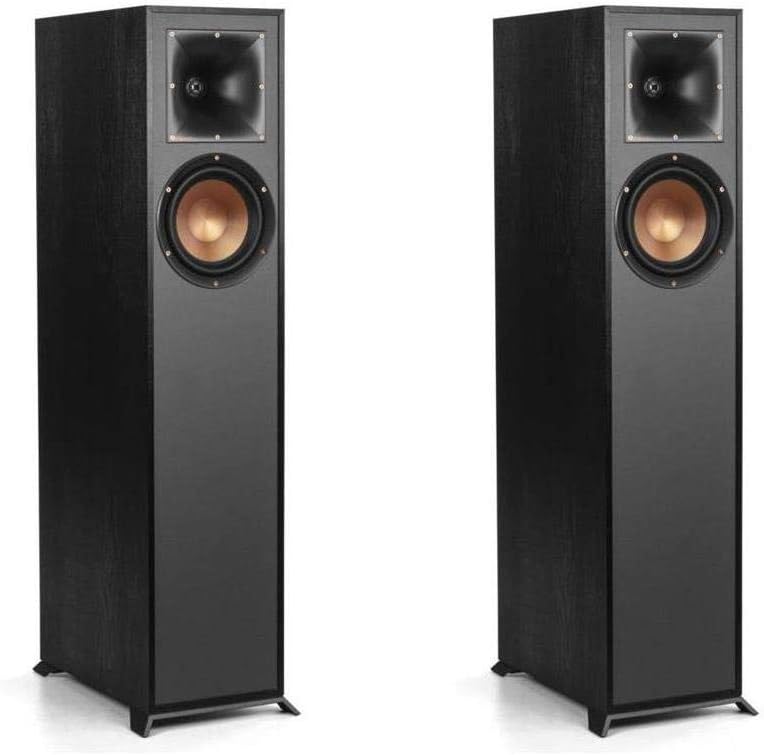
Klipsch Reference R-610F Floorstanding Speaker (Pair)

The Klipsch Reference R-610F pair is the refined all-rounder, delivering a wide 45Hz to 21kHz response and Klipsch's crisp aluminium LTS tweeter on a square Tractrix horn for detailed, articulate highs. Its high 94dB sensitivity means even a modest receiver drives it to satisfying volume without strain, and the 8-ohm load plays nicely with most amplifiers. As a matched pair it makes a clean, dynamic front stage for music and movies alike.

Config
2-way floorstanding, pair
Power
85W continuous / 340W peak
Drivers
6.5in woofer, 1in aluminium LTS tweeter
Connectivity
8-ohm, 94dB sensitivity

What we liked

  • High 94dB sensitivity is easy to drive
  • Wide 45Hz-21kHz frequency response
  • Signature Tractrix horn clarity
  • Sold as a matched pair

Worth noting

  • Premium price for a two-way tower
  • Single woofer moves less air than duals
4Best Single Tower

Klipsch R-610F Floorstanding Speaker (Single)

This single-cabinet version of the Klipsch R-610F is the flexible option for anyone building a room piece by piece, or replacing one tower in an existing setup. It shares the pair's spun-copper woofer, aluminium LTS Tractrix-horn tweeter, high 94dB sensitivity and even 45Hz to 21kHz response, so it timbre-matches perfectly to its twin. Buy the exact quantity your layout needs rather than being forced into a boxed pair.

Config
2-way floorstanding, single
Power
340W power handling
Drivers
6.5in spun-copper woofer, 1in aluminium LTS tweeter
Connectivity
94dB, +/-3dB 45Hz-21kHz

What we liked

  • Buy exactly the number you need
  • High 94dB sensitivity
  • Crisp aluminium LTS horn tweeter
  • Wide, even frequency response

Worth noting

  • Single unit, less value than the pair
  • One woofer limits deep-bass output
5Best Powered Tower

Fluance Ai81 Elite Powered Floorstanding Speakers (Pair)

The Fluance Ai81 Elite is the modern, fuss-free tower, packing a 150-watt amplifier inside so you skip the receiver entirely. Dual 6.5-inch woven glass-fibre woofers and neodymium tweeters produce a spacious, detailed soundstage, and connectivity spans Bluetooth 5, dual RCA, optical and a subwoofer output for flexible hookup to a TV, turntable or computer. Wrapped in natural walnut, it is a handsome all-in-one stereo solution for a living room.

Config
Powered 2-way tower, pair
Power
150W built-in amplifier
Drivers
Dual 6.5in glass-fibre woofers, neodymium tweeters
Connectivity
Bluetooth 5, 2x RCA, optical, sub out

What we liked

  • No separate amplifier or receiver needed
  • Bluetooth 5, RCA and optical inputs
  • Subwoofer output for added bass
  • Natural walnut cabinet looks superb

Worth noting

  • Built-in amp fixes your power ceiling
  • Fewer upgrade paths than passive towers
6Best for Dolby Atmos Music

Polk Signature Elite ES55 Tower Speaker

The Polk Signature Elite ES55 is a room-filling passive tower with a Dynamically Balanced acoustic array, a one-inch Terylene tweeter and dual 6.5-inch woofers arranged in a 2.5-way crossover. Polk's Power Port technology delivers cleaner, louder bass than a conventional port, and the speaker is Hi-Res Audio certified and Dolby Atmos and DTS:X compatible. Gold-plated binding posts and both 4- and 8-ohm operation make it easy to integrate into most systems.

Config
2.5-way cascading crossover tower
Power
4- & 8-ohm compatible
Drivers
Dual 6.5in woofers, 1in Terylene tweeter
Connectivity
Hi-Res, Dolby Atmos, DTS:X

What we liked

  • Hi-Res Audio certified for detail
  • Power Port technology for deeper bass
  • Dual 6.5in woofers fill a room
  • Gold-plated 5-way binding posts

Worth noting

  • Needs a receiver to drive it
  • Bass wants careful room placement
7Best Value

Elimavi Passive Floorstanding Speakers (Brown)

The Elimavi passive tower in brown is the budget-friendly way into floor-standing sound, wrapping a two-way design with a one-inch tweeter and 6.5-inch woofer in a handsome woodgrain cabinet that doubles as furniture. The MDF enclosure curbs resonance, gold-plated banana terminals keep the connection clean, and it partners easily with turntables, TVs and home-theatre receivers. Just remember it is passive, so you will need an amplifier to bring it to life.

Config
Passive 2-way tower
Power
120W RMS, 4-ohm
Drivers
6.5in woofer, 1in tweeter
Connectivity
Gold-plated banana terminals

What we liked

  • Attractive woodgrain furniture finish
  • 120W RMS handling for the price
  • Gold-plated banana terminals
  • Wide device compatibility

Worth noting

  • Requires an external amplifier
  • Lesser-known brand, no Bluetooth
8Best Compact

Elimavi Passive Floorstanding Speakers (Black)

The black-finish Elimavi tower is the same affordable two-way design in a sleeker, more modern colourway for rooms where a dark cabinet blends in better. It offers the same one-inch tweeter, 6.5-inch woofer, 120-watt RMS handling and gold-plated banana terminals, all in a resonance-damping MDF enclosure. Like its brown sibling it is a passive speaker that pairs with any home-theatre receiver, making it an easy, inexpensive way to add real towers to a stereo.

Config
Passive 2-way tower
Power
120W RMS, 4-ohm
Drivers
6.5in woofer, 1in tweeter
Connectivity
Gold-plated banana terminals

What we liked

  • Sleek black finish suits modern rooms
  • 120W RMS handling at a low price
  • Gold-plated banana terminals
  • Sturdy MDF cabinet controls resonance

Worth noting

  • Passive design needs an amplifier
  • Unfamiliar brand, no wireless input

How We Chose the Best Floor-Standing Speakers

Best Floor-Standing Speakers in 2026

A tower speaker is a bigger commitment than a bookshelf pair, in space, in money and in the amplification it demands, so the ranking had to reward speakers that justify that commitment. We began with output and dynamics, the ability to fill a room with clean, effortless sound rather than straining at volume, because that headroom is the main reason to choose a tower in the first place. From there we weighed low-frequency depth, since larger cabinets and multiple woofers are what let a tower reach the low notes a small speaker simply cannot produce.

We then looked at the qualities that separate a merely loud speaker from a genuinely good one. High-frequency clarity from the tweeter shapes how detailed and open the sound feels, which is why Klipsch's horn-loaded designs and Polk's Terylene tweeter stood out. Cabinet construction mattered because a dense, well-braced enclosure suppresses the resonances that blur the sound. We considered sensitivity and impedance to judge how easily each speaker pairs with a typical receiver, and we noted whether a model is passive or powered, since that decides whether you need a separate amplifier. Finally, we kept the list varied, from immersive Atmos towers to an all-in-one powered pair and affordable value options, so there is a sensible tower for every room and system.

Understanding Tower Speakers and How They Fill a Room

The defining advantage of a floor-standing speaker is internal volume. A tall cabinet gives the drivers a large sealed or ported space to work in, which lets the woofers move more air and produce deeper, more authoritative bass than a compact speaker can manage. That is why a tower can often anchor a music system without a subwoofer, and why models like the Klipsch Reference R-26FA with its dual 6.5-inch woofers or the Polk Signature Elite ES55 fill a room so easily. The larger baffle also lets designers space the drivers for better imaging and fit more of them, adding the woofer area that translates directly into effortless, room-filling scale.

The other big decision is passive versus powered. Most towers here, including the Klipsch and Polk models and the Elimavi pairs, are passive, meaning they contain no amplifier and rely on an external receiver or stereo amp to drive them. That keeps them flexible and upgradeable, since you can improve the sound later by improving the amplifier. The Fluance Ai81 Elite takes the opposite approach, building a 150-watt amplifier and Bluetooth, RCA and optical inputs into the cabinet so it plays straight from a phone or TV with no extra box. Neither approach is better in the abstract; the passive route rewards enthusiasts who like to tinker, while the powered route suits anyone who wants big sound with minimal clutter.

Matching the Speakers to Your Needs

For an Immersive Home Cinema

If films are your priority, the towers that build in height and horn clarity make the biggest difference. The Klipsch Reference R-26FA is the standout, with integrated Dolby Atmos elevation drivers that add overhead effects and dual woofers that hit hard during action scenes. The Klipsch R-620F brings the same concert-hall energy in a slimmer single cabinet, and the Polk Signature Elite ES55 adds Dolby Atmos and DTS:X compatibility with Polk's bass-boosting Power Port. Any of these makes a dramatic, dynamic front stage.

For Two-Channel Music

If you mostly listen to music in stereo, the priority shifts to tonal balance and easy amplifier matching. The Klipsch Reference R-610F pair is a superb choice, offering a wide, even response and high 94dB sensitivity that lets even a modest amp drive it cleanly, while its crisp aluminium LTS tweeter keeps vocals and instruments detailed. Its high efficiency means you do not need an expensive amplifier to enjoy full, satisfying volume, making it a smart hi-fi anchor.

For a Simple, Modern Setup

Not everyone wants a rack of components. The Fluance Ai81 Elite is the answer for a clean, cable-light living room, since its built-in 150-watt amplifier and Bluetooth, RCA and optical inputs let it connect directly to a TV, turntable or phone with no receiver at all. Its subwoofer output leaves room to add bass later, and the natural walnut cabinet looks the part in a modern space where a stack of black boxes would feel out of place.

For a Tight Budget

If you want the scale of real towers without a premium outlay, the Elimavi pairs deliver. Available in brown or black woodgrain finishes, they offer a two-way design with a 6.5-inch woofer, 120-watt RMS handling and tidy gold-plated banana terminals for a modest price. They are passive, so you will need an amplifier, but for adding genuine floor-standing sound to an existing receiver on a budget, they are an easy recommendation.

Specifications That Matter Most

Two specifications tell you the most about a tower's character: woofer configuration and sensitivity. The number and size of the woofers determine how much air the speaker moves and therefore how deep and effortless its bass feels, which is why the dual-6.5-inch Klipsch R-26FA and R-620F and the Polk ES55 sound fuller than a single-woofer design. Sensitivity, measured in decibels, tells you how efficiently a speaker converts amplifier power into volume; the Klipsch R-610F's high 94dB rating means it plays loud from a modest receiver, while less sensitive towers need more power to reach the same level.

Impedance and cabinet build round out the picture. Most of these towers present an 8-ohm or dual 4- and 8-ohm load that partners easily with common receivers, a point the Klipsch and Polk models highlight, so match your amplifier's rating to the speaker to avoid straining it. Cabinet construction matters because a dense, internally braced MDF enclosure, emphasised across the Fluance, Polk and Elimavi listings, suppresses the resonances that muddy the sound and lets the drivers do their job cleanly. Finally, decide early whether you want a passive tower for maximum flexibility or a powered one like the Fluance Ai81 Elite for simplicity, because that choice shapes the rest of your system.

A Closer Look at the Top Picks

The Klipsch Reference R-26FA earns the top spot by doing something the other towers cannot, adding true overhead dimension through its integrated Dolby Atmos elevation drivers while still delivering the crisp, dynamic horn-loaded sound Klipsch is known for. Its dual copper-spun woofers and high peak-power handling make it as capable with music as with films, and the bi-wire binding posts leave room to grow. Sold as a pair, it is a complete, immersive front stage in a box.

Behind it, the Klipsch R-620F brings that same energy to home cinema in a slim single cabinet, and the Reference R-610F pair is the refined, efficient choice for two-channel music, with its single-cabinet sibling offering flexibility for those building a system piece by piece. The Fluance Ai81 Elite is the standout for a clutter-free modern room thanks to its built-in amplifier and wide connectivity, while the Polk Signature Elite ES55 delivers Hi-Res, Atmos-ready sound with clever Power Port bass. The two Elimavi towers close out the list as affordable value picks for anyone wanting real floor-standing scale without spending big.

Getting the Best Sound From Your Towers

Placement transforms how a tower sounds. Set the two speakers a few feet apart along the front wall, angled gently inward toward your seat, and keep them clear of corners where bass builds up into a boomy mess. Ported designs such as the Klipsch R-620F and Polk ES55 are especially sensitive to a nearby wall, so give them breathing room and experiment with the amount of toe-in until vocals lock into a sharp, central image between the speakers.

Getting the amplification right matters just as much for passive towers. Match your receiver or amplifier to the speaker's impedance and give it enough power to reach comfortable volume without clipping, since a strained amp damages speakers faster than a powerful one ever will. High-sensitivity models like the Klipsch R-610F are forgiving here, but a bigger tower still appreciates a capable amp. If you chose the powered Fluance Ai81 Elite, you sidestep all of this, though its subwoofer output is worth using if you crave deeper bass. With careful placement and a well-matched amplifier, any tower on this list will fill your room convincingly.

Final Recommendation

For most buyers, the Klipsch Reference R-26FA is the best floor-standing speaker in 2026, combining crisp horn-loaded clarity, dual-woofer punch and built-in Dolby Atmos height into an immersive, do-everything pair. If films are your focus but budget is tight, the Klipsch R-620F delivers concert-hall energy in a slim cabinet, while the Reference R-610F pair is the efficient, refined choice for music lovers. For a simple modern room, the powered Fluance Ai81 Elite removes the need for a receiver entirely, and the Polk Signature Elite ES55 adds Atmos-ready versatility. On a budget, the Elimavi towers bring real scale for less. Match the speaker to your room and amplifier, place it with care, and a good tower will anchor your system for years.

How we picked

We judged each tower on room-filling output and dynamics, low-frequency depth from its woofers, high-frequency clarity from its tweeter, cabinet build and resonance control, sensitivity and amplifier matching, and the value it offers at its price. Because towers anchor a whole system, we prioritised speakers that deliver clean, powerful sound and integrate easily with common receivers, and we mixed passive and powered designs so the list suits both traditional hi-fi setups and simpler modern ones.

Frequently asked questions

Do floor-standing speakers need an amplifier or receiver?

Most do. Passive towers like the Klipsch Reference R-610F, Polk Signature Elite ES55 and Elimavi pairs require a separate amplifier or AV receiver to drive them. The exception here is the Fluance Ai81 Elite, which has a 150-watt amplifier built in and connects directly to a source over Bluetooth, RCA or optical, so no external amp is needed.

How many towers do I need for home theatre?

A stereo setup uses two towers as the left and right front speakers. Some listings, like the Klipsch Reference R-26FA and R-610F pair, include two, while others such as the Klipsch R-620F and single R-610F are sold individually, so check the quantity and buy a matched pair for balanced imaging across your front stage.

What does speaker sensitivity mean for tower speakers?

Sensitivity, measured in decibels, tells you how loud a speaker plays for a given amount of power. A high figure like the 94dB of the Klipsch R-610F means the speaker is efficient and reaches satisfying volume even from a modest receiver, whereas lower-sensitivity towers need a more powerful amplifier to sound their best.

Are Dolby Atmos towers worth it?

If you watch a lot of films with height effects, yes. The Klipsch Reference R-26FA has upward-firing elevation drivers that bounce sound off the ceiling for a three-dimensional effect, and the Polk Signature Elite ES55 is Dolby Atmos and DTS:X compatible. Both add a sense of overhead space that standard towers cannot produce.

Where should I place floor-standing speakers?

Position towers a few feet apart along the front wall, angled slightly toward the listening position, and keep them clear of corners and walls where bass can build up unevenly. Ported towers such as the Klipsch R-620F and Polk ES55 especially benefit from breathing room, so give them space and experiment with toe-in to sharpen the stereo image.