Best Overall
MSI B850 Gaming Plus WIFI6E
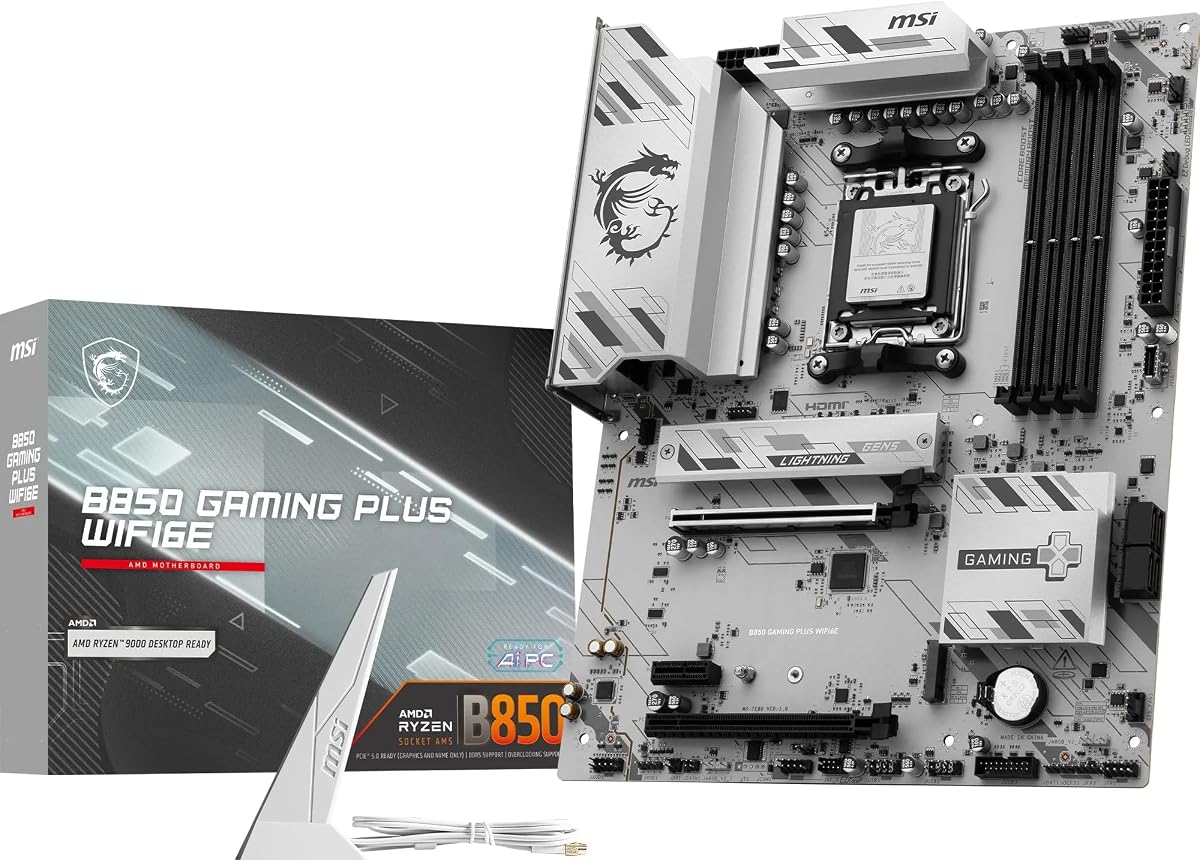
- 12 Duet Rail VRM with Frozr Guard cooling for Ryzen 9000 gaming loads
- Gen5 M.2 plus Wi-Fi 6E and 2.5G LAN without a barebones rear panel
- Highest pack rating and strong DDR5 overclocking headroom for the money
Expert Review & Guide
Building on AMD's AM5 socket no longer means spending flagship money on a motherboard. In 2026, budget-friendly B650, B850, and carefully chosen X870 boards deliver DDR5, modern M.2 storage, and solid Ryzen 7000 through 9000 support without the premium tax of heavily stacked X870E models. The challenge is knowing which shortcuts actually matter: a weak VRM under a hot Ryzen 7 or 9, missing Wi-Fi that forces a USB dongle, or an mATX layout that fights your case and cooler clearance.
This roundup focuses on value-first AM5 boards from our curated product pack only. We weighed power-phase design, heatsink coverage, storage lane generation, wired and wireless networking, and day-one build convenience features such as BIOS Flashback and tool-less M.2 latches. Ratings stay tied to the live listings, and every image and ASIN comes straight from the pack so you can jump from comparison to purchase without chasing mismatched SKUs.
Whether you want a simple mid-tower gaming PC, a compact mATX living-room build, or a future-leaning board with Wi-Fi 7 and USB4 without emptying the parts budget, the ten boards below cover the sensible middle of the AM5 market. Read the comparison table first if you already know your form factor and wireless needs, then dig into the full reviews for BIOS maturity notes, upgrade headroom, and who each board actually suits.


As an Amazon Associate we earn from qualifying purchases. We may earn a commission at no additional cost to you.
Scan form factor, VRM class, M.2 generation, and wireless standard before you commit. Specs below avoid street pricing and stick to the features that change build quality on a budget AM5 platform. Ratings are pulled from the product pack listings.
The MSI B850 Gaming Plus WIFI6E earns Best Overall in this budget AM5 roundup because it hits the features most builders actually feel day to day without drifting into luxury-board pricing. You get a 12 Duet Rail Power System tuned for Ryzen 9000, 8000, and 7000 CPUs, extended heatsinks with thick thermal pads, and networking that does not force a later dongle purchase. On a value-first AM5 shopping list, that combination of VRM confidence, Wi-Fi 6E, and Gen5 storage is hard to beat.
Power delivery is the quiet hero here. MSI's P-PAK Duet Rail layout and Core Boost architecture are aimed at multi-core Ryzen chips that spike hard in games and productivity bursts. Pair that with Frozr Guard cooling—7W/mK MOSFET pads, choke pads, an extended heatsink, chipset coverage, and M.2 Shield Frozr—and you have a board that stays composed when a Ryzen 7 or mid-tier Ryzen 9 sits under a mid-tower air cooler. Budget boards sometimes cut heatsink mass; this one does not feel like a stripped chassis.
Memory and graphics lanes are practical rather than speculative. Four SMT DDR5 DIMM slots advertise aggressive overclocking headroom, with 8200+ MT/s mentioned for favorable one-DIMM-per-channel kits. The primary PCIe slot is Gen4 x16 with Steel Armor, which is still more than enough for current mainstream GPUs. If you were hoping for a PCIe 5.0 graphics slot on every budget board, this is a tradeoff to accept—storage gets the Gen5 treatment instead, which is usually the more useful place to spend silicon on a value build.
Storage is a two-drive NVMe setup: one Gen5 x4 slot and one Gen4 x4 slot, both benefiting from Shield Frozr coverage and EZ M.2 Clip II hardware. That is perfect for a blazing boot drive plus a large game library SSD. Builders who want three or four M.2 devices should look at denser AORUS or TUF options later in this guide. For most gaming and creator PCs, two fast M.2 slots plus SATA leftovers still cover years of upgrades.
Connectivity lands where budget AM5 buyers should insist it lands. Wi-Fi 6E with Bluetooth 5.3, 2.5Gbps Ethernet, USB 10Gbps Type-C on the rear, and Audio Boost 7.1 codecs mean you are not stuck hunting add-in cards on week one. The combo fan header for pump and system fans also helps if you later move from air cooling to a modest AIO. First-time AM5 builders will appreciate that the board does not feel incomplete out of the box.
Audio Boost and the broader Gaming Plus I/O layout also make this board friendlier for streamers who plug in cameras, capture devices, and headsets without immediately buying a powered hub. Budget AM5 builds often fail because the rear panel is too thin; MSI avoided that trap while still keeping the board in value territory. That everyday completeness is a big part of why it ranks first even against prettier or newer-sounding alternatives.
Choose the Gaming Plus WIFI6E if you want one ATX board that covers Ryzen 9000 gaming, modern wireless, and a Gen5 SSD without paying for ROG cosmetics or USB4. Skip it only if you need three-plus M.2 slots, a white aesthetic, or a PCIe 5.0 graphics path as a hard requirement. For the largest slice of budget AM5 builds in 2026, this is the safest default recommendation in the pack.
Gamers pairing a Ryzen 5 or Ryzen 7 with a mid-range GPU, streamers who want 2.5G LAN and Wi-Fi fallback, and upgraders leaving AM4 who want DDR5 headroom without overbuying chipset features will feel at home. It is also a smart pick if your case already expects a standard ATX rear I/O and you want tool-friendlier M.2 installs.
Update the BIOS before chasing memory extremes, enable EXPO with a QVL-friendly kit, and seat the Gen5 drive in the primary M.2 slot with the Shield Frozr cover reinstalled. Confirm antenna orientation if your desk sits far from the router—Wi-Fi 6E thrives on clear line of sight to a compatible access point.
Against the GIGABYTE B650 Eagle AX, you gain a newer B850 feature set and stronger pack rating while giving up a third M.2 slot. Against the B850 AORUS Elite WIFI7, you save toward Wi-Fi 6E instead of Wi-Fi 7 and accept fewer AORUS luxury extras. For most households, Wi-Fi 6E remains plenty.
We may earn a commission at no additional cost to you.
The GIGABYTE B650 Eagle AX remains one of the clearest budget ATX answers on AM5. It keeps the essentials that make a Ryzen build pleasant—DDR5 with EXPO support, Wi-Fi 6E, a PCIe 5.0 M.2 slot, and two additional PCIe 4.0 M.2 slots—while avoiding the premium stacking that turns a motherboard into the most expensive part of a mid-range PC. If your goal is a reliable gaming or productivity tower without chasing every 2026 buzzword, the Eagle AX still earns a top-tier value badge.
GIGABYTE's 12+2+2 digital VRM solution is appropriate for mainstream Ryzen 5 and Ryzen 7 chips and can handle many Ryzen 9 gaming loads when case airflow is sane. This is not a board we would choose for extreme all-core overclocking contests, but budget AM5 shoppers rarely need that. What they need is stable power under boost behavior, and the Eagle's phase count plus thermal guard coverage on M.2 and VRM areas is aimed exactly there.
Storage flexibility is a major reason the Eagle AX outranks some newer but leaner boards. One PCIe 5.0 M.2 plus two PCIe 4.0 M.2 slots means you can run a Gen5 boot drive, a large Gen4 game library, and a scratch or archive SSD without immediately reaching for SATA. That third slot is the difference between a clean parts list and a later expansion headache for photo, video, or Steam library collectors.
Networking is mixed in a way that still makes sense on a budget. AMD Wi-Fi 6E and Bluetooth keep laptops and phones paired without drama, while Realtek Gigabit Ethernet handles everyday wired use. If your home already runs multi-gig networking and you move large project files daily, prioritize boards in this guide with 2.5GbE. For most apartments and dorms, Gigabit plus Wi-Fi 6E is still the realistic daily driver.
GIGABYTE's soft features matter more than marketing slides admit. Smart Fan 6 helps quiet a budget air cooler, and Q-Flash is a safety net when a brand-new Ryzen 9000 CPU needs a BIOS that the board did not ship with. Combined with a high owner rating, those utilities reduce the classic first-build panic of a black screen after memory or CPU swaps.
The Eagle AX also benefits from how long B650 has been in the wild. Driver pages, BIOS revisions, and community troubleshooting notes are abundant, which is a hidden budget feature: less time lost to obscure first-boot issues. Newer chipsets are exciting, but a mature board with three M.2 slots can still be the higher-productivity purchase for someone who simply wants the PC finished this weekend.
Buy the Eagle AX when you want maximum storage lanes per dollar on a proven B650 ATX platform. Look elsewhere if 2.5Gb LAN, Wi-Fi 7, or a thicker VRM for a heavily overclocked Ryzen 9 is non-negotiable. As a balanced budget foundation for AM5, it remains one of the smartest ATX picks in the pack.
Ideal for mid-tower gamers, students building a long-lived AM5 box, and creators who need three NVMe drives without jumping to X870. Also a good match for builders who already own a Gigabit router and care more about M.2 count than multi-gig Ethernet.
Load an EXPO profile on a dual-channel kit from the QVL when possible, then stress-test overnight before enabling aggressive fabric tweaks. If you are installing a newly released Ryzen SKU, use Q-Flash with a FAT32 USB drive before the first full Windows install.
If a B850 board is only slightly more expensive and adds 2.5GbE plus a longer warranty, take the newer chipset. If the Eagle AX is meaningfully cheaper and you need that third M.2 today, it remains the sharper cart addition.
We may earn a commission at no additional cost to you.
GIGABYTE B850 AORUS Elite WIFI7
If the MSI Gaming Plus is the sensible everyday winner, the GIGABYTE B850 AORUS Elite WIFI7 is the step-up for builders who want newer wireless, a thicker power stage count, and AORUS convenience features while still staying in budget-conscious AM5 territory. The 14+2+2 design, three M.2 slots, PCIe 5.0 support, USB-C, Wi-Fi 7, and 2.5GbE LAN form a feature bundle that ages more gracefully than barebones B650 boards bought purely on sale stickers.
Power and thermals are where Elite branding usually earns its keep. AORUS boards in this class tend to ship with more serious MOSFET coverage and VRM heatsinking than Eagle-tier SKUs, which matters when you park a hotter Ryzen 7X3D or Ryzen 9 in a warmer case. Budget does not have to mean anemic phases; it means skipping exotic audio DACs and excessive rear USB sprawl while keeping the silicon that protects CPU boost behavior.
Connectivity is the headline differentiator versus older B650 value kings. Wi-Fi 7 is forward-looking for homes already upgrading mesh systems, and 2.5GbE is immediately useful on NAS transfers and local backups even if wireless remains Wi-Fi 6 today. USB-C and Sensor Panel Link also hint at GIGABYTE's DIY focus—builders who add secondary displays or front USB-C hubs will appreciate not fighting the rear I/O on day one.
Storage and expansion stay competitive: three M.2 slots and PCIe 5.0 paths give you room for a Gen5 boot drive and additional Gen4 or Gen5 media without immediate SATA dependence. Pair that with EZ-Latch hardware and the ownership experience feels closer to a premium board than a stripped bargain PCB. The five-year warranty is a quiet but meaningful budget argument—motherboard failures are rare, but longer coverage reduces anxiety on a platform you intend to keep through multiple Ryzen refreshes.
The honest tradeoff is price positioning. This board will often cost more than the Eagle AX or a lean mATX B850, so it only stays budget-friendly if the rest of your build remains disciplined—mid-tier GPU, sensible cooler, no impulse RGB controller shopping. If your router is still older Wi-Fi 5 hardware and you will never use a third M.2 slot, the MSI Gaming Plus or Eagle AX may return more satisfaction per dollar.
For creators who already run a multi-gig switch or plan a Wi-Fi 7 mesh refresh this year, the AORUS Elite WIFI7 avoids the false economy of buying a cheaper board and then stacking adapters, antennas, and a short warranty. That total-cost view is how budget AM5 shopping should work in 2026: optimize the platform, not only the checkout line item for the PCB itself.
Pick the AORUS Elite WIFI7 when you want a modern B850 ATX board with Wi-Fi 7, multi-gig Ethernet, and stronger phase counts without jumping all the way into X870 flagship pricing. It is the right compromise for gamers and creators who refresh networking gear on the same cycle as their PC.
Households with Wi-Fi 7 routers, multi-device streaming environments, and builders who keep a PC for five-plus years will appreciate the wireless headroom. If your access point tops out at Wi-Fi 6, you still get a capable adapter today and a cleaner upgrade path later.
AORUS brings an extra M.2 slot, Wi-Fi 7, and a higher phase count narrative; MSI counters with the pack's best rating and a very complete everyday feature set. Choose AORUS for future-facing networking and storage density; choose MSI for proven owner satisfaction and slightly leaner spending.
Confirm case ATX clearance for AORUS heatsinks, plan antenna placement away from GPU exhaust, and budget a quality EXPO DDR5 kit before chasing Sensor Panel accessories. Update BIOS early if pairing the newest Ryzen 9000 SKUs.
We may earn a commission at no additional cost to you.

Compact AM5 builds used to mean painful compromises: weak wireless, single M.2, and VRMs that made enthusiasts nervous about anything beyond a Ryzen 5. The GIGABYTE B850M Eagle WIFI6E pushes back on that stereotype. In a micro-ATX outline you still get DDR5, an 8+2+2 power design, dual M.2, PCIe 5.0 capability, USB-C, Wi-Fi 6E, and 2.5GbE LAN—enough to build a serious small tower without feeling punished for choosing a shorter PCB.
Form factor is the entire point. mATX frees volume for cleaner cable routes in many mid cases and enables smaller chassis that still fit a proper dual-slot GPU. Verify your case's motherboard tray and cooler clearance before buying, especially if you are coming from a full ATX habit. The board's DIY helpers—M.2 EZ-Latch, PCIe EZ-Latch, and Wi-Fi EZ-Plug—make those tighter spaces less annoying during assembly.
Power delivery is adequate for mainstream chips when airflow is planned, but it is not the board we would crown for a heavily loaded Ryzen 9 in a stifling SFF cube. Treat the 8+2+2 design as a green light for Ryzen 5 and Ryzen 7 gaming builds, and a yellow light for hotter SKUs unless you invest in intake that washes the VRM zone. Budget compact builds succeed when CPU, cooler, and case are chosen as a set.
Feature density is impressive for the size. Dual M.2 with PCIe 5.0 paths handles a fast boot drive and a secondary SSD; Wi-Fi 6E plus 2.5GbE means you are not choosing between wireless convenience and wired speed; USB-C keeps modern peripherals happier. Compared with the ASRock B650M entry option later in this list, the Eagle mATX feels like a fuller daily driver rather than a barebones starter PCB.
Warranty length is the quieter caveat. Some GIGABYTE boards in this roundup advertise five years; this Eagle lists three. That may not change your purchase if street pricing is sharp, but it is worth noting if you equate budget with long ownership. Still, for living-room PCs, LAN-party travel boxes, and desk mini-towers, the B850M Eagle WIFI6E is the compact pick we would actually enjoy using.
Cable management also changes on mATX. Front-panel USB-C routing, GPU power cables, and antenna leads compete for the same few centimeters beside the board edge. Planning those paths before you mount the motherboard saves a frustrating re-tear later, especially in cases with shallow cable channels. The Eagle's latch hardware helps, but it cannot invent clearance your chassis never had.
Choose it when case size is fixed and you refuse to sacrifice wireless or multi-gig Ethernet. Move up to the B850M Gaming X in this guide if you want a stouter 10+2+2 phase layout and fuller MOSFET heatsinks in the same mATX class.
Prioritize cases with a dedicated mATX tray and front intake that reaches the left side of the board. Low-profile or mid-height air coolers keep RAM and M.2 access sane; thick dual-tower coolers can still work if the case width allows, but measure twice.
If your CPU plan includes a hotter Ryzen 7 or light Ryzen 9 duty and you can spend a bit more inside mATX, the B850M Gaming X WIFI6E's 10+2+2 design and covered MOSFET heatsinks are the safer sibling upgrade.
Avoid mATX if you already own a spacious mid-tower and need three or four NVMe drives. In that situation a full ATX Eagle or AORUS board gives more expansion for similar money.
We may earn a commission at no additional cost to you.

ASUS ROG Strix B650-A Gaming WiFi
Budget AM5 shopping is usually about black PCBs and practical I/O, but plenty of builders still want a cohesive white or silver theme without buying a boutique limited edition. The ASUS ROG Strix B650-A Gaming WiFi is the pack's answer to that brief. It pairs a 12+2 power stage design, three heatsinked M.2 slots, 2.5G LAN, and Wi-Fi 6E with the silver-white Strix look that photographs well next to white coolers and light GPU shrouds.
Under the cosmetics sits a conventional strong B650 gaming board. ASUS calls out robust power stages, ProCool connectors, alloy chokes, and durable capacitors aimed at multi-core Ryzen CPUs. Massive VRM heatsinks with airflow channels help when a glass-panel case traps heat. If you are spending for looks, it is reassuring that the thermal hardware is not purely decorative.
Storage configuration is friendly: one PCIe 5.0 M.2 and two PCIe 4.0 M.2 slots, all with heatsinks. That matches or beats many value boards and keeps Gen5 SSD thermals in check during long game installs or compile jobs. USB 3.2 Gen 2x2 Type-C on the feature list also helps external SSD users who edit on the go.
Networking is appropriately modern for a Strix board in this price band—Wi-Fi 6E and 2.5G Ethernet—so you are not paying ROG money for a Gigabit-only rear panel. Aura Sync is optional flavor; if you dislike RGB, you can leave lighting disabled and still benefit from the board's layout and power design. The real cost of ROG is often the sticker, not mandatory rainbow behavior.
ASUS notes that a BIOS update may be required for Ryzen 9000 and 8000 desktop processors. That is normal across the AM5 ecosystem, but it is more important to respect on aesthetic boards that may sit on shelves longer before sale. Use BIOS FlashBack if your CPU is too new to POST, and do not assume the shipping BIOS is newest-SKU ready.
Theme builds also punish mediocre cable kits. If the Strix B650-A is the visual centerpiece, budget matching extensions or a clean PSU modular set so the silver shrouds are not framed by rainbow spaghetti. That soft cost is part of choosing an aesthetic board on a budget—ignore it and the photos will still look unfinished.
Buy the Strix B650-A when the white theme is part of the build goal and you still want three M.2 slots plus 2.5G networking. If you never see the motherboard and you are optimizing purely for dollars-per-feature, the MSI B850 Gaming Plus or GIGABYTE Eagle AX will usually be the sharper value play.
Pair with white DDR5 sticks, a light-colored air cooler or AIO, and cable extensions that do not clash with the silver shrouds. Keep GPU length and case cable-cover panels in mind so the white PCB remains visible rather than buried.
Skip if you need Wi-Fi 7, USB4, or maximum VRM for heavy workstation Ryzen 9 loads—the TUF X870-PLUS in this guide is the sturdier future-facing alternative. Also skip if a black MSI or GIGABYTE board saves enough money to upgrade your GPU tier.
Keep a small FAT32 USB drive in the parts box. Aesthetic boards are popular gifts and open-box finds; FlashBack is how you recover when the shipping BIOS predates your CPU.
We may earn a commission at no additional cost to you.

ASUS TUF Gaming X870-PLUS WiFi
Not every board in a budget roundup has to be the cheapest possible PCB. Sometimes the budget move is buying one stronger motherboard and keeping it across two CPU generations. The ASUS TUF Gaming X870-PLUS WiFi is that kind of pick: still far from halo X870E pricing in spirit, yet packed with 16+2+1 80A SPS stages, four M.2 slots, Wi-Fi 7, 2.5Gb LAN, and USB4 40Gbps that entry B650 boards simply do not offer.
Power delivery is the clearest justification. An 8-layer PCB, ProCool connectors, alloy chokes, and durable capacitors surround a phase design meant for demanding Ryzen 9000 loads and creator spikes. If your AM5 plan includes a Ryzen 9, local AI workloads, or long encoding sessions, overspending slightly on the board can be cheaper than replacing a stressed bargain VRM later. TUF's reputation is durability-first rather than RGB-first, which fits that calculus.
Connectivity is where X870 earns shelf space in 2026. USB4 at 40Gbps transforms docking, external GPUs in niche cases, and fast Thunderbolt-adjacent accessory ecosystems depending on host support. Wi-Fi 7 and 2.5Gb Ethernet keep the rear panel from aging out the moment your router upgrades. Four M.2 slots also matter for editors and power users who treat NVMe the way older PCs treated banks of 2.5-inch drives.
ASUS soft features—AI Overclocking, AI Cooling II, AEMP memory helpers, Dynamic OC Switcher, Core Flex, and PBO Enhancement—can shorten the tuning curve for builders who want performance without living in a BIOS manual. You can ignore them and run EXPO defaults, or lean on them when you want a bit more from a cooled Ryzen chip. Either path beats hunting third-party utilities on day one.
The tradeoff is philosophical: if your GPU budget is already strained, a cheaper B850 board plus a better graphics card often raises frame rates more than USB4 will. This TUF board is budget in the sense of smart long-term AM5 spending, not in the sense of absolute lowest street price. Be honest about whether you will use four M.2 slots and USB4 before you promote it over the MSI or GIGABYTE value kings.
For AI PC marketing claims, translate the brochure into parts: fast local storage, stable CPU power, and high-bandwidth I/O for docks and capture devices. The motherboard enables those workflows; it does not replace a capable CPU, GPU, or model runtime. Buy TUF when the platform layer is the bottleneck you refuse to revisit in eighteen months.
Choose the TUF X870-PLUS when the motherboard is a multi-year platform investment and you want headroom for docks, dense storage, and hotter CPUs. Choose a B650 or B850 pick above when the next GPU tier is the higher-priority upgrade.
ASUS markets advanced AI PC readiness here, which in practical terms means power stability, fast storage lanes, and high-bandwidth I/O for local models and media pipelines. You still need a capable CPU and GPU; the board simply stops being the bottleneck first.
Both bring Wi-Fi 7 and modern AM5 X870 features. TUF leans harder into phase count, USB4, and ASUS tuning software; the X870 Eagle often plays as a slightly simpler GIGABYTE-flavored alternative with dual USB4 called out in its pack notes. Compare live street pricing and rear I/O photos before deciding.
If you are building a 1080p esports box with a mid-tier GPU and no dock, put the money into the graphics card instead. Future-proof ports are worthless when your FPS target is gated by the GPU.
We may earn a commission at no additional cost to you.

Before B850 flooded value shelves, the GIGABYTE B650 AORUS Elite AX was the board many reviewers pointed at for a no-drama AM5 gaming PC. It still deserves a slot here. The twin 14+2+1 phase design with 70A power stages, 8-layer 2X copper PCB, heatpipe cooling, and fully covered MOSFET heatsinks is a more serious electrical foundation than entry Eagle hardware, and the I/O mix—Wi-Fi 6E, 2.5GbE, USB-C—still feels current for 2026 budget builds.
Thermal design is a highlight in the pack notes: a 6mm heatpipe, MOSFET coverage, M.2 thermal guard, and PCIe armor signal that GIGABYTE expected this board to live under sustained loads. That matters when a Ryzen chip boosts hard beside a hot GPU in a compact mid-tower. Budget boards that skimp on heatsink mass can throttle or simply run noisy fans; Elite AX hardware tries to stay ahead of that spiral.
Connectivity remains competitive against newer B850 options. PCIe 5.0 support for storage, front and rear USB-C pathways, and 2.5Gb Ethernet mean you are not stuck in older I/O land. RGB Fusion is available if you want AORUS lighting synced across components, and equally ignorable if you do not. EZ-Latch and Q-Flash continue to be the practical reasons AORUS boards stay popular with DIY builders.
Why does it rank below the MSI B850 and Eagle AX picks? Mostly market timing and rating dynamics. Newer B850 boards offer fresher chipset marketing and, in MSI's case, a higher pack rating, while the Eagle AX often undercuts on price with three M.2 slots. The Elite AX still wins when you specifically want AORUS-class VRM hardware on B650 without jumping to X870.
Memory support covers four DIMMs with EXPO and XMP profiles, which is what every AM5 gamer should expect. Populate dual-channel kits first, keep firmware current, and treat four-DIMM high-speed configs as an advanced project rather than a default. That advice applies across this roundup, but it is especially relevant on boards people buy specifically to push DDR5.
Sale pricing decides this board's destiny more than any paragraph can. When the Elite AX dips near mainstream B650 street levels, its VRM and 2.5GbE package looks generous. When it sits near B850 AORUS Elite WIFI7 money, compare warranty length and wireless generation carefully before staying on B650 out of brand habit.
Get the B650 AORUS Elite AX when you find it at a compelling discount and want proven power delivery plus 2.5GbE on a mature platform. If street prices sit near B850 AORUS Elite WIFI7 territory, compare those two directly—newer wireless and warranty terms may tip you forward a generation.
Excellent with Ryzen 5 and Ryzen 7 gaming chips, comfortable with many Ryzen 9 configurations when case airflow is decent. Extreme manual overclockers may still prefer thicker X870 TUF hardware, but that is outside typical budget AM5 goals.
Lean on Q-Flash for CPU swaps, keep M.2 guards installed after drive upgrades, and use Smart Fan-style controls in GIGABYTE software if you want a quieter office profile during the workday.
Choose Eagle AX if you need three M.2 slots and the Elite AX's extras are not on sale. Choose Elite AX if VRM mass and 2.5GbE matter more than the third drive bay.
We may earn a commission at no additional cost to you.

The GIGABYTE X870 Eagle WIFI7 is how budget-minded builders sample the X870 generation without immediately buying a fully loaded TUF or AORUS flagship. Pack details highlight a 14+2+2 power design, DDR5 with EXPO support, PCIe 5.0, multiple M.2 slots, dual USB4, front and rear USB-C, Wi-Fi 7, 2.5GbE, EZ-Latch helpers, and a five-year warranty. That is a lot of future-facing I/O for an Eagle-tier nameplate.
USB4 is the feature that changes real desks. A single high-bandwidth cable can drive displays, storage, and downstream devices through a quality dock, which matters for creators who bounce between a tower and a laptop ecosystem. If you will never buy a USB4 dock, you are partly paying for unused silicon—and a B850 board may be the wiser spend. If docks are already on your shopping list, this Eagle suddenly looks efficient.
Power and cooling sit in a sensible middle. Fourteen-plus phases with thermal guards are appropriate for mainstream and upper-mainstream Ryzen chips in normal cases. Enthusiasts chasing the absolute strongest VRM in this pack should still eye the TUF X870-PLUS, but most gamers will never notice the difference if airflow is competent and EXPO memory is stable.
Wireless and wired networking both point forward: Wi-Fi 7 for next-router upgrades and 2.5GbE for NAS or low-latency wired play today. Combined with PCIe 5.0 storage paths and multi-M.2 capacity, the board supports a clean creator layout—boot drive, project drive, and archive—without immediate PCIe bifurcation gymnastics.
Eagle positioning means you should expect fewer cosmetic extravagances than AORUS Elite. That is fine on a budget AM5 shortlist; you are buying lanes and ports, not a light show. Five-year coverage is the quieter luxury feature, especially if this motherboard is meant to outlast a single GPU generation.
Think about the cable and dock ecosystem before checkout. USB4 rates collapse when a cheap passive hub sits in the middle, and display bandwidth depends on the dock and monitor combination. The motherboard is only the first link; budget the accessories that make dual USB4 meaningful or you will own impressive ports that never leave idle.
Pick the X870 Eagle WIFI7 when USB4 and Wi-Fi 7 are concrete needs and TUF street pricing feels too rich. Stick with B850 if your peripherals are still USB 3.2-centric and you would rather fund a better CPU cooler or GPU.
Budget for certified USB4 or compatible high-bandwidth cables, confirm your monitor inputs, and remember that not every hub labeled USB-C delivers USB4 rates. Read dock specifications carefully before assuming daisy-chain miracles.
On a platform AMD has committed to for years, a longer motherboard warranty improves the math of buying once. Factor that beside raw phase counts when comparing Eagle X870 against slightly cheaper B850 alternatives.
Choose Eagle when dual USB4 and GIGABYTE DIY habits matter more than ASUS AI tuning and the stoutest 80A stage story. Choose TUF when Ryzen 9 creator loads and software-assisted overclocking are central.
We may earn a commission at no additional cost to you.

GIGABYTE B850M Gaming X WIFI6E
Think of the GIGABYTE B850M Gaming X WIFI6E as the Eagle mATX's more confident sibling. You stay in micro-ATX, keep Wi-Fi 6E, 2.5GbE, USB-C, dual M.2, and PCIe 5.0 paths, but move to a 10+2+2 power design with fully covered MOSFET heatsinks and a five-year warranty. For compact builds that still want a hotter Ryzen 7, that bump is the entire reason this board exists in the pack.
Smaller boards concentrate heat. Full MOSFET covers are not glamorous, yet they are exactly what you want when a short case puts the VRM beside a chunky GPU. The Gaming X approach is to spend the budget on cooling and phases rather than on Wi-Fi 7 marketing. If your router is Wi-Fi 6E-class anyway, that is a rational trade.
Feature parity with the Eagle mATX elsewhere keeps decision-making simple: two M.2 slots, modern USB-C, multi-gig wired Ethernet, and EZ-Latch hardware. Builders graduating from ITX frustrations often land on mATX for this reason—it restores sane connector placement without demanding a full-size tower. Just remember to verify chassis support; almost-ATX cases are not always mATX-friendly in the ways that matter for standoff patterns.
Compared with the ASRock B650M-HM.2+ entry board, the Gaming X is the clearer premium compact choice: stronger phase narrative, better networking, and newer B850 positioning. Compared with full ATX B850 options, you sacrifice an M.2 slot and some layout breathing room to reclaim case volume. That is the right sacrifice for streaming boxes and desk PCs that must stay short.
The five-year warranty is a meaningful differentiator against the three-year Eagle mATX listing in this same guide. On a platform you may refresh with another Ryzen CPU later, longer coverage supports the buy-once compact philosophy. Pair it with a cooler that does not smother the M.2 zone, and keep intake dust filters clean so those MOSFET covers can actually shed heat.
Noise-conscious living-room builds also benefit from the extra thermal margin. A VRM that runs cooler lets system fans stay lower during long movie nights or lightly threaded game sessions. That comfort factor is easy to miss in spec sheets and easy to appreciate at midnight when the PC sits three feet from the couch.
Buy the B850M Gaming X when mATX is mandatory and CPU thermals make you nervous about the lighter Eagle. Buy the Eagle instead when the build is a mild Ryzen 5 gaming PC and you want to redirect savings into a better SSD or power supply.
Pair with a short dual-slot or compact triple-slot GPU, a 240mm AIO or strong low-profile air cooler, and a case with a perforated side or roof. Cable extensions help because mATX often sits closer to PSU shrouds than full ATX boards do.
With two M.2 slots, make the primary a fast Gen5 or quality Gen4 boot drive and the secondary a high-capacity game library. Use SATA only if you truly need bulk cold storage; do not waste the second M.2 on a slow leftover drive if you can avoid it.
If the Gaming X and Eagle mATX are close in price, take Gaming X for phases, covers, and warranty. If Eagle is sharply cheaper and your CPU is mild, keep the savings for a better case fan kit.
We may earn a commission at no additional cost to you.

The ASRock B650M-HM.2+ is the honest barebones door into AM5. It exists for builders who need a Ryzen 7000, 8000, or 9000 machine to boot, show a display through HDMI or DisplayPort, and store files on a mix of M.2 and SATA drives without paying for Wi-Fi 7, thick VRM armor, or four DIMM slots. On a strict budget, that honesty is useful—as long as you respect the board's limits.
Power delivery is a 6+1+1 Dr.MOS design aimed at everyday computing and moderate workloads. Translate that to shopping language: excellent for office Ryzen 5 builds, light gaming with efficient CPUs, and HTPC-style machines; a poor match for hot Ryzen 9 all-core stress in a tiny case. If your parts list already includes a power-hungry CPU, spend more on one of the B850 or AORUS options above instead of hoping phases will magically catch up.
Memory support is dual-channel via two DDR5 DIMMs with advertised overclocking up to 6400+ on favorable kits. Two slots keep the board cheaper and shorter, but they also mean you should buy the capacity you need now—32GB today rather than 16GB with a vague upgrade plan. Four-DIMM flexibility is one of the first things you give up at this tier.
Storage and display connectivity are brighter spots. A Blazing PCIe Gen5x4 M.2 slot, an additional PCIe 4.0 M.2, and four SATA3 ports cover boot, games, and archival disks. Integrated graphics outputs matter if you are delaying a GPU purchase or building a silent office PC around a Ryzen CPU with RDNA graphics. Nahimic audio enhancement and multiple USB 3.2 Gen1 ports including Type-C round out a basic but usable rear and header set.
Networking is the compromise most buyers will feel. Realtek Gigabit LAN is fine for general web use, yet there is no onboard Wi-Fi in the pack feature list, so wireless users must budget a PCIe or USB adapter. BIOS Flashback and ASRock's Auto Driver Installer soften the software side of first builds, which partly offsets the missing wireless nic for beginners who at least have an Ethernet cable during setup.
ASRock also warns that micro-ATX may not fit every case, and that warning is not boilerplate. Some chassis advertise mATX support while blocking tall coolers or oddly placed standoffs. Measure, read the case manual, and do not assume a board this inexpensive will be the easy part of an ill-specified small build.
Buy the B650M-HM.2+ when the motherboard must be as inexpensive as possible and your CPU plans stay mild. Verify micro-ATX case compatibility carefully. If you can stretch to the GIGABYTE B850M Eagle WIFI6E, you gain Wi-Fi 6E, 2.5GbE, and a more comfortable modern feature set that will frustrate you less six months later.
Students building a first AM5 office PC, secondary household machines, and temporary iGPU systems waiting on a GPU deal. It is not the board for a showcase gaming rig or a long render workstation.
Plan a Wi-Fi adapter if you lack Ethernet at the desk, buy a full-capacity dual-channel DDR5 kit on day one, and choose a cooler that does not demand extreme VRM thermal headroom. Those three decisions determine whether this entry board feels clever or limiting.
AM5 CPU upgrades remain possible within the board's power comfort zone, but moving from a mild Ryzen 5 to a hot Ryzen 9 is the wrong way to extract value here. If that upgrade is likely within a year, start on a stronger B850 board instead.
We may earn a commission at no additional cost to you.
AM5 boards all socket the same Ryzen generations on paper, yet they do not all feed those CPUs equally. Match phase design and heatsink coverage to your processor's personality. Efficient Ryzen 5 gaming chips thrive on entry and mid boards; hotter Ryzen 7 and Ryzen 9 parts prefer the 12-phase and higher designs from MSI, AORUS Elite, and TUF in this guide. A bargain motherboard under a fiery CPU in a sealed case is how budget builds earn bad reputations they did not need.
ATX remains the easiest path for cable management, cooler clearance, and three-plus M.2 layouts. Micro-ATX is the right call for shorter cases and cleaner desks, provided you verify standoffs and rear I/O cutouts. Do not buy mATX purely because it is cheaper if your case is a standard mid-tower—you may only be saving a little money while losing slots and VRM mass.
Boards that omit Wi-Fi look cheaper until you add an adapter. Prefer onboard Wi-Fi 6E at minimum for most households, and consider Wi-Fi 7 if your router upgrade is already funded. Likewise, 2.5GbE is worth prioritizing if you keep a NAS or edit from a local server. Gigabit LAN is acceptable on true entry boards like the ASRock HM.2+, but only with eyes open.
For budget AM5 gaming PCs in 2026, a PCIe 5.0 M.2 slot usually matters more than a PCIe 5.0 x16 graphics slot. Gen5 SSDs and high-end Gen4 drives benefit from the storage path today, while mainstream GPUs remain comfortable on PCIe 4.0. Chase extra M.2 count if you hoard games and media; chase USB4 if docks define your workflow; chase raw VRM if your CPU is the expensive centerpiece.
Ryzen 9000 and newer refreshes may require a BIOS update on boards that sat in warehouse stock. Favor models with Q-Flash, BIOS FlashBack, or clear USB BIOS buttons when you are pairing a brand-new CPU. Update firmware before chasing extreme DDR5 speeds, enable EXPO on a dual-channel kit, and only then explore PBO or vendor AI overclocking tools.
A motherboard that looks cheap can still wreck the budget if it forces a weaker cooler, a Wi-Fi dongle, and an earlier platform replacement. Decide whether you are optimizing this year's checkout total or three years of ownership. In many carts, moving from the ASRock entry board to the MSI B850 Gaming Plus or GIGABYTE Eagle AX is a better investment than another RGB strip or a marginally faster RAM kit you will never stress.
Yes, especially when street pricing undercuts newer B850 boards and the B650 SKU still includes Wi-Fi 6E, adequate VRM coverage, and the M.2 count you need. Boards like the GIGABYTE B650 Eagle AX and B650 AORUS Elite AX remain excellent foundations for Ryzen 7000 through 9000 CPUs. Choose B850 instead when you want fresher chipset features, stronger multi-gig networking defaults, or a longer warranty package at a similar price.
No. Ryzen 9000 series CPUs run on B650 and B850 boards with appropriate BIOS versions. X870 makes more sense when you specifically want USB4, denser M.2 layouts, Wi-Fi 7, or stouter power hardware for long-term platform investment. If your build is a straightforward gaming PC, a strong B850 board such as the MSI Gaming Plus WIFI6E is usually the smarter budget path.
A well-heatsinked 12-phase class design is a comfortable target for most Ryzen 7 gaming builds, which is why the MSI B850 Gaming Plus and several GIGABYTE 12-plus and 14-plus boards populate the top of this list. Lighter 6+1+1 designs can work with efficient chips and excellent airflow, but they leave less margin for hot weather, poor case intake, or later CPU upgrades. When in doubt, spend a bit more on VRM and cooling than on RGB accessories.
Wi-Fi 7 is worth a premium when your router or mesh system already supports it, or when you know you will upgrade networking within the life of the PC. Otherwise Wi-Fi 6E remains excellent for typical homes and apartments. Boards like the GIGABYTE B850 AORUS Elite WIFI7 and X870 Eagle WIFI7 make sense as future-facing picks; the MSI B850 Gaming Plus WIFI6E proves you do not need Wi-Fi 7 to earn a top recommendation today.
Only if the case requires it or you value a smaller footprint. Micro-ATX can be cheaper, but the better reason to choose it is chassis fit. Compact GIGABYTE B850M boards in this guide still include Wi-Fi 6E and 2.5GbE, so you are not automatically sentenced to barebones I/O. Avoid mATX when you need three or four M.2 drives or maximum VRM mass for a hot CPU.
Yes, if your Ryzen CPU includes graphics and the motherboard exposes HDMI or DisplayPort outputs. The ASRock B650M-HM.2+ explicitly calls out HDMI and DisplayPort for iGPU use, which is ideal for office builds or temporary systems waiting on a graphics card. Always confirm both CPU graphics capability and rear I/O photos before assuming a display will light up.
Two covers most gaming PCs: one fast boot drive and one large library SSD. Three is the comfort zone for creators and collectors, which is why the Eagle AX and several AORUS and Strix boards stand out. Four slots on X870 boards help editors and power users who treat NVMe as primary storage tiers. SATA remains useful for cold archives but should not be your only expansion plan on AM5.
Start with two matched DIMMs in the slots your manual recommends for dual-channel operation, enable AMD EXPO, and prioritize stability over the highest advertised megatransfer number. Four-DIMM high-speed setups are more sensitive and unnecessary for most gamers. On two-slot boards like the ASRock B650M-HM.2+, buy your final capacity immediately rather than planning a later stick-by-stick upgrade.
It can be enough for mild Ryzen 5 class gaming with a discrete GPU, decent cooling, and realistic expectations. It is not the board we recommend if gaming performance and upgrade headroom are the primary goals—those buyers should look at the MSI B850 Gaming Plus, GIGABYTE Eagle AX, or B850M Eagle WIFI6E instead. Use the ASRock when the motherboard budget is extremely tight and wireless can be added separately.
If your CPU is newer than the board's shipping BIOS support list, update first using the vendor's USB BIOS Flash or Q-Flash method. Even when the system posts immediately, a current BIOS often improves memory compatibility and power behavior on AM5. Install Windows after firmware and memory training look stable so you are not troubleshooting storage drivers and BIOS issues at the same time.
For most budget AM5 builds in 2026, start with the MSI B850 Gaming Plus WIFI6E: it balances VRM cooling, Gen5 storage, Wi-Fi 6E, and 2.5G networking with the strongest owner rating in this pack. If you want maximum M.2 flexibility on a classic value ATX board, the GIGABYTE B650 Eagle AX remains a brilliant buy. When you can stretch for newer wireless and a thicker feature stack, the GIGABYTE B850 AORUS Elite WIFI7 is the step-up that still respects a parts-list budget.
Compact builders should shortlist the B850M Eagle WIFI6E and B850M Gaming X WIFI6E, while white-theme fans can justify the ROG Strix B650-A. Treat the ASUS TUF X870-PLUS and GIGABYTE X870 Eagle as intentional platform investments when USB4 or denser I/O will actually get used. Leave the ASRock B650M-HM.2+ for truly entry-level iGPU or mild Ryzen 5 machines where every saved dollar matters.
Lock the motherboard that matches your case, CPU heat, and networking reality, then spend the remaining budget on cooler airflow and the GPU you will look at every day. AM5 rewards that discipline: a well-chosen budget board can carry multiple Ryzen refreshes if you do not starve it on power delivery and BIOS hygiene from day one.