Best Overall
Klipsch R-51M Bookshelf Speakers
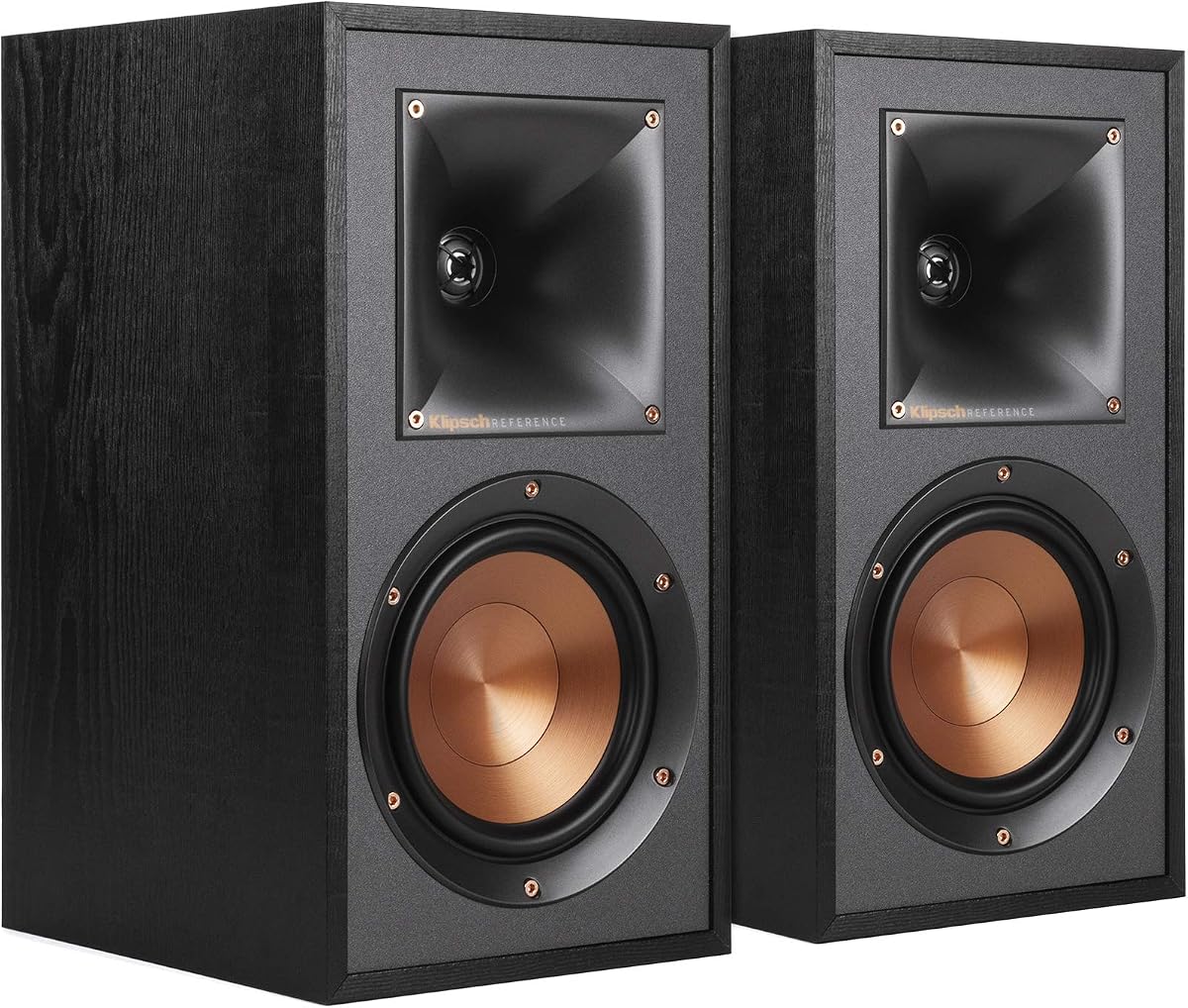
- Tractrix horn tweeters deliver clear, efficient highs across a wide seat
- Dual 5.25" spun-copper IMG woofers for punchy music and movie midbass
- Compact passive cabinets that wake up everyday AV receivers
Expert Review & Guide
Bookshelf speakers still deliver the best balance of sound quality, room fit, and upgrade potential for most homes. Unlike soundbars that hide every compromise in one slim enclosure, a real stereo pair can image instruments in space, scale with a better amplifier or subwoofer, and sit on stands, consoles, or sturdy shelves without dominating a room. In 2026 the category splits cleanly into powered Bluetooth bookshelves that plug into TVs and desks, and passive pairs that shine once you add an AV receiver or stereo amp.
This ReviewConsensus roundup sticks to the products in our bookshelf speaker pack: Edifier’s R1280 family and MR3 monitors, Klipsch’s horn-loaded R-51M, Sony’s three-way Hi-Res SS-CS5M2, Polk’s T15, Monitor XT20, and Signature Elite ES20, plus a USB-friendly active pair for desktop users. We weigh connectivity, driver size, whether amplification is built in, and how each option behaves for music, movies, and near-field computer work—not just brochure adjectives.
Short on time? Choose the Klipsch R-51M if you already own an amplifier and want lively, room-filling bookshelves; pick the Edifier R1280DBs for the most complete powered Bluetooth package with optical inputs and a subwoofer out; and shortlist the Polk Signature Elite ES20 when home theater bass and Atmos-ready expansion matter most. The full reviews below unpack tradeoffs, setup advice, and FAQs so you can match a pair to your room and sources.

As an Amazon Associate we earn from qualifying purchases. We may earn a commission at no additional cost to you.
Scan powered versus passive designs first, then check driver size and inputs. Ratings come from listed customer scores at research time. Specs avoid pricing and focus on the details that change day-to-day listening.
Klipsch R-51M Bookshelf Speakers
The Klipsch R-51M earns Best Overall in this bookshelf speaker roundup because it does the classic passive job unusually well: it wakes up modest receivers, throws a lively stereo image, and keeps dialogue and lead vocals intelligibly forward without turning harsh in a typical furnished room. The signature 90x90 Tractrix horn is not a gimmick here. It helps the one-inch aluminum LTS tweeter cover a wider listening area, which matters when two people sit on a sofa rather than in a single sweet-spot chair.
Driver design is straightforward and purposeful. Dual five-and-a-quarter-inch spun-copper IMG woofers handle midrange and bass duties inside a bass-reflex cabinet with a rear-firing port. In practice that means drums and soundtrack impacts land with more snap than many four-inch powered pairs can muster, while the horn keeps cymbals and effects from disappearing into the couch cushions. Dimensions around thirteen inches tall keep the cabinets shelf-friendly, yet the acoustic presentation often feels like a larger speaker once the pair is toed in slightly toward the listening seat.
Because these are passive speakers, setup quality depends on your amplifier. A modern AV receiver with clean power will reveal more scale and control than an underpowered mini-amp pushed into clipping. Keep speaker wire runs sensible, match polarity carefully, and give the rear ports a few inches of clearance so the reflex loading does not boom. If your room forces the cabinets hard against a wall, expect more midbass bloom and plan a small EQ cut or toe-in adjustment rather than blaming the speakers alone.
Musically, the R-51M favors energy and presence. Indie rock, classic albums, and cinematic scores benefit from the horn’s projection and the woofers’ quick attack. Jazz and acoustic recordings still fare well, though listeners who prefer a softer, darker treble may want slightly more absorption behind the speakers or a gentler amp tone control. Movie night is where many owners fall for the pair: footsteps, Foley, and center-panned dialogue stay localized even before you expand into a full surround array.
Compared with powered Edifier models in this guide, the Klipsch route asks for more system thinking and rewards you with higher efficiency and a more theatrical presentation. Compared with Polk’s larger six-and-a-half-inch Signature Elite and Monitor XT bookshelves, the R-51M is a bit more compact and more immediately lively up top. That tradeoff is intentional. If you already own an amp or receiver and want bookshelf speakers that sound exciting without needing a huge tower footprint, this pair is the clearest recommendation for 2026.
Build and finish are cleanly executed for the category, with a black aesthetic that disappears into entertainment centers as easily as it sits on dedicated stands. The high listed rating aligns with how forgiving the speakers are when placement is only good, not perfect. You still owe them honest setup—level matching, seating distance, and basic acoustic awareness—but you do not need a measurement microphone to enjoy them on day one.
Choose this pair if you already have an AV receiver or stereo amplifier and want bookshelf speakers that sound bigger and more engaging than their size suggests. They suit apartment living rooms, dedicated media rooms, and starter home theaters that may later grow into a 5.1 system with matching surrounds.
Skip them if you need a self-powered solution for a desk or turntable with no amp in the chain. In that case, jump to the Edifier R1280DBs or MR3 instead of forcing a passive pair into the wrong role.
Start with the speakers at ear height, slightly toed in, with equal distance to the listening position. Keep rear ports clear, then experiment with a few inches of movement if bass feels thick. Many listeners settle on a modest toe-in that sharpens the center image without spotlighting the horns.
Give the drivers a few evenings of varied playback before judging treble balance. Horn speakers can sound a touch brighter in an empty room; rugs, curtains, and a filled bookcase usually tame that edge naturally.
Against the Polk Signature Elite ES20, the Klipsch is more compact and more assertive in the upper mids, while the Polk digs deeper and feels more cinematic when paired with a subwoofer. Against the Sony SS-CS5M2, the R-51M is less about ultra-wide Hi-Res extension and more about efficient, horn-driven excitement with everyday amps.
We may earn a commission at no additional cost to you.
Edifier R1280DBs Active Bluetooth Bookshelf Speakers
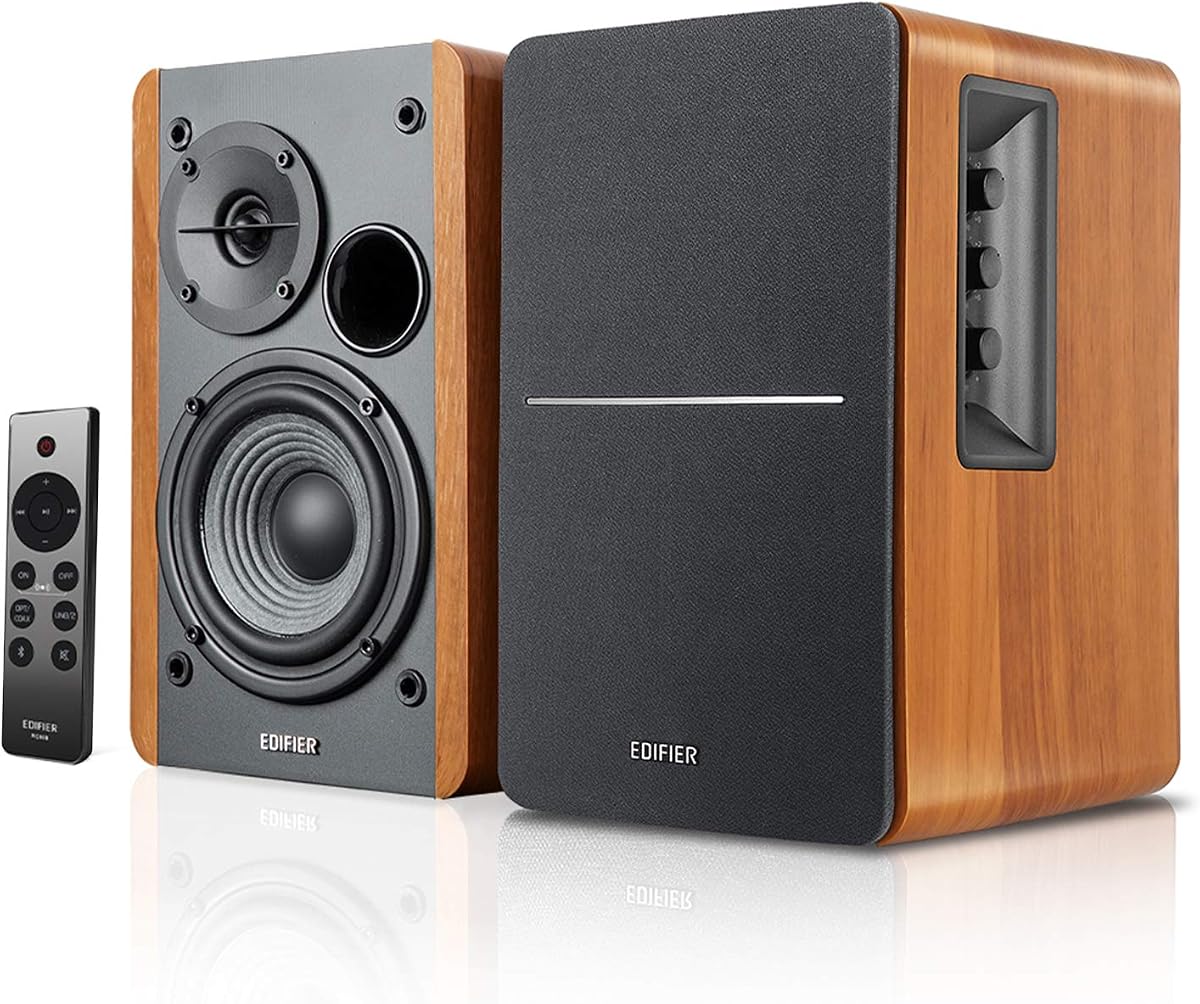
The Edifier R1280DBs is the powered Bluetooth pick for people who want bookshelf presence without assembling a separate amp, DAC, and remote ecosystem. At forty-two watts RMS continuous power, the active architecture puts amplification inside the speakers so a TV optical out, a laptop line out, or a phone over Bluetooth can feed the system directly. That flexibility is why this model sits near the top of our ranking even though several passive Polk and Klipsch pairs score slightly higher on raw customer ratings.
Connectivity is the real differentiator versus the older R1280T. You get Bluetooth 5.0 for casual wireless listening, optical and coaxial inputs for cleaner digital links from televisions and desktops, traditional line-in for analog sources, and a subwoofer output that detects an attached sub and applies a built-in crossover mindset. If you eventually want movie thunder without abandoning the bookshelf aesthetic, that sub out is a smarter upgrade path than replacing the entire pair.
Tonally, the R1280DBs follows the familiar Edifier R1280 family recipe: a thirteen-millimeter silk-dome tweeter for smooth highs and a four-inch woofer that prioritizes midrange clarity over subterranean rumble. Side knobs let you tilt bass and treble for room taste, while the remote handles volume, mute, and input switching from the couch. Soundfield Spatializer widens the image for background listening; leave it off when you want a more natural stereo focus for albums or dialogue-heavy shows.
On a desk, these speakers behave like grown-up computer monitors with furniture-friendly cabinets. On a living-room console under a television, optical input removes a common source of TV Bluetooth lip-sync frustration. Vinyl fans can still use them with a phono preamp into line-in. The wood-grain vinyl finish on MDF cabinets remains one of the reasons this series became a default recommendation for apartment stereo upgrades.
Honest limitations matter. If your primary goal is reference mixing, the MR3’s Hi-Res certification and balanced TRS inputs are more studio-appropriate. If you already own a strong AV receiver and want maximum cinematic scale from larger woofers, the Polk ES20 or XT20 passive pairs will outmuscle the R1280DBs once amplified. What the DBs version nails is the complete powered lifestyle package: wireless convenience, digital TV friendliness, expandable bass, and controls that do not require an app for basic daily use.
For 2026 buyers comparing the crowded Edifier R1280 alphabet soup, prioritize the DBs when subwoofer expansion and Bluetooth both matter. Choose the DB if you need optical and Bluetooth without the sub out emphasis, and keep the T version when you only need dual analog AUX simplicity at a desk. That naming overlap is confusing on product pages; the feature split above is the practical way to decide.
Best in small-to-medium rooms where speakers sit on a media console, bookshelf, or sturdy desk. Phones, tablets, smart TVs with optical out, and PCs are natural partners. Add a powered sub later if you watch action films or electronic music at higher volumes.
Use optical from a TV when possible to avoid compressed wireless handshakes. Place the active speaker according to Edifier’s cable orientation, keep the pair roughly equidistant, and start with bass/treble knobs near center before boosting. If Bluetooth dropouts appear, reduce crowded 2.4 GHz interference or move the phone closer during pairing tests.
Pick the R1280T if you never need Bluetooth or digital inputs. Pick the MR3 if you want monitor voicing, app EQ, and balanced TRS for production. Pick Klipsch or Polk passives if an amplifier is already in the rack and you want larger-driver dynamics.
We may earn a commission at no additional cost to you.
Polk Signature Elite ES20 Bookshelf Speakers
Polk’s Signature Elite ES20 is the home-theater bookshelf choice when you want scale, bass authority, and a clear upgrade ladder into a full surround system. The Dynamically Balanced array pairs a one-inch Terylene dome tweeter with a six-and-a-half-inch woofer, and Polk’s Power Port claims roughly three decibels louder bass than a conventional port by reducing turbulence. In a real room, that translates to soundtrack weight and music low-end that smaller desktop monitors simply cannot fake with EQ boosts.
Compatibility is thoughtfully modern. The ES20 is Hi-Res Audio certified and designed to work with Dolby Atmos and DTS:X capable receivers, whether you use the pair as stereo fronts today or as surrounds and elevation speakers later. Four- and eight-ohm friendly sensitivity means many mainstream AVRs can drive them without drama. Keyhole slots and screw inserts support wall placement when stands are not an option, which helps apartment theaters reclaim floor space.
Compared with the Klipsch R-51M, the Polk sounds a bit more grounded and less horn-forward, with deeper midbass and a more cinematic bloom when the volume rises. Compared with Polk’s own Monitor XT20, the Signature Elite finish and Power Port tuning aim a notch higher in presence and bass ease, though both share the brand’s approachable, wide soundstage philosophy. Build a matching Signature Elite stack if seamless timbre across channels matters more than mixing brands.
Music listeners should not assume these are theater-only tools. Acoustic and pop mixes benefit from the open midrange and the woofer’s ability to carry male vocals and kick drums without immediate subwoofer support. Dense electronic tracks and action films still improve with a dedicated sub, especially if you sit far from the speakers in a larger room. That is normal for bookshelves this size; the ES20 simply needs less help than many competitors before the system feels complete.
Aesthetic choices matter in shared rooms. The contemporary walnut pair reads as furniture rather than gaming peripheral, which makes acceptance from non-audiophile housemates more likely. Place them on isolation pads or stands if your shelf resonates, and avoid burying the Power Port against fabric or wall clutter. Once positioned, dialogue clarity and spatial cues are strong enough that many users delay center-channel purchases longer than expected—though a matched center remains the right move for serious surround.
If your shopping question is “best bookshelf speakers for movies and a future 5.1 build,” the ES20 is the most complete answer in this pack. If your shopping question is “best plug-and-play speakers for a laptop,” look elsewhere in the powered section. Matching the speaker architecture to the system you actually own remains the fastest way to avoid returns.
Use the ES20 as stereo fronts with a sub for music and TV, or expand into Signature Elite towers, the ES35 center, and surrounds when budget allows. Timbre matching across the series keeps pans and Atmos objects from changing character as they move around the room.
These shine in medium rooms with an AVR that has honest headroom. Start with moderate crossover settings if a sub is present, and leave enough front clearance for the Power Port to breathe. Wall mounting works, but stands often yield tighter imaging.
We may earn a commission at no additional cost to you.
Sony SS-CS5M2 Hi-Res Bookshelf Speakers
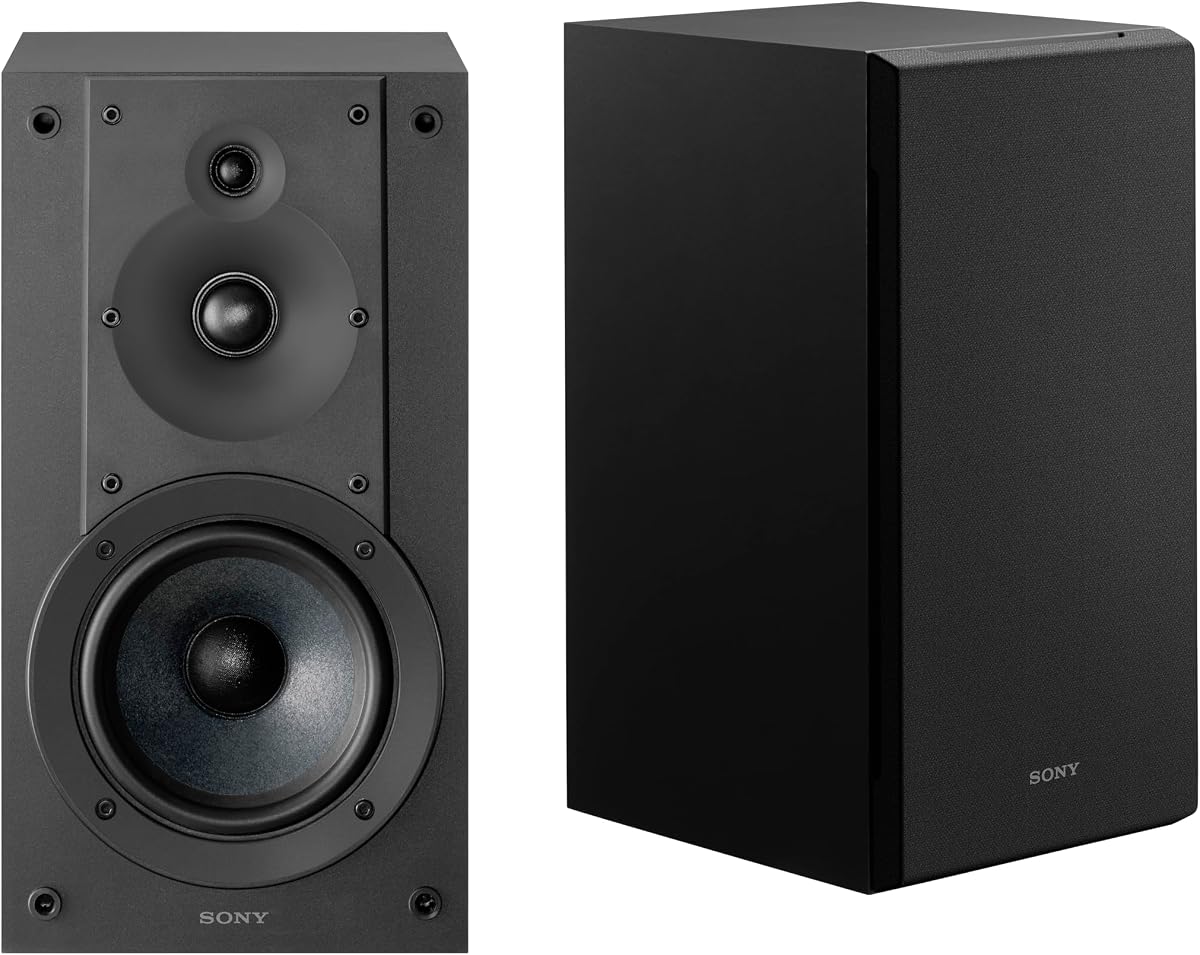
Sony’s SS-CS5M2 stands out in this roundup as the three-way Hi-Res specialist. Instead of asking a single tweeter and woofer to cover everything, Sony adds a wide-dispersion super tweeter above a high-precision tweeter and a five-point-twelve-inch woofer. The intent is an expansive soundstage with treble air that conventional two-way budget bookshelves often smear or roll off early. Hi-Res Audio branding and a claimed response stretching toward fifty kilohertz signal that these speakers are aimed at listeners who keep higher-resolution catalogs, not only Bluetooth playlists.
Compact dimensions make the CS-series practical where tower speakers are socially or spatially impossible. The bass-reflex enclosure and reinforced cellular cone focus on distortion-resistant low frequencies rather than chest-rattling output. In a near-to-midfield living room, that yields articulate bass lines and soundtrack detail; in a large open-plan space, you will still want a subwoofer for explosions and pipe-organ territory. That is an expected bookshelves-plus-sub conversation, not a failure of the design.
System matching is friendly. Sony positions the CS speakers as natural companions to Sony AV receivers, but they are still conventional passive loudspeakers that work with other brands when impedance and power are respected. Binding posts and standard speaker wire keep installation familiar. Give them rigid stands or a dense shelf, keep them away from buzzing glass cabinets, and toe them in until the super-tweeter air locks into a stable center image.
Against the Klipsch R-51M, the Sony is less about horn projection and more about layered treble refinement and a slightly more polite presentation. Against the Polk ES20, the Sony’s woofer is smaller, so Polk usually wins pure midbass slam, while Sony can feel more open and sparkling on well-recorded acoustic and orchestral material. Pick based on whether your library and ears favor excitement or airy detail.
These are excellent front speakers for a compact Hi-Res stereo or as part of a Sony-centric surround plan. They are the wrong buy for a USB-only laptop desk with no amplifier. Read the product type carefully: bookshelf does not automatically mean powered. The SS-CS5M2 assumes you bring amplification, and it rewards that assumption with a more ambitious driver array than most pairs at this size class.
Finish and component messaging emphasize premium tuning rather than RGB or gaming aesthetics, which helps the speakers disappear into adult living spaces. If your household already streams from services that offer higher-resolution tiers, the three-way layout has somewhere meaningful to go. If every source is heavily compressed mobile audio, you may not hear enough of the super tweeter’s contribution to justify choosing Sony over a simpler two-way Polk or Klipsch.
Stereo music in apartments, compact home theaters with a Sony or other AVR, and listeners who specifically want Hi-Res-capable bookshelves without floorstanding cabinets.
Keep the cabinets aimed near ear height. Extreme vertical placement can waste the wide-dispersion benefit. A slight toe-in usually improves focus; excessive toe-in can narrow the stage. Experiment in small moves while playing a familiar vocal track.
A clean AV receiver with a sub out is the happy path. Use the Sony pair for mains, add a sub for LFE, and consider matching surrounds later if movies become the priority.
We may earn a commission at no additional cost to you.

Edifier MR3 Powered Studio Monitor Speakers
The Edifier MR3 is the studio-style answer in a bookshelf roundup that otherwise mixes lifestyle Bluetooth pairs and passive home-theater speakers. Hi-Res Audio certification and a claimed flat-leaning response from fifty-two hertz to forty kilohertz position the MR3 for creators who need honest midrange while still wanting Bluetooth for phone breaks. Peak SPL around ninety-two point five decibels and eighteen watts per channel RMS are appropriate for arms-length desk listening, not warehouse volumes.
Connectivity is unusually complete for the size. Balanced TRS inputs welcome audio interfaces, while RCA and AUX cover consumer gear, and a headphone output supports quick private checks. Bluetooth 5.4 with multipoint reduces the ritual of reconnecting phone and laptop. That combination lets one pair serve a production session in the afternoon and a casual playlist in the evening without constant cable surgery.
Music, Monitor, and Custom modes matter more than marketing bullets suggest. Monitor mode aims you toward drier translation for editing decisions. Music mode relaxes the presentation for enjoyment. Custom mode, deepened through the EDIFIER ConneX app, is where room quirks and personal taste get finer control than side knobs alone. If you never install the app, the speakers still function; if you do, they become more adaptable than the classic R1280T.
Versus the R1280DBs, the MR3 is the better desk instrument and the weaker living-room furniture piece. Versus PreSonus-style monitors outside this pack, Edifier’s advantage is the modern Bluetooth and app ecosystem. Versus passive Polks and Klipsch, the MR3 wins convenience and loses ultimate dynamic headroom. Choose it when accuracy and desk inputs dominate the purchase reason.
Cabinet construction uses MDF to reduce ringing, which helps on hollow desks. Keep the speakers on pads if your tabletop amplifies bass, and form an equilateral triangle with your head for the most trustworthy stereo. Guitar practice, video editing, podcast review, and general computing all fit the use case list Edifier calls out—and that breadth matches how most hybrid work desks actually get used.
Bass expectations should stay adult. A three-and-a-half-inch driver can outline kick drums and bass guitars in near field, but it will not replace a subwoofer for EDM club impact. If that limitation is unacceptable and you refuse a sub, step up to larger passive bookshelves with an amp, or powered speakers with bigger woofers. If you accept near-field physics, the MR3 is one of the most capable small monitors in this specific product pack.
Producers, editors, students in dorm desks, and hybrid workers who need TRS or RCA flexibility plus Bluetooth. Less ideal as the only speakers in a large open living room.
Use Monitor for mix checks and dialogue editing. Switch to Music when the workday ends. Custom EQ is worth five minutes of setup if your desk sits against a wall that exaggerates bass.
We may earn a commission at no additional cost to you.

Edifier R1280DB Powered Bluetooth Bookshelf Speakers
The Edifier R1280DB is the classic digital-input evolution of the R1280 idea: keep the warm wooden bookshelf look and silk-dome politeness, then add Bluetooth plus optical and coaxial connections so televisions and computers can feed the speakers cleanly. If the original R1280T feels too analog-only for a modern media stand, the DB version is the straightforward fix without jumping into a full passive speaker and receiver project.
Sound character remains family-consistent. The four-inch woofer and thirteen-millimeter silk dome prioritize natural midrange and non-fatiguing treble over aggressive brightness. That makes long Netflix sessions and playlist evenings easy. Bothersome room bass can be trimmed on the side panel, and thin rooms can take a gentle bass bump—within reason—before the small drivers complain.
Wireless use is simple for phones and tablets, while optical is the better everyday TV path when your set offers it. Coaxial covers older digital sources that still show up in mixed gear drawers. The remote’s ability to change inputs matters more than people expect; households that share a TV between streaming apps, a game console optical extractor, and a Bluetooth phone will use that feature constantly.
Where does the DB sit against the DBs? If you know you want a subwoofer later, pay attention and choose the DBs for the sub out and newer convenience features. If you want the proven Bluetooth-plus-digital recipe and do not care about a dedicated sub line, the R1280DB remains a highly sensible powered bookshelf. Against passive Klipsch or Polk speakers, it wins cable simplicity and loses ultimate loudness and bass extension once those passives are properly amplified.
Placement follows the usual active-bookshelf playbook. Keep the cabinets at a reasonable height, avoid stuffing the rear of the active speaker against a wall if ports need air, and run the speaker interconnect between cabinets carefully so it is not pinched by furniture. The wood-effect finish disguises the tech enough that the pair can live in a living room without looking like computer accessories.
For buyers overwhelmed by nearly identical Edifier names, remember this shorthand: T for dual analog AUX simplicity, DB for Bluetooth with optical and coaxial, DBs for that recipe plus sub out and refreshed control details. The R1280DB earns its badge here as the digital-input classic that still makes sense whenever a television is the primary source and a separate amplifier is not on the shopping list.
Optical from the television is the preferred low-friction path. On a desk, Bluetooth or line-in both work; use line-in when latency or wireless congestion becomes annoying during video calls or editing.
Happy with bookshelf volume and midrange? Stay here. Craving deeper movies? Move to R1280DBs plus a sub, or step into passive Polk/Klipsch territory with an AVR.
We may earn a commission at no additional cost to you.

Polk Monitor XT20 Bookshelf Speakers
The Polk Monitor XT20 is the versatile passive workhorse of this list: compact enough for stands or shelves, serious enough for Hi-Res music, and officially comfortable in Dolby Atmos and DTS:X systems. A one-inch Terylene tweeter and six-and-a-half-inch Dynamically Balanced woofer give it the same broad-strokes authority that makes Polk a default living-room brand, while the Monitor XT industrial design updates the old Monitor look for contemporary rooms.
Use cases flex more than the badge might imply. As stereo fronts, the XT20 delivers open mids and punchy bass for daily streaming. As surrounds or rears, the same pair can lock into a timbre-matched Monitor XT theater with towers, center, height modules, and subwoofer options. That flexibility protects your purchase if today’s stereo experiment becomes tomorrow’s full surround weekend project.
Sonic personality is engaging without the horn intensity of Klipsch. Vocals sit forward enough for TV clarity, and the woofer has real weight compared with four-inch powered Edifiers. Compared with the Signature Elite ES20, the XT20 is the more value-driven sibling in spirit—still Hi-Res capable, still Atmos ready, with a slightly more utilitarian positioning in Polk’s lineup. Many rooms will be delighted with either; choose ES20 when Power Port bass and Signature Elite styling are the priority.
Amplifier friendliness is part of the appeal. Four- and eight-ohm compatibility helps the XT20 play nicely with common AVRs and stereo amps. Still, quality in equals quality out: a strained receiver will compress dynamics no matter how good the speakers are. Set sensible volume habits, engage a subwoofer crossover when available, and avoid shoving the cabinets into corners that turn the woofer into a one-note boom box.
For gaming on a console through an AVR, the XT20’s soundstage and punch make footsteps and environmental cues easier to parse than TV speakers ever will. For music, they reward better source material but do not punish casual playlists. That balance is why they earn the versatile badge rather than a narrower niche award.
If you need powered Bluetooth speakers for a bedroom desk, keep scrolling to Edifier. If you are building or refreshing a real home audio chain and want bookshelf speakers that can grow with you, the Monitor XT20 belongs on the shortlist beside the ES20 and Klipsch R-51M.
Buy the XT20 as a stereo pair today, add a Polk sub next, then expand into matching Monitor XT channels when ready. This staged approach spreads cost without orphaning the original speakers.
Pick XT20 for flexible Monitor-series matching and a modern black aesthetic. Pick ES20 when you want Signature Elite presence, Power Port bass emphasis, and walnut-forward styling.
We may earn a commission at no additional cost to you.

Edifier R1280T Powered Bookshelf Speakers
The Edifier R1280T remains the analog classic for a reason: plug in a source, adjust the side knobs, and enjoy a wooden bookshelf pair that sounds more expensive than a typical plastic computer speaker. Forty-two watts RMS, a thirteen-millimeter silk-dome tweeter, and a four-inch driver create a friendly near-field presentation for desks, bedrooms, and small dens. If your world is still RCA and three-point-five-millimeter cables, the T version avoids paying for wireless features you will never pair.
Dual AUX inputs are the sleeper feature. A computer and a phone DAC, or a turntable preamp and a TV headphone out, can stay connected at once so you are not crawling behind furniture every afternoon. The remote covers volume from the seat, while bass and treble knobs on the active speaker handle taste and room correction in the most tactile way possible.
Studio-monitor language in the marketing should be read as “near-field capable,” not “flat reference calibrator.” The R1280T is more lifestyle monitor than laboratory tool. It is smoother and more forgiving than many bright budget actives, which is exactly why it became a default recommendation for people upgrading from tiny USB globes. For stricter creative work, the MR3 is the better Edifier in this pack.
Against the R1280DB and DBs, the T is the cable-first minimalist. That can be a feature: fewer radios inside the chassis, fewer pairing menus, and a slightly simpler ownership story for users who distrust wireless audio. Against passive Polk and Klipsch speakers, the T wins the no-amp convenience contest and loses when the room grows and dynamics need more driver area and external power.
Set them up with the active speaker placed for cable reach, form a triangle with your listening position, and start with tone controls centered. If the desk is against a wall, reduce bass a notch before assuming the speakers are muddy. Isolation pads help when the wood finish looks perfect but the hollow desk sings along with every kick drum.
In 2026 the R1280T is no longer the most connected Edifier, and that is fine. It is the cleanest expression of the series’ original appeal: approachable powered bookshelves with honest musicality and furniture-like presence. Keep it on your list when Bluetooth is irrelevant and simplicity is the selling point.
Writers, students, and office setups with a PC line out or USB-C DAC to AUX will feel at home. Add a simple RCA switch only if you outgrow the dual inputs.
Move to DB/DBs for TV optical and Bluetooth. Move to MR3 for balanced inputs and app EQ. Stay on T when analog simplicity is the entire brief.
We may earn a commission at no additional cost to you.
Polk Audio T15 Bookshelf Speakers
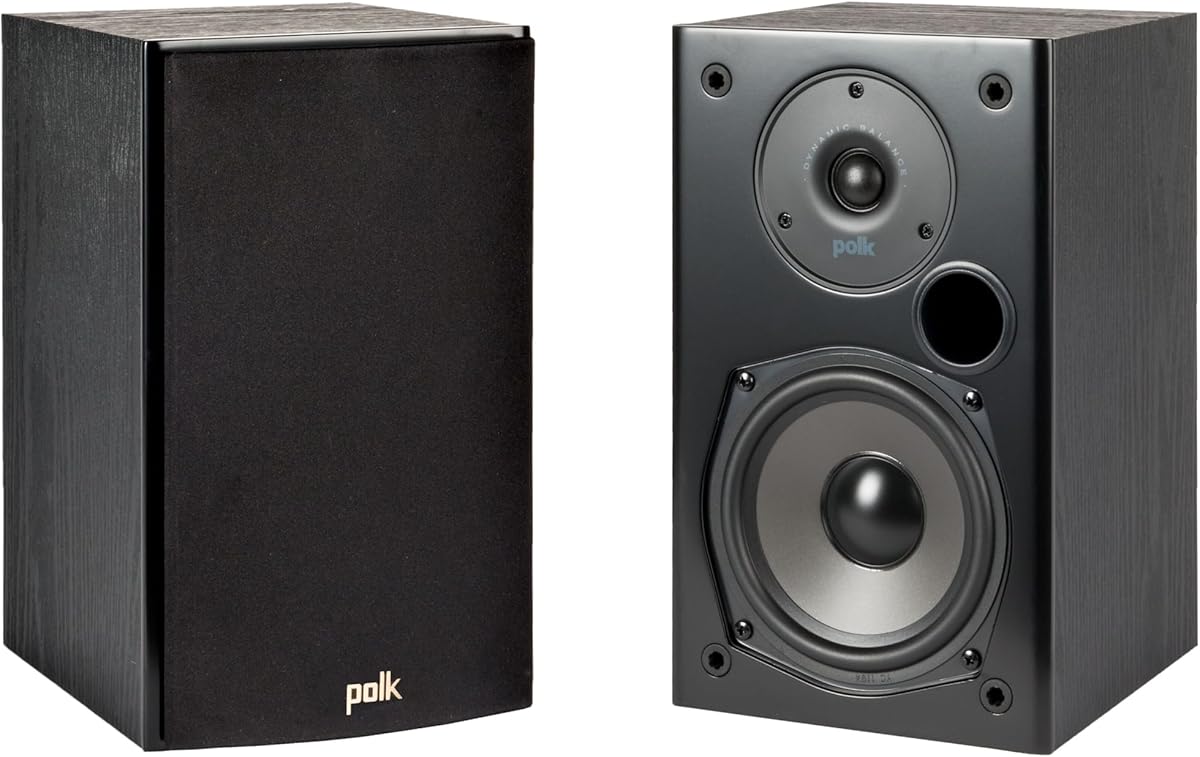
Polk Audio’s T15 is the budget passive starter that reminds people why TV speakers feel incomplete. A three-quarter-inch tweeter and five-and-a-quarter-inch Dynamic Balance driver aim for clear dialogue and surprisingly satisfying bass at living-room volumes, especially once an AV receiver applies basic management and a possible subwoofer crossover. As a first pair of “real” speakers, the T15 teaches placement, polarity, and the joy of a stable stereo image without demanding enthusiast money.
Home-theater framing is honest. Polk positions the T15 as fronts, left-right, or surrounds, with an expansion story toward T50 towers, a T30 center, and a subwoofer. That roadmap matters because many shoppers buy bookshelves first, then decide movies are the household priority. Starting inside a timbre-related family reduces the chance you replace everything eighteen months later.
Do not expect Signature Elite polish or Klipsch horn drama. Expect competent, friendly sound that beats built-in television audio by a wide margin and makes weeknight streaming feel like a system. Wall-mount capability is genuinely useful in dorms and small apartments where stands are trip hazards and shelves are already full of books.
Versus the Monitor XT20 and ES20, the T15 is the on-ramp. Those higher Polk models add Hi-Res credentials, larger or more advanced driver systems, and stronger long-term ceiling. Versus powered Edifiers, the T15 only makes sense if an amplifier already exists or is part of the plan. Buying passive speakers with no amp is how returns happen.
Wire them carefully, keep lengths reasonable, and mount them securely if you leave the shelf. Dial in a listening triangle even for casual couch use. If dialogue still seems thin, check TV audio settings and receiver processing before blaming the tweeters—source configuration mistakes are common when households jump from soundbars to component audio.
As a 2026 pick, the T15 earns its badge by being the least intimidating passive entry in the pack, not by winning a resolution contest. If your goal is simply to start a Polk theater journey and learn the hobby, it is a smart first step. If your goal is maximum fidelity per cabinet, spend attention on the ES20, XT20, Sony, or Klipsch instead.
Pair the T15 with an entry AV receiver and, when possible, a subwoofer. Use the bookshelves as fronts first. Add a center channel when dialogue-heavy shows become the household complaint.
Skip if you need powered desktop speakers, or if you already know you want Hi-Res certified bookshelves and can stretch to the XT20 or ES20.
We may earn a commission at no additional cost to you.

MEVOSTO DS19 Active Bookshelf Speakers
Sold in this pack as active bookshelf speakers with thirty-six watts RMS, Bluetooth 5.4, and five-inch woofers, the MEVOSTO-style DS19 pair targets desktop users who want more cabinet and bass than mini USB globes provide. Dual one-inch silk-dome tweeters and five-inch bass drivers aim at fuller music and gaming impact, while USB digital audio offers a cleaner PC connection than a basic analog headphone jack when your computer supports it.
Connectivity coverage is broad: Bluetooth for phones, AUX and RCA for TVs, turntables with preamps, and legacy gear, plus USB for digital desktop duty. The listing is careful to warn that USB must be an audio-capable port, and that Dolby Audio from some televisions is not supported. Those warnings are worth reading before you assume any cable in the box will unlock every device in the house.
Customization is unusually granular for the category, with bass and treble adjustable across ten levels and a remote for distance control. That helps games and movies feel punchier without forcing a separate EQ app. Voice prompts and a front indicator make source changes obvious, which is helpful when households share the desk or dorm shelf.
Compared with Edifier’s R1280 family, these speakers trade brand maturity and long marketplace track record for bigger advertised woofers and USB-centric desktop features. Compared with passive Polk and Klipsch pairs, they restore the no-amp convenience that desktop shoppers need. Keep expectations aligned: this is a powered lifestyle bookshelf solution, not a Hi-Res studio monitor like the MR3 or a Tractrix theater speaker like the R-51M.
Placement on a desk should leave space around the cabinets and keep the remote IR path reasonably clear if you rely on it. For turntable use, confirm you have a phono preamp before connecting to AUX or RCA. For TV use, prefer PCM stereo output rather than Dolby bitstream formats the speakers cannot decode. Those small setup choices determine whether the pair feels plug-and-play or frustrating.
Specialty power notes mention twelve, fifteen, or eighteen volt DC operation for RV, camper, and yacht contexts, with guidance about current requirements at twelve volts. Most apartment users will simply use the standard supply and ignore that flexibility, but travelers and mobile offices may care. As always, match the supply to the stated requirements instead of improvising underpowered adapters.
Choose these when USB desktop convenience, Bluetooth 5.4, and five-inch powered woofers are the headline needs. Choose Edifier when you want a more established R1280 ecosystem, and choose Polk or Klipsch when a receiver-based living room is the real destination.
Confirm your PC USB port supports audio class devices if USB is your main plan. Confirm your TV can output stereo PCM over AUX or RCA if the television is the main source. Confirm Bluetooth latency is acceptable for your video habits.
Start with mid bass and treble settings, then raise bass for games until kick and explosions feel solid without muddying voices. For acoustic music, flatten the controls and let the silk domes carry detail.
Home-theater builders with AVRs should prefer Polk or Klipsch passives. Critical mix engineers should prefer the Edifier MR3. Shoppers who want optical TV input with sub out should prefer the R1280DBs.
We may earn a commission at no additional cost to you.
Powered (active) speakers include amplification. You connect a source and play. They are ideal for desks, bedrooms, and TV consoles when you do not want a separate receiver. Edifier’s R1280 models and MR3, plus the USB-friendly active pair in this guide, live in that camp.
Passive speakers need an external amplifier or AV receiver. That extra box is a feature if you want higher dynamic ceiling, surround processing, and a longer upgrade path. Klipsch R-51M, Sony SS-CS5M2, and the Polk models are passive. Buy them only when amplification is part of the plan.
Four-inch powered woofers excel at midrange clarity and near-field music. Five- to six-and-a-half-inch woofers move more air and sound more convincing for movies without immediate EQ boosts. Rear ports need clearance; corner placement exaggerates bass and can muddy vocals.
A subwoofer remains the honest solution for deep LFE and electronic music pressure. Neither compact bookshelves nor optimism replace physics. Prefer models with a sub out—such as the R1280DBs—or an AVR with a dedicated subwoofer pre-out when movies matter.
Televisions are happier with optical or a clean analog line when Bluetooth latency frustrates you. Computers may prefer USB digital audio, balanced TRS from an interface, or a simple AUX DAC. Phones love Bluetooth until you sit down for critical listening and switch to a cable.
List every weekly source before shopping. Dual AUX on the R1280T, digital inputs on the DB/DBs, TRS on the MR3, and speaker-wire terminals on passives each solve different friction. The best speakers on paper sound wrong when the cable you need is missing.
Bookshelf speakers want a stable surface, roughly ear-height tweeters, and a listening triangle. Soft furnishings help tame bright horns and lively domes; bare rooms exaggerate treble. Stands often beat overcrowded shelves packed against walls.
Small rooms can be overwhelmed by aggressive bass boosts. Large rooms expose the limits of compact powered pairs. Match speaker ambition to the sofa distance you actually use, not the square footage you wish you had.
If surround sound is likely, prefer a brand family with matching centers and surrounds—Polk Signature Elite and Monitor XT are clear examples in this pack. Mixing random leftovers can work, but pans become more noticeable when timbre shifts channel to channel.
Atmos and DTS:X badges matter only when your receiver and speaker placement can use them. Stereo listeners should not overpay for surround marketing they will never enable, but they also should not fear those badges if the stereo performance is already right.
Customer ratings help spot broadly liked products, yet they compress many use cases into one number. A 4.8 passive speaker can be the wrong buy for a USB desk, and a 4.6 powered pair can be perfect. Read badges and connectivity first, ratings second.
Our ranking blends listed ratings with fit-for-purpose judgment across music, movies, and desktop work. That is why a complete powered system can outrank a higher-rated passive speaker for shoppers who lack an amplifier.
For most shoppers who already have an amplifier or AV receiver, the Klipsch R-51M is our best overall pick thanks to efficient Tractrix horn treble, punchy five-and-a-quarter-inch woofers, and a compact footprint that still sounds lively in real rooms. If you do not own an amp and want a complete powered system, start with the Edifier R1280DBs instead. Home-theater builders who want deeper bookshelf bass and Atmos-ready expansion should prioritize the Polk Signature Elite ES20.
Buy powered speakers when you want fewer boxes and you primarily connect a TV, computer, or phone. Models like the Edifier R1280 series and MR3 include amplification and often extras such as Bluetooth or digital inputs. Buy passive speakers when you want maximum system flexibility, surround processing, and a longer upgrade path through a receiver. Klipsch, Sony, and Polk pairs in this guide are passive and expect speaker wire plus external power.
Not always for music at moderate volumes in small rooms, especially with six-and-a-half-inch passive woofers like those on the Polk ES20 and XT20. For action movies, electronic music, or larger spaces, a subwoofer adds the low frequencies compact cabinets cannot reproduce cleanly. The Edifier R1280DBs makes that upgrade easier with a dedicated subwoofer line out, while AVRs pairing with passive speakers usually offer a sub pre-out and crossover controls.
Yes. Powered speakers with optical input, such as the Edifier R1280DB and R1280DBs, are the simplest TV companions. Passive bookshelf speakers connect through an AV receiver, which then accepts HDMI or optical from the television and handles volume and surround modes. Avoid relying on poorly implemented TV Bluetooth when dialogue sync matters; a wired digital or analog path is usually more consistent.
They can be excellent in near field if the cabinets fit and you are not blasting a giant room. The Edifier MR3 is the most studio-desk-oriented option here with balanced TRS inputs and monitor modes. The R1280T remains a favorite wired desktop classic with dual AUX inputs. USB-capable active bookshelves help when you want a digital PC connection. Large passive theater bookshelves are usually overkill on a shallow desk unless you also have room for an amp.
The R1280T is the analog classic with dual AUX inputs and no Bluetooth. The R1280DB adds Bluetooth plus optical and coaxial digital inputs for TVs and computers. The R1280DBs keeps the wireless and digital convenience while adding a subwoofer output with automatic detection and updated remote control details. All three share the broader R1280 sound philosophy of silk-dome treble and approachable midrange, so the decision is mostly about connectivity and expansion.
A reliable starting point is an equilateral triangle: the distance between the speakers roughly matches the distance from each speaker to your ears. Toe them in until vocals lock to the center without sounding narrow. Keep rear ports a few inches from walls when possible. If the image collapses or bass booms, move in small increments rather than making dramatic leaps. Ear-height tweeters matter as much as left-right spacing.
Some models are designed for it. Polk’s T15 and Signature Elite ES20 include mounting provisions that help small rooms. Wall placement can strengthen bass because of boundary reinforcement, which may help or hurt depending on the recording and your taste. Use proper anchors, mind port clearance, and accept that imaging may change versus stands. When in doubt, stands or a solid console remain the most predictable acoustic choice.
Hi-Res certification indicates the speaker design targets wider bandwidth and higher-fidelity playback, but compressed mobile streams will not magically become studio masters. You may still hear benefits in clarity, staging, and dynamics compared with TV speakers, yet the biggest gains appear with better source material, cleaner amplification, and thoughtful placement. Sony’s SS-CS5M2 and Polk’s Hi-Res models make more sense if you also use higher-quality streaming tiers or local high-resolution files.
Bookshelf speakers can play plenty loud for apartments and many living rooms, especially efficient designs like the Klipsch R-51M or larger-woofer Polks on a capable amp. Towers usually move more air and maintain ease at higher levels in big open spaces. If you constantly listen at reference movie volumes in a large room, towers plus a subwoofer may satisfy longer. For everyone else, well-chosen bookshelves remain the practical sweet spot.
The best bookshelf speakers in 2026 are the ones that match your amplification reality and your weekly sources. Klipsch R-51M pairs reward amp owners with lively horn-driven clarity; Edifier R1280DBs covers the powered Bluetooth and TV-optical lifestyle with a subwoofer escape hatch; Polk Signature Elite ES20 brings home-theater bass and an Atmos-ready expansion story. Sony’s three-way SS-CS5M2, Edifier’s MR3 monitors, and the broader Polk and Edifier options fill the gaps between those headlines.
Ignore price theater and focus on fit: powered versus passive, inputs, driver size, and room distance. Place carefully, start with neutral tone settings, and add a subwoofer when movies demand it. Do that, and a compact bookshelf pair can outperform soundbars and built-in TV speakers for years without taking over the room.
Use the comparison table to shortlist, then read the two or three reviews that match your setup. Whether you are wiring a first AV receiver or simply replacing lifeless desktop speakers, the right pair in this guide should sound intentional on day one and still make sense when your system grows.