Best AM5 Motherboards in 2026
We may earn a commission from links on this page, at no extra cost to you. Learn more.
AMD's Socket AM5 is the long-life home of Ryzen 7000, 8000 and 9000 series processors, with a DDR5-only design and a roadmap AMD has committed to supporting for years. Choosing the right AM5 board means picking the chipset that fits your ambitions, from value B650 and B850 boards to feature-rich X870 and X870E flagships, then matching VRM strength, DDR5 speed, PCIe 5.0 provision and networking to your build. This guide ranks nine of the best AM5 motherboards in 2026 from GIGABYTE, MSI and ASUS ROG, spanning affordable Eagle-class boards up to 18-phase overclocking monsters, so there is a right pick whether you run a Ryzen 5 or a Ryzen 9.
Top 9 Best AM5 Motherboards
Our top 9 picks, reviewed
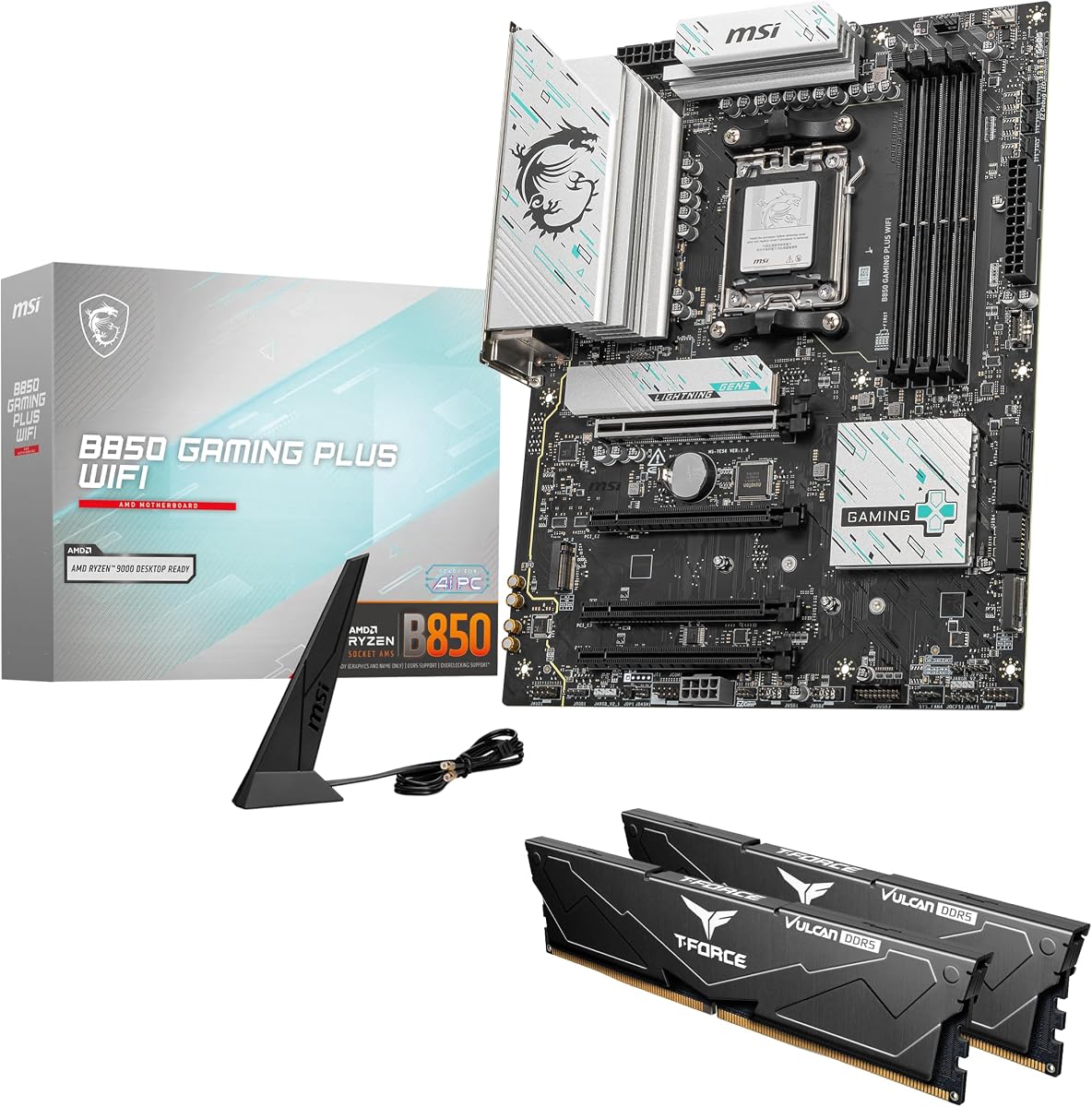
MSI B850 GAMING PLUS WiFi (RAM Bundle)
The MSI B850 GAMING PLUS WiFi tops the list as a build-ready bundle, arriving with a matched TEAMGROUP 32GB DDR5 kit so your system is ready to assemble with tested components. Beyond the RAM, the board itself is strong: PCIe 5.0, M.2 Gen5, Wi-Fi 7 and 5G LAN back Ryzen 9000 support. A perfect 5.0 rating and one-click EXPO tuning to 6000MHz make it the easiest premium AM5 starting point.
- Socket
- AM5 / B850
- Memory
- DDR5 8200+ OC, 32GB kit
- Power
- Core Boost VRM
- Connectivity
- PCIe 5.0, M.2 Gen5, Wi-Fi 7, 5G LAN
What we liked
- Ships with a matched 32GB DDR5 kit
- PCIe 5.0 x16 and M.2 Gen5 storage
- Wi-Fi 7 and 5G LAN networking
- One-click EXPO/XMP to 6000MHz
Worth noting
- Bundle pricing runs high
- Overkill for a light Ryzen 5 build
ASUS ROG Strix X870-A Gaming WiFi
The ASUS ROG Strix X870-A Gaming WiFi is the overclocker's choice, wielding a 16+2+2 power solution rated for 90A per stage that feeds even a Ryzen 9 without strain. Four M.2 slots, PCIe 5.0, Wi-Fi 7 and USB4 cover every modern need, and ROG extras like Dynamic OC Switcher, Core Flex and AI Overclocking simplify pushing clocks. It is a top-tier X870 board with the power to match its ambitions.
- Socket
- AM5 / X870
- Memory
- DDR5 AEMP
- Power
- 16+2+2, 90A stages
- Connectivity
- PCIe 5.0, 4x M.2, Wi-Fi 7, USB4
What we liked
- Huge 16+2+2 VRM rated for 90A stages
- Four M.2 slots and PCIe 5.0
- Wi-Fi 7, USB4 and Q-Release Slim
- Dynamic OC Switcher and AI overclocking
Worth noting
- Premium ROG pricing
- More board than a mid-range CPU needs
GIGABYTE B850 AORUS Elite WiFi 7
The GIGABYTE B850 AORUS Elite WiFi 7 is a superb balanced B850 board, pairing a robust 14+2+2 VRM with PCIe 5.0, three M.2 slots, Wi-Fi 7 and 2.5GbE. It supports the full Ryzen 7000, 8000 and 9000 range and adds GIGABYTE's EZ-Latch conveniences plus a reassuring 5-year warranty. For a mainstream Ryzen 7 build that wants strong power delivery and modern networking without ROG pricing, it hits the sweet spot.
- Socket
- AM5 / B850
- Memory
- DDR5, 4x DIMM
- Power
- 14+2+2 phase
- Connectivity
- PCIe 5.0, 3x M.2, Wi-Fi 7, 2.5GbE
What we liked
- Strong 14+2+2 power phase design
- PCIe 5.0 and three M.2 slots
- Wi-Fi 7 and 2.5GbE networking
- 5-year warranty and EZ-Latch DIY
Worth noting
- Sits mid-pack on price
- Simpler OC tools than ROG boards
MSI MAG B850 Tomahawk MAX WiFi
The MSI MAG B850 Tomahawk MAX WiFi brings serious power to the B850 tier, running a 14 Duet Rail VRM with 80A SPS stages that handles a Ryzen 9 comfortably. It supports extreme DDR5 tuning up to 8400+ MT/s, offers four M.2 slots with two at Gen5 speeds, and rounds out with Wi-Fi 7, Bluetooth 5.4 and 5Gbps LAN. A modern, well-cooled board for a high-performance mainstream Ryzen build.
- Socket
- AM5 / B850
- Memory
- DDR5 8400+ OC
- Power
- 14 Duet Rail, 80A SPS
- Connectivity
- PCIe 5.0, 4x M.2, Wi-Fi 7, 5G LAN
What we liked
- 14 Duet Rail VRM with 80A SPS stages
- DDR5 overclocking to 8400+ MT/s
- Four M.2 slots including two Gen5
- Wi-Fi 7, Bluetooth 5.4 and 5Gbps LAN
Worth noting
- Higher price within the B850 tier
- Aesthetic is understated
GIGABYTE X870 AORUS Elite WiFi 7
The GIGABYTE X870 AORUS Elite WiFi 7 delivers X870 features at a sensible price, with a 16+2+2 VRM, four M.2 slots, PCIe 5.0 and standout dual USB4 connectivity front and rear. Wi-Fi 7 and 2.5GbE keep networking current, and GIGABYTE backs it with a 5-year warranty. For builders who want the X870 chipset's expanded USB4 and strong power without ROG-level cost, it is an excellent value flagship.
- Socket
- AM5 / X870
- Memory
- DDR5, 4x DIMM
- Power
- 16+2+2 phase
- Connectivity
- PCIe 5.0, 4x M.2, USB4, Wi-Fi 7
What we liked
- Strong 16+2+2 power phase design
- Four M.2 slots and PCIe 5.0
- Dual USB4 with front and rear USB-C
- Wi-Fi 7, 2.5GbE and 5-year warranty
Worth noting
- X870 pricing above B-series boards
- Fewer OC extras than ROG Strix
GIGABYTE B650 AORUS Elite AX
The GIGABYTE B650 AORUS Elite AX is the value gateway to AM5, offering a genuinely strong 14+2+1 VRM with 70A stages, PCIe 5.0 NVMe M.2 support and an 8-layer copper PCB at the lowest price here. It supports the full Ryzen 7000, 8000 and 9000 range and includes EXPO and XMP memory tuning plus Wi-Fi 6E. For a cost-conscious Ryzen 5 or 7 build, it delivers the AM5 essentials affordably.
- Socket
- AM5 / B650
- Memory
- DDR5, EXPO & XMP
- Power
- 14+2+1, 70A stages
- Connectivity
- PCIe 5.0 M.2, USB-C, Wi-Fi 6E, 2.5GbE
What we liked
- Best value entry to Socket AM5
- 14+2+1 VRM with 70A power stages
- PCIe 5.0 NVMe M.2 support
- 8-layer 2x copper PCB and Wi-Fi 6E
Worth noting
- Wi-Fi 6E rather than Wi-Fi 7
- Older B650 chipset than B850
MSI MPG X870E Carbon WiFi
The MSI MPG X870E Carbon WiFi is the creator's pick, using the top-tier X870E chipset for maximum PCIe lanes and connectivity. It offers USB 40Gbps, dual premium LAN, PCIe 5.0 and M.2 Gen5 storage with M.2 Shield Frozr cooling, ideal for high-throughput editing and streaming rigs. Convenience touches like EZ PCIe Release ease assembly. For a Ryzen 9 workstation that needs abundant fast I/O, it is a compelling choice.
- Socket
- AM5 / X870E
- Memory
- DDR5
- Power
- Heavy MOSFET VRM
- Connectivity
- PCIe 5.0, M.2 Gen5, USB 40Gbps, Wi-Fi 7
What we liked
- X870E chipset with maximum lane budget
- USB 40Gbps and dual premium LAN
- PCIe 5.0 and M.2 Gen5 storage
- EZ PCIe Release and M.2 Shield Frozr
Worth noting
- Premium X870E pricing
- More connectivity than gamers need
GIGABYTE X870 Eagle WiFi 7
The GIGABYTE X870 Eagle WiFi 7 is the affordable way into the X870 chipset, keeping a solid 14+2+2 VRM, PCIe 5.0, three M.2 slots and standout dual USB4 connectivity. It supports the full Ryzen 7000 through 9000 range with EXPO memory tuning, adds Wi-Fi 7 and 2.5GbE, and carries a 5-year warranty. For builders who want X870's USB4 advantages on a tighter budget, it trims cost without losing the fundamentals.
- Socket
- AM5 / X870
- Memory
- DDR5, EXPO
- Power
- 14+2+2 phase
- Connectivity
- PCIe 5.0, 3x M.2, Dual USB4, Wi-Fi 7
What we liked
- Affordable route into the X870 chipset
- 14+2+2 VRM for Ryzen 9 support
- Dual USB4 with front and rear USB-C
- Wi-Fi 7, 2.5GbE and 5-year warranty
Worth noting
- Three M.2 slots rather than four
- Eagle line trims some premium extras
ASUS ROG Strix X870E-E Gaming WiFi
The ASUS ROG Strix X870E-E Gaming WiFi is the extreme flagship, built around an enormous 18+2+2 VRM rated for 110A per stage that laughs off an overclocked Ryzen 9. Five M.2 slots enable serious storage arrays, and Wi-Fi 7, USB4 and Q-Release Slim cover top-end connectivity and convenience. ROG's Dynamic OC Switcher and AI tools make it a dream for tinkerers, though its price puts it firmly in enthusiast territory.
- Socket
- AM5 / X870E
- Memory
- DDR5 AEMP
- Power
- 18+2+2, 110A stages
- Connectivity
- PCIe 5.0, 5x M.2, Wi-Fi 7, USB4
What we liked
- Massive 18+2+2 VRM rated for 110A stages
- Five M.2 slots for huge storage arrays
- Wi-Fi 7, USB4 and Q-Release Slim
- AI overclocking and Dynamic OC Switcher
Worth noting
- Most expensive board on this list
- Far beyond what mid-range builds need
How We Chose the Best AM5 Motherboards

AM5 is AMD's long-life socket for Ryzen 7000, 8000 and 9000 processors, and choosing a board here is really about picking the right chipset for your goals and then matching power, memory and connectivity to the CPU you intend to run. Because AM5 spans a wide range from value B650 boards to extreme X870E flagships, we began by understanding what each chipset tier offers, then focused on the VRM, since a board's power delivery determines whether it can cleanly feed a hungry Ryzen 9 under sustained multi-core load.
From there we weighed the specifications that shape a real Ryzen build. AM5 is DDR5-only, so we assessed each board's memory support and overclocking headroom, then M.2 and PCIe 5.0 provision for storage and graphics. Networking mattered next, weighing the now-common Wi-Fi 7 against the still-capable Wi-Fi 6E and confirming multi-gig wired options. Finally we balanced all of it against price, because AM5 boards range widely in cost and a flagship's features are wasted on a modest CPU. The result is a list spanning affordable Eagle-class boards to 18-phase overclocking monsters, with a sensible pick for every Ryzen build.
Understanding the AM5 Chipset Tiers
AM5's chipsets form a clear ladder, and knowing where each sits helps you avoid overspending. At the value and mainstream levels sit B650 and its newer B850 sibling, represented here by the GIGABYTE B650 AORUS Elite AX, GIGABYTE B850 AORUS Elite and MSI MAG B850 Tomahawk MAX. These boards deliver strong VRMs, PCIe 5.0 storage and modern networking at lower prices, and for the vast majority of gamers and general users they offer everything needed to run any Ryzen chip.
Above them, X870 and X870E add expanded connectivity and PCIe lanes. X870 boards like the GIGABYTE X870 AORUS Elite and X870 Eagle guarantee USB4 support and richer I/O, while the top-tier X870E, seen on the ASUS ROG Strix X870E-E and MSI MPG X870E Carbon, brings the most PCIe lanes and the most extensive rear ports for workstation and enthusiast builds. Every board here supports the full Ryzen 7000, 8000 and 9000 range, so the choice comes down to how much connectivity and overclocking headroom you genuinely need versus what you are willing to pay.
VRM and Power Delivery Across the Range
Power delivery is the specification that most cleanly separates the tiers on AM5, and matching it to your CPU is key. For a demanding Ryzen 9, the flagship boards leave nothing to chance: the ASUS ROG Strix X870E-E runs an enormous 18+2+2 VRM rated for 110A per stage, while the ROG Strix X870-A uses a 16+2+2 array at 90A per stage. The GIGABYTE X870 AORUS Elite matches that with a 16+2+2 design. Any of these will feed an overclocked 12 or 16-core Ryzen without breaking a sweat.
For mainstream builds, the value boards are more than capable. The GIGABYTE B650 and B850 AORUS Elite both run strong 14-phase VRMs with 70A stages, and the MSI MAG B850 Tomahawk MAX uses a 14 Duet Rail design with 80A SPS stages, giving it genuine Ryzen 9 headroom despite its B-series chipset. In practice, unless you are chasing extreme all-core overclocks, a well-built 14-phase board like the B850 AORUS Elite handles even a Ryzen 9 comfortably. Match the VRM to your ambitions and you will never see thermal throttling from the board.
DDR5 Memory: Speed and EXPO Tuning
AM5 is a DDR5-only platform, which simplifies memory buying: every board here takes DDR5, and there is no DDR4 option to consider. The differences lie in supported overclocking speeds and tuning technology. The MSI MAG B850 Tomahawk MAX leads on paper, rated for extreme DDR5 speeds up to 8400+ MT/s, while other boards target the 6000 to 8200 MHz range that suits the vast majority of Ryzen builds. Hitting the highest speeds depends on your specific kit and CPU memory controller, but higher ratings give more room to tune.
For most users, the simplest path is enabling your kit's AMD EXPO profile in BIOS, which the GIGABYTE AORUS boards and MSI Tomahawk all support for one-click speed increases. The ASUS ROG boards add AEMP, ASUS's memory profiling technology, for further tuning. Notably, the MSI B850 GAMING PLUS bundle ships with a matched 32GB DDR5 kit already, so you can enable EXPO to 6000MHz and be running at full speed immediately. Sweet-spot DDR5 speeds around 6000MHz pair particularly well with Ryzen, offering strong performance without exotic tuning.
Storage and PCIe 5.0 on AM5
Storage flexibility scales with chipset tier, so plan your drives to the board. The most generous options are the flagships: the ASUS ROG Strix X870E-E offers five M.2 slots for large, fast storage arrays, while the ASUS ROG Strix X870-A, GIGABYTE X870 AORUS Elite and MSI MAG B850 Tomahawk MAX each provide four M.2 slots. Value boards like the GIGABYTE B650 AORUS Elite and X870 Eagle step down to three M.2 slots, which is still ample for a boot drive plus games and data drives.
Every board here includes a PCIe 5.0 x16 slot for the graphics card, future-proofing your GPU upgrade path across the long-lived AM5 socket. Faster M.2 Gen5 storage appears on several boards, including the MSI B850 Tomahawk with two Gen5 slots and the MSI MPG X870E Carbon, letting you take advantage of the quickest current NVMe drives. Thermal solutions like MSI's M.2 Shield Frozr and GIGABYTE's M.2 Thermal Guard keep high-performance drives from throttling during sustained transfers, so match your storage plan to the slot count and speeds each board provides.
Connectivity: Wi-Fi 7, USB4 and Networking
Connectivity is where the AM5 chipset tiers really diverge. Wi-Fi 7 is now common across the range, appearing on the GIGABYTE B850 and X870 AORUS boards, the MSI B850 Tomahawk and both ROG X870 boards, and it is worth having if you own a Wi-Fi 7 router. The value GIGABYTE B650 AORUS Elite uses Wi-Fi 6E, which remains fast and perfectly adequate for most users. Wired networking is strong throughout, with 2.5GbE common and the MSI B850 Tomahawk and MSI X870E Carbon stepping up to 5G LAN for the fastest home networks.
USB is a key reason to choose the X870 tier. X870 and X870E boards guarantee USB4 support, and boards like the GIGABYTE X870 AORUS Elite and X870 Eagle offer dual USB4 with both front and rear USB-C, while the MSI MPG X870E Carbon provides USB 40Gbps for high-throughput external storage. If you rely on fast external drives, docks or capture devices, the X870-class boards' richer USB4 provision is a genuine advantage over the B-series, which is otherwise excellent for pure gaming and general use.
A Closer Look at the Top Picks
The MSI B850 GAMING PLUS WiFi earns the top spot as the most build-ready option here, arriving with a matched 32GB DDR5 kit that removes the guesswork from memory compatibility. Beyond the bundle, the board itself is genuinely strong, with PCIe 5.0, M.2 Gen5, Wi-Fi 7 and 5G LAN backing full Ryzen 9000 support, and a perfect 5.0 owner rating. For anyone who wants a premium AM5 base that is ready to assemble with tested components, it is the easiest recommendation.
Behind it, the ASUS ROG Strix X870-A is the overclocker's dream with its 16+2+2 VRM and AI tuning, while the GIGABYTE B850 AORUS Elite and MSI B850 Tomahawk deliver outstanding mainstream value with strong power and Wi-Fi 7. The GIGABYTE X870 AORUS Elite and X870 Eagle bring the X870 chipset's USB4 advantages at sensible prices, and the GIGABYTE B650 AORUS Elite is the budget gateway to the platform. For creators and enthusiasts, the MSI MPG X870E Carbon and ASUS ROG Strix X870E-E offer maximum lanes, storage and overclocking headroom.
Final Recommendation
For most builders, the MSI B850 GAMING PLUS WiFi is the best AM5 starting point in 2026, combining a strong modern board with a matched DDR5 kit for a genuinely build-ready package. If you want mainstream value without a bundle, the GIGABYTE B850 AORUS Elite and MSI MAG B850 Tomahawk MAX deliver excellent power and Wi-Fi 7, while the GIGABYTE B650 AORUS Elite is the budget gateway to the platform. Overclockers should choose the ASUS ROG Strix X870-A or the extreme X870E-E, and creators the MSI MPG X870E Carbon for its abundant fast I/O. Because AM5 is a long-life socket, any board here sets you up for multiple Ryzen upgrades, so match the chipset and power to your CPU and build with confidence.
How we picked
We judged each AM5 board on chipset and CPU support across Ryzen 7000, 8000 and 9000, VRM design and power-phase count, DDR5 speed and overclocking headroom, PCIe 5.0 and M.2 Gen5 storage, networking such as Wi-Fi 7 and multi-gig LAN, and value against price. Because AM5 buyers range from value builders to serious overclockers, we prioritised boards whose power and cooling genuinely suit their target Ryzen chips, and kept the list varied across chipsets and budgets.
Frequently asked questions
What CPUs work with an AM5 motherboard?
Every AM5 board in this roundup supports AMD Ryzen 7000, 8000 and 9000 series desktop processors, from a Ryzen 5 up to a Ryzen 9. AM5 is a long-life socket that AMD has committed to supporting for several generations, so a board like the GIGABYTE B650 AORUS Elite or MSI B850 Tomahawk gives you a genuine upgrade path across multiple Ryzen releases.
What is the difference between B650, B850, X870 and X870E?
B650 and B850 are the value and mainstream tiers, offering strong VRMs and PCIe 5.0 M.2 at lower cost, as on the GIGABYTE B650 AORUS Elite and MSI B850 Tomahawk. X870 adds guaranteed USB4 and more connectivity, like the GIGABYTE X870 AORUS Elite. X870E sits at the top with the most PCIe lanes and I/O, seen on the ASUS ROG Strix X870E-E and MSI MPG X870E Carbon.
Does AM5 use DDR5 or DDR4 memory?
AM5 is DDR5-only, so every board here takes DDR5 and there is no DDR4 option on the platform. This keeps things simple: buy a DDR5 kit and enable its AMD EXPO profile in BIOS for one-click speed. Boards like the MSI B850 Tomahawk support very high DDR5 speeds up to 8400+ MT/s for enthusiasts who want to push memory further.
How many VRM power phases do I need for a Ryzen 9?
For a Ryzen 5 or 7, the 14-phase VRMs on boards like the GIGABYTE B650 and B850 AORUS Elite are plenty. For an overclocked Ryzen 9, favour the strongest designs here, such as the 16+2+2 on the ASUS ROG Strix X870-A or the 18+2+2 rated for 110A stages on the ROG Strix X870E-E, which stay cooler and more stable under sustained multi-core load.
Do I need Wi-Fi 7 on an AM5 motherboard?
Wi-Fi 7 is standard on most boards here, including the GIGABYTE B850 AORUS Elite, MSI B850 Tomahawk and both ROG X870 boards, and it is worth having if you own a Wi-Fi 7 router or want maximum future-proofing. The value GIGABYTE B650 AORUS Elite uses Wi-Fi 6E, which is still fast and fine for most users. Most AM5 boards also include 2.5GbE or faster wired LAN.