Skip to content

Best 5.1 Speaker Systems in 2026

By Ethan BrooksUpdated July 5, 2026

We may earn a commission from links on this page, at no extra cost to you. Learn more.

A true 5.1 speaker system surrounds you with five channels and a subwoofer, the layout that makes movies, sports and games feel like they wrap around the room. But 5.1 covers two very different worlds. Some systems are passive satellite sets that need an AV receiver to drive them, rewarding you with serious sound if you already own or plan to buy the electronics. Others are self-powered soundbar or all-in-one kits that plug into a TV over HDMI and just work. This guide ranks nine of the best 5.1 speaker systems you can buy in 2026, spanning both approaches, so there is a right pick whether you want a receiver-based home cinema or a plug-and-play upgrade over your TV speakers.

Top 9 Best 5.1 Speaker Systems

Our top 9 picks, reviewed

1Best Overall

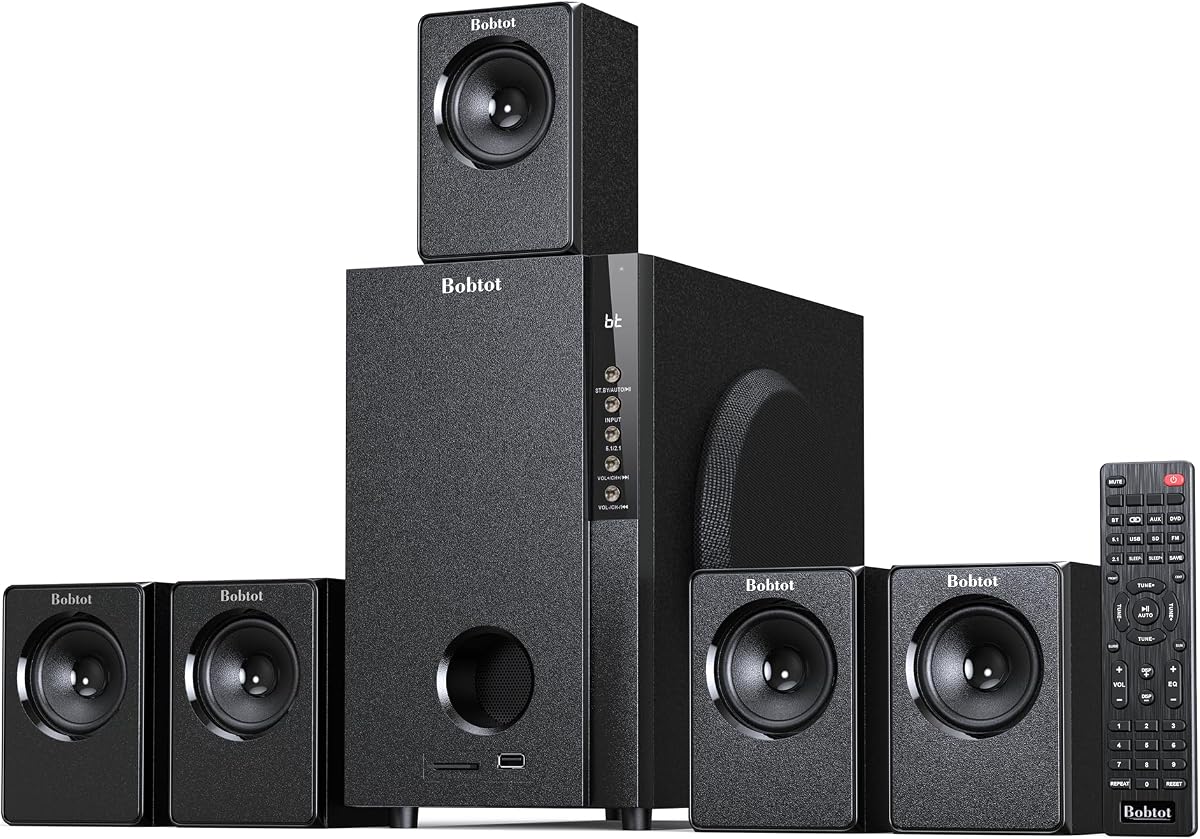
Bobtot Wireless Surround Sound System

The Bobtot system tops the list by making 5.1 genuinely easy: the 8-inch subwoofer houses the receiver, so there is no separate amp to buy, and four wireless satellites can go anywhere within 32 feet. You get switchable 5.1 or 2.1 modes, ARC, optical, Bluetooth and even karaoke mic inputs. The build is budget, but for a plug-in surround upgrade it delivers a full, room-filling experience.

Channels
5.1/2.1 switchable
Power
1000W peak
Subwoofer
8in built-in receiver
Inputs
ARC/Optical/Bluetooth

What we liked

  • Self-powered with built-in receiver, no amp needed
  • Four wireless satellites simplify placement
  • Switchable 5.1 or 2.1 modes
  • Karaoke mic inputs and FM tuner included

Worth noting

  • MDF and plastic build feels budget
  • 1000W is a peak, not continuous, figure
2Best Wired Value

Elimavi 5.1 Surround Sound System

The Elimavi is the value pick for anyone who wants a proper wired 5.1 without an AV receiver. Its six-piece set covers front, center, rear and a 6.5-inch powered subwoofer, and the generous 30-foot rear cables let you place surrounds at the back of a real living room. Bluetooth 5.3, optical, coaxial and RCA inputs connect to almost anything, and the metal grilles feel sturdier than the price suggests.

Channels
True 5.1 wired
Subwoofer
6.5in powered
Connectivity
Bluetooth 5.3/Optical/Coax/RCA
Extras
30ft rear wires, metal grilles

What we liked

  • Genuine six-piece wired 5.1 layout
  • Long 30ft rear cables for real placement
  • Bluetooth 5.3 plus optical, coax and RCA
  • Durable metal mesh grilles

Worth noting

  • Wired rears need cable routing
  • 3in satellites limit outright loudness
3Best for Audiophiles

Klipsch Reference Cinema 5.1.4 Dolby Atmos

For buyers chasing genuine cinema sound, the Klipsch Reference Cinema is the audiophile choice, going beyond 5.1 to a 5.1.4 Atmos layout with four height-enabled satellites for overhead effects. The Tractrix horns and aluminum tweeters give it the crisp, detailed high end Klipsch is known for, and the all-digital sub amp is efficient and accurate. You will need a capable Atmos AV receiver to drive it, but the payoff is spectacular.

Channels
5.1.4 Atmos
Tweeters
Aluminum, Tractrix 90x90 horn
Subwoofer
All-digital amp
Height
Front and rear Atmos

What we liked

  • Adds four Dolby Atmos height channels
  • Signature Klipsch horn clarity and detail
  • Efficient all-digital subwoofer amplifier
  • Truly immersive 360-degree soundstage

Worth noting

  • Passive satellites require an AV receiver
  • Premium price and larger footprint
4Best Complete Package

Energy Take Classic 5.1 Home Theater System

The Energy Take Classic is a long-standing favorite for a reason: five gloss satellites and a 200W, 8-inch front-firing subwoofer deliver a balanced, room-filling 5.1 that punches above its size. The compact speakers fit anywhere and wall-mount neatly for surrounds. As a passive set it needs an AV receiver, but pair it with a decent one and it forms a clean, dependable home cinema core.

Channels
5.1
Satellites
4 gloss 2-way
Subwoofer
200W, 8in front-firing
Mounting
Wall mountable

What we liked

  • Classic, well-reviewed satellite set
  • Punchy 200W front-firing subwoofer
  • Compact satellites suit any room size
  • Wall-mountable for tidy placement

Worth noting

  • Passive, so a receiver is required
  • No wireless or digital inputs of its own
5Best PC and Multimedia

Logitech Z906 5.1 Surround Sound System

The Logitech Z906 is the go-to 5.1 for PCs, consoles and multimedia setups. It is self-decoding and THX certified, so you plug in over optical without an AV receiver, and its 500W of continuous power with a 165W subwoofer delivers genuinely thunderous bass. The control console lets you switch between six connected devices instantly. The look is dated, but as an all-in-one surround kit it remains a benchmark.

Channels
5.1 THX certified
Power
500W RMS, 1000W peak
Subwoofer
165W
Inputs
6 devices, optical

What we liked

  • THX, Dolby Digital and DTS certified
  • Powerful 500W continuous output
  • Built-in decoding needs no receiver
  • Connects up to six devices at once

Worth noting

  • Dated control-console aesthetic
  • Bulky wiring back to the sub unit
6Best Budget Passive Set

Monoprice 5.1 Channel Home Theater Speakers

The Monoprice 5.1 set is the budget gateway into receiver-based surround. Four satellites, a center and a self-powered downfiring 8-inch subwoofer give you a complete channel layout for very little, and the sub accepts line or speaker-level inputs so it works even with older amps. Wall brackets are included. The satellites are modest, but as a first 5.1 for a small to mid-size room it is remarkable value.

Channels
5.1
Subwoofer
60W RMS, 8in downfiring
Impedance
8 ohm, 125W handling
Extras
Wall brackets included

What we liked

  • Very affordable full 5.1 satellite set
  • Downward-firing 8in powered subwoofer
  • Wall-mount C brackets in the box
  • Works with any receiver, even older amps

Worth noting

  • Requires an AV receiver to run
  • Small drivers limit large-room output
7Best Soundbar-Style 5.1

ULTIMEA Poseidon D50 5.1 Soundbar System

The ULTIMEA Poseidon D50 blends soundbar convenience with real rear speakers for a hybrid 5.1. The bar handles the front stage, two wired rears add surround, and the wireless subwoofer keeps cable clutter down. HDMI ARC makes hookup effortless, and the ULTIMEA app offers deep EQ tuning. It leans on virtual processing rather than fully discrete channels, but for an easy TV upgrade it delivers convincing immersion.

Channels
5.1 virtual
Power
320W peak
Rears
2 wired + wireless sub
Inputs
HDMI ARC/Optical/AUX/Bluetooth

What we liked

  • Soundbar layout is easy to place
  • Wired rears plus wireless subwoofer
  • App control with EQ presets
  • Simple HDMI ARC connection

Worth noting

  • Virtual surround, not discrete channels
  • Rear speakers still need wiring to the bar
8Best Soundbar Alternative

Sony HT-S40R 5.1ch Home Theater System

The Sony HT-S40R gives you a genuine 5.1 soundbar setup with true rear channels fed by a wireless amplifier box, so surrounds sit at the back of the room without a long run to the bar. Rated at 600W with color-coded connections, it is beginner-friendly and carries Sony's reliability. Bass is gentler than a big standalone sub, but for a clean, brand-name TV surround upgrade it is a safe pick.

Channels
5.1ch real surround
Power
600W
Rears
Wireless rear amp box
Setup
Color-coded connections

What we liked

  • Real 5.1 rear channels via wireless amp
  • Trusted Sony brand and support
  • Simple color-coded setup
  • Bluetooth music streaming built in

Worth noting

  • Rear speakers connect to a wired amp box
  • Bass is modest versus dedicated subs
9Best Receiver Bundle

Energy Take Classic 5.1 with Denon AVR-S670H

This bundle solves the biggest hurdle of passive 5.1 by pairing the well-regarded Energy Take Classic speakers with a Denon AVR-S670H 8K receiver, so you get everything needed for a proper component home theater in one purchase. The Denon handles 8K and 4K/120 passthrough for modern TVs and consoles, adds HEOS streaming and AirPlay 2, and includes Audyssey room correction. It is the easiest route to a real receiver-driven surround system.

Channels
5.1
Receiver
Denon AVR-S670H 8K
Subwoofer
200W, 8in
Streaming
HEOS, AirPlay 2, Bluetooth

What we liked

  • Speakers and 8K receiver in one box
  • Denon supports 8K/60 and 4K/120 passthrough
  • HEOS wireless multi-room streaming
  • Audyssey room calibration included

Worth noting

  • Costs more than speakers alone
  • Requires a full component-style setup

How We Chose the Best 5.1 Speaker Systems

Best 5.1 Speaker Systems in 2026

Building a 5.1 setup is less about chasing a single spec and more about matching the system to how you want to live with it. The first fork in the road is amplification. Some 5.1 systems are passive, meaning the speakers contain no electronics and depend entirely on a separate AV receiver to power them and decode the surround signal. Others are self-powered, with the amplifier and processing built into the subwoofer or a control unit, so they connect directly to a TV and work out of the box. Each answers a different kind of buyer, and we made sure the list represents both.

From there we weighed the things that actually shape the experience: how convincing the surround effect feels, how deep and controlled the subwoofer is, how many and what kind of inputs the system offers, and how much fiddly wiring the layout demands. We rewarded systems that make a genuine 5.1 layout achievable in a real room, whether through long rear cables, wireless satellites or a receiver bundle. Finally, we kept the list varied on purpose, from an audiophile Klipsch Atmos set to a plug-and-play Logitech console, so there is a sensible answer at every level of ambition and budget.

Passive Systems vs Self-Powered Systems

The single most important thing to understand before buying 5.1 is whether a system is passive or self-powered, because it changes what else you need to spend and how you set it up. Passive systems, such as the Klipsch Reference Cinema, the Energy Take Classic and the Monoprice 5.1 set, contain only drivers and crossovers. They produce no sound on their own and must be wired to an AV receiver that supplies the power and decodes the Dolby or DTS soundtrack. The upside is flexibility and higher ceilings for sound quality; the downside is the added cost and complexity of the receiver.

Self-powered systems fold the amplifier and decoding into the package. The Logitech Z906 does its own THX-certified surround processing from an optical input, the Bobtot houses its receiver inside the subwoofer, and the Sony HT-S40R and ULTIMEA Poseidon D50 are soundbar-style kits that connect over HDMI ARC. These are the plug-and-play choices, ideal if you do not want to research and buy a separate receiver. If you like the idea of a passive set but not the hassle, the Energy plus Denon bundle splits the difference by including a matched receiver in the box.

Understanding the 5.1 Channel Layout

A 5.1 system spreads sound across six outputs, and knowing what each does helps you place them well. The two front speakers establish the main stereo image and carry most of the music and effects. The center channel sits at or near the screen and reproduces dialogue, which is why films feel clearer with a proper 5.1 than with a stereo pair. The two surrounds go behind you to place ambient and directional effects, and the subwoofer, the .1, handles the deep bass that gives explosions and film scores their physical impact.

Not every system delivers those channels the same way. Discrete sets like the Elimavi and the Energy Take Classic give you five separate physical speakers plus a real subwoofer, which is the most authentic approach. Soundbar-style systems such as the ULTIMEA Poseidon D50 combine some channels into a single bar and generate part of the surround field virtually, trading a little precision for far simpler placement. Both can sound excellent; the discrete route just rewards careful positioning with a more convincing, wraparound effect.

Subwoofer and Bass Performance

The subwoofer often makes the biggest first impression, because bass is felt as much as heard. Size and amplifier power are the headline figures. The Energy Take Classic and its Denon bundle use a 200W, 8-inch front-firing sub, while the Logitech Z906 pairs a 165W subwoofer with its 500W of total output for genuinely thunderous low end. The Elimavi opts for a 6.5-inch powered woofer that stays tight in smaller rooms, and the Monoprice sub is a 60W downfiring 8-inch design that punches respectably for its price.

Watch how power is quoted, though. Peak figures like the Bobtot's 1000W or the ULTIMEA's 320W look impressive but describe brief maximums, not sustained output, so they are not directly comparable to an RMS rating. What matters more in practice is whether the subwoofer offers a crossover control to blend it with the satellites, and whether it can move enough air for your room. In a large space the bigger 8-inch subs will feel more effortless; in an apartment the 6.5-inch Elimavi may be all you need.

Connectivity and Ease of Setup

Getting sound into a 5.1 system is where convenience diverges sharply. The self-powered options shine here: the ULTIMEA Poseidon D50 and Sony HT-S40R use HDMI ARC for a single-cable link to a modern TV, and the Bobtot and Elimavi add Bluetooth alongside optical, coaxial and RCA so they connect to phones, TVs, consoles and turntables alike. The Logitech Z906 goes further with inputs for up to six devices switched from its control console, making it a natural hub for a desk crammed with a PC, console and TV.

Passive systems shift the connectivity onto the receiver, which is both a limitation and a strength. On its own the Monoprice or Klipsch set has no inputs at all; everything routes through your AV receiver, which is what makes the Energy plus Denon bundle so appealing, since the included Denon AVR-S670H brings 8K passthrough, HEOS streaming, AirPlay 2 and Audyssey room calibration in one unit. Also weigh the wiring reality: rear surrounds need cable runs, so systems with long leads like the Elimavi's 30-foot rears, or wireless rears like the Sony's amp box, save real hassle.

Room Size and Placement Considerations

The room you are filling should steer your choice as much as the spec sheet does. In a small living room, bedroom or apartment, a compact set like the Elimavi with its 6.5-inch subwoofer, or the Monoprice satellites, provides plenty of surround presence without overwhelming the space or annoying neighbors. In a larger open-plan room or a dedicated home theater, the extra output of the 8-inch subwoofers in the Bobtot and Energy Take Classic, or the sheer capability of the Klipsch Reference Cinema, pays off with sound that stays effortless at higher volumes.

Placement determines whether a 5.1 system actually delivers surround. Front left, center and right belong across the front near the screen, with the center at ear level for clear dialogue. The two surrounds should sit slightly behind and to the sides of your seat, ideally at or just above ear height, which is where long cables or wireless rears become essential. The subwoofer is more forgiving; corners reinforce bass, so experiment with position. Systems with wireless satellites like the Bobtot, or wireless rear amps like the Sony HT-S40R, make correct placement far easier in rooms where running wires behind the seating is impractical.

A Closer Look at the Top Picks

The Bobtot Wireless Surround Sound System earns the top spot by removing the two biggest obstacles to 5.1: it builds the receiver into the subwoofer and makes the rear satellites wireless, so a full surround layout goes up quickly and cheaply. It is not the last word in refinement, but it delivers the room-filling effect most buyers want with the least friction. Just behind it, the Elimavi is the wired-value champion, offering a genuine six-piece layout with long rear cables and versatile inputs.

For those willing to invest in electronics, the Klipsch Reference Cinema is the audiophile's choice, adding Atmos height channels and that unmistakable horn-loaded clarity, while the Energy Take Classic remains a balanced, dependable passive set, especially in its Denon-receiver bundle. The Logitech Z906 is the enduring pick for PCs and consoles thanks to its self-decoding, high-output design, and the Monoprice set is the budget entry into receiver-based surround. The ULTIMEA Poseidon D50 and Sony HT-S40R round things out for buyers who want soundbar-style simplicity with real rear channels.

Final Recommendation

For most buyers, the Bobtot Wireless Surround Sound System is the best 5.1 speaker system in 2026, combining a built-in receiver, wireless satellites and easy connectivity into a package that just works. If you prefer a wired setup with authentic channel separation, the Elimavi is the value standout. Audiophiles with an Atmos receiver should reach for the Klipsch Reference Cinema, PC and console users the self-decoding Logitech Z906, and anyone who wants a turnkey component system the Energy plus Denon bundle. Decide first whether you want a passive, receiver-driven setup or a self-powered plug-and-play one, match the subwoofer to your room, and a 5.1 system will transform how films, games and music feel at home.

How we picked

We judged each 5.1 system on surround immersion and channel separation, bass depth from the subwoofer, connectivity and ease of setup, build quality, and value for the price. Because 5.1 splits between receiver-driven and self-powered designs, we noted which systems need an external AV receiver and which include their own amplification, and we mixed both types so the list reflects the two very different ways to build a surround setup.

Frequently asked questions

Do I need an AV receiver for a 5.1 speaker system?

It depends on the type. Passive sets like the Klipsch Reference Cinema, Energy Take Classic and Monoprice 5.1 need an external AV receiver to power the speakers and decode surround. Self-powered systems such as the Bobtot, Elimavi, Logitech Z906 and the Sony and ULTIMEA soundbars include their own amplification, so they connect straight to a TV over HDMI or optical with no receiver required.

What does the 5.1 channel layout actually mean?

The 5 refers to five main speakers: front left, front right, a center channel for dialogue, and two rear surrounds. The 1 is the subwoofer that handles low-frequency bass. Systems like the Elimavi and Energy Take Classic follow this discrete layout, while soundbar-style options such as the ULTIMEA Poseidon D50 create some of the surround effect virtually from fewer physical speakers.

Can I get Dolby Atmos with a 5.1 system?

Standard 5.1 does not include overhead height channels, but the Klipsch Reference Cinema is a 5.1.4 layout that adds four Atmos height-enabled satellites for overhead effects. To use them you need an Atmos-capable AV receiver. The Energy bundle's Denon receiver and most modern soundbars also support Atmos decoding, so it is worth checking channel counts before buying.

Are self-powered 5.1 systems as good as receiver-based ones?

Self-powered kits like the Logitech Z906 trade some flexibility for convenience and are excellent for PCs, consoles and easy TV setups. Receiver-based passive systems such as the Klipsch or the Energy plus Denon bundle generally scale higher in sound quality and let you upgrade components later, but they cost more and require more setup. Choose based on how hands-on you want to be.

How should I place the rear surround speakers?

Rear surrounds should sit slightly behind and to the sides of your listening position, ideally at ear level or just above. Systems with long cables help here: the Elimavi ships with 30-foot rear wires and the Sony HT-S40R uses a wireless rear amp box, both making it easy to reach the back wall of a real living room without buying extension cables.