MSI B850 Gaming Plus WIFI6E
- AM5 B850 ATX with premium WiFi 6E, Bluetooth 5.3, and 2.5Gb LAN backup
- 12 Duet Rail P-PAK VRM and Frozr Guard cooling for Ryzen 9000 gaming PCs
- Gen5 + Gen4 M.2 with Shield Frozr and Steel Armor PCIe for modern GPUs
Expert Review & Guide
WiFi 6E matters when your router actually offers a 6GHz band and your desktop still fights neighbors on congested 2.4/5GHz airspace. The standard adds that cleaner 6GHz lane with the efficiency tricks of WiFi 6—OFDMA, better multi-device behavior, modern security—so gaming PCs, creator towers, and compact office boxes stop begging for Ethernet tape across the hallway. A motherboard with a true WiFi 6E module is the cleanest path; a PCIe AX210 card or better antennas can rescue boards that shipped with weaker radios or stubby stock aerials.
Our best-wifi-6e-motherboards pack mixes onboard WiFi 6E AM4/AM5/Intel boards, one WiFi 6 Prime board that needs an honest caveat, a high-gain tri-band antenna kit, and a TP-Link Intel AX210 adapter for upgrades. We ranked every item for radio generation accuracy, antenna practicality, LAN backup options, and whether the rest of the board is worth building around once wireless works. Ratings mirror Amazon averages in the pack; prices are omitted because wireless SKUs rotate constantly.
Start with the top picks if you want a current AM5 WiFi 6E ATX board, a compact B850M option, or a Tomahawk-class AM4 board that already speaks 6E. Then read the antenna and PCIe card reviews if your motherboard is fine but your signal path is not.
As an Amazon Associate we earn from qualifying purchases. We may earn a commission at no additional cost to you.
Every pack product appears below. Specs emphasize wireless generation, wired backup, and platform class so you can spot WiFi 6-only outliers and accessory upgrades quickly.
External WiFi 6E Tri-Band Antenna
Stock motherboard antennas are often short, poorly placed, and trapped behind a desk against a wall. This tri-band kit exists for builders who already own a WiFi 6E board or PCIe card but live with one bar of 6GHz signal. Rated around 9dBi with dual 6.5-foot RP-SMA cables, it covers 2.4GHz, 5.8GHz, and 6GHz ranges used by WiFi 6/6E networks.
Compatibility notes in the listing call out ASUS ROG Strix/Maximus and GIGABYTE series boards plus desktop PCIe WiFi cards—the exact ecosystems in this pack. Confirm your board uses RP-SMA male antenna connectors before ordering; most gaming boards do, but oddball adapters exist.
Placement beats mythology. Raise the magnetic base above the PC, keep line-of-sight toward the router when possible, and avoid coiling spare cable into an RF knot. Omni-directional design means you need not aim like a satellite dish, but height still wins.
This accessory will not magically create a 6GHz radio. If your board is WiFi 6 only—like the Prime B550M-A WiFi II in this pack—buy the TP-Link AX210 card instead, then consider these antennas if the card’s stock aerials disappoint.
Creators who move large footage wirelessly and gamers who refuse Ethernet should try antenna placement before blaming “bad WiFi 6E motherboards.” Often the PCB is fine and the plastic stubs are not.
Buy these when your 6E module is real and your signal path is tragic. Skip them when you can run 2.5Gb Ethernet—the lowest-latency upgrade remains a cable.
Power down, swap one antenna at a time so you do not cross-thread SMA connectors, route cables away from PSU modular spaghetti, then retest throughput on the 6GHz SSID specifically.
Thick masonry, mesh nodes on the wrong band, or Windows preferring 5GHz can still bottleneck you. Force 6GHz SSID selection and update WLAN drivers.
We may earn a commission at no additional cost to you.
GIGABYTE B850M Gaming X WIFI6E
B850M Gaming X WIFI6E is the small-case answer for shoppers who typed WiFi 6E but still want a modern Ryzen platform. You get AM5 support for 9000/8000/7000 CPUs, DDR5, a 10+2+2 design, PCIe 5.0, dual M.2, USB-C, 2.5GbE, and—critically—WiFi 6E in the product name and feature set.
Wireless performance still depends on antenna routing. On mATX builds, mount antennas high on the rear I/O or use the external tri-band kit above if the case sits on the floor. 2.5GbE remains your competitive-play escape hatch.
Versus MSI B850 Gaming Plus WIFI6E, this board trades ATX space and some VRM/storage headroom for a smaller footprint. Versus Strix B650-A, you gain B850 freshness in mATX form. Versus AM4 6E boards, you gain DDR5 upgrade runway.
EZ-Latch helpers make SSD installs easier in cramped chassis where your knuckles already hate you. Keep M.2 shields on; compact cases run warmer around wireless modules and drives alike.
Choose Gaming X WIFI6E for SFF-ish Ryzen gaming PCs that need 6GHz. Skip it if you want ATX cable luxury or WiFi 7 specifically.
After Windows install, confirm the adapter enumerates as WiFi 6E-capable and join the 6GHz SSID deliberately—many routers still default clients to 5GHz.
You need a WiFi 6E (or tri-band WiFi 7) router that exposes 6GHz. A WiFi 6-only router will never unlock 6E client features no matter how good the motherboard is.
Same-room or light-wall separation from the AP. 6GHz attenuates faster than 5GHz through dense walls—plan node placement accordingly.
We may earn a commission at no additional cost to you.
Strix B550-F WiFi II remains one of the clearest AM4 answers to “motherboard with WiFi 6E.” ASUS pairs the 6E radio with Intel 2.5Gb Ethernet, Bluetooth 5.2, a 12+2 power design, and the ROG software/BIOS comfort blanket. If you are finishing a 5800X3D-class tower and already own DDR4, this board still feels premium in 2026.
Wireless shoppers should still wire antennas correctly and keep the 2.5Gb port as plan A for tournaments. 6E shines for downloads, cloud sync, and everyday latency when Ethernet is ugly to run.
Versus Tomahawk MAX WiFi, Strix leans ROG aesthetics and ASUS tooling; Tomahawk leans MAG durability storytelling and similar 6E+2.5G networking. Versus Prime B550M WiFi II, Strix is actual WiFi 6E rather than WiFi 6.
Do not buy Strix B550 expecting AM5 longevity. Buy it because your AM4 gaming PC needs a proper 6GHz client without a PCIe adapter consuming a slot.
BIOS Flashback helps CPU swaps. Keep firmware current if you chase late Ryzen 5000 steppings.
Antenna tip: if stock aerials underperform behind a desk, the tri-band kit earlier in this guide is the first upgrade—not a new motherboard.
Owners keeping DDR4 who just upgraded to a WiFi 6E router and hate USB WiFi dongles sticking out of the rear I/O.
Onboard 6E frees PCIe slots for GPUs and capture cards. That integration is the quiet advantage versus the TP-Link upgrade path.
We may earn a commission at no additional cost to you.
Strix B650-A is the stylish AM5 WiFi 6E pick when you want DDR5 and a ROG board without jumping to WiFi 7 marketing. Onboard 6E, 2.5G LAN, three M.2 slots with heatsinks, USB Gen2x2 Type-C, ALC4080 audio, and Aura Sync make a complete wireless-capable gaming platform for Ryzen 7000–9000 CPUs.
If MSI’s B850 Gaming Plus WIFI6E is similarly priced, the newer chipset and 4.7 rating may win. If you love white Strix and find B650-A discounted, it remains an excellent 6E host—flash BIOS first when required.
Antenna placement on ATX boards is usually easier than mATX cubes. Still, raise aerials above the case. Glass-heavy showcases can attenuate signals if the PC sits in a corner.
Storage and power features exceed what wireless alone demands, which is good: you are buying a whole PC foundation, not a WiFi dongle with DIMM slots.
Choose B650-A for aesthetic AM5 6E builds. Choose B850 Gaming Plus when you want the freshest WiFi 6E ATX board in this pack. Choose Tomahawk MAX when staying on AM4.
Driver hygiene: install chipset and WLAN drivers from ASUS, then verify Windows reports 6GHz capability under the adapter’s properties.
If your router is WiFi 6E, this board matches it. If you already bought WiFi 7 access points, consider whether a WiFi 7 motherboard is worth the premium—or whether 6E still saturates your ISP plan.
USB Gen2x2 Type-C helps portable SSDs when wireless backups feel slow. Use both tools: 6E for convenience, fast USB for bulk archives.
We may earn a commission at no additional cost to you.
PRO B550M-VC WiFi proves WiFi 6E is not only a Strix tax. MSI packs 6E and Bluetooth 5.2 into a micro-ATX PRO board with PCIe 4.0, Shield Frozr M.2, Core Boost/Digital PWM language, and thickened copper notes aimed at quiet daily drivers and compact gaming PCs on Ryzen 5000/3000 (with listed APU exceptions).
For wireless-first bedrooms and dorms, onboard 6E beats USB dongles that fall out when you vacuum. Place antennas outside the metal shell. If signal still lags, try the magnetic tri-band kit before replacing the board.
Versus Tomahawk MAX, you give up ATX space and 2.5Gb LAN emphasis for a smaller cheaper PCB. Versus Prime B550M WiFi II, you gain actual 6E rather than WiFi 6. Versus AM5 boards, you stay on DDR4 by choice.
Creator Genie and DDR4 Boost extras are MSI sauce—use what helps, ignore what does not. The wireless radio is the headline for this article’s keyword.
Buy PRO B550M-VC WiFi for compact AM4 6E builds. Skip it when you need 2.5GbE onboard or a future AM5 CPU path.
Note the APU incompatibility list before you plan a budget graphics-free build with older G-series chips.
PRO styling suits muted office towers that still join a WiFi 6E SSID for video calls and after-hours games. RGB is optional; radios are not.
Bluetooth 5.2 covers many pads and headsets. Keep USB receiver spares for competitive latency-sensitive peripherals anyway.
We may earn a commission at no additional cost to you.
Intel builders searching for WiFi 6E motherboards should land here inside this pack. PRO B760-P WiFi DDR4 combines LGA 1700 support (listing covers 12th/13th/14th gen messaging across title/about variants), WiFi 6E, Bluetooth 5.3, 2.5Gb LAN, and a 12+1 power design on an ATX PCB with thickened copper construction notes.
Choosing DDR4 intentionally lowers memory spend for office and gaming hybrids that still want 6GHz wireless. If you already bought DDR5 kits, look outside this exact SKU. If you want affordable Intel + 6E, this is the on-pack answer.
Wireless setup mirrors AMD boards: update drivers, join 6GHz, place antennas high, keep 2.5Gb Ethernet as the competitive backup. Shield Frozr keeps the boot SSD from cooking beside a warm Intel gaming chip.
Versus AM5 B850 Gaming Plus, pick this for Intel CPUs you already own. Versus Z790 TUF boards in other guides, B760 is the value chipset with fewer overclocking toys—fine for locked gaming CPUs.
PRO aesthetics stay quiet in office glass cubes. That may be exactly what WiFi 6E productivity towers need.
Buy it for Intel DDR4 WiFi 6E ATX builds. Skip it for Ryzen or DDR5-first Intel plans.
Confirm your exact Core generation on MSI’s support list and update BIOS if purchasing older warehouse stock for newer CPUs.
Even on a WiFi 6E article, wired backups win tournaments and large NAS copies. This board smartly includes both.
We may earn a commission at no additional cost to you.
Honesty first: Prime B550M-A WiFi II is a WiFi 6 board that appears in WiFi 6E shopping graphs. ASUS’s own about text specifies WiFi 6 (802.11ax), 1Gb LAN, PCIe 4.0 SafeSlot, dual M.2, HDMI 2.1, and 5X Protection III. It can be a fine AM4 mATX motherboard. It is not a WiFi 6E motherboard.
Why keep it in the roundup? Because this is how people accidentally buy the wrong radio generation. If you need 6GHz, either choose a true 6E board above or pair this Prime with the TP-Link Archer TXE72E AX210 card—and accept that a PCIe slot plus antenna mounts become part of the build.
As a WiFi 6 board, it still benefits from good antenna placement and 5GHz SSIDs. You simply will not join a 6GHz network with the onboard module.
ECC memory mention and OptiMem messaging hint at ASUS’s stability focus. Gamers should care more about the wireless mismatch than ECC headlines.
Buy Prime B550M-A only if WiFi 6 is enough or you planned a PCIe 6E card anyway. Everyone searching specifically for WiFi 6E should skip to Tomahawk, Strix B550-F WiFi II, B850 Gaming Plus, or B850M Gaming X.
Retail page skimming tip: “WiFi II” in ASUS names does not automatically mean 6E—read the standard line every time.
Install the TP-Link AX210 card, disable or ignore the onboard WiFi in BIOS/Device Manager to avoid conflicts, and connect the Bluetooth USB header cable if you want BT from the card.
Budget AM4 builders on WiFi 6 routers who do not need 6GHz and want HDMI 2.1 troubleshooting outputs in mATX form.
We may earn a commission at no additional cost to you.
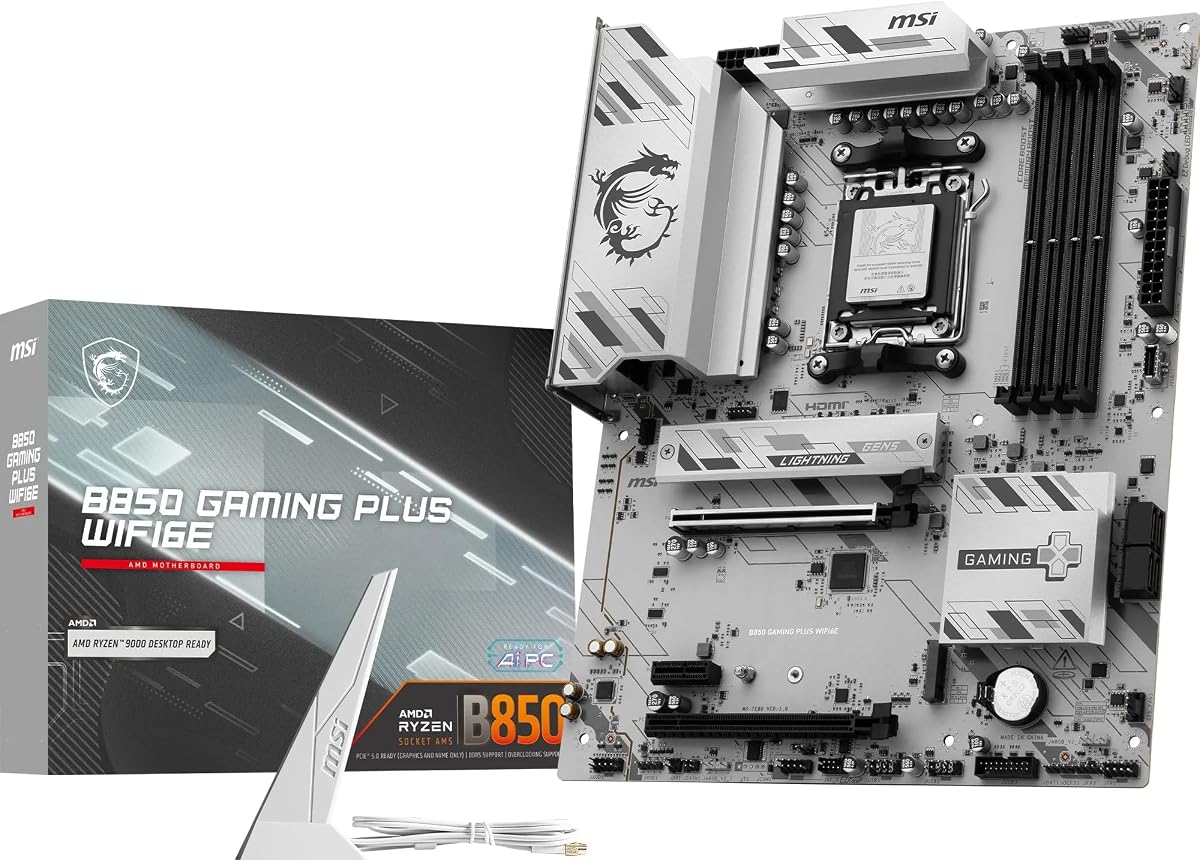
MSI B850 Gaming Plus WIFI6E is our overall pick for shoppers who want a current AM5 board that still takes the WiFi 6E keyword literally. A 12 Duet Rail power design, Frozr Guard cooling with 7W/mK pads, extended heatsinks, DDR5 Boost messaging, Gen5 and Gen4 M.2 with Shield Frozr, WiFi 6E, Bluetooth 5.3, and 2.5Gb LAN form a coherent 2026 gaming platform—with the pack’s strongest 4.7 rating snapshot.
Wireless-first users get a premium 6E module without hunting adapters. Competitive users keep 2.5Gb Ethernet one cable away. That duality is what “best WiFi 6E motherboard” should mean: great radio, adult wired backup.
Note the PCIe 4.0 x16 Steel Armor slot language on this SKU. For the vast majority of GPUs and games, that is not a practical limiter; enthusiasts chasing PCIe 5.0 x16 specifically should read manuals carefully and compare sibling B850 boards.
Versus B850M Gaming X, you gain ATX space and the higher-rated MSI feature pack. Versus Strix B650-A, you gain B850 chipset freshness and a 6E-focused Gaming Plus identity. Versus Tomahawk MAX, you move to DDR5 AM5.
EZ M.2 Clip II and Shield Frozr keep storage installs friendly. Audio Boost is a nice onboard touch for headset gamers who have not bought a DAC yet.
Buy this board when WiFi 6E + modern AM5 is the brief. Skip to accessories only if you already love your motherboard and merely need better antennas or a PCIe radio.
MSI advertises high DDR5 OC ceilings; for daily WiFi gaming stability, enable a validated EXPO profile near mainstream speeds first, then experiment.
Attach both antennas, update WLAN/BT drivers, and test 6GHz throughput with a tool you trust. Stuttering often traces to power-saving wireless quirks, not motherboard VRMs.
Homes that already deployed WiFi 7 access points and want client parity. If your AP is 6E, Gaming Plus matches the network you actually own.
We may earn a commission at no additional cost to you.
Not every desktop needs a new motherboard to join WiFi 6E. The TP-Link Archer TXE72E uses Intel’s AX210 chipset to add tri-band 6E connectivity—up to 2402Mbps on 6GHz or 5GHz class links and 574Mbps on 2.4GHz—plus Bluetooth 5.3, WPA3, and OFDMA/MU-MIMO features aimed at busy networks and lower latency gaming.
Installation is the tax: occupy a PCIe slot, mount antennas, and connect the Bluetooth USB cable to an F_USB header. Low-profile brackets help mini towers. If your case is a Faraday cage, combine this card with the magnetic tri-band antenna kit for better placement flexibility.
TP-Link notes Windows 11 for utilizing 6GHz. Treat that seriously—verify OS version before you blame the card. Driver installs from TP-Link/Intel usually beat generic Windows defaults for first-week stability.
This card is the redemption arc for Prime B550M-A WiFi II owners and any solid board stuck on WiFi 5/6. It is less ideal if you already own B850 Gaming Plus WIFI6E and simply need better antennas.
Disable onboard WiFi in BIOS or Device Manager after the AX210 works to prevent weird metric routing. Keep Ethernet enabled as failover.
Buy TXE72E to retrofit 6E. Buy a native 6E motherboard when you were upgrading the board anyway for CPU/socket reasons.
Without the F_USB cable connected, WiFi may work while Bluetooth does not. Check the card’s cable before RMA-ing “dead BT.”
WiFi 6E can feel excellent on a clean 6GHz SSID, but wired Ethernet still wins jitter-sensitive competitive play. Use the right tool for the match.
We may earn a commission at no additional cost to you.
MSI MAG B550 Tomahawk MAX WiFi
Tomahawk MAX WiFi is the AM4 ATX board we trust when WiFi 6E and 2.5Gb LAN both need to be excellent. MSI’s extended heatsink stack, thickened copper notes, Gen4 M.2 Shield Frozr, and Turbo USB 3.2 Gen 2 features support nonstop gaming PCs that happen to live on wireless most weeknights.
The networking story is dual-path done right: AMD WiFi 6E for the 6GHz SSID, 2.5Gb LAN with LAN Manager when you drop a cable. That flexibility is why Tomahawk still appears in WiFi 6E shortlists years after AM5 launched.
Versus Strix B550-F WiFi II, pick Tomahawk for MAG durability vibes and MSI BIOS familiarity; pick Strix for ROG ecosystem and HDMI 2.1 living-room quirks. Versus PRO B550M-VC, pick Tomahawk for ATX space and 2.5Gb LAN.
If you are building brand-new with upgrade ambitions, AM5 B850 Gaming Plus WIFI6E is the wiser long game. If you are maximizing a DDR4 gaming PC you love, Tomahawk MAX WiFi is the 6E ATX closer.
Keep antennas out of the cable nest. Update BIOS for your Ryzen 5000 CPU if needed. Enjoy a platform that finally matches a modern router.
Final thought: WiFi 6E motherboards only shine when the AP cooperates. Buy the board and audit your router bands the same weekend.
Use wired 2.5Gb for ranked nights and large Steam downloads overnight; keep 6E for couch moves and cleaner desks.
Extended heatsinks help CPUs; they also mean more metal near rear I/O. Raise antennas slightly to clear the heatsink forest.
We may earn a commission at no additional cost to you.

WiFi 6 and WiFi 6E are not synonyms. 6E adds 6GHz. Read the spec line, not just the title words “WiFi” and “II.” The Prime B550M-A WiFi II in this pack is the cautionary example.
You need a 6E-capable access point and a client OS/driver stack that can use 6GHz. Several adapters call out Windows 11 for full 6GHz use—plan images accordingly.
Replace the motherboard when you also need a new socket/chipset. Add a PCIe AX210 card when the board is fine but the radio is old. Replace antennas when the radio is already 6E but placement is terrible.
Prefer boards with 2.5GbE alongside WiFi 6E. Wireless is convenience; copper is consistency for competitive play and huge transfers.
Install vendor packages before judging speeds. Generic Windows drivers hide features.
Many meshes use separate SSIDs or band steering. Confirm the connection properties show 6GHz.
Avoid trapping aerials behind the case against a wall. Use extension antennas if needed.
Know your wired baseline so you can tell RF issues from ISP issues.
If you added a PCIe card, turn off onboard WiFi to prevent weird routing metrics.
For new AMD builds in this pack, the MSI B850 Gaming Plus WIFI6E is the best overall ATX choice with a 4.7 rating, WiFi 6E, Bluetooth 5.3, and 2.5Gb LAN. Compact builds should consider the GIGABYTE B850M Gaming X WIFI6E. AM4 finishers should look at MSI MAG B550 Tomahawk MAX WiFi or ASUS ROG Strix B550-F WiFi II.
Yes, if you want the 6GHz band. A WiFi 6E motherboard on a WiFi 5/6-only router will fall back to older bands. Match client and access point generations.
If your router is WiFi 6E, yes—buy a 6E board and stop overpaying for WiFi 7 you cannot use. If you already own WiFi 7 APs, a WiFi 7 motherboard can make sense, but many homes still see ISP limits before radio limits.
Often yes, with a PCIe card like the TP-Link Archer TXE72E (Intel AX210). You need a free slot, antenna mounts, and usually an F_USB header connection for Bluetooth.
Because it appears in the same shopping set, yet its onboard radio is WiFi 6, not 6E. We include it as a warning and as a candidate for a PCIe 6E upgrade—not as a native 6E recommendation.
They can if the motherboard already has a 6E module and stock aerials are poorly placed. They cannot add 6GHz support to WiFi 6-only silicon.
Yes for competitive play whenever possible. Choose boards that include 2.5GbE—like B850 Gaming Plus, Tomahawk MAX, Strix B550/B650, and PRO B760—so you can cable in without buying a USB LAN adapter.
Yes. B850M Gaming X and PRO B550M-VC show that. Just be more intentional about antenna placement in small metal cases.
It can. Some adapters explicitly require Windows 11 to utilize 6GHz. Verify OS requirements on the card or motherboard support page before troubleshooting phantom band issues.
The best WiFi 6E motherboard is the one with a real 6E radio, antennas you can place sanely, and a wired port for the nights wireless is the wrong tool. In this pack, MSI’s B850 Gaming Plus WIFI6E leads fresh AM5 builds, GIGABYTE’s B850M Gaming X covers compact cases, and Tomahawk MAX WiFi / Strix B550-F WiFi II close strong AM4 chapters.
If your board is already right but your signal is wrong, upgrade antennas or add the TP-Link AX210 card—and double-check you did not accidentally buy WiFi 6 when you meant 6E. Then put the router on a shelf that is not the floor behind a fish tank, because physics still bats last.