Marshall Acton III (Black)
- Wider Marshall soundstage with dynamic loudness for late-night low volume
- Plug-in powered Bluetooth with analog bass and treble knobs
- Iconic design that doubles as dresser décor, not just a black brick
Expert Review & Guide
Bedroom speakers have a different job than party cylinders or desktop gaming bars. They need to fill a small-to-medium room at neighbor-friendly volumes, wake you without panic beeps if that is your style, and look acceptable on a dresser at 7 a.m. when the lights are honest. Bass that thrills in a garage can turn a mattress into a subwoofer platform; RGB that looks cool on Twitch can sabotage melatonin.
This guide reviews every product in the bedroom-speaker pack: Marshall Acton III statement Bluetooth homes in black and cream, Edifier and Saiyin powered bookshelf pairs for stereo nightstands, an ANJANK white-noise alarm clock with dual Bluetooth drivers, plus portable options people still park on shelves. We rank for bedroom realities—dimmable habits, plug-in versus battery, stereo width across a bed, and whether the speaker invites late-night volume wars. Ratings reflect Amazon listing scores at research time.
Need a fast shortlist? Choose Marshall Acton III (Black) for iconic room-filling Bluetooth with physical bass and treble knobs. Pick Edifier R1280T when a wooden bookshelf pair and remote volume control fit dresser-and-desk life. Grab the ANJANK sound machine when sleep sounds, night lights, and gentle alarms matter as much as music. Full reviews cover all ten pack products so portable leftovers are judged in bedroom context, not beach context.
As an Amazon Associate we earn from qualifying purchases. We may earn a commission at no additional cost to you.
Compare plug-in home speakers, stereo bookshelf pairs, sleep machines, and portables that end up on nightstands anyway. Bedroom fit prioritizes controllable tone, low-light manners, and stereo geometry across a bed. Ratings reflect listed customer scores at research time.
Marshall Acton III in black is the bedroom speaker for people who want the room to have a center of gravity. The wider soundstage versus prior Acton generations matters in rectangular bedrooms where a mono portable collapses to one nightstand. Plug it in, pair Bluetooth, and you are listening without building a component stack—exactly the friction level most bedrooms tolerate.
The analog bass and treble knobs are not nostalgia cosplay; they are how you keep neighbors alive. Roll bass down for apartment floors, brighten treble for podcast mornings, and leave a neutral center for album nights. Dynamic loudness is the secret bedroom weapon: at low volume it lifts detail so you are not constantly chasing the phone slider.
Next-generation Bluetooth readiness means the hardware is built to adopt newer Bluetooth features as they arrive, which is reassuring for a plug-in speaker you expect to keep for years. The 3.5 mm aux input covers turntables with preamps, older TVs, or a laptop when wireless feels fussy.
Design still does Marshall’s rock vocabulary—brass-ish controls, vinyl-adjacent attitude—but Acton III’s material story leans more sustainable while staying recognizable. In a bedroom that already has posters and guitars, it looks intentional. In an all-linen quiet luxury room, cream may be the calmer twin.
Powered plug-in status is a feature for always-ready morning playlists and a limitation if you wanted balcony battery freedom. For primary bedroom sound, tethered power is usually the correct trade: no dead speaker when you forgot to charge after a late movie.
Choose black Acton III when you want one beautiful Bluetooth home speaker to own the room. Choose a bookshelf pair if you prefer left/right geometry across the headboard more than a single statement chassis.
Start with bass at noon on the knob, enable dynamic loudness implicitly by listening quietly, and raise treble slightly for dialogue-heavy shows so you are not compensating with raw volume.
Center the Acton on a dresser opposite the foot of the bed or on a solid shelf at roughly ear height when sitting up—avoid soft duvet surfaces that swallow bass.
Marshall wins on single-chassis design and brand presence. Edifier wins when you want true stereo pairs, wood aesthetics, and a remote without buying into Marshall’s look.
We may earn a commission at no additional cost to you.
ANJANK White Noise Alarm Clock Speaker
ANJANK exists because bedrooms are not only playlist rooms—they are sleep theaters. Twenty-one relaxing sounds spanning white/brown/pink noise, fan sounds, and nature beds let you mask hallway noise or a partner’s different sleep schedule. Thirty volume levels sound excessive until you share a wall with someone who notices every notch.
Bluetooth 5.0 dual 10W speakers elevate it above toy clock radios when you want actual music or audiobooks before the timer fades things out. That hybrid identity—sound machine plus real-ish stereo Bluetooth—is why it belongs in a best speakers for bedroom shortlist rather than only a baby-registry aisle.
Seven ambient night-light colors and a 0–100% dimmer display acknowledge that light hygiene is part of audio hygiene. Red or warm options help some people wind down; others will disable lights entirely. Eight wake sounds (birds, sea, piano, and friends) offer gentler mornings than a single beep identity crisis.
Kids’ rooms and adult primary bedrooms both benefit, though adults should still treat music quality expectations realistically. This is a sleep system that can play Spotify; it is not a hi-fi bookshelf pair in disguise.
Place it on a nightstand within arm reach so volume and timer changes do not require phone brightness. Keep the display dimmed; the whole product’s value collapses if the clock becomes a lighthouse.
Buy ANJANK when sleep tooling is the priority and music is secondary. Buy Marshall or Edifier when albums are the point and your phone already handles alarms.
Start with a brown-noise bed at low volume, Bluetooth a calm playlist for twenty minutes, then let the sleep timer hand the room back to noise-only masking.
Agree on a maximum night-light brightness and a noise type that neither of you hates—fan textures often translate better than rainforest thunderstorms.
We may earn a commission at no additional cost to you.
Some bedrooms already lost the outlet war to lamps, CPAP bricks, and phone chargers. A 20W HD Bluetooth portable solves that by living on battery for up to roughly a day at mid volume. Dual-driver tuning stays composed for shows and playlists without demanding a dresser throne.
IPX5 is oddly useful in bedrooms that share steam with ensuite baths. More important for sleepers: disable the multicolor beat lights. What reads as party energy at noon becomes sleep sabotage at midnight.
TWS pairing is the clever bedroom trick. Two units on opposite nightstands create a gentle stereo field across the mattress—closer to a bookshelf experience without wood cabinets. One unit alone is fine for podcasts; two units help music feel less mono-centered.
Compared with Ortizan, this model is less waterproof-obsessed and more everyday HD. Compared with Marshall, it is disposable in the best way: cheap to move, easy to lend guests, painless if it migrates to the kitchen.
Do not expect it to satisfy someone shopping specifically for “bedroom hi-fi.” Do expect it to be the speaker that actually gets used because charging anxiety is lower than packing a plug-in brick into a tiny apartment layout.
Choose it as a flexible loaner or secondary bedroom speaker. Choose Acton III or Edifier when the bedroom is the main listening room of the home.
Top up during morning routines so overnight listening never hits a sudden shutdown mid-audiobook.
Map the light button on day one and practice killing LEDs in the dark—muscle memory beats fumbling at 1 a.m.
We may earn a commission at no additional cost to you.
Sanyun’s SW208 pair is built for small hi-fi geometry: active bookshelf design with carbon-fiber driver units and multi-layer voice coils aiming for cleaner output than toy satellite speakers. In a bedroom, placing one cabinet per nightstand—or flanking a wall-mounted TV—creates width a single Marshall cannot mimic.
The 24-bit USB DAC is the sleeper feature for laptop-in-bed workers and students. Digital audio over USB can sound more resolved than a random headphone jack feeding AUX. Bluetooth 5.0 still covers phone playlists when you are done typing.
Side knobs for volume, treble, and bass let you tune for pillow distance. Small rooms often need less treble than product demos; SW208 makes that adjustment tactile. Quiet standby and input filtering aim to keep hiss from haunting silent nights.
White finish is a deliberate bedroom aesthetic play. It reads softer than gaming RGB bars and pairs with light furniture. Dust visibility is the tax; a weekly wipe keeps them looking intentional.
Sixty watts of marketing power across the pair is plenty for bedrooms and too much if you treat max volume as a personality. Keep levels modest and the carbon-fiber drivers stay cleaner longer.
Choose SW208 for compact stereo in bright rooms. Choose Edifier R1280T for fuller 4-inch wood warmth, or the 36W active pair later if you want larger woofers and Bluetooth 5.4.
Use USB when the laptop is the source for classes or movies; switch to Bluetooth when the phone takes over for sleep playlists.
Keep the pair roughly symmetrical relative to your pillow; extreme asymmetry makes panned mixes feel broken.
We may earn a commission at no additional cost to you.
Edifier R1280T remains a bedroom classic because it sounds like speakers, not like a phone with ambition. Silk dome tweeters and 4-inch drivers in MDF wood cabinets deliver natural reproduction at the distances you actually sit or lie from a nightstand. Forty-two watts RMS is honest power for small rooms without chest-rattling nonsense.
Dual AUX inputs are underrated bedroom infrastructure. Leave a TV optical-to-analog converter on one input and a phone cable or turntable preamp on the other—no crawling behind furniture at midnight. Side-panel EQ plus a remote means the comfortable listening position stays comfortable.
The wood-effect finish complements dressers and bookshelves in a way RGB soundbars never will. If your bedroom design language includes oak, walnut, or any “grown-up furniture” cue, R1280T belongs in the conversation before another black Bluetooth tube.
Lack of Bluetooth on the T variant is the intentional trade. You gain simpler analog fidelity and dual wired inputs; you lose one-tap phone pairing. Many bedroom users solve that with a cheap Bluetooth receiver on AUX, or they graduate to Edifier’s DB/DBs cousins in other packs when wireless is mandatory.
Near-field monitor manners help dialogue and acoustic music. EDM fans can still enjoy them, but they may prefer Saiyin’s Bluetooth bookshelf with optical TV hooks or Marshall’s bassier single-box attitude.
Choose R1280T when stereo wood bookshelves are the dream and wires are acceptable. Choose Acton III when a single iconic wireless box should dominate the visual field.
Program your brain to find the remote’s volume rocker in the dark; it beats unlocking a bright phone and wrecking night vision.
Use a TV headphone or line-out into AUX; disable the TV speakers to avoid hollow double-audio.
Edifier T is the wired purity pick. Saiyin adds Bluetooth 5.3 and optical/coaxial for cleaner modern device matrices.
We may earn a commission at no additional cost to you.
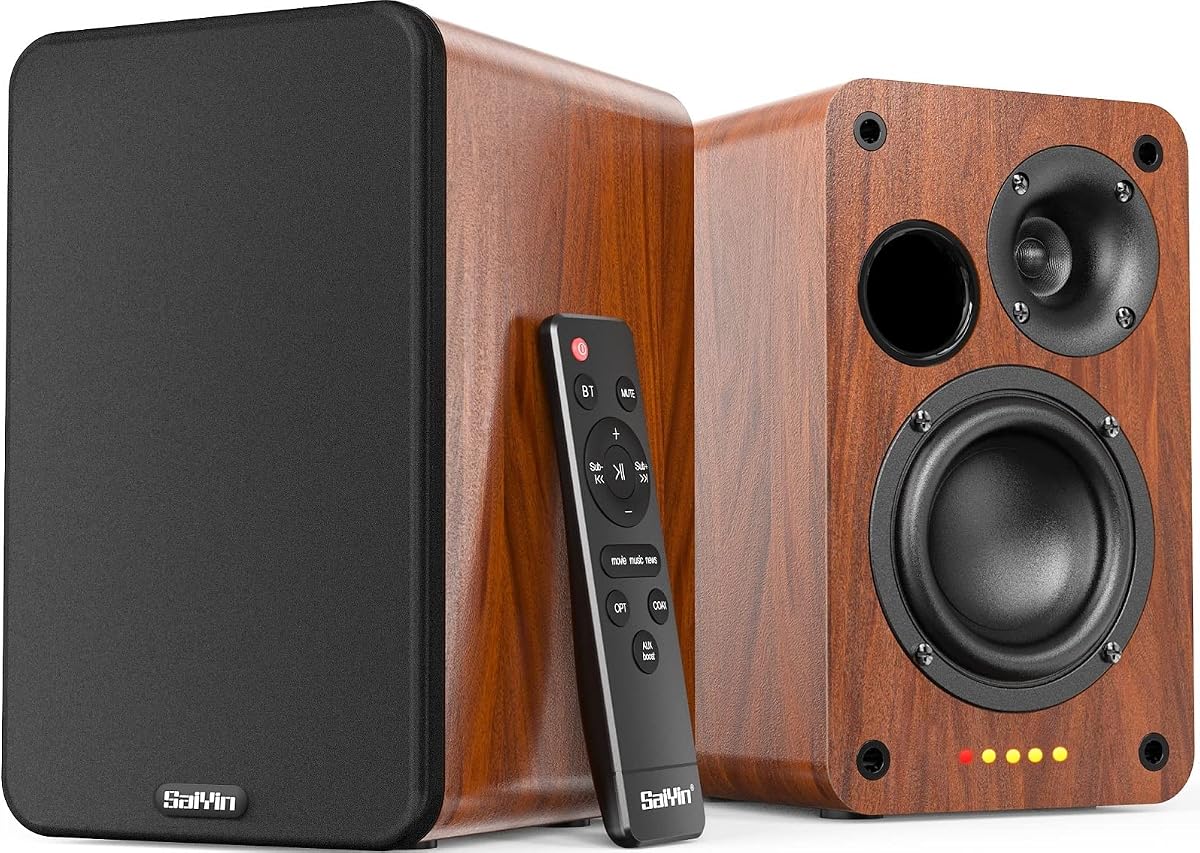
Saiyin Powered Bluetooth Bookshelf Speakers
Saiyin’s powered Bluetooth bookshelves solve a bedroom truth: the same speakers often serve a TV at the foot of the bed, a phone for playlists, and occasionally a compact turntable on the dresser. Bluetooth 5.3 handles the phone; optical and coaxial catch modern TVs; AUX and RCA keep analog gear honest. That input matrix is why this pair ranks above simpler Bluetooth-only cubes for mixed bedrooms.
Thirty watts per side with 3.75-inch woofers and silk horn tweeters is tuned for rooms, not stadiums. Active plus passive cabinets mean no receiver shelf. Dimensions around 5.3 by 6.3 by 8.6 inches fit deep nightstands better than chunky gaming bars.
Remote and on-speaker buttons matter when you are already under a blanket. Flip from optical TV mode to Bluetooth without a flashlight archaeology dig behind the dresser. For turntables, Saiyin’s own guidance still applies: use a preamp or a deck with one built in before RCA.
Tonally these aim for versatile living—movies, games on a bedroom PC, and music—rather than studio-monitor neutrality. If you want wood-classic Edifier manners with zero Bluetooth, R1280T remains purer. If you want one wireless statement box, Marshall is simpler visually.
Apartment dwellers should still respect shared walls. Optical TV audio at night can sneak louder than you think because dialogue normalization differs by streaming app—start low.
Choose Saiyin when bedrooms double as mini media rooms. Skip if you only need white noise and alarms—ANJANK is the tighter tool.
Place speakers at equal distances from center screen line and disable TV speakers to prevent chorus artifacts.
Confirm phono preamp, use RCA into the Saiyin, and keep the platter away from woofer coupling that can induce feedback.
We may earn a commission at no additional cost to you.
Ortizan Portable Bluetooth Speaker
Ortizan earns a bedroom ranking because ensuite life is real. An IPX7 cylinder that survives shower steam and still offers thirty-hour battery claims can live on a nightstand all week, then hang in the bath on Sunday without buying a second “bathroom speaker.” Dual passive radiators keep bass present at modest volumes.
The night-theme light is the redeeming lighting story: unlike beat-sync raves, it can glow softly without music. Use that mode as a calm cue; keep rainbow party themes for daytime energy only.
TWS pairing two Ortizans across a king bed approximates stereo width on a budget. It will not match Edifier wood pairs for tonal maturity, but it beats a phone on a pillow.
Bluetooth 5.3 with roughly sixty-six feet of claimed range is more than bedrooms need unless you wander to the kitchen mid-podcast. Built-in mic covers speakerphone mornings when earbuds are lost in sheets.
If your bedroom aesthetic is curated Marshall cream and linen, Ortizan will look like a tourist. If your bedroom is practical and shares a wet bath, it looks like competence.
Choose Ortizan for waterproof continuity. Choose Acton III when the speaker should never leave the dresser and should look like it pays rent.
Enjoy IPX7 in the shower, but dry ports fully before USB-C charging on the nightstand afterward.
Agree that RGB shows end at an agreed hour—night theme only after that—or the speaker becomes a relationship issue with a battery.
We may earn a commission at no additional cost to you.
Cream Acton III is not a different speaker with different drivers—it is a finish decision that changes whether Marshall dominates or cooperates with a bright bedroom. Pale walls, birch dressers, and linen headboards often reject black monoliths; cream keeps the knobs and attitude while lowering visual contrast.
Acoustically you still get the wider Acton III soundstage, dynamic loudness for late-night detail, and analog bass/treble controls that make apartment diplomacy possible. Aux input still welcomes wired sources when Bluetooth is the wrong tool.
Care is the cream tax. Makeup powder, coffee mist, and sunscreen hands leave evidence. A soft cloth monthly is part of ownership if you chose the lighter jacket.
Households sometimes mix finishes—cream in the primary bedroom, black in a den—without sonic mismatch. What changes is photography of the room and how guests read your taste.
Sustainability-minded material updates apply across Acton III colors, so you are not picking “eco” versus “not” when you pick cream. Pick the palette that lets you keep the speaker visible instead of hiding a black box you resent.
Choose cream when the bedroom’s light palette is non-negotiable. Choose black when you want the speaker to visually recede against dark furniture.
Pair with warm metals rather than chrome overload; the knobs already provide the jewelry.
Solid surface, ear-height when sitting up in bed, bass knob moderation—paint color does not change physics.
We may earn a commission at no additional cost to you.
dbsono Portable Bluetooth Speaker
dbsono’s five-star portable is almost too much speaker for a typical bedroom—and that is occasionally perfect. Large primary suites, loft sleeping areas, and rooms that open to living spaces need headroom so you are not redlining a tiny driver. One hundred watts peak with a proper tweeter/woofer layout delivers that headroom; discipline delivers good neighbor relations.
Bedroom configuration tip: never default bass boost on. The button exists for patio EDM, not for 11 p.m. jazz. Neutral mode with Bluetooth 6.0 stability is already strong. Multi-speaker pairing is overkill indoors unless you are hosting.
LED light-bar modes should join the same rulebook as Ortizan RGB—off for sleep weeks. The soft-grip handle ironically helps bedroom tidiness: hang it on a closet hook when you want the dresser clear.
USB-C audio is excellent for movie nights when Bluetooth latency bothers you. IPX5 covers drink spills more than showers; for steam baths, Ortizan remains safer.
If your bedroom is small and your walls are thin, this is the wrong default—Marshall’s dynamic loudness or Edifier near-field manners will treat you better. If your bedroom is basically a studio apartment’s only room, dbsono can be the one speaker that does day and night.
Choose dbsono for large-room versatility. Choose ANJANK when sleep masking beats wattage.
Find the knob position where bass stops exciting the joists; mark it mentally as your weeknight maximum.
Keep the bedroom charge topped so Friday patio plans do not strand you with a dead “house” speaker.
We may earn a commission at no additional cost to you.
Active Bookshelf Speakers 36W RMS
These 36W RMS active bookshelves target people whose bedroom is also a workstation. Dual silk dome tweeters and 5-inch woofers deliver deeper low end than the Sanyun 3-inch pair, while Bluetooth 5.4 and USB digital audio cover both phone leisure and laptop focus sessions. Ten-level bass and treble adjustments are unusually granular for the segment—useful when a closet corner booms.
Studio-monitor language in the listing is a hint: place them symmetrically on isolation-friendly surfaces, not buried behind laundry piles. Near-field habits from desk use translate well to sitting-up-in-bed movie watching.
USB lossless-leaning connections reduce the mushy laptop-jack problem. When work ends, Bluetooth takes the evening playlist without recabling. That dual personality is the product’s bedroom justification.
Compared with Edifier R1280T, you gain Bluetooth and larger woofers while trading some of Edifier’s long-earned accessory ecosystem simplicity. Compared with Saiyin, you lean more “monitor” than “TV optical hub,” so check whether you need optical before choosing.
Keep EQ conservative at night. Five-inch woofers couple into bed frames easily; a couple of bass steps down often cleans the entire presentation.
Choose this pair for desk-bedroom hybrids that want modern wireless and real woofer size. Choose Marshall when a single beautiful box should replace a pair entirely.
Angle the speakers toward the pillow when the desk faces elsewhere, or accept that one orientation will be a compromise and EQ for the nighttime seat.
Begin with mid bass and mid treble, then cut bass first if the room booms—boosting treble to “fix” boom usually just adds harshness.
Pick these for bigger woofers and Bluetooth 5.4. Pick Sanyun for smaller white cabinets and a 24-bit USB DAC emphasis in tighter spaces.
We may earn a commission at no additional cost to you.

If albums are the point, prioritize Marshall Acton III or a stereo bookshelf pair with tone controls. If sleep is the point, prioritize ANJANK’s sound library, dimmers, and gentle alarms. Many people need both—and should budget for a small sleep device plus a music speaker rather than forcing one gadget to lie about its job.
A left/right bookshelf pair across a bed creates spatial music that a single portable cannot. A Marshall statement box wins on simplicity and décor impact. King beds benefit more from pairs; tiny rooms often sound cleaner with one well-placed chassis.
RGB party modes, bright clock digits, and LED bars sabotage melatonin. Prefer dimmable displays, night themes, or pure dark speakers for primary sleep spaces. Save light shows for guest rooms that double as hangout dens.
Plug-in speakers are more reliable for everyday bedroom use. Battery portables help when outlets are gone—but introduce charge anxiety. Measure dresser depth before ordering 5-inch woofer cabinets.
Bedroom shopping is where “loudest” is often the wrong KPI. Clean vocals at 30% volume beat distorted flex at 80%. Use bass knobs as social tools.
A single Marshall Acton III or a compact bookshelf pair like Sanyun SW208 usually beats a large portable with bass boost enabled. Small rooms exaggerate bass; use physical EQ knobs and keep speakers off corners when possible.
Bluetooth wins for phone convenience. Wired AUX/USB/optical often wins for TVs and turntables. Mixed-input powered bookshelves (Saiyin) or a Marshall with aux give you both paths without running a full receiver.
For sleep, yes—ANJANK is built for that. For music enjoyment, no. If you love albums, keep a real speaker and use the sound machine as a specialist, not a compromise that does neither job well.
Ear height when you sit up is ideal. Symmetry across the headboard helps stereo pairs. Avoid aiming woofers straight into a wall corner behind the headboard if bass already feels muddy.
Turn bass knobs down, disable boost modes, use dynamic loudness or clearer mid/treble for dialogue, and consider isolation pads under bookshelf cabinets so the dresser does not become a drum.
Only if you can fully disable lights. Ortizan’s night theme can be gentle; beat-sync rainbow modes are better for daytime. Sleep quality should outrank desk aesthetics in a primary bedroom.
Yes for most suites at comfortable levels. Extremely large loft bedrooms may prefer dbsono headroom or a 5-inch bookshelf pair, with the understanding that volume still needs manners after 10 p.m.
Not necessarily. Podcasts and audiobooks are fine from a single centered speaker. Stereo pairs matter more for music and movies with directional mixing.
Choose a single Acton III on a dresser, a slim portable on the nightstand, or wall shelves that free furniture surfaces. Forcing oversized cabinets onto tiny stands invites tip-overs and bad sound.
Yes—Edifier R1280T and the 36W active pair are essentially bedroom-friendly powered monitors. Just style and place them as furniture, and kill any bright status LEDs you can.
The best speakers for bedroom use in 2026 depend on whether you are building a tiny listening room, a sleep sanctuary, or both. Marshall Acton III (black or cream) delivers the strongest single-box music presence with tactile EQ. Edifier R1280T and the newer Bluetooth bookshelf options create true stereo across a bed. ANJANK handles the sleep stack that pure music speakers ignore.
Match lights, bass, and footprints to shared walls and nightstand reality. If you pick with the room’s nighttime job in mind—not a beach-party wattage chart—you will get a bedroom that sounds intentional instead of like a leftover portable waiting to be charged.