Best Overall
dbsono Portable Bluetooth Speaker Wireless

- 100W peak / 60W RMS stereo with dedicated bass-boost button
- Bluetooth 6.0 with TWS, multi-speaker sync, and USB-C audio
- IPX5 rugged housing with soft-grip handle and LED light bar
Expert Review & Guide
Spending under one hundred dollars on a portable Bluetooth speaker used to mean tinny phone-dock leftovers. In 2026 that ceiling buys real stereo drivers, splash protection, all-day batteries, and pairing tricks that used to sit in pricier catalogs. The catch is marketing noise: peak-watt stickers, light shows, and “up to” battery claims all compete for attention while the speaker you actually carry has to survive backpacks, pool decks, and weekend campsites without crumbling into distortion the moment volume climbs.
This guide reviews every speaker in the under-$100 portable pack—ten listings from brand-name travel cylinders to jobsite-loud boomboxes. We weigh waterproof class, Bluetooth range honesty, bass behavior outdoors, weight, and whether dual-speaker TWS pairing is worth buying two. Ratings mirror Amazon listing scores at research time. We also flag when a speaker’s size fights its wattage story, and when a lightweight IP67 travel unit makes more sense than a party tower you will hate packing.
Need a shortlist first? Take the dbsono if you want the pack’s top-rated all-rounder with Bluetooth 6.0, bass boost, and multi-speaker pairing. Choose the IPX7 floatable 100W jobsite model when pool immersion and loud garage volume matter most. Grab the Sony SRS-XB100 when a strap-ready, dustproof travel companion with clear Sony tuning is the priority. The comparison table and full reviews cover every pack product so you can match size and sealing to how you actually listen.


As an Amazon Associate we earn from qualifying purchases. We may earn a commission at no additional cost to you.
Scan waterproof ratings, playtime caveats, and pairing options before diving into the long reviews. Peak wattage is listed where manufacturers publish it, but outdoor loudness still depends on driver layout and enclosure size. If you plan to buy a stereo pair, prioritize TWS or dual-pairing rows. Ratings reflect listed customer scores at research time.
dbsono Portable Bluetooth Speaker Wireless
The dbsono lands as the pack’s clearest under-$100 all-rounder because it pairs a three-driver stereo layout with a genuinely current wireless stack. Rated at up to 100W peak and 60W RMS, it splits duties between a 30W-peak tweeter for edge and dual 35W-peak woofers for body, then adds a one-press bass-boost mode when you want the racetrack woofer to lean harder into kick drums and hip-hop. That is more acoustic ambition than most bargain cylinders bother with, and the perfect five-star listing score reflects how often buyers feel they got “more speaker” than the budget suggested.
Bluetooth 6.0 is the quiet differentiator. Faster pairing and a claimed stable link out to roughly ninety-six feet matter when your phone sits on a picnic table and the speaker rides a cooler ten yards away. Low-latency streaming helps video clips and casual gaming feel less rubber-banded than older Bluetooth 4.x leftovers still floating around this price. Smart power management that shuts the unit down after fifteen idle minutes is a small quality-of-life win for people who forget the power button after packing up camp.
Build details lean practical rather than fashion-forward. Shock-resistant ABS, grippy silicone, and tear-resistant nylon fabric give the chassis a jobsite-adjacent toughness without turning it into a twenty-pound brick. IPX5 water resistance covers rain, hose mist, and poolside splashes; it is not an invitation to dunk the speaker in the deep end. The integrated soft-grip handle makes one-handed carry between garage and patio feel natural, which sounds trivial until you have juggled a handle-less brick with wet hands.
Multi-speaker pairing and TWS stereo widen the value story. One unit already fills a medium backyard; two units in true left/right mode create a wider stage for movie nights on the deck. USB-C audio is an underrated escape hatch when a park is crowded with Bluetooth chatter or when you want a laptop hardwired for lower latency. Dynamic LED light-bar modes cover party and camping moods, and they can be killed when you need every milliamp for late-night playlists.
Where the dbsono can frustrate perfectionists is expectation management. Peak wattage marketing always sounds louder on a product page than in a windy open field, and bass boost can thicken mixes that already run hot in the low end. Still, for buyers hunting the best portable Bluetooth speakers under $100 who want modern wireless, real stereo hardware, and outdoor-capable sealing without stepping into boombox bulk, this is the pack’s strongest default recommendation.
If your use case is mostly beach immersion or shower hanging, an IPX7 floatable elsewhere in this list may feel safer. If you need backpack silence and brand-tuned clarity above raw output, the Sony XB100 is the calmer travel pick. Everyone else shopping for a single under-$100 speaker that can host a cookout, survive a campsite drizzle, and pair a second unit later should start here.
Backyard hosts, garage playlist people, and campers who want one speaker that does not feel apologetic at volume. Also ideal if you already own a USB-C cable ecosystem and like the option of wired audio without hunting a 3.5 mm jack adapter.
Keep the phone within line of sight for the longest Bluetooth stretch, disable the light bar for multi-hour sessions, and only enable bass boost after you have heard the track at neutral EQ—some EDM masters do not need the extra shove.
Choose dbsono for Bluetooth 6.0 polish, bass-boost control, and handle-friendly carry. Choose the IPX7 floatable model when the speaker may sit in pool water or needs a wireless phone-charging top plate more than the latest Bluetooth revision.
We may earn a commission at no additional cost to you.

Portable Bluetooth Speaker Line
This Line-in portable is the pack’s reminder that “under $100” can also mean “under a pound.” At about 0.694 pounds and roughly 4.5 by 2.0 by 3.4 inches, it disappears into a jacket pocket or the side pouch of a hiking pack in a way the W-KING boombox never will. The tuning aims for balanced HD playback—deep enough bass for pop, readable mids for podcasts, and crisp highs that cut through trail wind better than a phone speaker ever will.
TWS pairing is the clever answer to the size problem. One unit is a personal trail companion; two units create a wider stereo field for picnic tables and tent vestibules. That matters because buyers often judge small speakers unfairly against party boxes. Treated as a stereo pair, this model becomes a modular system you can split between rooms or reunite for movie night.
Battery marketing needs a careful read. The up-to-24-hour figure assumes roughly 30% volume with the light show disabled. Crank it for a beach afternoon with LEDs dancing and you will not see a full day. Still, for commuting playlists and campsite background music, the cell is generous, and Bluetooth 5.3 keeps pairing quick with phones and tablets.
IPX5 weather resistance covers sweat, light rain, and poolside splash without pretending the speaker is a submarine. The colorful light modes are pure mood lighting—fun in a dorm, optional on a ridge at sunrise. Packaging deliberately omits a USB-C cable to cut e-waste, which is environmentally tidy and mildly annoying if your cable drawer is empty.
Giftability is part of the listing’s pitch for a reason. The form factor feels like an impulse upgrade rather than a commitment to owning a boombox. Teens, travelers, and anyone who already owns bigger living-room speakers but wants a throw-in-the-tote option will appreciate that restraint.
Skip it if your definition of portable still includes filling a noisy backyard from one chassis. For that job, stay with the dbsono or W-KING. Choose this Line speaker when grams matter as much as watts and you are willing to buy a second unit later for stereo width.
Bike basket playlists, climbing approach trails, dorm desks, and carry-on personal-item packing where every cubic inch is contested.
Test your preferred volume for thirty minutes on day one, note how fast the gauge drops, and decide whether lights are worth the hit before a weekend trip.
We may earn a commission at no additional cost to you.
Speakers Bluetooth Wireless (IPX7 Floatable)
If your under-$100 budget has to survive actual water—not just a nervous splash—this IPX7 floatable unit is the pack’s most convincing pool and jobsite answer. The housing is built to shrug off downpours and sit in the water without the anxiety that IPX5 models invite. For lake houses, pool decks, and boat docks, that sealing class is worth more than another LED animation mode.
Acoustically it leans into 100W peak output with an emphasis on deep bass and intelligible vocals. That balance matters in noisy environments: lawn equipment, garage fans, and party chatter bury delicate treble first. A speaker that keeps lyrics readable while still thumping kick drums earns its keep faster than one that only wins on a quiet desk demo.
Runtime lands around twenty hours depending on volume and how aggressively you run the three colorful light modes. Treat the lights as a party accessory rather than a default. TWS pairing lets a second matching speaker widen the stage for backyard movies or campsite surround vibes without dragging a receiver into the dirt.
Utility extras push this model past “just a speaker.” A wireless charging pad on top keeps a compatible phone topped up while playlists run—handy when the only outlet is across the garage. The flashlight with constant-on and SOS patterns is the sort of detail you ignore until a tent zipper fails at midnight. Connection flexibility is strong: Bluetooth 5.3 for daily streaming, plus AUX, TF card, and USB-C paths when phones die or playlists live offline.
Bluetooth range is listed around sixty-five feet unobstructed, which is solid for a patio though short of the dbsono’s longer claim. In practice, walls and bodies still matter more than brochure feet. Place the speaker with a clear line to the source phone and you will hear fewer dropouts than stacking it behind a cooler wall.
Buy this when water immersion and loud utility spaces define your week. Skip it when your priority is a featherweight travel cylinder—the Sony XB100 or Beach Essentials model will feel kinder in a suitcase. For everyone else who wants an under-$100 Bluetooth speaker that can float, flash, and fill a garage, this is the pack’s workhorse pick.
Floating is fine; cannonball splash zones and chlorine overnight soaks are not. Rinse freshwater after salt or heavy pool chemical exposure and dry the ports before charging.
Campsite latrine walks, fuse-box trips in dark garages, and roadside waits when you want SOS visibility without digging for a separate torch.
This floatable jobsite model prioritizes louder outdoor output and phone charging. Ortizan counters with longer claimed playtime and a more classic party-cylinder light show in a smaller vertical form.
We may earn a commission at no additional cost to you.

Twenty watts does not sound heroic next to triple-digit peak claims, yet this dual-driver HD speaker often sounds more composed indoors because it is not fighting to flex marketing numbers. Two drivers and careful processing aim for powerful, well-balanced playback with minimal distortion—exactly what you want for gaming sessions, kitchen playlists, and movie dialogue on a laptop night.
Outdoor credibility comes from IPX5 sealing and a chassis sized for tote bags rather than wheeled coolers. Parties, pool edges, campsites, and hiking rest stops are all in the intended orbit. Bluetooth 5.3 with a claimed hundred-foot reach gives you room to leave the phone on a blanket while the speaker sits nearer the group.
Battery life is advertised up to twenty-four hours at about half volume with lights off. That is a more honest test point than many “max hours at whisper volume” claims. Keep the multicolor beat-sync show for Friday nights; shut it down for Sunday trail days. Actual runtime still swings with genre loudness and winter cold, so treat the number as a ceiling.
TWS pairing is the upgrade path. One speaker handles a bedroom; two create a wider stereo image that helps movies and electronic music feel less mono-centered. The built-in microphone covers quick calls without hunting earbuds, and the AUX jack saves older devices or latency-sensitive setups.
Physical footprint sits in a friendly middle ground—about 7.9 by 2.8 by 2.8 inches and roughly 1.28 pounds—so it feels substantial without becoming luggage. Packaging includes the Type-C cable many ultra-budget rivals omit, which lowers day-one friction.
Choose this when you want an everyday under-$100 Bluetooth speaker that sounds intentional at living-room volumes and still survives weekend moisture. Look elsewhere if you need floatable IPX7 immersion or jobsite-shaking 108 dB ambitions.
Dorms, small apartments, camping coolers, and patio tables where clarity beats pure loudness contests.
Place the two speakers at ear height with a few feet of separation; stuffing both on the same shelf collapses the width you paid for.
We may earn a commission at no additional cost to you.

Ortizan Portable Bluetooth Speaker (1st Gen)
Ortizan’s first-generation portable has stuck around for a reason: it nails the party-cylinder brief without asking you to abandon waterproofing or battery life. Dual 12W drivers (24W total) work with an advanced DSP and two passive radiators to push crisp treble, detailed mids, and boosted outdoor bass that punches above the modest wattage on paper. At campsite volumes the radiators do the heavy lifting that tiny sealed cups cannot.
IPX7 is the confidence feature. The listing describes immersion protection up to about three feet for roughly thirty minutes, which covers shower steam, beach wipeouts, and cooler-melt puddles. You still should not treat any Bluetooth speaker as a dive computer, but Ortizan’s sealing class is a clear step up from IPX5 splash-only rivals.
Thirty-hour playtime around 65 dB is the pack’s endurance headline. That is background-to-moderate listening, not festival volume, yet it means a long weekend is realistic without hunting an outlet. Bluetooth 5.3 keeps a stable link out to about sixty-six unobstructed feet and pairs cleanly with phones, TVs, and laptops.
The light show is more than decoration. Gradient party themes pulse with music, while a night theme can act as a soft lantern in a tent vestibule even when audio is paused. Dual pairing (TWS) lets two Ortizans behave like left/right channels for a surprisingly wide movie-night stage on a budget.
Form factor is a tall-ish cylinder about three inches across and 6.7 inches tall at roughly 1.28 pounds—easy to grip, less easy to forget in a coat pocket. The included Type-C cable and user guide lower setup friction, and the HD mic covers speakerphone moments when earbuds are elsewhere.
Pick Ortizan when waterproof parties and marathon batteries define your under-$100 search. If you need maximum absolute loudness for a noisy worksite, the W-KING or floatable 100W model will feel more assertive. If you need suitcase stealth, Sony still wins on compactness.
IPX7 helps, but rinse salt crystals, keep charging ports dry before plugging in, and avoid soap buildup in fabric textures after steamy bathrooms.
Set speakers left and right of the screen at similar heights; avoid placing one behind cushions that swallow the radiators’ bass contribution.
We may earn a commission at no additional cost to you.
Sony’s SRS-XB100 is the under-$100 portable you buy when brand tuning and travel manners matter more than winning a wattage shouting match. The improved driver focuses on clear sound with deeper low-end than the tiny chassis suggests, while the Sound Diffusion Processor spreads energy so the speaker feels less like a flashlight beam of treble and more like a small room filler.
Portability is the point. The engineered strap turns the XB100 into something you clip to a duffel, hang in a shower, or tether near a beach chair without inventing a MacGyver mount. IP67 waterproof and dustproof sealing plus a UV coating acknowledge real travel abuse: sand, sunscreen mist, sudden rain, and that hotel bathroom steam cloud.
Sixteen hours of battery with an indicator is enough for a full travel day and then some at sensible volumes. It is not the pack’s longest claim, but Sony’s number tends to feel grounded for people who already distrust fantasy endurance figures. USB-C charging matches modern cable kits, so you are not packing a legacy barrel adapter.
Stereo pairing with a second XB100 is the elegant expansion route. Instead of forcing one micro-speaker to party-host a warehouse, you add width. Hands-free calling with echo canceling is surprisingly useful on hotel balconies and campsite reception pockets when earbuds are packed away.
What you give up is sheer output. Garage DJs and beach megaphone people will still prefer W-KING or the floatable 100W unit. What you gain is a speaker you will actually bring because it never feels like a chore to carry—often the deciding factor between a speaker that gets used weekly and one that lives in a closet.
Within a best portable Bluetooth speakers under $100 shortlist, the XB100 is the refined travel vote. Pair it with a louder patio speaker at home if you want both lifestyles; do not expect this single chassis to replace a boombox.
Strap it outside a backpack mesh pocket for quick airport playlist access, but keep it inside during checked-bag chaos—compact does not mean crush-proof under suitcase wheels.
Hang it away from direct showerhead spray even with IP67; steam and incidental splash are the design target, not a pressure-washer demo.
Sony wins on brand tuning, dust sealing, and call quality. The Beach Essentials model wins on raw grams and a cheaper path to TWS stereo if brand prestige is less important.
We may earn a commission at no additional cost to you.

W-KING D9-1 Loud Bluetooth Speaker
The W-KING D9-1 is what happens when an under-$100 budget is spent almost entirely on displacement and output. A four-driver layout—two subwoofers and two tweeters—plus a massive 7.2-inch rear passive radiator chase 100W peak energy and a claimed 108 dB presence. In open air, that radiator’s moving surface is why bass remains audible when smaller cups have already turned to midrange shout.
This is a boombox, not a pocket pebble. The rugged, floatable IPX6 shell and carry handle telegraph jobsite and camping priorities: rain, mud splash, cooler-adjacent abuse. IPX6 is strong spray protection even if it is not the same immersion story as IPX7 cylinders. For most outdoor parties, the distinction is academic; for pool floating, prefer the dedicated floatable IPX7 model.
Dual pairing can push a stereo pair toward a 200W-peak party wall, which is overkill for apartments and perfect for field hangouts. Bluetooth 5.0 with roughly a hundred-foot claim still works fine in yards, though it lacks the newer 6.0 niceties of the dbsono. Hands-free calling covers quick worksite check-ins.
EQ switching is a practical outdoor tool. One click leans bass for EDM, another clarifies mids for talk radio or coaching videos, another brightens treble when generators and wind mask detail. Forty-hour playtime at low volume is the camping-sleep-playlist number; loud daytime sessions will land far sooner, as with every big battery claim.
Extras include TF card and AUX for offline and wired playback, NFC tap pairing on compatible Android phones, and the ability to charge phones from the speaker so your music source does not die first. Charge the W-KING itself with a proper 5V/2A adapter for saner refill times.
Buy the D9-1 when loudness and bass authority are the assignment. Do not buy it as a discreet hotel companion—that is Sony or Beach Essentials territory. Within best portable Bluetooth speakers under $100, this is the volume king with the tradeoffs that title implies.
Place it on a stable surface away from sawdust blowers; floatable does not mean immune to a three-foot drop onto concrete.
W-KING warns that D9 and D9-1 generations do not pair across lines—buy matching units if stereo linking is part of your plan.
We may earn a commission at no additional cost to you.

SOWO Bluetooth Speaker Wireless
SOWO’s wireless cylinder sits in the sweet spot between fashion-forward fabric and waterproof practicality. Twenty-five watts of stereo drivers plus two wide passive radiators aim for loud, coherent playback, while Bassboom processing claims roughly a twenty-eight percent bass lift over the untuned baseline. For pop, hip-hop, and camping folk playlists, that extra low-end is the difference between “cute” and “actually fun.”
IP67 waterproof and dustproof sealing means showers, beach bags, and dusty trailheads are fair game. The injection-molded structure under the fabric wrap keeps the body feeling solid in the palm, and the braided lanyard encourages hanging rather than balancing the speaker on precarious cooler lids.
Sixteen hours of playtime from a high-cycle battery chemistry is enough for day-to-night listening if you are not constantly at maximum volume. SOWO emphasizes recharge longevity versus disposable bargain cells—useful framing if you keep speakers for years rather than seasons. Bluetooth 5.0 with about a thirty-nine-foot claim is the weak spot next to 5.3/6.0 competitors; keep the phone closer in crowded parks.
TWS surround pairing is the party trick. Two SOWO units create a left/right image that helps movies and electronic albums feel less mono. RGB lighting under the fabric adds campsite ambience; turn it down when you want fabric to look like fabric instead of a nightclub sleeve.
The built-in mic covers quick calls, and the compact cylinder slides into backpacks more kindly than the W-KING boombox while sounding fuller than the tiniest ultralights. It is a balanced “I want one nice outdoor speaker” choice rather than a specialist extreme.
Choose SOWO when IP67 confidence and bass-forward fun matter, and you can live with older Bluetooth range. Choose Ortizan if marathon batteries matter more, or dbsono if you want the newest wireless stack and a handle-equipped chassis.
Rinse sand gently, avoid stuffing the wet fabric into a sealed plastic bag overnight, and let it air-dry before the next charge cycle.
Plan for backyard-scale wireless, not house-spanning. If you routinely walk rooms away from the speaker, prioritize dbsono or the 20W HD model’s longer claims.
We may earn a commission at no additional cost to you.

Maidsonic’s 100W peak boombox chases the same loud-outdoor brief as W-KING but dresses it in a more light-show-forward personality. A three-unit system—one tweeter and two woofers with dual-diaphragm thinking—tries to keep bass fun without letting mids disappear when the playlist gets dense. That tweeter focus is valuable at block-party volumes where cheaper dual-woofer toys turn muddy.
IPX6 waterproofing targets thunderstorms, beaches, poolsides, and boats. It is spray-and-weather armor rather than swim-with-it armor, which still covers most portable chaos. Dynamic LEDs sync to the beat and can be color-locked to match a theme—purely optional for camping, nearly mandatory for the buyer who wants the speaker to look like part of the party.
Bluetooth 5.3 and TWS pairing modernize the wireless story. Two units fill larger rooms with surround-leaning stereo for games and movies. The thirty-six-hour playtime claim rides on a 10,000 mAh cell; as always, loud LED-heavy nights will not see that ceiling, but multi-day festivals at moderate volume become plausible.
The package includes a Type-C cable and manual, plus a mic for calls and an AUX path for wired sources. That completeness matters in a segment where some listings proudly ship without cables. Gift framing is heavy in the marketing, and the feature set—lights, loudness, long battery—matches birthday-party energy more than audiophile desk duty.
The 4.4 rating, lowest in the pack, is a reminder to read recent reviews for unit consistency and light-board durability. Plenty of buyers love the output; a minority hits quality-control gripes common to flashy boomboxes. Buy from a retailer with easy returns if you are sensitive to that risk.
Pick Maidsonic when LED theater and long battery life share priority with loud outdoor sound. Pick W-KING if you care more about the giant radiator and EQ button than synchronized light drama. Pick Sony if you want none of the boombox lifestyle at all.
Use TWS stereo at medium levels before maxing one chassis; distortion and neighbor goodwill both improve when two speakers share the workload.
Disable or dim LEDs after dark to protect night vision and battery, especially in shared campgrounds.
We may earn a commission at no additional cost to you.
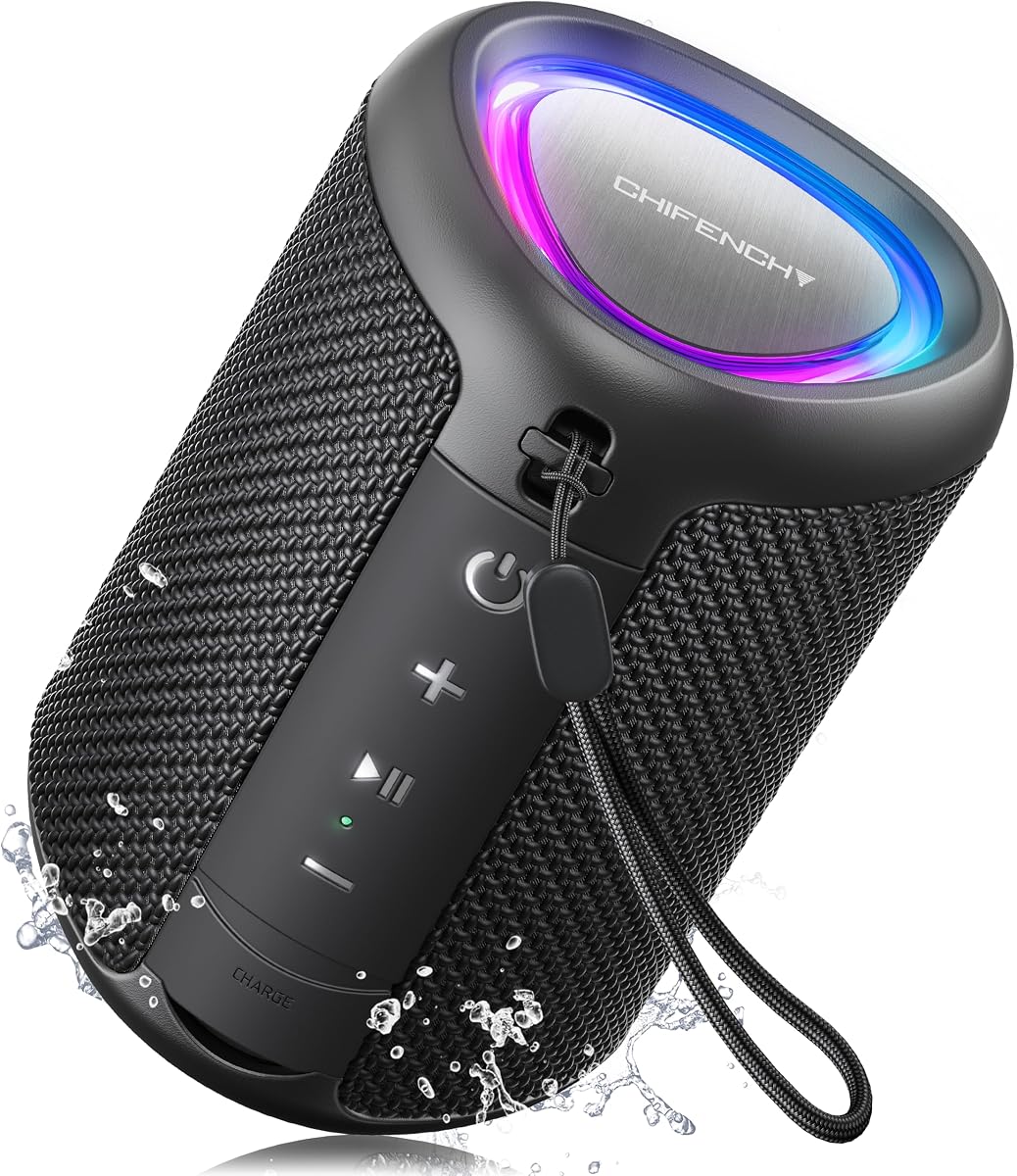
Portable Beach Essentials Speaker
The Beach Essentials speaker is engineered around a blunt truth: the best portable speaker is the one that is still in the tote when you leave the house. At roughly three inches square and 4.25 inches tall, weighing about 0.582 pounds (264 grams), it is easier to bring than to forget. Twenty watts peak and fifteen watts continuous give it surprising punch for backpack speakers that often sound like clock radios.
IPX5 waterproofing plus a sand-resistant attitude covers ocean mist, rain showers, and poolside splashes. The listing’s practical advice—rinse it when sand settles—matters more than logo theater. This is a rinse-and-go summer tool, not a sealed submarine, so treat charging ports with respect after beach days.
Bluetooth 5.3 with up to about one hundred feet of range is excellent for the size class, letting the phone stay in a tent while the speaker hangs from a beach umbrella via the built-in lanyard. Dynamic lights earn their keep at sunset hangs and dorm celebrations; they are optional atmosphere, not the acoustic reason to buy.
Fifteen hours of playtime covers sunrise yoga to evening card games if volume stays sane. TWS pairing is the hidden power feature: two ultralight units become a thirty-watt stereo set that still weighs less than many single boomboxes. That modular approach fits students and travelers who want flexibility without owning a permanent party appliance.
Sound character prioritizes punchy bass and crisp highs for outdoor clarity. It will not reproduce organ pedals like a living-room tower, and it should not be asked to. Within its lane—beach, dorm, garage bench, camping pouch—it delivers music you can share without carrying a brick.
Choose Beach Essentials when grams and grab-and-go habit formation matter most. Choose Sony if you want stricter IP67 dust sealing and brand call quality. Choose dbsono or W-KING when one speaker must own a noisy yard alone.
Rinse with fresh water after beach days, shake out grit around buttons, and dry fully before USB charging to protect the port.
Strong pick for teens, dorm moves, and travelers because it feels useful immediately without demanding shelf space or a separate power brick lifestyle.
Clip one speaker to each end of a blanket’s cooler handles for a quick left/right spread without stands or tables.
We may earn a commission at no additional cost to you.
Peak wattage is a ceiling, not a promise of clean loudness. A 100W peak three-driver system with a real enclosure will usually outplay a tiny 20W cup in open air, but only if you give it room to breathe and avoid maxing EQ into clipping. Under $100, trust driver count, passive radiators, and user comments about distortion more than the boldest number on the box.
If your listening is mostly desks, dorms, and hotel rooms, a well-tuned 20–25W speaker can sound more pleasant than a booming jobsite box playing at two notches above whisper. Match the tool to the acoustics you actually use.
IPX5 handles splashes and rain. IPX6 shrugs off stronger jets and storms. IPX7 / IP67 add immersion and, with the 6 dust digit, sand resistance. Pool float claims matter only if you will actually put the speaker in the water. Shower use favors IPX7 cylinders; desert camping favors IP67 dust sealing like Sony’s XB100.
Every long playtime number in this pack assumes a friendly volume and often lights off. Ortizan’s 30-hour and Maidsonic’s 36-hour figures are marathon ceilings. Sony’s 16 hours may feel more typical at travel volumes. Test your preferred loudness early; it is the only battery rating that matters.
True Wireless Stereo pairing is the budget path to width. Two small speakers spaced apart often beat one louder mono brick for movies and electronic music. Confirm matching generations before you buy a pair—some brands block cross-model linking.
Multi-speaker party modes that sync more than two units help large yards, but only if you enjoy managing batteries and volumes across the set.
Sub-pound speakers get used. Seven-pound boomboxes get left in the car. Be honest about whether your “portable” life is beach tote, bicycle, or driveway party. The best under-$100 speaker is the one whose weight matches your carrying habit.
AUX saves older devices and some TVs. TF cards keep music alive when phones overheat in the sun. USB-C audio on the dbsono is a modern wired escape hatch. Built-in mics are handy; they are not headset replacements for long work calls.
Enough to own a patio, beach blanket, or garage for a small group when you pick a 60–100W-peak multi-driver model. Filling a windy open park for dozens of people still favors larger pro gear. Compact 15–25W travel speakers excel up close and disappoint if you expect boombox reach from a coat pocket.
If two speakers sound similar acoustically, newer Bluetooth can mean snappier pairing and better stability at range—dbsono’s 6.0 stack is a real plus. It will not fix a weak driver. Choose wireless generation as a tiebreaker after waterproofing, size, and tonal taste.
Floatable IPX7 designs tolerate water exposure far better than IPX5 splash units, but all-afternoon chlorine soaks, sandy abrasion, and forgotten charging while wet still shorten product life. Use the float feature for convenience, rinse afterward, and dry ports before charging.
They cost power every minute they run. Manufacturers often quote max playtime with lights off for that reason. If endurance matters more than vibes, disable LEDs; if the speaker is mainly a party centerpiece, enjoy the show and pack a power bank.
Often yes for music and movies that benefit from stereo width—TWS pairs of Ortizan, SOWO, Beach Essentials, or the 20W HD model can sound more spacious than a single mono boombox. Choose one louder chassis when you need simple setup and maximum SPL from a single handle-carry unit.
Prefer IPX7 or IP67 models such as Ortizan, SOWO, the floatable jobsite speaker, or Sony XB100. Hang them away from direct high-pressure spray, and never charge while wet. IPX5 speakers are better as bathroom-counter splash guards than true shower companions.
A few brands skip cables to reduce packaging waste, assuming everyone already owns USB-C leads. Budget an extra cable if your household is not already standardized. Speakers that include Type-C leads simply reduce day-one friction.
No. Peak numbers describe short bursts; RMS describes continuous power. The dbsono’s dual listing (100W peak / 60W RMS) is more informative than peak-only marketing. When RMS is missing, lean on driver design and trusted reviews instead of assuming the peak figure is a steady output.
Prioritize weight and sealing: the Line speaker, Beach Essentials ultralight, or Sony XB100. Boomboxes belong at base camp, not on a summit push. Keep volume considerate on shared trails—portable does not mean you should soundtrack the whole switchback.
They can cover kitchens, bedrooms, and patios convincingly, especially in TWS pairs. They will not match bookshelf speakers with proper stands and room treatment for critical listening. Use portables for mobility and convenience; keep dedicated home speakers for seated album sessions if fidelity is your hobby.
The best portable Bluetooth speakers under $100 in 2026 are no longer jokes with flashlight LEDs. Between the dbsono’s Bluetooth 6.0 all-rounder package, the IPX7 floatable jobsite unit’s water confidence, and Sony’s strap-ready XB100 travel manners, you can cover cookouts, pools, and packing lists without crossing the hundred-dollar line. Boombox specialists like W-KING and Maidsonic remain the right answer when loudness is the entire brief.
Match sealing to water, weight to carry habits, and battery footnotes to your real volume. Use TWS pairing when width matters more than owning a single louder brick. If you start with the top-picks trio and then confirm your IP rating and size class in the comparison table, you will avoid the two classic mistakes of this category: buying a party tower you never take anywhere, or buying a pebble that cannot be heard over the waves.