Best Mainstream 4090 Mid-Tower
Lian Li V100

- GPU clearance up to 420 mm for long partner cards
- Four ARGB PWM fans ready for hot flagship thermals
- Top 360 mm radiator room if the CPU also runs hot
Expert Review & Guide
An RTX 4090 is not only a power bill—it is a length, thickness, and airflow problem that average mid-towers fail quietly. Partner cards often stretch well past 330 mm, eat multiple slots, and dump heat that stagnates behind solid front panels. The best PC cases for RTX 4090 duty in 2026 publish honest GPU clearance, keep intake open, and leave room for thick power cables beside a brick-sized cooler shroud.
This guide uses only the ReviewConsensus pack: Lian Li’s V100, SilverStone SETA storage and airflow towers, Antec’s dual-chamber C8, a compact wood-front Shiny Snake MATX that claims 400 mm GPU room, ANSAITE’s white panoramic C9, JONSBO D31/D41 mesh cases that explicitly mention RTX 4090 lengths, CORSAIR’s 4000D RS Frame, and DARKROCK’s EC2. No dollar prices—verify your exact card’s length and slot width against each clearance figure.
Start with the top picks if you already know your motherboard size. Compact MATX builders should study JONSBO and Shiny Snake carefully; E-ATX and storage-heavy workstations may prefer SilverStone or Antec.

As an Amazon Associate we earn from qualifying purchases. We may earn a commission at no additional cost to you.
Prioritize published GPU length and mesh or open intake. Specs omit prices so you can match your exact 4090 card dimensions and motherboard size.
For a conventional ATX gaming desk, Lian Li’s V100 is the safest mainstream answer to “will my RTX 4090 fit?” GPU clearance up to 420 mm swallows the long triple-fan partner cards that bounce out of 330–350 mm chassis. That single number is why it leads this pack for 4090 owners who do not want a specialty compact puzzle.
Four pre-installed ARGB PWM fans matter because a 4090 is an airflow appliance. Idle RGB is optional; moving air across a long shroud is not. Daisy-chain PWM control lets you ramp case fans with GPU load instead of running a hair dryer soundtrack all day.
CPU cooler height to 178 mm and a top 360 mm radiator mount acknowledge the other half of many 4090 systems: a high-core CPU that also wants serious cooling. You can liquid-cool the CPU while the 4090 stays on air—still the common high-end split.
Tool-less side access sounds minor until you are the person reseating a 12VHPWR cable for the third time because a 4090 would not post. Fast panels reduce the swear-word count.
Back-connect motherboard support helps visually and physically. Fat GPU power cables competing with ATX 24-pin runs are why flagship builds look angry; rear connectors calm the chamber beside a giant card.
Buy the V100 when you want a known mid-tower envelope, included fans, and length headroom. If you need E-ATX storage madness or a wood-front 34-liter MATX sculpture, keep reading—but for most 4090 ATX builds, start here.
Founders-style and partner cards differ. Check length, slot span, and whether a GPU support bracket is included. 420 mm case clearance is not a promise that every cooler shroud clearance and PCIe slot layout will feel identical.
Leave space between the glass and the 12VHPWR connector. Cases with generous width and tool-less panels make safe cable curves easier than ultra-slim showcases.
We may earn a commission at no additional cost to you.

Silverstone Technology SETA D1 Mid
Not every RTX 4090 lives in a rainbow gaming bedroom. SilverStone’s SETA D1 targets builders who pair a flagship GPU with an Extended ATX or SSI-EEB board and a pile of drives—think editing, simulation, or local AI toolchains that still want CUDA horsepower.
Durable steel and a modular storage system that mixes 5.25, 3.5, and 2.5 devices are the personality. A 4090 build that also hosts capture archives needs cage flexibility more than another ARGB strip.
Extensive air and water cooling support is the thermal handshake. Hot GPU plus high-core CPU plus many disks is an oven unless the chassis takes radiators and fans seriously.
Front I/O with Type-C, two USB 3.0 ports, and combo audio covers workstation peripherals. It will not make the case a light show; it will make daily cable reaches sane.
The 3.8 rating is a reminder to read recent owner notes about fitment and quirks. E-ATX chassis with modular storage can demand more planning than a simple mid-tower—especially when a 4090’s length intersects drive cages.
Choose the SETA D1 when motherboard size and storage flexibility outrank panoramic glass. Pure gamers with ATX boards and a single SSD should look at Lian Li, CORSAIR, or JONSBO instead.
Dry-fit the graphics card before locking every drive cage. Modular storage is a gift only if you leave the GPU’s exhaust path and power cable route open.
Workstation hybrid builders, NAS-leaning creators, and anyone whose board is wider than standard ATX. Not the impulse RGB buy.
We may earn a commission at no additional cost to you.
Antec’s C8 is one of the few cases in this pack that says the quiet part out loud: RTX 40-series GPU support. Paired with a dual-chamber full-tower layout, it is aimed at people who bought a 4090 as a centerpiece and want the chassis to look and cool like it knows that.
Fans are not included. That is frustrating on a packing list and liberating for enthusiasts who refuse mystery fan bundles. Plan three to six quality fans before the 4090 ever wakes up, or the glass palace will throttle in summer.
Radiator support is lavish—thick 360 mm mounts on top, bottom, and side simultaneously in Antec’s description, plus room for large fans on top and bottom including 140 mm or even 160 mm class mounts. A 4090 system with a hot CPU can go properly liquid on the processor side.
Dual-chamber design keeps the PSU and cable bulk from choking the GPU’s intake. Flagship cards hate recirculated PSU heat; separation is practical, not only photogenic.
Tempered glass front and side with seamless edge styling make the C8 a show case. Judge your room’s dust and your willingness to clean glass before prioritizing looks over a full mesh face.
Buy the C8 when you want a dual-chamber 40-series stage and will happily choose your own fans. Buy Lian Li or CORSAIR when you want fans in the box and a smaller mid-tower footprint.
At minimum, set a front or bottom intake array aimed at the 4090 and a rear/top exhaust path. Dual-chamber cases still need deliberate direction—empty mounts do not move air.
The C8’s E-ATX friendly full-tower nature suits wide boards and big GPUs together. Confirm standoff layouts if your motherboard is an unusual SSI size.
We may earn a commission at no additional cost to you.
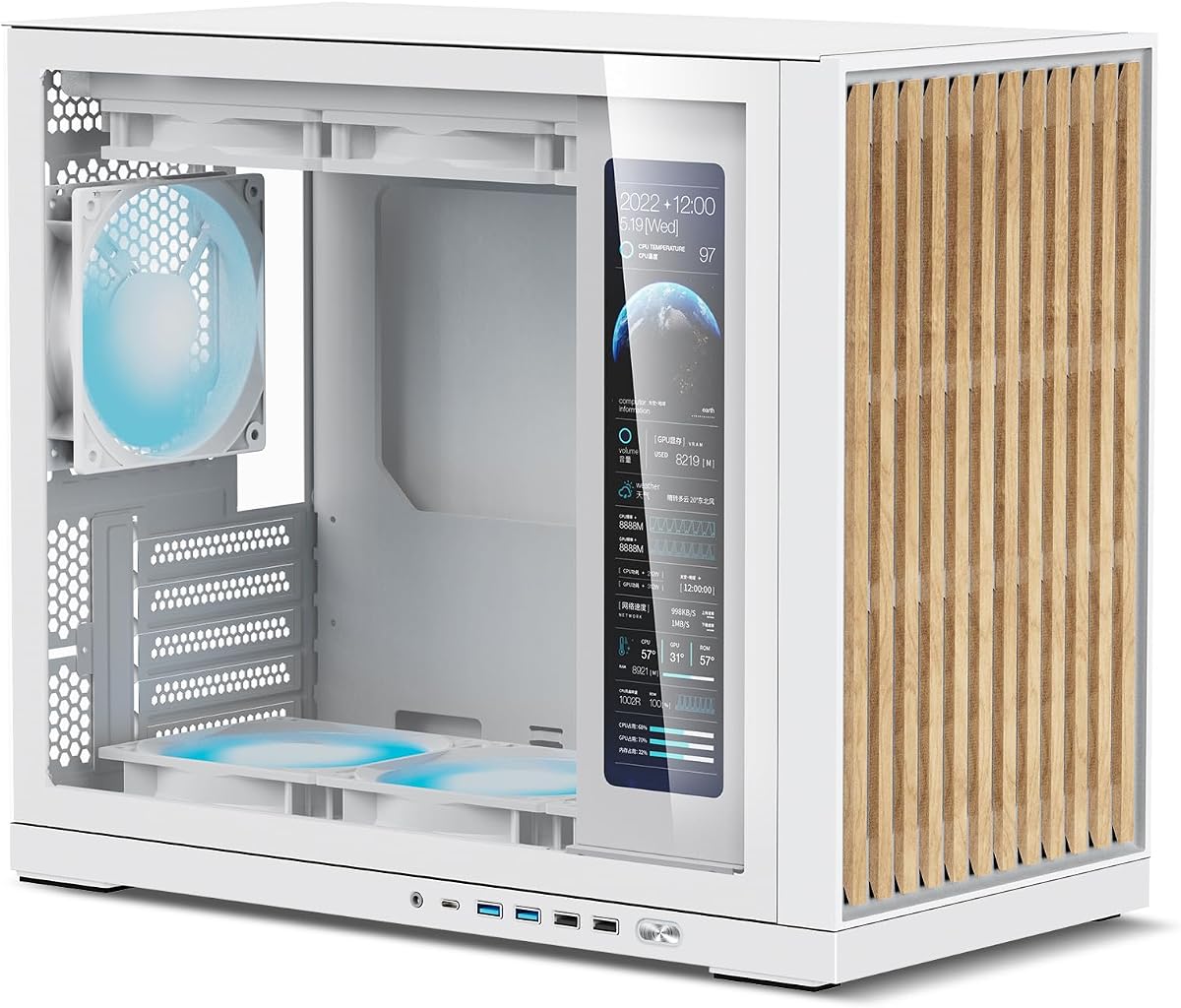
Shiny Snake G600 Compact MATX Case with Wood Front Panel
Shiny Snake’s G600 is the pack’s bold compact promise: furniture-grade wood up front, tempered glass on the side, and up to 400 mm of 5-slot GPU room for RTX 4090 and even 5090-class cards inside a roughly 34-liter shell sized for 50 cm desks.
The three-level adjustable PSU chamber is the engineering detail that makes long GPUs possible. You trade PSU length against graphics clearance instead of discovering the conflict after the motherboard screws are in.
Cooling options include 360 mm AIO mounts at top or bottom, a 120 mm rear AIO option, or a full 7×120 mm fan layout with air coolers up to 170 mm. Lab-verified high-airflow language aims to keep i9/Ryzen 9 + 4090 stacks stable in a small box.
Optional 11.3-inch 1920×480 auxiliary screen editions turn the case into a hardware dashboard for CPU/GPU temps and fan RPM—the kind of toy that thrills streamers and helps you notice a 4090 thermal limit before the game hitching does.
Front I/O is unusually complete for the size: 10Gbps Type-C, dual USB 3.0, dual USB 2.0, and combo audio. Storage mounts vary between standard and screen editions, so read which SKU you are actually ordering.
Consider the G600 if a living-room aesthetic and compact footprint matter as much as 4090 length. Validate your exact card thickness and PSU length against the adjustable bay, and treat the middling rating as a cue to dry-fit carefully.
Small cases can fit long cards and still run hot if intake is weak. Keep wood/glass beauty, but prioritize the ventilated airflow path the listing describes—do not block bottom intake with a solid shelf.
Pick the screen if telemetry theater matters; pick standard if you want the extra SSD mounts on the bracket area. Both still need the same GPU length homework.
We may earn a commission at no additional cost to you.

ATX PC Case 7 PWM ARGB Fans Pre
ANSAITE’s white C9 attacks the RTX 4090 problem with raw millimeters: up to 440 mm of GPU length inside a panoramic tempered-glass mid-tower. That is more length margin than several “4090 ready” compact cases advertise.
Seven prismatic ARGB fans and dual-channel airflow design try to keep the glass showcase from trapping 4090 heat. Vertical GPU-oriented flow with top exhaust is the right idea when a long card fills the lower chamber.
Top 360 mm radiator support lets the CPU join the cooling party. Many 4090 PCs pair the GPU with a high-TDP processor; having both cooling paths available matters.
Back-connect readiness helps the panoramic view when a giant white-or-black GPU already dominates the frame. Fewer front-side power cables means the card becomes the hero object.
Magnetic dust filters matter more with high-CFM 4090 coolers that pull room air aggressively. A clean filter keeps fin stacks from choking during long gaming sessions.
Pick the white C9 for long-card panoramic builds with fans included. Pick mesh JONSBO or CORSAIR if thermals beat glass theater, or Lian Li if you want a calmer brand mid-tower with 420 mm clearance.
Pair with clean cable extensions and a restrained ARGB profile. A rainbow storm around a flagship GPU often looks cheaper than the hardware deserves.
Long 4090 cards sag. Use the card’s included brace or an aftermarket support so panoramic glass does not frame a sad smile over time.
We may earn a commission at no additional cost to you.

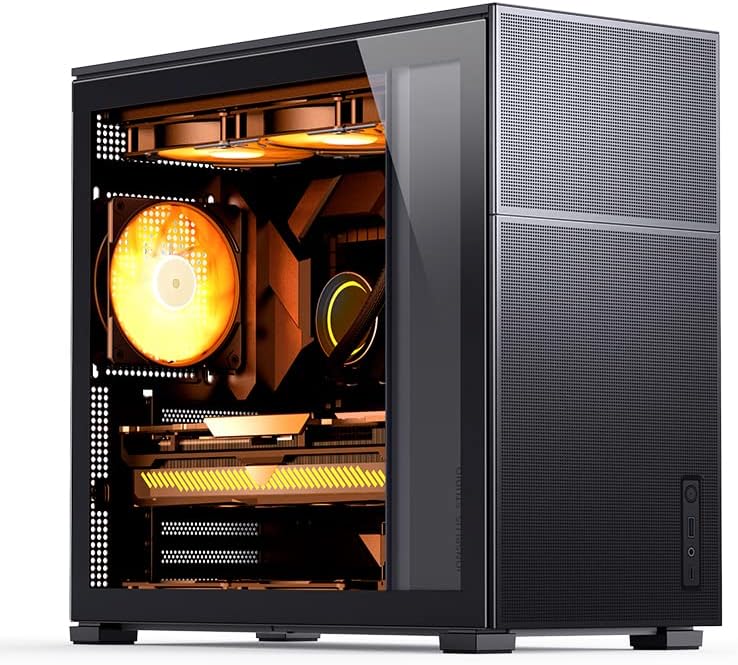
JONSBO D31 MESH Black Micro ATX Computer Case
JONSBO’s D31 Mesh is a Micro-ATX “pine cone” series case that puts RTX 4090 support in the title energy: GPU lengths called out around 330–400 mm, mesh for ventilation, and a small footprint that still claims big compatibility.
The four-level power supply height adjustment is the make-or-break feature. In compact chassis, PSU position often decides whether a 4090’s end plate clears the shroud. JONSBO exposes that adjustment instead of hiding it in a footnote.
AIO support lists 360/280/240 on top and 360/240 on bottom, with air coolers up to 168 mm. That lets MATX 4090 builds keep serious CPU cooling without jumping to a full tower.
PSU flexibility spans ATX and SFX from roughly 100–220 mm max length depending on configuration. Match your unit to the height setting you need for the GPU.
Mesh is the correct texture for this mission. A solid panoramic front on a compact 4090 box is how you buy thermal limiters. D31 chooses air.
Buy D31 when your motherboard is MATX/ITX and you want a mesh compact that admits the 4090’s length up front. Need ATX boards? Step to the D41 sibling next.
D31 is Micro-ATX; D41 grows to ATX while keeping the mesh 4090 brief. Pick based on motherboard first, aesthetics second.
Use the shortest safe PCIe power solution your PSU supports and route behind the tray early. Compact mesh cases have nowhere to hide bulk beside a 350–400 mm card.
We may earn a commission at no additional cost to you.
JONSBO D41 MESH Black ATX Computer Case
D41 is the ATX expansion of JONSBO’s mesh 4090 compact thesis. Same family language—mesh for heat, GPU lengths in the 335–400 mm band, ATX or SFX PSU flexibility—but you can drop a standard ATX gaming board instead of staying on Micro-ATX.
Compact ATX is the compromise many 4090 owners actually want: full board features and M.2 counts without a full-tower dual-chamber occupying half the desk. Dimensions around 407 × 205 × 452 mm keep it in the small-ATX conversation.
Air cooler height to 168 mm and AIO options at 360/280/240 top or 360/240 bottom mirror the D31 cooling menu. Pair a 360 mm CPU cooler with a 4090 on air if your processor runs hot under gaming + streaming loads.
Mesh remains non-negotiable. JONSBO is not trying to win a panoramic glass contest here; it is trying to keep flagship GPUs fed with cool air in a tight shell.
Tool-free touches matter when a 4090 install is a two-hand operation. Anything that reduces screw juggling while you support a heavy card is welcome.
Choose D41 for ATX + mesh + explicit 4090 length targeting. Choose D31 for MATX, Lian Li for more length headroom and included fans, or Antec C8 for dual-chamber spectacle.
ATX gamers with desk depth limits, LAN travelers who still insist on a 4090, and anyone allergic to solid front panels on hot GPUs.
If your partner card lists 402–420 mm, do not force D41—jump to Lian Li V100 or the white C9’s 440 mm claim instead.
We may earn a commission at no additional cost to you.

CORSAIR 4000D RS ARGB Frame Modular Mid
CORSAIR’s 4000D RS Frame earns its place in a 4090 guide through airflow architecture more than a single millimeter brag. The 3D Y-pattern steel front is built to keep restriction low so a long, hot graphics card can drink cool air instead of recirculating through a solid fascia.
Three RS ARGB PWM fans in front with Zero RPM capability give you quiet idle and real intake when a 4090 load hits. Daisy-chain PWM keeps wiring sane beside chunky GPU power.
The removable internal side panel near the motherboard tray is uniquely relevant to flagship GPUs. Leave it on for clean cables; remove it to mount side fans when the card’s hot spot needs a side attack—an option many mid-towers never offer.
InfiniRail mounting helps place fans where the GPU path actually is, not where a decade-old screw pattern assumed a shorter card would sit. Targeted airflow beats generic “seven fans somewhere.”
FRAME modularity and back-connect board friendliness support the long life of a 4090-era PC that may later host a 50-series card in the same shell. Upgradable trays and I/O are future-proofing with a receipt trail.
Pick the 4000D RS when mesh-first cooling and modular brand tooling matter more than dual-chamber glass. Measure your card’s length against CORSAIR’s current 4000-series guidance for the RS Frame revision you receive.
If GPU hotspot temps climb with the cable cover installed, test the open side-fan configuration. Flagship cards often reward that extra lateral airflow more than another top exhaust fan.
Use Zero RPM at idle and a steep curve only under GPU load. A 4090 does not need full fan scream while you are in Discord.
We may earn a commission at no additional cost to you.

Silverstone Technology SETA H1 E
SilverStone’s SETA H1 is a mesh-first E-ATX tower with two 160 mm front fans and a 140 mm rear fan already in place. For RTX 4090 thermals, oversized front fans behind a perforated mesh face are a love letter to cool intake air.
Unobstructed airflow is the headline. An embedded ARGB strip tries to add style without turning the front into a solid billboard that chokes intake. That balance is exactly what hot GPUs want.
Ample interior space and SSI-EEB support mean the H1 is not only a 4090 gaming box; it can host wide boards and inventive cooling layouts. Extensive air and water cooling support keeps CPU options open when the GPU is already an air furnace.
A perfect 5.0 rating in the pack is a small sample risk and a positive signal at once—read recent reviews for fitment notes, but the cooling thesis is sound on paper.
Front I/O with Type-C, dual USB 3.0, and combo audio matches the SETA D1’s practical bent. SilverStone is speaking workstation-capable gaming language.
Choose the SETA H1 when maximum mesh airflow and E-ATX space outrank compact desks. Apartment builders with 50 cm depth limits should prefer JONSBO or Shiny Snake instead.
Larger fans can move comparable air at lower RPM than dense 120 mm arrays, which helps keep a flagship gaming PC audible as a PC rather than a shop vac.
Keep the mesh front as GPU intake and place a CPU AIO up top when possible so the 4090 and radiator are not fighting for the same front real estate without a plan.
We may earn a commission at no additional cost to you.

DARKROCK EC2 ATX Mid Tower Gaming Computer PC Case
DARKROCK’s EC2 closes the pack as a cautionary value pick. Mesh front, Type-C, tempered glass, front 360 mm radiator support, and talk of 50-series cards sound 4090-friendly—until you hit the 340 mm GPU length ceiling. Plenty of RTX 4090 partner cards are simply longer than that.
If your specific 4090 (or a shorter dual-fan variant / different flagship) fits under 340 mm, the EC2 can still be a sensible mesh ATX box. If your card is 350–380 mm, this is the wrong chassis no matter how good the mesh looks in photos.
One pre-installed fan means a 4090 build needs an immediate fan shopping list. Do not boot a flagship GPU in a nearly empty case and hope.
Magnetic dust filters and tempered glass are fine living features. They do not add millimeters to GPU clearance.
Up to eight 120 mm fan mounts and a front 360 mm radiator give cooling upgrade room for CPUs, which is useful when the GPU fits. The order of operations remains: length first, fans second.
Consider the EC2 only after you measure your card. Everyone else with a typical long 4090 should stay with Lian Li, JONSBO’s 400 mm window, ANSAITE’s 440 mm claim, or Antec’s dual-chamber stage.
Shorter 40-series cards, future mid-length GPUs, or builders who misclicked into this pack while owning a 4070-class card. It is a decent mesh ATX value—just not a universal 4090 hotel.
If the box says 340 mm and your GPU page says 352 mm, walk away. Tempered glass will not compress physics.
We may earn a commission at no additional cost to you.

Ignore vibe words like “flagship ready” until you see a millimeter number. In this pack, 340 mm (DARKROCK) is risky for many 4090s, 400 mm (JONSBO, Shiny Snake) covers a wide band, and 420–440 mm (Lian Li, ANSAITE) adds comfort for elongated partner cards. Also check slot width—some 4090s are thicker than the case’s clearance above the motherboard tray.
A 4090 will expose weak intake. Mesh fronts (JONSBO, SilverStone SETA H1, CORSAIR Y-pattern, DARKROCK) are the thermal default. Dual-chamber glass cases like the Antec C8 can work beautifully if you add enough fans and keep PSU heat isolated—but empty glass is not cooling.
Compact MATX (D31, G600) maximizes desk space and demands precise PSU/GPU choreography. ATX mid-towers (V100, 4000D RS, D41) are the painless majority choice. E-ATX/SSI-EEB towers (SETA D1/H1, Antec C8) suit wide workstation boards and storage-heavy 4090 machines.
Plan PSU wattage and 12VHPWR (or adapter) routing before the case ships. Leave bend radius behind the glass, use a support bracket against sag, and avoid crimping sense pins against side panels.
Most cards under that length will, but you must still check thickness, power connector clearance, and whether a front radiator steals space. A 396 mm card can fail in a 400 mm case if the shroud hits a drive cage or cable tunnel.
No. Many mid-towers and even some compact MATX cases in this pack claim 400 mm-plus clearance. Full towers like the Antec C8 help with radiators, E-ATX boards, and cable luxury—not because the 4090 magically needs a server rack.
Prioritize mesh or high-airflow perforated fronts for intake. Glass on the side is fine. Glass or solid panels blocking the front are how flagship GPUs hit thermal limits early.
Only if your specific card is at or under 340 mm and you add fans. Many 4090 models are longer. Measure first; do not rely on “50-series support” phrasing alone.
Founders and partner designs differ in length, cooler height, and connector placement. Always use the measurements for the SKU in your cart. Case marketing that says “4090 support” is a starting claim, not a universal passport.
No. Most builders air-cool the 4090 and optionally liquid-cool the CPU. Cases with strong intake and optional AIO mounts (V100, JONSBO, C8, C9) support that split well.
Because the power supply and graphics card compete for the same lower chamber. Adjustable bays—like those on JONSBO D31 and Shiny Snake G600—let you prioritize GPU length without permanently stranding longer PSUs.
Enough for a clear intake path across the GPU and an exhaust exit for hot air—often three to six quality fans depending on case size. Seven ARGB fans look busy; directed airflow matters more than LED count.
Usually not. E-ATX shines when you need wider boards, more slots, or workstation layouts. Pure gamers on ATX boards should prioritize GPU clearance and mesh, not board size marketing.
The best PC case for an RTX 4090 in 2026 is whichever shell publishes enough GPU length for your exact card and then feeds that card cool air. Lian Li’s V100 is the balanced ATX default with 420 mm room and fans included; Antec’s C8 is the dual-chamber 40-series stage if you will add your own fans; JONSBO’s D41 (and D31 for MATX) prove compact mesh boxes can still speak 4090 millimeters honestly.
SilverStone’s SETA towers serve E-ATX and airflow-max builders, Shiny Snake chases furniture-compact ambition with adjustable PSU geometry, ANSAITE’s white C9 stretches clearance to 440 mm in panoramic glass, and CORSAIR’s 4000D RS Frame attacks thermals with Y-pattern intake and a side-fan option. Treat DARKROCK’s 340 mm limit as a hard filter, not a suggestion.
Measure twice, mount a support bracket, give the 12VHPWR cable room to curve, and let mesh do the unsexy work that keeps a flagship GPU quiet and cool.