Expert Review & Guide

Best Laptops for Online Classes in 2026: Webcam, Mic &

Online classes punish the wrong laptop in ways a normal homework machine never will. A dim webcam makes you look washed out under kitchen lighting. A muffly built-in mic forces classmates to ask you to repeat answers. A heavy chassis turns a backpack commute into a shoulder workout. And a short battery means you are hunting for an outlet mid-lecture while everyone else is still taking notes. In 2026, the best laptops for online classes are the ones that stay visible, audible, charged, and easy to carry—not the ones with the flashiest GPU marketing.

This roundup judges every pack product through four practical filters: webcam readiness for Zoom, Teams, and Google Meet; microphone usefulness for discussion-heavy seminars; real-world battery character for multi-hour class blocks; and lightweight portability for dorm-to-library days. We include Windows student notebooks with privacy shutters and stereo speakers, featherweight value machines under four pounds, a compact 14-inch HP that calls out its webcam and mic in the listing, and one dedicated 1080p USB webcam for anyone who wants a sharper camera upgrade without replacing an otherwise fine laptop.

You will get three top picks for most remote learners, a full comparison of all ten products, deep reviews with honest tradeoffs, and a buying guide that maps class load, Wi-Fi quality, and backpack weight to the right choice. No invented prices, no invented ASINs—just call-first guidance for students who live on video.

Our Top Picks for Online Class Laptops

Best Overall for Live Classes

Lenovo Business Laptop

★★★★★9/10
Lenovo Business Laptop
  • HD 720p webcam with physical privacy shutter for secure class sessions
  • 13th Gen i5-13420H multitasks Zoom, notes, and browser research smoothly
  • 3.70 lb chassis with WiFi 6 and all-day battery positioning for campus days
Check Price →
Best Built-In Webcam & Speakers

Windows 11 Laptop Computer i3

★★★★★10/10
Windows 11 Laptop Computer i3
  • Webcam plus dual stereo speakers ready for lectures and group discussions
  • About 7 hours mixed-use battery from a 57.75Wh pack for full class days
  • 3.6 lb portable build with WiFi 6 and a backlit keyboard for late study
Check Price →
Best Featherweight Student Value

Amzboy 15.6” Windows 11 Laptop

★★★★★9/10
Amzboy 15.6” Windows 11 Laptop
  • Only 3.3 lbs with a privacy camera for lighter backpack days
  • Fanless quiet design keeps mic pickup cleaner during discussion classes
  • 45W USB-C PD charging means one compact cord for laptop and phone
Check Price →

As an Amazon Associate we earn from qualifying purchases. We may earn a commission at no additional cost to you.

Online Class Laptop Comparison at a Glance

Scan webcam cues, battery capacity signals, weight, and RAM/storage before reading full reviews. Specs emphasize what matters on a live-call school day—camera privacy, microphone-friendly quiet chassis, unplugged stamina, and how heavy the machine feels in a backpack.

#ProductSpecificationsScore
1
  • 15.6" FHD anti-glare, Intel N100, 16GB RAM, 1TB SSD
  • 3.64 lbs with long battery life positioning for study marathons
  • WiFi 6, HDMI, USB ports; Windows 11 + Microsoft 365 ready
8.2
2
  • 15.6" FHD anti-glare, N4020, 4GB RAM, 128GB eMMC
  • 3.3 lbs featherweight with privacy camera and fanless quiet design
  • 45W USB-C PD fast charging; TF expansion up to 1TB
9
3
  • 15.6" FHD anti-glare, Intel N100, 8GB RAM, 256GB SSD
  • 3.64 lbs lightweight build with long battery life claims
  • WiFi 6 plus included 5-in-1 hub for docks and accessories
8.4
4
  • 15.6" FHD, Celeron J4105, 6GB RAM, 128GB SSD
  • 53.2Wh battery pack; 180° lay-flat hinge for shared viewing
  • AI Meet mode plus 1-year Office 365 for class workflows
9.8
5
  • 15.6" FHD anti-glare, Core i3, 12GB RAM, 256GB SSD
  • Webcam, dual stereo speakers, ~7-hour 57.75Wh battery
  • 3.6 lbs, WiFi 6, backlit keyboard, USB-C PD support
10
6
  • 14" HD, Intel dual-core, 4GB RAM, 64GB eMMC
  • Built-in webcam with microphone called out for online classes
  • Lightweight notebook with long-lasting battery support claims
7.8
7
  • 15.6" FHD IPS, Pentium Gold 6500Y, 12GB RAM, 256GB SSD
  • Privacy shutter webcam; lightweight portable school design
  • Long battery life positioning; dual USB-C, HDMI, WiFi 5
8.4
8
  • 16" WUXGA IPS, i5-13420H, 8GB DDR5, 512GB SSD
  • HD 720p webcam with privacy shutter; WiFi 6 connectivity
  • 3.70 lbs Luna Grey chassis with fast-charging support
9
9
  • 15.6" FHD, Celeron N4000, 12GB RAM, 256GB SSD
  • 38Wh battery for hours of mixed class and streaming use
  • 20mm thin portable shell; WiFi 5, USB 3.0, HDMI
7.4
10
  • 1080p HD USB webcam up to 30 fps for clearer class video
  • Plug-and-play on Windows/Mac; works with Zoom, Teams, Meet
  • Adjustable clip, 1.5m braided cable, low-light auto adjust
9.2

1. HP 15.6" FHD Laptop 2026 Edition - Best Storage for

HP 15.6" FHD Laptop 2026 Edition (16GB/1TB)

HP 15.6" FHD Laptop 2026 Edition (16GB/1TB)

8.2/10★★★★☆

If your online-class life is less about cinematic video quality and more about never running out of space mid-semester, this HP 2026 Edition configuration is the storage-first answer in the pack. Sixteen gigabytes of RAM and a full terabyte SSD mean you can keep Zoom open, leave lecture recordings on the drive, park a dozen PDF readers, and still have room for Microsoft 365 work without constantly deleting files. That matters more than most students expect: recorded classes and downloaded textbooks balloon storage faster than casual browsing ever does.

  • Intel N100, 16GB RAM, 1TB SSD, 15.6" FHD anti-glare
  • Lightweight 3.64 lbs with long battery life positioning
  • WiFi 6, full-size keyboard with numeric keypad, Windows 11
Check Price →
✓ Pros
  • 16GB RAM keeps Zoom, Canvas, and research tabs from thrashing
  • 1TB SSD swallows recorded lectures, PDFs, and project folders
  • 3.64 lb carry weight is realistic for daily campus backpacks
  • WiFi 6 helps stabilize video classes on crowded dorm networks
  • Anti-glare 15.6" panel is easier for long lecture viewing
✕ Cons
  • N100 is everyday-class silicon, not a heavy editing workstation
  • Listing emphasizes battery stamina more than webcam resolution specs
  • 15.6" footprint is larger than compact 14" class notebooks

Detailed review

The online-class angle here is stamina and carry, not creator-camera bragging rights. HP positions long battery life and a 3.64-pound chassis as the mobility story, which matches how remote learners actually move—kitchen table to coffee shop to library carrel. You will not confuse this with an ultraportable ultrapremium, but under four pounds with a full 15.6-inch screen is a sweet spot for typed note-taking and slide-heavy lectures. The anti-glare display helps when you sit near a window during morning sync sessions.

WiFi 6 is the quiet hero for live classes. Dorm and apartment networks get congested exactly when everyone logs into the same seminar. Newer wireless helps keep video from freezing when a roommate starts a download. Pair that with multiple USB ports, HDMI, and a headphone jack, and you can attach a better headset mic if the built-in array is not enough for discussion sections. Many students end up happier with a cheap USB headset than with chasing a premium laptop mic.

Performance expectations should stay honest. The Intel N100 is tuned for browser tabs, Office, streaming, and simultaneous class apps—not for coding compiles that melt fans or for 4K video projects. Within that lane, 16GB of memory is what makes the machine feel composed when your LMS, chat, notes, and a second browser window all stay open for three hours. Copilot AI and Microsoft 365 readiness are useful extras for summarizing notes or drafting discussion posts after class, not a substitute for solid RAM.

Who should skip it? Anyone who needs a confirmed high-resolution webcam as the headline feature, or who wants a sub-three-pound bag companion, should look at the Lenovo with its privacy shutter camera, the Amzboy featherweight, or the dedicated USB webcam upgrade elsewhere in this guide. Who should buy it? Students juggling many courses, large media downloads, and multi-tab research who still want a lightweight-enough Windows laptop with modern wireless and room to grow through senior year.

Webcam, mic, and call setup tips

Treat this HP as a strong class workstation first. For clearer presence on camera, sit facing a window or a desk lamp, raise the laptop with a book so the lens is nearer eye level, and mute when you are not speaking so keyboard noise does not dominate. If professors complain about audio, a USB headset with a boom mic is a cheaper fix than swapping the whole machine.

Before the first graded discussion, run a Zoom or Meet test call. Check that Windows privacy settings allow camera and microphone access for your conferencing app, and disable unnecessary background effects that can tax the N100 during long sessions.

Who it fits best

Ideal for undergraduates with heavy document loads, hybrid workers taking midday webinars, and households sharing one student-office machine. Less ideal for pure travel minimalists or anyone whose school requires specialized GPU-heavy software.

Check Price on Amazon →

We may earn a commission at no additional cost to you.

2. Amzboy 15.6” Windows 11 Laptop - Best Featherweight Student

Amzboy 15.6” Windows 11 Laptop

Amzboy 15.6” Windows 11 Laptop

9/10★★★★★

The Amzboy earns its top-pick badge for a simple reason online learners feel every day: three-point-three pounds. When you already carry textbooks, a water bottle, and a charger, shaving laptop weight matters more than another marketing core count. This machine is aimed at Zoom classes, documents, and browsing—not at being the fastest Windows box on campus—and it is honest about that lane.

  • Intel N4020, 4GB RAM, 128GB eMMC, 15.6" FHD anti-glare
  • 3.3 lbs thin chassis with privacy camera and 180° lay-flat hinge
  • 45W Type-C PD charging; fanless quiet design; TF up to 1TB
Check Price →
✓ Pros
  • 3.3 lb weight is the lightest laptop carry in this pack
  • Privacy camera shutter supports safer shared-housing class days
  • Fanless design cuts fan roar that can leak into your mic
  • USB-C PD 45W charger is easier to pack than bulky bricks
  • 180° hinge helps show slides or notes to a study partner
✕ Cons
  • 4GB RAM is the tightest multitasking ceiling in the roundup
  • 128GB eMMC fills quickly without a TF card expansion habit
  • WiFi 5 and entry CPU are better for light class loads than heavy stacks

Detailed review

For webcam and mic culture, two design choices stand out. The privacy camera lets you physically cover the lens between classes, which is a real comfort in dorms and shared apartments. The fanless solid-state approach means there is no spinning fan roar under the keyboard when the CPU warms during a long Meet session. Fan noise is one of the most common complaints professors hear from budget laptop mics; silence helps your voice stay clearer even if the microphone hardware itself is basic.

Battery and charging story centers on modern convenience. The compact 45W USB-C PD adapter means you can often travel with one cable family for phone and laptop, which reduces the junk that lives at the bottom of a backpack. Pair that with a slim profile and you get a machine that is easier to top up between classes than older barrel-plug designs. Still, 4GB of RAM means you should close unused apps before joining a graded oral exam—memory pressure can make video apps stutter long before the battery does.

Storage discipline is mandatory. One hundred twenty-eight gigabytes of eMMC is fine for Windows, a browser, Office web workflows, and a semester of PDFs if you offload recordings to a TF card. The slot supporting up to 1TB expansion is not a nice-to-have here; it is part of making the laptop viable. Buy a reputable card on day one if you know your professors post large lecture videos.

Choose the Amzboy when backpack weight, quiet call behavior, and a privacy shutter matter more than raw speed. Skip it if you routinely keep twenty Chrome tabs, desktop Photoshop, and a local IDE open beside Zoom. In that case the HP 16GB model or the Core i3 12GB machine will feel less constrained, even if they weigh a few ounces more.

Making 4GB RAM survive online class day

Use one browser profile for school only. Prefer Meet or Zoom desktop apps over stacking three browser-based call tabs. Store large downloads on the TF card, not the system drive. Those habits matter more on this machine than on the 12GB and 16GB options.

Versus heavier student HPs

Compared with the HP 15.6-inch 2026 Editions at 3.64 pounds, you save meaningful carry weight and gain fanless quietness and a privacy camera callout. You give up RAM headroom, SSD speed character, and WiFi 6. Pick based on whether your pain point is backpack fatigue or multitasking lag.

Check Price on Amazon →

We may earn a commission at no additional cost to you.

3. HP 15.6" FHD Laptop 2026 Edition - Best Hub-Ready Midrange

HP 15.6" FHD Laptop 2026 Edition (8GB/256GB)

HP 15.6" FHD Laptop 2026 Edition (8GB/256GB)

8.4/10★★★★☆

This is the more approachable twin of the 16GB/1TB HP in the same 2026 Edition family: same lightweight 3.64-pound story, same long-battery positioning, same WiFi 6 and anti-glare 15.6-inch canvas—but with 8GB of RAM, 256GB of SSD storage, and a 5-in-1 hub in the bundle. For many online-class buyers, that combination is the practical middle. You get enough memory for a live call plus notes and a reading tab, faster storage than eMMC value machines, and a hub that makes plugging in a better webcam or headset less annoying.

  • Intel N100, 8GB RAM, 256GB SSD, 15.6" FHD anti-glare
  • 3.64 lbs with long battery life and WiFi 6 connectivity
  • Includes 5-in-1 hub; Windows 11 and Microsoft 365 ready
Check Price →
✓ Pros
  • Same lightweight 3.64 lb student chassis as the higher-RAM HP twin
  • 8GB RAM is a more realistic class multitasking floor than 4GB models
  • 256GB SSD boots and loads apps faster than eMMC entry machines
  • Bundled 5-in-1 hub helps attach webcams, drives, and docks
  • WiFi 6 supports stabler live video on busy networks
✕ Cons
  • Half the memory of the 16GB HP sibling for tab-heavy research days
  • 256GB fills faster if you archive every recorded lecture locally
  • Webcam quality still benefits from lighting discipline or a USB upgrade

Detailed review

Online classes often become an accessory problem as much as a laptop problem. Students buy a fine notebook, then discover they need an Ethernet adapter at a dead Wi-Fi corner of campus, an SD reader for a media class, or a second USB port for a webcam while a mouse occupies the first. A 5-in-1 hub will not magically improve the built-in camera sensor, but it removes friction from upgrading your call setup. That fits this guide’s unique focus: webcam and mic readiness is often a system, not a single checkbox on a spec sheet.

Battery and weight remain the HP student-laptop pitch. Carry it between hybrid in-person labs and afternoon Zoom discussions without feeling like you packed a desktop replacement. Long battery life claims should still be tested with your own brightness and call load—video conferencing drains faster than document editing—but the positioning is clearly aimed at marathon study rather than desk-bound only use.

Compared with the Amzboy, you trade some ounces and the fanless privacy-camera personality for better RAM, an SSD, and WiFi 6. Compared with the 16GB/1TB HP, you save money in the typical street hierarchy and still cover mainstream class apps, but you should be more aggressive about closing background Chrome profiles. Eight gigabytes is workable for online school; it is not endless.

Buy this configuration if you want a balanced HP student machine and value the hub bundle for webcam, headset, and storage accessories. Stretch to the 16GB/1TB version if your professors assign large local media files or you refuse to manage tab counts. Look elsewhere if you need an explicitly featured 720p privacy-shutter webcam as a primary selling point—the Lenovo owns that narrative in this pack.

Using the hub for better class calls

Plug a USB headset into one hub port and keep the dedicated Webcam for PC from this pack on another if your built-in camera looks soft. Leave the HDMI path free for presenting slides to a living-room TV during group projects. Organize cables once so you are not troubleshooting adapters two minutes before attendance is taken.

Battery habits that actually help

Drop screen brightness one or two steps during long lectures, close unused webcam preview windows, and enable Windows Battery Saver between classes. Those small habits often add more real minutes than chasing a slightly larger Wh number on a different listing.

Check Price on Amazon →

We may earn a commission at no additional cost to you.

4. 15.6" FHD Laptops with AI Assistant - Best AI-Assisted Study

15.6" FHD Laptops with AI Assistant Included

15.6" FHD Laptops with AI Assistant Included

9.8/10★★★★★

This model’s online-class personality comes from software and battery numbers as much as from raw CPU fame. A 53.2Wh pack is a specific energy figure you can compare against thinner 38Wh machines later in the list, and the included AI assistant advertises a Meet mode aimed at communication tasks. Pair that with a year of Office 365 and you get a student-oriented bundle: write papers, join sessions, and lean on assistive modes without hunting for subscriptions on day one.

  • Celeron J4105 quad-core, 6GB RAM, 128GB M.2 SSD
  • 53.2Wh battery; 15.6" FHD; 180° lay-flat hinge
  • AI modes including Meet; 1-year Office 365 included
Check Price →
✓ Pros
  • 53.2Wh battery capacity is a concrete stamina signal for class days
  • AI Meet mode aligns with online-class communication workflows
  • 180° hinge helps collaborative study and shared screen viewing
  • Office 365 for a year reduces startup friction for papers
  • Expandable storage path via SSD or TF card when 128GB fills
✕ Cons
  • 6GB RAM sits between constrained and comfortable depending on tab habits
  • 128GB SSD still needs expansion planning for video-heavy courses
  • Entry Celeron class is for everyday study, not heavy creation

Detailed review

The 180-degree lay-flat hinge is more useful for remote learning than it sounds. Group projects still happen in person even when lectures are virtual. Flattening the display on a table lets two classmates review a slide deck or a shared document without crowding behind a partially open lid. For solo use, it also helps you find a comfortable viewing angle on a dorm bed or couch where a traditional laptop hinge fights you.

Webcam and mic expectations should stay grounded. The listing leans into AI Meet assistance and FHD visuals more than it brags about a studio-grade camera module. That means lighting, framing, and optionally a USB webcam upgrade still matter. Where this machine can help call quality indirectly is battery headroom: a healthier Wh rating often means fewer mid-seminar panic charges that yank the laptop onto a crowded outlet strip and jostle your camera angle.

Performance is everyday quad-core Celeron territory with 6GB of RAM. That is enough for browser-based classes, Office, and streaming review videos if you keep the background clutter sane. It is not the Lenovo i5. Students who live in many Electron apps at once should watch memory use. Storage starts at 128GB on an M.2 SSD—snappier than eMMC in feel—but recorded lectures will push you toward the advertised expansion options quickly.

Pick this laptop when you want a named battery capacity, lay-flat collaboration tricks, and AI/Office software hand-holding for study routines. Skip it if you already know you need 12GB-plus RAM for engineering toolchains, or if a privacy-shutter webcam is non-negotiable from the first unboxing.

Using AI Meet mode without relying on it

Treat assistive modes as drafting and organization helpers before and after class—summaries, outlines, quick rewrites—not as a substitute for listening. For live sessions, prioritize stable Wi-Fi, muted keyboard habits, and a clean camera background. AI features cannot fix a noisy café mic or a backlight silhouette.

Battery context versus other pack options

Against the 38Wh Celeron N4000 model, 53.2Wh is a meaningful step up on paper. Against the i3 machine’s 57.75Wh pack with an explicit ~7-hour mixed-use claim, this sits in a similar serious-student stamina conversation. Real results still depend on brightness and whether the webcam stays on for hours.

Check Price on Amazon →

We may earn a commission at no additional cost to you.

5. Windows 11 Laptop Computer i3 - Best Built-In Webcam

Windows 11 Laptop Computer i3

Windows 11 Laptop Computer i3

10/10★★★★★

Among the pack’s Windows student notebooks, this Core i3 model is the clearest “I was built for online classes” story. The manufacturer calls out a webcam, dual stereo speakers, roughly seven hours of mixed-use runtime from a 57.75Wh battery, and a 3.6-pound chassis that slips into a backpack. That is the exact quartet this guide cares about: see you, hear you, keep you charged, keep you light.

  • Intel Core i3 (up to 3.4GHz), 12GB RAM, 256GB SSD
  • Webcam, dual stereo speakers, ~7 hours from 57.75Wh battery
  • 3.6 lbs, 19.5mm thin, WiFi 6, backlit keyboard, USB-C PD
Check Price →
✓ Pros
  • Listing explicitly includes webcam and dual stereo speakers for classes
  • About 7 hours mixed-use battery matches a full remote school day
  • 12GB RAM handles Zoom plus notes and research more calmly
  • 3.6 lb weight keeps the portable promise under four pounds
  • WiFi 6 and backlit keyboard help night classes and crowded networks
✕ Cons
  • Dual-core i3 is competent, not a multi-heavy-app creator chip
  • 256GB SSD still benefits from TF expansion for media courses
  • Speaker loudness varies by room; headphones remain wiser for privacy

Detailed review

Twelve gigabytes of RAM is the multitasking buffer that makes live school feel less fragile. A typical remote morning might include the conferencing app, a shared slide deck, a notes document, the LMS, and a chat thread. On 4GB machines that stack collapses into stutter. Here, the Core i3 with Intel UHD Graphics 620 and 12GB of memory is aimed at keeping that stack responsive while you still stream an HD review lecture later.

Audio matters twice in online school: hearing the professor and being heard when you answer. Dual stereo speakers make it easier to follow a lecture without immediately hunting headphones, which is useful in a private room. For shared housing, plug in earbuds so you do not broadcast classmates’ discussion. The included webcam covers attendance and breakout rooms; if you want sharper facial detail for presentations, the pack’s 1080p USB webcam is a natural accessory rather than a mandatory replacement of the whole laptop.

Connectivity is modern where it counts. WiFi 6 helps on dense campus apartment networks. USB-C with PD3.0 fast charging, three USB 3.0 ports, HDMI 2.1, and a TF slot expandable toward 2TB mean you can dock a monitor for long seminar days and still expand storage for project files. The backlit keyboard is a quality-of-life win for late asynchronous classes and night study after synchronous sessions end.

This is our pick when you want the pack’s best balance of called-out webcam/speakers, concrete battery hours, lightweight carry, and enough RAM for real class multitasking. Choose the Lenovo instead if you need a stronger 13th Gen i5 and a privacy shutter on a taller 16-inch productivity screen. Choose the Amzboy if absolute lowest weight and fanless quiet matter more than 12GB comfort.

Mic etiquette that improves any built-in array

Sit closer than you think—twelve to eighteen inches from the deck mic helps. Mute on entry, unmute only when called on, and avoid typing during your answer. If your voice still sounds thin, a five-minute Windows sound settings pass to raise mic input and disable unnecessary enhancements often helps more than buying a new laptop.

Who should buy this over the Lenovo

Prefer this i3 machine if you want a conventional 15.6-inch class layout, explicit speaker inclusion, and a strong mixed-use hour claim at a student-first feature mix. Prefer Lenovo if your coursework leans into heavier multitasking, spreadsheets on a taller 16-inch panel, and a privacy shutter as a default security habit.

Lightweight reality check

At 1.63 kg (3.6 lbs) and 19.5 mm thin, this is backpack-true portable, not just marketing-thin. Combined with USB-C PD, it supports the charge-between-buildings rhythm many hybrid students live.

Check Price on Amazon →

We may earn a commission at no additional cost to you.

6. HP 2026 14" HD Laptop - Best Compact Webcam-Mic

HP 2026 14" HD Laptop

HP 2026 14" HD Laptop

7.8/10★★★★☆

If your priority list literally reads webcam, microphone, battery, and lightweight—and you want those words reflected in a compact chassis—this 14-inch HP is the pack’s most on-the-nose marketing match. The title and about copy call out a built-in webcam with microphone for online classes, virtual meetings, and remote learning, while promising long-lasting battery support and a slim body for school bags. That clarity is useful when you are shopping specifically for call readiness rather than generic “student laptop” vagueness.

  • 14" HD display, Intel dual-core, 4GB RAM, 64GB eMMC
  • Built-in webcam with microphone emphasized for online classes
  • Lightweight carry with long-lasting battery support claims
Check Price →
✓ Pros
  • Smaller 14" format is easier to hold on a lap during long calls
  • Listing explicitly markets built-in webcam and microphone for classes
  • Lightweight notebook design suits commuting students
  • Full I/O ports help attach headsets and external displays
  • Microsoft 365 bundle aids papers and presentations out of the box
✕ Cons
  • 4GB RAM and 64GB eMMC are the most constrained combo in the pack
  • HD panel is less sharp for slide-heavy lectures than FHD classmates
  • Best as a light-duty class device, not a long-term power multitasker

Detailed review

The tradeoff is capability. Four gigabytes of RAM and sixty-four gigabytes of eMMC put this firmly in light-duty territory. It can be the right tool for browser-based LMS work, Office workflows, and video calls if you are disciplined. It will frustrate anyone who treats Chrome like an infinite shelf. Plan on cloud storage, USB drives, and closing apps before joining class. Think of it as a dedicated remote-learning appliance more than a forever computer.

The 14-inch HD screen is a portability win and a sharpness compromise. Smaller panels are easier to angle for flattering webcam framing on a kitchen table, and the whole package tends to feel less shoulder-heavy than 15.6-inch plastic classmates. Lecture slides will look softer than on the FHD options, so sit a bit closer or cast to a TV via HDMI when reviewing dense diagrams after class.

Because the webcam and mic are part of the product story, spend ten minutes on placement. Raise the laptop, face a soft light, and test microphone levels in Windows. Full I/O ports make it straightforward to add a wired headset if the built-in mic picks up too much room echo. That accessory path is how many students turn an entry HP into a reliable discussion machine without overspending.

Buy this when you need the smallest practical Windows notebook in the pack with explicit camera/mic positioning for online school and you accept entry memory/storage limits. Skip it if you can stretch to the i3 12GB model or either of the stronger HP 15.6-inch configs—those will age more gracefully across a four-year degree.

When a 14" screen helps online class focus

Smaller displays reduce the temptation to tile six distracting windows beside the professor’s face. For attention-challenged study sessions, a compact HD panel plus full-screen Meet can be a feature, not a bug—provided your coursework does not demand constant side-by-side coding and video.

Storage survival plan

Keep the OS and core apps on the 64GB eMMC. Push downloads to OneDrive or Google Drive immediately. Offload finished semester folders to a USB stick monthly. Without that ritual, free space warnings will interrupt class more often than battery warnings will.

Check Price on Amazon →

We may earn a commission at no additional cost to you.

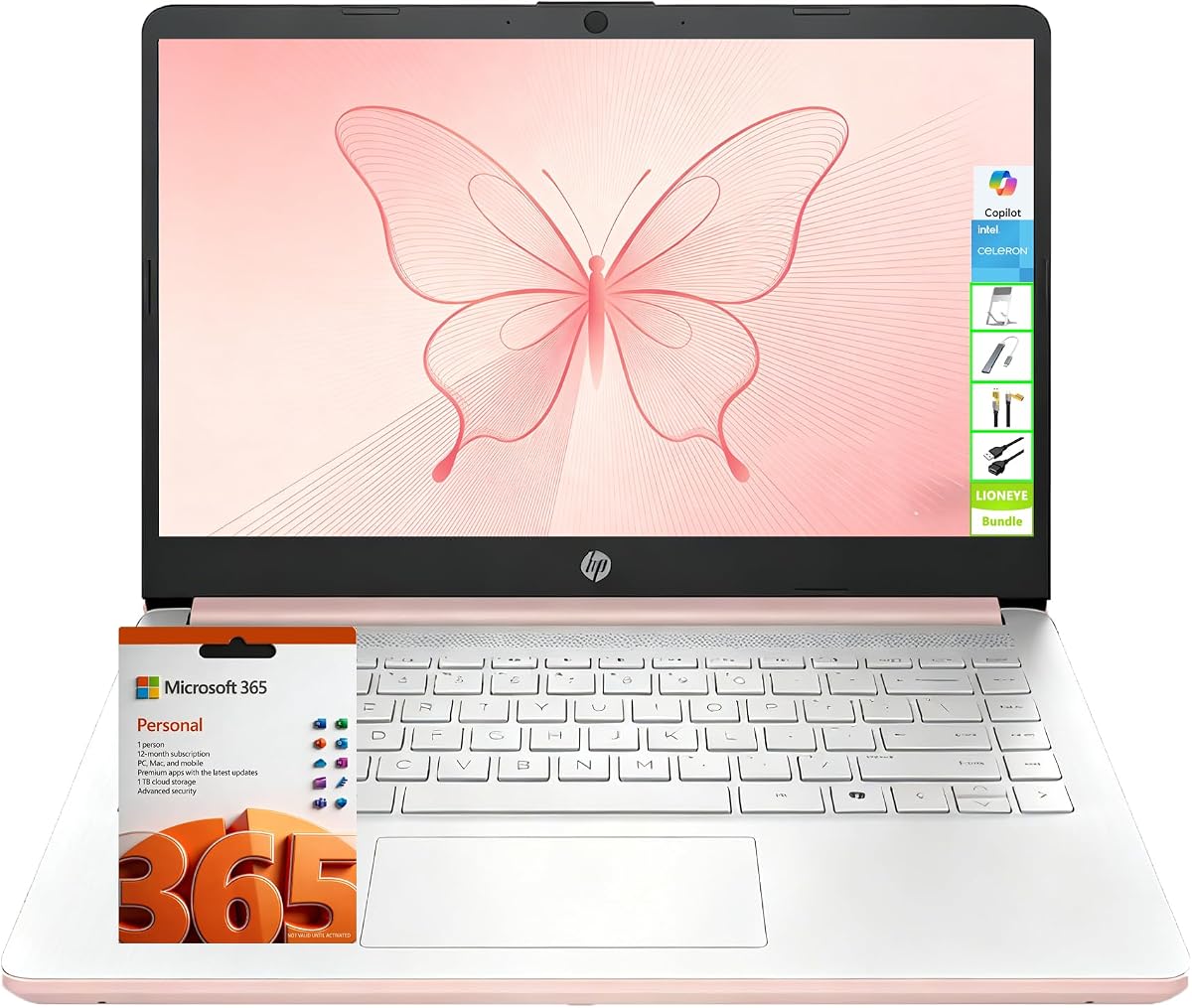
7. Pink Laptop Computer for Students - Best Style Pick

Pink Laptop Computer for Students

Pink Laptop Computer for Students

8.4/10★★★★☆

Not every online-class buyer wants a gray slab. This pink student laptop pairs a distinctive finish with the practical ingredients that actually affect remote learning: a privacy shutter over the webcam, 12GB of RAM, a 256GB SSD, an FHD IPS display, and a lightweight portable design marketed for school and online classes. If you care about not being seen when the camera should be off, a physical shutter beats hoping you remembered to close the app.

  • 15.6" FHD IPS, Pentium Gold 6500Y up to 3.4GHz
  • 12GB RAM, 256GB SSD; privacy shutter webcam
  • Lightweight school design; dual USB-C, HDMI, long battery claims
Check Price →
✓ Pros
  • Privacy shutter is a real webcam security win for dorm living
  • 12GB RAM matches stronger student multitasking needs
  • FHD IPS panel helps lecture slides and Meet galleries look clearer
  • Lightweight portable design aimed at school carry
  • Numeric keypad speeds spreadsheet-heavy business classes
✕ Cons
  • WiFi 5 instead of WiFi 6 on denser campus networks
  • Pentium Gold is fine for classes, not heavy local rendering
  • Colorway preference is personal—style is not a performance upgrade

Detailed review

Twelve gigabytes of memory puts this in the same comfort band as the Core i3 model for everyday class stacks. Switching between documents, browsers, and video apps is the job description, and IPS wide viewing angles help when you share the screen with a roommate while studying. Long battery life positioning and dual USB-C ports support the mobile student pattern—work unplugged, then top up without hunting a rare proprietary brick.

Microphone and webcam quality still depend on environment. The shutter solves privacy; clarity still needs light and reasonable distance. Dual USB-C plus USB 3.2 and HDMI mean you can add a headset or the pack’s 1080p webcam without giving up your mouse. For discussion seminars, prioritize a quiet room over any chassis color.

Pentium Gold 6500Y performance is efficient everyday computing. It is a sensible match for LMS sites, Office, streaming lectures, and light multitasking. It is the wrong expectation for local machine-learning labs or big video exports. WiFi 5 is adequate in many apartments but less ideal than WiFi 6 options when the whole floor joins evening classes at once—sit closer to the router or use a phone hotspot backup for graded exams if your building is notorious.

Choose this machine when you want student-ready RAM/SSD specs, a privacy shutter, and a lighter emotional design language without abandoning FHD. Choose the Lenovo if you need a stronger i5 and a taller productivity display. Choose the i3 model if explicit stereo speakers and a ~7-hour battery claim matter more than pink aesthetics.

Privacy shutter habits worth keeping

Close the shutter at the end of every class session, not only when you leave the dorm. It is a two-second ritual that prevents accidental camera wake-ups during chaotic notification days. Open it only after you confirm the correct Meet link and framing.

Style versus substance for parents buying

If you are buying for a student who will actually use the machine more because they like how it looks, that engagement is a legitimate factor. Just verify the 12GB/256GB and shutter features are what you are paying for—not only the color.

Check Price on Amazon →

We may earn a commission at no additional cost to you.

8. Lenovo Business Laptop - Best Overall for Live Classes

Lenovo Business Laptop

Lenovo Business Laptop

9/10★★★★★

For most students who attend live classes several times a week, the Lenovo is the pack’s most complete answer. A 13th Gen Core i5-13420H with eight cores and twelve threads has the headroom to keep Zoom or Teams smooth while you annotate a PDF and keep research tabs alive. The HD 720p webcam with a physical privacy shutter directly serves the webcam-and-trust problem online school creates, and the 16-inch WUXGA IPS panel gives you more vertical space for documents than a standard 1080p 15.6-inch screen.

  • 13th Gen Intel Core i5-13420H, 8GB DDR5, 512GB SSD
  • 16" WUXGA IPS with HD 720p webcam and privacy shutter
  • 3.70 lbs, WiFi 6, USB-C PD, fast charging, Windows 11
Check Price →
✓ Pros
  • Strongest processor in the pack for call-plus-coursework multitasking
  • HD 720p webcam with physical privacy shutter for secure sessions
  • 16" tall WUXGA screen shows more notes beside the video gallery
  • 512GB SSD and DDR5 memory feel modern for semester workloads
  • 3.70 lb weight stays portable despite the larger productivity panel
✕ Cons
  • 8GB RAM can still fill up with many heavy desktop apps open
  • Larger 16" footprint needs a roomier backpack sleeve
  • Premium-feeling specs may be more machine than light LMS-only users need

Detailed review

Lightweight still applies, even at sixteen inches. At about 3.70 pounds it is not the featherweight champion—the Amzboy wins that race—but it remains a realistic daily carry for a productivity-first machine. Fast charging and USB-C Power Delivery support the unplugged professional-student rhythm: morning lectures on battery, midday top-up, evening asynchronous work. WiFi 6 and Bluetooth 5.2 round out a connectivity story that matches modern classrooms and hotspots.

Microphone and speaker realities on business-class Lenovos are usually competent for office calls; still, treat any built-in array as a starting point. The privacy shutter is the standout hardware courtesy. Close it when class ends. During sessions, the 300-nit anti-glare screen helps you see shared slides near windows without cranking brightness so high that battery collapses. That interplay—readable screen without max backlight—is how larger laptops still survive long days.

Eight gigabytes of DDR5 is faster memory than older DDR4 sticks at the same capacity, which helps responsiveness, but capacity is still capacity. If your program lives in many simultaneous heavy apps, learn Task Manager hygiene or prioritize this machine for its CPU and display while keeping browser profiles lean. Half a terabyte of SSD storage is one of the healthier baselines in the pack for keeping lecture archives local.

This is the best overall online-class laptop here if you want credible webcam privacy hardware, stronger multitasking than N-series and Celeron options, and a taller screen for notes beside the call. Pick the i3 15.6-inch model instead if you want explicitly dual stereo speakers and a slightly lighter conventional footprint. Pick the Amzboy if your shoulders demand the lowest weight and your class software is truly light.

Framing a 16" webcam session

Larger lids push the camera higher, which often flatters face angle compared with hunched 14-inch use on a low desk. Still, avoid pointing a bright window behind your head. A simple desk lamp in front of you does more for 720p friendliness than any software beauty filter that consumes CPU.

Versus the HP 16GB student model

The HP 16GB/1TB configuration can feel roomier in memory and storage for download hoarders. The Lenovo answers with a much stronger CPU, a privacy-shutter 720p webcam story, DDR5, and a more spacious 16-inch productivity panel. If live-class smoothness and camera privacy lead your checklist, Lenovo wins; if pure RAM/SSD bulk leads, the HP storage king wins.

Ports for classroom accessories

Two USB-A ports, USB-C with PD and DisplayPort, HDMI, SD reader, and a headphone jack cover headsets, HDMI projectors for hybrid presentations, and SD media from camera courses. That versatility matters when your “online” class still includes occasional in-person show-and-tell.

Check Price on Amazon →

We may earn a commission at no additional cost to you.

9. 15.6" FHD Laptop - Best Budget Multitasking Starter

15.6" FHD Laptop

15.6" FHD Laptop

7.4/10★★★★☆

This essential Windows 11 student laptop is the pack’s reminder that RAM allocation can rescue an older efficient CPU for online class duty. Twelve gigabytes of memory and a 256GB SSD give the Celeron N4000 a fair chance to run classes, browser research, and streaming review sessions without the immediate choke you feel on 4GB/64GB machines. If your budget band points here, that memory ceiling is the reason to consider it.

  • Celeron N4000, 12GB RAM, 256GB SSD, 15.6" FHD
  • 38Wh battery; ~20mm thin lightweight portable shell
  • WiFi 5, USB 3.0, HDMI; Windows 11 pre-installed
Check Price →
✓ Pros
  • 12GB RAM is generous for the price-class Celeron segment
  • 256GB SSD beats eMMC for snappier class-day responsiveness
  • FHD screen improves lecture and Netflix clarity over HD panels
  • Thin 20mm lightweight design is easy to move room to room
  • Micro SD expansion helps when course files accumulate
✕ Cons
  • 38Wh battery is smaller than the 53–57Wh class leaders
  • Older Celeron N4000 needs modest expectations during busy calls
  • WiFi 5 and unspecified webcam details mean accessories may help

Detailed review

Battery and weight tell a mixed but usable story. The shell is about 20 mm thin and positioned as lightweight and portable, which helps dorm shuffling and café study. The 38Wh battery supports hours of use rather than the fuller-day claims attached to the 57.75Wh i3 model. Plan to charge during lunch if your schedule stacks morning sync lectures and afternoon labs on video. Long battery life marketing still applies relative to ancient netbooks, but the Wh number keeps expectations honest.

Webcam and mic are not the headline features in the listing, so assume average built-in conference hardware. That does not disqualify the machine for online school—it means you should budget attention for lighting and, if needed, the dedicated 1080p USB webcam also covered in this roundup. HDMI and USB 3.0 ports make that upgrade path easy. WiFi 5 is acceptable on clean home networks; on congested apartment Wi-Fi, sit close to the router during exams.

The FHD 15.6-inch display is a quality-of-life upgrade for reading slides and joining gallery views. Anti-fatigue study still depends on brightness discipline if you want the 38Wh pack to last. Windows 11 out of the box keeps setup simple for families who do not want to image a drive before the first semester login.

Buy it as a budget multitasking starter when 12GB RAM and SSD storage matter more than CPU prestige or maximum Wh. Look up-market to the i3 or Lenovo when live classes are daily, graded oral participation is frequent, and you want clearer webcam/speaker or privacy-shutter stories baked into the product narrative.

Stretching a 38Wh class day

Use Battery Saver between sessions, disable keyboard backlighting if present in software, download lecture PDFs on Wi-Fi before leaving home, and prefer audio-only mode in Zoom when the professor is screen-sharing slides you already have. Those tactics reclaim minutes on smaller batteries.

When to add the USB webcam

If classmates say you look soft or dark on camera even after lighting fixes, clip on the pack’s 1080p Webcam for PC. Keep this laptop for its 12GB multitasking comfort and use the external camera as your face sensor for presentation weeks.

Check Price on Amazon →

We may earn a commission at no additional cost to you.

10. Webcam for PC - Best Webcam Upgrade for Any

Webcam for PC

Webcam for PC

9.2/10★★★★★

Not every online-class problem requires a new computer. If your current laptop already has enough RAM, acceptable battery life, and a weight you can carry—but your built-in camera makes you look like a soft silhouette—this 1080p USB webcam is the targeted fix. It is included in the pack because remote learning is a system: laptop for compute and battery, camera for presence, headset for mic clarity when needed.

  • 1080p HD video up to 30 fps for clearer online classes
  • USB plug-and-play; Zoom, Teams, Meet, and YouTube friendly
  • Adjustable clip, 1.5m braided cable, low-light auto adjust
Check Price →
✓ Pros
  • True 1080p upgrade path for laptops with soft built-in cameras
  • No-driver USB setup keeps pre-class stress low
  • Works across major conferencing apps students already use
  • Low-light adjustment helps dim dorm and apartment rooms
  • Clip mount and long cable fit laptop lids and external monitors
✕ Cons
  • Adds another accessory to pack compared with strong built-in webcams
  • Still needs decent lighting to look its best
  • Does not fix a weak laptop microphone by itself

Detailed review

Plug-and-play matters on school mornings. There is no scavenger hunt for drivers when you are already late to a synchronous seminar. Connect USB, select the new camera in Zoom, Teams, or Google Meet settings, and run a preview. Compatibility spanning Windows and Mac widens usefulness for households with mixed devices, and the stable transmission chip story aims at fewer dropped frames during long sessions.

Low-light auto adjustment is the feature that matches real student housing. Many learners attend class before sunrise or in rooms with one overhead bulb. A webcam that reduces noise and restores color in dim scenes can look more “alive” than a neglected laptop module pointed at a backlight. Still, place a lamp in front of your face when you can; sensors help, they do not repeal physics.

Mounting flexibility is part of the online-class win. Clip it to the laptop lid for portable days, or to an external monitor when you dock at a desk for marathon lecture blocks. The 1.5-meter braided cable gives you room to position the camera at eye level even if the USB port sits on the side of a crowded notebook. Eye-level framing instantly improves how engaged you appear in discussion classes.

Use this accessory with any laptop in the roundup that under-delivers on camera clarity—especially entry HD machines and older modules—while keeping a stronger machine like the Lenovo or i3 model as your battery-and-RAM foundation. Remember that mic quality is a separate purchase if your voice is the complaint; this webcam solves the video half of presence.

Quick pre-class camera checklist

Confirm the conferencing app selected the USB webcam, not the built-in lens. Wipe the glass. Check that the clip is centered. Mute your mic, join early, and glance at gallery view if the host allows—it is the fastest way to catch a tilted horizon before you present.

Pairing ideas from this pack

Especially strong pairings: the HP 14-inch webcam-mic notebook when you want better video than the built-in HD camera, the 38Wh Celeron machine when RAM is fine but the camera is generic, and either HP 15.6-inch 2026 Edition when you love the battery/weight story but want sharper 1080p presence for graded presentations.

Check Price on Amazon →

We may earn a commission at no additional cost to you.

Best Laptops for Online Classes in 2026: Webcam, Mic &

How to Choose a Laptop for Online Classes in 2026

Start with webcam and framing, not megapixel envy

Online classes fail socially before they fail computationally. If professors and classmates cannot see your face clearly, participation grades and group trust suffer. Prefer machines that at least acknowledge a webcam in the feature list, celebrate privacy shutters when you share housing, and plan lighting before you obsess over CPU tiers. A 720p camera with good front lighting often beats an ignored 1080p sensor pointed at a bright window behind you.

If a laptop is perfect on battery and weight but soft on camera, budget for a USB 1080p webcam instead of discarding the whole machine. That is why this pack includes a dedicated camera: upgrade the weak link.

Microphone strategy: built-in first, headset when needed

Built-in mics are convenient and increasingly usable in quiet rooms. They struggle with echoey kitchens, fan noise, and typing. Fanless designs can help. For discussion-heavy seminars, a USB headset with a boom mic is the highest-ROI audio upgrade you can make on any of these notebooks. Mute discipline remains mandatory regardless of hardware.

Battery math for real class blocks

Lightweight carry thresholds that matter

Under about 3.5 pounds feels noticeably kinder on long walking commutes. Between 3.5 and 4.0 pounds is the common student sweet spot for 15–16-inch screens. Much above that, ask whether you truly need the larger panel every day or only at a desk. The Amzboy’s 3.3 pounds, the HP twins at 3.64, the i3 at 3.6, and the Lenovo at 3.70 all sit in a realistic backpack band; choose based on which other traits you refuse to compromise.

RAM and storage floors for online school

Treat 8GB as a minimum for comfortable Windows class multitasking and 12GB-plus as the happier place if you keep many tabs and apps open. Storage at 128GB or less needs an expansion plan; 256GB is a practical semester baseline; 512GB–1TB is comfort for download-heavy courses. Pair those floors with WiFi 6 when you can if your building’s wireless is famously awful during evening classes.

Frequently Asked Questions

01

What matters more for online classes: CPU power or webcam quality?

For most remote courses, a clear webcam and stable connection matter more than a high-end CPU. You need enough processor and RAM to keep the conferencing app smooth—think modern Intel N-series, Pentium Gold, Core i3, or better with 8GB-plus memory—but once that floor is met, lighting and camera clarity decide how you show up. A strong i5 like the Lenovo’s helps when you multitask heavily; it will not save a pitch-black silhouette. Fix presence first, then buy headroom.

02

Is a privacy shutter actually useful for students?

Yes, especially in dorms, shared apartments, and family homes. Software camera toggles fail when an app relaunches or a notification pops a preview. A physical shutter on machines like the Lenovo, Amzboy, and pink student laptop gives you a tactile off switch. Make closing it a habit after every session.

03

How many hours of battery do I need for online school?

Aim for enough mixed-use runtime to cover your longest unplugged block plus a buffer. If you stack three live hours away from an outlet, targets around six to seven hours of mixed use—or mid-50Wh-class packs—are more reassuring than tiny 38Wh batteries. Video calls drain faster than note-taking, so test with your real brightness and apps. USB-C PD machines are easier to top up between hybrid commitments.

04

Can I use a lightweight 4GB laptop for Zoom university classes?

You can if your workflow is disciplined: one conferencing app, limited tabs, cloud storage, and no heavy local software. The Amzboy and HP 14-inch models live in that world. If you routinely juggle research, Slack-like chat, IDEs, or large slide decks beside the call, stretch to 8GB minimum and prefer 12GB options like the i3 or pink student laptop.

05

Do I need an external webcam if my laptop already has one?

Only if your built-in camera looks soft, dark, or awkwardly angled even after you improve lighting and framing. Many students are fine with built-in 720p-class modules on machines like the Lenovo. Others—especially on entry HD notebooks—look dramatically more professional with a 1080p USB webcam. It is a cheaper fix than replacing a laptop that already has good battery life and weight.

06

What is the best way to improve microphone quality without buying a new laptop?

First, change the room: close windows, move away from fans and kitchens, and mute when not speaking. Second, adjust Windows mic levels and disable odd enhancements. Third, add a USB headset with a boom microphone. That combination outperforms chasing a slightly nicer laptop mic in almost every student scenario, including on otherwise excellent machines.

07

Is a 14-inch or 15.6-inch laptop better for remote learning?

Fourteen-inch models are easier to carry and often easier to angle for webcam framing on small desks. Fifteen-point-six and sixteen-inch screens are better for reading slides and tiling notes beside the video gallery. If you walk a lot between charging spots, lean smaller/lighter. If you sit for long synchronous seminars and read dense materials, lean larger FHD or WUXGA panels—as long as weight stays near the 3.5–3.7 pound band seen in this pack’s stronger options.

08

Should online students prioritize WiFi 6?

If your router and campus housing support it, yes. WiFi 6 helps in congestion, which is exactly when everyone joins evening classes. Machines like the HP 2026 Editions, the i3 student laptop, and the Lenovo include WiFi 6. WiFi 5 still works on quieter networks; just have a hotspot backup for exam days if your building is unreliable.

09

How much storage do online classes really need?

If professors post large recordings, 128GB fills fast after Windows and apps. Two hundred fifty-six gigabytes is a healthier baseline; 512GB to 1TB is comfort. Otherwise lean on cloud storage and external TF/microSD expansion—several pack laptops support card slots on purpose. Do not assume “online” means zero local files; LMS downloads accumulate.

10

Can one family laptop handle multiple students’ online classes?

Yes if you create separate Windows profiles, stagger live sessions when possible, and pick enough RAM for overlapping browser use—ideally 12GB or 16GB configurations. Webcam scheduling conflicts are the hidden problem: two kids with simultaneous video classes need either two devices or carefully staggered cameras/headsets. A shared Lenovo or HP 16GB machine works better than a 4GB ultraportable for multi-user households.

Conclusion

The best laptop for online classes in 2026 is the one that keeps you visible, audible, charged, and willing to carry it every day. Across this pack, the Lenovo Business Laptop is the most complete live-class machine thanks to its privacy-shutter webcam, strong 13th Gen i5 multitasking, and portable 16-inch productivity panel. The Core i3 student laptop is the clearest built-in webcam-and-speakers companion with roughly seven-hour mixed-use battery ambitions at 3.6 pounds. The Amzboy is the featherweight quiet option when backpack weight and fanless call behavior dominate your constraints.

If your current computer already thinks fast enough but looks soft on camera, start with the 1080p USB Webcam for PC before you replace the whole notebook. If you need maximum local storage for downloaded lectures, the HP 15.6-inch 16GB/1TB configuration remains the pack’s warehouse. Match the machine to your heaviest real school day—not to a hypothetical rendering workload you will never run.

Set up lighting, test mute shortcuts, and verify battery drain on a practice call before the semester’s first graded discussion. Those habits, paired with the right lightweight class laptop, do more for remote learning success than any single spec sheet bullet.