Best Curved Gaming Monitors in 2026
We may earn a commission from links on this page, at no extra cost to you. Learn more.
A curved gaming monitor combines two things competitive and immersive players crave: a fast, responsive panel and a screen that wraps around your field of view. Done well, the curve pulls you into the world while a high refresh rate and low response time keep fast motion razor-sharp, giving you both immersion and a real edge. But the category runs from affordable QHD screens to sweeping ultrawides and premium OLED panels, and the right choice depends on your resolution, budget and how competitive you are. This guide ranks nine of the best curved gaming monitors you can buy in 2026, spanning fast value QHD panels, immersive ultrawides and top-tier OLED displays, so there is a right pick whether you chase frames, immersion or sheer visual quality.
Top 9 Best Curved Gaming Monitors
Our top 9 picks, reviewed
Samsung 37in Odyssey G7 (G75F) 4K
The Samsung Odyssey G7 37-inch is the best all-round curved gaming monitor, marrying a spectacular 4K UHD panel with a fast 165Hz refresh, 1ms GtG response and a deep 1000R curve. VESA DisplayHDR 600 delivers genuine contrast with deep blacks and bright highlights, and the huge screen wraps around your view for total immersion. It commands a premium and wants a capable graphics card, but for sharp, fast, immersive gaming it leads the field.
- Size
- 37in
- Resolution
- 4K UHD
- Refresh Rate
- 165Hz
- Curve
- 1000R
What we liked
- Stunning 37in 4K UHD panel
- Fast 165Hz with 1ms GtG
- VESA DisplayHDR 600 for real HDR
- Aggressive 1000R immersive curve
Worth noting
- Premium price
- 4K at 165Hz needs a strong GPU
Samsung 32in Odyssey G55C
The Samsung Odyssey G55C is the value champion, delivering a big 32-inch QHD panel, a fast 165Hz refresh and a deeply immersive 1000R curve at a keen price. HDR10 brings scenes to life and AMD FreeSync keeps the picture tear-free, while the sharp QHD resolution looks great across the large screen. Its 1ms figure is MPRT rather than GtG, but for immersive, smooth gaming without a huge outlay this Odyssey is hard to beat.
- Size
- 32in
- Resolution
- QHD
- Refresh Rate
- 165Hz
- Curve
- 1000R
What we liked
- Excellent value for 32in QHD
- Fast 165Hz refresh rate
- Deep 1000R immersive curve
- HDR10 and FreeSync
Worth noting
- 1ms is MPRT not GtG
- No DisplayPort noted
ASUS TUF Gaming 34in (VG34VQ3B)
The ASUS TUF Gaming VG34VQ3B is the ultrawide pick, stretching a 34-inch 21:9 QHD panel across your view with a 1500R curve and a fast 180Hz refresh. ASUS ELMB Sync tackles ghosting, 90% DCI-P3 delivers rich colour and HDR adds contrast, all backed by a three-year warranty. It wants a capable graphics card to feed the extra pixels, but for wraparound immersion and competitive smoothness it is outstanding.
- Size
- 34in
- Resolution
- QHD 3440x1440
- Refresh Rate
- 180Hz
- Curve
- 1500R
What we liked
- Immersive 21:9 ultrawide format
- Fast 180Hz refresh rate
- ELMB Sync cuts motion blur
- 90% DCI-P3 wide colour and HDR
Worth noting
- Ultrawide demands a strong GPU
- Premium price
LG 32GS60QC-B UltraGear
The LG UltraGear 32GS60QC pairs a big 32-inch QHD panel with a rapid 180Hz refresh, a genuine 1ms GtG response and a steep 1000R curve for immersive, competitive gaming. HDR10, a virtually borderless design and both HDMI and DisplayPort inputs round out a strong package. The stand only tilts and pixel density eases at this size, but for fast, immersive big-screen QHD gameplay it offers excellent value.
- Size
- 32in
- Resolution
- QHD 2560x1440
- Refresh Rate
- 180Hz
- Curve
- 1000R
What we liked
- Large 32in QHD panel
- Fast 180Hz with 1ms GtG
- Steep 1000R immersive curve
- HDMI and DisplayPort inputs
Worth noting
- Tilt-only stand
- QHD less dense at 32in
LG 34G630A-B UltraGear WQHD
The LG UltraGear 34G630A is the speed-focused ultrawide, running a 3440x1440 WQHD panel at a blistering 240Hz with a 1ms GtG response for the smoothest, most competitive motion here. A fully adjustable tilt, height and swivel stand, USB-C alongside HDMI and DisplayPort, and DisplayHDR 400 round it out. It costs more and demands a strong graphics card to hit 240Hz, but for fast, immersive ultrawide play it is a superb tool.
- Size
- 34in
- Resolution
- WQHD 3440x1440
- Refresh Rate
- 240Hz
- Curve
- Curved
What we liked
- Blistering 240Hz refresh rate
- 1ms GtG response time
- USB-C plus HDMI and DisplayPort
- Tilt, height and swivel stand
Worth noting
- 240Hz WQHD needs a powerful GPU
- Premium price
LG 27GS60QC-B UltraGear
The LG UltraGear 27GS60QC is the sweet-spot QHD value pick, running 2560x1440 at 180Hz with a genuine 1ms GtG response and a deep 1000R curve on a manageable 27-inch panel. HDR10, a virtually borderless design and both HDMI and DisplayPort inputs make it a focused gaming display. The stand only tilts and it is smaller than the 32-inch options, but for crisp, fast QHD gaming at a fair price it delivers.
- Size
- 27in
- Resolution
- QHD 2560x1440
- Refresh Rate
- 180Hz
- Curve
- 1000R
What we liked
- Sharp QHD at a keen price
- Fast 180Hz with 1ms GtG
- Steep 1000R immersive curve
- Dual HDMI and DisplayPort
Worth noting
- Tilt-only stand
- 27in smaller than rivals
Sceptre 34in Curved Ultrawide (C345B-QUT168)
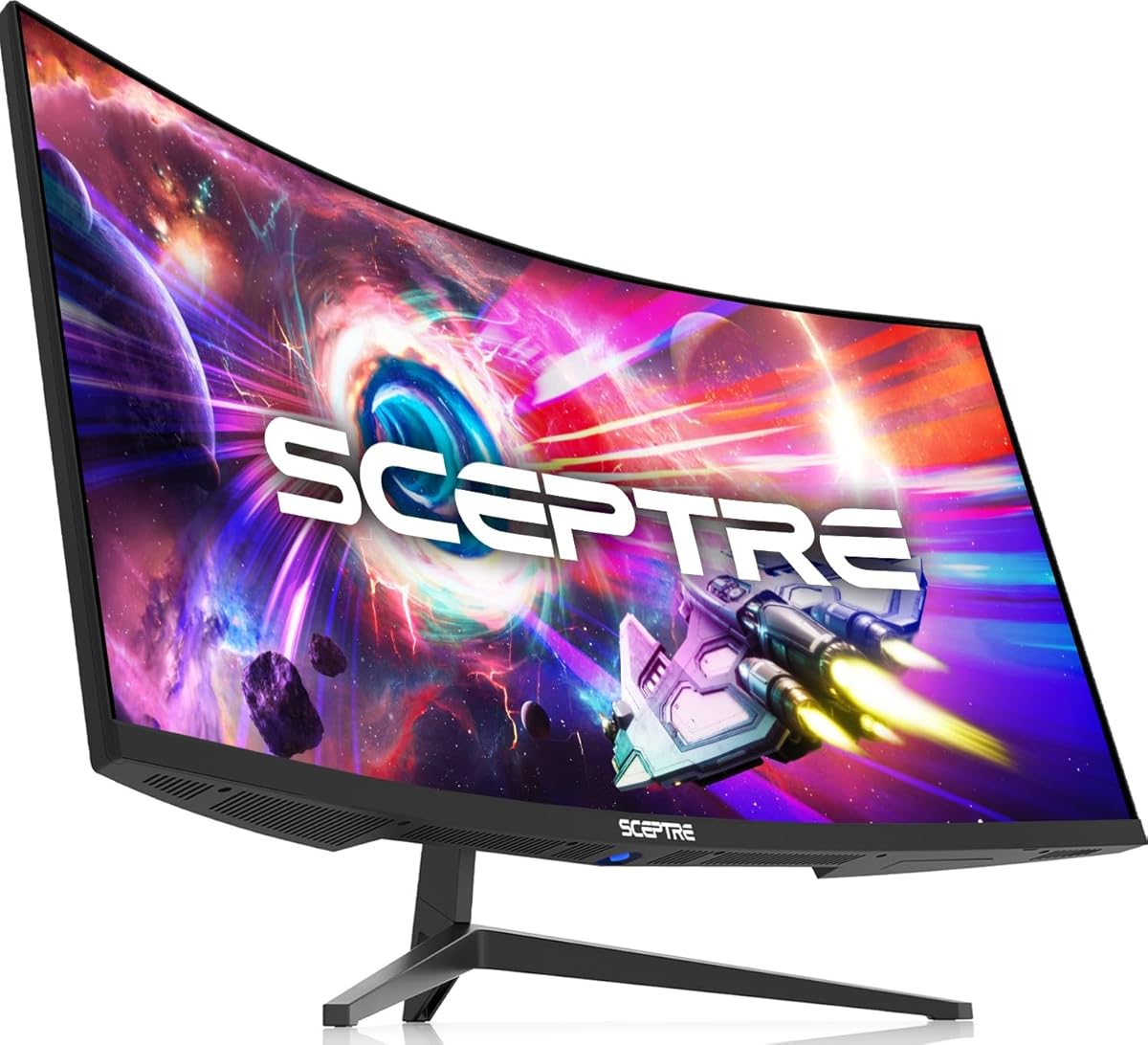
The Sceptre 34-inch Curved Ultrawide is the budget route into 21:9 gaming, offering a 3440x1440 WQHD panel, up to 180Hz refresh and a 1ms response for far less than most ultrawides. A 1500R curve, 99% sRGB colour, RGB backlighting and built-in speakers make it feel more premium than its price. There is no USB hub, but for immersive, roomy ultrawide gaming on a budget it is a smart, capable buy.
- Size
- 34in
- Resolution
- WQHD 3440x1440
- Refresh Rate
- 180Hz
- Curve
- 1500R
What we liked
- Affordable 21:9 ultrawide
- Up to 180Hz refresh rate
- 1ms response and 99% sRGB
- Built-in speakers
Worth noting
- VA panel over IPS
- No USB hub
Samsung 34in Odyssey G5
The Samsung Odyssey G5 34-inch wraps an ultrawide WQHD panel in an unusually aggressive 1000R curve that matches the human field of view for deep immersion. A 165Hz refresh, FreeSync Premium and HDR10 keep gaming smooth and vivid, and the VA panel's strong contrast makes dark scenes pop. Response is quoted as MPRT and the price is premium, but for enveloping ultrawide immersion this Odyssey delivers a striking sense of presence.
- Size
- 34in
- Resolution
- WQHD 3440x1440
- Refresh Rate
- 165Hz
- Curve
- 1000R
What we liked
- Steep 1000R curve for deep immersion
- Roomy 21:9 WQHD panel
- 165Hz with FreeSync Premium
- HDR10 and VA contrast
Worth noting
- MPRT rather than GtG response
- Premium price
Samsung 49in Odyssey G93SC QD-OLED
The Samsung Odyssey G93SC is the premium showpiece, a 49-inch super-ultrawide QD-OLED with a 5120x1440 DQHD resolution, a blazing 240Hz refresh and a near-instant 0.03ms response. DisplayHDR True Black 400 delivers perfect blacks, and both G-Sync and FreeSync Premium Pro keep motion flawless. It costs a fortune and demands a powerful graphics card and a big desk, but for the ultimate immersive OLED gaming experience nothing here comes close.
- Size
- 49in
- Resolution
- DQHD 5120x1440
- Refresh Rate
- 240Hz
- Curve
- 1800R
What we liked
- Stunning QD-OLED image quality
- Blazing 240Hz with 0.03ms response
- Massive 49in super-ultrawide
- G-Sync and FreeSync Premium Pro
Worth noting
- Very high price
- 49in needs a serious GPU and desk
How We Chose the Best Curved Gaming Monitors

Choosing a curved gaming monitor is a balancing act between speed, immersion and cost. A faster panel, a sharper resolution and a bigger, more curved screen all improve the experience, but each pushes the price up and demands more from your graphics card. So rather than crown a single spec winner, we hunted for the monitor whose blend of refresh rate, response time, resolution and curve best matches a particular kind of gamer and budget, then repeated that across the range so every player finds a clear right answer.
We started with the two specs that define gaming feel: refresh rate and response time. We noted where a screen hit 165Hz, 180Hz or a blistering 240Hz, and whether its response figure was a true GtG number like the LG UltraGear models' 1ms or a less meaningful MPRT quote. Resolution and screen size came next, since a 4K panel like the Samsung Odyssey G7 or an ultrawide WQHD looks dramatically different from a 27-inch QHD screen. We then weighed the curve and its immersion, adaptive sync and HDR quality, connectivity and stand adjustability, and the value each offers. The result runs from affordable QHD panels to premium OLED, with a best pick at every level.
What a Curved Gaming Monitor Actually Buys You
The honest appeal of a curved gaming monitor is that it delivers immersion and a competitive edge at once. The curve wraps the screen toward you so more of it falls within your peripheral vision, pulling you into the game, while a high refresh rate and low response time keep fast motion sharp and lag low. Expect a 27 to 49-inch panel, a curve from a gentle 1800R to an aggressive 1000R, refresh rates from 165Hz up to 240Hz, and resolutions from QHD through ultrawide WQHD to 4K and super-ultrawide DQHD. Prices stretch from the value Samsung Odyssey G55C to the premium OLED Odyssey G93SC.
What you are really choosing between is where the design leans. The Samsung Odyssey G55C and LG UltraGear pair pour money into fast, affordable QHD gaming. The ASUS TUF, Sceptre and Samsung Odyssey G5 buy you ultrawide immersion at different prices. The LG 34G630A chases pure speed at 240Hz, the Samsung Odyssey G7 adds 4K sharpness, and the Odyssey G93SC delivers no-compromise OLED. Understanding that trade-off is the key to buying well: decide whether frames, immersion, resolution or image quality matters most, match it to your graphics card and budget, and you will be delighted with the result.
Matching the Monitor to Your Play Style
For Competitive, High-Frame Gaming
If you play fast shooters and want every frame, prioritise refresh rate and a true GtG response. The LG UltraGear 34G630A pushes an ultrawide WQHD panel to 240Hz, and the Samsung Odyssey G93SC's OLED hits 240Hz with a near-instant 0.03ms response for the sharpest motion here.
For Value QHD Gaming
If you want great gaming without a huge spend, a fast QHD panel is the sweet spot. The Samsung Odyssey G55C offers a big 32-inch QHD screen at 165Hz for a keen price, while the LG UltraGear 27GS60QC and 32GS60QC deliver 180Hz with a genuine 1ms GtG response.
For Immersive Ultrawide Play
If cinematic immersion is your goal, a 21:9 ultrawide wraps you in the action. The ASUS TUF VG34VQ3B pairs 180Hz with wide colour, the Sceptre 34-inch brings ultrawide value with speakers, and the Samsung Odyssey G5 uses a deep 1000R curve for the most enveloping view.
For the Ultimate Setup
If budget is no object, the Samsung Odyssey G7 37-inch delivers 4K sharpness at 165Hz, and the Odyssey G93SC super-ultrawide OLED offers the finest image quality and speed here, provided you have the graphics card and desk to match.
Specifications That Matter Most
Two specifications shape the gaming experience above all: refresh rate and response time. A high refresh rate delivers smoother, clearer motion, and the panels here span 165Hz on the Samsung Odyssey G55C up to a blistering 240Hz on the LG 34G630A and Samsung Odyssey G93SC. Pair that with response time, but read the fine print: a true GtG figure like the LG UltraGear models' 1ms reduces ghosting more meaningfully than a quoted MPRT number, and the OLED Odyssey G93SC's 0.03ms is in a class of its own. Crucially, match the refresh rate to a graphics card that can actually push those frames, or you leave performance on the table.
Resolution, curve and adaptive sync round out the picture. Higher resolutions like the Samsung Odyssey G7's 4K look stunning but demand far more from your GPU, while QHD strikes a friendlier balance for most builds. The curve determines immersion, with a steep 1000R wrapping tightly for gaming and a gentler 1500R or 1800R feeling more relaxed. Adaptive sync, whether FreeSync or G-Sync compatibility, keeps the picture tear-free and is worth having on any gaming screen. Finally, consider HDR quality, since a genuine DisplayHDR 600 or True Black 400 rating like the premium Samsung panels' adds real contrast, whereas basic HDR10 support offers a milder lift.
A Closer Look at the Top Picks
The Samsung Odyssey G7 37-inch earns the top spot because it delivers the most complete high-end gaming experience here, uniting a spectacular 4K UHD panel with a fast 165Hz refresh, a true 1ms GtG response, genuine DisplayHDR 600 and a deeply immersive 1000R curve. It asks for a premium and a capable graphics card, but the payoff is sharp, fast, enveloping gaming that few screens can match.
Behind it, the Samsung Odyssey G55C is the value hero with a big 32-inch QHD panel at 165Hz, while the LG UltraGear models at 27 and 32 inches deliver the crispest 180Hz QHD response. The ASUS TUF, Sceptre 34-inch and Samsung Odyssey G5 cover ultrawide immersion across budgets, the LG 34G630A chases 240Hz speed, and the Samsung Odyssey G93SC stands alone as the premium super-ultrawide OLED showpiece for players who want the very best.
Tips for Getting the Most From a Curved Gaming Monitor
A little setup care unlocks the full potential of a gaming panel. Always connect over DisplayPort or, on the LG 34G630A, USB-C where it supports the full refresh rate, since some HDMI ports cap the frame rate below the panel's maximum. Enable your monitor's highest refresh rate in your operating system's display settings, as it often defaults to a lower value, and turn on FreeSync or G-Sync in both the monitor menu and your graphics driver to banish tearing. For competitive play, explore any low-latency or black-stabiliser modes, like those on the LG UltraGear models, to sharpen visibility and cut input lag.
Match your hardware to the panel to avoid disappointment. A 4K screen like the Samsung Odyssey G7 or a 240Hz ultrawide rewards a powerful graphics card, while the QHD Odyssey G55C and 27-inch UltraGear run happily on more modest builds. If your GPU cannot reach a panel's top frame rate in demanding titles, dropping a few in-game settings or enabling upscaling can help you get closer, and adaptive sync will smooth over the frames you do land. Mind ergonomics too: several picks here ship with tilt-only stands, so a VESA arm can help you find a comfortable height, and OLED owners should use pixel-shift and screen-saver features to protect against burn-in.
Take a moment to tune the picture as well. Gaming monitors often default to an oversaturated or overly bright mode, so calibrating brightness, contrast and colour to your room pays off, and features like the LG UltraGear's Black Stabilizer or a crosshair overlay can give a competitive edge. On the super-ultrawide Odyssey G93SC and other 21:9 and 32:9 panels, confirm your games support the wider aspect ratio to avoid black bars. Finally, buy from listings with clear return protection, since curve preference and immersion are personal, and a generous return window costs nothing to lean on.
Final Recommendation
For most buyers chasing the best, the Samsung Odyssey G7 37-inch is the finest curved gaming monitor in 2026, combining 4K sharpness, a fast 165Hz refresh, real HDR and deep immersion. On a budget, the Samsung Odyssey G55C delivers immersive 165Hz QHD gaming for far less, while the LG UltraGear 27 and 32-inch models offer the crispest 180Hz response. Ultrawide fans have the ASUS TUF, Sceptre 34-inch and Samsung Odyssey G5, speed seekers the 240Hz LG 34G630A, and enthusiasts the premium Odyssey G93SC OLED. Whichever you pick, match refresh rate, resolution and curve to your graphics card and play style, and a curved gaming monitor will make every session sharper and more immersive.
How we picked
We judged each curved gaming monitor on refresh rate and response time, resolution and screen size, curvature and immersion, adaptive sync and HDR quality, and the value it delivers at its price. Because gamers span budgets and priorities, we weighted real-world smoothness and immersion over spec sheets, and mixed affordable QHD panels with ultrawide and premium OLED options so competitive and casual players alike find the right fit.
Frequently asked questions
What makes a good curved gaming monitor?
The best curved gaming monitors combine a fast refresh rate, a low response time and an immersive curve. A high refresh like the 165Hz on the Samsung Odyssey G55C or 180Hz on the LG UltraGear models keeps fast motion clear, a true 1ms GtG response reduces blur, and a deep curve such as 1000R wraps the picture around your view. Adaptive sync and good HDR round out the experience.
Is a 1000R curve too aggressive for gaming?
For gaming, no; a steep 1000R curve like the Samsung Odyssey G55C and LG UltraGear models use is designed to match your field of view and maximise immersion, pulling you into the action. Some people find gentler curves like the ASUS TUF's 1500R more comfortable for mixed work and play, but for pure gaming the tighter 1000R curve is a genuine immersion boost.
Do I need an ultrawide for gaming?
You do not need one, but a 21:9 ultrawide like the ASUS TUF VG34VQ3B or Samsung Odyssey G5 adds cinematic immersion and extra field of view in supported games. Just remember an ultrawide has more pixels to drive, so games run best with a stronger graphics card. If your GPU is modest, a 27 or 32-inch QHD panel like the LG UltraGear is an easier match.
Is an OLED gaming monitor worth the extra cost?
For image quality, OLED is in a class of its own. The Samsung Odyssey G93SC's QD-OLED panel delivers perfect blacks, vivid colour and a near-instant 0.03ms response that standard panels cannot match. It costs far more and demands a powerful graphics card, so it suits enthusiasts with the budget and hardware; for most players a fast QHD panel like the Odyssey G55C offers better value.
What refresh rate should a gaming monitor have?
For most gamers, 144Hz to 165Hz is plenty, and panels like the Samsung Odyssey G55C at 165Hz feel smooth and responsive. Competitive players benefit from more, with the LG UltraGear 34G630A and Samsung Odyssey G93SC reaching 240Hz for the clearest fast motion. Match the refresh rate to a graphics card that can actually push those frames to feel the full benefit.