Air cooler screens versus AIO pump displays
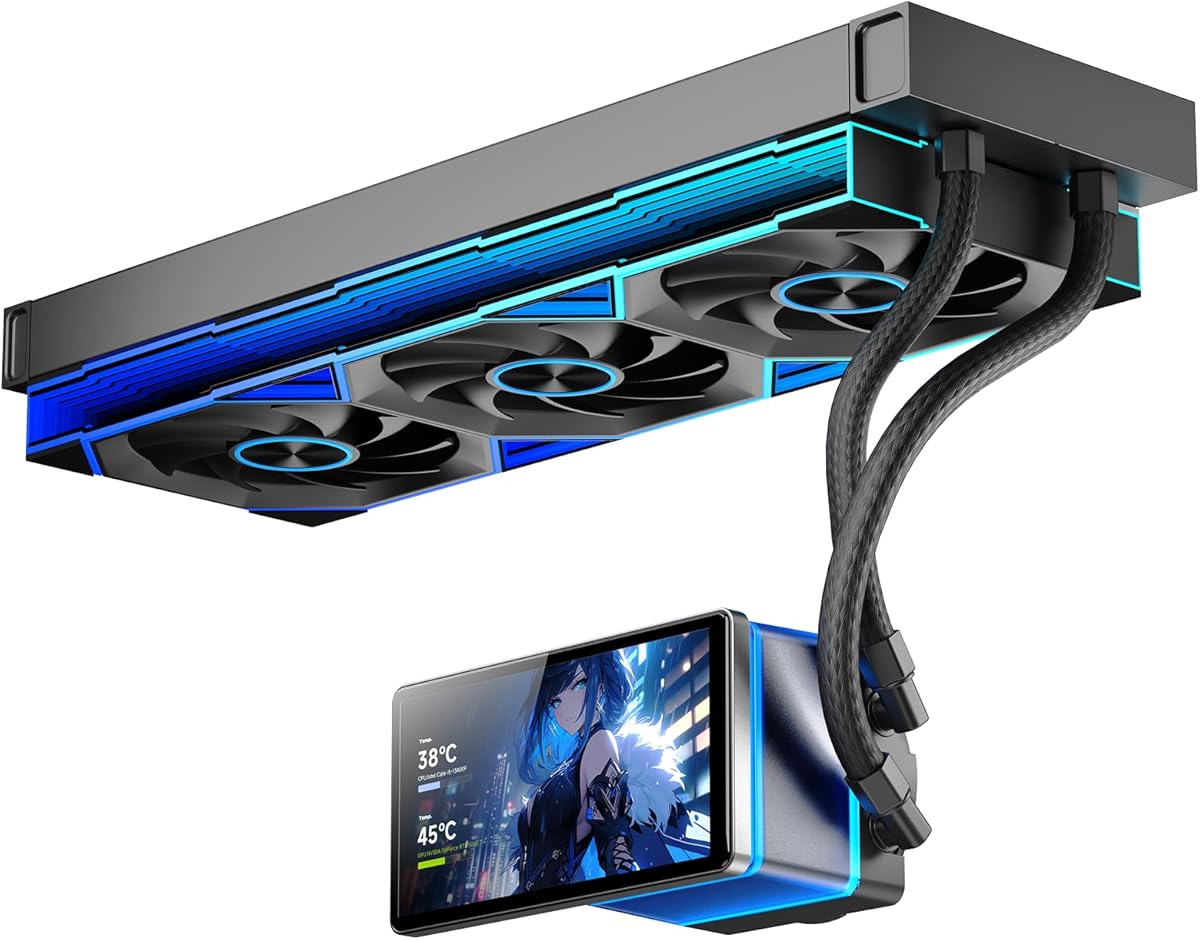
Screen-equipped air coolers like the Thermalright Peerless Assassin 120 Vision MAX and TRYX TURRIS 620 mount the panel on a magnetic tower top cover rather than on the pump block. That keeps the display visible above RAM and GPU territory in many mid-towers, but it also adds height—164mm on the Thermalright Vision MAX line—so you must verify case CPU cooler clearance before ordering. AIO screens live on the pump head, which sits lower over the socket but still needs USB power for most software suites and careful tube routing so cables do not tug the display module.
Neither layout cools better purely because the screen is larger. Thermals still come from heat pipes, fin area, radiator size, and fan airflow. Treat the display as a monitoring and personalization layer you pay for in dollars, USB headers, and occasional software updates. If you will never open TRCC, KANALI, or iCUE, a non-screen cooler from another guide may save complexity without sacrificing temperatures.
Resolution, panel type, and readability
This pack spans 320×240 two-inch squares on the Thermalright FW SE through 480×480 and 480×854 IPS panels on Thermalright Vision products, 1280×720 on TRYX TURRIS, and 2K AMOLED on TRYX Panorama SE and Chill Arc. Higher pixel counts matter when you show dense sensor grids or crisp GIFs; lower resolutions can look fine for a large temperature numeral and a logo. AMOLED curved panels deliver contrast and viewing angles that IPS struggles to match in photos, but they also draw more power and may need brighter ambient lighting control to avoid glare on curved glass.
Refresh rate shows up on premium entries—60Hz on Peerless Vision and Panorama SE—while CORSAIR’s Titan LCD targets 30 FPS for animations. For static dashboards the difference is minor; for video loops and meme GIFs it is noticeable. Pick the panel that matches how you will actually use it, not the highest spec on the chart alone.
Software ecosystems: TRCC, KANALI, and iCUE
Thermalright TRCC drives Peerless Vision AIOs and Peerless Assassin Vision air coolers over a motherboard 9-pin USB header. Expect real-time monitoring, custom backgrounds, and video support on larger models. TRYX KANALI adds GIPHY native browsing on TURRIS and Panorama SE, split-screen layouts, and an embedded processor that handles playback without loading the CPU—useful when you run heavy games and still want smooth animations on the cooler face.
CORSAIR iCUE and iCUE LINK on the Titan 360 RX LCD integrate the pump screen with RX120 fans and the included System Hub for daisy-chain wiring. That is the most cohesive premium ecosystem in this pack if you already own CORSAIR fans and controllers. Budget time on day one to install software, confirm USB detection, and save a fallback static image in case an update resets themes.
Cooling capacity and noise
Marketing TDP figures—280W on TRYX air and AIO, 320W on Chill Arc and PF 360—describe design targets, not guarantees on your exact chip and case. A 360mm AIO with three aggressive fans generally beats a dual-tower air cooler on sustained all-core loads, but a quality dual-tower with a huge screen like TURRIS 620 can still keep gaming CPUs comfortable when case airflow is solid. Noise follows fan RPM: 2000–2150 RPM ratings need tuned PWM curves or they will announce themselves during light desktop work.
Rail-mounted ROTA fans on TRYX models and S-FDB bearings on Thermalright units aim to reduce vibration. Infinity-mirror and ARGB fan rings add visual weight but do not replace static pressure through radiator fins. Plan radiator position—top exhaust versus front intake—before you commit to a 360mm screen AIO that also needs a USB cable path to the pump.
Sockets, clearance, and long-term ownership
Verify AM5, AM4, LGA 1700, and LGA 1851 explicitly for 2026 builds. Several Thermalright listings note AMD installs require the motherboard’s original backplate—not included in the box. Intel kits are generally complete, but read the diagram for your exact LGA generation before torqueing screws. RAM clearance matters on offset dual-tower designs: TRYX publishes 55mm on TURRIS; tall RGB heat spreaders may force fan height adjustments on any 164mm tower.
Screen coolers are still coolers first. Keep radiator dust filters clean, remount with fresh paste if you swap boards, and treat USB-powered displays as components that may need driver or firmware attention after major OS updates. Buy from sellers with workable returns, test pump and fan noise inside the return window, and photograph cable routing while the panel is open so future upgrades go faster.