Expert Review & Guide

Best Chromebooks of 2026 for Students and ChromeOS Work

Chromebooks are not “cheap Windows laptops.” They are ChromeOS machines: fast to boot, stubborn about security, fluent in Google Workspace, and increasingly capable of running Android apps from the Play Store. That combination is why schools standardized on them—and why the wrong Chromebook still disappoints at home. Buy a 4GB gateway, install three Android apps, forget to enable Offline, and a dead café Wi-Fi connection turns into a missed deadline. Buy a Chromebook Plus with 8GB RAM and a real SSD, pin your course Drive folder, and ChromeOS’s limits suddenly look like strengths: less malware drama, automatic updates, and a UI students already know from Classroom.

This roundup sticks to the products in our Chromebooks pack and judges them the way students and parents actually live: Can you work Offline on the bus? Do Android apps behave, or do they devour a 64GB eMMC? Is the screen clear enough for PDFs? Will the hinge survive a locker? We highlight ChromeOS strengths (sandboxing, speed, cloud sync) and ChromeOS limits (specialized desktop software, uneven offline media tools, school testing exceptions) so you are not sold a slogan.

Our top picks favor configurations that make Offline and Android practical: the Acer Chromebook Plus 514 Touch for balanced student power and 512GB storage, the Acer Chromebook Plus 515 for large-screen homework sprawl, and the ASUS Chromebook Flip CX1 for convertible study modes. Everything else in the pack earns an honest lane—budget FHD workhorses, compact 2-in-1s, and bare-bones gateways included.

Our Top Chromebook Picks for 2026

Best Overall for Students

Acer Chromebook Plus 514 Touch

★★★★☆8.8/10
Acer Chromebook Plus 514 Touch
  • 512GB SSD keeps Offline Docs, Android lesson packs, and class PDFs onboard
  • i3-N355 and 8GB RAM multitask through Classroom, Meet, and Gemini drafts
  • 14" WUXGA touch with durable chassis for real backpack student life
Check Price →
Best Large-Screen Chromebook Plus

Acer Chromebook Plus 515

★★★★☆8.6/10
Acer Chromebook Plus 515
  • 15.6" FHD touch spreads research tabs and lecture video without squinting
  • Chromebook Plus i3-1305U performance for heavier homework stacks
  • 256GB SSD plus Wi-Fi 6E for campuses and cloud-first Offline workflows
Check Price →
Best Convertible for Hybrid Study

ASUS Chromebook Flip CX1

★★★★☆8.8/10
ASUS Chromebook Flip CX1
  • 360° FHD touchscreen for tablet reading, tent streaming, and markup
  • 8GB RAM and 128GB storage avoid the worst budget Chromebook bottlenecks
  • MIL-STD durability and full ports for hybrid school-and-home days
Check Price →

As an Amazon Associate we earn from qualifying purchases. We may earn a commission at no additional cost to you.

Chromebook Spec Comparison at a Glance

Use this table to match ChromeOS realities—RAM headroom for Android apps, local storage for Offline files, and screen format for reading—before you fall for a thin price tag. Specs below skip street prices on purpose; configurations change, Offline needs do not.

#ProductSpecificationsScore
1
  • Intel Core i3-1305U, 8GB RAM
  • 256GB SSD, 15.6" FHD touch
  • Wi-Fi 6E, HDMI, ChromeOS
8.6
2
  • Intel Celeron N4500, 8GB RAM
  • 64GB eMMC, 15.6" FHD
  • USB-C/A, ~10-hour battery class
8.6
3
  • Intel Celeron N4500, 4GB RAM
  • 64GB eMMC, 14" FHD
  • Wi-Fi 5, ChromeOS Gateway
8.4
4
  • Intel Core i3-N355, 8GB RAM
  • 512GB SSD, 14" WUXGA touch
  • Wi-Fi 6E, MIL-STD 810H
8.8
5
  • Intel Celeron N-series, 8GB RAM
  • 64GB storage, 15.6" HD
  • ChromeOS, travel-friendly
8.8
6
  • Intel Core i3-N355, 8GB RAM
  • 512GB SSD, 14" WUXGA touch
  • Backlit KB, Wi-Fi 6E
8.8
7
  • Intel Celeron N4120, 4GB RAM
  • 64GB eMMC, 14" HD
  • Fast Charge, thin design
8.6
8
  • Intel N100, 4GB RAM
  • 128GB (eMMC+SD), 12.2" WUXGA
  • 360° 2-in-1, Wi-Fi 6
10
9
  • MediaTek Kompanio 540, 8GB
  • 64GB UFS, 14" WUXGA IPS
  • Gemini, military-grade build
8.2
10
  • Intel Celeron N4500, 8GB RAM
  • 128GB eMMC, 14" FHD flip
  • Wi-Fi 6, MIL-STD 810H
8.8

2. Acer Chromebook Plus 515 - Best Large-Screen Chromebook Plus

Acer Chromebook Plus 515

Acer Chromebook Plus 515

8.6/10★★★★☆

The Acer Chromebook Plus 515 is the pack’s desk-friendly student workstation: a 15.6-inch Full HD IPS touch panel that makes split-screen note-taking beside a lecture stream feel natural. ChromeOS already encourages tabbed workflows; a bigger screen simply reduces the constant alt-tabbing that shrinks focus on 14-inch HD panels. For households that park a Chromebook on the kitchen table for homework help, the extra real estate is the feature you notice every night.

  • Intel Core i3-1305U
  • 8GB LPDDR5X + 256GB SSD
  • 15.6" FHD IPS touch, Wi-Fi 6E
Check Price →
✓ Pros
  • 15.6-inch FHD touch spreads worksheets and video lectures comfortably
  • i3-1305U and 8GB handle heavy tab stacks better than Celeron models
  • 256GB SSD supports Offline Drive and Android app caches
  • HDMI plus dual USB-C simplify classroom projection
  • Chromebook Plus AI and security features for shared family accounts
✕ Cons
  • Larger chassis is less ideal for tight backpacks than 14-inch models
  • 256GB is solid but trails the 512GB Plus 514 for media-heavy majors
  • ChromeOS still cannot replace specialized Windows creative suites

Detailed review

Intel’s Core i3-1305U with 8GB LPDDR5X and a 256GB PCIe Gen4 SSD lands firmly in Chromebook Plus territory. Versus entry Celerons, you get calmer multitasking when Meet, Classroom, Docs, and a research rabbit hole coexist. Versus the Plus 514’s i3-N355 and 512GB drive, you trade some storage headroom and portability for a larger canvas and a U-series CPU tuned for sustained laptop work. For essay-heavy high schoolers and college freshmen writing research papers, that trade often makes sense.

ChromeOS strengths—fast resume, sandboxing, and Play Store Android apps—pair well with Wi-Fi 6E on dense campus networks. Android apps extend offline: download podcasts, language packs, or textbook companion apps before a flight home. Remember ChromeOS limits: Linux containers help developers, but they are not a full Ubuntu desktop replacement, and some banking or school VPN clients remain spotty. Always test critical apps during return windows.

Connectivity is pragmatic: two USB-C ports with DisplayPort and charging, one USB-A, HDMI 1.4, Bluetooth, and a 720p webcam. The webcam is adequate for class, not creator-grade. Up to roughly ten hours of claimed battery life covers a school day if brightness and cellular hotspots stay reasonable; streaming all day will cut that, as on any Chromebook.

Security messaging around Titan C2 and ChromeOS’s clean virus track record is more than marketing for student devices that bounce between school Wi-Fi and coffee shops. Automatic updates reduce the “did you install the patch?” parental nag. The flip side of Google’s cloud-first design is account dependency: without offline prep, a dead hotspot equals stalled homework. Spend fifteen minutes pinning Offline files after purchase—that ritual matters more than any spec sheet.

Choose the 515 when screen size and Chromebook Plus performance matter more than absolute lightest weight. Choose the 514 Touch when backpack grams and 512GB of local files win. Both outclass 4GB/64GB gateways for anyone living in Android apps plus Offline Docs.

Best student workflows on a 15.6-inch ChromeOS machine

Use snap layouts: Docs on one half, Classroom or PDF on the other. Enable touch for scrubbing timelines in YouTube lectures. Install only the Android apps your courses require so the Play Store does not become a distraction store.

For group projects, HDMI to a dorm TV turns the 515 into a shared review station without leaving ChromeOS.

When the larger Plus model is the wrong buy

If you walk miles between classes or already own a tablet for reading, a 14-inch Plus or the ASUS Flip may feel freer. If you need native Windows, no Chromebook size saves you—look elsewhere and keep ChromeOS as a secondary browser box.

Check Price on Amazon →

We may earn a commission at no additional cost to you.

7. Lenovo IdeaPad 3i Chromebook - Best FHD Screen on

Lenovo IdeaPad 3i Chromebook

Lenovo IdeaPad 3i Chromebook

8.6/10★★★★☆

The Lenovo IdeaPad 3i Chromebook is the straightforward large-screen homework clamshell: 15.6-inch Full HD, Intel Celeron N4500, 8GB RAM, and 64GB eMMC on ChromeOS. In a sea of soft HD panels, the 1920×1080 resolution is why this model still deserves attention in 2026. Spreadsheets, PDF textbooks, and video lectures look cleaner, which reduces fatigue during long study blocks.

  • Intel Celeron N4500
  • 8GB RAM + 64GB eMMC
  • 15.6" FHD 1920×1080 display
Check Price →
✓ Pros
  • Full HD 15.6-inch panel beats fuzzy HD budget screens
  • 8GB RAM supports saner ChromeOS + Android multitasking
  • Familiar ports including USB-C and USB-A for school accessories
  • Up to ~10-hour battery narrative for all-day classes
  • Simple Abyss Blue clamshell for students who skip convertibles
✕ Cons
  • 64GB eMMC still constrains Offline libraries and big Android games
  • Celeron N4500 is adequate, not Plus-tier snappy
  • No 360° hinge if tablet annotation is a priority

Detailed review

Eight gigabytes of RAM again separates usable budget Chromebooks from obsolete ones. ChromeOS will run Android apps from Google Play—Khan Academy, Duolingo, Microsoft 365, Adobe Express—without the instant memory collapse 4GB machines show. Keep expectations honest: the N4500 is a dual-core efficiency chip. It boots fast and browses well; it will not love dozens of 1080p streams plus WebGL simulations.

Offline strategy is everything on 64GB. Pin active Google Docs and Classroom materials, not your entire Drive. Use Android apps that offer lesson downloads sparingly. For media courses, external storage is part of the kit, not an accessory. ChromeOS strengths (safe browsing defaults, automatic updates, quick resume) make this a strong first laptop for families leaving aging Windows 10 hand-me-downs that feel slow and risky.

Lenovo’s port mix covers USB-C and USB-A for flash drives and mice. The 720p camera handles homeroom check-ins. A physical lock slot is a rare mention that matters in open campus libraries. Battery life up to about ten hours matches the “leave the charger in the locker” dream if workloads stay light.

Compared with HP’s 15.6 Premium, prioritize the IdeaPad when FHD sharpness matters. Compared with Acer Plus units, accept slower storage and less CPU headroom to save budget. Compared with convertibles, you gain keyboard stability and lose tablet modes.

This is a best-fits-most budget Chromebook for Google-school households who want a clear screen and enough RAM, and who will respect Offline limits instead of treating eMMC like a bottomless folder.

Android apps worth installing first

Start with your school’s required apps, then a PDF annotator, then Microsoft 365 if teachers still send .docx files. Avoid installing five near-duplicate note apps—they waste 64GB and RAM.

After installs, reboot once and open Offline Docs in airplane mode to verify the student’s workflow before Monday morning.

Clamshell versus convertible for note-taking

If teachers require stylus markup daily, look at the ASUS Flip or Lenovo Flex instead. If typing essays is 90% of the work, the IdeaPad’s fixed hinge is a feature: fewer wobbles on wobbly desks.

Check Price on Amazon →

We may earn a commission at no additional cost to you.

10. Acer Gateway Chromebook 314 - Best Bare-Bones Gateway Pick

Acer Gateway Chromebook 314

Acer Gateway Chromebook 314

8.4/10★★★★☆

The Acer Gateway Chromebook 314 is the pack’s honest floor: Celeron N4500, 4GB LPDDR4X, 64GB eMMC, 14-inch Full HD, Wi-Fi 5, ChromeOS. It exists for shoppers who need a secure Google document machine and nothing more. Credit where due—the FHD panel is kinder than the HD screens on some cheap laptops, so reading Docs and PDFs is pleasant when the OS is not swapping memory.

  • Intel Celeron N4500
  • 4GB LPDDR4X + 64GB eMMC
  • 14" FHD, Wi-Fi 5
Check Price →
✓ Pros
  • Full HD 14-inch panel punches above typical gateway expectations
  • ChromeOS boot speed and virus-resistant design suit first-time users
  • Gemini and Google app access for basic AI-assisted homework help
  • Long battery claims around 10.5 hours for light study days
  • Lowest-complexity option when budget is the binding constraint
✕ Cons
  • 4GB RAM bottlenecks Android apps and heavy Classroom sessions
  • 64GB eMMC plus Wi-Fi 5 feel dated on busy campuses
  • Not the machine to stretch into media-heavy or Linux-heavy courses

Detailed review

ChromeOS strengths do the heavy lifting. Sub-ten-second startups, automatic updates, Titan C2 security messaging, and Play Store access mean a sixth grader can email, write, and watch lessons without antivirus theater. ChromeOS limits are equally blunt here: with 4GB RAM, each Android app costs dearly. Prefer web apps. Offline mode works for pinned Docs, but downloading multiple Android course packs will crush storage and performance.

Wi-Fi 5 dual-band is adequate at home and strained in packed lecture halls compared with Wi-Fi 6/6E Plus models. Battery life up to about 10.5 hours fits light browsing. Ports are minimalist—one USB-C, one USB-A, headphone jack—so budget for a hub if you present often. A short Google AI Pro trial with cloud storage may appear in promotions; enjoy it, but do not buy the Gateway for AI features alone.

Who should buy it? Families replacing a dead laptop solely for Google Classroom, library Wi-Fi users, or anyone who wants a disposable-travel browser that still receives ChromeOS patches. Who should not? Students already complaining about lag on 4GB devices, anyone deep into Android offline media, or households that can stretch to the 8GB IdeaPad 3i / HP 15.6 tier.

Stacked against the HP Chromebook 14, both are entry machines; pick based on screen preference (Gateway’s FHD versus HP’s thinner HD travel story) and current pricing. Stacked against Chromebook Plus, the Gateway is a different product category—fine for basics, frustrating as a four-year high school daily driver.

If the Gateway is truly the budget cap, buy it with a clear Offline and tab-discipline plan on day one. If you can add a little more, 8GB RAM will improve student happiness more than any brand slogan.

Make a 4GB Gateway usable

One school profile, minimal extensions, web-first Microsoft 365, and ruthless Download folder cleanups. Skip Play Store games entirely on this tier—they steal RAM from homework.

Keep a USB-C drive in the backpack for anything larger than Documents.

When to return and step up

If Meet calls stutter while Docs is open during the return window, exchange for an 8GB model. That symptom rarely softens with “getting used to it.”

Check Price on Amazon →

We may earn a commission at no additional cost to you.

1. Acer Chromebook Plus 514 Touch - Best Overall for

Acer Chromebook Plus 514 Touch

Acer Chromebook Plus 514 Touch

8.8/10★★★★☆

If you want one Chromebook that respects how students actually work in 2026—Google Classroom tabs, Android annotation apps, Offline Docs on the bus, and enough local storage that a dropped Wi-Fi day does not erase the week—the Acer Chromebook Plus 514 Touch is the clearest pick in this pack. ChromeOS shines when files live in Drive and apps stay lightweight, but its classic weakness is tiny eMMC. Acer’s 512GB SSD flips that script: you can pin Offline Google Docs, Sheets, and Slides; keep a semester of PDFs; install Android apps from Play that cache media; and still leave headroom for Linux (Crostini) tools if a CS class needs them.

  • Intel Core i3-N355 (8-core)
  • 8GB LPDDR5X + 512GB SSD
  • 14" WUXGA IPS touch, Wi-Fi 6E
Check Price →
✓ Pros
  • 512GB SSD sidesteps ChromeOS local-storage anxiety for offline class files
  • WUXGA touch and backlit keyboard suit long study sessions
  • MIL-STD 810H build matches backpack abuse
  • Chromebook Plus AI tools and multi-monitor ports for group projects
  • Long update window through mid-2030s supports multi-year school plans
✕ Cons
  • Not a Windows replacement for specialized desktop software
  • Touchscreen adds weight versus ultra-thin clamshells
  • Heavy video editors may still prefer a Windows or Mac machine

Detailed review

The Intel Core i3-N355 eight-core chip and 8GB LPDDR5X sit in the Chromebook Plus performance band Google designed for multitasking beyond pure browsing. Expect smooth Meet/Zoom splits, Canva or Adobe Express in the browser, and Gemini-assisted drafting without the stutter that 4GB Celeron models show when a dozen Classroom tabs meet YouTube. Intel graphics will not replace a gaming laptop, yet cloud clients like GeForce NOW and casual Android games are realistic after-school options.

ChromeOS strengths show up immediately: sub-ten-second boots, automatic background updates, and a security model that has kept successful viruses effectively off the map. The Titan-class chip story and verified boot matter when a shared family machine also holds student accounts. Limits still apply—no native Adobe Premiere desktop workflow, limited offline music library tools compared with iTunes-era PCs, and some school districts still mandate Windows-only testing software. Verify your school’s lockdown browser and assessment apps before you buy for testing day.

The 14-inch WUXGA (1920×1200) IPS touchscreen is taller than old 16:9 panels, so you see more of a Doc or spreadsheet without endless scrolling. Touch helps with Android drawing apps and quick UI taps; the privacy-shutter 1080p webcam is better than the 720p cams on budget siblings for office hours. Dual USB-C, dual USB-A, HDMI, Wi-Fi 6E, and Bluetooth 5.3 mean classroom projectors and dorm docks usually work without hunting for dongles.

Battery life and the roughly 3.09 lb chassis make this a commute machine: library, lecture hall, coffee shop. Fast charge helps between classes. Chromebook Plus promotions that unlock Google AI Pro and cloud storage for a year amplify NotebookLM study workflows—upload lecture notes, ask for outlines, then edit offline later once you pin the Doc. Treat promo terms as time-limited; the hardware remains useful after the trial ends.

Compared with the 15.6-inch Plus 515 in this roundup, the 514 trades screen sprawl for backpack friendliness and doubles storage. Against the ASUS Flip, you lose 360° tablet mode but gain a faster processor and far more SSD capacity. For K–12 through early college students living in Google Workspace, this is the configuration that makes ChromeOS feel like a strength rather than a compromise.

Who should buy this Chromebook

Choose the Plus 514 Touch if your coursework lives in Google Workspace, Canvas, or Schoology; you need Android apps for annotation or language practice; and you want offline resilience without babysitting a 64GB eMMC. Parents buying one machine for middle school through early high school get durability and a long Auto Update Expiration window.

Skip it if you must run full Windows CAD, industry DAWs, or district software that blocks ChromeOS. In those cases Chromebooks remain secondary devices.

Offline and Android app setup tips

After sign-in, open Drive settings and enable offline for critical folders. In Docs/Sheets/Slides, toggle Offline. Install Android apps only for tasks browsers handle poorly—GoodNotes-style note apps, language flashcards, or school-mandated readers—and check each app’s offline behavior on a plane-mode test before relying on it for exams.

If storage still feels tight years later, move bulky media to an external USB-C drive; ChromeOS handles removable storage cleanly for photo dumps and video projects.

Versus the other Plus 514 listing

This pack includes a second Acer Chromebook Plus 514 with matching i3-N355, 8GB, 512GB, and touch specs. Treat them as sibling listings: compare seller fulfillment, included promo language, and current availability. Spec-for-spec they occupy the same tier; pick the better-stocked offer.

Check Price on Amazon →

We may earn a commission at no additional cost to you.

6. HP 15.6 Premium Chromebook - Best Budget 15.6-Inch Daily

HP 15.6 Premium Chromebook

HP 15.6 Premium Chromebook

8.8/10★★★★☆

HP’s 15.6-inch Premium Chromebook targets families who want ChromeOS simplicity on a large screen without jumping to Chromebook Plus SSD pricing. The important upgrade versus true gateways is memory: 8GB of DDR5. That single choice determines whether Android apps and Classroom tabs coexist or thrash. If your prior Chromebook was a 4GB brick, this HP will feel like a different product category even before you notice the processor name.

  • Intel Celeron N-series
  • 8GB DDR5 + 64GB storage
  • 15.6" HD display, Chrome OS
Check Price →
✓ Pros
  • 8GB RAM elevates a budget chassis above painful 4GB models
  • Big 15.6-inch screen helps shared homework sessions
  • ChromeOS keeps the experience simple for first-time laptop users
  • Light travel weight suits students who want size without Plus pricing
  • Solid rating for everyday browsing, Docs, and streaming
✕ Cons
  • 64GB storage forces strict Offline and Android install discipline
  • HD panel is less sharp than FHD/WUXGA options in this guide
  • Celeron-class CPU lags Chromebook Plus chips under load

Detailed review

Storage stays at 64GB, which reintroduces classic ChromeOS limits. Offline Google files, Play Store apps, and downloaded lessons share a small pool. The mitigation plan is non-negotiable: live in Drive, enable Offline only for active courses, stream media instead of downloading, and keep a cheap USB-C flash drive for video projects. ChromeOS handles removable storage well—use it.

The 15.6-inch HD display prioritizes size over sharpness. Text looks fine; photo editing in web apps looks softer than on the FHD Lenovo IdeaPad 3i or Acer Plus panels. For essay writing and Zoom, it is acceptable. For design students, step up. Performance from the Intel N-series Celeron with turbo behavior covers Docs, Sheets, Canva-in-browser, and GeForce NOW-style cloud gaming at modest settings—not local AAA titles.

ChromeOS strengths remain the sales pitch: rapid updates, phishing-resistant defaults relative to neglected Windows PCs, and Play Store access for Android education apps. Weaknesses remain too: no full offline Creative Cloud desktop, possible school testing incompatibilities, and dependence on Google accounts. HP’s lightweight travel pitch fits backpacks, and battery life is described as long-lasting for study and streaming—calibrate expectations after a week of real Meet usage.

Versus the Lenovo IdeaPad 3i’s FHD panel, the HP trades sharpness for a similar large-screen, 8GB, 64GB recipe. Versus Acer Gateway’s 4GB/14-inch machine, the HP is the wiser daily driver for multitasking. Versus Plus models, you are choosing budget over Offline abundance.

Buy it when 8GB RAM and a big screen matter more than SSD capacity, and you are willing to practice ChromeOS cloud hygiene. Skip it if your student downloads everything “just in case”—they will hit the 64GB wall by October.

Cloud-first habits that make 64GB survivable

Turn on camera uploads to Google Photos with backup quality suited to your storage plan. Empty Downloads monthly. Prefer streaming music services with offline playlists on a phone instead of filling the Chromebook.

If Android apps refuse to update due to space, uninstall the largest games first—education apps should win that fight.

Who outgrows this HP quickly

High school media electives, dual-enrollment students juggling many Offline textbooks, and anyone installing Linux toolchains should budget for a Plus SSD model instead.

Check Price on Amazon →

We may earn a commission at no additional cost to you.

4. Acer Chromebook Plus 514 - Best Long-Haul Storage Twin

Acer Chromebook Plus 514

Acer Chromebook Plus 514

8.8/10★★★★☆

This Acer Chromebook Plus 514 listing is the storage-and-stamina twin of our Best Overall pick: Intel Core i3-N355, 8GB LPDDR5X, 512GB SSD, 14-inch WUXGA touch, Wi-Fi 6E, and a backlit keyboard. If the other 514 is out of stock or a bundle looks better here, you are not stepping down in the specs that matter for ChromeOS life—local files, Android app caches, and Offline Google Workspace.

  • Intel Core i3-N355 (8-core)
  • 8GB LPDDR5X + 512GB SSD
  • 14" WUXGA IPS touch, Wi-Fi 6E
Check Price →
✓ Pros
  • Same student-ready Plus formula: 8GB RAM and 512GB SSD
  • WUXGA touch and backlit keyboard for late-night homework
  • Military-standard durability messaging for backpack life
  • Strong port set including HDMI and dual USB-C
  • Education-focused positioning with long ChromeOS support window
✕ Cons
  • Overlaps heavily with the other Plus 514 listing—compare offers carefully
  • Still bound by ChromeOS software limits for niche desktop apps
  • Touch Plus chassis costs more than basic Celeron gateways

Detailed review

Why repeat the model in a roundup? Retail reality. Chromebook shopping often means two Amazon listings with near-identical hardware and different promo copy (“long battery life” versus “Gemini AI” emphasis). Our job is to keep you from assuming they are different tiers. Both are Chromebook Plus machines aimed at K–12, college, and light business. Both lean on ChromeOS strengths: quick boot, sandboxing, and cloud sync. Both inherit ChromeOS limits: assessment software compatibility and scarce native pro apps.

For students, 512GB is transformative. Offline mode stops being a nervous checkbox when you can pin entire course folders. Android apps that download lessons for subway commutes stop evicting each other. Linux containers for introductory programming have room to breathe. That is the practical rebuttal to “Chromebooks have no storage.” Cheap 64GB models earned that reputation; Plus SSDs retire it.

Daily use mirrors the sibling: Meet calls on a 1080p shuttered webcam, multi-monitor homework via HDMI/USB-C, and Gemini-assisted outlining when online. Battery and fast-charge behavior support full campus days. The ~3.09 lb MIL-STD 810H story matches real locker-slam life better than glossy ultraportables that crease under a textbook stack.

If you already decided on the Plus 514 platform, buy whichever listing ships faster with clearer return terms. If you are still deciding platforms, compare this tier against the 15.6-inch Plus 515 for screen size and against the ASUS Flip for convertibility. Do not confuse either Plus 514 with the Gateway 314—those live in different performance galaxies.

One buying caution: confirm the exact SKU details on the product page at checkout (RAM, SSD, touch). Marketplace variants occasionally differ. Stick to the 8GB/512GB touch configuration described here to keep Offline and Android flexibility intact.

How to choose between the two Plus 514s

Ignore cosmetic title differences. Compare fulfillment (sold by whom), current promotions for Google AI Pro or storage trials, and customer Q&A about the precise model number. Spec parity means offer quality decides the winner.

Student IT and managed ChromeOS notes

If a school manages devices via Google Admin, personal Chromebook Plus units may still enroll as personal devices—great for homework, not always accepted as the locked testing device. Keep the school Chromebook for exams when required and use this Acer for everything else.

Check Price on Amazon →

We may earn a commission at no additional cost to you.

9. HP Chromebook 14 - Best Lightweight Secondary ChromeOS

HP Chromebook 14

HP Chromebook 14

8.6/10★★★★☆

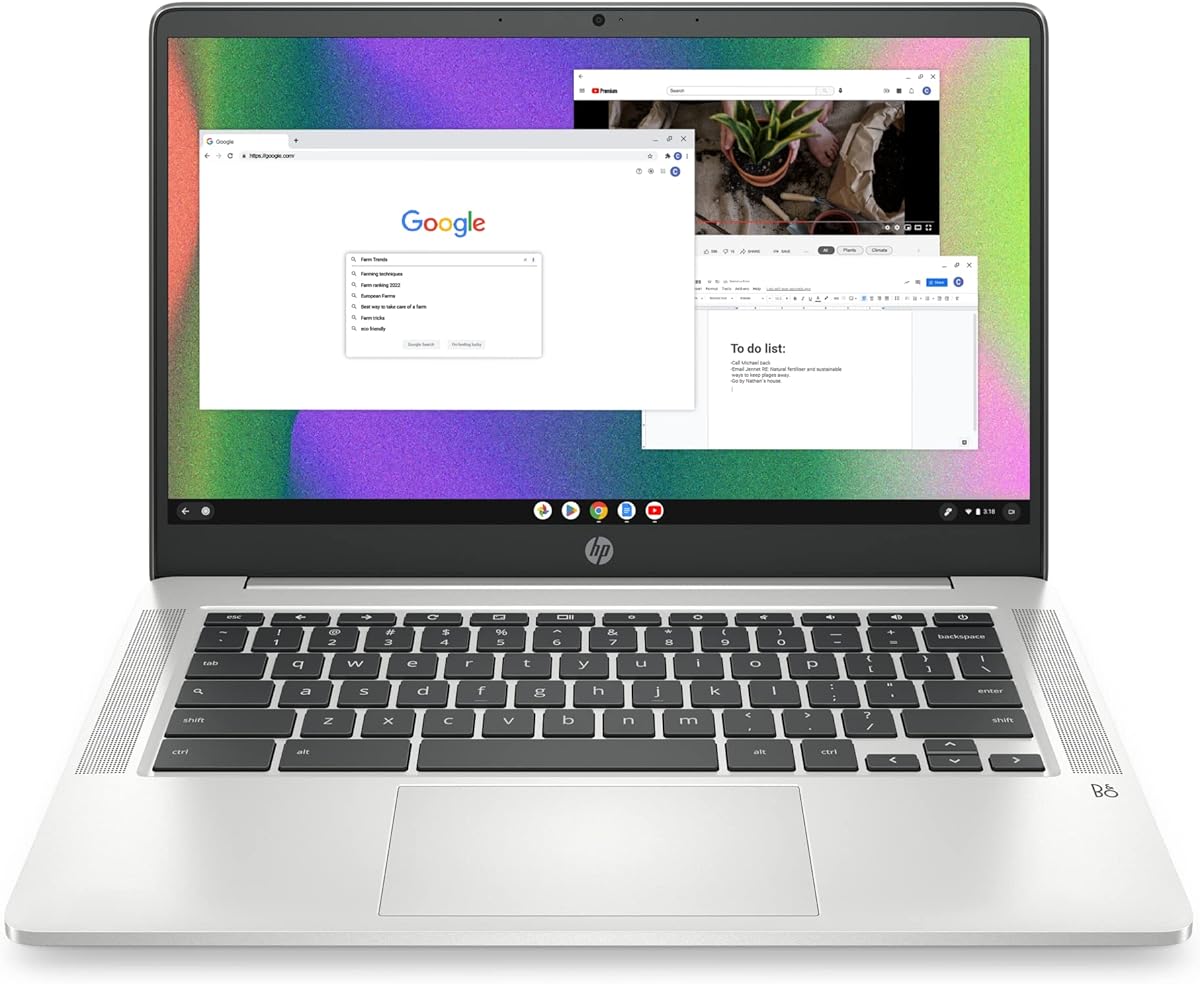
The HP Chromebook 14 (14a-na0226nr) is a thin Mineral Silver clamshell for households that need a simple Google homework device, not a primary creator laptop. Intel Celeron N4120, 4GB RAM, 64GB eMMC, and a 14-inch HD anti-glare panel define a classic entry Chromebook. Used within those rails—Classroom, Docs, light YouTube—it remains competent. Used like a Windows multitasking PC, it frustrates.

  • Intel Celeron N4120
  • 4GB RAM + 64GB eMMC
  • 14" HD anti-glare, long battery
Check Price →
✓ Pros
  • Thin 14-inch design is easy for younger students to carry
  • Long battery life claims and HP Fast Charge reduce charger anxiety
  • Quad-core N4120 is serviceable for light Docs and streaming
  • ENERGY STAR / EPEAT angle for eco-minded buyers
  • Mature, simple ChromeOS experience for browser homework
✕ Cons
  • 4GB RAM is the harsh multitasking limit in 2026
  • HD 1366×768 looks dated beside FHD classmates
  • Older 2022-era platform—check remaining Auto Update years at purchase

Detailed review

ChromeOS strengths still redeem the hardware: fast boot, automatic updates, Play Store access, and a security posture kinder than neglected PCs. Offline use is possible but strict: pin a handful of Docs, download only essential Android lessons, and lean on Drive. With 4GB RAM, avoid stacking Android apps; prefer browser tabs for Microsoft 365 and Adobe Express when available.

HP’s battery story—up to around fourteen hours and Fast Charge to roughly 50% in about forty-five minutes—is a genuine student perk when outlets are scarce. The micro-edge HD screen and custom-tuned speakers make it a fine Netflix-after-homework machine. Intel UHD Graphics 600 can stream 4K in supported ChromeOS pipelines, though the panel itself is HD, so you are decoding more than you are displaying.

Know the limits clearly. Many districts moved on to newer managed Chromebooks; as a personal purchase in 2026, verify the Auto Update Expiration date on the sticker or in ChromeOS settings after unboxing so you are not buying short-support hardware for a sixth grader who needs five years. The 4GB ceiling means Meet plus research plus music will reload tabs. That is physics, not user error.

Versus the Acer Gateway 314, you get a similar entry tier with HP’s battery and thinness emphasis. Versus 8GB Lenovo/HP 15.6 models, those are better primary devices. Versus Plus SSDs, this HP is a secondary or younger-student machine.

Buy it as a lightweight browser-first Chromebook for carefully scoped schoolwork, or as a travel companion beside a heavier main laptop. Do not buy it as the sole device for a tab-heavy high school senior.

Check AUE before you commit

ChromeOS Auto Update Expiration determines security update longevity. On older retail stock, remaining years vary. If AUE is uncomfortably close, redirect budget to a Plus model dating into the 2030s.

Parent setup checklist

Use a supervised Google Family Link configuration if appropriate, install only required extensions, and practice Offline mode together once. Teach the student that Downloads is not infinite—64GB fills silently with video.

Check Price on Amazon →

We may earn a commission at no additional cost to you.

5. Lenovo IdeaPad Flex 3i Chromebook - Best Compact 2-in-1

Lenovo IdeaPad Flex 3i Chromebook

Lenovo IdeaPad Flex 3i Chromebook

10/10★★★★★

The Lenovo IdeaPad Flex 3i Chromebook shrinks the convertible idea to a 12.2-inch WUXGA touch canvas with a 360° hinge—Laptop, Yoga, Flip, and Tablet modes in a bag-friendly footprint. For elementary and middle-school students, or anyone who wants a ChromeOS reader that still types essays, the size is the point. Android apps feel natural on a panel this small; Offline comics, textbooks, and language apps travel well.

  • Intel N100
  • 4GB LPDDR5 + 128GB (eMMC+SD)
  • 12.2" WUXGA touch 2-in-1
Check Price →
✓ Pros
  • Small 12.2-inch 2-in-1 shines for reading and younger students
  • Intel N100 feels snappier than older Celerons in light ChromeOS use
  • Bundle storage includes SD expansion path
  • Wi-Fi 6, NFC, HDMI, and privacy-shutter webcam packed into a light shell
  • High customer rating signals satisfaction for intended light duties
✕ Cons
  • 4GB RAM is the ChromeOS multitasking ceiling—expect tab discipline
  • Storage expansion via SD card is not as seamless as a large internal SSD
  • Warranty split on expanded SD storage needs careful reading

Detailed review

Intel’s N100 (four cores, up to roughly 3.4GHz) with 4GB LPDDR5 is a generational step up from aging dual-core Celerons, yet RAM remains the constraint. ChromeOS manages memory aggressively, but Android apps plus twenty tabs will push you into reloads. Teach students to pin only essential Offline Docs and to close Meet tabs after class. Within that discipline, Classroom, YouTube lessons, and Docs stay usable.

Storage is advertised as 128GB through 64GB eMMC plus a 64GB SD card, with a disclosure that the laptop ships expanded and the SD portion carries a separate multi-year warranty from the expander while Lenovo covers the rest for a year. That honesty matters. SD-backed capacity helps Offline media, but the card is not identical to a soldered 512GB SSD for speed or permanence. Keep critical coursework in Drive with Offline enabled so a card issue never deletes the only copy.

ChromeOS strengths—fast boot, sandboxing, Play Store—are intact, with Auto Update Expiration listed into June 2031. That is shorter than some Plus models dating to 2035, so consider how long a younger student needs the device. Ports are generous for the size: USB-C, dual USB-A, HDMI 1.4, microSD, audio jack, Wi-Fi 6, Bluetooth 5.3, and NFC. Dual external display support helps when a dorm desk appears later in life.

Battery claims up to about twelve hours match the light-and-small brief. The 720p camera with privacy shutter and low-blue-light certification suit daily Google Meet check-ins. Versus the ASUS Flip, you gain a newer N100 and a smaller tablet feel but lose RAM headroom and some screen space. Versus Acer Plus machines, you are choosing portability and price of entry over SSD abundance and 8GB calm.

Buy the Flex 3i for touch-first students who live in Android education apps and Offline reading, and who will accept tab manners. Stretch to an 8GB Chromebook Plus if your household already fights reload storms on a 4GB machine.

Managing 4GB RAM on ChromeOS

Prefer Progressive Web Apps or browser tabs over duplicate Android apps when both exist. Disable unnecessary extensions. Use one Google profile for school to avoid sync bloat from a personal browsing profile.

For offline travel, download fewer large videos and more Docs/PDFs—text pins are cheap; HD video caches are not.

2-in-1 classroom etiquette

Tablet mode invites fidgeting in lecture halls; use clamshell mode for typed exams and tent mode for kitchen-table video. NFC is a novelty for quick pairing—nice, not required for coursework.

Check Price on Amazon →

We may earn a commission at no additional cost to you.

8. Lenovo Chromebook m 14 - Best MediaTek Everyday Option

Lenovo Chromebook m 14

Lenovo Chromebook m 14

8.2/10★★★★☆

Lenovo’s Chromebook m 14 takes a MediaTek Kompanio 540 path with 8GB RAM, 64GB UFS, and a sharp 14-inch WUXGA IPS display. UFS storage typically feels snappier than older eMMC at the same capacity, which helps ChromeOS boot and app install times, but sixty-four gigabytes still define Offline limits. Think fast small SSD vibes, not big SSD freedom.

  • MediaTek Kompanio 540
  • 8GB RAM + 64GB UFS
  • 14" WUXGA IPS, Gemini on home screen
Check Price →
✓ Pros
  • WUXGA 16:10 IPS is excellent for documents and coding classes
  • 8GB RAM keeps ChromeOS responsive for everyday study
  • Military-grade durability claims in a sub-3 lb class chassis
  • Full-size ports including HDMI reduce adapter clutter
  • Gemini integration suits brainstorming and study planning online
✕ Cons
  • 64GB UFS still demands cloud-first Offline discipline
  • Arm/MediaTek software quirks can appear with niche Linux tools
  • Lower rating than several Intel options in this pack

Detailed review

ChromeOS on Arm-based MediaTek chips is mature for Google apps, Android apps, and streaming. That is the strength: efficient battery behavior, Gemini on the home screen for planning writing assignments, and a display ratio that shows more of a Doc. Limits appear at the edges—advanced Crostini packages, some browser codecs, or obscure peripherals may favor Intel models. Students living entirely in Workspace rarely notice; CS majors compiling exotic toolchains might.

The under-three-pound military-grade pitch targets real student carry. Webcam privacy shutter, MaxxAudio tuning, and USB-C/USB-A/HDMI connectivity support presentations without a dongle pouch. All-day battery messaging aligns with ChromeOS’s efficiency reputation when you are in Docs and Classroom rather than continuous local video export.

Android apps remain a major reason to choose ChromeOS over a cheap Windows clamshell: install the mobile versions of tools you already know, download offline lessons, and use Circle-to-Search-style launcher tricks Lenovo highlights for translating or shopping from on-screen content. Still verify each app’s offline mode; “Android” does not automatically mean “works on the subway.”

Versus Intel Celeron peers with 8GB/64GB, the Chromebook m differentiates with panel quality and build story more than raw storage. Versus Acer Plus SSDs, it is lighter on local files and sometimes cheaper. The 4.1 rating suggests more mixed feedback—read recent reviews for thermals and Wi-Fi in your region before committing.

Pick the Chromebook m when you want a polished 14-inch everyday ChromeOS companion with 8GB RAM and Gemini-assisted study, and you accept cloud-first storage. Stretch to Plus if Offline video and large Android libraries are non-negotiable.

Gemini on ChromeOS without overreliance

Use Gemini to outline essays and explain jargon, then rewrite in your own voice—teachers notice unedited chatbot tone. Offline, Gemini features that need the cloud will pause; your pinned Docs should carry the actual assignment.

MediaTek versus Intel for school shopping

If your school lists specific Windows-only or Intel-validated testing software, confirm ChromeOS compatibility generally—and prefer Intel only if a vendor explicitly requires it. For standard Google for Education deployments, MediaTek is fine.

Check Price on Amazon →

We may earn a commission at no additional cost to you.

3. ASUS Chromebook Flip CX1 - Best Convertible for Hybrid

ASUS Chromebook Flip CX1

ASUS Chromebook Flip CX1

8.8/10★★★★☆

The ASUS Chromebook Flip CX1 is the pack’s answer when students want ChromeOS strengths—security, speed, Android apps—without giving up tablet-style reading. Flip the 14-inch FHD NanoEdge touchscreen 360° for annotation, kitchen-counter recipes, or tent-mode Netflix after homework. That flexibility is where convertibles beat fixed clamshells for younger students who still think in touch-first gestures.

  • Intel Celeron N4500
  • 8GB RAM + 128GB eMMC
  • 14" FHD 360° touch, Wi-Fi 6
Check Price →
✓ Pros
  • 360° hinge enables tablet, tent, and stand modes for reading and video
  • 8GB RAM avoids the worst 4GB ChromeOS multitasking pain
  • 128GB eMMC plus microSD beats bare 64GB gateways for Offline files
  • MIL-STD 810H durability and ~11-hour battery suit campus days
  • Full USB-C/A port set reduces dongle stress
✕ Cons
  • Celeron N4500 trails Chromebook Plus i3 chips under heavy tab loads
  • eMMC is slower than the NVMe SSDs on Plus models
  • Convertible hinges add moving parts versus simple clamshells

Detailed review

Hardware is thoughtfully midrange rather than Plus-tier: Intel Celeron N4500, 8GB RAM, and 128GB eMMC. The RAM choice is the silent hero. Many budget Chromebooks ship 4GB and choke when Android apps plus Chrome collide; 8GB keeps Classroom, Docs, and a Play Store reader civilized. Storage at 128GB, expandable via microSD, is enough for Offline Drive pins and app caches if you stay disciplined about downloads. It will not match the Plus 514’s 512GB SSD for film-club projects.

ChromeOS limits still apply. You will not run Photoshop desktop, SolidWorks, or many high-stakes exam clients. You will run Google Docs Offline, Microsoft 365 web/Android apps, Adobe Express, and countless education titles from Play. Plane-mode test your stack: enable Offline in Drive, download maps or textbooks, and confirm Android apps that claim offline mode actually open without Wi-Fi. That fifteen-minute drill separates happy Chromebook owners from frustrated ones.

Build quality leans student-proof with MIL-STD 810H claims and a roughly 3.59 lb weight—not the lightest, but reassuring. Wi-Fi 6 helps in crowded dorms. Dual USB-C with power delivery and display out, dual USB-A, dual audio jacks, and a microSD reader cover lab sensors, flash drives, and SD dumps from cameras. Battery claims around eleven hours are realistic for mixed Docs and browsing; tablet-mode streaming drains faster.

ASUS often bundles a short Google One AI Premium trial—useful for Gemini-powered brainstorming, not a reason to pick the laptop alone. After the trial, the Flip still earns its keep as a durable hybrid. Versus the Lenovo Flex 3i’s smaller 12.2-inch panel and 4GB RAM, the ASUS offers more screen and memory for older students; versus Acer Plus models, you sacrifice CPU/SSD speed for hinge versatility.

Buy the Flip CX1 when annotation, shared-screen tent mode, and Android-friendly touch matter as much as raw ChromeOS Plus horsepower. It is one of the most honest “school and couch” Chromebooks in this set.

Tablet mode study habits that work

In tablet mode, pair a Bluetooth keyboard only when writing essays; otherwise use Android handwriting apps for markup on PDF worksheets. Tent mode is ideal for recipe-style lab instructions or watching recorded lectures while taking paper notes.

Disable distracting Play Store suggestions in supervised accounts if this is a middle-school device.

Convertible care and ChromeOS updates

Avoid forcing the hinge past resistance and keep the touchscreen clean with a microfiber cloth—smudges hurt outdoor readability. Stay signed into a Google Account so automatic ChromeOS updates continue through the device’s Auto Update Expiration date; convertibles benefit especially from input and graphics fixes over time.

Check Price on Amazon →

We may earn a commission at no additional cost to you.

Best Chromebooks of 2026 for Students and ChromeOS Work

ChromeOS Buying Guide: Strengths, Limits, Android Apps, Offline, and School Use

ChromeOS strengths that still matter in 2026

ChromeOS boots in seconds, updates itself in the background, and verifies system integrity at startup. For shared family computers and student accounts, that reduces the “something installed itself” chaos common on neglected PCs. Google apps—Gmail, Docs, Drive, Meet, YouTube, Gemini—are first-class. Chromebook Plus models add higher minimum hardware and AI perks that help with outlining and NotebookLM-style study.

The security model is a genuine strength: layered sandboxing and a track record with virtually no successful widespread viruses on ChromeOS as commonly discussed in Google’s education messaging. That does not make phishing impossible—students can still type passwords into fake sites—but it does mean less ransomware theater.

ChromeOS limits you should respect before buying

ChromeOS is not a stealth Windows license. Full desktop Creative Cloud suites, many engineering CAD tools, some proprietary exam clients, and niche offline music library managers may be missing or constrained. Linux (Crostini) expands developer options but is not a guarantee every .deb just works—especially on Arm/MediaTek devices.

Cloud dependence is the other limit. Without Offline pins and downloaded Android content, a Chromebook in airplane mode is a nice keyboard attached to a brick. That is user-setup, not fate—but budget 64GB machines punish sloppy downloads.

Android apps: force multiplier or storage trap

Google Play on Chromebooks lets you run mobile apps for annotation, language learning, Microsoft 365, Adobe Express, and school readers. On a touch convertible, Android apps feel native. On a clamshell, windowed Android can still save you when a teacher sends a mobile-only workflow.

The trap is install bloat. Android games and offline video packs devour eMMC and RAM. Prefer web apps when feature parity exists, and audit storage monthly on 64GB devices.

Offline readiness checklist for students

Enable Google Drive Offline. Open Docs, Sheets, and Slides and turn Offline on. Pin active course folders—not your entire life. Test airplane mode before a trip. Download only the Android lessons you need for the week. Carry USB-C storage for media classes. On Chromebook Plus SSDs, you can be generous; on 64GB gateways, you must be ruthless.

RAM, storage, and display priorities

RAM: 8GB is the practical modern floor for mixed Chrome + Android. 4GB is survivable for browser-only younger students with discipline. Storage: 64GB demands cloud purity; 128GB is workable; 256GB–512GB SSD makes ChromeOS feel grown-up. Display: FHD or WUXGA beats HD for PDFs; 16:10 WUXGA helps documents; 15.6-inch helps shared homework; 12–14-inch helps backpacks.

Frequently Asked Questions

01

Are Chromebooks good for students in 2026?

Yes—when coursework lives in Google Workspace, Canvas, Schoology, or browser tools, and when you size RAM/storage for Offline and Android apps. Chromebooks remain a poor sole device for majors locked to Windows-only lab software. Many students thrive with a Chromebook daily driver plus occasional lab-computer access.

02

What are the biggest ChromeOS limitations versus Windows?

Native desktop application support, some offline creative workflows, and certain enterprise/school exam tools. ChromeOS compensates with web apps, Android apps, and optional Linux containers, but feature parity is not universal. Always verify the exact app your school or job requires.

03

Do Chromebooks work offline?

They do if you prepare. Enable Drive Offline, toggle Offline inside Docs/Sheets/Slides, pin files ahead of time, and download Android content that supports offline mode. Without that setup, ChromeOS feels online-only—especially on devices with tiny local storage.

04

Can Chromebooks run Android apps well?

Most education and productivity apps run well in windowed mode, particularly on touch models. Performance depends on RAM and storage more than brand. Games and large offline media packs are the usual sources of slowdowns and “storage full” errors on 64GB machines.

05

How much RAM does a Chromebook need?

8GB is the comfortable recommendation for mixed tabs and Android apps in 2026. 4GB remains common on gateways and can serve younger students with light browser homework, but it shows strain in Meet-plus-research sessions.

06

Is 64GB enough storage on a Chromebook?

It can be if you stream media, keep files in Drive, and rarely download Android packs. It is not enough if you pin lots of Offline video, install many Play Store apps, or use Linux tools. Chromebook Plus SSD capacities like 256GB or 512GB remove most of that anxiety.

07

What is Chromebook Plus?

Chromebook Plus is Google’s higher hardware bar—typically stronger processors, at least 8GB RAM, and improved displays—plus access to elevated AI and creative app experiences. In this pack, Acer’s Plus 514 and Plus 515 models represent that tier versus Celeron gateways.

08

Should students buy a convertible Chromebook?

Buy a convertible if tablet reading, tent-mode video, or touch markup is weekly. Otherwise a clamshell often offers a sturdier typing feel for less complexity. The ASUS Flip CX1 and Lenovo Flex 3i are the convertible paths in this guide.

09

Will a Chromebook last through high school?

Hardware can, especially durable Plus and MIL-STD models, but ChromeOS Auto Update Expiration sets the software clock. Prefer newer Plus units with update dates into the 2030s for multi-year plans, and avoid aging clearance stock without checking AUE.

10

Can I use Microsoft Office on a Chromebook?

Yes via Microsoft 365 web apps and Android apps, with some advanced desktop-only features missing. Google Docs can also open and export many Office files. For teachers who demand perfect Word track-changes fidelity, test your real assignments during the return period.

Conclusion

The best Chromebook in 2026 is the one that treats ChromeOS honestly: lean on its security and speed, extend it with Android apps where mobile tools help, and configure Offline before you need it. In this pack, the Acer Chromebook Plus 514 Touch is the student-ready center of gravity thanks to 8GB RAM and a 512GB SSD that make Offline and app caches realistic. The Plus 515 wins when a 15.6-inch canvas matters at the family homework desk, and the ASUS Chromebook Flip CX1 wins when hybrid tablet modes are part of studying—not a gimmick.

Budget 8GB/64GB models from Lenovo and HP remain sensible if you commit to cloud-first habits. 4GB gateways still boot into Docs quickly, but they are the first to punish Android multitasking. Match the machine to your software list and Offline ambition, verify update longevity, and ChromeOS will feel like a deliberate platform choice—not a compromise you regret by midterms.