Expert Review & Guide

Best 2-in-1 Laptops 2026: Hinge Modes, Stylus & Touch

A 2-in-1 only earns its name when the hinge, touch layer, and software actually change how you work—not when a marketing slide lists four poses. In 2026 the useful question is narrower: which convertibles make laptop, tablet, tent, and stand modes feel intentional, and which ones are just clamshells that fold past 180 degrees? This roundup ranks machines by hinge confidence, touch usability, stylus readiness, and the moments when flat tablet mode truly beats typing in a traditional lid.

I evaluated every model in this pack through that lens. Some shine as stylus sketchpads or presentation tents. Others are renewed business Latitudes that still fold into a boardroom tablet. A few Chromebooks keep student days simple with 360-degree flips and cloud-first apps. You will see Windows Copilot+ convertibles next to Chrome OS flip books and value-oriented 15.6-inch touch machines—same category, very different daily rhythms.

Use the top picks if you want a fast shortlist, then skim the comparison table for hinge-relevant specs before diving into the full reviews. The buying guide and checklist at the end walk through how to choose between tablet-first and clamshell-first habits so you do not pay for a 360-degree hinge you will never open past halfway.

Top Picks for Mode Switching, Stylus Work, and Touch

Best Overall Mode Switcher

Lenovo Yoga 7i 2-in-1 Laptop

★★★★★9.2/10
Lenovo Yoga 7i 2-in-1 Laptop
  • 360° hinge with laptop, tablet, tent, and stand modes plus Lenovo Transition auto full-screen
  • 16-inch 1920×1200 IPS touchscreen sized for finger navigation and shared viewing
  • Core Ultra 7 155U, 16GB DDR5, and 1TB SSD for sustained multitasking across modes
Check Price →
Best Stylus Flip

HP OmniBook X Flip 14 2-in-1 Laptop

★★★★★9.6/10
HP OmniBook X Flip 14 2-in-1 Laptop
  • Seller-bundled stylus pairs with a bright 14-inch WUXGA IPS multitouch panel
  • Intel Core Ultra 5 226V with 40 TOPS NPU for sketch, annotate, and Copilot-assisted edits
  • Flip flat, fold, or tent while Thunderbolt 4 keeps docks and displays simple on the go
Check Price →

As an Amazon Associate we earn from qualifying purchases. We may earn a commission at no additional cost to you.

2-in-1 Spec Snapshot: Screens, Modes, and What Matters

Ratings and three hinge-relevant specs for every laptop in the pack. No prices—focus on touch panel size, memory for multitasking while flipped, and the storage or OS traits that decide whether tablet mode stays useful after the first week.

#ProductSpecificationsScore
1
  • 14" FHD touchscreen, 360° business 2-in-1 (Renewed)
  • Core i5-1145G7, 16GB DDR4, 512GB SSD
  • Windows 11 Pro with tablet-hold form factor
8.2
2
  • 16" 1920×1200 IPS touch, four Yoga modes
  • Core Ultra 7 155U, 16GB DDR5, 1TB PCIe SSD
  • Wi-Fi 6E, Thunderbolt 4, fingerprint reader
9.2
3
  • 12.2" WUXGA IPS touch, x360 hinge modes
  • Intel N100, 4GB LPDDR5, 128GB (eMMC + SD)
  • Chrome OS, Wi-Fi 6, NFC, long battery focus
10
4
  • 14" FHD IPS touch with 360° flip (Renewed)
  • Intel N100, 4GB DDR5, 64GB storage
  • Chrome OS, Wi-Fi 6, 720p dual-mic webcam
9.2
5
  • 15.6" FHD IPS touch, laptop/tablet/tent/stand
  • Core m3-8100Y, 16GB dual-channel, 512GB SSD
  • Windows 11 Pro, backlit keyboard, ~3.6 lb chassis
10
6
  • 16" WUXGA IPS touch, 100% DCI-P3, 360° hinge
  • AMD Ryzen AI 5 340, Radeon 840M, 16GB + 1TB
  • Copilot+ PC, MIL-STD-810H, Windows Hello
8.2
7
  • 14" WUXGA IPS multitouch, ~400 nits, stylus bundle
  • Ultra 5 226V, Arc 130V, 16GB RAM, 512GB SSD
  • Thunderbolt 4 ports, long battery claim, Win 11 Home
9.6
8
  • 14" FHD anti-glare touchscreen 2-in-1 (Renewed)
  • Core i7-1165G7, 32GB RAM, 512GB SSD
  • Windows 11 Pro, backlit keyboard, business ports
10
9
  • 14" FHD NanoEdge 360° touchscreen flip
  • Celeron N4500, 8GB RAM, 128GB eMMC
  • Chrome OS, MIL-STD-810H, Wi-Fi 6, ~11-hour battery
8.8
10
  • 15.6" FHD touch, four-mode 360° flip hinge
  • Core m3-8100Y up to 3.4GHz, 16GB RAM, 512GB SSD
  • Windows 11, deep purple chassis, Wi-Fi 5 + BT 5.0
9.2

1. Dell Latitude 7420 2-in-1 (i5) - Renewed Business Tablet

Dell Latitude 7420 2-in-1 Business Laptop

Dell Latitude 7420 2-in-1 Business Laptop

8.2/10★★★★☆

This renewed Dell Latitude 7420 2-in-1 is the pack’s clearest reminder that a business convertible can still earn its hinge after a first life on a corporate lease. The pitch is not novelty; it is continuity. You get a 14-inch FHD touchscreen that Dell’s own positioning frames as something you can hold like a tablet, plus 16GB of DDR4 and a 512GB SSD under Windows 11 Pro. For people who already think in Outlook, Teams, and PDF markups, that combination matters more than a flashy consumer chassis.

  • 14" FHD touchscreen convertible for hold-as-tablet use
  • Intel Core i5-1145G7 up to 4.4GHz, 16GB DDR4, 512GB SSD
  • Windows 11 Pro on a renewed business chassis
Check Price →
✓ Pros
  • Genuine 2-in-1 hinge that supports holding the panel as a tablet
  • 16GB RAM keeps browser-heavy work usable after years of service
  • Windows 11 Pro suits managed business and remote-access needs
  • FHD touch helps mark up decks and navigate without a mouse
  • Port richness typical of Latitude docking culture
✕ Cons
  • Renewed unit—cosmetic wear and non-original accessories are possible
  • 11th-gen Core i5 trails current Ultra and Ryzen AI chips for AI offload
  • No stylus bundle; tablet mode is finger-and-keyboard first

Detailed review

The Core i5-1145G7 sits in Intel’s 11th-generation Tiger Lake family, with a base around 2.6GHz and turbo up to 4.4GHz. In clamshell mode it remains a competent document and browser machine. In tablet or stand mode, the same silicon keeps video calls and light annotation fluid as long as you respect thermal limits—convertibles often quiet fans when folded, so sustained exports or heavy compile jobs belong on a desk with airflow. Treat tablet mode as interaction and reading, not as a substitute for a cooling stand during long renders.

Touch on a Latitude is a productivity tool first. Pinching maps, scribbling on a slide with a finger, or flipping the lid into tent mode for a shared spreadsheet review is where this machine feels different from a fixed clamshell. Anti-glare business panels are rarely as vivid as consumer IPS glass, but they reduce reflections in conference rooms—exactly when stand and tent modes get used. If you expected a glossy stylus canvas, look instead at the OmniBook X Flip further down this list.

Because this listing is renewed, inspect seller condition notes, battery health language, and return windows carefully. Chargers may be compatible rather than original OEM, and packaging is typically plain. That is normal for refurbished enterprise stock and not automatically a red flag, but it does mean your first week should include a hinge flex test through all four poses, a keyboard key-by-key check, and a touch calibration pass under Windows.

Compared with the i7/32GB Latitude also in this pack, this i5/16GB configuration is the lighter wallet pick for the same 14-inch hinge family. You sacrifice headroom for dozens of Chrome tabs and virtual machines, yet you keep the same tablet-hold form factor and Pro OS features. For consultants who mostly live in Office, Slack, and a handful of line-of-business web apps, the i5 remains a rational renewed 2-in-1—so long as you buy it for modes and ports, not for bleeding-edge AI acceleration.

Who this Latitude suits

Choose this renewed i5 Latitude if you need Windows 11 Pro, a trustworthy 14-inch touch panel, and a hinge that can leave the keyboard behind during walk-and-talk reviews. Skip it if you want a bundled pen, a bright creative display, or guaranteed new cosmetics.

Hinge and mode tips

Cycle through laptop, tablet, tent, and stand on day one. Confirm the OS rotates correctly and that palm rejection on the touchscreen feels predictable when the keyboard is folded away. If rotation lags, check tablet-mode settings and display orientation locks before assuming a hardware fault.

Versus a fixed clamshell

A conventional Latitude clamshell may type more comfortably for marathon writing days, but it cannot become a handheld briefing tablet. If half your meetings involve standing beside a screen and pointing, the 2-in-1 layout pays for itself in fewer awkward laptop-lid gymnastics.

Check Price on Amazon →

We may earn a commission at no additional cost to you.

2. Lenovo Yoga 7i 2-in-1 - Best Overall Mode Switcher

Lenovo Yoga 7i 2-in-1 Laptop

Lenovo Yoga 7i 2-in-1 Laptop

9.2/10★★★★★

The Yoga 7i is the pack’s strongest argument that mode switching can be software-aware, not just mechanical. Lenovo’s 360-degree flip-and-fold design covers laptop, tablet, tent, and stand, and Lenovo Transition steps in to push applications toward full screen as you change orientation. That detail sounds small until you have watched a half-maximized window look silly on a tablet pose—here the OS partnership reduces friction.

  • 16" 1920×1200 IPS touch with natural finger navigation
  • Intel Core Ultra 7 155U (up to 4.80GHz), 16GB DDR5, 1TB SSD
  • 360° Yoga modes with Lenovo Transition auto full-screen
Check Price →
✓ Pros
  • Large 16-inch touch canvas makes tablet and tent modes genuinely useful
  • Lenovo Transition helps apps snap full-screen when you change poses
  • Core Ultra 7 plus 1TB SSD covers work and media without constant pruning
  • Wi-Fi 6E, Thunderbolt 4, HDMI, and dual USB-A cover modern docking
  • Fingerprint reader and backlit keyboard suit mixed day/night schedules
✕ Cons
  • 16-inch convertibles feel less tablet-light than 12–14-inch flips when held
  • Stylus is not the headline accessory here versus the OmniBook bundle
  • U-series efficiency still asks for realistic expectations on sustained GPU loads

Detailed review

The 16-inch 1920×1200 IPS touchscreen is the other half of the story. A taller 16:10-ish canvas gives documents and browsers more vertical room in clamshell mode, then becomes a shared media wall in tent mode or a whiteboard-sized finger canvas in tablet mode. Wide viewing angles matter when two people lean over a tented Yoga during a kitchen-table planning session. LED backlighting keeps the panel efficient enough that flipping modes does not feel like a battery punishment every time.

Under the glass, a 12-core Core Ultra 7 155U with turbo up to 4.80GHz, 16GB of DDR5, and a 1TB PCIe SSD form a modern Windows 11 Pro workstation that can stay flipped without choking on ordinary creative suites. Intel Turbo Boost gives you bursts for compiles or export spikes, then settles for quieter efficiency during note review in tablet mode. This is not a discrete-GPU gaming convertible, and treating it as one will only teach you how loud thin hinges can get under load.

Connectivity is unusually complete for a slim Yoga: Wi-Fi 6E for congested apartments, Gigabit LAN when you need a wired tether, two USB-A, two USB-C/Thunderbolt-class ports, HDMI, microSD, and a headphone combo jack. That mix means tent-mode movie night can still feed an external display, and tablet-mode fieldwork can still dump photos from a card. Fingerprint login shortens the unlock dance when you keep flipping the lid closed between coffee runs.

Where the Yoga 7i wins the overall badge is balance. It is newer and more mode-aware than the renewed Latitudes, larger and more productive than the 12.2-inch Flex Chromebook, and more complete as a daily driver than the value m3 convertibles. If your week mixes typed reports, finger-driven markups, and couch streaming in tent mode, this is the hinge you will actually use past the unboxing photos.

Hold one caveat in mind: a 16-inch tablet is a two-hand tablet. If your dream is one-handed reading on the subway, a 12–14-inch flip will feel kinder. If your dream is a digital desk that sometimes lies flat for sketching with a finger or a separately purchased pen, the Yoga’s acreage becomes an advantage rather than a burden.

Best daily mode rhythm

Clamshell for deep writing, tablet for reading and light markup, tent for shared video, stand for video calls with the keyboard facing away. Practice the transitions once so Lenovo Transition’s full-screen behavior becomes muscle memory instead of a surprise.

Who should buy it

Professionals and students who want one Windows machine that does not force a tablet purchase on the side. Skip it only if you need a bundled stylus out of the box or insist on Chromebook simplicity.

Check Price on Amazon →

We may earn a commission at no additional cost to you.

3. Lenovo IdeaPad Flex 3i Chromebook - Lightest Student Flip

Lenovo IdeaPad Flex 3i Chromebook 12.2" 2-in-1 Laptop

Lenovo IdeaPad Flex 3i Chromebook 12.2" 2-in-1 Laptop

10/10★★★★★

Among 2-in-1s, size decides whether tablet mode is a gimmick or a habit. The IdeaPad Flex 3i Chromebook’s 12.2-inch body is small enough that spinning into tablet mode feels natural for annotated PDFs, Kahoot-style quizzes, and couch browsing. Lenovo’s x360 hinge language—Laptop, Yoga share mode, Flip convertible for binge-watching, and Tablet spin—maps cleanly onto a student day that rarely stays at one desk.

  • 12.2" WUXGA (1920×1200) IPS touch, 300 nits, low blue light
  • Intel N100, 4GB LPDDR5, 128GB via eMMC + included SD
  • Chrome OS with AUE into June 2031, NFC, Wi-Fi 6
Check Price →
✓ Pros
  • True lightweight tablet feel in flip mode without Windows bloat
  • Four Flex modes for classes, sharing, binge-watching, and spin tablet use
  • WUXGA touch with comfort-focused TÜV low blue light certification
  • Chrome OS updates planned through June 2031 for longer school careers
  • USB-C, dual USB-A, HDMI, microSD, and dual-display support up to 4K
✕ Cons
  • 4GB RAM is the hard ceiling for heavy multi-tab research days
  • Storage expansion relies partly on an included SD card—plan cloud habits
  • Chrome OS is the wrong bet if you require native Windows-only software

Detailed review

The panel is a WUXGA 1920×1200 IPS touchscreen at about 300 nits with TÜV Rheinland Low Blue Light certification. That combination is kinder for evening homework than harsh blue-leaning budget panels. An HD 720p webcam with privacy shutter and stereo speakers cover remote classes without hunting for accessories. Touch response here is about tapping UI chrome and scrolling feeds, not pressure-sensitive illustration—set expectations accordingly.

Intel’s N100 with four cores up to 3.4GHz and Intel UHD Graphics is enough for Docs, Classroom, Zoom, and streaming when paired with 4GB of LPDDR5. The catch is honesty: 4GB means you close tabs and avoid stacking a dozen extensions. Storage is advertised as 128GB through a 64GB eMMC plus a 64GB SD card expansion, with a separate multi-year warranty note on the expanded card from the seller’s partner. Live in Google Drive and you will be fine; treat it like a local video archive and you will not.

Battery life up to roughly twelve hours is the Chromebook advantage that makes tent and tablet modes practical away from outlets. Wi-Fi 6, Bluetooth 5.3, and NFC add modern convenience for classroom pairing. Two external displays at up to 4K give surprising desk potential when you dock at home—clamshell for typing, external monitors for research, then undock into tablet mode for reading on the bus.

Chrome OS Auto Update Expiration into June 2031 is a quiet purchasing detail parents should notice. A 2-in-1 bought for middle school can remain a secure browser appliance deeper into high school than many abandoned Windows images. If your household already lives in Google accounts, this Flex is the hinge-first student pick in the pack. If you need Adobe desktop apps or niche Windows lab software, look at the Yoga or OmniBook instead.

Setup for school

Enroll the Chromebook in the student’s Google account, enable Find Hub/device tracking features available on Chrome OS, and practice flipping into tablet mode with classroom apps pinned to the shelf. Keep the SD card seated and backed up—expanded storage is useful only if files are also in Drive.

Tablet versus clamshell for homework

Use clamshell for essays and code sandboxes in the browser. Flip to tablet for reading textbooks, marking worksheets, and consuming lecture recordings. Tent mode is the family-friendly way to watch a shared video without propping a lid with a water bottle.

Check Price on Amazon →

We may earn a commission at no additional cost to you.

4. HP 14 2-in-1 Chromebook - Renewed Classroom Flip

HP 14 2-in-1 Chromebook 14in FHD Intel CPU 4GB 64GB Storage (14b-Renewed)

HP 14 2-in-1 Chromebook 14in FHD Intel CPU 4GB 64GB Storage (14b-Renewed)

9.2/10★★★★★

HP’s 14-inch 2-in-1 Chromebook in renewed form is the classroom flip for households that want a larger touch surface than a 12-inch Flex without paying for a brand-new Yoga. The 360-degree FHD IPS touchscreen is the feature that matters: essays happen in clamshell, group projects share a tented screen, and younger students often prefer tablet browsing for less trackpad friction.

  • 14" FHD IPS touchscreen with 360° flip
  • Intel N100 up to 3.40GHz, 4GB DDR5, 64GB storage
  • Chrome OS, Wi-Fi 6, Bluetooth 5, 720p dual-array mics (Renewed)
Check Price →
✓ Pros
  • Full 14-inch FHD IPS touch gives tent and stand modes more presence
  • Same efficient N100 class silicon as many new student Chromebooks
  • 720p webcam with dual-array mics helps remote learning clarity
  • Simple port set still covers USB-C, USB-A, and headset needs
  • Renewed path can stretch budgets when cosmetic perfection is optional
✕ Cons
  • Renewed condition varies—hinge play and battery wear need inspection
  • 64GB local storage demands disciplined cloud use
  • 4GB RAM mirrors other entry Chromebooks’ multitasking limits

Detailed review

The Intel N100 again headlines performance, with four cores up to 3.40GHz, Intel graphics suitable for streaming, 4GB of DDR5, and 64GB of storage. That storage figure is the sharpest constraint. Photos, offline media, and large downloads will push you into Google Drive quickly. For a school device that mostly streams and edits cloud docs, that is acceptable; for a family media library, it is not.

Wireless is contemporary enough—sixth-generation Wi-Fi and Bluetooth 5—while the 720p webcam with dual-array digital microphones covers attendance checks and oral presentations. Ports are minimalist: USB-C, USB-A, and a headphone/microphone jack. You will not find a full docking zoo, but Chromebooks rarely need one when the browser is the platform.

Buying renewed means you inherit someone else’s hinge cycles. On arrival, open and close through tablet and tent repeatedly, listen for grinding, and confirm the touchscreen registers corners evenly. Chrome OS makes OS reinstallation less painful than Windows if you need a clean slate, which is a quiet advantage of shopping refurbished in this category.

Stack this HP against the Flex 3i and the ASUS Flip CX1: the Flex is lighter and newer with more carefully marketed storage expansion; the ASUS brings 8GB of RAM and MIL-STD durability; this HP is the straightforward 14-inch renewed touch Chromebook when you prioritize screen size and a known N100 experience over extras. It will not win a stylus duel with the OmniBook, and it should not be asked to.

Renewed checklist

Photograph any cosmetic marks on unboxing, test every hinge stop, run a touch grid test in a drawing web app, and verify charger handshake. Keep the return window open until battery life through a school day feels realistic.

When tablet mode helps

Reading assignments, annotating with a finger, and propped video calls in stand mode. Keep clamshell for timed essays where a keyboard still wins every time.

Check Price on Amazon →

We may earn a commission at no additional cost to you.

5. EYY 15.6" 2-in-1 - Big-Screen Value Flip

EYY 15.6" 2 in 1 Touchscreen Laptop

EYY 15.6" 2 in 1 Touchscreen Laptop

10/10★★★★★

EYY’s 15.6-inch convertible aims at buyers who want Windows tablet modes without the Ultra-series invoice. The durable 360-degree hinge language is familiar—Laptop, Tablet, Tent, Stand—and the FHD IPS touchscreen makes those poses visually roomy. For streaming a lecture in tent mode or sketching light diagrams with a finger, the diagonal size is the product.

  • 15.6" 1920×1080 IPS touch, four 360° modes
  • Intel Core m3-8100Y up to 3.4GHz, 16GB RAM, 512GB SSD
  • Windows 11 Pro, backlit keyboard, ~3.6 lb portable chassis
Check Price →
✓ Pros
  • Large FHD touch canvas for note-taking, browsing, and streaming
  • 16GB dual-channel RAM keeps everyday multitasking comfortable
  • 512GB SSD with M.2 expansion path up to 1TB claimed
  • Windows 11 Pro and office-ready software positioning out of the box
  • USB-A trio, HDMI, and USB-C cover classroom and living-room cables
✕ Cons
  • m3-8100Y is an older low-power chip—fine for office, not for heavy creation
  • Wi-Fi 5 trails Wi-Fi 6E machines in crowded apartments
  • Brand-support experience differs from Lenovo/HP/Dell enterprise channels

Detailed review

Sixteen gigabytes of dual-channel memory (listed as 8GB + 8GB) and a 512GB SSD are the configuration surprises at this tier. Many Chromebooks in this pack ship with 4GB; here, browser multitasking and Office windows coexist more peacefully. The M.2 design’s claimed expansion toward 1TB is relevant if you archive coursework locally. Just remember that storage upgrades require comfort opening a chassis—or a technician.

The Intel Core m3-8100Y with Intel UHD Graphics 615 tops out around 3.4GHz and targets office work, online learning, web browsing, and video conferencing. That is the right framing. Photo dumps, light Canva-style work, and class Zoom sessions fit; sustained 4K timelines and modern AAA games do not. Windows 11 Pro plus pre-installed office software positioning reduces first-day friction for students who need Word and PowerPoint without hunting installers.

At roughly 3.6 pounds and under an inch thick, the chassis is travel-friendly for a 15.6-inch screen, though tablet mode still asks for two hands. Connectivity includes three USB 3.0 ports, HDMI, USB-C data, a 3.5mm jack, Wi-Fi 5, and Bluetooth 5.0, plus dual speakers and a privacy-minded pop-up front camera. The backlit keyboard helps when clamshell work stretches into evening hours.

Compare it with the deep-purple 15.6-inch m3 convertible also in this pack: similar silicon and memory stories, different finishes and listing details. EYY emphasizes Windows 11 Pro, backlighting, and a 365-day warranty note. If your priority is a big touch Windows flip for notes and entertainment—and you accept Y-series CPU limits—this is a coherent value path. If you need stylus latency, Copilot+ NPUs, or Wi-Fi 6E, step up to OmniBook or Yoga.

Realistic performance envelope

Think email, browser research, streaming, light photo edits, and presentations. Exit tablet mode and return to a cooler clamshell posture for longer CPU spikes so the fan has a clearer path.

Stylus expectations

This listing centers touch and hinge flexibility rather than a branded active pen. Finger navigation and optional third-party pens may work, but artists chasing pressure curves should prioritize the OmniBook’s bundled stylus path.

Check Price on Amazon →

We may earn a commission at no additional cost to you.

6. Lenovo IdeaPad 5 2-in-1 Copilot+ - Best Copilot+ Convertible

Lenovo IdeaPad 5 2-in-1 Laptop - Copilot+ PC - AMD Ryzen AI 5 340 CPU - 16" WUXG

Lenovo IdeaPad 5 2-in-1 Laptop - Copilot+ PC - AMD Ryzen AI 5 340 CPU - 16" WUXG

8.2/10★★★★☆

If the Yoga 7i is the polished mode switcher, the IdeaPad 5 2-in-1 is the Copilot+ creative companion with a color-forward screen. Lenovo positions it as an AI-driven convertible: AMD Ryzen AI 5 silicon, Windows Hello, USB-C connectivity, and a 360-degree design that flips among tablet, laptop, tent, and stand without drama. The point of Copilot+ here is not a party trick—it is summarizing notes after a tablet brainstorm or accelerating edits while the hinge is still flat.

  • 16" IPS touch, 16:10, 100% DCI-P3 color claim
  • AMD Ryzen AI 5 340, Radeon 840M, 16GB LPDDR5X, 1TB storage
  • 360° modes, Copilot+ PC, MIL-STD-810H durability
Check Price →
✓ Pros
  • Certified Copilot+ features map well onto stylus-adjacent creative workflows
  • Wide-gamut 16-inch touch panel makes tablet sketching and photo review vivid
  • Radeon 840M helps light creative GPU tasks beyond basic UHD graphics
  • Military-grade testing language inspires confidence when flipping daily
  • 57Whr battery with Rapid Charge Boost suits long mode-hopping days
✕ Cons
  • Rating sits lower than some rivals—read recent owner notes on thermals and AI feature availability
  • Larger 16-inch tablet mode is less casual than a 14-inch flip
  • Stylus may be sold separately depending on bundle—confirm before assuming pen-in-box

Detailed review

The 16-inch IPS touch display with a 16:10 ratio and a 100% DCI-P3 color claim is unusually ambitious in this pack. Tablet mode becomes a portable light table for photo culling; tent mode becomes a shared color-aware review surface. Compared with business anti-glare Latitudes, this panel prioritizes vividness. Designers and students in visual majors will feel that difference immediately, even if they only use a finger until they add a pen.

Sixteen gigabytes of LPDDR5X and a terabyte of storage keep projects local. AMD Radeon 840M graphics raise the ceiling for light creative acceleration relative to older UHD solutions. Still, treat gaming and heavy 3D as occasional, not defining. The MIL-STD-810H durability story—heat, drops, altitude, humidity testing language—matters when a 2-in-1 lives in a backpack and gets folded into tablet mode on campus lawns.

Battery capacity around 57Whr with Rapid Charge Boost supports the reality of convertibles: tablet browsing sips power differently than clamshell compiles. Windows Hello speeds re-entry when you constantly close the lid between classes. Recycled material claims in the chassis and packaging will matter to some buyers; they do not change hinge feel, but they fit the IdeaPad’s modern positioning.

Why a top-pick badge despite a 4.1 rating? Because the feature mix—Copilot+, wide-gamut 16-inch touch, Ryzen AI, and a ruggedized flip—is unique in this set. Ratings can lag feature launches or reflect early unit variance; read recent reviews for thermals and which Copilot+ experiences are enabled on your exact SKU. If AI-assisted creative workflows across hinge poses are your north star, this IdeaPad belongs on the shortlist beside the Yoga and OmniBook.

Creative mode playbook

Flat tablet for sketch ideation, clamshell for typed project briefs, stand mode for reference videos while you work on a secondary device, tent mode for showing clients a color-accurate slideshow without handing them the keyboard.

Versus the Yoga 7i

Yoga emphasizes Transition polish, Thunderbolt 4 completeness, and Ultra 7 efficiency. IdeaPad 5 emphasizes Copilot+ certification, DCI-P3 color, Radeon 840M, and MIL-STD toughness. Pick Yoga for generalist mode fluency; pick IdeaPad 5 when color and AI features lead.

Durability habits

Military-grade testing is not a license to toss the laptop. Use a sleeve, avoid stressing the hinge with one-handed flips from the corner of the lid, and keep vents clear in tablet mode.

Check Price on Amazon →

We may earn a commission at no additional cost to you.

7. HP OmniBook X Flip 14 - Best Stylus Flip

HP OmniBook X Flip 14 2-in-1 Laptop

HP OmniBook X Flip 14 2-in-1 Laptop

9.6/10★★★★★

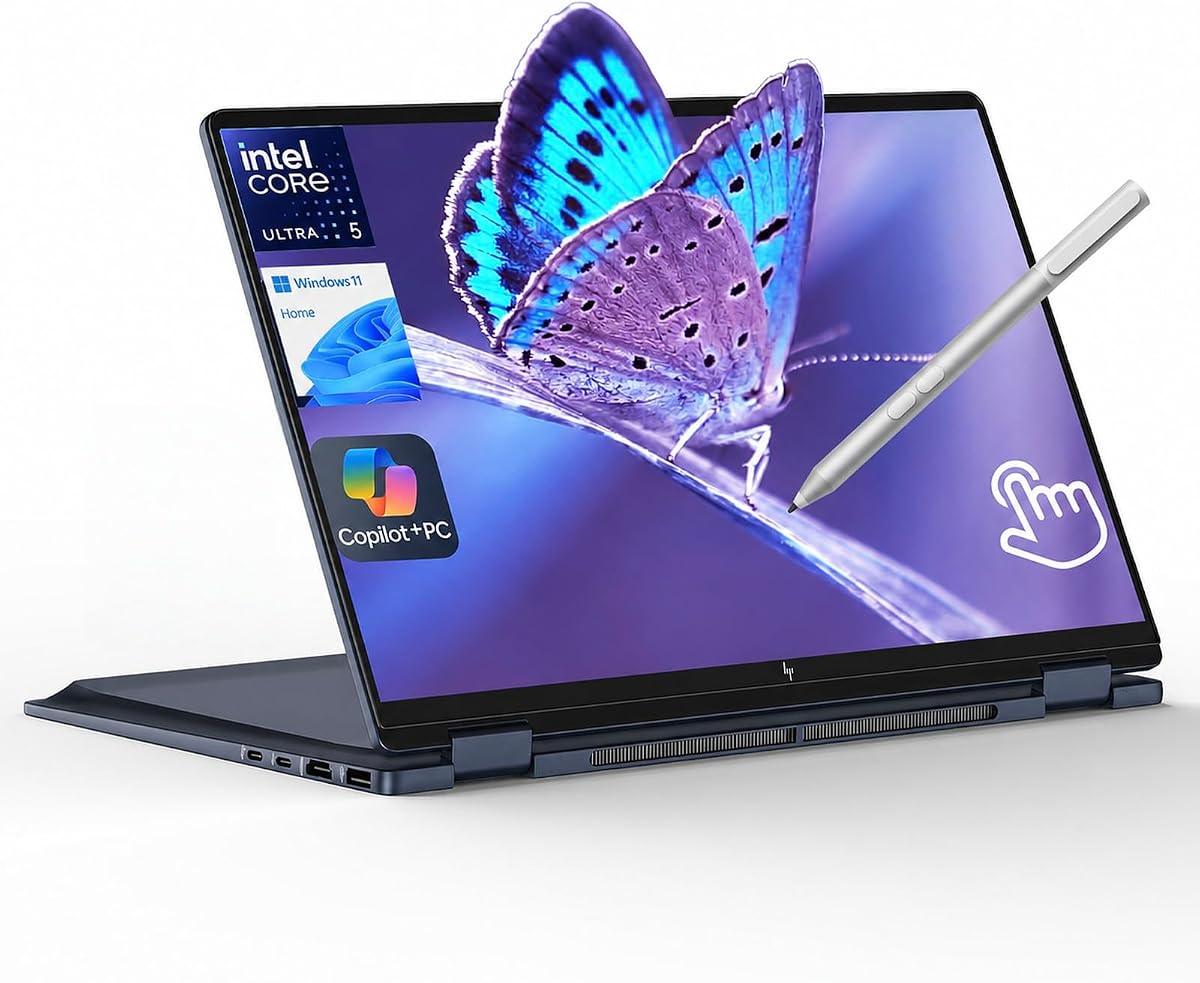
Tablet mode without a stylus is mostly finger scrolling. The OmniBook X Flip is the pack member that treats the pen as part of the product story, with a stylus included by the listed seller. Paired with a 14-inch WUXGA IPS multitouch panel at roughly 400 nits and a high screen-to-body ratio, it is the convertible I would hand to someone who marks PDFs, sketches UI wireframes, or journals digitally between meetings.

  • 14" WUXGA IPS multitouch ~400 nits, edge-to-edge glass
  • Intel Core Ultra 5 226V, 40 TOPS NPU, Arc 130V, 16GB + 512GB
  • Stylus pen bundled by seller, Thunderbolt 4, long battery claim
Check Price →
✓ Pros
  • Bundled stylus makes tablet mode a writing and drawing surface on day one
  • Bright ~400-nit WUXGA touch panel aids outdoor patio annotation
  • 40 TOPS NPU plus Arc graphics support AI edits and light creative work
  • Exceptional claimed battery endurance for all-day flip use
  • Thunderbolt 4 and HDMI 2.1 keep docks and displays first-class
✕ Cons
  • Stylus availability is tied to the seller bundle—confirm contents before buying
  • Windows 11 Home rather than Pro may matter for some IT policies
  • 14-inch canvas is smaller than the 16-inch Yoga/IdeaPad creative desks

Detailed review

Intel’s Core Ultra 5 226V brings an eight-core design, a dedicated AI engine rated around 40 TOPS, PCIe 5.0 pathways, Thunderbolt 4, and LPDDR5X-class responsiveness. Intel Arc 130V graphics elevate light creative projects beyond basic office UHD. Copilot AI features sit alongside that NPU so edits, design assists, and drawing workflows can lean on local acceleration instead of waiting on the cloud for every nudge.

Battery life claims stretch toward the low twenties of hours depending on workload—ambitious numbers that still signal a platform tuned for portable study and work. Fast charging helps when you forget the brick. Privacy-minded extras such as walk-away lock, wake on approach, and auto screen dimming fit a flip you might leave open in tablet mode on a café table. A backlit keyboard covers the hours you return to clamshell typing.

Portability is the 14-inch sweet spot: large enough for comfortable handwriting, light enough that tablet mode does not punish your wrists the way a 16-inch glass slab can. Connectivity includes Thunderbolt 4 / USB-C options, HDMI 2.1, additional USB-C, and dual USB-A—excellent for a machine that may dock at a desk in clamshell mode, then undock into a pure slate for a design critique.

Against the Yoga 7i, the OmniBook trades some screen acreage for stylus immediacy, brightness, and Lunar Lake-class AI efficiency. Against the IdeaPad 5 Copilot+, it offers a more compact flip and a pen-in-box path, while the IdeaPad counters with DCI-P3 color and a bigger canvas. If your definition of a 2-in-1 requires ink, start here.

One purchase note: the stylus is called out as bundled by the seller Super Prime Shop on this listing. Marketplace bundles can vary over time—read the current what’s-in-the-box section so you do not assume a pen that a later seller omitted.

Stylus-first setup

Pair and calibrate the pen, enable Windows ink workspace shortcuts, and pick a notes app with solid palm rejection. Practice writing in tablet mode with the keyboard folded flat so accidental key presses never interrupt strokes.

When clamshell still wins

Long-form writing, spreadsheet modeling, and multi-window research remain faster with keyboard and trackpad. Use the stylus as a surgical tool, not a full keyboard replacement, unless you are deliberately practicing handwriting-first workflows.

Check Price on Amazon →

We may earn a commission at no additional cost to you.

8. Dell Latitude 7420 2-in-1 (i7/32GB) - Renewed Power Latitude

Dell Latitude 7420 2-in-1 Business Laptop

Dell Latitude 7420 2-in-1 Business Laptop

10/10★★★★★

This renewed Latitude 7420 configuration is the RAM-rich sibling to the i5 model earlier in the list. Same 14-inch FHD anti-glare touch 2-in-1 idea, but with a Core i7-1165G7 (up to 4.7GHz, four cores, eight threads) and 32GB of memory. If your tablet mode still keeps twenty browser tabs, a VM, and Teams alive, memory is the hinge’s silent partner—swapping kills the illusion of a fluid slate.

  • 14" FHD anti-glare touchscreen 2-in-1 (Renewed)
  • Core i7-1165G7 up to 4.7GHz, 32GB RAM, 512GB SSD
  • Windows 11 Pro, backlit keyboard, business-oriented ports
Check Price →
✓ Pros
  • 32GB RAM transforms multitasking in both clamshell and tablet workflows
  • i7-1165G7 offers more turbo headroom than the i5 Latitude sibling
  • Anti-glare FHD touch reduces fatigue in bright offices
  • Windows 11 Pro features for security, virtualization, and remote work
  • Backlit keyboard helps late flights after daytime tablet briefings
✕ Cons
  • Still a renewed 11th-gen platform without modern NPU AI acceleration
  • Charger and packaging may be non-original on refurbished units
  • No bundled stylus—finger and external pen strategies only

Detailed review

Anti-glare touch is a business preference that ages well. In stand mode during a conference-room share, reflections stay manageable. In tablet mode, fingerprints show, but the matte treatment keeps the panel readable under fluorescent lighting where glossy consumer glass washes out. Fatigue reduction is a real claim when your day mixes typed reports and handheld briefings.

Windows 11 Pro unlocks BitLocker-friendly management, Remote Desktop hosting scenarios, and virtualization features that matter to consultants and IT-adjacent users. Language support breadth helps multilingual teams. None of that is hinge-specific, yet Pro features often decide whether a renewed convertible can join a company fleet instead of remaining a personal side machine.

Refurbishment honesty is built into the listing: power supplies may be compatible rather than original, and packaging is ordinary rather than retail. Functionality is the bar. Your acceptance test should still include hinge smoothness through 360 degrees, keyboard backlight verification, SSD health checks, and a battery runtime sample in airplane mode. Cosmetics are secondary if the convertible mechanisms are tight.

Choose this over the i5 Latitude when RAM is non-negotiable and you still want the Latitude tablet-hold form factor. Choose a Yoga, OmniBook, or IdeaPad 5 instead when you want newer AI silicon, brighter creative panels, or a pen-forward experience. This machine is a renewed workhorse flip—not a canvas laptop—and it is excellent inside that lane.

Who needs 32GB in a 2-in-1

Analysts with heavy sheets, developers with containers, researchers with dozens of PDFs, and anyone who screenshares while keeping research panes open. Tablet mode does not reduce memory pressure; it only changes input.

i7 versus i5 Latitude

Same family hinge and screen class; i7 and 32GB buy headroom and longevity for demanding browsers. If your load is light Office, the i5 saves money without abandoning 2-in-1 behavior.

Check Price on Amazon →

We may earn a commission at no additional cost to you.

9. ASUS Chromebook Flip CX1 - Durable Chrome Flip

ASUS Chromebook Flip CX1 Convertible Laptop

ASUS Chromebook Flip CX1 Convertible Laptop

8.8/10★★★★☆

ASUS builds the Flip CX1 around a straightforward promise: four modes—clamshell, tent, stand, tablet—on a 14-inch FHD NanoEdge touchscreen that survives real student handling. MIL-STD-810H durability language and a roughly 3.59-pound weight make frequent flips feel less fragile. If your household has cracked cheap lids before, that framing matters.

  • 14" FHD NanoEdge 360° touchscreen, four work modes
  • Intel Celeron N4500, 8GB RAM, 128GB eMMC
  • Chrome OS, MIL-STD-810H, Wi-Fi 6, ~11-hour battery claim
Check Price →
✓ Pros
  • 8GB RAM is a meaningful step up from 4GB student Chromebooks
  • MIL-STD-810H durability suits backpacks and frequent mode changes
  • NanoEdge FHD touch looks modern in tablet and tent poses
  • Dual USB-C with display/power delivery plus USB-A and microSD
  • Promotional Google One AI Premium trial adds cloud headroom for new buyers
✕ Cons
  • Celeron N4500 trails Intel N100 peers on some bursty tasks
  • eMMC storage is fine for cloud life, not for huge local libraries
  • Not the stylus showcase OmniBook is for ink-heavy users

Detailed review

Eight gigabytes of RAM is the quiet hero versus 4GB Chromebooks in this pack. Multitasking across Classroom, Docs, YouTube, and a research tab stays calmer. The Intel Celeron N4500 will not win silicon races against N100 or Core Ultra chips, but Chrome OS keeps the experience snappy when you stay inside the browser and Android app universe Google supports on Chromebooks.

One hundred twenty-eight gigabytes of eMMC plus strong cloud habits cover school files. Wi-Fi 6 and Bluetooth 5.2 handle dorm congestion better than older wireless. Battery claims around eleven hours support a day of mixed clamshell typing and tablet reading. Dual USB-C ports with display and power delivery, dual USB-A, dual audio jacks, and a microSD reader make the CX1 unusually flexible for a Chromebook when you want a portable monitor or quick card ingest.

Security messaging around Chrome OS—sandboxing, verified boot, automatic updates—fits families tired of malware anxiety on shared Windows PCs. Microsoft Office files remain editable through Google’s editors or Office for the web. That is enough for most K–12 and many college survey courses; engineering toolchains and specialized Windows labs still need a different machine.

Promotional Google One AI Premium trial language (Gemini Advanced and expanded cloud storage for a limited period) can sweeten the first months if the offer remains active on your purchase date—always verify current terms. As a hinge device, the CX1 is a durable Chrome flip: more RAM than the renewed HP, tougher marketing than many plastic peers, and less Windows versatility than the Yoga. Pick it when Chrome is the plan and backpack survival is the fear.

Mode guide for families

Clamshell for homework typing, tablet for reading and tapping through lessons, tent for shared cartoons or lecture recordings on a coffee table, stand for video calls with kids who otherwise tip a regular laptop closed.

Versus other Chromebooks here

Flex 3i is lighter and newer with N100 and NFC; renewed HP is a budget 14-inch path; CX1 balances 8GB RAM, MIL-STD toughness, and a mature Flip design. Match to RAM needs and durability anxiety first.

Check Price on Amazon →

We may earn a commission at no additional cost to you.

10. 15.6" Deep Purple 2-in-1 - Style-Led Media Flip

15.6" 2-in-1 Laptop/Tablet

15.6" 2-in-1 Laptop/Tablet

9.2/10★★★★★

This deep-purple 15.6-inch 2-in-1 leans into personality while speaking the same four-mode language as its EYY cousin: Laptop for typing, Tablet for drawing and browsing, Tent for sharing videos, Stand for video calls. The FHD touchscreen is the entertainment and note-taking stage—big enough that streaming in tent mode feels like a mini portable TV, and wide enough that finger sketching has room to breathe.

  • 15.6" FHD touchscreen with laptop/tablet/tent/stand modes
  • Intel Core m3-8100Y up to 3.4GHz, 16GB RAM, 512GB SSD
  • Windows 11, deep purple design, Wi-Fi 5, Bluetooth 5.0
Check Price →
✓ Pros
  • Four-mode 360° hinge covers study, sketch, share, and call postures
  • 16GB RAM + 512GB SSD punch above typical budget convertible configs
  • Large FHD touch surface suits media and finger-driven note capture
  • Distinct deep purple chassis stands out from silver business clones
  • USB-A trio, HDMI, and Type-C keep peripherals simple
✕ Cons
  • m3-8100Y performance envelope matches other Y-series value flips—not Ultra AI PCs
  • 38Wh-class battery is more modest than flagship convertible claims
  • Wi-Fi 5 and value-brand support trails premium Yoga/OmniBook ecosystems

Detailed review

Hardware basics align with the value Windows convertible pattern in this pack: Core m3-8100Y up to 3.4GHz, 16GB of RAM for smooth multitasking, and a 512GB SSD for projects, movies, and music. Boot times and app launches benefit from the SSD in ways older eMMC Chromebooks cannot match when storing local media. Windows 11 arrives ready for touch-optimized gestures, which matters the moment you fold into tablet mode.

A roughly 38Wh battery supports hours of classes or couch sessions rather than the marathon claims of the OmniBook. That is acceptable if you charge during lunch; it is a constraint for unplugged fieldwork all day. Dual-band Wi-Fi 5 and Bluetooth 5.0 cover typical home and campus networks, while three USB 3.0 ports, HDMI, and Type-C handle projectors and flash drives without a shopping trip for dongles.

Design is the differentiator. Where Latitudes whisper corporate gray and Chromebooks often disappear into backpack anonymity, the deep purple finish signals a student or creator who wants the hinge machine to look like a personal device. Aesthetics do not change CPU limits, but they do change whether the laptop spends life on a desk or gets carried to the library in tablet mode more often.

Buy this when you want a stylish Windows media flip with generous RAM/SSD for the money and you accept older low-power silicon. Look to OmniBook for stylus and AI battery life, to Yoga or IdeaPad 5 for premium 16-inch creative canvases, and to Chromebooks when cloud simplicity beats local Windows apps. As a closing option in the pack, it proves the 2-in-1 idea scales downmarket—so long as you judge it on hinge usefulness and touch comfort, not on workstation benchmarks.

Entertainment-first modes

Tent mode for shared shows, tablet mode for recipe scrolling in the kitchen, stand mode for watching lectures while you take paper notes beside it, clamshell when you finally write the essay.

Versus the EYY 15.6" flip

Expect similar m3-class performance and memory/storage philosophy. Choose based on finish preference, warranty language, keyboard backlight needs, and current listing details rather than imagining a generational CPU gap.

Check Price on Amazon →

We may earn a commission at no additional cost to you.

Best 2-in-1 Laptops 2026: Hinge Modes, Stylus & Touch

How to Choose a 2-in-1: Hinge, Touch, Stylus, and OS

Start with the modes you will actually use

Ignore marketing that lists four poses if your life is ninety percent clamshell typing. A 2-in-1 tax—thicker hinge, touch digitizer, sometimes a slightly mushier keyboard—is worth paying only when tablet, tent, or stand appears weekly. Sketch your week: handheld reading, couch streaming, whiteboard-style brainstorming, standing presentations. If two or more of those show up, keep shopping convertibles. If not, a lighter fixed laptop may serve better.

Tablet mode versus clamshell: decide the primary identity

Tablet-primary buyers should prioritize weight under the mid-threes (pounds), bright touch panels, stylus support, and 12–14-inch sizes. Clamshell-primary buyers who want occasional flips can enjoy 16-inch Yogas and IdeaPads with better typing desks, accepting that tablet mode becomes a two-hand affair. Neither choice is wrong; mismatching identity is how convertibles become expensive clamshells that never fold past 135 degrees.

Stylus and touch quality

Finger touch is enough for navigation, casual markup, and streaming UI. Active styluses unlock handwriting, precise annotation, and illustration. In this pack, the OmniBook X Flip is the clearest pen-forward path because a stylus is part of the bundle story. Elsewhere, assume finger-first unless you budget for a compatible pen and verify protocol support (AES, Wacom AES, MPP, etc.) with the manufacturer—not with wishful thinking.

Windows versus Chrome OS convertibles

Windows 2-in-1s (Yoga, IdeaPad 5, OmniBook, Latitudes, value m3 flips) run full desktop software, local creative tools, and richer stylus ecosystems. Chrome OS flips (Flex 3i, HP 14 renewed, ASUS CX1) boot fast, update quietly, and shine when school or work already lives in Google’s cloud. Choose Chrome when simplicity and safety matter more than niche .exe installers; choose Windows when your toolchain demands it.

Silicon and memory for mode hoppers

Flipping modes does not lighten CPU work—your tabs and apps come along for the ride. Prefer 16GB RAM on Windows convertibles when budgets allow; 32GB on the renewed i7 Latitude is a gift for heavy multitaskers. Chromebooks can feel fine with 8GB (ASUS CX1) and constrained with 4GB when students pile extensions. For AI features and long unplugged stylus sessions, newer Ultra and Ryzen AI platforms outclass 11th-gen renewed business chips.

Renewed and refurbished caveats

Several strong options here are renewed Latitudes or a renewed HP Chromebook. That can be smart value if you test hinges, batteries, and touch layers immediately. Expect possible non-original chargers and plain boxes. Do not buy renewed if you need pristine cosmetics for client-facing theater—buy if you need Pro OS features and a proven 14-inch business hinge at a softer cost of entry.

Frequently Asked Questions

01

What makes a laptop a real 2-in-1 rather than a touchscreen clamshell?

A real 2-in-1 combines a hinge that travels to roughly 360 degrees (or a detachable design) with software that rotates and reflows when the keyboard faces away. Touch alone is not enough. You should be able to use tablet, and usually tent or stand poses, without the machine fighting orientation. In this roundup, Yoga-style and Flip-style hinges are the mechanical proof; Lenovo Transition on the Yoga 7i is an example of software that respects those poses.

02

When is tablet mode better than staying in clamshell?

Tablet mode wins for reading long documents, walking through a space while referencing plans, annotating with a finger or stylus, and consuming media on a couch where a trackpad feels fussy. Clamshell wins for heavy typing, multi-window research, and any task where keyboard shortcuts are the accelerator. Many people should live in clamshell and visit tablet—not the reverse—unless they are note-first students or artists.

03

Do I need a stylus for a 2-in-1 to be worthwhile?

No. Plenty of convertibles earn their keep through tent-mode sharing, stand-mode calls, and finger navigation. A stylus becomes important when handwriting, mathematics markup, illustration, or precise PDF redlines are weekly tasks. If that is you, prioritize the HP OmniBook X Flip’s bundled pen path or budget for a compatible active pen on another Windows convertible. Chromebooks can use styluses too, but ecosystem polish varies by model.

04

Are renewed Dell Latitude 7420 2-in-1s safe buys in 2026?

They can be, if you buy from sellers with clear return policies and you test hinge tension, battery health, and touch accuracy immediately. You are purchasing mature 11th-generation Intel hardware with Windows 11 Pro—excellent for Office-centric business mobility, weaker for on-device AI features found in Ultra and Ryzen AI Copilot+ PCs. Treat cosmetics and charger originality as flexible; treat hinge integrity as mandatory.

05

How much RAM do I need in a convertible?

For Windows 2-in-1s used with modern browsers and Office, 16GB is the comfort zone represented by the Yoga 7i, IdeaPad 5, OmniBook, and value m3 machines. The renewed i7 Latitude’s 32GB is ideal for VMs and heavy multitasking. Chromebooks often ship with 4GB, which works for focused schoolwork but frays under tab chaos; the ASUS Flip CX1’s 8GB is a wiser Chrome baseline when you can get it.

06

Is a 16-inch 2-in-1 too big for tablet use?

It depends on your arms and your use case. A 16-inch Yoga or IdeaPad 5 is superb as a digital desk that sometimes lies flat, and awkward as a one-handed e-reader on the train. If handheld tablet hours dominate, prefer 12–14-inch flips like the Flex 3i Chromebook or OmniBook X Flip. If shared tent-mode viewing and spacious UIs matter more, go big.

07

Chrome OS or Windows for students who flip between modes?

Chrome OS wins when assignments live in Google Classroom, battery life and low maintenance matter, and you want a device that stays updated without parental IT duty. Windows wins when classes require desktop applications, advanced stylus creative tools, or IT-managed Pro features. Several Chromebooks in this pack—including the Flex 3i with updates into 2031—are purpose-built for that simpler path.

08

Will tent and stand modes hurt the hinge over time?

Quality hinges are designed for those angles, but abuse still shortens life. Avoid forcing past soft stops, do not lift the machine by the screen corner, and keep grit out of the hinge line. MIL-STD language on machines like the IdeaPad 5 and ASUS CX1 suggests extra validation, yet daily care still matters. If a renewed unit already feels loose in tablet mode, return it—looseness rarely improves.

09

Can these 2-in-1s replace both a laptop and a tablet?

For many people, yes—with compromises. You gain one charger, one ecosystem, and four postures. You give up the ultra-light feel of a dedicated tablet and sometimes the keyboard perfection of a non-convertible laptop. Artists who need best-in-class pen latency or executives who want the thinnest possible slate may still prefer separate devices. Everyone else can stop packing both.

10

What should I test in the first 48 hours after buying?

Cycle every hinge mode ten times, verify auto-rotation, open a drawing site to test all touch corners, pair a stylus if included, run a battery discharge sample, confirm webcam/mic in stand mode, and plug in every port you care about. On renewed units, also check SSD health utilities and listen for coil whine or grinding. Keeping the return window alive until those checks pass is part of buying convertibles wisely.

Conclusion

The best 2-in-1 laptop in 2026 is the one whose hinge matches your week. For most Windows users who will truly flip among laptop, tablet, tent, and stand, the Lenovo Yoga 7i is the most complete mode switcher in this pack. If ink defines tablet mode for you, the HP OmniBook X Flip’s stylus-centered bundle and bright 14-inch panel take priority. Creators who want Copilot+ features on a wide-gamut 16-inch canvas should keep the Lenovo IdeaPad 5 2-in-1 close behind.

Chromebook flips from Lenovo, HP, and ASUS remain the sane student path when cloud apps rule, while renewed Latitude 7420 configurations still make sense for Pro-oriented business tablet briefings—especially the 32GB i7 when multitasking is heavy. Value 15.6-inch m3 convertibles prove the four-mode idea can land on a budget if you accept older low-power silicon.

Pick your primary identity—tablet or clamshell—then let stylus need, OS ecosystem, and RAM write the shortlist. A convertible you unfold daily will always beat a prettier machine that never leaves laptop angle.