Best Overall
Lenovo IdeaPad Slim 3X

- Snapdragon X Copilot+ PC with a 45 TOPS NPU for on-device AI
- 16GB memory, 512GB storage, and a tall 15.3" WUXGA 16:10 display
- Metal MIL-STD 810H chassis, fingerprint login, and all-day 60Wh battery
Expert Review & Guide
Ultraportable used to mean a wafer-thin 13-inch machine that felt fragile on a train tray. In 2026 the category is broader and more honest: light enough to forget in a backpack, strong enough for Zoom, docs, and a browser tab farm, and thin enough that airport security bins do not become a wrestling match. Weight still wins the argument—most of the machines in this guide sit around three to three-and-a-half pounds—but buyers also care about USB-C charging, privacy shutters, and whether the panel is Full HD or a grainy HD compromise.
We ranked ten Amazon ultraportables from a single curated pack. The spread runs from a Snapdragon X Copilot+ IdeaPad with 16GB of memory and a 15.3-inch WUXGA canvas, through efficient Intel N-series and Pentium Gold daily drivers, down to lean Celeron and eMMC configs that trade horsepower for silence and price. You will also find a 360-degree ASUS Chromebook Flip for people who live in Google Docs, plus Windows notebooks that ship with Office 365 or Windows 11 Pro already loaded. Nothing here is invented; every ASIN, image, rating, and feature bullet comes from the pack listing.
If you hop between coffee shops and client sites, prioritize all-day battery claims, Type-C PD charging, and at least 8GB of RAM—12GB or 16GB if Chrome is your second home. Students who mainly write papers and stream lectures can thrive on a 14-inch N150 or a Chromebook convertible. Treat 4GB RAM and 128GB eMMC machines as secondary devices or homework-only tools, not as your only workhorse. Dig into the comparison table, then read each review for the real tradeoffs before you pick a bag-friendly laptop.


As an Amazon Associate we earn from qualifying purchases. We may earn a commission at no additional cost to you.
Use this table to compare weight-relevant specs—processor class, memory, storage type, display sharpness, and I/O—before reading the full reviews. Specs stick to travel facts only; no dollar prices.

This Lenovo 2026 business edition aims at people who still need a full 15.6-inch canvas but refuse to haul a thick plastic brick. At 3.33 pounds and 0.78 inches thick, it clears the ultraportable bar for commuters who prefer a larger keyboard deck over a cramped 13-inch layout. The Business Black shell reads professional on a café table, and the anti-glare Full HD panel (1920×1080 at 250 nits) is a meaningful upgrade over the HD panels still shipping on many budget travel notebooks.
Under the lid, an Intel N100 quad-core that boosts to 3.4GHz pairs with 8GB of DDR5 and a 256GB PCIe 4.0 NVMe SSD. That combination matters for ultraportable buyers more than raw core counts: DDR5 keeps browser tabs and Teams from stuttering as quickly as older DDR4 8GB kits, and a Gen4 NVMe drive boots Windows 11 fast enough that morning stand-ups do not start with a loading spinner. Lenovo positions it for small-business apps, video conferencing, and everyday office suites—exactly the workload most mobile professionals actually run.
Connectivity is where this machine earns its briefcase badge. Wi-Fi 6 and Bluetooth 5.2 cover hotel and coworking networks, while a Gigabit Ethernet jack still exists for locked-down offices that distrust wireless. Two USB-A 3.2 ports, two USB-C ports with Power Delivery and DisplayPort, HDMI 1.4b, and a headphone jack mean you can drive an external monitor and charge without a shopping bag full of dongles. That dual USB-C story is rare at this weight and makes hotel-desk setups far less painful.
Security features punch above the typical student ultraportable. An HD 720p webcam includes a physical privacy shutter, firmware TPM 2.0 handles BitLocker-style encryption needs, and a Kensington lock slot lets you cable the chassis to a hotel desk. Those details matter if you travel with client spreadsheets or HR files. Copilot AI PC branding on the listing also signals Windows AI helpers are available for summarization and drafting once you are signed into your Microsoft account.
Who should buy it? Remote accountants, consultants, and students who write long documents and want a bigger screen without jumping past four pounds. Who should skip it? Photographers editing RAW files, students living inside Chrome with forty tabs and Slack, and anyone who needs more than 256GB of local storage without cloud backups. For those buyers, step up to the 16GB IdeaPad Slim 3X or the MOONFISH i5 configuration later in this guide.
In short, this Lenovo is the sober business ultraportable in the pack: FHD glass, modern memory and SSD, real docking ports, and a weight you can carry five days a week. It will not replace a workstation, but it will replace the bulky 15-inch laptop you left at home because it hurt your shoulder.
The dual USB-C ports with Power Delivery and DisplayPort let you run a single-cable monitor if your display supports it, or split charge and video across the two ports. Pair that with HDMI 1.4b for projectors that still expect a full-size HDMI plug. Keep a short Ethernet cable in your bag for conference rooms that throttle guest Wi-Fi—few ultraportables still include a wired jack.
Move photo libraries and recorded Zoom archives to OneDrive or an external SSD. Leave the internal NVMe for apps and the current project folder. If you regularly keep offline movies for flights, budget for a pocket drive; otherwise the 256GB capacity will feel tight within a semester.
We may earn a commission at no additional cost to you.

HP’s 2026 14-inch edition is the backpack-friendly student pick when every ounce counts. At 3.11 pounds it undercuts most 15.6-inch ultraportables here, and the tranquil pink matte finish plus full-size crepe pink backlit keyboard make it feel less like a generic black slab. The 84% screen-to-body claim keeps the footprint compact even though the panel itself is a conventional 14-inch size—ideal for lecture halls where desk space disappears.
Performance comes from an Intel N150 with four cores, up to 3.6GHz turbo, and 6MB of L3 cache, backed by 8GB of DDR4 and Intel UHD Graphics. That stack is tuned for browsing, documents, streaming, and online learning rather than local video export. Boot and app launches benefit from a 256GB SSD primary drive, while a secondary 128GB UFS store soaks up photos and downloaded PDFs. Think of UFS as handy overflow, not as a substitute for a second NVMe drive—but the dual-storage layout is still smarter than a lone 128GB eMMC brick.
The display is the honest compromise. You get a 14-inch HD 1366×768 anti-glare panel at 250 nits. Text is readable for essays and slides, yet spreadsheets and side-by-side windows feel tighter than on the FHD Lenovo or MOONFISH screens. If you grade papers or design slides for hours, consider an external monitor at home. On campus, the anti-glare coating and lighter weight matter more than pixel density for many students.
HP loads the soft extras that reduce friction. Windows 11 Home arrives in S Mode with a year of Microsoft 365 Personal, so Word and Excel are ready before orientation week. An AI Copilot hotkey sits on the keyboard, the HD 720p camera includes a privacy shutter, and dual mics with AI noise reduction help when roommates are loud. Wireless is solid: Wi-Fi 6 (2×2) and Bluetooth 5.4. Ports include one USB-C 3.2 Gen 1 (data only), two USB-A 3.2 Gen 1, HDMI 1.4, a combo audio jack, and an AC smart pin charger—plus a bundled 5-in-1 hub with USB-A, USB-C, USB 3.0, USB 2.0, SD/Micro SD, and RJ-45 Ethernet.
That hub is more than a freebie for ultraportable life. Because the laptop’s native USB-C does not carry Power Delivery, you still rely on HP’s smart-pin brick for charging, but the hub restores Ethernet and card slots when you land at a dorm desk. Students who bounce between labs and coffee shops will use those extras weekly. Just remember S Mode restrictions: if a professor requires a Win32 installer that the Microsoft Store cannot supply, switch out of S Mode early and keep backups of your files.
Buy this HP when you want the lightest practical Windows ultraportable in the pack, a year of Office apps, and a hub that covers SD cards and Ethernet. Skip it if you refuse anything below Full HD, need USB-C charging, or already own a Chromebook ecosystem and prefer the ASUS Flip instead.
Scale Windows text to 125% and avoid packing three browser windows side by side. Stream lectures full-screen; edit docs in a single maximized Word window. When you need sharper detail for design coursework, mirror to a classroom projector or a home FHD monitor through HDMI.
Ultraportables often drop Ethernet and SD readers. The included hub brings both back without buying a separate dongle kit. Keep it clipped in the same pouch as the charger so you are not hunting adapters five minutes before a hybrid seminar.
We may earn a commission at no additional cost to you.
If one machine in this pack defines what ultraportable should feel like in 2026, it is the IdeaPad Slim 3X. Lenovo pairs a Snapdragon X processor and a 45 TOPS NPU with 16GB of memory and 512GB of storage inside a Luna Grey metal chassis tested to MIL-STD 810H. That is a different league from fanless Celeron notebooks: you get Copilot+ features that smooth video calls and accelerate AI tasks locally, plus a battery story built around a 60Wh cell and Rapid Boost charging for travelers who recharge during short layovers.
The display is a standout for mobile work. Instead of a flat 16:9 15.6-inch panel, Lenovo uses a 15.3-inch WUXGA 16:10 screen that adds vertical pixels for documents, code, and browser toolbars. Colors and contrast are positioned for streaming and light creative work, not just spreadsheet gray. Carrying a taller panel still keeps the laptop in ultraportable territory because Snapdragon’s efficiency lets Lenovo avoid a thick cooling stack, and the metal lid survives backpack compression better than bargain plastic shells.
Privacy and login security match the premium pitch. A physical webcam shutter covers the lens between calls, a fingerprint reader speeds unlocks in airports when typing a password feels awkward, and Lenovo’s Enhanced Security Suite adds another layer for people who keep tax PDFs and client decks offline. Those details matter more on an ultraportable you open in public spaces than on a desktop tower that never leaves home.
Storage planning is unusually friendly. The ready-to-expand SSD slot lets you add capacity later without a service center visit—rare among sealed ultraportables. Start with the included 512GB, then upgrade when photo libraries grow. Lenovo also includes three months of Xbox PC Game Pass, which is a nice weekend perk on hotel Wi-Fi, though this is still an efficiency laptop rather than a dedicated gaming machine. Play lighter titles; leave AAA ray tracing to a desktop.
Software compatibility deserves a clear-eyed note. Snapdragon X Copilot+ PCs have improved dramatically for Office, browsers, and Microsoft Store apps, yet specialized lab software, some older antivirus suites, and certain printer utilities may still need ARM-aware builds or emulation. Check your must-have apps before you commit if you rely on niche Windows tools. For everyone living in Edge, Chrome, Teams, Notion, and Adobe’s cloud-friendly apps, the Slim 3X feels future-ready rather than experimental.
Choose the IdeaPad Slim 3X when you want the best blend of AI features, memory headroom, battery ambition, and durable metal design in this ultraportable roundup. It is the machine we would pack for a week of client visits without hunting for outlets every two hours. If you need Ethernet and dual USB-C DisplayPort docking on Intel silicon instead, the first Lenovo business model remains the more traditional office traveler.
Consultants summarizing meeting transcripts, students rewriting lecture notes, and creators generating draft outlines benefit most from the 45 TOPS NPU. Features that run on-device save bandwidth on hotel Wi-Fi and keep sensitive text from round-tripping through the cloud when privacy matters.
MIL-STD 810H testing does not make a laptop indestructible, but the premium-grade metal shell resists flex when you type on a couch arm or toss the bag into an overhead bin. Compared with the plastic 15.6-inch generics later in this list, the Slim 3X feels like a long-term daily carry rather than a disposable semester machine.
Use the DIY-ready SSD slot when your 512GB fills with local video projects. Keep a screwdriver kit and a compatible drive on hand; Lenovo’s pitch is that you should not need a depot ticket for a simple capacity bump.
We may earn a commission at no additional cost to you.
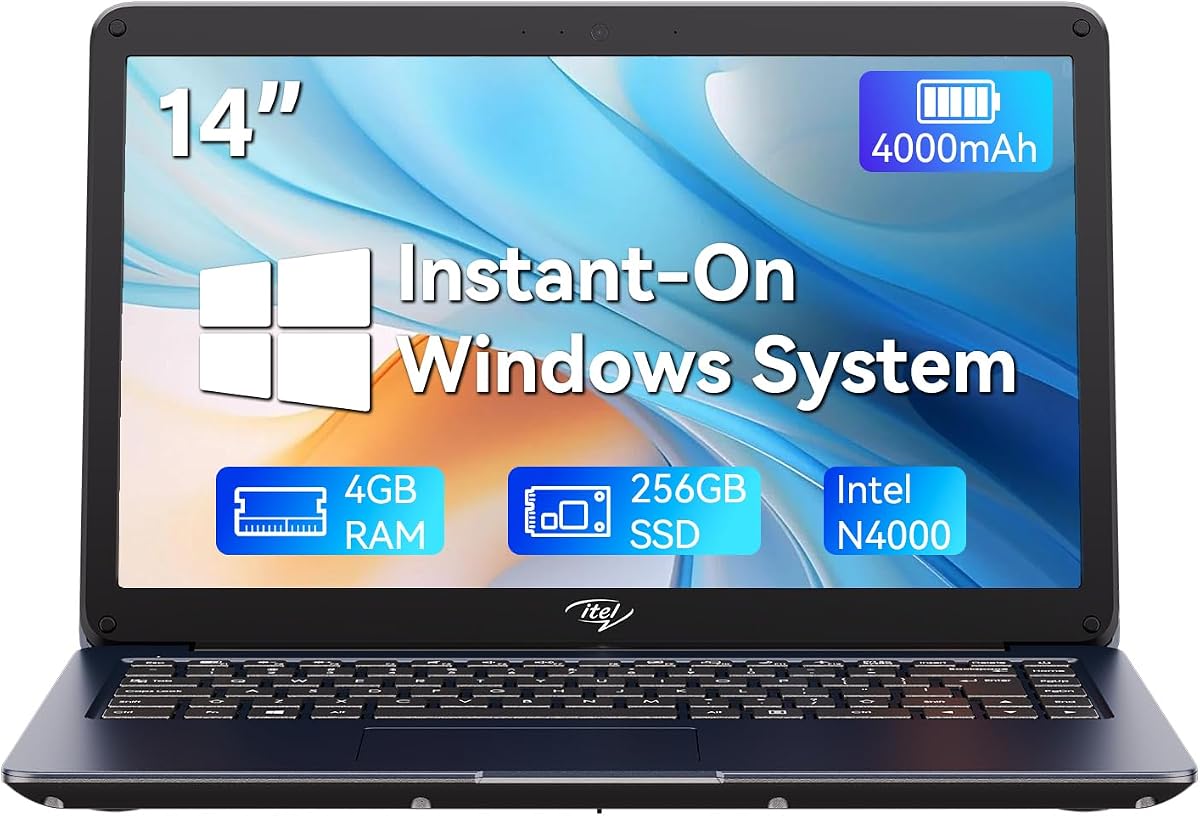
Sold under the Itel listing with LETSUNG branding in the feature bullets, this 14-inch ultraportable is the expandable bargain of the pack. The chassis is 0.8 inches thin and about 3.1 pounds, so it slides into a tote the way a true ultraportable should. Unlike several cheaper 15.6-inch machines that ship with soft HD panels, this one advertises a 1920×1080 display with anti-glare coating and 4K output over an external screen—welcome news if you sometimes plug into a living-room TV.
Compute is modest: a Celeron N4000 dual-core that tops out around 2.6GHz with UHD Graphics 600. Expect comfortable web browsing, HD streaming, and light Word work. Do not expect smooth local photo catalogs with dozens of tabs. The 4GB of LPDDR4X RAM is the real limiter; Windows 11 and a modern browser will consume most of it before your homework even opens. Treat this as a single-task or dual-task device, not a Chrome circus.
Where the Itel/LETSUNG design punches up is storage flexibility. You start with a 256GB M.2 SATA SSD that can grow to 1TB, plus a 2.5-inch SATA HDD bay (7mm) for another terabyte, plus a microSD reader for SD/SDHC/SDXC cards. Few ultraportables still offer an internal HDD bay. Students who shoot lots of phone video can park archives on a cheap 2.5-inch drive while keeping the SSD for the OS. That expandability can outlast the Celeron’s useful life if you eventually recycle the chassis as a media laptop.
Ports and wireless are practical if a bit older. Dual-band Wi-Fi 5 and Bluetooth 4.2 handle campus networks; Gigabit Ethernet saves you when dorm Wi-Fi collapses; two USB 3.0 ports, HDMI, and the microSD reader cover peripherals. The full-size keyboard and spacious trackpad are fine for essay writing. Battery marketing cites a 4000mWh pack with up to 7.5 hours of continuous use—realistic only with dim screens and light loads, so pack the charger for long clinic or lab days.
The three-year warranty is a genuine differentiator. Many ultraportable bargains vanish behind 90-day policies; LETSUNG’s longer coverage reduces anxiety if a hinge or SSD fails mid-semester. Still, warranty length cannot invent missing RAM. If your budget can stretch to the 8GB HP 14-inch or the 12GB Pentium Gold model, you will feel the difference every day. Buy the Itel when expandability, FHD glass, and warranty length matter more than CPU horsepower—and you accept 4GB as a known constraint.
Keep only one browser profile and disable heavy startup apps. Store textbooks as PDFs on the SSD; dump lecture recordings to the HDD bay or microSD. Close Teams when you are not in a call. These habits matter more on 4GB machines than on 16GB Copilot+ laptops.
Parents buying a backup laptop for middle school or a travel machine that only needs email and Netflix may value three years of coverage over peak Geekbench scores. Power users writing code or editing video should look elsewhere in this list.
We may earn a commission at no additional cost to you.

MOONFISH 2026 Laptop Computer Window 11 Pro
MOONFISH’s Windows 11 Pro 15.6-inch ultraportable targets buyers who want memory and software readiness more than brand prestige. The silver chassis is 0.8 inches thin and 3.5 pounds—still backpack-friendly—while 16GB of RAM and a 256GB SSD make everyday multitasking far less stressful than the 4GB machines nearby. A crisp 1920×1080 IPS panel at 60Hz covers spreadsheets, streaming, and browser research without the softness of 1366×768 panels.
The 4425Y processor is a low-power workhorse rather than a modern N-series celebrity. Expect quick boots, snappy file copies to the SSD, and comfortable switching among Word, Excel, Slack, and a handful of tabs. Local Premiere exports or large Visual Studio solutions are outside its comfort zone. Pair the CPU’s limits with the generous RAM and you get a responsive office ultraportable that feels better than the silicon generation alone suggests.
Software is the sales pitch. Windows 11 Pro brings BitLocker-friendly management features and professional tooling that small businesses appreciate, while lifetime Office 365 pre-installation means you are not hunting for a separate Word license on day one. That combination helps freelancers and students who need Pro features without configuring a corporate image. Just verify what “lifetime Office 365” means in the listing terms—activation steps and account requirements can vary by seller kit.
On the road, a 5000mAh battery claim aims at all-day light productivity, and ports cover USB 3.0, Mini HDMI, and a microSD slot. Mini HDMI is the quirky bit: pack a Mini-HDMI-to-HDMI cable if you present often. The keyboard is described as precision-engineered with a large touchpad suitable for long sessions. Support extras stand out for a lesser-known brand: a two-year warranty, six-month free returns, 24/7 online help, and weekday phone support at the listed number.
This MOONFISH makes sense as a secondary business travel laptop or a primary machine for document-heavy students who value 16GB RAM and Pro OS features. If you need more SSD space and a newer Core i5, jump to the higher-rated MOONFISH i5 512GB model later in the pack. If you need Snapdragon AI and a metal shell, the IdeaPad Slim 3X still leads. For pure office ultraportable duty with strong memory, this Pro configuration earns its slot.
Pro is useful if you use Remote Desktop host features, group policy tinkering, or BitLocker encryption without upgrading later. Home users who never touch those tools can still benefit from the included Office apps and 16GB RAM—the Pro badge is a bonus, not a requirement.
Keep a short Mini-HDMI-to-HDMI adapter on your keychain pouch. Conference rooms almost never supply Mini HDMI cables, and ultraportable travelers lose presentation time hunting one.
We may earn a commission at no additional cost to you.

Amzboy 15.6” Windows 11 Laptop
Amzboy’s 15.6-inch Windows 11 ultraportable leans into silence and modern charging. At 3.3 pounds with a slim profile and a Full HD 1920×1080 anti-glare panel, it looks like a bigger laptop than it feels in a bag. The fanless solid-state design means no whirring during exams or overnight flights—something loud plastic gaming leftovers cannot claim. For ultraportable buyers who work in quiet rooms, that acoustic absence is a feature, not a footnote.
Inside sits an efficient Intel N4020-class CPU with 4GB of RAM and 128GB of eMMC storage. Daily Zoom classes, document editing, and browsing are the intended lane. eMMC is slower and less expandable internally than a proper NVMe SSD, so keep expectations honest: apps install, Windows updates eventually finish, but you will not mistake this for a workstation. The rescue hatch is a TF card slot supporting up to 1TB—slide in a high-endurance card for media and keep the eMMC lean.
Charging is the travel win. A compact 45W Type-C PD adapter replaces the chunky proprietary bricks many budget 15-inch machines still use. In practice, you can share PD chargers with phones and tablets when hotel outlets are scarce. Dual Type-C ports plus USB 3.2 cover flash drives and a mouse without forcing a hub for basic setups. The 180° lay-flat hinge is handy for sharing a screen across a café table or flipping the lid for a quick demo.
A privacy camera cover is included—use it. On a light ultraportable that travels through airports and dorms, physical lens coverage beats hoping software mute icons work. Wi-Fi 5 handles typical networks; just know you will not get the Wi-Fi 6 headroom of the HP or Lenovo business models. Windows 11 arrives ready, so first-boot friction is low.
Buy the Amzboy when silence, USB-C PD, and a big FHD screen matter more than RAM headroom—think secondary travel laptop, kid homework machine, or note-taking device that should never interrupt a library. Skip it as your only professional machine if you live in heavy browser multitasking; step up to 8GB or 12GB options elsewhere in this guide.
Install only essential apps, keep OneDrive Files On-Demand enabled, and park movies on a TF card. Offload Windows update leftovers periodically. Treat the internal eMMC like a boot drive, not a media vault.
Shared hostel rooms, silent study floors, and overnight flights punish coil whine and fan ramp. A fanless N4020 machine stays socially invisible. The tradeoff is thermal and performance headroom—light tasks only.
We may earn a commission at no additional cost to you.

This generic-branded 15.6-inch Core i3 ultraportable exists for people who type numbers all day. A full-size keyboard with an independent numeric keypad and backlight is rare in featherweight machines, and it matters for accountants, inventory work, and spreadsheet-heavy coursework on the train. The roughly 1.6 kg body keeps that larger deck from becoming a shoulder problem, and a 180° lay-flat hinge helps share the screen without spinning the whole laptop around.
The Core i3 dual-core, quad-thread design with a 2.0GHz base frequency plus 8GB of RAM is enough for smooth daily office work, web browsing, and modest multitasking. You will feel a clear step up from the 4GB N4020 and N4000 machines: Excel recalcs and browser tabs coexist more peacefully. The 128GB SSD keeps boots quick, though capacity is the choke point—plan on a TF card up to 1TB for textbooks and media from week one.
Connectivity covers the usual ultraportable needs with two USB 3.0 ports, a 3.5mm audio jack, HDMI, a MicroSD/TF slot, and a DC power port. Wireless is Wi-Fi 5 and Bluetooth 4.2—adequate, not cutting-edge. Fingerprint unlock is a quality-of-life win when you open the lid a dozen times between classes. Use it; passwords typed in coffee shops are shoulder-surfing magnets.
Display language in the listing focuses on a 15.6-inch high-definition experience for daily viewing. Compared with the explicitly 1920×1080 IPS panels on the MOONFISH and Pentium Gold models, treat visual expectations carefully if pixel density is your top priority. For email, LMS portals, and number entry, the screen is serviceable; for photo color grading, look higher in this guide.
Pick this Core i3 ultraportable when the backlit numpad and fingerprint sensor match your workflow and 8GB RAM is your minimum. Skip it if you need 512GB local storage out of the box or Wi-Fi 6 for congested dorms—the MOONFISH i5 and Lenovo business models cover those needs more cleanly.
Most ultraportables kill the numpad to shrink the deck. If you enter invoices or lab data for hours, the wider chassis is worth the extra few centimeters. If you only write essays, a 14-inch HP without a numpad will feel lighter in hand.
Enroll multiple fingers so you are not stuck when one is wet from a water bottle. Combine fingerprint unlock with a strong PIN for BitLocker or Windows Hello recovery. On shared-family machines, keep separate Windows profiles.
We may earn a commission at no additional cost to you.
MOONFISH 2026 Laptop Computer Window 11
When ultraportable shoppers say they want “something that will not choke,” this MOONFISH Core i5 configuration is the pack’s straightforward answer. You get an i5 that boosts to 2.8GHz, 16GB of RAM, and a 512GB SSD inside a 0.8-inch, 3.5-pound silver notebook. That trio handles concurrent browser research, Office apps, and light media without the constant tab triage forced by 4GB machines. The 15.6-inch FHD IPS panel at 1920×1080 and 60Hz keeps text crisp for long reading sessions.
Compared with the 4425Y MOONFISH sibling, the i5 and doubled SSD capacity are the upgrades that matter for students storing offline lectures and freelancers keeping local project folders. Boots and file transfers feel lively; switching among Teams, Excel, and a design preview window stays tolerable. It is still not a creator laptop for 4K timelines, but as a grab-and-go Windows ultraportable it sits near the top of this list for raw daily competence.
The backlit keyboard is a practical night-owl feature—airplane mode lighting and dim dorm rooms are where backlight earns its keep. Ports include Type-C, USB 3.0, Mini HDMI, and microSD, so you can charge or transfer on USB-C while still connecting older projectors with a Mini HDMI cable. The 38.5Wh battery is the honest limiter: lighter than the IdeaPad Slim 3X’s 60Wh pack, so treat outlet scouting as part of long travel days even if light office work lasts a workday stretch.
Software and support mirror the Pro-focused MOONFISH story: Windows 11 Pro, lifetime Office 365, two-year warranty, six-month free returns, and phone support on weekdays. That bundle helps less-technical buyers who want a machine ready for business documents without hunting licenses. High 4.8 rating in the pack reflects buyer satisfaction with the balance of screen, memory, and storage more than luxury chassis materials.
Choose this model as your primary ultraportable if you want Intel-class multitasking, half a terabyte of SSD, and Pro/Office readiness without jumping to Snapdragon software questions. Choose the IdeaPad Slim 3X instead if all-day battery and on-device AI are non-negotiable. Choose the lighter HP 14-inch if your bag already feels heavy and you can live with an HD panel.
Pick Intel i5 when your department still distributes x86 lab tools or legacy VPN clients. Pick Snapdragon Copilot+ when your stack is Microsoft 365, browsers, and AI helpers—and you want the bigger battery. Both can be ultraportable; they optimize different risks.
Drop brightness, use Windows Battery Saver on flights, and close Chromium hardware acceleration if the GPU idles hot. Carry a compact USB-C power bank that supports laptop PD if you roam buildings without open outlets.
We may earn a commission at no additional cost to you.

This 15.6-inch ultraportable sells itself on memory: 12GB of RAM in a 3.5-pound, 0.8-inch chassis. The listing’s claim that it can feel up to roughly one-and-a-half times snappier than entry-level 8GB notebooks during multitasking matches real-world browser behavior—extra gigabytes delay the moment Windows starts compressing tabs. Students streaming a lecture while taking notes and checking LMS notifications will notice the breathing room.
The Pentium Gold 6500Y boosts to 3.4GHz at a tiny 7W TDP, which keeps heat and fan drama low for an ultraportable lifestyle. Paired with a 128GB SSD, everyday boots and document work feel responsive. The storage ceiling is the catch: 128GB disappears after Windows, Office, and a photo dump. Use the TF card slot early, or lean on OneDrive. Do not treat the internal SSD as infinite.
Display quality is a pleasant surprise for a generic-branded travel laptop. The 1920×1080 FHD IPS anti-glare panel delivers wide viewing angles and less eye strain than TN-style budget screens. That helps whether you are reviewing slides on a bus or bingeing a show after class. Colors will not replace a creator monitor, but they beat the soft HD panels on some lighter 14-inch machines.
I/O is unusually complete for a thin ultraportable: two USB 3.2 ports, one USB 2.0, one full-function USB-C, one charging-only USB-C, HDMI, TF card, and an audio jack. Label the charging-only port with a tiny bit of tape if you must—the distinction frustrates first-week owners who wonder why a dock is not powering on. A physical camera privacy slider covers the lens between Zoom sessions, which is the right default for shared housing.
With a 4.9 rating in the pack, buyer sentiment looks strong for student, home, and everyday roles. Buy it when you want more RAM than 8GB without jumping to a 16GB MOONFISH, and when port variety matters as much as weight. Look elsewhere if you need 512GB internal storage or Copilot+ NPU features—the IdeaPad Slim 3X still owns that crown.
Plug displays and data docks into the full-function USB-C port. Reserve the charge-only port for power. Mixing them up is the most common ultraportable support ticket on dual-USB-C budget machines—learn the icons on day one.
Eight gigabytes is the modern floor; sixteen is comfort. Twelve gigabytes sits in the middle for Chrome-heavy students who cannot stretch to the 16GB MOONFISH or Slim 3X. It will not fix a slow SSD that is 95% full, so pair the RAM advantage with ruthless storage hygiene.
We may earn a commission at no additional cost to you.
The ASUS Chromebook Flip CX1 is the ultraportable for people who live in browser tabs and Google Workspace. At 3.59 pounds with a Transparent Silver convertible chassis tested to MIL-STD 810H, it survives backpack life while offering a 14-inch FHD 1920×1080 NanoEdge touchscreen that folds through four modes: clamshell, tent, stand, and tablet. On a crowded flight tray, tent mode for movies is more than a gimmick—it is how you reclaim space.
Intel’s Celeron N4500 plus 8GB of RAM is a sensible ChromeOS pairing. You get decent multitasking for Docs, Sheets, Classroom, Netflix, and Android apps without the Windows update tax. Storage is 128GB eMMC; ASUS sweetens the cloud story with a promotional Google One AI Premium plan that includes Gemini Advanced and 2TB of cloud storage for three months. After the promo, keep using Drive aggressively or expand via the microSD reader.
Battery life is a headline ultraportable reason to choose this Flip: up to eleven hours depending on conditions. Dual USB-C ports support display output and power delivery, so one compact charger covers the laptop. You also get two USB-A 3.2 Gen 1 ports, dual audio jacks, and Wi-Fi 6 with Bluetooth 5.2. That I/O list is stronger than many Windows ultraportables that stranded users on a single USB-C hole.
ChromeOS security—sandboxing, verified boot, and automatic updates—fits shared-family and student scenarios where “never had a virus” marketing actually maps to architecture. You can edit Microsoft Office files through Google Docs, Sheets, and Slides, and many web apps feel native. The break point is specialized Windows lab software, desktop Lightroom catalogs, or corporate tools that refuse browsers. If your syllabus or employer mandates those, stay on a Windows machine from this list.
As a convertible ultraportable, the CX1 wins when flexibility and battery matter more than Win32 compatibility. Annotate PDFs in tablet mode on a lab bench, flip to clamshell for essays, and stop worrying about fan noise. Pair it with the IdeaPad Slim 3X recommendation only if you need both ecosystems; otherwise, most Google-first travelers can make this ASUS their only bag laptop.
Use clamshell for typing, tent for watching lectures on a bunk, stand mode for kitchens where you follow a recipe with messy hands, and tablet mode for markup with a basic stylus-compatible workflow. The 360-degree design is why this Chromebook feels more ultraportable than a fixed-lid 15.6-inch Windows slab of similar weight.
Pick ChromeOS if your files already live in Drive and your tools are web-first. Pick Windows if you need offline Win32 apps, Pro management, or local creative suites. Ultraportable success is less about screen inches and more about whether your software can travel with you.
Before the three-month AI Premium promo ends, decide whether to keep paid Google One or migrate bulky video to a microSD card. Chromebook ultraportables stay pleasant when local eMMC is not choking on offline downloads.
We may earn a commission at no additional cost to you.

Call a laptop ultraportable when you will actually carry it daily. In this pack, that usually means roughly 3.1 to 3.6 pounds and profiles around 0.7 to 0.8 inches. A 15.6-inch screen can still qualify if the chassis is thin and the battery chemistry is efficient; a light 14-inch machine simply disappears faster in a tote. Ignore marketing that says “ultraportable” on a 5-pound gaming slab.
Four gigabytes is homework-only territory on Windows 11. Eight gigabytes is the practical floor for students and office travelers. Twelve or sixteen gigabytes is where ultraportables stop apologizing when Slack, Docs, and twenty tabs collide. If your budget forces a 4GB machine, plan TF-card storage and ruthless tab habits—or choose ChromeOS, which generally feels lighter on the same RAM.
Full HD (1920×1080) or WUXGA 16:10 panels make ultraportable hours more pleasant—sharper text, better streaming, less squinting on spreadsheets. HD 1366×768 panels keep costs and power down but look soft on a 14-inch lid. If you write all day, prioritize FHD even if you sacrifice an ounce of weight. If you mostly check email between classes, HD can be acceptable on a very light chassis like the HP 14-inch.
All-day claims vary with brightness and radios. Favor larger watt-hour packs (the IdeaPad’s 60Wh) or Chromebook efficiency (the ASUS Flip’s up-to-11-hour story) when outlets are rare. USB-C Power Delivery is a quality-of-life upgrade: one compact brick can charge phone and laptop. Proprietary smart-pin or DC-barrel chargers still work, but they clutter packing cubes. Always pack the charger on exam days regardless of marketing hours.
Ultraportables often amputate Ethernet and HDMI. If you present weekly, demand HDMI or USB-C DisplayPort. If your office networks are finicky, Ethernet on the Lenovo business model or a hub with RJ-45 (bundled with the HP) saves careers. Dual USB-C with PD is ideal; know when a second USB-C is charge-only. microSD/TF slots are underrated insurance for 128GB eMMC machines.
Windows 11 Home covers most people. Windows 11 Pro helps with BitLocker and business features on the MOONFISH units. ChromeOS on the ASUS Flip minimizes maintenance and shines for Google-first workflows. Match the OS to your software, not to habit alone—forcing Windows-only lab tools onto a Chromebook creates pain that no hinge mode can fix.
In practical terms, an ultraportable is a notebook you will carry most days without dreading the weight—typically around three to three-and-a-half pounds, with a thin chassis and enough battery for a work or school block. Screen size can be 14 or even 15.6 inches if the engineering keeps mass low. Marketing labels alone do not qualify; if you would rather leave it at home, it is not ultraportable for you.
Yes, when the chassis stays near 3.3–3.5 pounds and under an inch thick, as with several Windows models in this guide. You gain keyboard space and easier multitasking; you lose a bit of bag flexibility versus a 14-inch Flip or HP. Choose 15.6 inches if you hate trackpad typing on tiny key decks, and choose 14 inches if airline tray tables and crowded lecture desks are your battlefield.
Aim for 8GB as a Windows minimum for documents and light browsing. Step to 12GB or 16GB if you live in Chromium with chat apps open. Configurations with 4GB can handle focused homework or streaming but will frustrate anyone who multitasks. ChromeOS on 8GB, as on the ASUS Flip, often feels smoother than Windows on 4GB because of how the OS manages processes.
Buy a Chromebook like the ASUS Flip CX1 if your courses run on Google Classroom, Docs, and web apps—and you value battery life and low maintenance. Buy Windows if professors require specific desktop software, engineering tools, or Pro features. Many students thrive on Chromebooks until a single required Windows app appears; verify syllabi before you commit.
Only if you will use on-device AI features, want the efficiency of platforms like Snapdragon X, and accept checking app compatibility. The Lenovo IdeaPad Slim 3X is the Copilot+ standout here with a 45 TOPS NPU. Everyone else can be productive on N150, i3, i5, or Chromebook silicon without AI branding. Copilot+ is a accelerator, not a prerequisite for email and essays.
Usually yes for travelers. USB-C Power Delivery lets you share compact chargers across phone and laptop and reduces brick clutter. Models like the Amzboy with a 45W PD adapter and the ASUS Flip with dual USB-C PD make hotel nights easier. If a laptop uses a proprietary charger, it can still be excellent—just pack that cable deliberately and keep a spare if you travel weekly.
Very, if you read or edit for hours. FHD or WUXGA panels reduce eye strain and make split windows usable. HD 1366×768 panels are tolerable for casual use and help some light machines hit lower weights and costs, but they are the first place ultraportables feel “cheap” during long sessions. Prioritize FHD unless weight savings are your absolute top constraint.
For writing, browsing, calls, and light Office work, yes—especially if you dock with HDMI or USB-C to a monitor at home. For sustained compiling, advanced photo/video work, or GPU-heavy tasks, an ultraportable should be your mobile half, not your only machine. Several pack options intentionally target mobility over workstation power.
256GB is a workable minimum if you use cloud storage. 512GB is comfortable for mixed offline work. 128GB eMMC or SSD configs need a plan on day one—TF cards, microSD, or Drive. Expandable designs (Itel’s HDD bay, IdeaPad’s upgradeable SSD slot, TF-card machines) extend lifespan when internal capacity starts tight.
They can be excellent values when warranty and return policies are strong—MOONFISH advertising two-year coverage and phone support is an example—but you trade brand ecosystem polish and sometimes resale value. Stick to clear specs, read recent owner feedback on heat and keyboards, and buy from listings with straightforward return windows. For corporate-managed devices, stick to Lenovo, HP, or ASUS.
The best ultraportable laptop in 2026 is the one that disappears into your bag and still feels calm when you open it on a noisy train. From this pack, the Lenovo IdeaPad Slim 3X is the all-around winner for buyers who want metal durability, 16GB of memory, Copilot+ AI, and a tall WUXGA screen with serious battery ambition. The MOONFISH Core i5 16GB/512GB configuration is the multitasking Windows alternative when you want familiar Intel software paths and a roomy SSD, while the ASUS Chromebook Flip CX1 is the convertible to beat for Google-first travelers who live on USB-C charging and long battery days.
Everyone else in the lineup fills a niche: the Lenovo 15.6-inch N100 for dock-friendly business carry, the HP 14-inch for light student bundles with Office and a hub, the 12GB Pentium Gold for Chrome-heavy everyday use, and the leaner 4GB machines for silent or expandable secondary roles. Match RAM, panel sharpness, and OS to your real week—not to a spec sheet fantasy—and your ultraportable will earn its keep every time you leave the house.