Best Classic Wired Vinyl Pair
Edifier R1280T

- Dual AUX inputs for turntable and a second source
- 42W RMS with silk dome tweeter and 4-inch driver
- Side-panel bass/treble knobs plus remote volume
Expert Review & Guide
Vinyl sounds only as good as the speakers—and the cable path—you pair with the turntable. The best speakers for a record player in 2026 are usually powered bookshelf monitors with RCA or AUX line inputs, optional Bluetooth for non-vinyl nights, and enough tone control to tame bright rooms. Passive speakers that need a separate amp are a different project; this Amazon pack focuses on active pairs and one statement Marshall home speaker that still offers RCA and 3.5 mm for decks.
Inside you will find Edifier R1280T, R1280DB, and R1280DBs staples; Saiyin and RIOWOIS Bluetooth bookshelves with optical and RCA flexibility; OHAYO and MEVOSTO desktop actives; PreSonus Eris Accent studio-leaning monitors; and Marshall Stanmore III for listeners who want one iconic box instead of a stereo pair. Critical caveat repeated across several Bluetooth bookshelf listings: your turntable needs a Bluetooth transmitter/output to stream wirelessly—or you use a wired LINE OUT (phono output still needs a preamp).
No prices appear here because marketplace numbers bounce. Match inputs to your deck first, then voicing and room size.


As an Amazon Associate we earn from qualifying purchases. We may earn a commission at no additional cost to you.
Confirm LINE OUT versus PHONO on your turntable, then compare speaker inputs. Specs from listings—no prices.
The R1280T remains the gateway powered pair for vinyl because it refuses to complicate the signal path. Dual AUX-style inputs accept a turntable’s LINE OUT (or a phono preamp’s line output) and still leave a second jack free for a phone, streamer, or cassette deck. Forty-two watts RMS through a silk dome tweeter and four-inch driver delivers the natural midrange vinyl lovers chase without requiring a separate amplifier purchase.
Side-panel bass and treble knobs are the quiet superpower. Apartments with glass and bare floors often sound sharp; a small treble cut restores long-session comfort. Carpeted dens that swallow bass get a gentle low-end lift. Remote volume keeps you on the couch between record flips.
MDF cabinets with wood-effect vinyl look intentional beside most entry and mid turntables. They are studio-monitor-inspired nearfield speakers: place them at desk or shelf height, slightly toed in, with some breathing room from the wall so the rear ports can work.
What they will not do: decode Bluetooth from a phone, accept TV optical bitstreams, or amplify a raw PHONO signal. If your suitcase player only has a Bluetooth receiver for phones—not a transmitter—you still need a cable from LINE OUT. If your deck is PHONO-only, add a preamp first.
Choose R1280T when wired purity and EQ knobs matter more than app features. Step to R1280DB/DBs when you also want optical TV nights and Bluetooth streaming on the same pair.
Cable tip: use a quality RCA or 3.5 mm-to-RCA cable sized for your furniture layout. Strain-relieved routes behind the stand prevent accidental yanks during dusting.
Bedroom and living-room listeners building a dedicated analog corner without a full hi-fi rack.
Ear-height tweeters, equal distance forming a triangle with your chair, and a few inches from the rear wall.
We may earn a commission at no additional cost to you.

OHAYO’s sixty-watt peak-class desktop pair (thirty watts per side as marketed) is the space-saving answer when a full Edifier footprint feels large. Carbon-fiber-accented silk dome and three-inch full-range-style driver with a rear port aim for clear highs and usable mid-bass on a desk that also holds a compact turntable. Bluetooth 5.3 covers wireless evenings; RCA, AUX, and USB cover the serious wired nights.
For vinyl, prefer the RCA/AUX line path from a LINE OUT or external preamp. The listing’s broad compatibility note—turntables, TVs, mixers, PCs—matches how real rooms work: Saturday records, Sunday laptop playlists. An integrated independent sound card angle helps USB computer duty more than pure analog spinning, but the analog jacks are why it belongs in this guide.
MDF construction and a front volume knob keep operation tactile. You are not hunting a remote under couch cushions to drop level between tracks. Bass will not shake a loft the way five-inch MEVOSTO woofers might; nearfield listening is the design center.
Choose OHAYO for dorm-scale and desk-scale vinyl. Choose Saiyin 40W or Edifier when you want larger woofers and living-room authority. Choose Marshall when a single statement speaker fits the décor brief better than a pair.
Desk coupling tip: isolation pads under both speakers and the turntable reduce groove feedback when volume climbs.
USB note: USB input is for digital audio from computers, not a magic phono solution. Keep the vinyl path analog-line clean.
Perfect when the “listening room” is also the office and every inch of shelf is contested.
Wireless from a phone is easy. Wireless from a turntable requires a deck with Bluetooth transmit—or stick to cables.
We may earn a commission at no additional cost to you.

Saiyin’s forty-watt-per-side Bluetooth bookshelves are built for people who refuse to own separate speaker systems for records and Netflix. Four-inch woofers and silk dome tweeters cover music with authority, while optical and coaxial inputs (24-bit/192 kHz class digital support as marketed) take TV audio when you set the television to PCM stereo. A dedicated sub out with automatic detection language means you can add a powered sub later without abandoning the pair.
Turntable guidance in the listing is unusually candid and important: connect via LINE OUT; if you only have PHONO, use a preamp. Bluetooth to these speakers works when your turntable transmits Bluetooth—not when it only receives Bluetooth for phone playback through built-in speakers. That single misunderstanding causes countless “no sound” returns.
Remote control covers mute, input switching, and volume; top buttons remain as backups. Lifetime remote replaceability language reduces a common long-term annoyance. Dimensions around 150×170×240 mm keep them shelfable without dominating a console.
Amplifier warning: these are powered speakers. Do not feed them like passives from a receiver’s speaker outputs. If you insist on inserting a receiver, use its line outputs carefully per the manufacturer notes.
Choose this Saiyin when sub expandability and TV optical matter beside vinyl. Choose the compact 30W Saiyin when shelves are tinier. Choose Edifier R1280DBs for a more established sub-out Bluetooth Edifier ecosystem.
TV setup tip: force PCM/stereo on optical. Dolby digital bitstreams are a common crackle/no-sound culprit called out across these active speakers.
Start with the pair for vocals and midrange beauty; add a sub when electronic and orchestral low end feels thin.
Confirm your deck advertises Bluetooth transmit/output before planning a wireless vinyl path.
We may earn a commission at no additional cost to you.
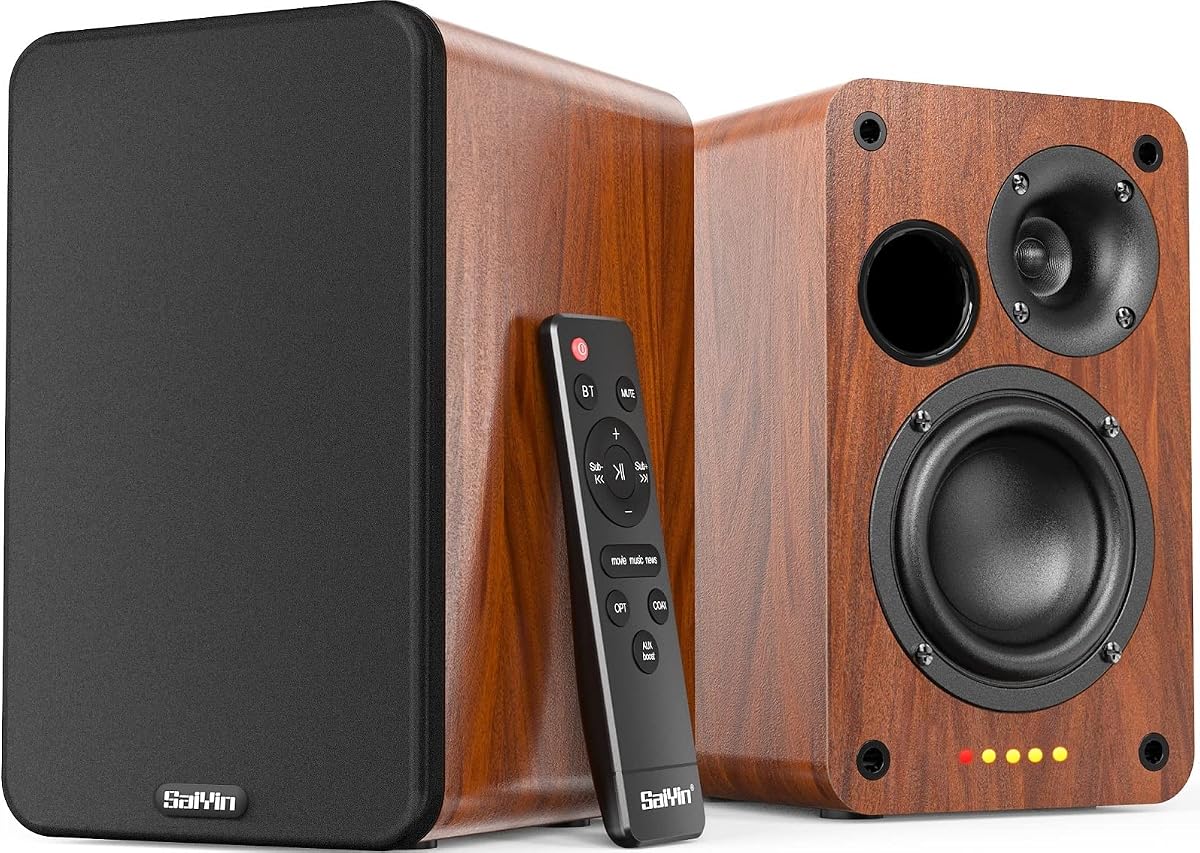
Saiyin 30W x 2 Compact Bookshelves
Think of this compact Saiyin as the apartment-shelf edition of the 40W model. Thirty watts per side into 3.75-inch woofers and horn-loaded silk domes prioritizes clarity and footprint over chest-thumping bass. Dimensions near 5.3 × 6.3 × 8.6 inches slide beside many suitcase turntables on a single console without looking like studio monitors invaded the décor.
Input story mirrors its bigger sibling: Bluetooth 5.3 for phones, optical/coax for TV PCM, AUX/RCA for the record player’s LINE OUT. The same Bluetooth transmitter requirement applies—verify before you cut the RCA cable from your life. Remote and top controls keep switching painless when guests ask for a playlist between albums.
Active architecture means no receiver required. If you already own an amp you love, these are not the speakers to hang on its binding posts—use line-level thinking or choose passives instead.
Sonically, expect articulate mids that flatter vocals and acoustic records. Electronic albums with subterranean bass may push you toward the 40W Saiyin, MEVOSTO five-inch pair, or an Edifier with sub out.
Choose compact Saiyin when inches matter. Choose 40W Saiyin when you anticipate a sub and want more woofer. Choose R1280T when you want analog-only simplicity.
Isolation tip: small speakers on hollow IKEA boards buzz. Blu-Tack or pads help more than another EQ click.
Use LINE OUT into these speakers and mute or ignore weak built-in suitcase speakers for a night-and-day upgrade.
Both are compact actives. Saiyin adds optical/coax TV talent; OHAYO emphasizes USB computer flexibility and a front knob.
We may earn a commission at no additional cost to you.

RIOWOIS targets the modern hybrid living room: spin records through AUX, stream via Bluetooth 5.3, and lift TV sound through optical or TV-ARC—with the tantalizing promise of volume control from a TV remote over ARC. That single living-room remote dream is why this pair earns a distinct badge even with smaller 2.75-inch woofers.
Forty watts through horn-loaded silk domes prioritizes clarity and presence. Reinforced MDF cabinets reduce crackle-inducing resonance, and hand-polished rounded wood-grain corners help the pair look intentional beside a mid-century console. Three remote sound effects give quick movie/music tilts without a mobile app.
Turntable rules remain ironclad in the listing: Bluetooth vinyl needs a transmitting deck; PHONO outputs need a preamp; LINE OUT is the happy path. Powered-speaker incompatibility with receivers is also spelled out—do not wire them like passives.
Bass expectations should be adult. These excel at dialogue-friendly TV and midrange-rich records; add a separate sub elsewhere if you need club low end, since this model’s feature list emphasizes ARC convenience over sub out.
Choose RIOWOIS when TV remote harmony matters as much as Saturday vinyl. Choose Saiyin 40W when sub out is the growth plan. Choose Marshall when you want one box, not a pair.
ARC tip: enable CEC/ARC properly on the TV and set digital output to PCM. Fight the menu once so every movie night is one-button simple.
Fire TV remote compatibility plus ARC TV control reduces coffee-table remote piles—a real quality-of-life win.
Favor vocal jazz, indie, and dialogue. For synth-heavy catalogs, prioritize larger woofers or sub-ready Edifier/Saiyin models.
We may earn a commission at no additional cost to you.

MEVOSTO 36W RMS Active Bookshelves
MEVOSTO’s thirty-six-watt RMS pair swings above compact desktops with dual five-inch bass drivers and one-inch silk domes. That woofer area is why bass-heavy pressings and cinematic game nights feel more complete without an immediate subwoofer purchase. Ten-level bass and treble adjustment is unusually granular for the tier—fine-tune for jazz evenings versus movie weekends instead of living with one compromised curve.
Bluetooth 5.4, RCA, AUX, and USB digital audio (including flash drive language) cover a wide desk-and-den lifestyle. Record players connect through line-level RCA/AUX as with the rest of this guide. Natural wood finish and voice prompts with a front indicator make the system feel finished rather than DIY.
Important limitations are printed clearly: no Dolby Audio support, and USB must actually carry audio from your device. RV/12V power notes exist for niche installs—verify your supply if that is your use case. These reminders prevent the “silent TV” returns that plague active speakers.
Compared with Edifier’s four-inch classics, MEVOSTO trades some brand heritage for woofer size and EQ granularity. Compared with Saiyin, you gain bass drivers but should check whether you need optical/ARC specifically—MEVOSTO’s listed strengths are BT/RCA/AUX/USB.
Choose MEVOSTO when physical bass and tone shaping headline your wishlist. Choose R1280DB when optical TV input is mandatory. Choose PreSonus when studio-balanced honesty outranks consumer bass boosts.
EQ hygiene: return bass/treble to neutral before blaming a pressing. Many “bad records” are leftover movie EQ.
Medium dens and dedicated listening nooks. In tiny bedrooms, five-inch ported boxes may need careful wall distance.
Confirm your computer’s USB port supports audio output if that is your planned connection—not all ports do.
We may earn a commission at no additional cost to you.
R1280DB is the “I grew up” version of the T: same forty-two-watt RMS studio-minded recipe with four-inch drivers and silk domes, plus Bluetooth, optical, and coaxial inputs so the pair can be the house speakers, not only the vinyl speakers. Remote input switching means flipping from a Saturday afternoon record to a Sunday match on TV without crawling behind furniture.
Analog vinyl still shines through RCA/AUX line connection from LINE OUT or a preamp. Many owners leave the turntable permanently on one input and use Bluetooth for kitchen playlists. Side bass/treble knobs remain the Edifier signature for room correction without apps.
Optical and coaxial enable lossless-leaning digital links from TVs and PCs when formats are set correctly. That flexibility is why DB often wins over T for mixed-use apartments even if the vinyl path is identical.
If you know you want a subwoofer later, consider R1280DBs in this same pack—the sub out and Bluetooth 5.0/spatializer updates target that growth. If you want zero wireless complexity, R1280T remains purist-friendly.
Choose R1280DB as the balanced default for vinyl-plus-life. It is the recommendation I give most often when someone wants one pair to handle records and everyday media.
Remote battery tip: stash a spare coin cell in the turntable dust-cover box. You will thank yourself during a listening party.
T = wired analog champion. DB = add Bluetooth and digital inputs. DBs = DB ideas plus sub out and newer Bluetooth/spatial features.
Label the cables behind the active speaker. Future you will not remember which RCA pair is the turntable.
We may earn a commission at no additional cost to you.
Stanmore III is for listeners who want the record player corner to look like a poster came to life. One plug-in powered cabinet delivers Marshall’s wider-than-before soundstage and signature rock-ready voicing, with RCA and 3.5 mm inputs explicitly called out for record player compatibility. Pair, play, and turn it up is the philosophy—no rack of separates required.
Physical bass and treble controls matter for vinyl because pressings and rooms vary. A bright 1980s digital-era cut may want less treble; a warm jazz mono reissue may want a different balance than a modern indie LP. Bluetooth 5.2 handles the rest of the week when the platter is still.
Stereo imaging from a single box will not duplicate two bookshelves placed six feet apart, yet Marshall’s stage is intentionally wide for the form factor. If pinpoint left/right guitar separation is your religion, Edifier or PreSonus pairs will please you more. If presence, attitude, and design unity matter, Stanmore wins hearts.
Sustainability notes—PVC-free, high recycled plastic, vegan materials—matter to some buyers without changing the RCA story. It remains a home speaker: park it, power it, enjoy it.
Choose Stanmore III when one iconic object should be the system. Choose R1280DB when classic stereo pairs and optical TV inputs matter more than brand theater.
Vinyl gain staging: start knobs neutral, raise turntable/preamp to healthy line level, then use Stanmore volume—avoid stacking three volume controls at maximum.
Lofts and living rooms where a speaker pair would visually clutter a carefully styled console.
Pairs win stereo separation and often sub expandability. Stanmore wins simplicity and statement design.
We may earn a commission at no additional cost to you.
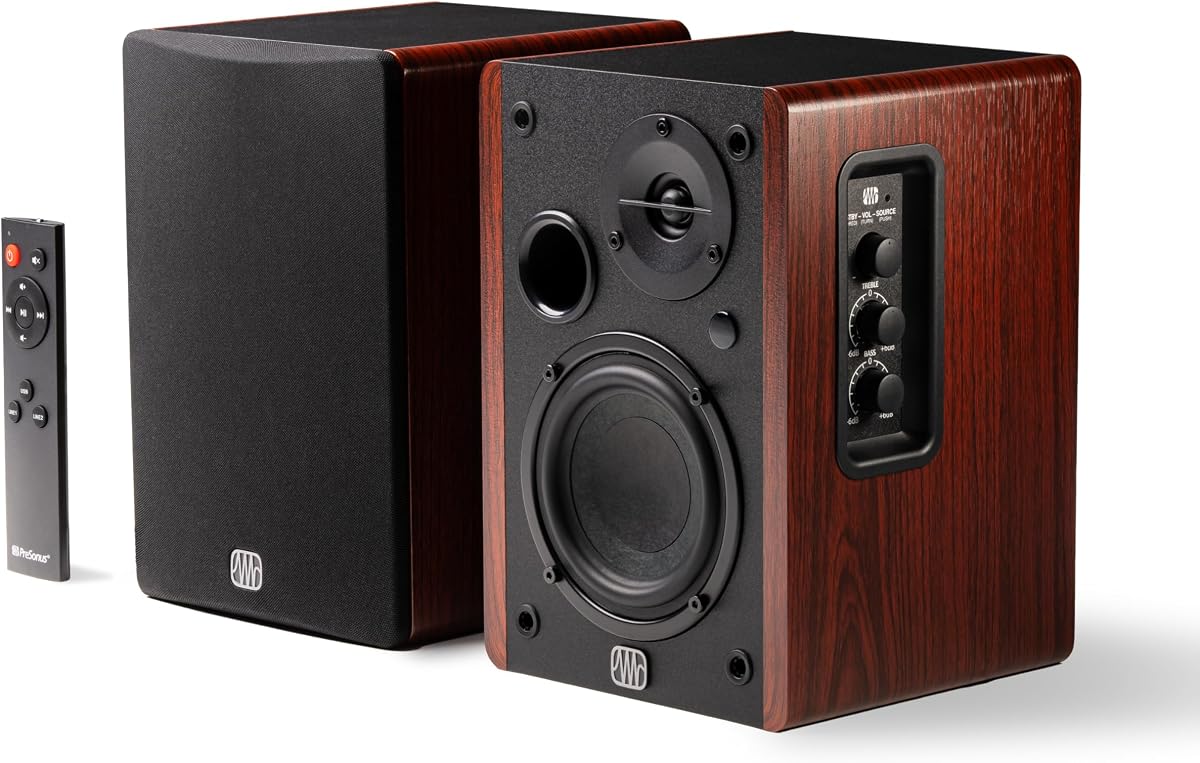
PreSonus Eris Accent brings studio-monitor manners to the record-player desk: fifty watts of powered stereo, four-inch woofers, half-inch silk domes, and a published 55 Hz–20 kHz style bandwidth with healthy peak SPL for nearfield rooms. The point is balance—hear the groove, the room sound on the tape, and the difference between pressings—rather than a perpetual smile EQ.
USB-C and RCA inputs support computers and turntables (line-level). RCA sub out invites a subwoofer without guesswork. Onboard volume, treble, bass, power, and source controls plus a remote cover couch and desk. Wood grain keeps them home-friendly despite the studio surname.
Absence of Bluetooth is a feature for some vinyl purists and a drawback for others. If you need wireless playlists, Edifier DB/DBs or Saiyin fit better. If you want the speakers to tell the truth about a thrift-store pressing versus a quiet modern AAA reissue, Eris Accent earns its 4.8.
Placement still follows monitor logic: tweeters at ear height, symmetrical triangle, manage boundary bass boost near walls using the onboard bass control.
Choose PreSonus when accuracy and sub expandability matter more than Bluetooth. Choose Marshall when vibe outranks analysis. Choose R1280T when you want warmer consumer ease at a classic price tier.
Listening fatigue tip: analytical speakers reward reasonable volumes. If you find yourself cranking to chase excitement, check the recording before blaming the monitors.
Collectors comparing pressings, producers who also spin vinyl, and listeners tired of smiley-face consumer tuning.
Use the RCA sub out and set a crossover that keeps male vocals out of the sub—let the Eris mids stay clean.
We may earn a commission at no additional cost to you.
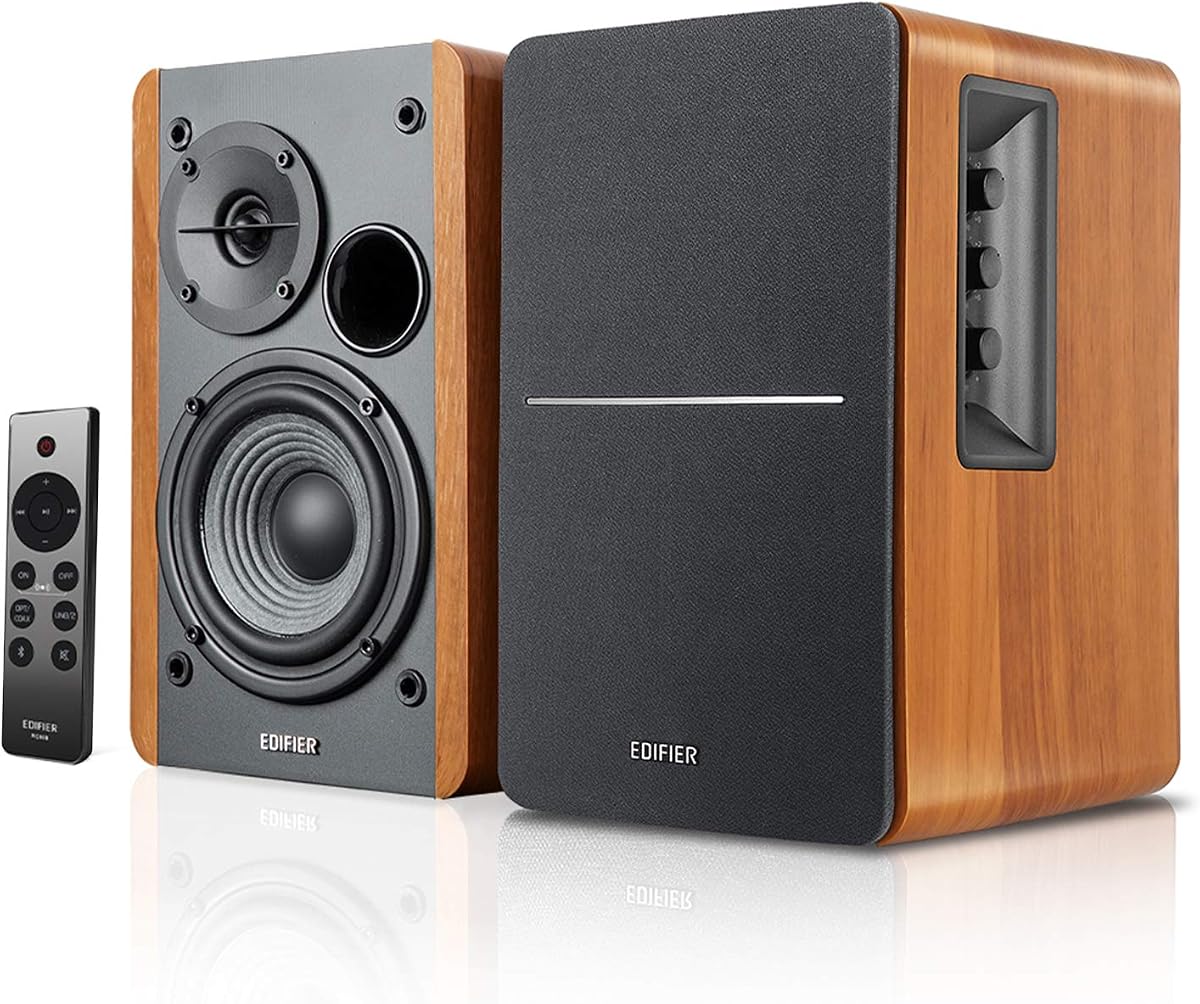
R1280DBs closes the Edifier trilogy in this pack by adding Bluetooth 5.0, optical/coax, Soundfield Spatializer, and a subwoofer line out with automatic detection and built-in crossover thinking. Forty-two watts of continuous undistorted power through the classic thirteen-millimeter silk dome and four-inch woofer recipe remains the musical core; the extras make the pair a long-term living-room platform.
For vinyl, cable in via line-level inputs exactly as with R1280T/DB. Many collectors add a compact powered sub for organ pedals and electronic albums while keeping vocals anchored in the bookshelves—the sub out exists for that exact journey. Updated remote covers mute, input modes, and Bluetooth switching without leaving the listening chair.
Spatializer can widen a narrow room’s image for playlists; try it off for critical vinyl sessions if you prefer a more traditional stereo presentation. Side knobs still offer the fastest EQ in the house.
Compared with Saiyin’s sub out, Edifier brings broader retail familiarity and the R1280 voicing lineage. Compared with PreSonus, you gain Bluetooth convenience and lose some studio-monitor strictness.
Choose R1280DBs when you want the Edifier ecosystem with growth to a sub and digital TV inputs. Choose R1280T if you will never need those extras. Choose Stanmore if you want one cabinet, not two.
Sub matching tip: start with low sub gain and a conservative crossover, then raise until kick drum gains weight without bloating male vocals.
Buy DBs when you already suspect a sub is in your twelve-month plan—saves a full speaker swap later.
A/B a familiar pressing. Keep the setting that preserves center image solidity for vocals.
We may earn a commission at no additional cost to you.

LINE OUT can feed powered speakers directly. PHONO-level signals are tiny and EQ’d for RIAA—they need a phono preamp (built into many decks or added externally) before any speaker in this guide. Connecting PHONO straight to AUX usually sounds whisper-quiet or thin.
A turntable with Bluetooth receive (for phones into built-in speakers) is not the same as Bluetooth transmit (to wireless bookshelf speakers). Several Saiyin/RIOWOIS listings warn about this explicitly—believe them.
Stereo pairs (Edifier, Saiyin, PreSonus, MEVOSTO) create a proper left/right stage. Marshall Stanmore III trades that for design unity and simpler placement. Choose based on whether imaging or aesthetics leads.
If the same speakers must serve a television, prioritize optical/ARC models and remember PCM/stereo settings. If vinyl is sacred and separate, a pure analog R1280T keeps life simple.
Three-inch desktops suit nearfield desks. Four-inch classics cover most apartments. Five-inch MEVOSTO-style pairs fill medium dens. Walls, carpets, and speaker distance change bass as much as driver size—use onboard EQ.
Find LINE, PHONO, or a switchable PHONO/LINE toggle. Set to LINE if speakers have no phono stage.
PHONO-only decks need an external preamp; connect preamp LINE OUT to speaker RCA/AUX.
Cable with speakers off, power speakers, then raise volume gradually while a familiar record plays.
Form an equilateral triangle with your seat, keep speakers symmetrical, and leave port breathing room.
Start bass/treble at center. Adjust only after placement is right—EQ cannot fix a speaker jammed in a corner forever.
Only if the turntable outputs a line-level signal to wired inputs, or if it has Bluetooth transmit to speakers that receive Bluetooth. Many suitcase decks only receive Bluetooth for phones—they will not send vinyl wirelessly to Saiyin/Edifier speakers.
No for the powered models in this guide—they have amplification built in. You may still need a phono preamp for PHONO outputs. Do not connect powered speakers to a receiver’s speaker terminals.
Because dual analog inputs, honest voicing, side EQ, and a huge user history still solve the core vinyl problem without Bluetooth complexity. When you need digital inputs, step to DB/DBs.
Yes via RCA or 3.5 mm if your deck (or preamp) provides line-level audio. It is explicitly marketed as record player compatible. It is a single stereo speaker, not a left/right bookshelf pair.
Often Dolby/DTS bitstreams sent to speakers that only accept PCM stereo. Switch the TV digital output to PCM/stereo/non-surround as multiple listings warn.
Match room and placement. Desktop three-inch pairs are fine nearfield. Living rooms usually prefer four- or five-inch bookshelves or a substantial home speaker like Stanmore III.
When kick drums and synth lows feel thin after correct placement and EQ. Prefer models with sub outs (R1280DBs, Saiyin 40W, PreSonus) for cleaner integration.
They can be more revealing of poor pressings and surface noise. Many collectors love that honesty; others prefer warmer consumer voicing like Marshall or classic Edifier.
Not through a proper line-level connection. Acoustic feedback can occur if speakers sit on the same resonant board as the turntable at high volume—use isolation and distance.
A wired line connection remains the most reliable fidelity path. Bluetooth is convenient for optional wireless decks or non-vinyl streaming on the same speakers—not a requirement for great analog sound.
The best speakers for a record player in 2026 start with a correct LINE-level connection, then branch by lifestyle. Edifier R1280T remains the wired classic; R1280DB and R1280DBs add Bluetooth, digital TV inputs, and sub growth; Saiyin and RIOWOIS chase hybrid living rooms with optical/ARC conveniences; MEVOSTO and PreSonus serve bass seekers and accuracy seekers; Marshall Stanmore III wins when one iconic cabinet should be the whole system.
Verify your turntable’s output type before you buy, ignore Bluetooth myths that strand suitcase decks, place the speakers with care, and use EQ only after placement. Do that, and even a modest powered pair will reveal why you bought the record in the first place.