Expert Review & Guide

Best Office Monitors in 2026 for Clear Text and Long

An office monitor earns its keep differently than a gaming panel. You stare at spreadsheets, Slack threads, PDFs, and browser tabs for hours. Color that washes out when a coworker glances from the side becomes annoying. Flicker that you barely notice at first becomes a headache by 3 p.m. A tiny 22-inch screen can feel cramped once you keep Outlook, a doc, and a reference PDF open together—while a 32-inch curve can feel like overkill if your desk is shallow. In 2026, the best office monitors balance readable Full HD clarity, eye-care features, sensible refresh rates around 100–120Hz, and sizes that match real desks.

This guide reviews ten current Amazon picks from Philips, Sceptre, LG, Samsung, and Acer. Several lean on VA panels for punchy contrast and EasyRead or Reader modes aimed at document work. Others use IPS for wider viewing angles and steadier color when you share the screen in a huddle. A few add Adaptive-Sync or FreeSync so casual after-hours gaming does not tear, without turning the whole roundup into an esports shortlist. We judge each one as a workday display first: text sharpness, comfort features, stand flexibility, ports, and whether the footprint makes sense for a home office or cubicle.

Below you will find three top picks for different desks, a comparison table of all ten, then full reviews with tradeoffs. We stick to pack products and listing facts—no invented ASINs and no dollar prices—so you can match a monitor to how you actually work.

Our Top Office Monitor Picks

Best Overall Workday Display

LG 27U411A-B 27" IPS

★★★★★9.2/10
LG 27U411A-B 27" IPS
  • 27-inch Full HD IPS with up to 99% sRGB and HDR10 for vivid office color
  • 120Hz refresh plus Reader Mode and Flicker Safe for long document days
  • Switch app layouts and tilt stand help multitasking and video-call angles
Check Price →
Best Compact Desk Value

Philips 24" 241V8LB

★★★★★9.2/10
Philips 24" 241V8LB
  • 23.8-inch FHD VA panel with strong contrast for text and video calls
  • EasyRead mode, flicker-free design, and low blue light for reading-heavy work
  • Three-side virtually bezel-free look plus VESA and four-year advance replacement
Check Price →
Best Large Immersive Desk

LG 32MR50C-B Curved 32"

★★★★★9.2/10
LG 32MR50C-B Curved 32"
  • 32-inch curved FHD canvas spreads sheets, browsers, and slides with room to spare
  • 100Hz FreeSync and OnScreen Control suit mixed work-and-casual-play desks
  • Reader Mode and tilt stand keep long reading sessions more comfortable
Check Price →

As an Amazon Associate we earn from qualifying purchases. We may earn a commission at no additional cost to you.

Office Monitor Comparison at a Glance

Use this table to shortlist by size, panel type cues, refresh rate, and comfort features before diving into the full reviews. Specs focus on workday relevance—resolution, eye-care modes, ports, and whether the panel is flat IPS, flat VA, or curved.

#ProductSpecificationsScore
1
  • 23.8" FHD VA, 100Hz, 4ms GtG, Adaptive Sync
  • EasyRead, flicker-free, low blue light, tilt, VESA
  • HDMI 1.4; three-side virtually borderless design
9.2
2
  • 22" FHD up to 144Hz with HDMI and DisplayPort
  • Built-in speakers and Blue-Light Shift for desk comfort
  • Minimal bezel styling suited to dual-monitor rows
8.8
3
  • 21.5" viewable FHD VA, 100Hz, Adaptive-Sync
  • Wide 178° viewing angles and strong VA contrast
  • Flicker-free, low blue light, tilt, HDMI 1.4
9.2
4
  • 32" curved FHD VA-class color, 100Hz FreeSync
  • Reader Mode, OnScreen Control, Black Stabilizer
  • Tilt stand and HDMI for a simple large-desk setup
9.2
5
  • 27" FHD IPS with 120Hz for smoother scrolling
  • Flicker Free and Eye Saver Mode for long sessions
  • Slim bezels and flexible device connectivity
8.8
6
  • 27" FHD 1800R curved panel at 100Hz
  • TÜV-oriented advanced eye comfort and Game Mode
  • HDMI and D-sub ports for mixed office PCs
9.2
7
  • 27" FHD IPS, 120Hz, HDR10, up to 99% sRGB
  • Reader Mode, Flicker Safe, Switch app multitasking
  • Tilt -5° to 20°, HDMI, slim three-side borderless look
9.2
8
  • 27" FHD VA, 100Hz, 4ms GtG, Adaptive Sync
  • EasyRead, flicker-free, low blue light for documents
  • HDMI 1.4 and VGA plus VESA and advance replacement
9.2
9
  • 27" FHD IPS, 100Hz, tilt-only ergonomic stand
  • Advanced eye care with reduced blue light and flicker
  • Game Mode plus slim modern bezel aesthetic
9
10
  • 23.8" FHD IPS, up to 120Hz, 1ms VRB, 99% sRGB
  • Adaptive-Sync FreeSync compatible, ZeroFrame design
  • HDMI 1.4, VGA, VESA 100x100, tilt -5° to 25°
9.2

1. Philips 24" 241V8LB - Best Compact Everyday Desk

Philips 24" 241V8LB

Philips 24" 241V8LB

9.2/10★★★★★

The Philips 241V8LB is the kind of 24-inch monitor that disappears into a productive day—which is exactly what you want from office hardware. At 23.8 inches with a Full HD 1920×1080 VA panel, text in Word, Notion, and browser tabs stays crisp without the pixel sprawl that can make FHD feel soft on much larger screens. Philips leans hard into contrast: brighter whites, deeper blacks, and the sense of more gradients across 16.7 million colors. For people who live in dark Slack themes or Excel grids with alternating row colors, that VA punch is more than marketing language—it reduces the washed-out gray look cheaper TN office panels used to leave on desks.

  • 23.8" Full HD VA with 100Hz and Adaptive Sync
  • EasyRead mode, flicker-free, low blue light
  • VESA mount ready with tilt and HDMI 1.4
Check Price →
✓ Pros
  • Strong VA contrast helps text and dark UI themes pop
  • EasyRead mode is genuinely useful for long PDF and contract days
  • Three-side virtually borderless look works well in dual setups
  • Four-year advance replacement warranty adds peace of mind for office buys
  • 100Hz feels smoother than older 60Hz office panels when scrolling
✕ Cons
  • VA can show slight gamma shift if you sit far off-axis versus IPS
  • HDMI-centric connectivity may need adapters for older docking stations
  • Full HD on 24 inches is sharp for office work but not a creative 4K canvas

Detailed review

Refresh rate sits at 100Hz with Adaptive Sync and a 4ms GtG response claim. You are not buying an esports display, but the jump from a stale 60Hz cubicle monitor is noticeable when you fling through long email threads or scrub a training video. Adaptive Sync helps keep motion from tearing if you also open a casual game after hours. Flicker-free operation and low blue light settings matter more for nine-to-five use. Philips also includes EasyRead mode, which aims for a paper-like presentation when you are buried in lengthy documents—exactly the scenario where many bright, cool-white panels make eyes feel sandy by late afternoon.

Viewing angles are listed at a wide 178/178 degrees, which is important when a manager stands beside your chair for a quick review. Colors hold up better than old TN office stock in that situation, though VA still typically trails IPS if an entire team crowds around one screen. The chassis is virtually bezel-free on three sides, so a side-by-side dual setup looks cleaner and wastes less desk width on plastic frames. Tilt adjustment and VESA compatibility cover both the stock stand and a monitor arm if you reclaim desk space.

Connectivity is straightforward: HDMI 1.4 is the modern path, and the listing positions this as a simple plug-in work monitor rather than a USB-C docking hub. That keeps cost and complexity down for IT bulk buys and home offices that already have a laptop dock. The stand is tilt-focused rather than a full ergonomic elevator, so if you need height adjust without an arm, plan accordingly. Still, for the common case—laptop or mini PC feeding a clean FHD desktop—this Philips hits the right compromises.

Warranty messaging is unusually office-friendly: a four-year advance replacement warranty is called out on the listing. For a company replacing a fleet of aging panels, that kind of coverage can matter as much as a slight contrast edge. Pair that with flicker-free and low blue light tuning, and the 241V8LB reads as a purpose-built workday tool rather than a discounted gaming leftover with office keywords glued on.

If your desk is shallow or you already run two screens, 24 inches remains the sweet spot. You get enough horizontal room for a document beside a browser without forcing your neck into a 32-inch panoramic sweep. The Philips does not try to be a color-critical creator monitor; it tries to be readable, comfortable, and reliable. On those office metrics, it earns its place near the top of this list.

Who should choose the 241V8LB

Pick this if you want a standard 24-inch office footprint, stronger contrast than many IPS value panels, and document-focused comfort tools like EasyRead. It is especially sensible for home offices that already use HDMI and for dual-monitor spreadsheets-and-email workflows where bezels should stay thin.

Setup notes for shared offices

Mount it on a VESA arm if multiple people use the same desk height, enable EasyRead for contract review blocks, and keep brightness moderate under overhead fluorescents. If coworkers frequently review from extreme side angles, an IPS option later in this guide may feel more consistent.

Check Price on Amazon →

We may earn a commission at no additional cost to you.

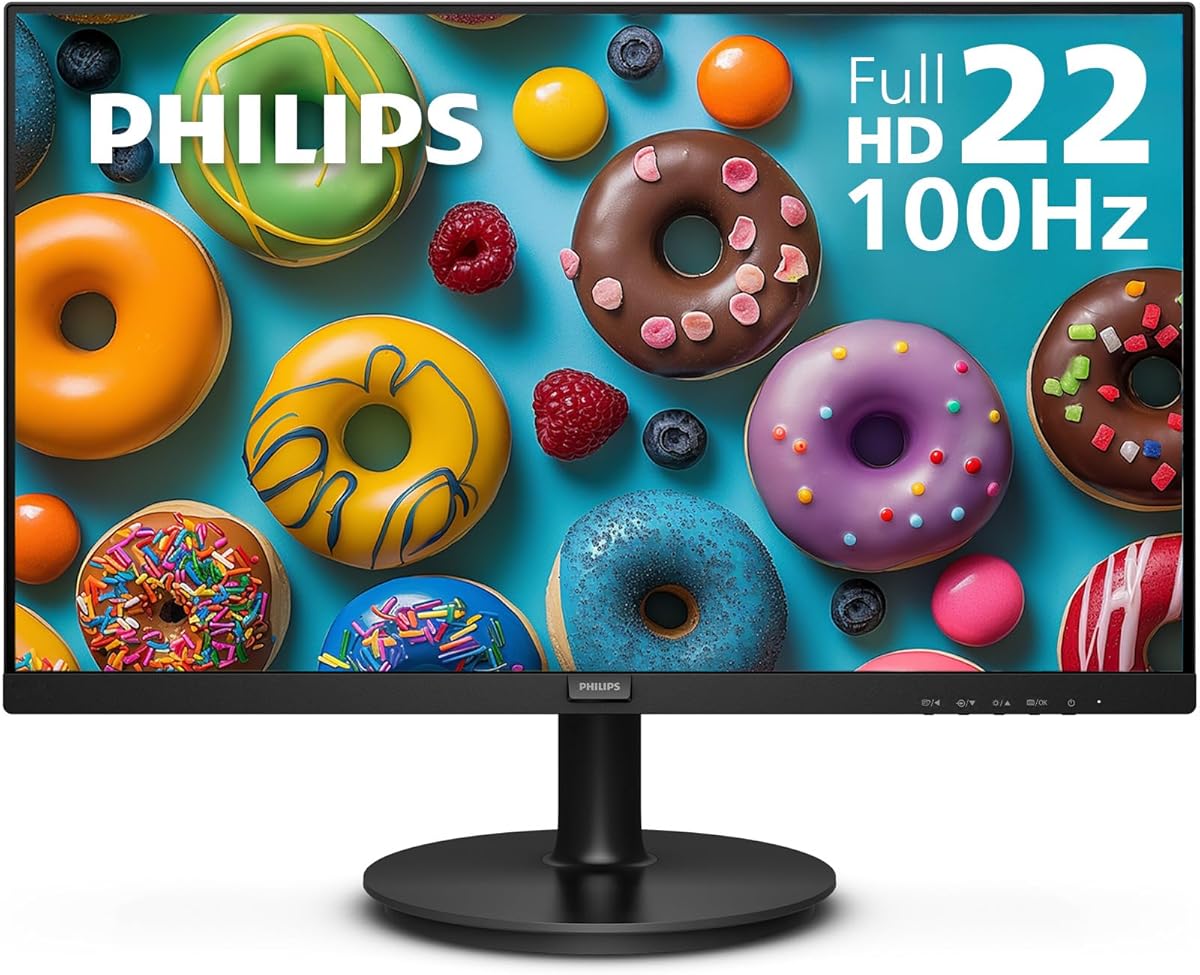
2. Sceptre 22" E225W-FW144 - Best Small Desk with Speakers

Sceptre 22" E225W-FW144

Sceptre 22" E225W-FW144

8.8/10★★★★☆

Sceptre’s 22-inch E225W-FW144 Series (2026) is the compact wild card in an office roundup. It markets itself with gaming language—up to 144Hz, Machine Black finish—yet the practical office story is smaller: a Full HD panel that fits cramped desks, includes speakers, and offers both HDMI and DisplayPort. If your workspace is a narrow console table or a hot-desk station where every inch of depth matters, that 22-inch footprint is the feature, not a compromise you apologize for.

  • 22" FHD panel with refresh up to 144Hz
  • HDMI and DisplayPort plus built-in speakers
  • Blue-Light Shift and near bezel-free dual-monitor styling
Check Price →
✓ Pros
  • Built-in speakers cut cable clutter for quick calls and training videos
  • Up to 144Hz feels lively for scrolling and light after-work play
  • DisplayPort plus HDMI covers more office PCs than HDMI-only value screens
  • Compact 22-inch size fits tight cubicles and laptop riser desks
✕ Cons
  • 22 inches can feel small once you keep three windows open all day
  • Speaker quality is convenience audio, not a substitute for real desk speakers
  • Gaming-oriented branding may include OSD extras you will never use at work

Detailed review

Built-in speakers are the differentiator versus several silent Philips and Samsung options here. They will not impress an audiophile, but they remove the need for a USB dongle speaker when you join a stand-up or watch a compliance video. Blue-Light Shift aims to reduce harsh blue content during long sessions, which aligns with office comfort more than RGB gimmicks. The near bezel-free framing also helps if you eventually add a second identical panel for a dual row without a thick plastic trench in the middle.

Refresh rate up to 144Hz is more than most spreadsheet work demands, but it is not useless. Window animations, browser scrolling, and scrubbing through recorded Zoom sessions feel cleaner than on ancient 60Hz TN leftovers many offices still deploy. Just remember that FHD on 22 inches is dense and sharp—great for text—while the physical canvas is still modest. People who tile a CRM, inbox, and documentation side-by-side may outgrow it quickly.

Port selection is a quiet win: DisplayPort alongside HDMI gives older desktop GPUs and some docking stations a native path without cheap adapters that introduce handshake drama. For IT closets that still mix generations of hardware, that flexibility matters. The monitor’s gaming DNA means you may see picture modes tuned for FPS contrast; for office use, dial those back toward a neutral or low-blue profile so Excel grids do not look artificially crushed.

Where this Sceptre trails purpose-built office panels is in explicit document modes like Philips EasyRead or LG Reader Mode, and in the sheer desktop real estate of 27-inch competitors. Choose it when space and speakers dominate the checklist. Skip it if your day is multi-window analysis on a wide desk—you will be happier with one of the 27-inch IPS or VA options later in this guide.

As a secondary screen beside a laptop, though, the Sceptre makes a lot of sense. Put Slack and calendar on the 22-inch while the laptop handles the active document. The high refresh and small size keep that satellite display responsive without dominating the room.

Best use case

Ideal as a primary display in tiny home offices or as a dedicated communication screen beside a laptop. Less ideal as the only monitor for heavy dual-pane research work.

Comfort tip

Enable Blue-Light Shift for afternoon writing blocks and keep speakers at modest volume so they do not muddy Teams calls—use a headset when voice clarity matters.

Check Price on Amazon →

We may earn a commission at no additional cost to you.

3. Philips 22" 221V8LB - Best Tight-Space Philips

Philips 22" 221V8LB

Philips 22" 221V8LB

9.2/10★★★★★

The Philips 221V8LB is essentially the 24-inch sibling’s smaller coworker: same V-line philosophy, same Full HD VA recipe, dialed into a 22-inch class chassis with about 21.5 inches viewable. That makes it a focused choice for reception desks, standing carts, and shallow shelves where a 27-inch panel would hang off the edge. You still get crisp 1920×1080 detail for tickets, browsers, and forms, plus the VA contrast story Philips emphasizes across this series—brighter whites, deeper blacks, and richer-looking gradients for everyday content.

  • 21.5" viewable FHD VA at 100Hz with Adaptive-Sync
  • 178° wide viewing angles and strong VA contrast
  • Flicker-free, low blue light, tilt, HDMI 1.4, warranty coverage
Check Price →
✓ Pros
  • True compact footprint without abandoning Philips eye-care tuning
  • 100Hz Adaptive-Sync makes motion smoother than legacy office 60Hz panels
  • VA contrast suits dark UI themes and video training content
  • Four-year advance replacement messaging matches the larger Philips siblings
✕ Cons
  • Less horizontal room than 24-inch and 27-inch office standards
  • No built-in speakers if you rely on monitor audio
  • Still Full HD—fine for office text, not a high-PPI creative canvas

Detailed review

100Hz refresh with Adaptive-Sync is the modern touch. Streaming a product demo or playing a lightweight browser game between tasks looks cleaner than on older office inventory. Response is listed around 4ms GtG, which is plenty for cursor work and typical business motion. Flicker-free and low blue light features continue the eye-comfort theme, and wide 178/178 viewing angles help when someone peeks from a slight angle during a quick check-in.

Compared with the Sceptre 22-inch in this same size class, the Philips trades built-in speakers and DisplayPort for a more explicitly office-tuned feature set and warranty positioning. If your laptop or dock already handles audio, that trade is fine. If you need a single cable desk with monitor speakers, the Sceptre may fit better. Either way, do not expect a 22-inch panel to replace a dual-monitor workflow—it is a primary screen for light multitasking or a secondary status display.

Tilt adjustment covers basic ergonomics; VESA opens the door to arms and poles. HDMI 1.4 is the connection path, so plan adapters if your only outputs are DisplayPort or USB-C without an HDMI profile. Once connected, leave Adaptive-Sync on if your GPU supports it, and consider a warmer color temperature for evening admin work.

This model makes the most sense when space is the constraint and you still want the Philips comfort toolkit rather than a bare-bones panel. It is less compelling if your desk can take 24 or 27 inches—those sizes simply give more room for side-by-side windows without shrinking UI scaling. Think of the 221V8LB as a deliberate small-desk tool, not a budget compromise you regret every time you open two documents.

For kiosks, shared check-in PCs, and compact homework nooks, the smaller Philips is easy to recommend. For full knowledge-worker desks, step up in size within this same guide.

Versus the Philips 24-inch

Choose 22 inches when depth or width is truly limited. Choose 24 inches when you can spare a couple of inches for noticeably more comfortable window tiling with the same general feature philosophy.

Who it is for

Reception, lab stations, dorm desks, and secondary screens. Not the first pick for analysts who live in wide spreadsheet layouts.

Check Price on Amazon →

We may earn a commission at no additional cost to you.

4. LG 32MR50C-B Curved 32" - Best Big Curved Canvas

LG 32MR50C-B Curved 32"

LG 32MR50C-B Curved 32"

9.2/10★★★★★

The LG 32MR50C-B is the maximalist office option in this pack: a 32-inch curved Full HD display that turns a single monitor into something closer to a dual-pane workspace. LG highlights vivid VA-driven color and clarity at 1920×1080, a 100Hz refresh rate for smoother streaming and casual play, and AMD FreeSync for tear-resistant motion. For project managers who keep Gantt charts, inbox, and a browser research pane visible together, the sheer acreage can replace a dual 24-inch setup—if you accept the pixel-density tradeoff that comes with FHD on a large panel.

  • 32" curved Full HD with 100Hz AMD FreeSync
  • Reader Mode, OnScreen Control, Black Stabilizer
  • Tilt stand and HDMI for straightforward large-desk installs
Check Price →
✓ Pros
  • Huge physical workspace for timelines, sheets, and reference panes
  • Curve pulls the edges closer so far corners feel less of a neck stretch
  • Reader Mode supports long reading blocks on a bright open desk
  • OnScreen Control helps split and organize the oversized canvas
  • FreeSync keeps casual play and video smoother after work
✕ Cons
  • Full HD stretched across 32 inches looks less sharp than FHD on 24–27"
  • Needs a deeper desk; shallow setups make the curve feel intrusive
  • Tilt-only stand may push power users toward a VESA arm if available

Detailed review

That tradeoff is the honest center of this review. On 24-inch screens, Full HD looks tight and businesslike. On 32 inches, UI elements grow physically larger and text is still readable, but you will notice softer edges if you sit close. Sit a bit farther back than you would with a 27-inch IPS and the experience improves. The curve helps by wrapping the sides toward your peripheral vision, which LG frames as easier, more efficient project work. For immersive video training or reviewing wide mockups, the shape feels natural; for perfectly uniform color across every inch, a flat IPS may still win.

Reader Mode reduces blue light for document comfort—important because a bright 32-inch panel can otherwise feel like a light box. OnScreen Control lets you customize workspace splits and basic options with mouse-driven convenience, which is more useful on a large canvas than on a tiny 22-inch screen. Dynamic Action Sync and Black Stabilizer lean gaming, yet Black Stabilizer can also help when you review dark screen recordings or poorly lit webinar archives. The tilt stand covers everyday angles; confirm VESA needs separately if you require height adjust.

HDMI keeps installation simple for office desktops and living-room-adjacent homework desks. This is not a USB-C productivity hub with 90W charging—it is a big, straightforward display. That simplicity is fine for many offices and a limitation for laptop-first creators who want one-cable docks. If your workflow is Windows desktop plus a single video cable, you will not miss the extras.

Who should buy it? Anyone whose bottleneck is space for windows, not pixel density. Who should hesitate? Designers who pixel-peep, or anyone on a 40-inch-deep desk who will sit too close. Also consider whether two smaller monitors might give you a sharper split with a bezel in the middle. Some people prefer that sharper dual FHD look; others love the uninterrupted curve.

Within this office list, the LG 32-inch is the clearest “go big” recommendation. Pair it with sensible scaling in Windows or macOS, enable Reader Mode for afternoon reading, and treat FreeSync as a bonus for evening downtime rather than the reason you bought it.

Pixel density reality check

If you sit closer than about an arm’s length and hate soft text, choose a 27-inch FHD IPS instead. If you sit farther back and want one wide canvas, the 32MR50C-B’s size advantage is hard to ignore.

Multitasking tip

Use OnScreen Control or OS snap layouts to lock a vertical third for chat and a wide center for your main app so the curve does not become a chaotic window pile.

Check Price on Amazon →

We may earn a commission at no additional cost to you.

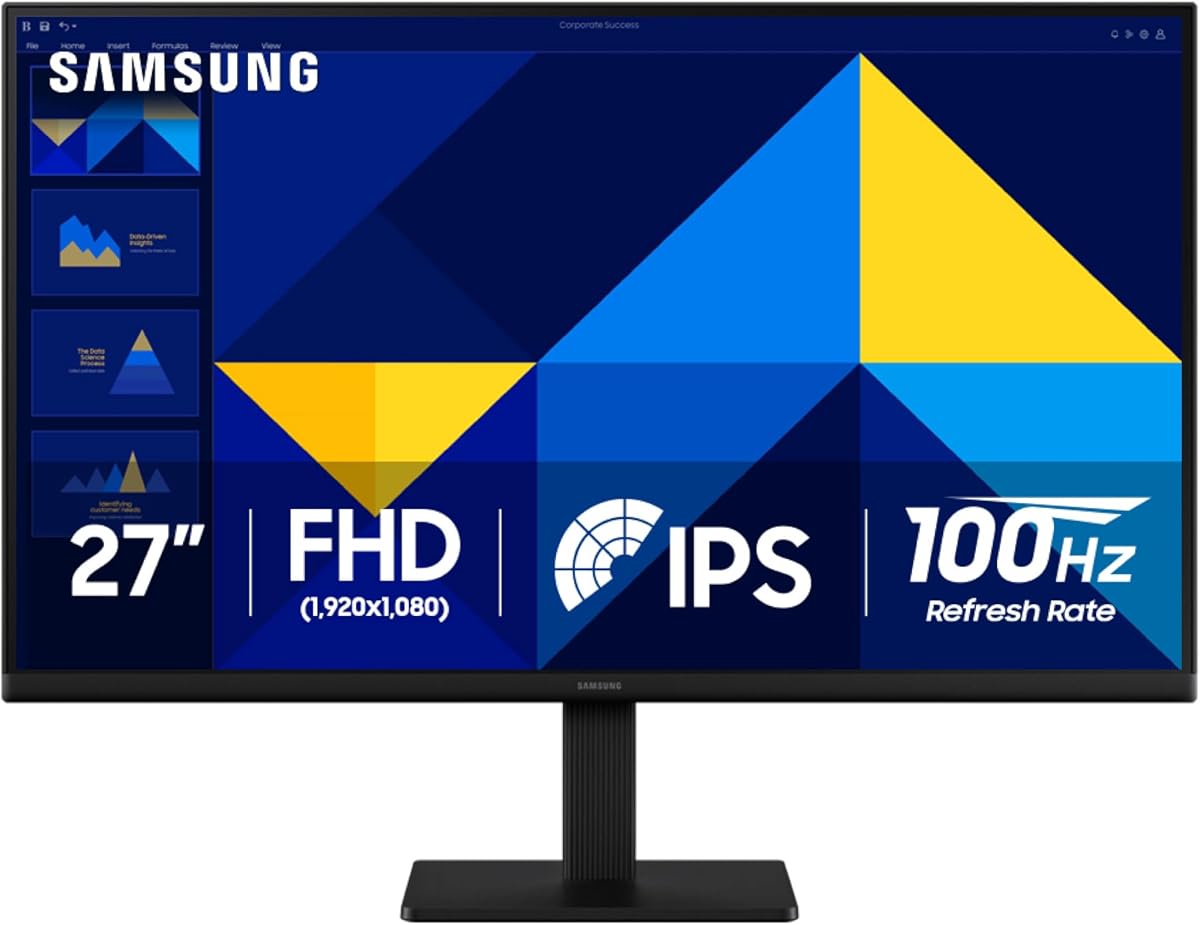
5. Samsung 27" S3 S32GF - Best 120Hz IPS Productivity

Samsung 27" S3 S32GF

Samsung 27" S3 S32GF

8.8/10★★★★☆

Samsung’s 27-inch S3 S32GF (LS27F320GANXZA) brings an IPS panel and 120Hz refresh into the Essential/S3 lane—exactly the combination many 2026 office buyers should shortlist. IPS keeps colors more stable across the screen when you shift in your chair or share the display in a stand-up. Full HD resolution on 27 inches remains the mainstream office compromise: enough pixels for sharp business text without the GPU and scaling headaches some 4K office deployments still create on older PCs.

  • 27" FHD IPS panel with 120Hz refresh
  • Flicker Free and Eye Saver Mode for long sessions
  • Slim modern design with flexible device connections
Check Price →
✓ Pros
  • IPS color consistency helps when colleagues glance from the side
  • 120Hz scrolling feels modern on dense browser-and-docs days
  • Eye Saver and flicker-free features target fatigue directly
  • 27-inch size is the default sweet spot for most knowledge work
✕ Cons
  • IPS contrast usually looks less “inky” than VA siblings in dark rooms
  • Game-oriented picture modes may need toning down for spreadsheet accuracy
  • Stand details are simpler than fully ergonomic enterprise monitors

Detailed review

The 120Hz refresh rate is the standout versus 100Hz VA options. It will not transform typing in Outlook, but it does make trackpad scrolling, window drags, and video playback feel less sticky. Samsung also talks up genre-based game settings and Game Picture Mode; for office purchase orders, treat those as optional evening features and start from a neutral picture mode with Eye Saver enabled when you write for hours.

Eye comfort is a first-class theme: flicker-free operation and Eye Saver Mode reduce blue light and flicker stress. That matters in open offices with mixed lighting where people already fight glare. The super-slim aesthetic with thin border bezels helps dual-monitor symmetry if you later add a second matching panel. “Connect to more” style flexibility in the listing points to practical port variety for mixed devices—always confirm the exact ports on the unit you receive match your dock.

Against the LG 27U411A-B later in this guide, Samsung’s S32GF is a close philosophical cousin: 27-inch IPS-class productivity with a high refresh lean. LG answers with HDR10, explicit sRGB coverage claims, Reader Mode, and the Switch app. Samsung answers with Eye Saver branding and the S3 series’ straightforward Essential positioning. Your choice may come down to which software extras and warranty channels your workplace prefers.

The main IPS caveat is contrast. In a dim home office, blacks look more like dark gray than on the Philips VA models. If you live in dark themes and watch a lot of video, VA may please you more. If you review colorful decks with coworkers hovering nearby, IPS usually wins. Most hybrid office workers fall into the second camp.

Recommend the S32GF when you want a modern 27-inch IPS daily driver without jumping to creator-grade 5K panels. It is a confident mid-desk choice for writing, CRM work, light creative review, and smoother motion than last decade’s office defaults.

Workday calibration quick start

Set Eye Saver for long writing blocks, disable overly saturated game modes for Excel, and match brightness to your room so a white Google Doc does not become a flashlight.

Versus curved Samsung S36GD

Pick this flat IPS when color consistency and shared viewing matter. Pick the curved S36GD when you want a more wrapped, immersive feel and can accept a different panel personality.

Check Price on Amazon →

We may earn a commission at no additional cost to you.

6. Samsung 27" S3 S36GD Curved - Best Curved 27"

Samsung 27" S3 S36GD Curved

Samsung 27" S3 S36GD Curved

9.2/10★★★★★

Samsung’s Essential S3 S36GD curves a 27-inch Full HD panel at 1800R, aiming to wrap more of the display into your field of view. In an office context, that can feel like gentle immersion: the edges come slightly toward you, which some writers and analysts say helps them stay inside the screen instead of noticing room distractions. It is a milder curve than ultrawide 1500R gaming monsters, so it still behaves like a normal productivity monitor rather than a cockpit.

  • 27" FHD 1800R curve with 100Hz refresh
  • Advanced eye comfort with TÜV-oriented claims
  • HDMI and D-sub for legacy and modern office PCs
Check Price →
✓ Pros
  • 1800R curve reduces peripheral distraction for focused deep work
  • 100Hz motion is smooth enough for video-heavy training days
  • Eye-comfort tuning supports long supervised computer use
  • D-sub plus HDMI helps older office towers stay useful
✕ Cons
  • Curve is not ideal if you need perfectly flat design-measurement work
  • D-sub era PCs will still be limited to lower quality analog signals
  • Game Mode features are secondary for pure productivity buyers

Detailed review

100Hz refresh reduces lag and motion blur for videos and lighter interactive work. Game Mode and contrast tweaks are available if you also unwind on the same screen, but the more important office line is advanced eye comfort with TÜV-oriented messaging around blue light and flicker reduction. That certification language is useful when HR or facilities teams care about ergonomic purchasing checkboxes.

Connectivity is pragmatic in a slightly old-school way: HDMI and D-sub. Plenty of warehouses, clinics, and municipal offices still have desktops with VGA-only outputs. D-sub keeps those machines alive while HDMI serves newer PCs. Image quality over D-sub will never match a clean digital link, so treat analog as compatibility, not as the preferred path.

Compared with Samsung’s flat S32GF IPS 120Hz model, the S36GD trades some refresh headroom and IPS-style angle behavior for curve immersion and that dual-port legacy friendliness. Compared with LG’s 32-inch curve, it keeps sharper-looking FHD density because the panel is smaller. That makes 27-inch 1800R a smarter daily driver for people who liked the idea of the 32-inch LG but worried about softness.

Ergonomics are typical for the Essential tier—expect tilt-focused stands rather than full pivot/height luxury. If your workplace standardizes on monitor arms, confirm VESA compatibility for the exact SKU. Visually, the slim modern styling fits home offices that want something nicer than a beige corporate relic without jumping into flashy gamer aesthetics.

Buy the S36GD if you specifically want a curved 27-inch workhorse with eye-comfort features and flexible inputs. Choose a flat IPS if multiple people regularly review work over your shoulder and you want maximum lateral color stability.

Curve and posture

Center yourself on the monitor so the curve benefits both eyes equally. Sitting far off to one side defeats the immersion advantage and can make the nearer edge feel magnified.

Legacy PC note

Use HDMI whenever possible. Keep D-sub as a fallback for older towers, and consider a cheap GPU or USB display adapter upgrade if image clarity on analog looks soft.

Check Price on Amazon →

We may earn a commission at no additional cost to you.

7. LG 27U411A-B 27" IPS - Best Overall Workday Display

LG 27U411A-B 27" IPS

LG 27U411A-B 27" IPS

9.2/10★★★★★

If this guide needs a single default recommendation for most office buyers in 2026, the LG 27U411A-B is it. You get a 27-inch Full HD IPS panel that stays vivid from practical viewing angles, a 120Hz refresh rate for smoother day-to-day motion, HDR10 support, and up to 99% sRGB coverage for richer color on slides and product images. LG’s three-side virtually borderless design and slim stand base give the desk a cleaner, more modern presence on video calls—small optics that matter when your monitor is also your backdrop.

  • 27" FHD IPS with 120Hz, HDR10, up to 99% sRGB
  • Reader Mode, Flicker Safe, Switch app layouts
  • Tilt -5° to 20° with three-side virtually borderless design
Check Price →
✓ Pros
  • IPS clarity plus wide sRGB coverage suits decks, photos, and UI review
  • 120Hz and motion tools keep the desktop feeling responsive
  • Reader Mode and Flicker Safe are practical for document marathons
  • Switch app multitasking is unusually useful for office window management
  • Slim borderless look elevates dual-monitor and video-call backgrounds
✕ Cons
  • Full HD will not satisfy buyers already committed to 1440p or 4K workflows
  • HDR10 on an office FHD panel is a highlight feature, not reference HDR
  • Height adjustment depends on tilt/stand limits unless you add an arm

Detailed review

Reader Mode lowers blue light for document-heavy stretches, while Flicker Safe targets the subtle flicker that contributes to fatigue under office lighting. Those two features alone put it ahead of generic “FHD 27-inch” commodity panels. Add the Switch app, which can split the screen into multiple sections and speed up layouts for calls and multitasking, and you have software support that matches how people actually work: browser research on one side, draft on the other, chat tucked into a third pane.

Motion features go beyond basic refresh. LG calls out 1ms Motion Blur Reduction for sharper fast movement, Dynamic Action Sync to minimize input lag, and Black Stabilizer for dark scenes. Office buyers can ignore the esports framing and still benefit when scrubbing through recorded meetings or playing a calm evening game. Adaptive comfort comes from tilt adjustment between -5° and 20°, enough to fix glare from a window without buying a new desk lamp first.

Color is a meaningful step up from older office TN stock and many no-name VA panels that oversaturate reds. Up to 99% sRGB means marketing PDFs and website mockups look more trustworthy before you hand them to a client. HDR10 can add pop to supported video content, though for spreadsheets you will live in SDR and should calibrate brightness to the room. This is still Full HD, so if your workplace already standardized on 1440p for coding, look outside this particular pack—but within these ten products, LG’s feature stack is the most complete for mixed productivity.

Versus Samsung’s 27-inch IPS S32GF, LG feels more “workspace software aware” thanks to Switch and Reader Mode naming. Versus Philips VA models, LG trades some contrast punch for better lateral consistency and explicit sRGB/HDR language. Versus the 32-inch curved LG, it keeps better perceived sharpness and a more conventional flat shape for design-adjacent work.

Choose the 27U411A-B as your primary office monitor if you want one screen that handles writing, light creative review, smoother motion, and thoughtful comfort modes without jumping into specialist 5K territory. It is the pick we would put on most hybrid workers’ desks from this list.

Who it fits best

Hybrid employees, students in long seminar blocks, and anyone who multitasks across documents and browsers on a mid-size desk. Also a strong single-monitor choice when you want IPS color without ultrawide complexity.

Suggested Switch app layout

Try a 50/25/25 split: main document center-left, reference PDF right-top, chat or calendar right-bottom. Save that layout for recurring deep-work mornings.

Versus buying two 24-inch panels

Two 24-inch monitors give more total pixels and separation between tasks. One 27-inch LG is cleaner, cheaper to mount, and simpler for laptop docking—pick based on whether you truly use dual screens all day.

Check Price on Amazon →

We may earn a commission at no additional cost to you.

8. Philips 27" 271V8LB - Best 27" VA Contrast Desk

Philips 27" 271V8LB

Philips 27" 271V8LB

9.2/10★★★★★

The Philips 271V8LB scales the V-line office formula to 27 inches: Full HD VA panel, 100Hz Adaptive Sync, flicker-free and low blue light tuning, EasyRead for document marathoners, and a three-side virtually bezel-free chassis for dual setups. If you liked everything about the 24-inch Philips but want more space for side-by-side windows, this is the direct upsizing path. Contrast remains the emotional hook—whites that feel brighter, blacks that feel deeper, and gradients that look less posterized in everyday video.

  • 27" FHD VA, 100Hz, Adaptive Sync, 4ms GtG
  • EasyRead, flicker-free, low blue light eye-care stack
  • HDMI 1.4 and VGA with VESA and advance replacement warranty
Check Price →
✓ Pros
  • VA contrast makes dark-theme coding and video look richer
  • EasyRead mode is tailored to lengthy document review
  • HDMI plus VGA covers mixed office hardware generations
  • Same warranty confidence as the smaller Philips V-line models
✕ Cons
  • IPS rivals hold color better for group shoulder-surfing reviews
  • 100Hz trails the 120Hz IPS options for buttery scrolling feel
  • FHD on 27 inches is standard, not retina-class sharpness

Detailed review

For office work, 27-inch FHD is familiar and readable. You can keep a widescreen browser and a notes app visible without microscopic UI scaling. EasyRead again targets paper-like document viewing, which is the feature that separates these Philips models from gaming leftovers that only mention “low blue light” in passing. Adaptive Sync and 4ms GtG keep motion competent for training videos and casual play without pretending this is a tournament panel.

Ports include HDMI 1.4 and VGA, echoing Samsung’s legacy-friendly thinking. That matters in schools, warehouses, and branch offices retiring machines slowly. VESA support plus tilt covers mounting flexibility, and the four-year advance replacement warranty remains a procurement-friendly talking point. The minimalistic look helps multi-monitor walls look intentional rather than pieced together from random freebies.

Where you might prefer LG or Samsung IPS instead is collaborative review. If three people huddle around your desk, IPS usually keeps the slide colors more consistent at angle. VA still lists wide 178-degree viewing angles, and for one or two viewers it is often fine—the difference shows up at more extreme side looks and in some dark-room blooming characteristics.

Think of the 271V8LB as the contrast-first 27-inch office pick. It is especially satisfying with dark IDEs, night-mode Notion, and video-heavy LMS coursework. It is slightly less ideal if your job is comparing subtle brand colors across a printed proof and an on-screen PDF—then the LG’s sRGB-focused IPS story is safer.

In a dual-monitor Philips pair, a 27-inch center display with a 24-inch side panel can work, though matching heights is easier with two identical 27s or a VESA arm. Either way, this model extends the Philips office comfort approach without forcing you into a curve or a 32-inch density compromise.

Ideal workflows

Document review, ticketing queues, dark-theme development, and video training. Less ideal for print-critical color comparison.

Ergonomic note

At 27 inches, a slight upward tilt and an arm’s-length viewing distance usually beat sitting too close. Enable EasyRead when a contract review block starts rather than after eyes already feel tired.

Check Price on Amazon →

We may earn a commission at no additional cost to you.

9. Samsung 27" S30GD IPS - Best Straightforward IPS Essential

Samsung 27" S30GD IPS

Samsung 27" S30GD IPS

9/10★★★★★

The Samsung S30GD Essential 27-inch is the no-drama IPS office monitor: Full HD resolution, 100Hz refresh, advanced eye care, Game Mode if you want it, and a tilt-only ergonomic stand in a slim bezel chassis. Samsung emphasizes colors that stay bright and clear even as angles change, with less washing than weaker panels. For stand-ups where someone reads your screen from the side, that IPS behavior is the reason to pick this over a cheaper VA mystery brand.

  • 27" FHD IPS at 100Hz with tilt-only stand
  • Advanced eye care reducing blue light and flicker
  • Game Mode plus slim bezel modern Essential design
Check Price →
✓ Pros
  • IPS panel keeps tones consistent across the screen for shared glances
  • 100Hz is a solid step up from aging 60Hz office inventory
  • Eye-care focus matches long supervised computer policies
  • Lightweight modern styling fits home offices and clean corporate desks
✕ Cons
  • Tilt-only stand means height fans will want a VESA arm
  • 100Hz trails Samsung’s own 120Hz S32GF for motion smoothness
  • Game Mode is optional fluff for pure productivity purchasing

Detailed review

100Hz refresh reduces motion blur relative to legacy office gear when you watch product demos or scroll long pages. It is not as aggressive as the 120Hz S32GF, so if buttery motion is your top priority within Samsung’s own family, step up there. If your PC or GPU pipeline is modest and you simply want a trustworthy 27-inch IPS for Word and browsers, 100Hz is plenty and can be easier on older hardware.

Eye care again covers blue light and flicker reduction for long sessions—the feature set facilities teams look for when replacing eye-strain complaints with hardware rather than reminders alone. Thin border bezels and a modern Essential aesthetic help the monitor disappear into a tidy desk photo, which is oddly relevant for remote workers who care about what sits behind them on camera.

The explicit “tilt only” stand language is refreshing honesty. You can angle the panel to fight window glare, but you cannot raise it to eye level without books, a riser, or a mount. Budget a VESA arm if your chair and desk heights fight each other. Connectivity is positioned around plugging devices in for flexibility—verify HDMI and any additional ports against your dock before bulk ordering.

Compared with the curved S36GD, this flat S30GD is the better shared-viewing colleague. Compared with LG 27U411A-B, it is a simpler Essential alternative if you do not need Switch app storytelling, HDR10, or the higher refresh LG and Samsung’s S32GF advertise. It is the “buy a normal good office monitor” choice.

We recommend it for straightforward IT refreshes and home offices that want IPS comfort without chasing every gaming spec on the box. Pair eye-care modes with reasonable room lighting and you will have a calm, readable 27-inch daily driver.

When to pick S30GD over S32GF

Choose S30GD when 100Hz IPS is enough and you want the Essential feature balance. Choose S32GF when you specifically want the 120Hz scrolling feel from Samsung’s related 27-inch IPS option.

Desk ergonomics

If your eyes land on the bottom third of the screen, raise the monitor with an arm or sturdy riser. Tilt alone cannot fix a panel that sits too low on a thick desk.

Check Price on Amazon →

We may earn a commission at no additional cost to you.

10. Acer KA242Y G0bi 23.8" - Best Color-Focused Compact IPS

Acer KA242Y G0bi 23.8"

Acer KA242Y G0bi 23.8"

9.2/10★★★★★

Acer’s KA242Y G0bi is a home-office IPS specialist in a 23.8-inch ZeroFrame chassis. Full HD 1080p keeps text clear for everyday apps, while the IPS panel and 99% sRGB coverage claim give slides, storefront photos, and UI mockups more trustworthy color than generic “16.7 million colors” marketing alone. If you want something smaller than 27 inches but do not want to give up color credibility, this Acer is the sharpest answer in the pack.

  • 23.8" FHD IPS up to 120Hz with 1ms VRB
  • 99% sRGB color and FreeSync Adaptive-Sync support
  • ZeroFrame design, HDMI & VGA, VESA 100x100, wide tilt
Check Price →
✓ Pros
  • 99% sRGB is unusually clear color guidance for a compact office panel
  • Up to 120Hz plus FreeSync keeps motion clean for mixed work and play
  • ZeroFrame edges are excellent for dual-monitor home offices
  • HDMI cable included messaging and VGA backup help first-time setups
  • Tilt range to 25° fights glare on bright desks
✕ Cons
  • 23.8 inches offers less space than the 27-inch productivity favorites
  • 1ms VRB is a motion setting tradeoff—use thoughtfully for text work
  • Brightness around 250 nits may feel modest in extremely bright sunrooms

Detailed review

Refresh climbs up to 120Hz with Adaptive-Sync FreeSync compatibility, so scrolling and supported games stay smoother with less tearing. Response is listed at 1ms VRB—visual response boost—which can sharpen motion at the possible cost of flicker or brightness behavior depending on how you enable it. For pure Excel days, a standard mode without aggressive VRB is often the calmer choice; flip motion tools on when you watch action content.

ZeroFrame design is more than aesthetics. Thin borders make dual KA242Y setups feel almost continuous, which is a classic home-office upgrade path: two 24-inch IPS panels instead of one soft 32-inch FHD curve. Acer includes practical connectivity with HDMI 1.4 and VGA, notes an HDMI cable in the listing details, and supports VESA 100x100 mounting. Tilt spans roughly -5° to 25°, a wider nod range than many tilt-only competitors, helpful under skylights.

Brightness is listed around 250 nits with a fine 0.275mm pixel pitch. Indoors that is typical and fine; in a sun-drenched loft you may need curtains or a hooded desk placement. Pixel pitch on 24-inch FHD yields crisper text than the same resolution stretched to 32 inches—another reason compact IPS still wins for writers who sit close.

Stack it against the Philips 24-inch VA and you choose between Acer’s IPS/sRGB color angle plus 120Hz, versus Philips’ VA contrast, EasyRead, and warranty story. Against LG’s 27-inch flagship in this guide, you sacrifice size and Switch app extras for a denser, smaller canvas that may actually feel sharper for text. Many people doing mostly writing and light photo checks will prefer this Acer footprint.

We like the KA242Y as the color-aware compact pick: FreeSync for flexibility, ZeroFrame for dual desks, and honest home-office positioning rather than pure esports theater. If your desk can only hold one screen and you want maximum window space, jump to 27 inches—but if you want crisp FHD IPS in a manageable size, Acer closes this list strong.

Dual-monitor suggestion

Two KA242Y units at equal height create a clean coding or research cockpit with better text density than one 32-inch FHD panel. Use a dual arm to align the ZeroFrame edges tightly.

Who should buy it

Home office workers, students, and hybrid employees who sit closer to a 24-inch screen and care about sRGB-guided color more than sheer size.

Check Price on Amazon →

We may earn a commission at no additional cost to you.

Best Office Monitors in 2026 for Clear Text and Long

How to Choose an Office Monitor in 2026

Start with desk depth and viewing distance

Measure before you fall in love with a 32-inch curve. A shallow 20–24 inch desk often pairs best with 22–24 inch panels or a single 27-inch flat screen pushed toward the back edge. Deeper desks can host 27–32 inch monitors without forcing your eyes into a close-up pixel peep. If you sit closer than an arm’s length, prioritize smaller FHD screens or higher-resolution panels outside this pack; FHD on 32 inches looks bigger, not sharper.

IPS vs VA for real office work

IPS (LG 27U411A-B, Samsung S32GF/S30GD, Acer KA242Y) generally wins when people review your screen from the side and when you care about consistent color across slides. VA (Philips V-line, LG 32-inch curve, Samsung curve) generally wins when you love deep contrast, dark themes, and movie-like training video. Neither is universally “more professional”—match the panel to whether shared viewing or contrast comfort matters more in your seat.

Refresh rate: 100Hz vs 120Hz vs 144Hz

Sixty hertz office leftovers feel dated once you try 100Hz scrolling. Most people in this guide will be happy at 100Hz. 120Hz on the LG 27, Samsung S32GF, and Acer KA242Y adds polish for window motion and light play. The Sceptre’s up-to-144Hz ceiling is a bonus on a small screen, not a requirement for Excel. Buy refresh for comfort, not for a spec sheet trophy.

Eye-care features that actually change your day

Look for named modes tied to documents—Philips EasyRead, LG Reader Mode—plus flicker-free operation and low blue light or Eye Saver styles from Samsung. These will not fix a blinding overhead LED directly above the screen, but they meaningfully help during contract review and long CMS sessions. Combine them with sensible brightness; a dim comfort mode on a maxed-out backlight still hurts.

Ports, stands, and mounting

HDMI is the common language here. DisplayPort on the Sceptre and VGA/D-sub on several Philips and Samsung models help mixed fleets. USB-C single-cable laptop docks are mostly outside this particular pack, so keep your existing dock if you rely on charging-plus-video. Tilt-only stands are normal at this tier; budget a VESA arm when eye level is wrong. Confirm 100x100 VESA on models that advertise it, like the Acer and Philips VESA-ready units.

One large screen vs two smaller screens

A 32-inch curved FHD canvas can replace dual monitors for people who hate bezels and live in wide timelines. Two 24-inch ZeroFrame or Philips panels often look sharper and let you put a call on one screen while keeping deep work unbroken on the other. Be honest about your window habits for a week before you buy—your browser history of snapped windows is a better guide than marketing renderings.

Frequently Asked Questions

01

What size office monitor is best for most desks?

Twenty-seven inches is the default recommendation for most knowledge workers who want room for two main windows without the pixel-density compromise of a 32-inch Full HD panel. Twenty-four inches remains excellent for smaller desks and dual-monitor pairs, while 22 inches fits truly tight spaces or secondary screens. Choose 32-inch curved only when you have depth and sit farther back.

02

Is 1080p enough for office work in 2026?

Yes for mainstream Word, Excel, browsers, and video calls—especially at 24–27 inches. Full HD keeps GPU and docking requirements simple on older PCs. You may want 1440p or higher for heavy coding, detailed design, or large panels where FHD looks soft. Within this pack, every monitor is FHD-focused, so size and panel type become the bigger differentiators.

03

Do I need 120Hz for office productivity?

You do not need it, but many people prefer it once they try it. 100Hz already feels clearly smoother than 60Hz for scrolling and video. 120Hz on models like the LG 27U411A-B, Samsung S32GF, and Acer KA242Y adds extra polish. Prioritize panel type, size, and eye-care features first; use refresh rate as a tie-breaker.

04

IPS or VA—which is better for Excel and documents?

Both work. IPS usually offers more consistent color when viewed off-angle and is friendlier for shared glances at your screen. VA usually offers deeper contrast that some people love for text in dark themes and for video. If coworkers often stand beside you, lean IPS. If you work alone and like punchy contrast, VA is satisfying.

05

Are curved monitors okay for professional work?

Yes, with caveats. A 27-inch 1800R or 32-inch office curve can feel immersive and reduce peripheral distractions. Curves are less ideal if you do precision layout work that benefits from a flat geometric reference, or if you sit extremely close. Try to center your seating so both edges feel equidistant.

06

What eye-care settings should I enable on day one?

Turn on the manufacturer’s reader, EasyRead, Eye Saver, or low blue light mode during long reading blocks, keep flicker-free features enabled, and reduce brightness until a white page looks like paper rather than a lamp. Also fix room lighting—no bright window directly behind the monitor—and take short focus breaks. Hardware helps; it does not replace posture and lighting.

07

Can these monitors work with Mac laptops?

Generally yes if you have the right cable or dock to HDMI (or DisplayPort on the Sceptre). macOS scaling on FHD is usable though not as dense as on native Retina displays. For color-critical Mac creative work you might eventually want a higher-resolution specialist display, but for documents, browsers, and calls, these office FHD options are practical with a quality adapter.

08

Is a 32-inch FHD monitor too soft for text?

It can be if you sit close. Full HD pixels are larger on 32 inches than on 24 inches, so edges look less crisp up close. Many users adapt by sitting farther back and using the curve’s immersion. If you are sensitive to soft text, choose a 27-inch FHD IPS/VA or a dual 24-inch setup instead of the large LG curve.

09

Do built-in speakers matter for office monitors?

They matter for convenience, not fidelity. The Sceptre’s speakers are handy for quick videos and alerts without another desk gadget. For daily calls, a headset still wins for mic quality and privacy in shared spaces. Do not choose a monitor only for speakers unless cable minimalism is your top constraint.

10

Should I mount an office monitor on a VESA arm?

If the included stand is tilt-only and the panel sits too low, yes. A VESA arm frees desk space, aligns dual monitors, and helps set the top of the screen near eye level. Confirm the mount pattern—Acer lists 100x100, and several Philips models advertise VESA readiness. A good arm often improves comfort more than jumping up one refresh-rate tier.

Conclusion

The best office monitor in 2026 is the one that matches your desk, your viewing distance, and the way you multitask—not the one with the loudest gaming badge. From this pack, the LG 27U411A-B stands out as the most complete everyday IPS workhorse with 120Hz smoothness, Reader Mode, and thoughtful multitasking support. The Philips 24-inch 241V8LB remains a smart compact VA pick with EasyRead comfort and strong warranty positioning, while the LG 32-inch curve is the go-big canvas for deep desks that want one wide workplace.

If you need tighter spaces, the Philips and Sceptre 22-inch options earn real roles; if you want color-aware compactness, the Acer KA242Y’s 99% sRGB IPS package is easy to like. Samsung’s 27-inch Essential models cover flat IPS and curved preferences with eye-care features suited to long days. Compare ports against your dock, decide honestly between one large screen and two smaller ones, and enable comfort modes on day one.

Choose for readability and posture first. When those are right, productivity follows—whether you are clearing an inbox, sharing a deck, or finishing the last PDF before dinner.