Western Digital 8TB WD Red Plus
- CMR Red Plus tuned for NAS systems up to 8 bays
- 180 TB/year workload rating for 24×7 small-business/home use
- 8TB capacity fits a serious movie-and-TV library without instant RAID sprawl
Expert Review & Guide
A Plex server is only as calm as the disks underneath it. Transcoding can hammer a CPU, but the silent killer of Saturday movie night is a desktop drive that was never meant to spin for weeks in a multi-bay chassis—or a tiny 1TB leftover that fills before your kids finish one animated franchise. In 2026 the smart Plex build still centers on high-capacity 3.5-inch SATA HDDs, with a clear fork between NAS-tuned CMR drives for always-on libraries and cheaper desktop Barracudas for simple single-drive boxes.
This roundup sticks to the ten drives in our product pack: WD Red Plus and Red Pro NAS models, Seagate BarraCuda desktop disks, a Renewed Seagate Exos enterprise unit, a plug-and-play WD Elements external, a classic WD Blue, and a Renewed WD AV-GP surveillance drive. You will see honest notes about Renewed stock, workload ratings, bay limits, and when an external USB disk is a fine starter library versus a false economy.
No dollar prices here—just which spindles belong in a quiet living-room NAS, which ones make sense inside a recycled gaming PC running Plex, and which capacities actually match a 4K remux habit versus a compressed H.265 archive.
As an Amazon Associate we earn from qualifying purchases. We may earn a commission at no additional cost to you.
Scan capacity, RPM/cache, and the role each disk is actually designed for—NAS, desktop, enterprise, external, or surveillance—before you fill a chassis.
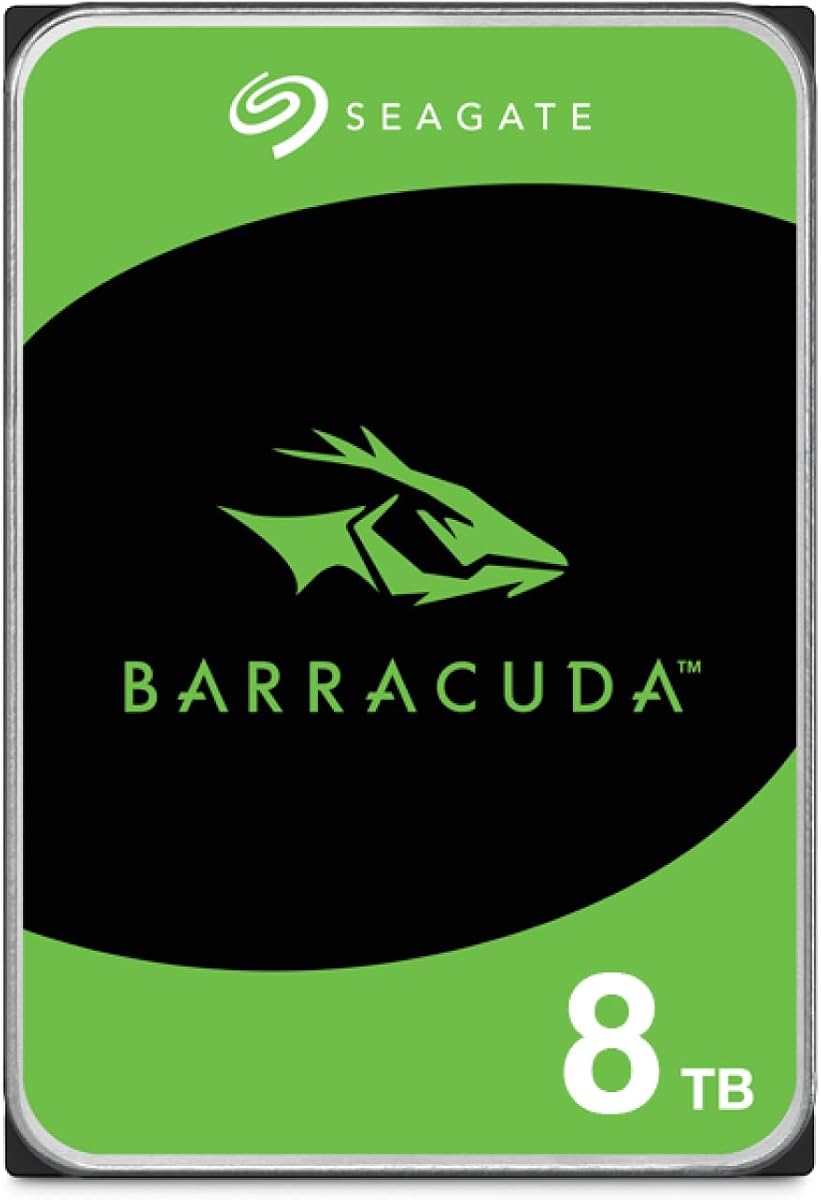
Most people discover Plex on a spare desktop, not a shiny eight-bay Synology. The 8TB BarraCuda is the disk that matches that origin story: a 3.5-inch SATA 6 Gb/s drive at 5400 RPM with 256 MB of cache, marketed for everyday PC bulk storage—music, video, photos, gaming installs. Drop it into a quiet tower, point Plex at a folder tree, and you suddenly have room for hundreds of movies without touching RAID terminology.
Seagate frames BarraCuda as a confident, long-running desktop lineage. That confidence is fair for single-drive duty. It is less fair if you plan to bolt five BarraCudas into a vibrating chassis and call it a NAS. Desktop firmware and acoustics targets differ from WD Red’s NASware approach. If your roadmap includes multi-bay RAID6 next year, start with Red Plus instead of normalizing desktop disks in an array.
For a household streaming one or two direct-play 1080p/4K files at a time, 5400 RPM sequential throughput is usually invisible. Plex hurts when the CPU transcodes, not when a Barracuda streams a remux to the living-room TV. Where you will notice the drive is during library scans, simultaneous season downloads, and backup jobs colliding with playback—schedule those for off hours.
Eight terabytes changes behavior. People stop deleting “maybe later” shows. That is good for enjoyment and bad for disaster recovery if the only copy lives on one spindle. Pair this drive with either cloud backup for irreplaceable home videos or a second external for cold copies of the library. Plex databases and posters are rebuildable; your ripped bluray folder is not.
Thermals in a closed living-room mini PC matter. Give the BarraCuda airflow, avoid carpet-blocked intake, and check SMART monthly. A 4.7 rating reflects broad consumer success, not immortality. Spindles die; your runbooks should assume it.
Buy the 8TB BarraCuda when Plex is a single internal disk in a PC or a simple non-RAID enclosure. Skip it as the foundation of a multi-bay NAS you expect to ignore for five years.
OS and Plex metadata on an SSD; media folder on the 8TB BarraCuda. Keep downloads staging on the SSD too so incomplete torrents are not fragmenting the media disk all afternoon.
When you add a second internal media disk for mirroring, or move into a proper NAS OS with RAID, migrate to Red Plus/Pro and treat the BarraCuda as a temporary bulk disk or backup target—not array member #1.
We may earn a commission at no additional cost to you.
The 4TB WD40EFZZ Red Plus is how a careful home lab starts: CMR, 5400 RPM, 128 MB cache, and explicit marketing for RAID-optimized NAS systems with up to eight bays and continuous operation. That sentence is doing a lot of work Plex users need—vibration tolerance, firmware tuned for arrays, and a workload expectation beyond “office documents sometimes.”
Four terabytes sounds small next to 16TB Pro drives, yet it is honest for a first mirror. Two 4TB Red Plus disks in RAID1 give you 4TB of protected space—enough for a selective movie shelf and kids’ TV without pretending you will archive every UHD disc ever pressed. Curated libraries age better than hoarder libraries on underpowered CPUs anyway.
Compared with a 4TB BarraCuda, you are paying (in tier, not discussed as price here) for NAS intent. If the drive will live alone in a USB dock attached to a NUC, the benefit shrinks. If it will sit beside a twin in a DS220+/TrueNAS Mini-class box humming for years, Red Plus is the correct class.
Library strategy tip: put 4K remuxes on a future larger disk and keep this 4TB volume for episodes and 1080p films if you are capacity-constrained. Plex lets you use multiple libraries across mount points; you do not have to fill one volume with everything.
WD’s support/warranty framing for Red Plus is part of the product story. Keep receipts, enable email SMART alerts in your NAS OS, and replace proactively when reallocated sectors climb. Continuous operation is a design goal, not a lifetime covenant.
Choose 4TB Red Plus when you are building a proper two-bay Plex NAS on a budget of bays and want CMR NAS firmware from day one. Plan an upgrade path to 8TB Red Plus when the empty-space warning becomes a weekly ritual.
Apartment setups, 1080p-first collectors, and anyone mirroring two disks who would rather protect fewer terabytes than risk an unprotected 8TB desktop disk.
This listing calls out CMR, which matters for RAID rebuilds and sustained writes. For Plex ingest bursts and array rebuilds, CMR Red Plus is the line you want—avoid assuming every “Red” you see historically is the same.
We may earn a commission at no additional cost to you.
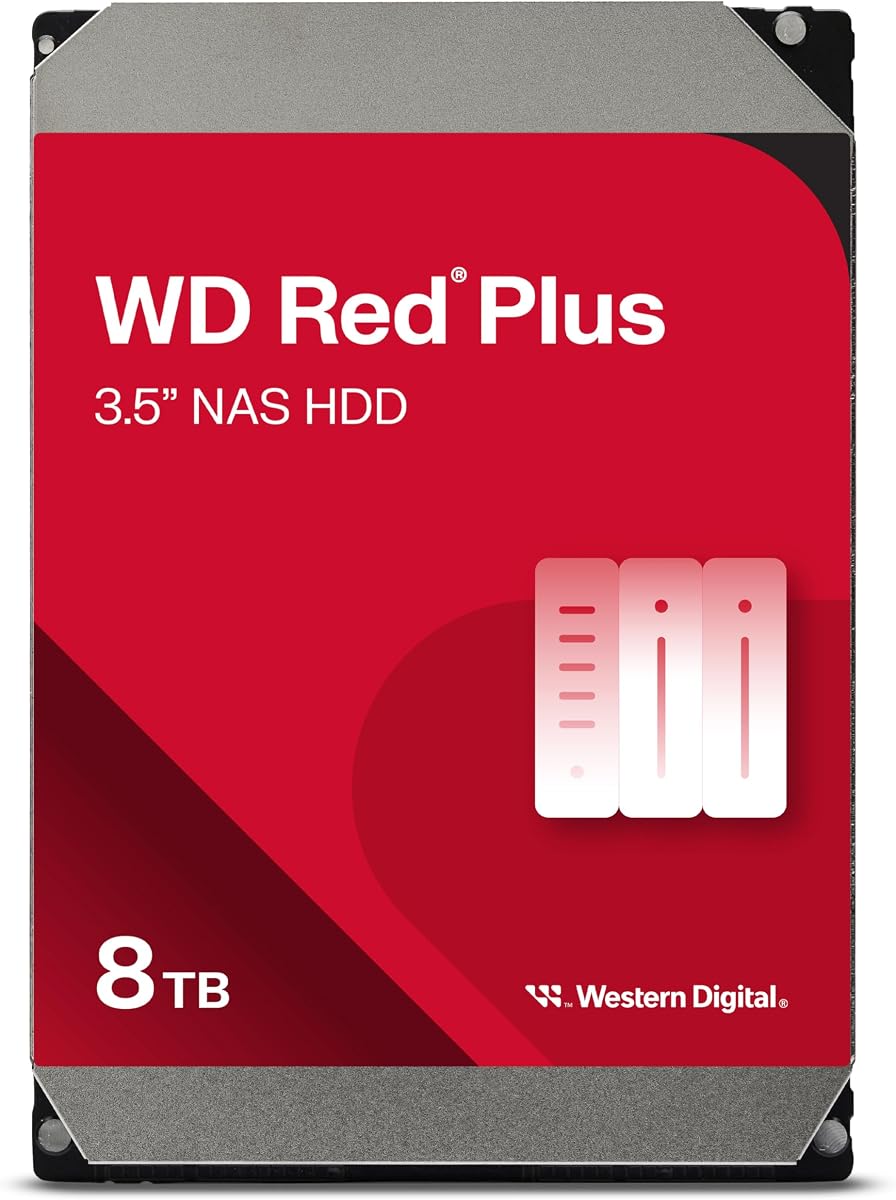
If I could put only one internal model into most DIY Plex NAS builds from this pack, it would be the 8TB WD80EFPX Red Plus. It keeps the CMR NAS recipe, steps cache up to 256 MB, lists a 5640 RPM class speed, and publishes a 180 TB/year workload rating with NASware firmware messaging for small or medium business NAS systems in 24×7 environments. That maps cleanly onto a family Plex box that also syncs photos and backups.
Eight terabytes of usable space (less after formatting and RAID overhead) covers a mixed 1080p/4K library without forcing you into 16TB jump-scare budgeting. Many households stabilize here for years if they are selective about remuxes versus encodes. Direct play remains the goal: the drive streams; the CPU should not melt.
Workload rating is the adult conversation. 180 TB/year is not a speedometer; it is WD’s way of saying the drive is qualified for a certain intensity of annual transfer in NAS duty. Home Plex plus occasional backup jobs usually lives comfortably inside that envelope. Hosting Plex for twenty remote friends who all transcode simultaneously is a different product conversation (and a CPU conversation).
Bay guidance up to eight keeps this in home/SMB NAS territory. That is perfect for DS920+-class, asymmetric DIY TrueNAS pools, and recycled Norco-style chassis that never become datacenter racks. If you are building a 12-bay monster with constant multi-user churn, look at the Red Pro options later in this guide.
Acoustics and power: NAS drives are not silent, but Red Plus in a well-dampened case is living-room tolerable for many people. Place the NAS on isolation feet, not inside a hollow IKEA cube that resonates like a drum.
This is the default recommendation: NAS firmware, CMR, practical capacity, workload rating that matches always-on Plex. Start with one for JBOD experimentation or two for a mirror, and grow deliberately.
Two-disk mirror for simplicity; three- or four-disk RAIDZ1/RAID5 only if you understand rebuild risk on large disks; keep a cold spare of the same model if uptime matters more than cleverness.
A healthy Red Plus will not fix remote transcoding limits. Pair it with adequate RAM for Plex, a GPU or strong CPU if you must transcode, and gigabit or better networking for 4K direct play.
Copy the library to the Red Plus, verify checksums or at least spot-check seasons, then repurpose the BarraCuda as an offline backup disk stored off-site or powered down.
We may earn a commission at no additional cost to you.
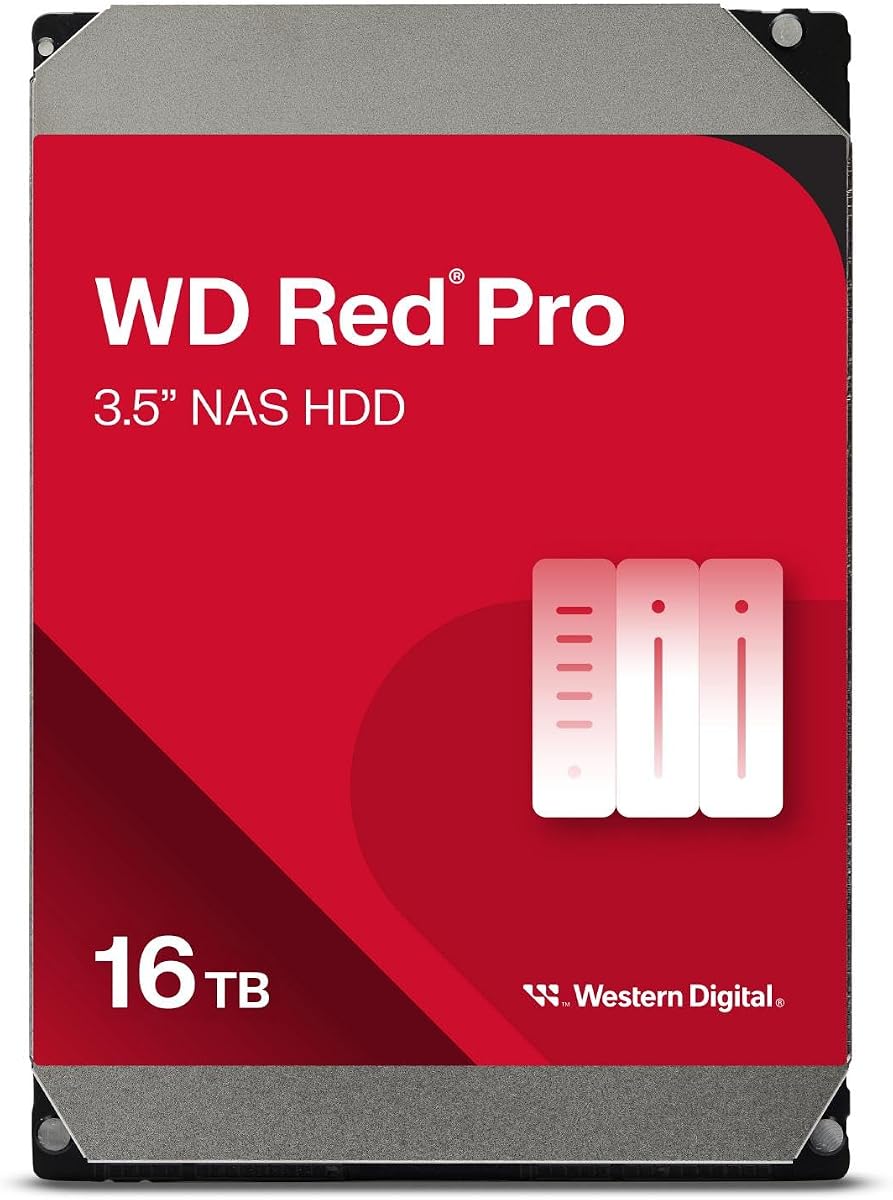
When the library outgrows polite eight-terabyte manners, the 16TB WD161KFGX Red Pro is the escalation path in this pack. It is a 7200 RPM CMR NAS drive with a 512 MB cache, rated for 550 TB/year workloads, and marketed for RAID-optimized systems with an unlimited bay count and high-intensity multi-user 24×7 environments. That is WD speaking to offices and power users, not weekend Netflix dabblers—but ambitious Plex hosts live in that overlap.
Capacity math is the headline. One 16TB disk holds what used to take a small array of 4TB drives. Fewer spindles can mean lower idle power and simpler cabling, though a single-disk failure also takes a bigger bite if you are not redundant. Never deploy 16TB as an unprotected sole copy of a treasured library.
The 7200 RPM choice helps when several family members scrub timelines, run scheduled optimizations, and stream at once. It also means more heat and acoustic energy. Verify your NAS cooling before stacking a full tray of Pro drives in a bedroom closet.
The 3.9 rating deserves respect. Large NAS drives see harsh duty and vocal reviewers. Burn in new disks with badblocks or manufacturer tools, watch SMART for the first weeks, and keep firmware/NAS OS updated. A Pro label is not a substitute for qualification testing on arrival.
Workload rating at 550 TB/year signals readiness for heavier annual transfer than Red Plus’s 180 TB/year class. If your Plex server is also a backup target for multiple PCs, that margin matters. If the box only streams two local clients at night, you may be buying Pro headroom you will not feel.
Take Red Pro 16TB when bay space is scarce, the library is 4K-heavy, and the chassis/cooling can handle 7200 RPM NAS disks. For quieter two-bay homes with modest libraries, 8TB Red Plus remains the happier daily companion.
Confirm intake clears dust filters, aim for even front-to-back airflow across all bays, and alert on temperatures that climb beyond your NAS OS recommendations during rebuilds.
Larger disks mean longer RAID rebuilds. During rebuilds, reduce remote transcode load and keep backups current—arrays are not backups.
We may earn a commission at no additional cost to you.
Seagate Exos x12 12TB (Renewed)
This listing is explicitly Renewed, and that word should lead every decision. You are looking at a Seagate Exos x12-class 12TB 3.5-inch enterprise SATA drive—7200 RPM, 256 MB cache—sold as refurbished/renewed inventory. Exos-class disks are built for 24/7 service in NAS, RAID, surveillance, and server roles, which is philosophically aligned with a never-sleep Plex host. Prior datacenter hours, however, are the unknown.
Treat arrival like receiving a used engine. Photograph the label, confirm the model string, run a full surface test, and watch SMART attributes for reallocated sectors and pending counts before you copy a single movie. If the Renewed channel includes a sane return window, use the early days aggressively for testing.
Performance-wise, 7200 RPM enterprise drives often feel snappier during simultaneous reads than 5400 desktop disks. Noise and idle power can be less friendly beside a couch. Mount in a garage lab or closet NAS with real airflow if your household is sound-sensitive.
The product notes mention lower power consumption relative to older heavy-duty expectations and reliability framing for continuous duty. Still, Renewed enterprise bargains are a home-lab sport: excellent when vetted, painful when someone skips testing and loses an unprotected library.
I like Exos Renewed as disk #3–#6 in a growing TrueNAS pool after you already have a backup strategy—not as the only copy of a decade of home video. Pair with Red Plus/Pro for a mixed pool only if you understand capacity and performance vdev design; many users prefer keeping vendor/model families consistent per vdev.
If you accept Renewed risk management, 12TB Exos is a potent Plex capacity jump. If you want sealed retail calm, stay with WD Red Plus 8TB and sleep more.
Zero tolerance for clicking noises, SMART warnings, or inconsistent capacities reported by the OS. Return quickly; do not “run it anyway” for Plex.
The pack listing references Exos model numbering that can look inconsistent between title and bullets—match the physical sticker to Seagate’s Exos documentation before integration.
We may earn a commission at no additional cost to you.
Not every Plex admin wants to open a chassis. The 6TB WD Elements desktop USB 3.0 drive is the living-room expansion pack: high-capacity add-on storage, fast USB transfers relative to older USB 2.0 gear, and plug-and-play framing for Windows PCs. Point Plex at the external folder and your library grows without a BIOS dance.
This shines as either the primary media disk on a mini PC with one USB port to spare, or—better—as the backup/mirror copy of an internal library. USB disks fail and disconnect; if your only copy is dangling off a blue port behind the TV stand, you will eventually meet an empty library screen after a vacuuming incident.
On Linux-based NAS appliances, USB open-bay disks can work but introduce quirks: sleep timers, renaming, and power loss behavior. If you are buying a NAS, buy internal Red Plus. If you are on Windows Plex with a small form-factor PC, Elements is the path of least resistance.
Six terabytes lands between starter and serious. It holds a solid encoded library; it will not forever hold an unmanaged 4K remux addiction. When it fills, resist daisy-chaining five USB disks like Christmas lights—migrate to a proper multi-bay box.
Place the desktop enclosure where it gets airflow and will not be kicked. Desktop USB drives are not rugged portables. Treat the cable as a consumable; keep a spare.
Buy Elements 6TB for convenience expansion and backups. Do not pretend it is a WD Red array just because the media plays.
Assign a stable drive letter, disable USB selective suspend experiments that sleep the disk mid-stream, and keep the Plex library path consistent after reboots.
Internal SSD for OS + Plex, internal or NAS HDD for primary media, Elements for scheduled robocopy/rsync backups stored offline between runs.
We may earn a commission at no additional cost to you.
Think of the WD8005FFBX as the Red Pro philosophy applied to the beloved 8TB size. You get CMR, 7200 RPM, 256 MB cache, and the 550 TB/year workload rating with unlimited-bay RAID positioning—without jumping straight to 16TB. For mixed-use NAS boxes that serve Plex, Time Machine/SMB backups, and a couple of editors, that Pro headroom is the point.
Why choose Pro 8TB over Plus 8TB? Duty cycle and bay scaling. If the NAS is a quiet two-bay media appliance, Plus is enough. If it is the family file server that never sleeps and may grow past eight bays, Pro’s brief matches better. Acoustic and thermal costs rise accordingly.
Plex itself rarely saturates a modern HDD’s sequential ability with one direct-play stream. The Pro drive earns its keep when library analysis, multiple users, and backup jobs overlap. Schedule heavy maintenance, but appreciate that 7200 RPM shortens some of those windows.
As with the 16TB Pro, treat the 3.9 rating as a prompt for discipline: test, monitor, keep spares. Large always-on disks accumulate opinions online; your SMART graphs matter more than strangers’ one-star heat stories—but ignore neither.
Integration tip: keep vdevs homogeneous. Mixing one Pro with assorted desktop leftovers invites confusing performance and failure behavior. Buy the disks your pool design requires, not whatever was in a desk drawer.
Pick Red Pro 8TB for busier home servers that still want manageable capacity chunks. Pick Red Plus 8TB for quieter, simpler Plex-first NAS builds.
If the NAS shares a bedroom wall, audition a single Pro drive before filling the chassis. Isolation mounts and longer SATA power extensions that ease cable rattle help more than people expect.
Streaming two direct-play movies is light duty. Nightly cloud sync of multiple PC profiles onto the same pool is not. Size the drive tier to the whole NAS workload, not the myth that Plex is “just watching videos.”
We may earn a commission at no additional cost to you.
The 4TB BarraCuda is the “prove Plex is worth it” disk. Same desktop DNA as the 8TB model—3.5-inch SATA, 5400 RPM, 256 MB cache—just half the shelf space. Install it, rip twenty favorite films, share with a living-room app, and decide whether you are a Plex household before investing in Red Plus arrays.
Because capacity is tight, be ruthless about encodes. Store efficient H.265 for TV, reserve pristine remuxes for titles you truly care about, and delete unfinished downloads. A full 4TB disk that is also your scratch share becomes a fragmentation and stress story.
RAID advice matches its bigger sibling: fine alone, questionable in numbers. Vibration and desktop firmware are why NAS lines exist. Use this as a single media volume or a backup target, not as five-of-nine in a homemade RAID tower.
Seagate’s broader BarraCuda messaging about music, video, photo, and gaming storage fits a mixed family PC that happens to run Plex beside homework files. If the machine is only a server, dedicate the disk to media and keep the OS on SSD for responsiveness.
Upgrade path is obvious: clone or copy to an 8TB BarraCuda or, better, into a mirrored Red Plus pair when the hobby becomes infrastructure. Do not wait until free space hits zero during a holiday movie binge.
Buy 4TB BarraCuda to start cheaply and learn. Budget mentally for the next disk; Plex libraries rarely shrink.
On 4TB, a watchlist-driven library beats a “download everything” habit. Your future NAS will thank you for already having quality control.
An older iGPU PC can direct-play plenty from this drive. If remote users need transcoding, fix the CPU/GPU first—the 4TB disk is not the bottleneck.
We may earn a commission at no additional cost to you.
The WD10EZEX Blue is a perfectly decent 1TB 7200 RPM desktop drive for everyday computing, and a perfectly inadequate home for a 2026 Plex movie collection. It earns a place in this pack as a cautionary baseline: if your “server” media disk is a leftover 1TB Blue, you do not have a library—you have a demo.
Where it still helps is infrastructure. Use Blue for cloning exercises with the mentioned Acronis True Image WD Edition software angle, for staging Plex configuration backups, or as a scratch disk. Keep the actual films on Red Plus or a large BarraCuda.
Technically, 7200 RPM and SATA 6 Gb/s are fine. Capacity is the blocker. A handful of 4K remuxes will consume the disk; TV seasons make it hopeless. You will spend more time deleting than watching.
Blue remains a desktop line—reliable everyday computing, not continuous multi-bay NAS messaging. Do not build RAID out of Blues and call it enterprise. Do not assume 7200 RPM magically makes 1TB enough.
If this is what you already own, install Plex, learn the apps, then migrate. Do not buy another 1TB thinking more small disks equal a strategy; buy one larger NAS-oriented drive instead.
Respect WD Blue for what it is. For Plex media in this guide’s context, treat it as a non-answer except for labs and scaffolding.
Optional secondary disk for incomplete downloads or temp transcoder working files—never the sole media root for a household library.
Move to at least the 4TB Red Plus or 8TB BarraCuda tiers in this guide once you confirm Plex fits your household.
We may earn a commission at no additional cost to you.
The WD10EURX AV-GP sits in Western Digital’s surveillance/media lineage: IntelliPower spindle behavior, 64 MB cache, SATA 6 Gb/s, bulk packaging, and marketing for 24/7 operation in DVRs, NVRs, set-top boxes, NAS, and media centers. Philosophically that is closer to Plex’s always-on streaming than a random office Blue disk—except the 1TB capacity and Renewed condition put hard brakes on recommending it as a library drive.
Renewed surveillance disks often come from security-system churn. They may have many power-on hours. That does not make every unit bad; it makes testing sacred. Run surface scans, check SMART, and listen for seeking distress before trusting any media.
Bulk single pack means you get the bare drive—no cables or accessories. Fine for builders, surprising for first-timers who expected a retail kit. Have a dock or internal bay ready.
Could you run a tiny Plex experiment on 1TB AV-GP? Yes. Should you invest emotion in ripping your Blu-ray collection onto it? No. Use it, if at all, for a camera archive sidecar or a disposable test volume while the real Red Plus pool is on order.
Cool-running, lower-power AV messaging is attractive in sealed DVR appliances. In a modern Plex NAS with large CMR disks, those virtues do not overcome the capacity gap.
Leave this Renewed AV-GP for niche 24/7 experiments. Your actual Plex movies belong on the Red Plus/Pro or large BarraCuda options earlier in the list.
Prior workload may have been write-heavy CCTV. Prefer fresh retail NAS drives for irreplaceable film libraries.
WD Red Plus 8TB for most NAS Plex hosts; BarraCuda 8TB for simple single-drive PCs; Red Pro when multi-user intensity climbs.
We may earn a commission at no additional cost to you.

Plex on a single internal disk in a PC can live on BarraCuda-class desktop HDDs. Plex on a multi-bay NAS should use CMR NAS drives like WD Red Plus or Red Pro. The difference is firmware, vibration tolerance, and workload expectations—not mystical streaming magic. Arrays amplify the wrong drive choice during rebuilds.
Estimate average gigabytes per movie and per TV season at the quality you actually keep. 1080P encodes and 4K remuxes are different sports. Then double the number because Plex users expand libraries when space exists. Starting at 8TB of protected space is the practical modern floor for households that intend to keep the hobby.
Mirrors and RAIDZ save you from one dead spindle, not from ransomware, accidental deletes, or a house fire. Keep a backup copy—external Elements, cloud for critical home videos, or a rotated offline disk. Plex metadata can be rebuilt; unique rips and home movies cannot.
Red Plus’s 180 TB/year and Red Pro’s 550 TB/year figures describe design intensity, not a scoreboard you must fill. Always-on Plex plus backups fits those narratives better than a desktop drive’s silent assumptions. If your NAS is also the family sync target, lean Pro or accept that Plus is for lighter SMB/home duty.
Renewed Exos or AV-GP drives can be excellent lab capacity when burned in, and disastrous when trusted blindly. For irreplaceable libraries, prefer sealed retail NAS drives. If you buy Renewed, test immediately and keep redundancy from day one.
Put the OS, Plex application, and metadata on SSD. Let HDDs do sequential media. This split keeps the UI snappy during library updates and reduces random I/O pain on the movie spindles.
Connect the new HDD, update firmware if applicable, run a full surface test on NAS/enterprise disks, and save a SMART snapshot before copying data.
Use the filesystem your NAS OS recommends. Mount media at a stable path. Avoid drive letters that reshuffle on Windows USB disks without persistence settings.
Create clear Movie and TV roots with consistent naming. Finish copying, then add the library in Plex—do not point agents at a half-copied tree.
Test local playback with direct play enabled. Confirm audio and subtitle behavior on your real client (TV app, shield, phone) before inviting remote users.
Run scrub/SMART tests and library maintenance in off hours so evening streams are not competing with array checks.
Only after a backup copy exists should you call the upgrade done. Then watch something fun on purpose.
You can, and many people have, but it is not the design center for those enclosures. Desktop drives lack the NAS firmware and vibration optimization of WD Red Plus/Pro. For a single-drive USB or internal volume, BarraCuda is reasonable. For multi-bay RAID, prefer CMR NAS drives and accept that desktop disks raise long-term risk.
Red Plus fits most home Plex NAS builds—especially two to eight bays with media streaming and light backup duty—thanks to CMR NAS tuning and a 180 TB/year workload class on models like the 8TB WD80EFPX. Choose Red Pro when you need higher 550 TB/year workload ratings, 7200 RPM responsiveness, and unlimited-bay multi-user intensity. Quieter homes with modest libraries usually prefer Plus.
Remuxed 4K films can consume tens of gigabytes each; efficient encodes use far less. A curated set of 100 4K titles might fit on 4–8TB depending on encode choices, while serious remux collectors blow past 16TB quickly. Inventory twenty representative files, average their sizes, multiply by your target count, then add 30–50% free space for growth and working room.
They can be cost-effective capacity if you burn them in, monitor SMART, and keep redundancy. They are not “safe” in the sealed-retail sense—the Exos 12TB in this guide is explicitly Renewed, so prior life is unknown. Never place an untested Renewed disk as the only copy of irreplaceable media.
USB externals like the 6TB WD Elements are fine for simple Windows Plex PCs and excellent as backup targets. They are weaker as the backbone of a serious multi-user NAS because cables disconnect, ports sleep, and enclosure electronics become extra failure points. Internals in a proper chassis scale more cleanly.
Yes, ideally. Use SSD for the operating system and Plex metadata so menus stay quick while HDDs stream large files. An all-HDD boot disk works but feels slower during updates and database churn.
CMR (conventional magnetic recording) behaves more predictably in RAID rebuilds and sustained writes than some SMR designs that complicated NAS shopping in past years. For Plex servers that also reshape arrays or ingest large seasons overnight, CMR NAS drives are the conservative, correct choice.
Only for demos, kids’ short encode sets, or as a non-media utility disk. The 1TB WD Blue and 1TB Renewed AV-GP in this pack illustrate the trap: always-on firmware stories cannot invent terabytes you do not have. Plan 4TB as an absolute minimum experiment and 8TB-class for a real household shelf.
Remote smoothness is usually about upload bandwidth and transcoding CPU/GPU, not whether the disk is 5400 or 7200 RPM. Faster NAS drives help more with concurrent local tasks and heavier multi-user file-server loads. Fix the network and transcoder before blaming RPM.
Rough math: if your average film is 8GB, you could approach a thousand titles before formatting overhead—until you add TV. If your average 4K remux is 50–70GB, you might only fit slightly over a hundred films. Measure your files; do not trust viral “80,000 songs” style claims for video.
For most Plex servers in 2026, a CMR WD Red Plus—especially the 8TB WD80EFPX—is the calm center of the target: NAS firmware, continuous-operation intent, and enough capacity to build a library without immediate sprawl. Step up to Red Pro when your NAS is a multi-user workhorse or you need 16TB slabs to keep bay count sane. Keep BarraCuda for simple single-drive PCs, Elements for USB expansion and backups, and treat Renewed Exos/AV stock as lab capacity that must earn trust through testing.
Leave 1TB Blues and tiny Renewed AV disks out of your long-term media plan. Put the OS on SSD, the movies on supervised HDDs, and a copy of anything irreplaceable somewhere else entirely.
Plex should feel like browsing a well-lit shelf, not nursing a dying spindle. Choose drives for the chassis and duty cycle you actually have—then press play before you start ripping the next trilogy.