Best NAS Enterprise Pick
Seagate IronWolf Pro 12TB

- All-CMR IronWolf Pro for 24×7 RAID NAS performance
- Up to 550TB/year workload, 2.5M hours MTBF, 5-year limited warranty
- Includes 3-year Rescue Data Recovery Services and IHM health tools
Expert Review & Guide
Enterprise storage shopping is where home-lab enthusiasm collides with datasheet literacy. A drive that looks enormous in a cart can still be the wrong tool if it is a desktop BarraCuda pressed into RAID duty, or a Renewed Exos accepted without burn-in. In 2026 the enterprise and nearline conversation still centers on CMR 7200 RPM SATA disks with published workload ratings, MTBF figures, and firmware aimed at always-on arrays—plus honest labels when inventory is Renewed.
This guide reviews the ten drives in our pack: Seagate IronWolf Pro and SkyHawk AI for NAS and AI surveillance, multiple Exos and Enterprise Capacity SKUs (several Renewed), WD Red Plus for smaller NAS bays, a desktop BarraCuda that does not belong in a rack fantasy, and a bus-powered Seagate One Touch external for offline backups—not for SAN duty.
Read for workload class, bay role, and Renewed risk—not for vanity terabytes alone. No dollar prices; just which spindles deserve a backplane.


As an Amazon Associate we earn from qualifying purchases. We may earn a commission at no additional cost to you.
Separate true nearline/NAS enterprise SKUs from desktop and external outliers before you populate a chassis.
IronWolf Pro is Seagate’s answer when a NAS stops being a photo dump and starts being infrastructure. This 12TB model is an all-CMR 3.5-inch SATA 6 Gb/s drive at 7200 RPM with 256 MB cache, sold explicitly for RAID network-attached storage with 24×7 performance expectations. That CMR callout matters: conventional magnetic recording remains the conservative choice for arrays that rebuild and rewrite heavily.
The dependability stack is why Pro earns the top NAS slot here: up to 550TB/year workload rating, 2.5 million hours MTBF, and a five-year limited warranty narrative. Those figures are statistical design targets, not personal immortality charms, but they separate Pro from desktop disks that quietly assume lighter duty.
Complimentary three-year Rescue Data Recovery Services change the emotional math of a failed volume. Recovery is never a plan A—backups remain mandatory—yet having a vendor recovery path is a real enterprise-adjacent perk home builds rarely get with bargain spindles.
IronWolf Health Management (IHM) integrates with many NAS platforms to surface prevention and intervention recommendations. Enable it. Ignoring health tools while bragging about enterprise drives is cosplay.
Twelve terabytes hits a practical bay math for SMB arrays: enough density to keep chassis counts sane without jumping straight into 24TB Renewed hyperscale territory. Pair matched Pro drives in a vdev; do not mix random desktop leftovers beside them and hope balancing algorithms save you.
Choose IronWolf Pro 12TB when the NAS serves multiple users, virtualization targets, or continuous backup ingest. Choose lighter Red Plus when the box is a quiet eight-bay home server with gentler annual transfer.
Keep spares of the same model family when uptime matters. Document serials, enable email alerts, and schedule scrubs during low-traffic windows.
Single-drive USB enclosures and silent living-room HTPCs gain little from Pro’s workload rating—buy capacity and quiet instead.
We may earn a commission at no additional cost to you.
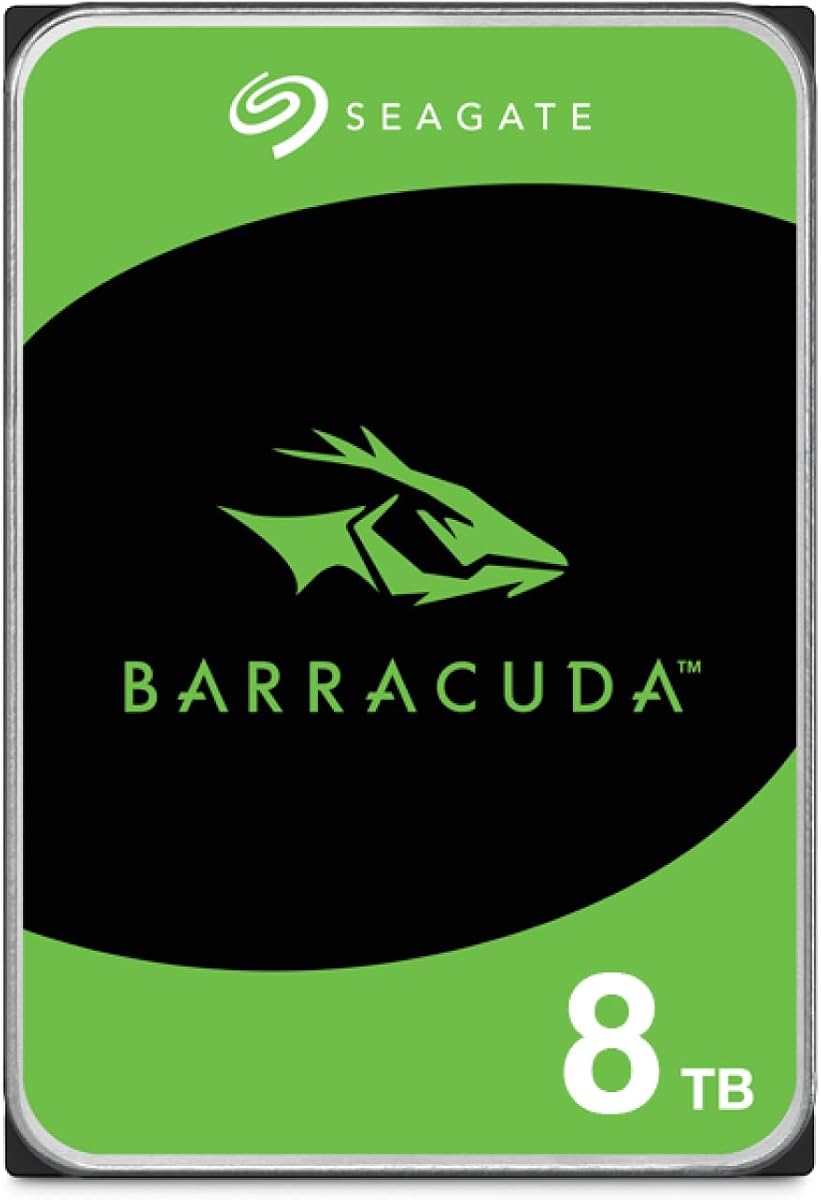
BarraCuda appears in enterprise roundups the way a sedan appears in truck brochures—popular, useful, and easy to misuse. This 8TB 5400 RPM desktop drive with 256 MB cache is Seagate’s go-to SATA disk for PCs: music, video, photos, gaming installs, general bulk storage. It is not IronWolf Pro in a different sticker.
Why include it? Because shopping algorithms blur categories, and readers deserve an explicit veto. If your ‘enterprise’ project is actually a single internal disk in a workstation, BarraCuda can be rational. If you are filling a 12-bay RAID with vibration and rebuild risk, walk away.
Workload and MTBF marketing here is the consumer story—twenty years of Seagate innovation language—not 2.5M-hour nearline claims. Plan backups accordingly; popularity is not redundancy.
Performance for sequential media is fine. Concurrent random I/O across virtualization guests is not this disk’s job posting. Latency-sensitive arrays want 7200 RPM enterprise/NAS lines.
I will happily recommend BarraCuda inside a creative PC. I will not recommend it as the backbone of a business failover store pretending to be Exos.
Use this review as a boundary marker: everything above and below that is truly NAS/enterprise-shaped should be judged against IronWolf Pro, Exos, SkyHawk AI, and Red Plus—not against desktop comfort food.
Workstation scratch, non-RAID archives, and temporary staging before data lands on a proper array.
If BarraCudas already sit in a NAS, prioritize replacing them with CMR NAS/enterprise SKUs during the next expansion—not after the first multi-disk incident.
We may earn a commission at no additional cost to you.
SkyHawk AI exists because modern camera systems do more than record dumb motion clips—they run analytics that change how storage is hit. This 16TB 3.5-inch SATA drive with 512 MB cache markets ImagePerfect AI for zero dropped frames under heavier workloads, support for up to 64 HD video streams as AI environments scale, SkyHawk Health Management, and enterprise-class reliability with 2.5M hours MTBF and a 550TB/year workload rate described as more than 3× standard surveillance drives.
That stream count is the buying cue. If your NVR is a handful of doorbell cameras, a lighter SkyHawk or even NAS drive may suffice. If you are aggregating dozens of HD streams with AI features enabled, SkyHawk AI’s brief matches the pain you are actually feeling when frames drop at 2 a.m.
Health management tools again matter operationally. Surveillance arrays fail quietly until lawyers ask for footage that never landed. Configure alerts; do not wait for a blank timeline.
Could you use SkyHawk AI in a TrueNAS media pool? Sometimes people do. Better practice is to keep surveillance-optimized disks in surveillance duty and file NAS disks in file NAS duty so firmware assumptions align with I/O patterns.
Sixteen terabytes of camera retention policy should be designed on purpose—days of 4K versus weeks of 1080p—before you celebrate raw capacity. Retention is a software setting riding on hardware stamina.
Pick SkyHawk AI 16TB for serious AI/NVR builds. Pick IronWolf Pro when the workload is general SMB NAS instead of camera math.
Validate the NVR vendor’s compatibility list, enable health monitoring, and burn-in new disks before going live on a site that needs evidentiary retention.
Multi-bay NVRs need adequate PSUs and trays that manage vibration—enterprise ratings assume a sane chassis, not a rattling shelf.
We may earn a commission at no additional cost to you.

Twenty-six terabytes of Exos in a Renewed listing is catnip for home labs and budget-conscious nearline builders. The drive is described as CMR SATA 6Gb/s, 7200 RPM, 512 MB cache, with a 2.5M MTBF claim and enterprise-class continuous operation framing. The word Renewed in the title is doing as much work as the capacity number.
Exos-class disks are what hyperscale and nearline arrays actually use: sustained throughput, vibration tolerance expectations, and firmware for always-on service. Pulling them via Renewed channels can unlock density that sealed retail pricing makes painful—if you qualify each unit like a professional.
Burn-in protocol: full surface test, SMART capture, temperature logging under load, and zero patience for clicking or pending sectors. Integrate only after the drive proves boringly healthy.
Pool design must respect rebuild physics. A dual-parity vdev of 26TB spindles can take a long time to resilver. Keep backups; keep I/O calm during rebuilds; consider hot spares.
A 4.8 rating on Renewed inventory can reflect happy outcomes—and survivorship. Read critical reviews about DOA units, and use return windows aggressively.
Buy Renewed 26TB Exos when density and lab budget align with rigorous testing. Buy sealed IronWolf Pro when you want retail warranty calm more than raw terabytes.
Confirm the ST model string on arrival matches expectations and that your HBA/RAID card plays nicely with 512e large-capacity drives.
If you have never rebuilt a degraded pool, practice on smaller disks first. Ultra-capacity teaches expensive lessons.
We may earn a commission at no additional cost to you.
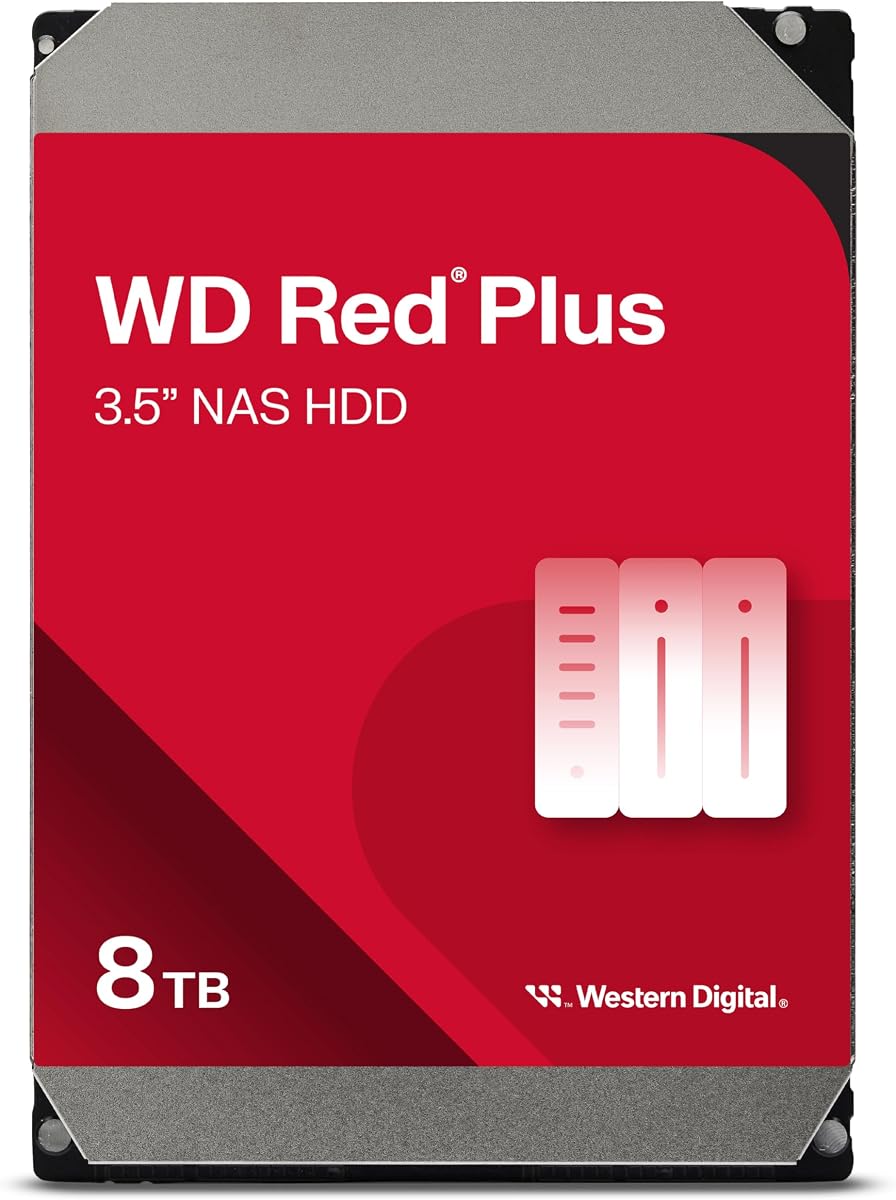
Western Digital’s 8TB Red Plus (WD80EFPX) is the bridge between ‘serious NAS’ and ‘not quite Exos rack.’ CMR, ~5640 RPM, 256 MB cache, NASware firmware, up to eight bays, 180TB/year workload, 24×7 small/medium business framing—this is the disk countless clean Synology volumes already trust.
In an enterprise roundup it represents the right-sized choice for branch offices and lab NAS boxes that should not inherit datacenter acoustics. You still get CMR RAID manners without pretending every closet is a hyperscale pod.
Choose Red Plus when annual transfer and bay count fit its envelope. If your backup targets constantly shove hundreds of terabytes around, IronWolf Pro’s 550TB/year class is the more honest match.
Acoustics favor Red Plus in shared offices. People underestimate how much productivity 7200 RPM trays cost in annoyance.
Keep firmware and DSM/QTS/TrueNAS updates current; NASware compatibility is a conversation between disk and OS, not a permanent spell.
Red Plus 8TB is the conservative enterprise-adjacent pick for eight-bay reality. Grow into Exos when density or workload demands it.
Two- to eight-bay NAS appliances serving file shares, light VMs, and departmental Plex/backup mashups with sane duty cycles.
Pro for heavier multi-user and higher workload ratings; Plus for quieter, bay-limited SMB comfort.
We may earn a commission at no additional cost to you.
Seagate Exos X24 24TB (Renewed)
Exos X24 is Seagate talking to cloud and massive scale-out architects: highly reliable performance with enhanced caching, hyperscale SATA tuning for large transfers and low latency, PowerBalance for watts per TB, and proven helium side-sealing weld technology. This Renewed 24TB ST24000NM000H listing brings that platform to builders who will qualify used enterprise gear.
Helium sealing enables higher platter counts and efficiency, which is why ultra-capacities keep climbing. It also means you should treat shipping damage as a first-class risk—inspect immediately.
PowerBalance matters in dense chassis where electricity and heat are monthly bills, not abstractions. Home labs feel it as fan noise; real facilities feel it as OpEx.
Use X24 in sequential-heavy nearline tiers: backup targets, media archives, object-store backends. Latency-sensitive databases may prefer different tiers entirely (often flash).
Renewed caution repeats because it must: burn-in, SMART, staged integration, backups first. A 24TB fake economy that loses a vdev is not economy.
This is our hyperscale capacity pick among Renewed options when 24TB slabs beat stuffing more 8–12TB bays—and when you have the operational maturity to host them.
Confirm 512e large-drive support on older RAID cards. Legacy 512n-only assumptions still bite aging controllers.
High-density Exos trays need front-to-back airflow. Do not bury a full chassis in a sealed cabinet without measuring temperatures under scrub load.
We may earn a commission at no additional cost to you.

Seagate Enterprise 6TB (Renewed)
Not every enterprise build needs moon-shot terabytes. The Renewed ST6000NM0024 6TB Enterprise Capacity disk brings 7200 RPM, 512e, 128 MB cache, about 216MB/s sustained transfer, PowerChoice, hot-plug support, and application targeting for RAID, surveillance, and backup/restore—with reliability notes around 1.4M-hour MTBF and 0.63% AFR at 24×7.
Smaller enterprise disks rebuild faster and hurt less when a single drive dies—psychologically and temporally. Labs teaching RAID discipline often learn better on 4–8TB enterprise units than on 28TB monsters.
Feature set (PowerChoice, hot-plug) hints at server backplane life. Confirm your enclosure actually supports hot-swap before you yank disks like a sitcom IT tech.
Capacity ceiling is the tax: you will spend more bays to reach a petabyte-scale dream. That can be fine when the lesson is reliability process, not maximum density.
As always with Renewed, test hard. Older enterprise generations may arrive with substantial power-on hours.
Pick 6TB Renewed enterprise when you want authentic nearline behavior in a safer capacity band. Move to X24/26/28 when density is the boss.
Four to six matched 6TB enterprise drives in RAIDZ2/RAID6 teach scrub/rebuild habits without week-long resilvers.
Even ‘Ideal for backup and restore’ array members need an offline or offsite copy. Nested irony is not a strategy.
We may earn a commission at no additional cost to you.

Seagate One Touch 8TB External
Enterprise guides that ignore restore targets encourage beautiful arrays with nowhere to run. The Seagate One Touch 8TB desktop external is here as the practical offline companion: bus-powered USB-C, no wall outlet required, high-capacity backup framing, and fuss-free one-cable connect for Windows and macOS, with Rescue recovery positioning.
Use it to pull critical datasets off the array on a schedule, then shelf the drive powered down. That pattern survives ransomware events that encrypt every online volume overnight.
Bus power is lovely until a flaky port sleeps the disk mid-backup—use quality cables and check power management settings on laptops.
This is not a substitute for IronWolf/Exos internals. It is the coat-check ticket for data you cannot rebuild from scratch.
If your protected set exceeds 8TB, rotate multiple externals or step to larger backup appliances. The principle stays: air-gap something.
Buy One Touch as process hardware. Buy Exos/IronWolf as pool hardware. Confusing the two is how ‘enterprise’ projects fail boringly.
Three copies, two media types, one offsite. One Touch can satisfy a local offline copy when used deliberately.
Encrypt sensitive backup sets—lost bus-powered drives in rideshares are an ancient genre of breach story.
We may earn a commission at no additional cost to you.

Seagate Enterprise 4TB ST4000NM0035
The ST4000NM0035 wears classic Enterprise Capacity clothing: 4TB, 7.2K RPM, 128 MB cache, 3.5-inch SATA 6Gb/s, 512n sectors, and a FIPS 140-2 callout that will matter to some compliance architectures and mean little to a media hobbyist. Seagate positions it for hyperscale/cloud solutions needing high-density storage with robust mechanical features—dual processors, ramp load technology, top-cover-attached motor—and fast data access with high reliability MTBF notes around 2.0M hours for 24×7 operation.
512n versus 512e is a compatibility footnote worth reading on aging RAID cards. Some environments still prefer native 512-byte sector reporting; others have moved on. Match the drive to the controller’s expectations.
FIPS 140-2 on a bare HDD is not a complete compliance program. It can be a required building block. Talk to your security architecture owners before assuming a shopping cart satisfies an audit.
Capacity is the obvious limitation in 2026. Four terabytes enterprise disks still appear in spares channels and specialized legacy arrays. For new greenfield pools, larger Exos units usually win on density unless 512n/FIPS constraints dictate otherwise.
I treat this SKU as a precision tool for specific stacks, not a general recommendation for every ‘enterprise’ keyword shopper.
Buy ST4000NM0035 when sector format and FIPS positioning are real requirements. Everyone else should look up-capacity at IronWolf Pro or Exos.
Purchase one, integrate with your controller and encryption workflow, then standardize. Never assume Amazon title shorthand equals your cert matrix.
Legacy SAN refresh spares, compliance lab gear, and controllers that dislike 512e translation layers.
We may earn a commission at no additional cost to you.

Twenty-eight terabytes is the pack’s density ceiling: Seagate Exos ST28000NM001C, 7200 RPM, SATA 6Gb/s, 512e, 3.5-inch enterprise form factor, sold Renewed. If your chassis bays are scarce and your data is sequential-cold, few things beat stuffing 28TB into each slot—after the drive proves it deserves to stay.
Perfect five-star aggregates on thin Renewed samples should make you curious, not complacent. Run the same ruthless burn-in you would on any prior-life Exos. Capacity multiplies both value and blast radius.
Architect for failure: dual parity minimum for large vdevs, backups that do not live solely inside the same chassis, and monitoring that pages a human—not a dashboard nobody opens.
Power, weight, and shipping: ultra-capacity helium drives arrive as expensive paperweights if mishandled. Inspect packaging, check for breaches, listen on first spin.
Workload fit remains nearline/archive/backup target more than snappy VM boot pools. Keep flash where latency matters; keep Exos where dollars per terabyte and watts per terabyte matter.
Take Renewed 28TB Exos when you are operationally ready. If you are still learning zpool syntax, buy smaller enterprise disks first and graduate.
Photograph labels, run smartctl tests, full write/read cycle, then quarantine for a burn-in week powered on before production data lands.
Production revenue systems with strict SLAs may prefer sealed IronWolf Pro/Exos retail channels despite lower density per dollar—risk transfer is part of enterprise buying.
We may earn a commission at no additional cost to you.
550TB/year class drives (IronWolf Pro, SkyHawk AI, many Exos stories) are built for heavier annual transfer than 180TB/year NAS Plus disks or desktop Barracudas. Size the rating to backups, camera ingest, and multi-user load—not to a single media stream.
Prefer CMR for RAID/NAS rebuilds and sustained writes. The IronWolf Pro, Red Plus, and Exos options in this guide lean on that conventional recording approach for a reason.
Exos 24/26/28TB Renewed deals can be excellent with burn-in, staged deployment, and strong backup hygiene. They are reckless if you skip testing. Always read the Renewed title tag as part of the product name.
SkyHawk AI for AI/NVR camera math, IronWolf Pro for SMB NAS, Exos for nearline/hyperscale density, Red Plus for quieter eight-bay NAS, externals for offline backup—not as array members.
512e is common on modern large drives; 512n appears on older enterprise SKUs like the ST4000NM0035. Confirm HBA/RAID compatibility, especially on aging cards.
Larger disks mean longer degraded-mode windows. Dual parity, hot spares, and reduced load during resilver are part of buying 20TB+ spindles—not optional lore.
Photograph the label, record model/serial/firmware, and confirm the seller/return window.
Use a known-good HBA/backplane, quality caddy, and current controller firmware before first tests.
Run full surface tests and SMART long tests. Reject clicking, rapidly climbing reallocated sectors, or thermal outliers.
Enable IronWolf/SkyHawk health features or equivalent SMART email/pager alerts before production data.
After data lands, schedule scrubs and verify that notifications actually reach a human.
Restore a sample dataset from backup media (such as a One Touch rotation). An untested backup is fiction.
Typically: 24/7 design targets, higher workload ratings, stronger MTBF/AFR claims, firmware for RAID/vibration, and support/warranty postures aimed at always-on systems. Exos and IronWolf Pro fit that story; desktop BarraCuda does not, even at 8TB.
For many SMB NAS deployments up to eight bays with moderate 180TB/year-class duty, yes. For heavier multi-user, unlimited-bay, or hyperscale density needs, step to IronWolf Pro or Exos. Match the bay count and workload, not the marketing adjective alone.
They can be if you burn them in, run redundancy, and keep backups. They are unsafe if you slot them straight into a revenue array because the terabyte count was exciting. Several Exos options in this guide are explicitly Renewed—treat that as part of the SKU.
IronWolf Pro targets RAID NAS multi-user file workloads with Rescue and IHM. SkyHawk AI targets AI-enhanced surveillance with stream-count and ImagePerfect framing plus SkyHawk Health Management. Both publish strong workload/MTBF stories; they optimize for different I/O personalities.
Only if you understand rebuild times, power/heat, and backup strategy. Many home labs are happier on 8–12TB NAS drives. Ultra-capacity shines when bay count is the constraint and operations maturity is high.
Only if your compliance architecture says so. The ST4000NM0035 advertises FIPS 140-2 positioning, but certification is about the implemented cryptographic module and system context—not a casual Amazon filter for everyone.
Technically possible; operationally messy. Different performance, firmware, and failure behaviors complicate predictive planning. Best practice is matched disks per vdev/array group.
As an offline/nearline backup courier, not as array storage. Bus-powered USB-C convenience helps rotate copies off the primary system—complementing, not replacing, enterprise internals.
MTBF is a statistical population metric, not a promise your disk will last N hours. Use it to compare design classes, then rely on SMART monitoring, scrubs, redundancy, and backups for actual survival.
7200 RPM remains common for Exos/IronWolf Pro/Enterprise Capacity lines seeking sustained throughput. Some NAS Plus drives use lower RPM classes for acoustics and power. Neither replaces good array design.
Enterprise buying in 2026 is a sorting exercise: IronWolf Pro 12TB for serious RAID NAS with Rescue/IHM, SkyHawk AI when camera analytics define the workload, WD Red Plus when eight-bay SMB calm is enough, and Renewed Exos 24/26/28TB when density plus burn-in discipline unlock nearline scale. Keep BarraCuda in desktops and One Touch on the backup shelf.
Respect Renewed labels, CMR needs, workload ratings, and rebuild math. The best enterprise drive is the one whose firmware, capacity, and failure plan match the array you will actually operate at 3 a.m.—not the largest number that fits in a shopping cart.