Best Low-Profile Performance
Noctua NH-L12Sx77

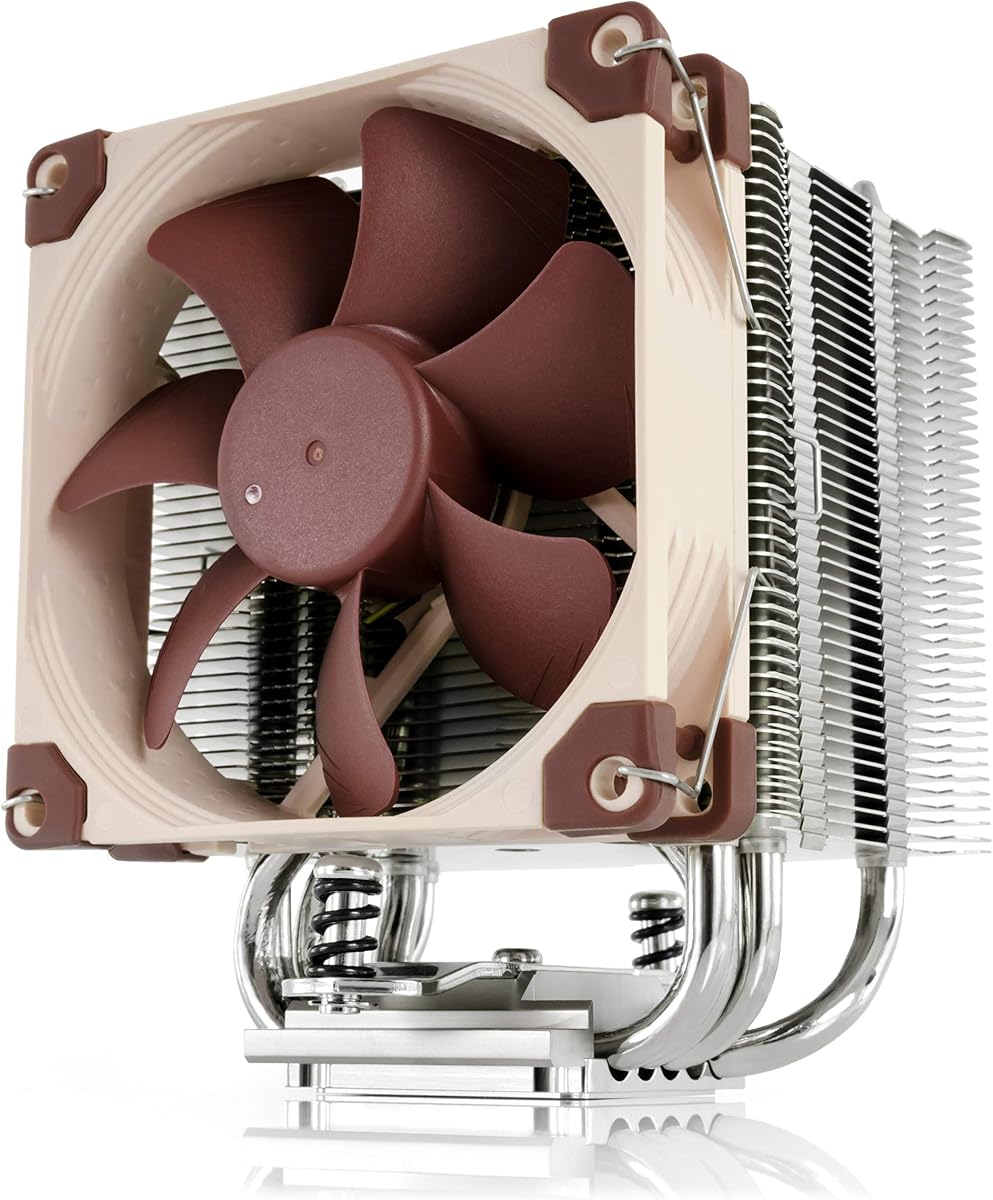
- 77 mm height with six heatpipes for real SFF headroom
- Slim 120 mm NF-A12x15 fan with LNA for quiet PWM control
- Named fitment for Terra, Milo ML12, Louqe Raw S1-class cases
Expert Review & Guide
Small form factor PCs punish cooler shopping. A dual-tower that looks modest in an ATX mid-tower can brick-wall into a sandwich-case lid, smash tall RAM, or starve a fat GPU sitting one slot away. The best CPU coolers for SFF builds in 2026 are defined first by millimeters of height and footprint, then by whether the heatsink still moves enough heat for your actual CPU—not the marketing TDP of a chip you are not buying.
This guide uses only the ten pack products: Noctua’s low-profile L9/L9x65/L12Sx77 family and compact NH-U9S tower, Thermalright’s Peerless Assassin 120 SE plus AXP90 X53/X36 sliders, Cooler Master’s Hyper 212 Black, and PCCOOLER’s RC600-67 67.5 mm SFF specialist. No invented ASINs, no dollar prices. Several listings explicitly name ITX, HTPC, and sandwich-case clearance; we treat those as the real spec sheet.
If your case manual allows 77 mm, the NH-L12Sx77 or RC600-67 class open serious thermal headroom. If you are stuck near 37–53 mm under a thin panel, the L9a-AM5 and AXP90 X36 world is your lane—and you should pick a cooler-friendly CPU to match. Dual-tower 155 mm units only belong here when the chassis truly clears them; otherwise they are ATX coolers cosplaying as SFF parts.

As an Amazon Associate we earn from qualifying purchases. We may earn a commission at no additional cost to you.
Measure case CPU cooler clearance before emotion. Specs omit prices; verify socket and RAM height against your board.

The NH-L9x65 chromax.Black is the “my panel says roughly 70 mm” problem solver. At 65 mm total height it clears many ITX lids that reject 77 mm parts while offering more fin mass than the ultra-flat 37 mm L9a. That middle band is where a lot of sandwich cases and slim HTPCs actually live once you subtract motherboard thickness and thermal-pad stacks.
The 95×95 mm footprint is as important as height. Wide low-profiles can bury M.2 screws, crowd VRM heatsinks, or force you into low-profile RAM you did not budget. Noctua’s tailored footprint pitch here is about leaving RAM and PCIe alone on current boards while keeping near-socket power connectors reachable after the sink is mounted—an assembly detail you only appreciate when your fingers no longer fit.
Acoustics ride the award-winning NF-A9x14 slim 92 mm fan with PWM and a Low-Noise Adaptor. Idle can be near silent; load ramps when the CPU asks. SecuFirm2 mounting and NT-H1 paste keep the unboxing ritual predictable across LGA1851/1700/1200/115x and AM5/AM4, including offset mounting notes for efficiency.
Noctua is explicit: target CPUs with low to moderate dissipation, citing examples across Intel Core Ultra parts and select Ryzen chips including some X3D SKUs. Translate that as: undervolt, keep a sane power limit, and respect case airflow. The L9x65 is not a permission slip for a fully unlocked hotspot CPU in a shoebox with no exhaust.
Pick the L9x65 chromax when you need black aesthetics, multi-socket coverage, and 65 mm realism. If your case clears 77 mm, jump to the L12Sx77 for more headroom. If you are on AM5 with a 40 mm lid, look at the L9a instead.
Whenever the case allows it. Extra fin stack height is free thermal capacity. Only drop to 37 mm coolers when the panel literally forces you there.
Performance focus is the same family; chromax is the all-black cosmetic path for builds that refuse beige fans in a windowed ITX cube.
We may earn a commission at no additional cost to you.

Thermalright Peerless Assassin 120 SE
Peerless Assassin 120 SE is in this SFF pack as a boundary marker: the cooler you choose when your “SFF” case is actually a compact cube or small mATX box with tower clearance, not a 7-liter sandwich. At roughly 155 mm tall with dual 120 mm fans, it will cool modern Ryzen and Intel chips that laugh at 37 mm pancakes—if the side panel closes.
Thermalright’s AGHP heatpipe language and full electroplated fin stack are why this model became a budget legend in larger cases. Six sintered pipes and a copper base move heat; the twin TL-C12C fans shove air at up to the listed CFM with a noise ceiling claim around 25.6 dBA. In a tight cube, remember that fan noise is only half the story—turbulence against mesh and GPU shrouds adds its own voice.
Dimensions matter surgically: 125×135×155 mm class. Check not only CPU cooler height in the manual but also whether the dual towers overhang the first PCIe slot or crush 40 mm RGB RAM. Thermalright calls out leaving room for memory chips; still verify your exact DIMM kit.
Socket support covers mainstream Intel 115x/1200/1700 families and AMD AM4/AM5 with the usual “use the right AMD plate” install note. That breadth makes PA120 SE a spare-parts bin favorite—but spare parts do not shrink your case.
Buy PA120 SE for compact towers and cubes that publish ≥160 mm cooler clearance. Do not buy it for thin ITX sandwich builds; that is how returns happen.
Think larger NR200-class, some Meshify Cubes, and roomy mATX fish tanks—not Dan-style sandwiches. If the manual lists 130 mm, walk away.
If PA120 fits, it will usually beat any L9-class cooler on a hot CPU. Fitment is the entire product decision.
We may earn a commission at no additional cost to you.

Hyper 212 Black is the cultural memory of air cooling, refreshed with SickleFlow 120 Edge PWM control and modern AM5 / LGA1851|1700 brackets. In an SFF context it plays the same role as PA120 SE: only enter the conversation when your case clearance is in the 155 mm neighborhood. The 152 mm tall claim is Cooler Master’s way of saying “performance with wide chassis compatibility,” not “fits every ITX lunchbox.”
Four heatpipes and a copper base are honest mid-tier thermodynamics. Great for many Ryzen 5/7 and Intel mid-stack chips with sensible power limits; less magical for fully unleashed flagship parts in stagnant cubes. The PWM range from roughly 690 to 2500 RPM means you can tune for silence or for survival—the curve is yours to set in BIOS or software.
Single-tower geometry often plays nicer with tall RAM and first-slot GPUs than dual towers of similar height. That is why 212 still appears in compact builds that reject Peerless Assassin width even when height clears. Installation simplicity is part of the product; included paste removes one shopping step.
If your SFF case clears 160 mm and you want a straightforward black tower without Noctua money, Hyper 212 Black remains sensible. If your clearance is 70 mm, this review does not apply—no amount of brand familiarity shrinks aluminum.
Choose 212 Black for compact cases with real tower clearance and familiar mounting. Skip it for sandwich ITX; use L12/L9/AXP/RC600 instead.
A mild PPT/PL undervolt in a mesh cube can turn a “barely okay” 212 mount into a quiet daily driver. SFF is a system problem, not only a cooler SKU problem.
Dry-fit your DIMMs before locking the fan. Some high RGB sticks still kiss 120 mm tower fans even when the case lid clears the heatsink.
We may earn a commission at no additional cost to you.

Noctua NH-L9a-AM5 chromax.Black
NH-L9a-AM5 chromax.Black is what you buy when the case CAD says the GPU already stole the Z-height. Thirty-seven millimeters is not a vibe; it is a hard constraint solution. The tailored AM5 footprint promises 100% RAM and PCIe compatibility across ITX, mATX, and ATX AM5 boards—critical when a single ITX slot GPU is millimeters from the socket.
The NF-A9x14 slim 92 mm fan is the acoustic conscience of the design: PWM automatic control, Low-Noise Adaptor, whisper idle. You are not spinning a thick 25 mm fan because there is no room. Cooling therefore depends on case airflow across the motherboard—intake that washes the top-down sink—not on magical CFM from nowhere.
Noctua positions this for moderate heat-load Ryzen parts (examples like 7900/7700/7600-class in the listing). Pair it with eco BIOS modes, undervolts, and mesh intake. Pairing it with a fully unlocked 16-core in a stagnant 10 L box is how people invent “Noctua failed” threads.
chromax is cosmetic and cultural: black hardware for black ITX builds without the classic brown/beige flex. Accessories include NT-H1 and SecuFirm2—the usual deluxe kit. Six-year warranty is part of why people pay Noctua tariffs in tiny cases where RMA logistics hurt.
Buy L9a-AM5 chromax when AM5 + ~40 mm clearance is the entire story. If you have 65 mm, prefer L9x65. If you have 77 mm, prefer L12Sx77.
Prefer efficient cores and X3D-style gaming chips with restrained power over hot flagship SKUs. The cooler is excellent; it is not infinitely elastic.
Top-down coolers heat the board neighborhood on purpose—good for VRMs if air moves. Ensure your sandwich has a path, not a sealed pillow of stagnant air.
We may earn a commission at no additional cost to you.
PCCOOLER’s RC600-67 is the pack’s aggressive “SFF without giving up the CPU” statement. At 67.5 mm including the fan, it sits beside Noctua’s L9x65 height class while advertising a 205W TDP capability via six heatpipes and an enlarged nickel-plated copper base. That combination is why it earns a top-pick badge for builders who refuse to downclock a modern mid-high chip into oblivion just to close a panel.
The slim 15 mm 120 mm PWM fan with FDB bearings is the differentiator versus 92 mm L9 fans: more swept area, listed up to about 68 CFM and 2.2 mmH2O, noise under roughly 35 dBA. In practice, tune PWM caps so the fan does not scream in a resonant sandwich panel. Top-down airflow also washes VRMs and near-socket MOSFETs—helpful on dense ITX boards.
Offset layout and RAM clearance claims matter because ITX memory often sits close to the socket. Socket support is current-gen broad: Intel LGA1851/1700/1200/115x and AMD AM5/AM4 with kit and paste included. That makes RC600-67 a flexible spare for mixed households of platforms.
Treat 205W as “designed for high heat in a short stack,” not a promise that any case will sustain it silently. Mesh intake, sensible GPU placement, and power limits still write the ending. Within those realities, RC600-67 is one of the most purpose-shaped SFF coolers in the pack.
Choose it when you clear ~70 mm and want 120 mm slim-fan authority. Choose Noctua instead when warranty culture and proven quiet curves outweigh peak TDP marketing.
Similar height band; RC600 bets on 120 mm slim airflow and hotter TDP claims, L9x65 bets on Noctua’s fan acoustics and ecosystem. Measure both against RAM dimm height.
Mount, then verify fan-to-side-panel gap with the case closed. Soft mounting pressure and even paste spread matter more on short heatpipe stacks.
We may earn a commission at no additional cost to you.

AXP-90 X53 is the living-room HTPC height: 53 mm, four 6 mm heatpipes, and a quiet 90 mm TL-9015 PWM fan with a noise claim at or under 22.4 dBA. That is the profile you want under a thin aluminum lid when the PC sits under a TV and must not announce every render spike.
Thermalright calls out all-metal platform structure, backplate fastening, and secondary reflow soldering—manufacturing language meant to signal durability versus toy coolers. Support bullets list Intel 115x/1200 and AMD AM4 (with 1851 mentioned in the title string). If you are on AM5, double-check the exact kit revision or prefer the AXP90 X36 / Noctua AM5 models in this same guide.
Four heatpipes at 53 mm will not redefine flagship cooling, but they are honest for efficiency-tuned AM4 gaming chips and many office ITX nodes. Keep power limits civilized and give the case a mesh breath. The quiet fan is the product’s personality—do not replace it with a screaming aftermarket wheel unless you enjoy regret.
Versus AXP90 X36, you gain height and likely thermal margin. Versus L9x65, you trade some Noctua acoustic polish and multi-socket confidence for Thermalright’s value posture. Versus RC600-67, you are shorter and cooler-running in noise terms, but usually less capable on hot chips.
Buy X53 for quiet 50-ish mm AM4/Intel SFF duty. Verify AM5 needs before assuming cross-compatibility.
Dust is the silent killer of low-profile fins. Schedule compressed-air maintenance; short sinks clog visibly faster in carpeted rooms.
Read the box contents for your platform. Low-profile coolers sometimes ship regional kit variants—AM5 buyers should prefer explicitly AM5-listed models in this pack.
We may earn a commission at no additional cost to you.
NH-U9S is the SFF tower that understands ITX politics. At 125 mm it fits a huge swath of compact cases that choke on 160 mm dual towers, while still offering true tower fin stacks and a proper NF-A9 92 mm PWM fan. If your case clearance sits between “low-profile only” and “full Peerless Assassin,” U9S is often the adult choice.
Noctua emphasizes zero RAM/PCIe overhang on most current boards. That matters when an ITX board’s 24-pin, M.2 armor, and first PCIe slot are already in a knife fight. Offset mounting options for AMD/Intel help place the tower where airflow and socket heat density want it.
The accessory kit is deluxe as usual: NT-H1, SecuFirm2, LNA. Warranty spans six years. Listing examples casually name very capable Intel Core Ultra and Ryzen 9000-class chips—read that as “compatible and intended for serious CPUs when the case allows,” not as “ignores thermodynamics.”
Acoustically, a single optimized 92 mm fan in a well-vented cube can be calmer than twin 120s thrashing in a choked dual-tower install. Thermally, respect case intake. U9S rewards mesh and punishes solid decorative panels.
Pick U9S when you clear 125 mm and want Noctua manners with real CPU headroom. Prefer L12Sx77 when height caps near 80 mm. Prefer PA120 when you clear 155 mm and want maximum cheap dual-tower mass.
Aim the tower to exhaust toward a mesh side or rear if the case allows. Dumping hot air into a solid side panel wastes the U9S’s personality.
Sandwich builders under 80 mm clearance, and silence obsessives who already standardized on chromax low-profiles for aesthetic uniformity.
We may earn a commission at no additional cost to you.
NH-L12Sx77 is Noctua’s answer when SFF builders say the L9 is too small but a tower will not fit. Seventy-seven millimeters, six heatpipes, and a bottom-to-top airflow path are meant to shove heat toward case exhaust rather than only bathing the motherboard. Naming Fractal Terra, Silverstone Milo ML12, and Louqe Raw S1 in the listing is unusually helpful specificity—measure your exact revision, then trust the intent.
The NF-A12x15 slim 120 mm fan with LNA is why this cooler feels modern: large blade area in a short vertical budget, PWM quiet at idle, authoritative under load. Extra clearance versus earlier L12S versions reduces the RAM and motherboard armor collisions that haunted some ITX builds.
SecuFirm2 mounting across LGA1851/1700/1200/115x and AM5/AM4, plus NT-H2 paste, makes the kit feel finished. Noctua again cites strong Intel and Ryzen examples; pair with case airflow and sane power targets for best silence.
Against RC600-67, L12Sx77 trades some marketing TDP swagger for proven fan acoustics, mounting polish, and case-name guidance. Against U9S, it fits shorter volumes but usually trails a true 125 mm tower when both fit. Against L9a, it is the upgrade you take the moment your panel allows.
Buy L12Sx77 as the premium default for ~80 mm SFF clearance. It is the cooler many Terra-class builders should shortlist first.
In dual-chamber sandwiches, confirm the cooler does not foul the GPU backplate or riser. Height clearance is necessary but not always sufficient.
You can experiment with other 15 mm 120 mm fans, but the included NF-A12x15 is already the point of the product for most buyers.
We may earn a commission at no additional cost to you.

AXP90 X36 exists for the build spreadsheet cell that says “CPU cooler max 37 mm.” At 36 mm with four AGHP heatpipes and a slim TL-9015 PWM fan, it is Thermalright’s ultra-flat ITX key. Nickel plating and reflow-soldering language target longevity and contact quality—important when you cannot run huge fin arrays.
Socket coverage is broader than the X53 bullet list in this pack: AM4/AM5 and Intel through 1700/1851 appear in the product title. That makes X36 a practical AM5 sandwich option alongside Noctua’s L9a, usually at a more value-driven posture.
Noise claims near 22.4 dBA suit HTPCs, but understand the physics: a short cooler needs help from case fans. Plan intake that crosses the socket. Plan a CPU that does not dump unchecked power. X36 rewards restraint and punishes denial.
Choose X36 when the panel wins. Upgrade to X53, L9x65, RC600, or L12Sx77 the moment a case revision or different chassis gives you millimeters back—those millimeters are free performance.
Buy AXP90 X36 as an emergency-fit AM5/Intel low-profile. Do not romanticize 36 mm if you have a taller option.
Both live in the mid-30 mm band. Noctua offers fan pedigree and warranty comfort; Thermalright offers aggressive fit and value. Same clearance rules apply to both.
On ultra-low coolers, even paste layers and correct torque matter. Re-seat once if temps look 10°C off expectations after a careful mount.
We may earn a commission at no additional cost to you.

The non-chromax NH-L9a-AM5 is the classic-finish twin of review #4: 37 mm, AM5-specific, NF-A9x14 slim fan, full RAM/PCIe clearance, NT-H1, SecuFirm2, six-year warranty. If you like Noctua’s traditional brown/beige flex—or simply found this ASIN first—the cooling story does not change.
Noctua frames it as the latest AM5 revision of a heavily awarded low-profile design. Moderate heat-load Ryzen guidance repeats for good reason. In a mesh ITX sandwich with an efficient CPU, L9a is a known quiet success. In a sealed chassis with a hot chip, it becomes a thermal educator.
Choose classic L9a when aesthetics allow or inventory is easier. Choose chromax when the build theme demands black. Choose taller Noctua or RC600 the instant clearance appears. Having both L9a finishes in one pack is really a finish fork, not two different thermodynamic classes.
Install care mirrors every ultra-low sink: confirm AM5 backplate orientation, apply paste thoughtfully, route the fan cable away from the GPU chamber hinge, and validate temps with a 10-minute all-core load before cabling management vanity.
Buy this ASIN for classic-look AM5 SFF. Skip it only if you already committed to chromax or a taller cooler your case permits.
Do not expect chromax to run meaningfully cooler. Pick the color that matches your case interior and move on to case airflow work.
Before pairing with a new Ryzen SKU, skim Noctua’s compatibility notes. Low-profile coolers are honest about which chips they endorse.
We may earn a commission at no additional cost to you.

Open the case manual and write down maximum CPU cooler height. Subtract a couple of millimeters for cable bumps and warped panels. That number decides whether you live in 36–37 mm L9/AXP land, 53–67 mm mid low-profile land, 77 mm L12 land, 125 mm U9S land, or 150 mm+ tower land. Everything else is secondary.
Ultra-low coolers want efficient chips and power limits. Mid low-profiles like RC600-67 and L12Sx77 unlock hotter parts. Compact towers like U9S unlock more still. Dual towers belong only when height clears. Buying a 9950X-class chip and a 37 mm cooler together is a planning error, not a product failure.
ITX boards are obstacle courses. Prefer coolers that advertise RAM/PCIe clearance. Check DIMM height. In sandwich cases, confirm the cooler does not collide with GPU backplates or riser cables when the case is closed—not merely when the motherboard tray is on a desk.
Top-down low-profiles rely on case intake washing the socket. Towers rely on a logical exhaust path. A brilliant heatsink in a solid decorative shell loses to a simpler heatsink in a mesh volume. Plan fans and dust filters with the cooler, not after.
SFF panels resonate. Cap fan curves even on “quiet” coolers. Use included Low-Noise Adaptors on Noctua units when temps allow. A 5°C rise nobody feels is often worth removing a tonal whine everyone hates on voice calls next to the desk.
Install the cooler without paste to confirm lid clearance, RAM clearance, and 24-pin/EPS cable paths.
Follow the brand’s cross-torque pattern. Uneven pressure on short heatpipe coolers shows up as uneven hotspot temps.
Keep PWM cables away from sandwich hinges and GPU backplates so closing the case does not pinch wiring.
Start with eco or manual PPT/PL limits, then loosen only if thermals and noise allow.
Run a 10–15 minute all-core load and watch package temp, hotspot, and fan RPM. Reseat once if numbers look abnormal.
Thermal paste can settle; panels can flex. Confirm the side panel still clears after cable dressing.
There is no single number. Sandwich ITX cases often land between 35 and 80 mm. Compact cubes may allow 130–160 mm. Always trust your case manual over forum folklore, and verify your exact case revision—manufacturers change internal brackets.
Sometimes, with power limits, strong case airflow, and a cooler in the 65–77 mm class or higher. Ultra-flat 36–37 mm coolers are best with moderate heat CPUs. Read each maker’s compatibility notes rather than assuming the socket fit equals thermal fit.
Only if the case clears roughly 155 mm and the dual towers do not foul RAM or the GPU. In true low-profile sandwiches, PA120 SE is the wrong shape regardless of its excellent value reputation in larger chassis.
This pack focuses on air coolers. AIOs can work in radiator-friendly SFF cases but add pump noise, tubing clearance, and failure modes. If your case was designed around a thick radiator, consider that path separately; if not, a strong low-profile air cooler is simpler.
They are finish variants of the same 37 mm AM5 low-profile idea. chromax is black; classic is traditional Noctua colors. Pick based on aesthetics unless one kit is easier to source.
Usually it moves more air at similar noise if the heatsink is designed for it, which is why RC600-67 and L12Sx77 look attractive in the 65–77 mm band. In 37 mm packages, there is often only room for 92 mm-class fans, so the comparison is moot.
Use a small pea or recommended pattern from the cooler maker, then seat with even pressure. Avoid toothpaste-thick layers that increase thermal resistance. If temps are abnormal, clean and remount once before chasing BIOS ghosts.
Top-down designs intentionally wash motherboard components. That can help VRMs when case air moves. In stagnant shells, everything runs hotter. VRM health is a case-airflow problem as much as a cooler-shape problem.
Yes for compact cases with ~150 mm clearance and builders who want a simple single tower. No for sandwich ITX. Relevance is clearance-shaped, not nostalgia-shaped.
Buying the CPU and cooler independently of the case’s published clearance and airflow. Start from the case, then CPU power target, then cooler height class. Reverse that order and you will meet the return portal.
For SFF builds that clear roughly 77 mm, Noctua’s NH-L12Sx77 is the premium low-profile centerpiece, with PCCOOLER’s RC600-67 as the high-TDP value challenger in the mid-60 mm band. If you can fit a compact tower, the NH-U9S remains the elegant ITX-friendly 125 mm answer. Ultra-thin sandwiches still belong to NH-L9a-AM5 or Thermalright’s AXP90 X36—paired with CPUs that respect thermodynamics.
Measure twice, mount once, and treat case airflow as part of the cooler. The best SFF CPU cooler in 2026 is the one that closes the panel, clears your RAM and GPU, and keeps your chosen chip quiet at the power limit you can live with.