Womier SK80 Display 75%
- Color multimedia display adds status and personality without a full-size footprint
- Hot-swap gasket structure with creamy sound tuning for Mac/Win desks
- Pre-lubed stabilizers help the board feel finished out of the box
Expert Review & Guide
Shoppers searching for the best 80 percent keyboards usually want the same thing: a board smaller than full-size that still keeps function keys and arrows within reach. In marketplace language that often lands on 75% rectangles, classic TKL 80%-ish footprints, and the occasional 60% neighbor that sneaks into the same browse session. In 2026 those compact layouts are where creamy gasket builds, OLED/status screens, knobs, and quiet membrane gamers all compete for the same slice of desk.
This guide reviews every product in the pack—from Womier’s display-equipped SK80 and wireless DK75, to Royal Kludge’s QMK/VIA R87 Pro and tri-mode R75, E-Yooso’s creamy knob 75%, Newmen’s white hot-swap mini, MageGee’s clicky 75% and blue-switch portable 68%, plus SteelSeries Apex 3 TKL and EWEADN’s quiet PBT membrane V80. We treat “80 percent” as a compact-desk intent, not a pedantic switch count, and we say plainly when a listing is true 75%, TKL, or smaller.
You will get three top picks, a comparison table, deep reviews with tradeoffs, and a buying guide focused on mouse space, noise, wireless needs, and whether a screen/knob actually improves your day. No invented ASINs and no dollar prices.
As an Amazon Associate we earn from qualifying purchases. We may earn a commission at no additional cost to you.
Layouts in this pack span true 75%, TKL-style 80%, silent membrane, and one portable 60%/68% neighbor. Compare wireless, gasket/creamy claims, and noise before reading full reviews.
Womier’s SK80 is the poster child for why people browse “80 percent” and land on premium 75% customs: a compact rectangle with a color multimedia display, gasket structure, hot-swap sockets, RGB, creamy sound goals, and pre-lubed stabilizers aimed at Mac and Windows desks. The display is not merely RGB cosplay—it can surface useful context while still letting you show a gif when you are off the clock.
Creamy gasket marketing matters here because SK80 is clearly chasing the soft thock internet ideal rather than a bare hard-mount clang. Hot-swap means the stock switches are a chapter, not the whole book. For creators who edit timelines and hop between Slack and games, the 75% footprint keeps F-keys without a numpad barge.
Versus RK R87 Pro, SK80 leans harder into the screen personality while R87 Pro leans into QMK/VIA depth. Versus Womier’s own DK75, SK80 is the wired mechanical creamy sibling while DK75 goes wireless membrane with OLED and a knob. Pick SK80 when sound and display character define the upgrade.
Desk placement tip: sit the board left enough that the display corner does not force your mouse into a tiny strip. The whole point of compact layouts is runway for aim and trackball alternative devices alike.
We like SK80 as the emotional favorite for people entering creamy compact culture with a visible twist other boards lack.
If you never glance at screens on keyboards, spend your attention on R87 Pro programmability or Apex 3 quietness instead—but if the display makes you smile, that joy is a legitimate buying reason.
Set connection/battery readouts first; save gif mode for after deadlines so the screen stays a tool.
Custom-curious gamers and creators who want 75% creaminess with a conversation-starting display.
We may earn a commission at no additional cost to you.
EWEADN’s V80 is one of the few boards in this pack that literally leans on 80% compact language: a TKL-style footprint with whisper-quiet membrane switches, PBT keycaps, RGB, and 26-key anti-ghosting for laptop and PC gamers. If gasket thock videos intimidate you but full-size boards steal your mouse space, V80 is the pragmatic on-ramp.
PBT on a membrane board is a quiet flex—legends and texture often outlast greasy ABS. Whisper-quiet switches make it apartment-safe in a way MageGee blue-switch units will never be. RGB still scratches the battlestation itch without demanding VIA homework.
Compared with SteelSeries Apex 3 TKL, V80 plays in the same quiet-compact sandbox; brand software polish and IP ratings may tip SteelSeries ahead for some, while V80’s explicit 80% labeling and PBT callout appeal to value shoppers.
Do not expect QMK layers or gasket flex. Expect a calmer soundtrack and a shorter board. For many people that is the entire win condition.
Recommended when neighbor peace and compact geometry beat mechanical hobby energy.
Also a sensible dorm buy when you share walls and still want RGB evenings.
You will not get deep mech travel. You will get familiarity plus better desk geometry.
Quiet-seeking gamers graduating from laptop keyboards into compact RGB desks.
We may earn a commission at no additional cost to you.
Newmen GM326 returns as the cheerful white 75% with a knob, hot-swap red linear switches, detachable USB-C, and rainbow backlight modes. In an 80%-class roundup it represents the simple wired custom-ish board: compact, cute, and immediately understandable.
Hot-swap is the long game. Start with reds for smooth gaming taps, then try tactiles if you write more than you frag. The knob replaces a surprising number of Fn+F-key gymnastics for volume and lighting.
Against SK80, GM326 is less display-centric and usually simpler. Against MageGee’s clicky 75%, Newmen’s reds are the roommate-safer mechanical choice.
Buy GM326 for bright desks and knob joy. Skip if silent membrane is mandatory.
A friendly compact that does not demand you join a firmware Discord on day one.
Students decorating white setups will “get it” immediately.
If ABS shine bothers you after a year, replacing keycaps is cheaper than replacing the whole hot-swap board—confirm stem type before ordering a boutique set.
Use a coiled or short USB-C to keep the white aesthetic tidy.
Wired 75% buyers who want a knob without wireless complexity.
We may earn a commission at no additional cost to you.
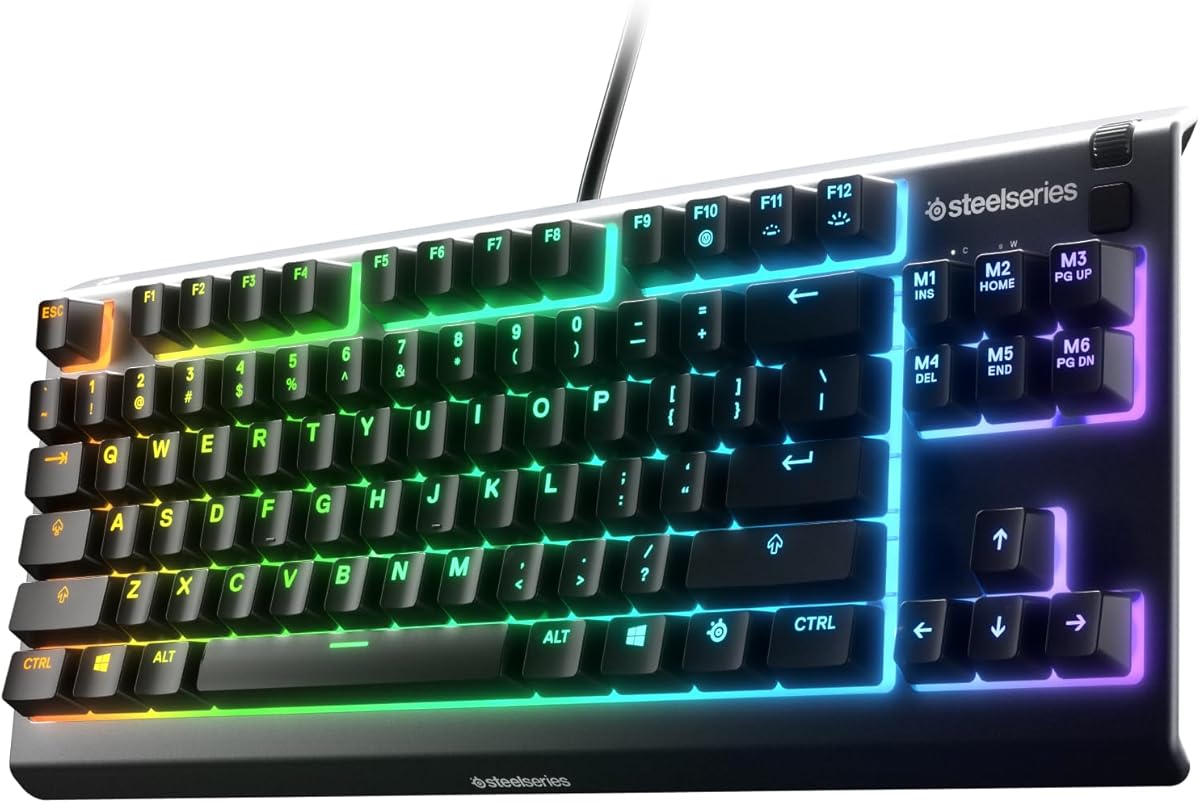
SteelSeries Apex 3 TKL is the quiet competitive compact: whisper-quiet gaming switches, anti-ghosting, 8-zone RGB, IP32 water and dust resistance, and a tenkeyless form factor SteelSeries correctly notes as popular with pros for mouse space. In an 80% shopping session it is often the board that makes housemates stop complaining.
You trade gasket creamy hobby vibes for durable quiet practicality. That trade is rational for ranked FPS and battle royale sessions that run past midnight. Spill resistance is not theoretical if you drink at the desk.
Versus EWEADN V80, Apex 3 brings stronger brand ecosystem gravity. Versus RK gasket boards, it will not thock for TikTok—and that is fine.
Our quiet gaming pick when compact mouse space matters as much as volume control.
Re-place your mousepad after install; the TKL dividend only appears if you close the old full-size gap.
A proven “stop buying loud boards” intervention.
Keyboard left, mousepad large, monitor centered on mouse path.
FPS players in apartments who still want RGB.
We may earn a commission at no additional cost to you.
MageGee’s 75%/TKL-style blue-switch board is for people who want compact geometry without giving up audible mechanical romance. LED backlighting, wired certainty, and an 87-key-class layout keep arrows available while dumping the numpad.
Bring diplomacy. Blues announce every adjective you type. In a private game room that can feel fantastic; on a Discord call with an open mic it can feel like sabotage.
Compared with MageGee’s smaller blue mini later in this list, this 75% keeps more dedicated keys and less layer friction. Compared with Newmen reds, it is louder and bumpier by design.
Buy only for private spaces. Everyone else should prefer Apex 3, EWEADN, or creamy linears.
A nostalgic compact click machine—not a shared-office tool.
If you love the sound, own the tradeoff proudly rather than apologizing mid-meeting.
In shared housing, blues are a relationship decision as much as a switch decision. If anyone on a call sits nearby, prioritize Apex 3 TKL or EWEADN before MageGee’s click symphony.
Deskmat helps a little; it will not silence blues.
Solo room gamers who miss classic clicky feedback.
We may earn a commission at no additional cost to you.
Womier DK75 attacks the compact wireless brief with an OLED screen, media knob, RGB, tri-mode 2.4GHz/USB-C/BT5.0, and a silent membrane switch story marketed with creamy language for Mac and Windows. It is the SK80’s wireless-membrane cousin: still about modern 75% convenience, less about hot-swap stems.
The OLED plus knob combination is more useful than either alone—see status, twist volume, keep typing. Silent membrane targeting makes DK75 friendlier than blue MageGee units for night work.
Choose DK75 when cables annoy you and you like Womier’s screen energy. Choose SK80 when mechanical hot-swap creaminess is non-negotiable. Choose RK R75 when you want wireless mechanical gasket instead of membrane.
A strong hybrid-worker compact for couches and standing desks alike.
Keep the 2.4G dongle labeled; Bluetooth slots fill up fast in multi-device homes.
Great when you want modern compact features without joining the switch-lubing hobby.
2.4G for games, Bluetooth for iPad/Mac writing, USB-C when battery anxiety hits.
Wireless-first users who like screens/knobs more than mechanical tinkering.
We may earn a commission at no additional cost to you.
RK R87 Pro is the power-user wired compact: gasket mount, hot-swap creamy linear switches, RGB, knob, and—critically—QMK/VIA support on an 88-key 75%-class board. If your fingers think in layers and macros, this is the listing that speaks fluent enthusiast.
VIA means you can build a coding layer, a streaming layer, and a clean gaming layer without fighting shallow vendor-only tools. The knob handles volume while your layers handle everything else. Gasket creaminess keeps it pleasant for prose between compiles.
Versus SK80, R87 Pro trades the flashy multimedia display emphasis for deeper programmability. Versus R75, it trades wireless for wired VIA focus (confirm your exact firmware expectations on the unit you receive).
Our top pick when compact layout and serious remapping both matter.
Budget time to map layers the first weekend—you will get more board than the box photos show.
Developers and power users should shortlist this before louder novelty boards.
Duplicate a default layout, then remap one layer only—caps as Esc, right keys as arrows if needed—before redesigning everything.
Programmers, streamers, and remappers who want wired gasket 75%.
We may earn a commission at no additional cost to you.
RK R75 is the wireless creamy 75% many compact shoppers actually want: gasket mount, hot-swap cream switches, PBT keycaps, knob, RGB, and BT5.1/2.4GHz/USB-C tri-mode in a white shell. It is lifestyle custom without forcing a dongle-free life of only Bluetooth lag anxiety.
PBT plus cream switches aim at feel and sound that still photograph well. Use 2.4G for games, Bluetooth for the work laptop, USB-C when you are updating or charging through a session.
Against Womier DK75, R75 is mechanical gasket rather than silent membrane. Against R87 Pro, R75 prioritizes wireless freedom over the deepest wired VIA narrative.
Buy R75 for cable-free creamy compact desks. Skip if you need maximum open-source remapping certainty—verify firmware features on your unit or choose R87 Pro.
A polished wireless 75% that makes compact feel premium.
Especially strong for mixed Mac/Win households tired of wrestling one wired board between machines.
Match a light deskmat so the board looks intentional rather than isolated.
Hybrid workers who want wireless mechanical creaminess in 75%.
We may earn a commission at no additional cost to you.
E-Yooso’s creamy 75% wired board focuses on the sensory upgrade: gasket structure, pre-lubed red linear hot-swap switches, knob control, and a quiet-portable compact pitch in white/red. If you came from a hollow plastic RGB brick, this is the “oh, that is why people care about foam and flex” moment.
Hot-swap keeps future options open. The knob handles volume during editing. Wired USB keeps student desks simple—no charger hunting before class.
Versus SK80, E-Yooso is less display-driven and more pure feel. Versus Newmen GM326, it leans harder into creamy gasket language. Versus MageGee blues, it is the civilized acoustic alternative.
Recommended as the soft wired daily compact for people who care how a board sounds on a deskmat mic.
Type a long email on day one; if your shoulders relax, you bought the right class of keyboard.
A strong value creamy experience without tri-mode overhead.
Deskmat + less bottom-out force = creamier results than any marketing adjective alone.
Writers and gamers chasing thock on a wire.
We may earn a commission at no additional cost to you.
MageGee’s MK-Box-style 68-key mini with blue switches is the pack’s extreme compact neighbor—useful to review because “80 percent” browse sessions often surface travel minis. You get LED backlight, wired portability, and arrows that strict 60% boards sometimes hide behind layers.
This is not a replacement for SK80 or R87 Pro as a primary desk board if you rely on a full F-row every minute. It is a devastatingly packable secondary for dorms, trips, and couch sessions—if you accept blue-switch volume.
Compared with MageGee’s larger blue 75%, the mini wins suitcase space and loses some dedicated-key comfort. Compared with quiet Apex 3, it is louder and more “toy mechanical,” for better and worse.
Buy as a travel clicky companion. Do not buy as your only office instrument.
A honest edge-case in an 80%-class roundup that still earns a role in mobile kits.
Pack a short cable; long cables defeat the mini’s point on tiny tables.
Use MK-Box as a secondary travel board even if a 75% lives on the main desk. The detachable cable and tiny shell earn backpack slots that TKL boards waste.
Use blues on planes only if you enjoy making enemies; libraries are a hard no.
Students and travelers who want mechanical feedback in a tiny wired brick.
We may earn a commission at no additional cost to you.

Purists argue percentages, but buyers usually mean “smaller than full-size, still usable without heavy layers.” That includes classic TKL (~80%) and denser 75% boards that pull the arrows and F-row into a tighter rectangle. If a listing says 60% or 68%, treat it as a more extreme compact cousin—not the same daily-driver compromise.
TKL keeps a more familiar gap and navigation cluster. 75% packs keys tighter and often adds knobs or screens in the freed corner. Gamers who hate relearning positions may prefer TKL; enthusiasts who want modern custom toys often prefer 75%.
Womier SK80, RK boards, and E-Yooso chase soft thocky mechanical sound. SteelSeries Apex 3 and EWEADN V80 chase whisper-quiet gaming without mech clack. Pick based on whether you want hobby sound or neighbor peace.
A display that shows connection mode, battery, or a gif can be surprisingly useful—or ignored after a week. Knobs for volume are the feature people keep using. Buy screens for joy; buy knobs for daily friction reduction.
RK R75 and Womier DK75 cover tri-mode lives. Wired SK80, R87 Pro, Newmen, MageGee, SteelSeries, and EWEADN keep latency anxiety low. Competitive players should prefer 2.4G or wired over plain Bluetooth.
QMK/VIA on R87 Pro is a different league from basic backlight toggles. If you remap layers for coding or streaming, prioritize VIA-capable boards. If you never open software, a quiet Apex 3 may make you happier.
Pre-lubed stabilizers and PBT caps shape daily joy more than a fifteenth RGB mode. When a listing stacks gasket foam, PBT, and hot-swap—as RK, E-YOOSO, and Womier SK80 do—you are in the modern value lane. When it only shouts blue switches and LED modes, expect classic loud energy with fewer acoustic comforts.
Desk surface still wins arguments: a hollow table will make even foamed boards sound worse than a solid desk with a thick mat. Budget the mat as part of the keyboard decision, especially if creamy sound was why you opened this guide.
Not exactly. Classic TKL is often called ~80% because it removes the numpad from full-size. 75% compresses further into a denser block, often with less gap around arrows. Shoppers use both terms when they want compact desks—this pack mixes them, so read the layout line on each product.
For quiet competitive play, SteelSeries Apex 3 TKL. For creamy mechanical feel with modern toys, Womier SK80 or RK boards. For programmable layers, RK R87 Pro. Match noise and remapping needs before RGB.
Only if you remaps layers often. Casual users may never open VIA. Power users who live in macros will feel trapped without it. R87 Pro is the clear programmability pick here.
Not necessarily. Creamy describes tone as much as volume. Whisper-quiet membrane boards like Apex 3 or EWEADN can be more neighbor-friendly than a thocky gasket board typed hard.
Buy a screen if you will use status info or simply enjoy it. If you are minimalist, a knob alone (Newmen, E-Yooso, RK) may deliver more lasting utility per glance.
Wired for simplicity and competitive calm. Tri-mode (R75, DK75) for multi-device homes. Keep a cable nearby even on wireless boards.
Because packs and search paths overlap. We review it as a portable neighbor and warn that it is a different compromise than 75%/TKL daily drivers.
Acoustically they are still loud. Compact size does not make clickies polite. Private rooms only unless everyone consents.
Several list Mac/Win support (Womier, RK, etc.). You may still remap Command/Option positions. Confirm before you need screenshot muscle memory mid-deadline.
It can improve comfort and mouse space, which helps consistency. It will not replace practice. Re-place your mousepad to actually use the freed width.
The best 80 percent-style keyboard in 2026 is the compact board that matches your noise rules and remapping ambitions—not a pedantic key-count trophy. Womier’s SK80 leads for creamy display-equipped 75% character, RK’s R87 Pro leads when QMK/VIA programming matters, and SteelSeries Apex 3 TKL remains the quiet competitive footprint for shared spaces.
If you want wireless creaminess, look at RK R75; if you want a soft wired knob board, E-Yooso; if you need absolute portability, MageGee’s smaller blue-switch mini. Be honest about whether you will use a screen, and whether clicky switches belong in your building.
Shrink the board, widen the mouse lane, and keep the keys you actually hit every hour—that is the whole compact-keyboard promise.