Expert Review & Guide

Best 5K Monitors in 2026 for Mac, Design, and Sharp

A true 5K panel changes how a desk feels under your hands. At 5120×2880 on a 27-inch screen, text stops looking slightly soft the way many scaled 4K setups still do, and UI chrome in Final Cut, Lightroom, or Xcode stays needle-sharp. Pixel density around 217–218 PPI is the reason Mac users chase these displays: you get Retina-like clarity with room for tools and timelines that a 1440p gaming monitor simply cannot match. In 2026, 5K is no longer a single-brand luxury niche—KTC, Samsung ViewFinity, BenQ, and INNOCN ultrawides all compete for that high-density workspace.

This roundup reviews every product in the pack, including neighbors that shoppers often compare beside 5K searches: a fast Samsung Odyssey QHD gamer, a Dell 4K S-series IPS, a Dell UltraSharp ultrawide productivity screen, and LG’s UltraFine 6K Thunderbolt 5 flagship. We call those differences out clearly so you do not buy 1440p when you meant 5120×2880. For the real 5K options, we weigh dual-mode refresh tricks, USB-C or Thunderbolt charging, color coverage (sRGB, DCI-P3, Adobe RGB), factory calibration claims, and whether an ultrawide 5120×2160 canvas fits your edit bay better than a square-ish 27-inch 5K.

You will get three top picks, a full comparison table, deep reviews with tradeoffs, and a buying guide focused on Mac cable reality, GPU bandwidth, and when dual-mode 2K high-refresh actually helps. No invented ASINs and no dollar prices—just density-first guidance.

Our Top 5K Monitor Picks

Best Overall 5K Productivity

Samsung 27" ViewFinity S8

★★★★★9.4/10
Samsung 27" ViewFinity S8
  • True 5K 5120×2880 at about 218 PPI for sharp text and UI chrome
  • USB-C with 90W charging, LAN, KVM, PIP/PBP, and Display Manager tools
  • HDR10+ and TÜV Eye Saver Mode for long creative and office sessions
Check Price →
Best Dual-Mode Creator Value

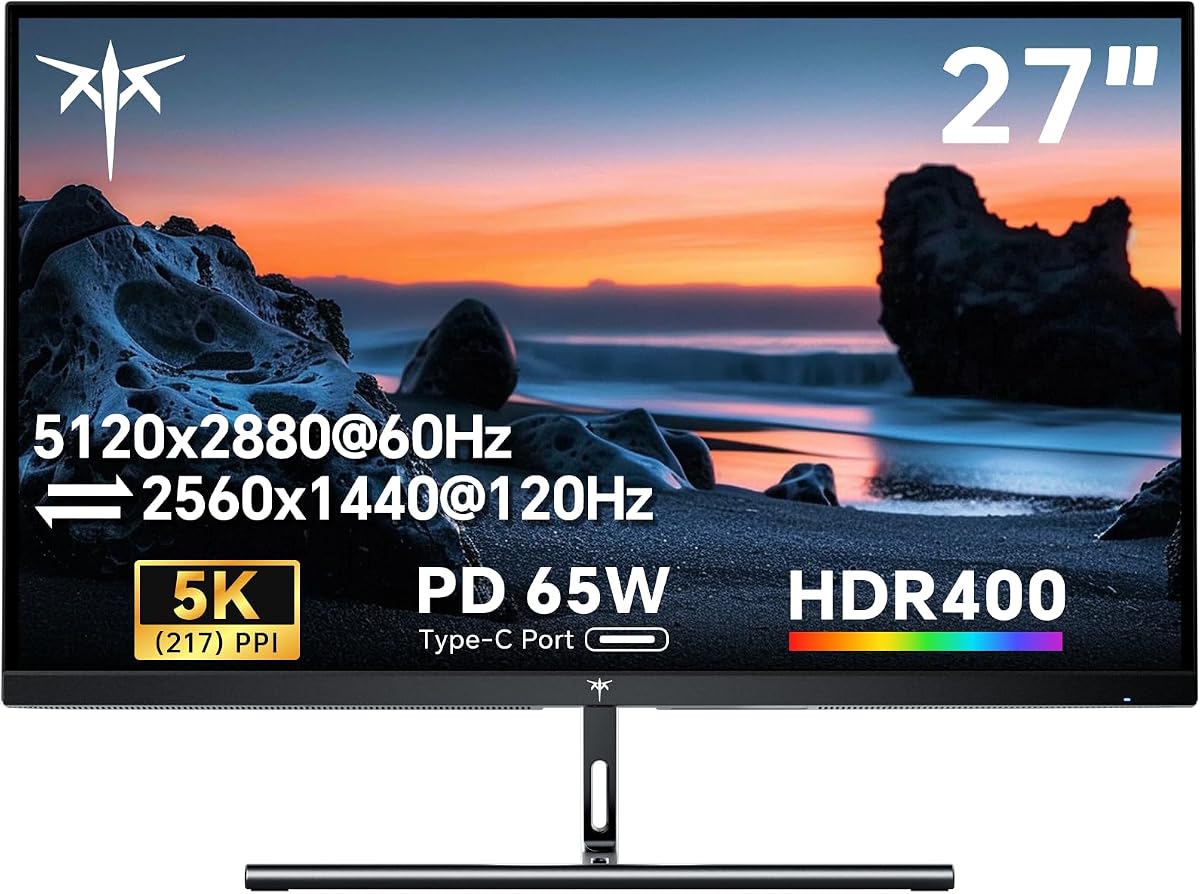
KTC 27" 5K Dual Mode H27P3

★★★★★9/10
KTC 27" 5K Dual Mode H27P3
  • Switch 5K@60Hz detail work and high-refresh 2K mode for smoother play
  • 99% DCI-P3, 100% sRGB, ΔE<2 targeting serious color tasks
  • USB-C 65W plus DP 1.4 and HDMI for Mac mini and PC desks
Check Price →
Best Pro Mac Thunderbolt 5K

BenQ PD2730S 27" 5K

★★★★☆7.8/10
BenQ PD2730S 27" 5K
  • 218 PPI 5K panel with 98% P3 and 2000:1 contrast for VFX storytelling
  • Thunderbolt 4 up to 90W with daisy-chain support for clean Mac desks
  • Nano matte eye-comfort panel plus built-in KVM and Hotkey Puck workflow
Check Price →

As an Amazon Associate we earn from qualifying purchases. We may earn a commission at no additional cost to you.

5K and High-Resolution Monitor Comparison

Scan resolution carefully—some pack neighbors are QHD, 4K, ultrawide 5K, or even 6K. Specs emphasize PPI cues, color claims, charging ports, and whether dual-mode or Thunderbolt features fit a Mac-heavy desk.

#ProductSpecificationsScore
1
  • 27" 5120×2880 IPS, ~217 PPI, HDR400
  • Dual mode 5K60 / 2K120 with Adaptive Sync
  • 65W USB-C, DP 1.4, HDMI 2.0, VESA 75×75
8.8
2
  • 27" 5K 5120×2880 at ~218 PPI, HDR10+
  • USB-C 90W, LAN, KVM, PIP/PBP
  • Eye Saver Mode and Samsung Display Manager
9.4
3
  • 5K@60Hz or 2K high-refresh dual mode
  • 99% DCI-P3, 100% sRGB, ΔE<2, HDR400
  • USB-C PD 65W, DP 1.4, HDMI 2.0, USB-A hub
9
4
  • 40" 21:9 5120×2160 IPS, 100Hz, HDR ready
  • 135% sRGB / 106% DCI-P3, ΔE<2 factory aim
  • HDMI 2.1, DP, 65W USB-C, height/swivel/tilt
8.4
5
  • 27" QHD 2560×1440 — not 5K density
  • 180Hz, 1ms, FreeSync, HDR10
  • Height-adjust stand with Black Equalizer
9
6
  • 34" UltraSharp productivity ultrawide
  • Anti-glare, ambient light sensor, PBP
  • Digital daisy chain and locking stand features
8.6
7
  • 27" 4K UHD IPS up to 120Hz FreeSync Premium
  • 99% sRGB, ComfortView Plus, HDR-ready tone
  • USB-C plus full ergonomic stand movements
8.8
8
  • 34" 21:9 5120×2160 VA, 120Hz, HDR400
  • ΔE<2 aim, USB-C 65W, PIP/PBP splitting
  • HDMI 2.1, DP, height/swivel/tilt, speakers
8.6
9
  • 27" 5K 218 PPI, 98% P3, nano matte panel
  • Thunderbolt 4 90W, daisy chain, KVM + puck
  • Uniformity-minded design for 3D/VFX desks
7.8
10
  • 32" 6K 6144×3456 Nano IPS Black, ~224 PPI
  • Thunderbolt 5 with up to 96W PD, DisplayHDR 600
  • Wide pro gamuts and daisy-chain creative workflows
7

1. KTC 27" 5K H27P3 - Best Mac mini 5K

KTC 27" 5K H27P3

KTC 27" 5K H27P3

8.8/10★★★★☆

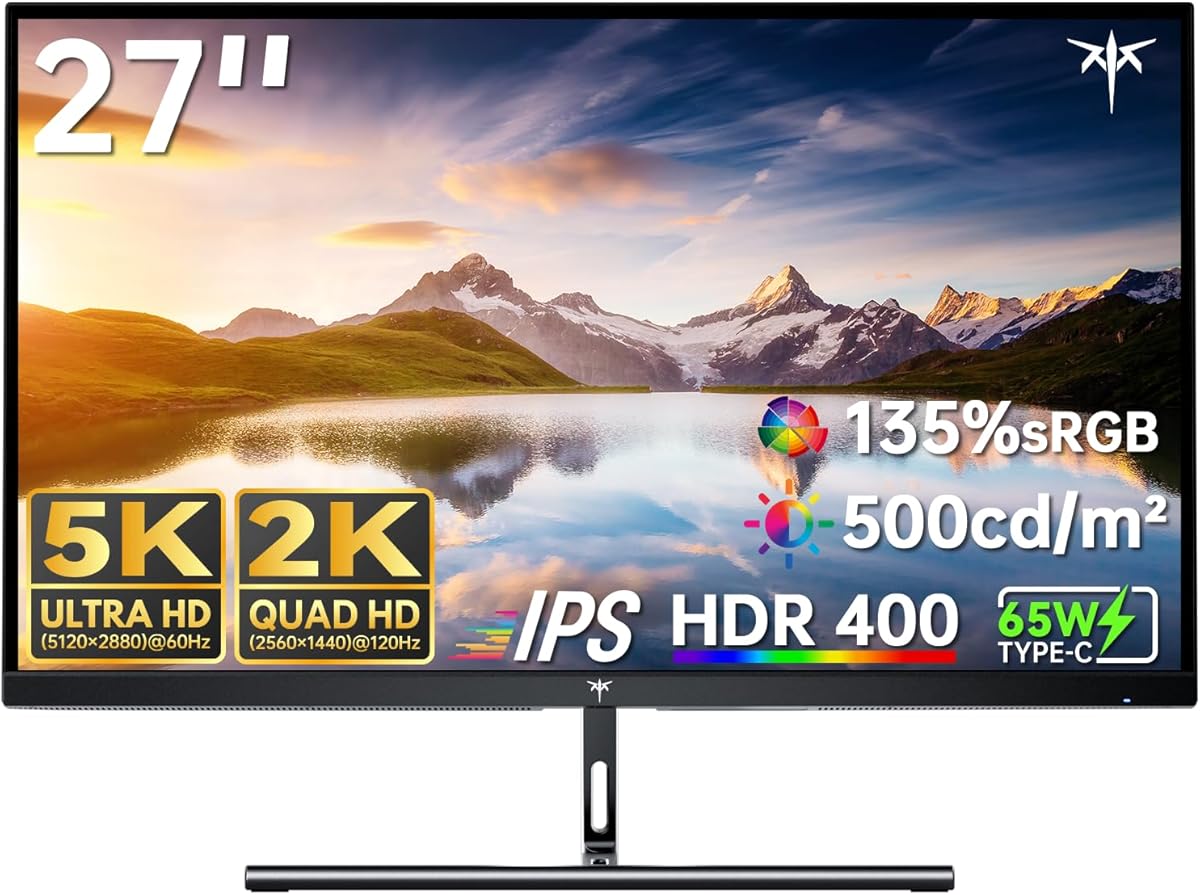
KTC’s 27-inch H27P3 is the approachable on-ramp to real 5K: 5120×2880 on an IPS panel at roughly 217 PPI, marketed explicitly for Mac mini–compatible desks. That pixel density is the headline. Spreadsheet grids, browser UI, and timeline ticks stop looking slightly fuzzy the way many scaled 4K monitors still do on macOS. HDR400, about 500 cd/m² brightness, a 2000:1 contrast claim, and 135% sRGB area / 100% sRGB coverage give everyday photo and video work more punch than office FHD leftovers.

  • 5120×2880 IPS at ~217 PPI with HDR400
  • Dual mode 5K60 or 2K120 plus Adaptive Sync
  • 65W full-function USB-C, DP 1.4, HDMI 2.0
Check Price →
✓ Pros
  • Genuine 5K density that makes UI text feel Mac-native
  • Dual mode lets you trade pixels for smoother motion
  • 65W USB-C simplifies laptop expansion on a clean desk
  • HDR400 and strong sRGB coverage suit mixed creative work
  • Three-year warranty messaging with responsive support claims
✕ Cons
  • 65W charging may not fully replace higher-watt MacBook bricks under load
  • Tilt-focused ergonomics may need a VESA arm for perfect eye line
  • Color story is solid but less P3-obsessed than the sibling dual-mode SKU

Detailed review

Dual mode is the clever trick. Stay in 5K at 60Hz when you are retouching or writing, then switch toward a 2K 120Hz pathway when you want smoother motion and Adaptive Sync behavior. That flexibility matters because pushing full 5K high refresh can demand more bandwidth than some docks and GPUs happily provide. KTC’s approach acknowledges real desks: creators who also game lightly should not need two monitors to cover both moods.

Connectivity covers full-function 65W USB-C, DisplayPort 1.4, and HDMI 2.0, with VESA 75×75 for arms. USB-C is the MacBook Air–friendly path for video plus charging on lighter loads; heavier Pro laptops may still want their power adapter during export spikes. Blue light reduction and flicker-free features support long grading or coding nights without pretending the panel is a medical device.

Against Samsung’s ViewFinity S8, the KTC trades some hub luxury (LAN, 90W, polished Display Manager ecosystem) for dual-mode agility and a more value-forward 5K entry. Against BenQ’s PD2730S, it trades Thunderbolt 4 niceties and nano-matte pro finishing for a simpler Type-C/DP/HDMI triangle. For many Mac mini creators building a first sharp desk, that simplicity is a feature.

Expect to spend a few minutes getting macOS scaled resolution looking right—5K rewards correct HiDPI settings. Once set, the clarity advantage over a random 4K IPS is immediate for text-heavy work. If you need factory ΔE paperwork and wide DCI-P3 guarantees, look at KTC’s dual-mode sibling next in this guide; if you need maximum port hub features, jump to Samsung.

Recommended as the practical 5K starter when you want density, HDR400 pop, and a mode switch without entering Thunderbolt flagship territory.

Mac mini cable tip

Prefer DisplayPort or a high-quality USB-C route that actually advertises 5K60 support. Cheap HDMI adapters are where 5K dreams go to become unexpected 4K60.

Who it fits

Students, indie developers, and photo hobbyists moving up from 1080p/1440p who want Retina-like sharpness without ultrawide desk gymnastics.

Check Price on Amazon →

We may earn a commission at no additional cost to you.

2. Samsung ViewFinity S8 27" - Best Overall 5K Productivity

Samsung ViewFinity S8 27"

Samsung ViewFinity S8 27"

9.4/10★★★★★

Samsung’s ViewFinity S8 (S80HF) is the productivity-first 5K we would put on most hybrid creator desks. You get 5120×2880 at about 218 PPI—a larger, sharper workspace than typical 4K 27-inch panels—plus HDR10+ for more engaging contrast in supported content. The pitch is not esports; it is exceptional clarity and speed for workflow, which matches how 5K actually gets used: dense UI, crisp text, and fewer windows stacked into illegible crumbs.

  • 5K 5120×2880 at ~218 PPI with HDR10+
  • USB-C 90W charging, LAN, KVM, PIP/PBP
  • TÜV Eye Saver Mode and Display Manager controls
Check Price →
✓ Pros
  • Highest-rated true 5K option in this pack for daily workflows
  • 90W USB-C plus LAN turns the monitor into a real laptop dock hub
  • Built-in KVM and PBP/PIP help dual-computer creative desks
  • Eye Saver certification supports long writing and review days
  • Display Manager streamlines splits, brightness, and calibration access
✕ Cons
  • Less dual-mode high-refresh gaming flexibility than the KTC 5K twins
  • Brand ecosystem tools matter most if you actually install Display Manager
  • Still a 27-inch rectangle—ultrawide editors may prefer INNOCN canvases

Detailed review

The hub feature set is why it wins overall. USB-C can charge at up to 90W while carrying video and data, a built-in LAN port restores Ethernet to modern port-light laptops, and a KVM switch plus PIP/PBP helps you run a work PC and a personal machine without two keyboards fighting for desk space. That is the difference between “nice sharp monitor” and “desk infrastructure.”

Eye Saver Mode with TÜV-oriented messaging reduces blue light and flicker concerns during marathon edit or spreadsheet days. Ergonomic design cues target better viewing angles for long sessions. Samsung Display Manager adds split-screen setup, brightness control, and calibration access, while MAPT-style device tracking language points at networked accessory awareness—useful in busier studios if you lean into the software.

Colorists who need explicit 98% P3 guarantees and nano-matte glare control may still prefer BenQ’s PD2730S. Gamers who want 160Hz-class motion will prefer KTC dual mode or the Odyssey QHD neighbor. But if your question is “What 5K monitor makes my laptop desk feel finished?”, ViewFinity’s charging wattage, LAN, and KVM stack is the most complete answer here.

Mac users should still verify cable quality and that their machine can drive 5K60 over the chosen path. Windows creators on USB-C/Thunderbolt laptops get the same docking benefits. Once configured, the sharpness advantage shows up every time you read 11-point UI labels without leaning in.

This is our default 5K recommendation for mixed professional work in 2026: dense, dock-like, and tuned for long days rather than RGB theatrics.

KVM scenario

Park a work laptop and a desktop on the S8, keep one keyboard/mouse pair, and use PBP when you need both OS desktops visible during a migration or render-watch.

Versus BenQ PD2730S

Pick Samsung for docking wattage, LAN, and polished productivity software. Pick BenQ when Thunderbolt 4 daisy chain, nano matte, and P3 storytelling accuracy are the job.

Check Price on Amazon →

We may earn a commission at no additional cost to you.

3. KTC 27" 5K Dual Mode - Best Dual-Mode Creator

KTC 27" 5K Dual Mode

KTC 27" 5K Dual Mode

9/10★★★★★

This KTC dual-mode H27P3 variant pushes harder into creator color than the first KTC entry. You still get 27-inch 5120×2880 for detail work at 60Hz, but the listing emphasizes switching into a high-refresh 2K pathway (marketing cites up to 160Hz-class 2K behavior alongside 120Hz notes depending on mode copy). The point is practical: keep 5K for color-critical pixels, then drop to 2K when you want motion smoothness that 5K60 cannot always deliver on midrange GPUs.

  • 5K@60Hz detail mode and high-refresh 2K mode
  • 99% DCI-P3, 100% sRGB, ΔE<2, HDR400
  • USB-C 65W, DP 1.4, HDMI 2.0, dual USB-A
Check Price →
✓ Pros
  • Wide DCI-P3 coverage with ΔE<2 targeting for design and video
  • Dual mode bridges sharp grading and smoother play/multitask motion
  • Mac mini compatibility messaging matches real compact creative desks
  • USB hub ports reduce dongle sprawl for tablets and card readers
✕ Cons
  • 65W PD still may under-power hotter laptops during heavy exports
  • HDMI path is more limited than DP for full 5K ambitions
  • Two similarly named KTC H27P3 listings can confuse cart choices—match the DCI-P3 dual-mode title

Detailed review

Color is the reason to prefer this sibling. Claims of 99% DCI-P3, 100% sRGB, and ΔE<2 put it in serious shortlist territory for YouTube colorists, thumbnail designers, and photo editors who need wider gamuts than office sRGB panels. HDR400 with about 500 cd/m² brightness keeps highlights lively in mixed lighting. Eye-care features include flicker-free operation, hardware low blue light, and DC dimming for long timelines.

USB-C PD 65W handles charging-plus-video for many ultrabooks and MacBooks in lighter use, DisplayPort 1.4 is the trustworthy 5K@60Hz pipe, and HDMI 2.0 is called out as more of a 4K@60 companion path—read that limitation before you buy an HDMI-only dock. Two USB-A 3.0 ports help peripherals live on the monitor instead of the laptop’s scarce sockets.

Compared with Samsung ViewFinity, you gain explicit P3/ΔE language and dual-mode agility, while giving up 90W charging, LAN, and Samsung’s KVM/Display Manager polish. Compared with BenQ, you save your way into similar resolution class without Thunderbolt 4 daisy-chain luxury. For Mac mini desks that also moonlight as mild gaming stations, this KTC is the most flexible density play in the pack.

Calibration still matters: factory ΔE targets are a starting line, not a lifetime guarantee under every OSD preset. Use a creative picture mode, warm up the panel, and verify with a chart if client print matching pays your rent.

Buy it when you want one 27-inch panel to cover “sharp workday” and “smoother evening mode” without abandoning wide-gamut ambitions.

Mode switching advice

Grade and write in 5K60. Switch to the high-refresh 2K mode for game nights or motion-heavy scrubbing if your GPU prefers the lighter pixel load.

Port priority

Use DP 1.4 or a validated USB-C full-function cable for 5K. Treat HDMI as secondary unless your source explicitly supports the resolution you need.

Check Price on Amazon →

We may earn a commission at no additional cost to you.

4. INNOCN 40C1U 40" Ultrawide - Best Giant 5K Ultrawide

INNOCN 40C1U 40" Ultrawide

INNOCN 40C1U 40" Ultrawide

8.4/10★★★★☆

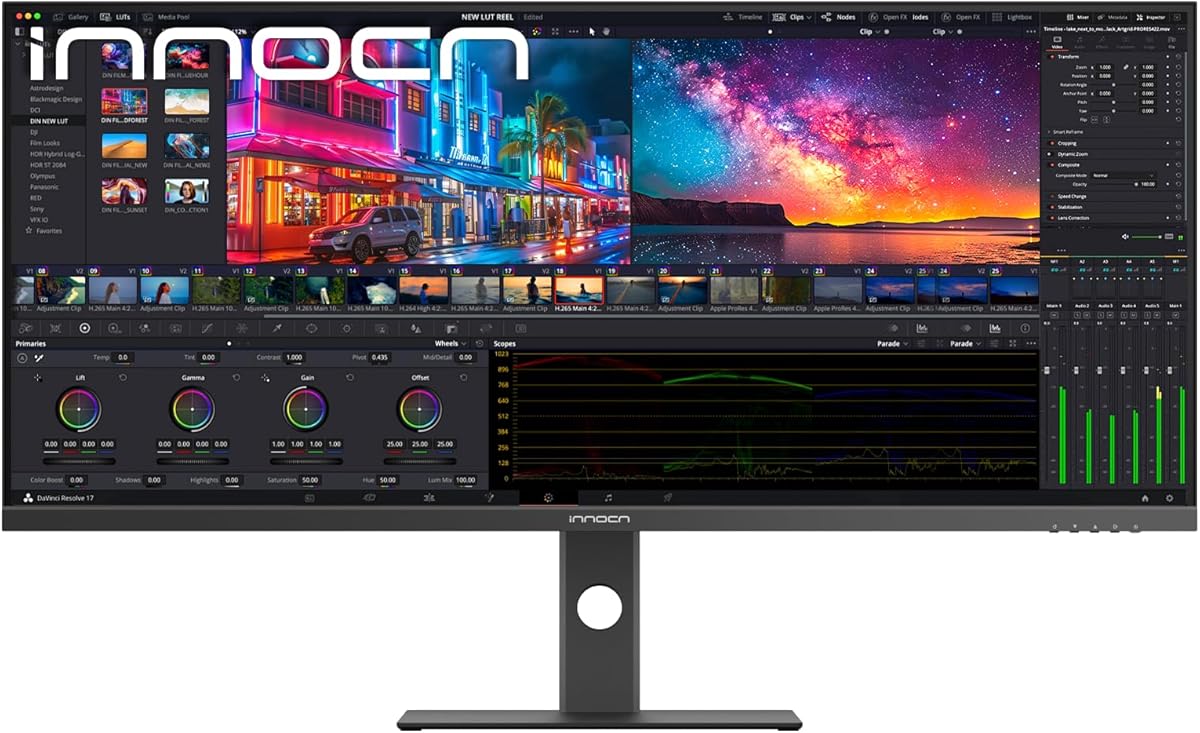
INNOCN’s 40C1U interprets 5K differently: 5120×2160 on a 40-inch 21:9 IPS ultrawide at 100Hz. That is a productivity landscape, not a 27-inch Mac-like rectangle. Editors can park a timeline, preview, and bins without drowning in overlapping windows. Researchers can keep papers and notes side by side. Factory ΔE<2 aims, 135% sRGB / 106% DCI-P3 claims, and HDR-ready brightness around 350 nits support serious color work if you verify with your own pipeline.

  • 40" 21:9 5120×2160 IPS at 100Hz
  • 135% sRGB / 106% DCI-P3, ΔE<2 aim, HDR ready
  • HDMI 2.1, DP 1.4, 65W USB-C, full ergonomic stand
Check Price →
✓ Pros
  • Enormous 21:9 timeline canvas for editors and researchers
  • True ultrawide 5K-class resolution rather than stretched 1440p
  • Strong connectivity including HDMI 2.1 and USB-C PD
  • Height, swivel, and tilt make a heavy productivity panel usable all day
✕ Cons
  • 40 inches demands a deep desk and careful viewing distance
  • Heavier chassis; plan mount strength if you go VESA
  • Not the same 218 PPI “Retina square” feel as 27-inch 5120×2880

Detailed review

Connectivity is unusually complete for the class: dual HDMI 2.1, DisplayPort 1.4, 65W USB-C PD, USB-A ports, and USB-B upstream. FreeSync helps tear-free motion, and built-in speakers handle reference audio when headphones are across the room. The metal stand’s height/swivel/tilt adjustments matter because a 40-inch panel that sits too low becomes a neck tax within an hour.

Be honest about PPI expectations. This is not 218 PPI like the 27-inch 5K squares. It is a large, sharp ultrawide with far more horizontal pixels than QHD ultrawides, but sitting distance should be farther than a 27-inch Retina desk. If you pixel-peep from 50 cm, you may prefer BenQ or Samsung 27-inch 5K instead.

Versus the 34-inch INNOCN 34C1U, the 40-inch is the maximalist canvas with IPS (the 34 lists VA) and a slightly lower 100Hz versus 120Hz. Versus Dell’s UltraSharp 34, INNOCN’s pitch is the rare 5120×2160 clarity story rather than classic enterprise ultrawide branding alone.

Blue light reduction and flicker-free features help during long edits. Warranty/support messaging is shorter than some premium brands, so factor support expectations into pro deployments.

Choose the 40C1U when your bottleneck is horizontal workspace for timelines and research arrays, and your desk can physically host a 40-inch wingspan.

Desk reality check

If your desk is under about 30 inches deep, strongly consider the 34-inch INNOCN or a 27-inch 5K instead. Ultrawide immersion collapses if your face is too close to the center.

Who it is for

Video editors, financial multi-pane traders, and developers who already know they love ultrawide and want 5K-class horizontal resolution.

Check Price on Amazon →

We may earn a commission at no additional cost to you.

5. Samsung Odyssey G5 27" QHD - Best Fast QHD

Samsung Odyssey G5 27" QHD

Samsung Odyssey G5 27" QHD

9/10★★★★★

Not every product beside a “best 5K monitors” search is actually 5K, and the Odyssey G5 G51F is the clearest example. It is a 27-inch QHD 2560×1440 gaming monitor: about 1.7× Full HD’s pixel count, 180Hz refresh, 1ms response marketing, AMD FreeSync, and HDR10. If you arrived here wanting Retina-like 218 PPI text, this is the wrong aisle—buy ViewFinity, KTC, or BenQ instead. If you realized you care more about frame rate than density, the G5 suddenly becomes the rational pick in the pack.

  • 27" 2560×1440 QHD — clearly not 5K
  • 180Hz, 1ms, AMD FreeSync, HDR10
  • Ergonomic stand with Black Equalizer tools
Check Price →
✓ Pros
  • 180Hz motion makes competitive play feel immediate
  • QHD is easier for GPUs to drive at high frames than 5K
  • Height-adjust stand suits long gaming/work hybrid nights
  • Honest alternative if you searched 5K but actually want speed
✕ Cons
  • Pixel density cannot match 27-inch 5K text clarity
  • Gaming feature stack is overkill for pure photo retouching
  • Included here as a pack neighbor—do not confuse with ViewFinity 5K

Detailed review

QHD at 180Hz is still a sweet spot for GPU-limited PCs. Black Equalizer helps in dark game scenes, the ergonomic stand covers tilt/pivot/height, and Auto Source Switch+ reduces input fuss when you juggle console and PC. HDR10 adds highlight pop without claiming to be a reference grading display.

For hybrid users who write docs by day and play ranked shooters by night, QHD high refresh often feels better than forcing a midrange GPU to drag 5K desktop pixels. Text is good, not ViewFinity-good. Creative color workflows that need P3 precision should look elsewhere.

We include this review to prevent accidental carts. Samsung’s naming ocean is wide; Odyssey and ViewFinity solve different jobs. Read the resolution line twice.

Recommended only when motion performance beats density on your priority list. Otherwise, step back to the true 5K options.

As a secondary fast monitor beside a 5K color panel, the G5 can make sense in dual-PC studios—just do not expect it to replace 5K clarity.

Quick confusion check

ViewFinity S8 = 5K productivity. Odyssey G5 = QHD speed. Same brand family energy, opposite jobs.

When QHD wins

Competitive gaming, GPU headroom, and users who dislike macOS-style HiDPI scaling complexity on Windows game machines.

Check Price on Amazon →

We may earn a commission at no additional cost to you.

6. Dell UltraSharp 34 U3425WE - Best Enterprise Ultrawide Neighbor

Dell UltraSharp 34 U3425WE

Dell UltraSharp 34 U3425WE

8.6/10★★★★☆

Dell’s UltraSharp U3425WE sits in this pack as the enterprise ultrawide neighbor. The title’s “5K QHD 1440p” phrasing is the kind of marketplace language that confuses shoppers hunting 5120×2880 density. Treat this as a premium 34-inch UltraSharp productivity ultrawide first, and confirm the exact native resolution and scaler behavior on the unit you receive before you bet a color-critical pipeline on it.

  • 34" UltraSharp ultrawide productivity design
  • Anti-glare panel with ambient light sensor
  • Picture-by-Picture, daisy chain, locking stand
Check Price →
✓ Pros
  • UltraSharp branding targets managed office and creator hybrids
  • Ambient light sensor helps brightness track changing rooms
  • PBP and daisy chain support multi-input professional desks
  • Locking stand details appeal to shared or secure workplaces
✕ Cons
  • Listing language emphasizes 5K QHD 1440p—verify exact native timing before assuming 5120×2880
  • Sparse public bullet set versus INNOCN’s detailed 5K ultrawide specs
  • Not the Retina-square 27-inch 5K experience Mac users often want

Detailed review

What the listing does clearly advertise is workplace polish: anti-glare coating, an ambient light sensor, Picture-by-Picture, digital daisy chain, and a locking stand. Those are IT-friendly features for offices that care about glare under fluorescents, automatic brightness comfort, and multi-input layouts when a laptop and desktop share one canvas.

Compared with INNOCN’s explicit 5120×2160 ultrawides, Dell’s strength is brand channel comfort, manageability cues, and UltraSharp ecosystem expectations rather than flashy DCI-P3 billboard numbers in the short bullet set. If your workplace standardizes on Dell docking and warranties, that can outweigh a longer Amazon feature poem from a lesser-known brand.

Creators who specifically need 218 PPI Mac-like text should still prefer Samsung ViewFinity, KTC 27-inch 5K, or BenQ. Ultrawide fans who want clearly documented 5120×2160 panels should compare INNOCN 34C1U/40C1U line items carefully against this Dell.

Ambient light sensing is underrated for real offices where afternoon sun rotates across the desk. Pair anti-glare with sensible placement and you will fight reflections less than on glossy entertainment panels.

Shortlist the U3425WE for managed professional ultrawide desks; verify resolution needs if your heart was set on true 5K square density.

Procurement note

Ask for the full datasheet timing table before fleet buys. Marketplace titles compress marketing phrases that do not always map 1:1 to the pixel grid you expect.

Who it fits

Offices already inside Dell’s monitor and dock universe that want ultrawide multitasking with PBP and daisy-chain convenience.

Check Price on Amazon →

We may earn a commission at no additional cost to you.

7. Dell S2725QS 27" 4K - Best 4K 120Hz Daily

Dell S2725QS 27" 4K

Dell S2725QS 27" 4K

8.8/10★★★★☆

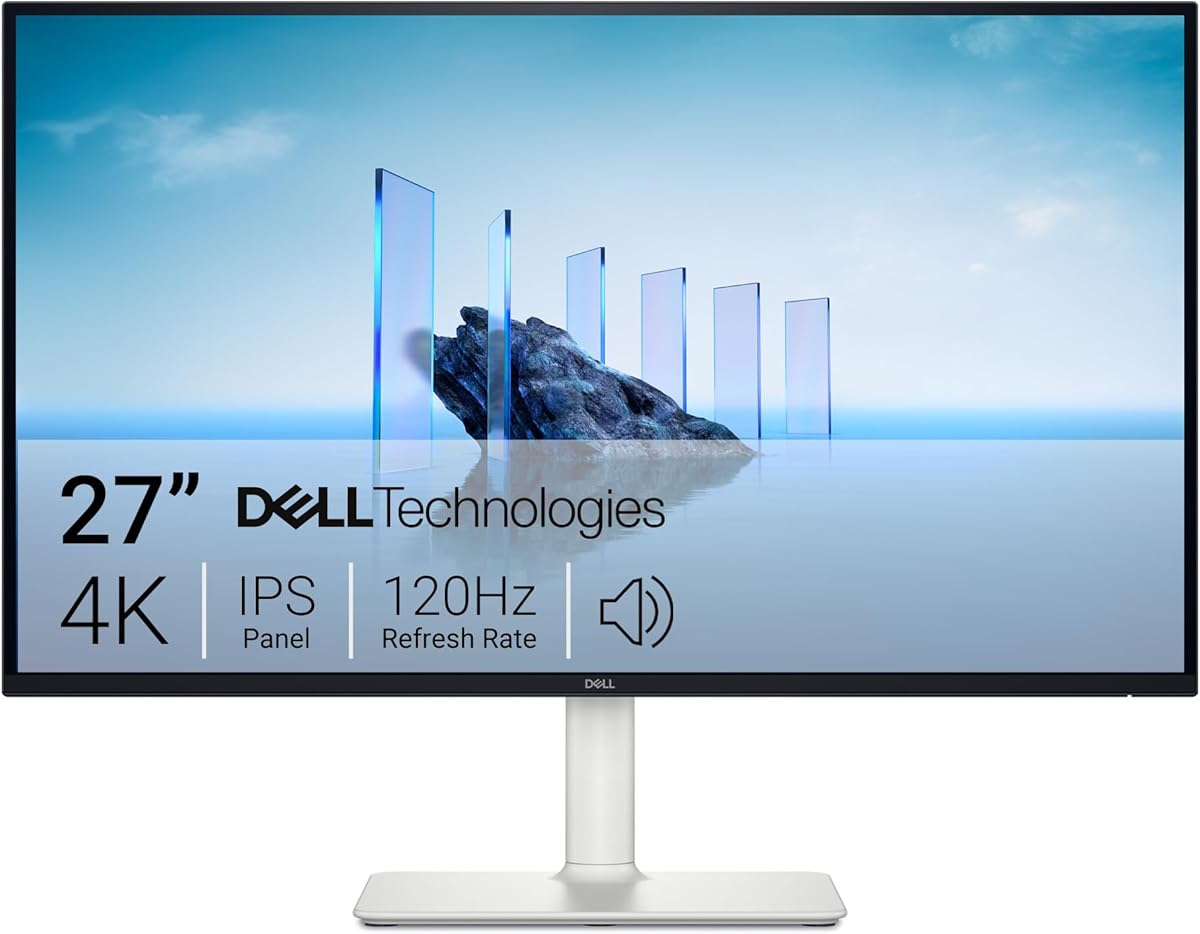
Dell’s S2725QS is the sensible 4K answer sitting beside 5K aspirations. You get 27-inch UHD IPS, up to 120Hz with FreeSync Premium, roughly 350 cd/m² brightness, 1500:1 contrast, 99% sRGB, anti-glare, and ComfortView Plus that aims to cut harmful blue light emissions substantially while protecting color accuracy. For many Windows offices, that package is more practical than chasing 5K cables and GPU load.

  • 27" 4K IPS up to 120Hz with FreeSync Premium
  • 99% sRGB, ComfortView Plus, ~350 cd/m²
  • USB-C with height/swivel/pivot ergonomics
Check Price →
✓ Pros
  • 120Hz 4K is a superb all-rounder when true 5K is unnecessary
  • ComfortView Plus keeps blue light lower without ditching color aims
  • Full ergonomic stand beats tilt-only 5K bargain stands
  • Polished ash-white thin-bezel look fits modern offices
✕ Cons
  • 4K is not 5K—macOS sharpness fans may still want ViewFinity/BenQ
  • 99% sRGB is narrower than wide-P3 creator panels
  • Included as a comparison neighbor, not a density replacement

Detailed review

Why it appears in a 5K guide: shoppers cross-shop 4K120 against 5K60 constantly. If your work is Office, browsers, light photo, and some play, 4K120 can feel snappier than 5K60 while still looking sharp—especially with Dell’s ergonomic stand covering height, swivel, and pivot. USB-C adds laptop convenience, and the re-engineered speaker story helps quick calls.

Where 5K still wins is fine text and UI density on macOS-like workflows. 4K on 27 inches is excellent, yet 5120×2880 remains in another clarity class for tiny labels and photo 1:1 checks. Wide-gamut graders will also look to BenQ/KTC P3 numbers rather than sRGB-led S-series positioning.

Choose S2725QS when you want a refined Dell daily driver with high refresh UHD and strong comfort features. Choose ViewFinity or BenQ when pixel density is the entire point of the upgrade.

The thin-bezel ash-white aesthetic is easy to live with on camera-facing desks. Pair ComfortView Plus with reasonable room light and long writing days get easier.

A strong “almost 5K” pick—just do not pretend the pixel math is the same.

4K vs 5K decision

Pick 4K120 for smoother versatility and easier GPU load. Pick 5K60 when text clarity and Mac-like density are non-negotiable.

Ergonomics win

If the 5K options you can get are tilt-only, Dell’s full stand movements may improve comfort more than the resolution jump alone.

Check Price on Amazon →

We may earn a commission at no additional cost to you.

8. INNOCN 34C1U 34" Ultrawide - Best 34" 5K Ultrawide

INNOCN 34C1U 34" Ultrawide

INNOCN 34C1U 34" Ultrawide

8.6/10★★★★☆

The INNOCN 34C1U is the more living-room-and-studio-friendly ultrawide 5K-class option: 5120×2160 at 120Hz on a 21:9 VA panel with HDR400, ΔE<2 factory aiming, and wide gamut claims (135% sRGB / 106% DCI-P3). Where the 40-inch model overwhelms smaller desks, 34 inches still replaces a dual-monitor span for email, calendar, and project panes while keeping viewing distance sane.

  • 34" 5120×2160 VA ultrawide at 120Hz HDR400
  • ΔE<2 aim with USB-C 65W laptop docking convenience
  • HDMI 2.1, DP, PIP/PBP splits, ergonomic metal stand
Check Price →
✓ Pros
  • 120Hz makes the ultrawide feel quicker than many 60Hz creator panels
  • USB-C PD can replace a dual-monitor clutter pile for laptops
  • PIP/PBP sharpen editing and office multitasking layouts
  • More desk-realistic than the 40-inch sibling for many rooms
✕ Cons
  • VA panel behavior differs from IPS 27-inch 5K squares—angles/gamma can vary
  • Still not 218 PPI Retina-square density
  • Weight and size still need a serious desk

Detailed review

Productivity framing is explicit: USB-C with power delivery turns the display into a cleaner laptop dock endpoint, height adjustment supports all-day posture, and PIP/PBP helps editors and remote workers split sources. HDMI 2.1 and DP 1.4 cover consoles and PCs, with USB hub ports for peripherals. Speakers handle casual playback when you are scrubbing interviews.

VA’s 3000:1 contrast claim can look punchier in dark grading rooms than many IPS ultrawides, though IPS fans who huddle with clients may still prefer angle consistency from the 40-inch IPS INNOCN or a 27-inch IPS 5K. Match panel personality to how you review work.

Versus Samsung ViewFinity, you gain horizontal timeline space and lose the classic 5K square PPI magic. Versus Dell UltraSharp 34, you get clearer 5120×2160 marketing and higher refresh emphasis in the listing. Versus the 40C1U, you gain 120Hz and a more manageable footprint.

MacBook users should validate that their USB-C/Thunderbolt path can drive the ultrawide timing they want. Mini PC creators often love these panels because one cable plus a hub covers the whole desk.

Best in pack for editors who know they want ultrawide 5K-class resolution without going fully 40-inch panoramic.

Layout idea

Put preview left-center, timeline full-width bottom, bins on the right. Use PBP when a client Zoom machine needs a permanent slice of the screen.

VA expectation

Great for contrasty dark rooms; sit centered. If clients constantly view from sharp side angles, consider IPS 5K squares instead.

Check Price on Amazon →

We may earn a commission at no additional cost to you.

9. BenQ PD2730S 27" 5K - Best Pro Mac Thunderbolt

BenQ PD2730S 27" 5K

BenQ PD2730S 27" 5K

7.8/10★★★★☆

BenQ’s PD2730S is the pro Mac monitor in the pack: 5120×2880 at 218 PPI with more workspace pixels than typical 4K, 98% P3 coverage, 2000:1 contrast, and a nano matte panel designed to diffuse ambient light for color-managed work. Thunderbolt 4 delivers up to 90W power and high-bandwidth display links, with daisy-chain scenarios for multi-display rooms when cables and hosts cooperate. This is the listing aimed at 3D artists, VFX animators, and game designers rather than RGB gamers.

  • 27" 5120×2880 at 218 PPI with 98% P3
  • Thunderbolt 4 up to 90W, daisy chain, KVM
  • Nano matte panel with uniformity-minded pro design
Check Price →
✓ Pros
  • Thunderbolt 4 Mac integration with serious 90W charging
  • 98% P3 and 2000:1 contrast aimed at VFX and game art
  • Nano matte diffusion fights ambient glare during color work
  • KVM plus Hotkey Puck speeds dual-system creative studios
  • Daisy chain support keeps multi-display desks cleaner
✕ Cons
  • Lower average rating than Samsung ViewFinity in this pack—read recent owner feedback
  • Pro feature stack may be more than casual 5K shoppers need
  • Premium positioning versus KTC dual-mode value twins

Detailed review

Uniformity language and matte optical behavior matter if you paint textures or grade shots under mixed practical lights. Glossy entertainment panels can sparkle; nano matte trades a bit of “pop” for control. Built-in KVM plus the wireless Hotkey Puck workflow lets you jump between a MacBook and a Windows render box without rebuilding your desk every time.

Compared with Samsung ViewFinity, BenQ speaks more directly to P3 storytelling and Thunderbolt daisy-chain creator infrastructure, while Samsung counters with LAN, Display Manager, and a higher pack rating. Compared with KTC, BenQ feels like the finishing tool after you decide 5K is definitely your lane. LG’s 6K UltraFine out-resolves it if you need the next density step and Thunderbolt 5.

The 3.9 rating in pack data is a caution flag worth reading—pro monitors sometimes collect setup-friction reviews about cables, scaling, or expectations. Budget a certified Thunderbolt 4 cable and time for calibration. If that sounds like friction you refuse, ViewFinity may make you happier day one.

For people who bill clients for visual fidelity, the PD2730S feature stack aligns with the job: density, P3, matte control, KVM, and Mac power delivery.

Our pro-Mac shortlist pick when Thunderbolt workflow beats generic USB-C hub convenience.

Ideal studio pair

PD2730S as the color-critical hero display, with a second daisy-chained or KVM-attached screen for email and references.

Who should skip it

Competitive gamers chasing 180Hz, or bargain hunters who will not use Thunderbolt daisy chain, KVM, or P3-critical soft proofing.

Check Price on Amazon →

We may earn a commission at no additional cost to you.

10. LG 32U990A-S UltraFine 6K - Best Beyond-5K Pro Flagship

LG 32U990A-S UltraFine 6K

LG 32U990A-S UltraFine 6K

7/10★★★★☆

LG’s 32U990A-S UltraFine evo is the beyond-5K ceiling in this roundup: 6144×3456 on a 32-inch Nano IPS Black panel at about 224 PPI, marketed as a pioneering Thunderbolt 5 6K professional monitor. Pixel math alone explains the appeal—LG cites dramatically more working pixels than standard 4K, so full-resolution content can stay visible beside timelines and panels without everything shrinking into soup. DisplayHDR 600, up to 99.5% Adobe RGB and 98% DCI-P3 claims, real 10-bit color language, and 2000:1-class Nano IPS Black contrast target paid creative work.

  • 32" 6K 6144×3456 Nano IPS Black at ~224 PPI
  • Thunderbolt 5 with up to 96W PD and DisplayHDR 600
  • Wide Adobe RGB / DCI-P3 aims with full ergonomic stand
Check Price →
✓ Pros
  • More pixels than 5K for tool-heavy 6K timelines and UI
  • Thunderbolt 5 bandwidth and daisy-chain ambitions for future rigs
  • DisplayHDR 600 and Nano IPS Black contrast for grading depth
  • Mac and Windows pro connectivity beyond a single USB-C port
✕ Cons
  • Lowest rating in this pack—early flagship friction is possible
  • 6K60 demands capable hosts; not a casual upgrade
  • Overkill if you only needed sharp text on a 27-inch 5K

Detailed review

Thunderbolt 5 is the infrastructure story: faster transfers than Thunderbolt 4, 6K daisy-chain support messaging, DisplayPort 2.1 pathways, and up to 96W power delivery for Mac and Windows hosts. HDMI 2.1 and USB-C round out a workstation hub approach. TÜV Rheinland Eye Comfort certification speaks to long session comfort, while the tilt/height/pivot stand treats ergonomics like part of the instrument, not an afterthought.

This is not a subtle upgrade from office 4K. You need hosts, cables, and software that behave at 6K. The pack’s 3.5 rating suggests some buyers hit early-adopter edges—always read recent reviews for firmware/cable notes. If your machine struggles to drive 5K comfortably, 6K will not magically feel smoother at 60Hz.

Who should buy it? Editors finishing high-resolution deliverables, AI visual pipelines, and design teams that already max out 5K and still want more UI room. Who should not? Anyone who mainly wanted sharper Word documents—Samsung ViewFinity or KTC 5K will satisfy that itch with less complexity.

As a pack neighbor, the LG clarifies the ladder: QHD speed (Odyssey), 4K versatility (Dell S2725QS), 5K density (Samsung/KTC/BenQ), ultrawide 5K-class (INNOCN), then 6K UltraFine flagship. Step onto the rung you can actually drive.

Recommended as the aspirational pro endpoint when Thunderbolt 5 and 6K density are the assignment—not as the default “first 5K” purchase.

Host readiness

Confirm Thunderbolt generation, GPU/display engine limits, and certified cables before purchase. Flagship panels punish bargain adapters.

When 5K is enough

If your apps already feel crisp on 27-inch 5K and your timeline fits, stay there. 6K shines when UI overcrowding is the daily pain.

Check Price on Amazon →

We may earn a commission at no additional cost to you.

Best 5K Monitors in 2026 for Mac, Design, and Sharp

How to Choose a 5K Monitor in 2026

Confirm you actually need 5K density

Buy 5K when text clarity and UI density are the problem you feel every hour. If your pain is motion smoothness in games, a 1440p 180Hz Odyssey-class panel may make you happier. If you want a refined all-rounder without Mac-like scaling drama, Dell’s 4K120 can be the calmer choice. True 5K shines for Retina-style desks, photo 1:1 checks, and crowded creative apps.

27-inch 5120×2880 vs ultrawide 5120×2160

Square-ish 27-inch 5K (Samsung, KTC, BenQ) maximizes PPI and Mac-like sharpness. Ultrawide 34/40-inch 5120×2160 (INNOCN) maximizes horizontal workspace for timelines and multi-pane research. Do not assume they feel the same; sit farther from ultrawides and expect different PPI.

USB-C vs Thunderbolt vs DP realities

DisplayPort 1.4 remains a reliable 5K60 friend on PCs. USB-C full-function ports vary wildly by laptop—65W may trickle-charge under load while 90W feels transformative. Thunderbolt 4/5 options (BenQ, LG) unlock docking, daisy chain, and higher-bandwidth creator desks when you use certified cables. HDMI is often the compromise path; read each listing’s HDMI limits carefully.

Color: sRGB, P3, Adobe RGB, ΔE

Office-accurate sRGB panels are fine for documents. Creators should look for DCI-P3 / P3 claims (KTC dual-mode, BenQ, INNOCN gamut numbers) and ΔE<2 factory aims, then still verify with a calibrator if clients pay for color. LG’s 6K adds wide Adobe RGB targeting for print-oriented pros.

Dual-mode and refresh tradeoffs

5K60 is normal. KTC’s dual-mode idea—keep 5K for work, switch to high-refresh 2K for play—is the pragmatic compromise when your GPU cannot treat 5K like a toy. Do not expect every 5K panel to also be a 160Hz competitive monitor.

Ergonomics and matte finishes

Height-adjust stands and nano matte / anti-glare coatings matter more once you stare at 200+ PPI for eight hours. BenQ’s nano matte and Dell’s anti-glare sensor story are not fluff if your room has windows. VESA-mount tilt-only bargains can still win if you budget an arm.

Frequently Asked Questions

01

What makes a monitor truly 5K?

In the Mac-like sense people usually want, 5K means 5120×2880. Ultrawide panels at 5120×2160 are also marketed as 5K-class because of the 5120 horizontal pixel count, but they do not feel identical to a 27-inch 218 PPI square. Always read the full timing, not just the number five in the title.

02

Is 5K better than 4K for MacBooks?

For text and UI sharpness at 27 inches, yes—5120×2880 typically looks more Retina-native than 3840×2160. For motion, a 4K120 panel like Dell’s S2725QS can feel smoother. Choose based on whether density or refresh is your daily frustration.

03

Can a midrange GPU run 5K?

Desktop UI at 5K60 is fine on many modern GPUs and Apple Silicon machines with the right cable. Heavy 5K gaming is another story—that is why KTC dual-mode switches to 2K high refresh. Editors should watch playback caches and proxy workflows more than brochure Hz.

04

Do I need Thunderbolt for 5K?

Not always. Some PCs do fine over DisplayPort, and some USB-C full-function ports carry 5K60. Thunderbolt 4/5 becomes important for single-cable charging docks, daisy chain, and higher-bandwidth pro setups like BenQ and LG emphasize. Match the cable standard to your laptop’s best port.

05

Why is the Samsung Odyssey G5 in a 5K roundup?

Because shoppers cross-compare it in the same pack/session, not because it is 5K. It is a 27-inch QHD 180Hz gaming monitor. We keep it labeled clearly so you do not buy speed when you meant density.

06

Are 34-inch and 40-inch 5K ultrawides good for coding?

They can be excellent for multi-pane IDEs and documentation, especially if you like ultrawide immersion. If you want the sharpest small text, a 27-inch 5120×2880 panel usually wins. Ultrawides reward horizontal layouts; square 5K rewards dense clarity.

07

How important is ΔE<2 factory calibration?

It is a strong starting signal for creators, not a forever guarantee under every OSD mode. If color pays your bills, use a calibrator periodically anyway. If you mostly write docs and browse, sRGB-accurate comfort panels may be enough.

08

Is LG 6K worth it over 5K?

It can be when your UI is still crowded on 5K and your host/cables support 6K cleanly. It is overkill for general productivity upgrades. Also note early flagship ratings can be mixed—verify recent feedback before you leap.

09

What charging wattage should I look for?

65W covers many ultrabooks and lighter MacBook sessions. 90W-class USB-C/Thunderbolt (Samsung ViewFinity, BenQ) feels better for Pro laptops. Peak export loads may still benefit from the laptop’s own charger. Treat monitor PD as desk simplification, not magic infinite power.

Conclusion

The best 5K monitor in 2026 depends on whether you want Retina-square density, ultrawide timeline space, or a pro Thunderbolt desk. Samsung’s ViewFinity S8 is our default true-5K productivity pick thanks to 218 PPI clarity plus 90W USB-C, LAN, and KVM docking muscle. KTC’s dual-mode DCI-P3 model is the agile creator value play, while BenQ’s PD2730S is the Mac-minded Thunderbolt color instrument.

INNOCN’s 34- and 40-inch 5120×2160 ultrawides solve a different problem—horizontal workspace—while Dell 4K, Dell UltraSharp, Samsung Odyssey QHD, and LG 6K sit in the pack as honest ladder rungs above and below classic 5K. Match resolution to the work, cables to the host, and desk depth to the panel’s wingspan.

Chase the pixel grid you mean to buy. When the resolution line on the box matches the job on your desk, high-density computing finally feels as sharp as the marketing renders.