Audio-Technica ATH-M50X Professional Studio Monitor Headphones
- 45mm drivers with critically trusted closed-back mix clarity
- Detachable coiled, straight, and short cables in the box
- Swiveling cups for one-ear monitoring during tracking
Expert Review & Guide
Wired headphones never really left—they just stopped winning the marketing wars. In 2026, creators still reach for closed studio monitors when Bluetooth latency and compression get in the way, audiophiles still prefer open-back staging that wireless ANC cups rarely match, and students still want a 3.5mm jack that works when a Chromebook’s battery saver murders wireless buds mid-lecture. The cable is not nostalgia; it is a reliability feature.
This ReviewConsensus roundup ranks ten wired options from our product pack only: professional closed backs like the Audio-Technica ATH-M50X and Sony MDR-7506, open Sennheiser models for home detail, Shure isolating IEMs for stage and commute, plus practical everyday picks from Apple, Sony’s bass earphones, AC01 study headsets, and Philips podcast cans. We call out renewed condition where it applies and keep dollar prices out of the copy because Amazon deals move constantly.
Start with the three top picks if you want a fast shortlist, skim the comparison table for form factor and cable cues, then read the full reviews for honest tradeoffs. The right wired headphones depend on whether you need isolation, soundstage, a microphone, or a Lightning connector—not on which product photo looks most futuristic.
As an Amazon Associate we earn from qualifying purchases. We may earn a commission at no additional cost to you.
Use this table to separate closed studio monitors, open-back listeners, isolating IEMs, and everyday wired headsets before you commit. Specs highlight drivers or design, cable reality, and the job each pair does best. Check live listings for current pricing.
Audio-Technica ATH-M50X Professional Studio Monitor Headphones
The Audio-Technica ATH-M50X remains the wired headphone most people mean when they say they want a serious studio monitor without jumping into boutique pricing. Proprietary 45 millimeter drivers with rare earth magnets and copper-clad aluminum voice coils deliver the kind of midrange honesty that makes vocal edits, guitar layering, and podcast cleanup feel trustworthy. Closed circumaural cups contour around the ears and cut enough room noise that you can track in a shared apartment without hearing every HVAC cycle.
What separates the M50X from cheaper closed cans is balance under pressure. Bass is present and deep enough for electronic and hip-hop reference checks, yet it does not smear kick drums over the low mids the way consumer bass-boosted headphones do. Highs stay articulate on cymbals and consonants without the piercing edge that makes long mix sessions fatiguing. That combination explains why engineers still recommend these years after the original M50 made its reputation.
The detachable cable system is a quiet productivity feature. You get a coiled cable for desk work, a longer straight cable for moving around a room, and a short straight cable for travel or tight setups. When a cable eventually fails—and studio cables do fail—you replace the cord instead of the headphones. The 90-degree swiveling earcups also matter in practice: flipping one cup for one-ear monitoring during vocal coaching or talkback is faster than removing the whole headset.
Comfort is professional rather than plush. The clamp starts assertive, which helps seal and isolation, then usually settles as the headband and pads adapt. Protein-leather style pads can warm your ears after multi-hour sessions; many owners keep a spare pad set or rotate listening breaks. Compared with open-back Sennheisers in this roundup, the M50X is the better choice for untreated rooms, live rooms, and any desk next to a noisy PC fan.
For music listening, these punch above casual Bluetooth headphones in detail and imaging, though they sound more analytical than fun-first consumer tuning. If your goal is accurate decisions about EQ, compression, and arrangement, that analytical lean is the point. Pair them with a clean headphone output or a modest DAC/amp if your laptop jack is noisy, and they reward careful listening far more than they demand exotic amplification.
In 2026 the ATH-M50X still earns Best Overall in a wired pack because it covers the widest set of serious jobs: tracking, mixing, editing, and critical listening. Buy these when you want one closed-back workhorse that professionals recognize and that will still feel relevant after you upgrade your interface, monitors, or room treatment.
Choose the M50X if you mix or track at home, produce content that needs honest midrange, or want isolation without active noise canceling batteries. Skip them if you mainly lounge listen in a quiet room and prefer the open soundstage of the HD 560S, or if you need a microphone-integrated headset for school Chromebooks—the AC01 covers that job better.
Start with the coiled cable at the desk and keep the short cable in a bag. Use the included adapter when plugging into 1/4-inch outputs on interfaces or mixers. Give the clamp a few long sessions before judging comfort. If your source sounds thin, check your interface headphone gain and sample-rate settings before blaming the drivers—these headphones expose source quality quickly.
Against the Sony MDR-7506, the M50X generally feels fuller and more modern in bass weight while remaining mix-friendly; Sony stays the broadcast classic with a brighter, very revealing top. Against the ATH-M20x, you pay for larger drivers, detachable cables, and a more refined overall presentation. If budget is tight and you only need tracking isolation, the M20x is a smart step-down.
We may earn a commission at no additional cost to you.
Sony MDR7506 Professional Large Diaphragm Headphone
Sony’s MDR-7506 is the wired headphone that shows up in film sets, radio booths, and ENG bags for a reason: it tells the truth quickly. Large-diaphragm 40 millimeter drivers with neodymium magnets deliver powerful, detailed sound that makes dialogue intelligibility and noise problems obvious. The closed-ear design reduces external noise so you can judge a take without the room rewriting what you hear.
The tuning leans revealing rather than luxurious. Midrange clarity is the star—voices, guitars, and Foley details sit forward so editing decisions feel confident. Bass is present and tight enough for production work, though it is not the bass-forward fun of consumer earbuds. Frequency response spanning 10 Hz to 20 kHz on paper matches what these headphones feel like in practice: extended enough for music checks, ruthless enough for technical monitoring.
Build quality is utilitarian in the best sense. The folding yoke and included soft case make these easy to stuff into a camera bag or backpack. The nearly ten-foot cord ends in a gold-plated plug with a 1/4-inch adapter in the box, which matters when you bounce between headphone jacks on cameras, recorders, and console inserts. That length is a feature on a cart and a mild annoyance on a tiny laptop desk—coil management becomes part of the ritual.
Comfort depends on head shape and session length. The closed cups seal well and can create more pressure than velour open-backs. Many broadcast veterans wear them for hours because the seal and clarity outweigh plushness; casual listeners who want lounge comfort may prefer the Sennheiser open models or thicker-padded closed cans. Still, for production monitoring, the MDR-7506’s fit is purposeful.
Compared with the ATH-M50X, Sony’s classic often sounds a bit brighter and more mid-forward, which some dialogue editors prefer and some music mixers find less forgiving. There is no detachable cable kit here, so treat the cord as a consumable you protect. If you need replaceable cables and a more contemporary closed-back music balance, look at the M50X first. If you want the reference many crews already share, stay with Sony.
Buy the MDR-7506 when your wired headphones need to survive professional audio workflows and communicate consistently with collaborators who already know this model’s voice. It remains one of the best wired headphones for location sound, broadcast monitoring, and anyone who values proven clarity over fashion finishes.
Ideal for location recording, video production monitoring, radio, and dialogue-heavy editing. Also strong for guitar practice and interface monitoring when you need isolation. Less ideal as a sole audiophile living-room headphone if you want a wide open soundstage and lush bass bloom.
Use the soft case whenever you pack them. Strain-relieve the fixed cable at the cup and plug. For laptop-only desks, a short extension or careful cable routing keeps the long cord from snagging chair arms. The fold mechanism is for storage—do not treat it like a toy hinge.
More field-proven than the Philips podcast cans, more isolating than open Sennheisers, and brighter than many bass-tuned consumer buds. Pair with the Shure SE215 when you need stage IEMs and keep the Sonys for desk and cart monitoring.
We may earn a commission at no additional cost to you.
Sennheiser HD 560S Open-Back Over-Ear Wired Headphones
The Sennheiser HD 560S is the open-back argument against treating every wired headphone like a portable island. Wide, natural soundstage and directional detail make mixes feel three-dimensional: reverb tails, panned guitars, and game footsteps occupy space instead of stacking inside your skull. If you have ever wondered why audiophiles insist open backs sound more lifelike, this model is a clear demonstration at an accessible tier.
Precision-tuned transducers chase neutrality across the band. Subtle details in acoustic recordings, classical dynamics, and vocal breaths become easier to hear without the V-shaped hype that masks balance problems. That same honesty helps creators refining podcast EQ or checking video dialogue against music beds. You hear what is there, which is exactly when open-back headphones earn their keep.
Comfort is a major reason people keep the HD 560S on for entire albums. Velour ear pads and ventilated earcups reduce heat and clamp pressure compared with many sealed studio monitors. Lightweight construction supports long music, gaming, schoolwork, or editing sessions from home. If closed cans leave you sweaty by track three, open Sennheisers feel like a different category of wearable.
Connectivity stays simple and reliable. The detachable cable lands with a 6.35 millimeter plug plus a 3.5 millimeter adapter, so PCs, laptops, record players, DACs, and home stereos are covered. There is no Bluetooth battery anxiety and no microphone remote for phone calls—these are listening and monitoring tools, not commute headsets. That clarity of purpose is a feature, not a missing checkbox.
Gaming and detailed listening both benefit from open-back acoustics. Positional accuracy helps in competitive and immersive titles, while music lovers get imaging that closed budget headphones rarely match. Just remember the social contract of open backs: people nearby will hear your audio, and you will hear them. Apartments with thin walls, libraries, and shared offices are the wrong venues.
Choose the HD 560S when your listening room is quiet enough to let the soundstage bloom and you care more about accuracy than isolation. In this pack it is the best open-back detail pick—pair it with closed M50X or MDR-7506 cans if you also need tracking headphones for noisier work.
Home listeners, gamers who value spatial cues, and creators checking mixes in a treated or at least quiet room. Not for flights, open offices, or late-night listening when leakage would disturb others.
Both are Sennheiser open backs with plush comfort and spacious presentation. The HD 560S is sold new with a more reference-leaning reputation for analytical listening. The HD 599 SE Renewed leans a bit more relaxed and musical for many listeners, and the renewed channel means you must accept refurbished condition variability in exchange for value.
These are easy to drive from most modern headphone outputs, but a cleaner DAC/amp can reduce hiss from cheap motherboard jacks. Keep volume moderate—open backs sound effortless, which can tempt you louder than closed isolation would allow.
We may earn a commission at no additional cost to you.
Audio-Technica ATH-M20x Professional Studio Monitor Headphones
The Audio-Technica ATH-M20x is the honest on-ramp to wired studio headphones. Advanced build quality for the tier and a design aimed at studio tracking and mixing mean you are not stuck with toy bass buds when you start recording. Forty millimeter drivers with rare earth magnets and copper-clad aluminum wire voice coils provide a clear, workmanlike foundation for hearing pitch, timing, and obvious EQ mistakes.
Tuning emphasizes enhanced low-frequency performance relative to ultra-bright cheap headphones, which helps when you need to feel kick drums and bass lines during tracking. It is still a monitor-oriented closed back, not a nightclub signature. Mids remain usable for vocals and guitars, though the M50X ultimately resolves more nuance if your edits demand it.
Circumaural cups that contour around the ears deliver excellent sound isolation in loud environments—practice spaces, untreated bedrooms, and computer desks with coil whine. The single-side cable exit keeps the cord from draping across both shoulders, which is a small ergonomic win when you turn your head toward a mic. There is no swivel kit as elaborate as the M50X, but the core closed-back job is covered.
Where the M20x asks for compromise is longevity of cable convenience and ultimate fidelity. The cable is not a multi-length detachable system, so protect the strain relief. Resolution and comfort sit a step below the M50X, which is expected. For students building a first interface kit, podcasters who need isolation without spending M50X money, and guitarists who want reliable cans for amp modeling, the trade is fair.
Against the Philips over-ears in this list, the M20x feels more like a studio tool and less like a general multimedia headset. Against Sony’s MDR-7506, it is usually less bright and less iconic in broadcast circles, but more approachable if you want Audio-Technica’s family tuning at lower cost. Against open Sennheisers, it wins on isolation and loses on soundstage romance.
Buy the ATH-M20x when you need closed-back wired headphones for learning production and do not yet need detachable cables or M50X-level refinement. It is the best entry studio can in this pack and a sensible stopgap that still teaches good monitoring habits.
Bedroom vocal tracking, DIY podcast recording, electronic music sketching, and homework mixing classes. Upgrade later to M50X when cable flexibility and extra clarity become daily needs.
Expect a secure seal and noticeable clamp compared with lifestyle Bluetooth headphones. Take breaks on long sessions. Isolation is passive only—good for focus, not the same as ANC on a plane.
We may earn a commission at no additional cost to you.
Shure SE215 PRO Sound Isolating Wired Earbuds
Shure’s SE215 PRO Sound Isolating earbuds prove that the best wired headphones are sometimes not headphones at all. A single dynamic MicroDriver delivers detailed, full-range sound with clear highs and rich, deep bass aimed at musicians and listeners who need reliability more than flashy multi-driver marketing. On stage or on a loud train, that combination of punch and control is more practical than a fragile open-back canonical.
Sound Isolating technology is the headline feature: blocking up to 37 dB of ambient noise without batteries or ANC modes. The seal does the work. That makes the SE215 excellent for commutes, travel, workouts where true wireless buds keep dying, and focus sessions where café chatter otherwise wins. Isolation quality tracks directly with tip choice and insertion depth, so the included flex and foam sleeves in multiple sizes are not accessories—they are part of the product.
The secure over-ear wireform keeps the earphones in place when you move. Detachable MMCX connectors rotate and lock, which matters when a cable snags on a strap or pedalboard. Replacing a cable is cheaper than replacing the monitors. The compact zippered case keeps the set tangle-managed in a gig bag. This is road-minded design refined over years of musician use.
Tonally, expect a bass-capable monitor rather than a bright analytical IEM. Low end has weight that helps click tracks, bass guitars, and modern pop translation, while mids stay clear enough for vocal pitch reference. Treble is controlled rather than sparkly-max. Audiophiles chasing the last bit of air may look higher in Shure’s range; most players and commuters will appreciate the musical balance.
Compared with Apple EarPods, the SE215 isolates far more and sounds more substantial, but requires tip fitting and over-ear routing. Compared with Sony’s deep-bass consumer earphones, Shure feels more pro and durable, with better cable serviceability. Compared with over-ear studio cans, IEMs win for portability and stage use and lose for all-day office comfort if in-ear pressure bothers you.
Buy the SE215 when you need wired isolation you can trust in noisy spaces and a fit that survives motion. They are the best isolating IEMs in this pack—professional tools that also moonlight as serious everyday listeners once you nail the seal.
Try foam and flex tips in multiple sizes. Insert, twist gently, and confirm bass feels full and outside noise drops. A bad seal makes these sound thin and leaky—almost always a fit issue, not a broken driver.
Use them for in-ear monitoring, airplane movies when you want passive quiet, and gym sessions where wireless buds are a theft or sweat risk. Keep a spare cable if you depend on them for gigs.
Choose SE215 for portability and max isolation; choose M50X or MDR-7506 for desk mixing comfort; choose HD 560S when you are home and want soundstage more than silence.
We may earn a commission at no additional cost to you.
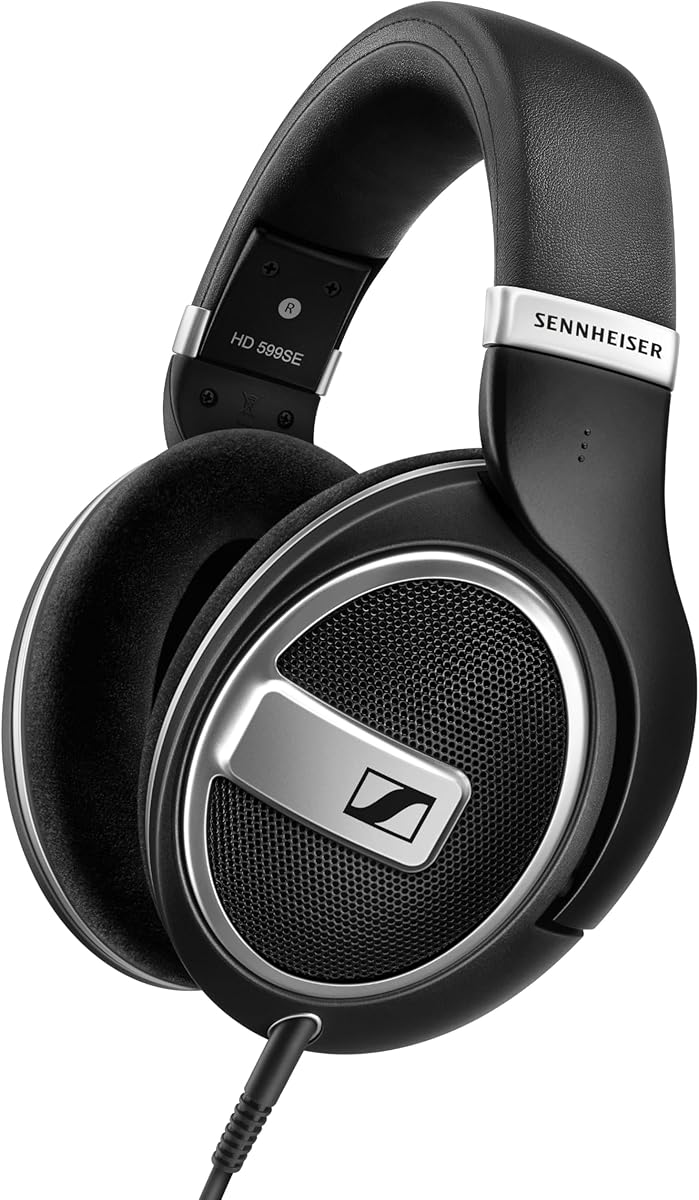
Sennheiser HD 599 SE Around Ear Open Back Headphone (Renewed)
The Sennheiser HD 599 SE Around-Ear Open Back headphone, offered here as a Renewed listing, is the relaxed audiophile counterweight to analytical studio closed backs. Natural, balanced audio with a spacious soundstage suits classical, acoustic, vocal jazz, and high-fidelity streaming when you want immersion without a sealed-cup clamp. If the HD 560S is the reference notepad, the HD 599 SE often feels like the evening listening chair.
Clarity and detail remain Sennheiser hallmarks: precise highs, rich mids, and controlled bass that supports music without thumping past the mix. These are wired headphones for people who notice arrangement space and timbre. They are less ideal if your library is exclusively sub-heavy EDM and you refuse EQ—closed consumer cans or bass IEMs will scratch that itch faster.
Luxurious comfort is a real differentiator. Lightweight construction and plush velour-covered ear pads reduce fatigue across long albums and gaming story campaigns. Ventilated open cups breathe. That comfort package is why open Sennheisers convert people who thought they disliked over-ears after owning clampy gaming headsets.
Compatibility is broad: phones (with adequate output), tablets, computers, and most audio devices work, and some gamers use them as open headsets for immersion when a separate mic is available. Detachable cabling includes a longer 6.3 millimeter cable and a shorter 3.5 millimeter cable, covering living-room receivers and portable players. No Bluetooth, no ANC, no apologies.
Because this pack SKU is Renewed, shop with eyes open. Renewed can mean inspected and restored stock with possible cosmetic marks, replaced pads, or mixed accessory completeness depending on the offer. Read the specific renewed condition notes, prefer sellers with clear return policies, and test early for channel balance, crackles, and headband integrity. The acoustic design can still be excellent; the purchase path needs slightly more diligence than buying new HD 560S stock.
Pick the HD 599 SE Renewed when you want Sennheiser open-back musicality and comfort and accept refurbished variability for the value. Keep a closed pair for work that needs isolation, and treat these as the home listening specialist in your wired toolkit.
Confirm what is included (both cables, adapter if expected). Check photos when available. Test left/right balance and swivel yokes immediately. Keep packaging until you finish your return window evaluation.
Orchestral, folk, singer-songwriter, jazz, and well-recorded rock benefit most. Heavily bass-boosted pop still works, but you may prefer a touch of EQ or a closed can for pure slam.
Choose new HD 560S if you want a more explicitly neutral, detail-first open back with straightforward new-unit confidence. Choose HD 599 SE Renewed if comfort-forward musicality and renewed value matter more.
We may earn a commission at no additional cost to you.
Apple EarPods Headphones with Lightning Connector
Apple EarPods with Lightning Connector exist for a boringly important reason: many iPhones still need a wired path that does not depend on Bluetooth batteries or loose dongles in a bag. The speakers are engineered to maximize output and minimize loss within Apple’s bud design, delivering high-quality audio for podcasts, calls, and everyday playlists. They will not replace ATH-M50X monitors, and they are not trying to.
Comfort is the design story. Unlike traditional circular earbuds, EarPods follow ear geometry so more people get a stable, less pokey fit. That open fit also means ambient sound remains audible—safer for walking in cities, worse for airplane roar. If isolation is your priority, Shure SE215 or closed over-ears are the correct tools.
The built-in remote is why these stay useful in 2026. Pinch the cord to adjust volume, control music and video playback, and answer or end calls without unlocking the phone. The microphone captures voice for phone calls, FaceTime, and Siri with the predictable Apple integration people expect. For interviews on the go or quick voice memos, that reliability beats hunting for wireless pairing menus.
Compatibility covers devices with Lightning connectors supporting iOS 10 or later, including iPhone, iPod touch, and older iPad models, plus iPad models that still use Lightning under iPadOS. If your device has moved fully to USB-C, these are the wrong EarPods generation—verify the connector before you buy. Within the Lightning universe, they remain the path of least resistance.
In a best wired headphones roundup, EarPods represent the smartphone-native end of the spectrum. They lose to Sony deep-bass earphones on low-end thump and lose to Shure on isolation, but they win on iOS control integration and pocket simplicity. Students, travelers, and anyone who still owns Lightning devices often keep a pair in a laptop sleeve as a failsafe.
Buy these when your primary source is a Lightning iPhone or iPad and you want wired calls and media control without managing another wireless gadget. They are the best Lightning daily driver in this pack—not the best headphones for mixing, and refreshingly honest about that role.
Skip them if you need noise isolation, studio accuracy, or USB-C/3.5mm connectivity. Look at SE215 for isolation, M50X for mixing, and AC01 for Chromebook classwork with a 3.5mm jack.
Store them so the Lightning plug does not collect lint. Use the remote gently—cable remotes fail from sharp yanks. Keep them as a wired backup even if wireless buds are your main listen.
We may earn a commission at no additional cost to you.
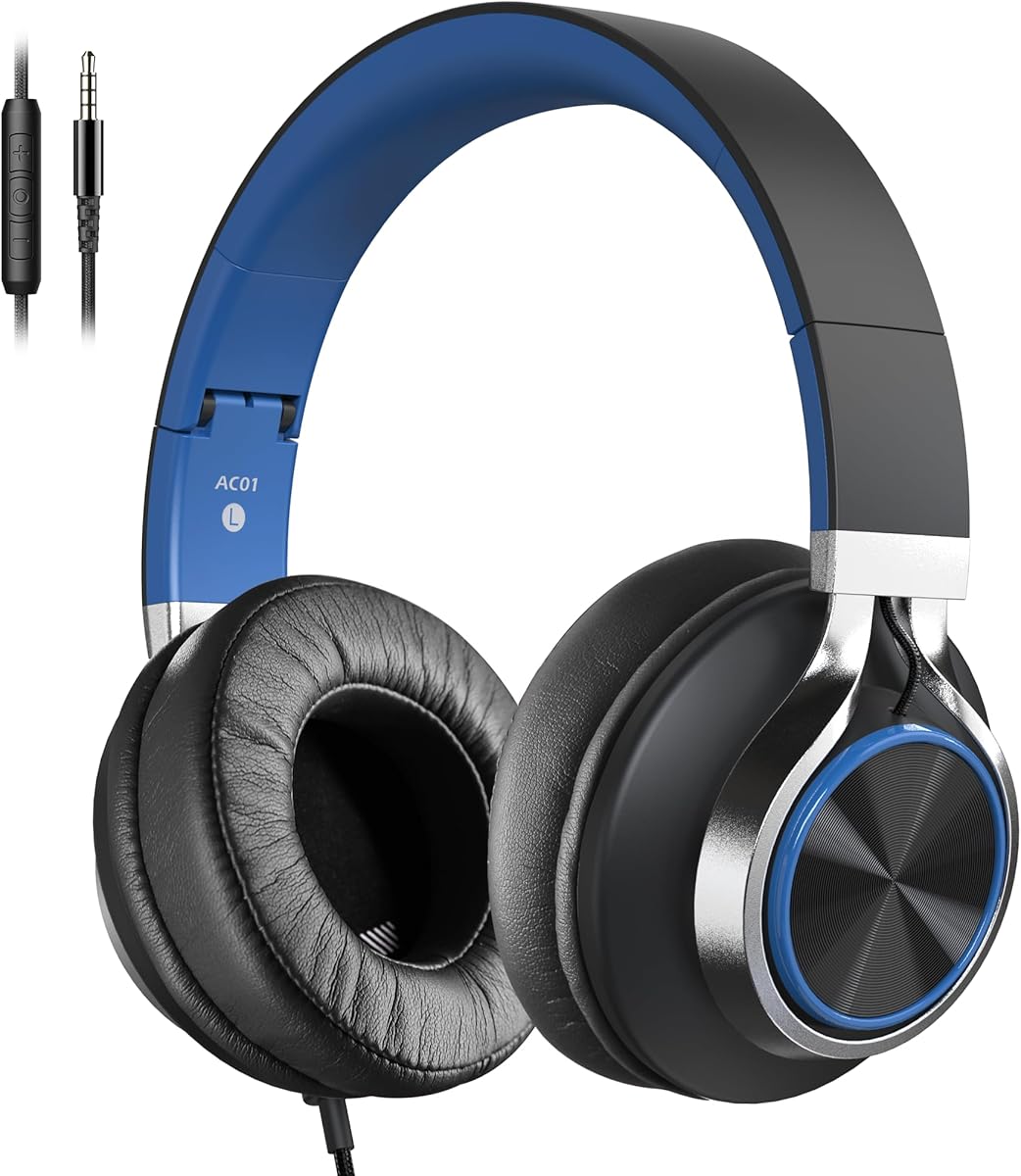
AC01 Over-Ear Headphones Wired with Mic Volume Control
The AC01 Over-Ear Headphones Wired with Mic Volume Control target the school-and-study reality that studio classics ignore. Three-hundred-sixty-degree over-ear noise-isolation construction aims to block a large share of ambient distraction, while 40mm DLC dynamic drivers deliver balanced bass and treble with clear stereo mids for lectures, language learning, and focused media. This is wired practicality for Chromebooks and tablets, not a broadcast reference.
Comfort features dominate the pitch—and for students they should. Ear cushions sized larger and deeper than many budget pads use protein leather and breathable mesh to surround the ear. The adjustable headband with a center relief zone uses lightweight TPU thinking for teens, adults, and kids twelve and older. If your last cheap headset crushed the top of your head during exam week, this design language is the corrective.
The 3.5mm gold-plated plug with onboard volume buttons covers phones, Fire tablets, Chromebooks, and laptops that still expose an analog jack. An HD microphone focuses on voice pickup with wind-noise suppression for calls, group projects, and online class comments. Important caveat from the listing: volume control and microphone functions are not compatible with all PC setups the same way; some computers need a separate adapter for mic use. Verify your device’s TRRS behavior before assuming headset CTIA wiring will just work.
Foldable, lightweight construction makes these more travel-friendly than rigid studio cans with long coiled cables. Passive isolation helps in noisy dorms without depending on ANC batteries that die during a three-hour lecture. Sound quality is immersive for the category—clear enough for YouTube lessons and pop playlists—without the ruthless treble of production monitors that make compressed lecture audio harsh.
Stack them against the Philips podcast headphones and you get a more student-lifestyle feature set with mic and inline control. Stack them against ATH-M20x and you get easier everyday wear and calling features, but less studio credibility for mixing. Against Apple EarPods, you gain over-ear isolation and a 3.5mm path for non-Lightning devices.
Buy the AC01 when the job is schoolwork, travel media, and plug-and-play calls on 3.5mm devices. They are the best student everyday pair in this wired roundup—choose Audio-Technica or Sony professional models when your priority shifts to accurate production monitoring.
Confirm your Chromebook or tablet has a 3.5mm jack or a reliable adapter. Test the mic in your class platform before the first graded session. Use isolation to your advantage in libraries, but stay aware of announcement audio you might need to hear.
Desktop PCs with separate headphone and mic jacks often need a splitter adapter for combo headsets. That is a cabling limitation, not necessarily a defect in the AC01. Check your motherboard front-panel wiring before troubleshooting software.
Move to ATH-M20x or M50X when you start producing music seriously. Move to SE215 when you need deeper isolation on the move. Move to HD 560S when home listening quality becomes the main goal.
We may earn a commission at no additional cost to you.
Sony Deep Bass Wired Earphones with Smartphone Control and Mic
Sony’s Deep Bass Wired Earphones with Smartphone Control and Mic represent the portable consumer end of wired listening: small 9mm neodymium diaphragms, a metallic black finish, and a tuning that advertises low-end energy for people who want impact from a phone jack. In a world of wireless buds, these exist for travelers who are tired of charging cases and for phones or devices that still expose analog outputs via dongle or native jack.
Deep bass is the selling point, so expect a fun lean rather than MDR-7506 neutrality. Kick drums and synth bass hit harder; ultra-analytical acoustic detail is not the mission. For commuting playlists, workouts where you accept a wired tether, and podcast voice that still needs warmth, that tuning makes sense. For mastering decisions, use the studio cans elsewhere in this guide.
Smartphone control and a mic keep the earphones socially useful. You can handle basic playback and calls without unlocking the screen every time. Convenience sits between Apple’s tightly integrated Lightning remote and Shure’s more pro, mic-less monitoring cable depending on configuration. Exact button mapping can vary by device OS, so treat call control as best-effort across Android skins.
As in-ears, fit and tip seal determine bass and noise rejection. If low end disappears, reseat the tips before assuming the drivers are weak. These will not match SE215 isolation claims or MMCX serviceability, and they are not over-ear study headphones. They win on pocketability and simple pleasure listening.
Within this pack, place them as the bass-first wired bud option beside Apple EarPods (platform integration) and Shure SE215 (pro isolation). Sony aims at enjoyment and everyday phone use. If your phone is Lightning-only without a dongle, EarPods may be smoother; if your phone is USB-C/3.5mm-friendly and you want thump, these are in the conversation.
Buy Sony Deep Bass Wired Earphones when you want inexpensive, battery-free bass-friendly buds with inline phone features. They are not the best wired headphones for studio work, but they are a valid best-in-class pick for portable fun within this set.
Bass-heavy streaming, casual gaming on phones, and spoken content where warmth helps. Skip them as your only monitoring tool for music production classes.
Wipe tips, avoid yanking the jack at an angle, and store without tight knots that stress the yoke. Inline mics fail most often from cable twists at the control module.
We may earn a commission at no additional cost to you.
Philips Over Ear Wired Stereo Headphones for Podcasts
Philips Over Ear Wired Stereo Headphones position themselves for podcasts, studio monitoring basics, and computer or instrument listening without demanding pro-audio budgets. Powerful 40mm drivers aim for crisp, clear sound, and the over-ear fit provides passive isolation so you can focus without broadcasting every click to the room. For creators who need a simple wired headset-style monitor for keyboard, guitar, or USB interface practice, that brief is clear.
Comfort is a central promise: soft ear-cup cushions and a cushioned adjustable headband target all-day sessions. Lightweight headband design reduces the fatigue that heavy gaming headsets create during long edits. These will not match velour open-back luxury, but for sealed podcast work they are intentionally wearable.
Versatility comes from the connector kit. You get a 1/8-inch (3.5mm) jack path and a snap-on 1/4-inch (6.3mm) adapter for interfaces, keyboards, and gear that still speaks in full-size headphone outputs. A two-meter cable gives desk freedom to stand, reach a guitar pedal, or keep a laptop farther from a mic stand. That length is enabling in a small studio and clumsy on a couch—coil it with intention.
Ninety-degree rotating earcups support one-ear monitoring, a practical touch when you need to hear your own voice or a room cue while keeping a cue mix in the other ear. It is a feature borrowed from DJ and studio habits and welcome at this tier. Do not expect M50X detachable cable logistics or Sony broadcast pedigree; do expect functional monitoring for learning creators.
The 4.1 rating in this pack is a signal to buy with calibrated expectations. Many listeners will find them perfectly adequate for podcasts and computer audio; critical mixers will outgrow them toward ATH-M20x, M50X, or Sennheiser open backs. Use them as a starter or secondary pair, not as a final mastering reference.
Choose Philips when you want wired over-ears with adapter flexibility for podcast and entry monitoring tasks and you are optimizing for approachability. They close this roundup as the best podcast starter over-ears—useful, honest about their tier, and easy to deploy next to a keyboard or interface.
Plug into your interface headphone out with the 1/4-inch adapter when needed. Wear one cup forward during script reads if you need acoustic self-monitoring. Keep volume conservative to protect hearing during long narrative sessions.
Step to ATH-M20x for more studio-oriented closed-back discipline, then M50X when detachable cables and higher refinement matter. Add HD 560S for home music enjoyment in quiet spaces.
We may earn a commission at no additional cost to you.

Closed-back headphones seal the cup so more sound stays in and more noise stays out. That makes models like the ATH-M50X, MDR-7506, ATH-M20x, AC01, and Philips the right tools for tracking, offices, and shared rooms. Open-back headphones vent the cup for a wider soundstage and more natural timbre—HD 560S and HD 599 SE shine at home and leak too much for libraries. In-ears such as the SE215, EarPods, and Sony deep-bass buds trade earcup comfort for portability; isolating IEMs can outperform over-ears for blocking noise if the tip seal is correct.
Wired rounds often skip ANC batteries on purpose. Passive isolation comes from cup seal, clamp, pad material, and—for IEMs—tip depth. Shure’s up-to-37 dB isolating claim is a different mechanism than wireless hybrid ANC, but in many buses and planes a deep foam tip seal is shockingly effective. Open backs offer almost no isolation; treat them as room-dependent instruments. If you need silence in chaos and also need studio accuracy, prioritize closed M50X/MDR-7506 or SE215 over open Sennheisers.
Match the connector to your devices: 3.5mm for most laptops and Chromebooks, 6.3mm adapters for interfaces and older gear, Lightning for compatible iPhones, MMCX detachable leads for serviceable IEMs. Detachable cables on M50X, HD 560S, HD 599, and SE215 are longevity features. Fixed long cables on MDR-7506 and Philips are studio-reach features that need management on tiny desks. If you need calls and class participation, prioritize EarPods, AC01, or Sony’s mic-equipped earphones—and verify TRRS compatibility on PCs.
Monitoring headphones should reveal problems: harsh esses, muddy low mids, clipped peaks. Fun consumer tunings boost bass and smooth edges so playlists feel exciting. Use M50X, MDR-7506, M20x, and HD 560S when you make decisions; use Sony deep-bass buds and lifestyle headsets when you want enjoyment first. Open Sennheisers excel at spatial realism; Shure SE215 balances pro monitoring with bass you can feel on stage.
Clamp force aids seal but can cause hotspot pain. Velour open pads usually breathe better than leatherette closed pads. In-ears fail when tips are wrong, not when drivers are doomed. Try to judge comfort after thirty minutes, not thirty seconds. If you wear glasses, pay attention to where pads meet frames—closed studio cans vary widely here.
The HD 599 SE in this pack is Renewed: inspect seller condition notes, test promptly, and use return windows. Value over-ears like AC01 and Philips can be excellent for school and podcasts without matching pro service lives. Buy for the job you have today, and plan an upgrade path when your ears or workflow outgrow the tier.
They are better for different jobs. Wired headphones win on latency for recording and gaming, consistency without codecs, and freedom from battery anxiety. Wireless wins for gym convenience and ANC commuting. Many people should own both: a wired studio or hi-fi pair at the desk and wireless buds for errands.
Start with the Audio-Technica ATH-M50X for closed-back isolation and trusted balance, or the Sony MDR-7506 if you want a broadcast-classic revealing voice. Add an open-back like the Sennheiser HD 560S for a second opinion on soundstage and reverb in a quiet room. Avoid bass-boosted consumer earphones as your only reference.
Only if your listening volume will not bother neighbors and you do not need privacy. Open backs leak. For apartments at night, closed M50X/M20x cans or SE215 IEMs are more considerate and more isolating.
Most models in this pack reach satisfying volumes from phones, laptops, and audio interfaces. A dedicated DAC/amp can clean up noisy computer jacks and improve control, especially on open Sennheisers, but it is not mandatory on day one. Fix source quality and tip/cup seal before shopping amplification.
The M20x is the entry studio option with strong isolation and enhanced low-end usefulness for tracking. The M50X adds larger-aperture 45mm drivers, a more refined overall presentation, swiveling cups, and a detachable multi-cable kit. Choose M20x to learn; choose M50X when headphones become a daily production instrument.
They can be a strong value if you buy from a listing with clear condition notes and a workable return policy. Test stereo balance, cable contacts, and headband adjustment immediately. Renewed means prior ownership and possible cosmetics—not a free pass to skip inspection.
Apple EarPods with Lightning Connector are the simplest native fit for Lightning iPhones, including remote and mic control. If your iPhone is USB-C, these Lightning EarPods are the wrong generation. For better isolation on iPhone via adapter, consider Shure SE215; for studio work, use an interface or quality dongle into M50X-class cans.
Yes—through passive isolation. Closed over-ears and well-sealed IEMs can dramatically reduce chatter and engine rumble. They will not run Transparency modes or adaptive ANC algorithms. For many study and stage uses, a solid passive seal is enough and more reliable than a dead wireless battery.
The AC01 over-ears are built for that scenario: 3.5mm plug, inline volume, microphone, and cushioned isolation for dorms and classrooms. Confirm mic compatibility with your specific Chromebook. For music production coursework, step up to ATH-M20x or M50X once assignments demand better monitoring.
Many studio monitors reveal treble energy and midrange faults that bass-heavy consumer tunings hide. That honesty helps mixing but can make poorly mastered streams feel sharp. Try moderate volume, quality sources, and a short break-in/comfort period before deciding the headphones are too bright—especially with MDR-7506’s revealing reputation.
The best wired headphones in 2026 are the ones that match your room and your jack. For most creators who need one serious closed-back workhorse, the Audio-Technica ATH-M50X is the clearest overall pick, with the Sony MDR-7506 close behind for broadcast and field monitoring DNA. If your room is quiet and you want soundstage, the Sennheiser HD 560S delivers open-back detail that sealed lifestyle headphones rarely touch.
Everyone else in this pack has a lane: ATH-M20x for entry studio budgets, Shure SE215 for isolating IEM duty, HD 599 SE Renewed for plush audiophile value with condition caveats, Apple EarPods for Lightning convenience, AC01 for school and Chromebook life, Sony deep-bass buds for portable thump, and Philips for starter podcast over-ears. Stay inside those lanes and wired listening still feels like an advantage, not a compromise.
Pick by isolation needs, connector realities, and whether you are making decisions or chasing enjoyment. Then spend a real session wearing the pair before you judge them—cables tell the truth quickly when you give them time.