Best Overall
Creative Pebble

- USB-powered 2.0 pair with 45° elevated drivers and passive radiators
- Single USB cable for power plus 3.5 mm AUX for universal PC compatibility
- Front-facing volume knob and compact pebble design for any desk
Expert Review & Guide
Built-in laptop speakers and thin monitor drivers are fine for notifications, but they flatten music, blur game cues, and push you toward headphones for anything longer than a quick video call. USB powered PC speakers exist because most desks already have a spare USB port—and buyers want better near-field sound without hunting for a wall outlet or learning driver software. In 2026 the category spans classic pebble pairs, USB-C upgrades with Bluetooth, under-monitor soundbars, clip-on monitor bars, and compact gaming-oriented boxes with touch lighting. What ties them together is power drawn from the computer itself, plus a simple analog or digital audio path that works on Windows, macOS, and Chrome OS.
This guide covers every product in our USB powered PC speakers pack and evaluates each one as desk hardware first. We looked at how much real volume a USB port can deliver, whether a design needs both USB and 3.5 mm cables or can run from a single USB-C connection, how bass behaves at arm’s length, and whether lighting or RGB helps or distracts during work hours. We also flagged models that advertise USB input but still rely on separate AC power, because that distinction matters when you are trying to simplify cable clutter. Ratings reflect listed customer scores; the recommendations below emphasize honest tradeoffs after long sessions of editing, streaming, and casual gaming.
Want the shortlist first? Choose the Creative Pebble when you want the strongest balance of sound, footprint, and plug-and-play simplicity from a true USB-powered pair. Step up to the Creative Pebble V3 if your PC has USB-C and you want louder output, Clear Dialog processing, and optional Bluetooth. Prefer a slim bar under your monitor? The Bluedee soundbar earns a top slot for dual connectivity and tidy cabling. Space-starved setups should look at the Cyber Acoustics clip-on bar, while budget buyers can start with Amazon Basics or the enduring Logitech S150. The reviews below walk through all ten pack products with setup notes, spec context, and clear cons.


As an Amazon Associate we earn from qualifying purchases. We may earn a commission at no additional cost to you.
Use this table to filter by form factor, connection style, and standout features before reading the full reviews. Specs focus on desk-relevant behavior—USB power draw, driver layout, control placement, and wireless options—rather than living-room party claims. All products draw primary power from a USB port unless noted in the review text.
The Creative Pebble earns the top spot in this USB powered PC speakers guide because it solves the most common desk problem with the least friction. Millions of workstations still output audio through a noisy headphone jack while leaving a USB port unused inches away. The Pebble uses that USB port strictly for power and keeps audio on a standard 3.5 mm AUX connection, which means compatibility across old office PCs, modern laptops, mini PCs, and many docking setups without hunting for drivers or special cables.
Sound quality is where the Pebble outclasses typical bargain USB speakers. Creative pairs custom-tuned far-field drivers with rear-facing passive radiators, a combination that helps small cabinets produce fuller mids and a touch of spring in the low end. The 45° elevated driver angle is not marketing fluff—it matters at a desk because most listeners sit slightly below the speaker plane. Angling drivers upward reduces the hollow, washed-out effect you hear when sound fires parallel to the desktop surface.
Controls are sensibly placed on the front of the right speaker, so volume adjustments do not require reaching behind a monitor or opening OS menus mid-call. That front knob becomes more important than it sounds during back-to-back video meetings, late-night YouTube sessions, and casual gaming when you want quick level changes without alt-tabbing. The design is intentionally minimal: two pebble-shaped enclosures that disappear beside a keyboard or under a monitor stand.
Setup takes under a minute. Plug the USB cable into any powered USB-A port for 5V delivery, connect the 3.5 mm cable to your PC headphone output or monitor audio pass-through, and adjust volume on the speaker. No software, no pairing dance, no firmware updates. For IT-managed machines or family computers where simplicity beats feature count, that reliability is a major selling point.
Compared with the Pebble V3, the original Pebble is quieter and lacks Bluetooth or USB-C single-cable convenience. Compared with soundbars like Bluedee, it occupies lateral desk space rather than a slim bar under the screen. Compared with Amazon Basics budget pairs, it generally delivers cleaner imaging and less boxy resonance. The honest ceiling is output level: this is a near-field upgrade, not a room-filling system.
If your desk goal is to stop relying on laptop speakers or tinny monitor audio without adding wall-wart power bricks or complex input menus, the Creative Pebble remains the safest recommendation in this pack. It is the reference point every other product here is measured against—compact, USB-powered, and genuinely pleasant for everyday PC listening.
Choose the Pebble if you want a proven USB-powered stereo pair for work calls, streaming, and light gaming on a space-limited desk. It is especially strong for users who value plug-and-play reliability over wireless extras.
Skip it if you need Bluetooth from your phone without swapping cables, or if you want substantially louder output for music-heavy sessions.
Place the speakers at equal distance from your seating position and angle them slightly inward so the tweeter axis crosses near your ears. Leave a little space behind the passive radiators so bass does not feel choked against the wall.
If your motherboard headphone output hisses, try the front panel jack or a cheap USB DAC—but the Pebble itself will still benefit from any cleaner analog source you can provide.
We may earn a commission at no additional cost to you.
The Creative Pebble V3 is the natural upgrade when you already like the Pebble form factor but want more headroom. Creative enlarged the drivers to 2.25 inches, raised RMS power to 8W, and added a built-in gain switch that unlocks louder USB audio when connected to a 10W-capable USB-C or USB-A port. On paper those numbers will not compete with active bookshelf systems, but at arm’s length the V3 feels meaningfully fuller for music, podcasts, and game effects.
Clear Dialog audio processing is the V3’s quiet killer feature for PC users who watch a lot of YouTube, lecture recordings, and streaming shows at a desk. Instead of boosting everything uniformly—and drowning dialogue in background effects—Clear Dialog emphasizes spoken word intelligibility. That means fewer moments where you rewind because a whispered line disappeared under soundtrack noise. For remote workers who live in video calls and training modules, that processing is more useful than RGB lighting.
Connectivity flexibility separates the V3 from the original Pebble. On newer laptops and MacBooks, a single USB-C cable can deliver power without a separate 3.5 mm audio run if your host supports USB audio over that port—check your device manual because behavior varies. When you need universal analog compatibility, the 3.5 mm AUX input remains. Bluetooth 5.0 covers the lazy evening scenario: pair your phone from bed or the couch without dragging the PC into the session.
Physically, the V3 retains the 45° elevated drivers and minimalist pebble aesthetic, but adds a longer cable between left and right speakers for more flexible placement around monitor stands and desk organizers. The black finish also hides office dust better than the white original. Volume and power controls stay front-facing for quick access.
Honest tradeoffs: the gain switch is not magic. If your USB port only supplies basic 5W, you will not reach the loudest advertised performance. Bluetooth is convenient but not ideal for competitive gaming due to latency. And if you planned to use AUX exclusively, remember the cable is not bundled—you may already have one in a drawer, but budget for it if not.
Buy the Pebble V3 when your desk has USB-C, you want louder pebble speakers, and you appreciate optional wireless streaming. Stick with the original Pebble if absolute simplicity and the highest pack rating matter more than volume and Bluetooth.
On supported hosts, USB-C alone reduces clutter dramatically. On older desktops, use the included USB-A adapter for power and keep a 3.5 mm cable for audio—still tidy, just not one-cable tidy.
Flip the gain switch only after confirming your port can supply 10W; otherwise leave it in standard mode to avoid unstable behavior or thin-sounding distortion at max volume.
Listeners who routinely push volume for music and games will hear the upgrade immediately. Remote workers who struggle with muddy dialogue on laptop speakers will benefit from Clear Dialog.
If your desk is already crowded and you refuse extra cables, verify USB-C audio support before buying—the V3 can simplify wiring, but not on every PC.
We may earn a commission at no additional cost to you.
Bluedee Computer Speakers for Desktop PC
The Bluedee soundbar answers a specific desk complaint: stereo pairs eat horizontal real estate. Measuring roughly 16.4 inches wide, it slides under most monitors and keeps your keyboard zone clear. Power still comes from USB—laptop, desktop, power bank, or adapter—so you avoid another wall brick unless you choose one for convenience. That makes it a strong USB powered PC speaker for compact workstations, dorm desks, and dual-monitor setups where speaker placement otherwise becomes a puzzle.
Audio hardware centers on dual drivers with dual diaphragms, a layout Bluedee markets as Hi-Fi stereo for PC use. Anti-magnetic technology targets the hiss and interference cheap speakers sometimes pick up when placed near LCD panels or poorly shielded cables. At near-field distances the result is usually cleaner highs and less fatigue during long editing sessions. Dual diaphragms help the slim enclosure produce a more balanced presentation than a single-driver bar, though physics still limit how deep sub-bass can go without a dedicated woofer.
Connectivity is practical. Bluetooth 5.0 handles phone playlists and tablet video when you step away from the PC, while the 3.5 mm jack keeps a zero-latency wired path for gaming and calls. The braided Y-cable merges USB power and analog audio into one run from the PC side, which is a small detail that makes daily use feel more polished than juggling separate cables that drift behind the desk.
Ambient light strips round out the aesthetic without forcing software installs. The glow is gentle—more desk mood than disco—which suits shared home offices where aggressive RGB would distract a partner on camera. If you want a gaming battlestation look, this is subtler than touch-lit compact pairs like the LENRUE G11.
Setup is genuinely plug-and-play: USB for power, AUX or Bluetooth for audio, bar centered under the monitor. Aim the bar forward and avoid pushing it flush against the back wall if mids sound boxy. Because the enclosure is wide but shallow, bass reflex behavior depends heavily on the gap beneath your monitor—experiment with a half-inch of breathing room.
Choose Bluedee when soundbar ergonomics matter more than traditional stereo imaging. Choose Creative Pebble pairs when you want separated channels for slightly wider staging. The Bluedee is the best soundbar-style USB powered option in this pack for users who prioritize desk cleanliness and dual wired/wireless connectivity.
Stereo pairs generally image better for games that rely on left-right cues because drivers sit farther apart. Soundbars trade some width for footprint efficiency and often feel more coherent for centered dialogue.
If your monitor stand has a low shelf or deep lip, measure clearance before buying—the Bluedee is slim but not invisible.
Bluedee highlights eco-friendly ABS construction and cardboard packaging, which may matter if sustainability influences your gear choices.
The listing mentions lifetime after-sales support via Amazon messages—worth remembering if you hit a DOA unit or cable defect early on.
We may earn a commission at no additional cost to you.

OHAYO 60W Computer Speakers for Music and Gaming
The OHAYO 60W pair appears in this USB powered PC speakers pack because it offers USB among its inputs, but honesty matters: this is an active bookshelf system first. The 30W-per-channel amplification, MDF wooden cabinets, carbon-fiber silk-dome tweeters, and three-inch full-range drivers require wall power to deliver their best performance. Treat USB here as a convenience input path, not the five-volt lifeline that defines the Pebble or Logitech S150.
Why include it anyway? Because many shoppers start searching for USB powered speakers, realize they want more scale, and wonder how far up the ladder they can climb without entering full studio-monitor territory. OHAYO answers that question with distortion-free headroom, rear bass ports, and an integrated sound card that keeps playback smooth for gaming and music. If your desk doubles as a listening station—not just a call center—the OHAYO delivers a bigger step up than any true USB-only pair in this list.
Connectivity is unusually broad for a computer speaker listing. Bluetooth 5.3 handles wireless phone streaming, RCA supports turntables and receivers, AUX covers standard PC outputs, and USB adds another digital-friendly path depending on your source device. That versatility makes the OHAYO a hub for mixed setups: desktop PC by day, vinyl or TV by evening, phone playlist during breaks.
Build quality cues—MDF cabinets, carbon-fiber drivers, front volume knob—signal a product meant to stay on the desk for years. Plastic pebbles are fine for portability, but wooden enclosures typically damp resonance better, which helps vocals and acoustic instruments sound less cardboard-like. The rear bass port adds low-end extension you simply cannot physics-engineer out of a palm-sized USB puck.
Tradeoffs are size and power style. These speakers occupy real estate beside your monitor and need an outlet. They are not travel-friendly, and they overshoot the plug-and-play USB ethos if that is your only requirement. Cable management takes a few extra minutes compared with a single USB soundbar.
Buy OHAYO when you outgrow USB power limits but still want a compact bookshelf aesthetic for PC gaming and music. Skip it if you need bus-powered simplicity, clip-on monitor mounting, or the smallest possible footprint.
True USB powered speakers draw 5V from your PC port to run amplifiers. The OHAYO uses mains-powered amplification and lists USB as one of several input options.
If your buying rule is strictly no wall adapters, prioritize Creative Pebble, Logitech S150, or Cyber Acoustics instead.
Flank the monitor with equal spacing and toe-in toward your ears. Keep the rear ports a few inches from the wall to avoid boomy bass.
Use wired AUX or USB for gaming latency; reserve Bluetooth for music when reaction time does not matter.
We may earn a commission at no additional cost to you.
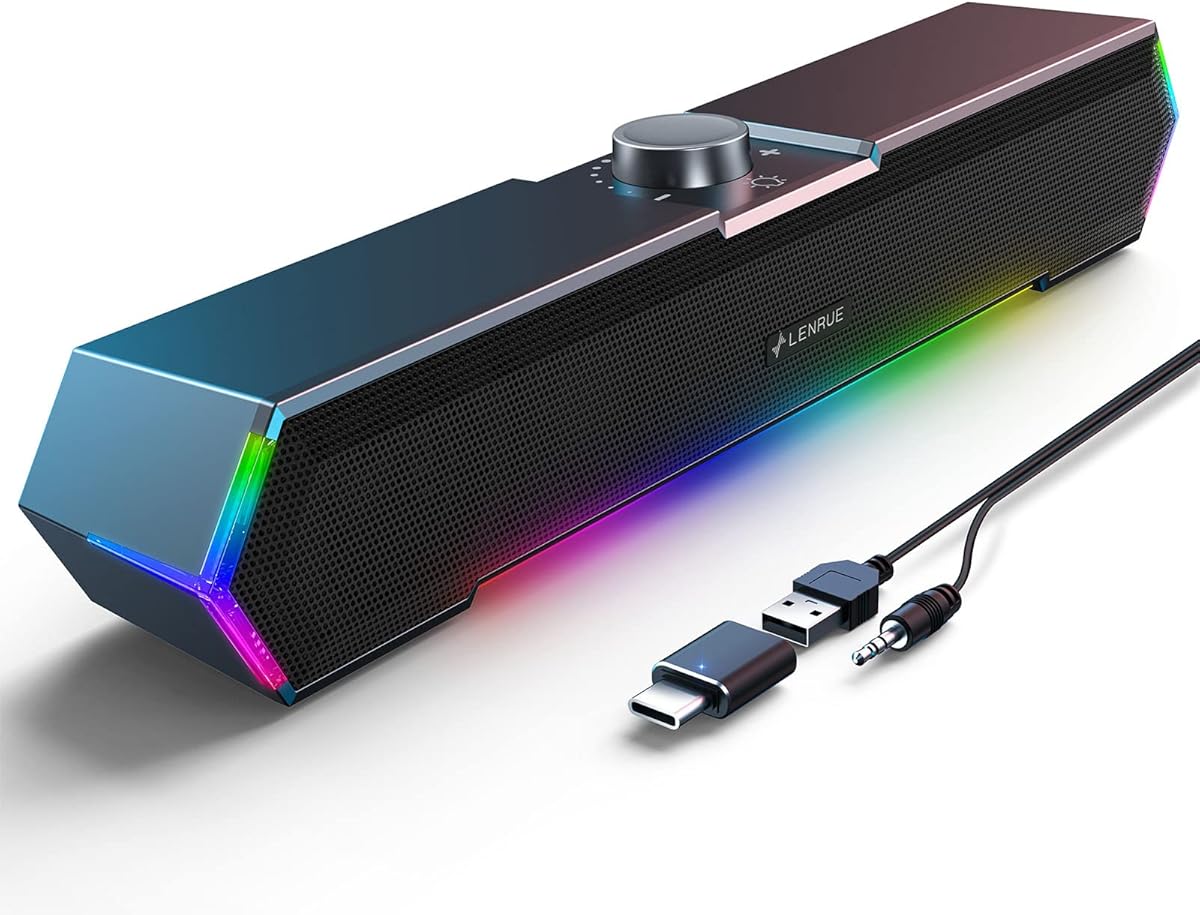
LENRUE G11 Computer Speakers for Desktop
The LENRUE G11 targets gamers and students who want USB powered PC speakers with personality. Its angular enclosure and touch-controlled atmosphere lights create a desktop look that reads gaming setup more than corporate cubicle. Touch control matters because many budget speakers hide lighting buttons on the rear panel where they are useless once cables are routed. Here, one tap toggles lights without spinning the speaker around.
Audio hardware uses four amplifier IC horns—a marketing phrase that translates to a compact stereo pair tuned for louder perceived output than typical plastic cubes. LENRUE claims distortion-free performance for movies, games, and music. Realistically, any bus-powered speaker hits physics limits, but the G11 aims for clearer highs and less grit when you push volume during action scenes or multiplayer alerts.
Desk ergonomics receive thoughtful attention. Cables are glued together to reduce the rat’s nest that separate USB and AUX runs create. The top-mounted volume knob is easy to find blind during gameplay. The overall footprint is designed to sit under a monitor without consuming lateral space—similar philosophy to a soundbar, but still a separated stereo pair for slightly wider staging.
Compatibility is straightforward for Windows, macOS, and Chrome OS via USB power plus 3.5 mm audio. The included USB-C adapter helps newer laptops that standardized on Type-C ports. Setup is truly plug-and-play: no drivers, no apps, no firmware.
Limitations are clearly stated in the listing and worth repeating. No Bluetooth means your phone cannot wirelessly hijack the speakers without a separate transmitter. No headphone jack means private listening requires plugging headphones directly into the PC, not the speakers. No TV compatibility rules this out for living-room reuse. And the lighting—while fun—may reflect off glass desks or appear unprofessional on camera.
Choose the LENRUE G11 when you want compact USB power, touch lighting, and gaming visual flair at a moderate footprint. Choose Creative Pebble V3 if you need Bluetooth or Clear Dialog for work-heavy desks.
Touch-off lighting before important calls if your desk surface is glossy—reflections can distract viewers more than the lights themselves.
If you stream or record desk content, test camera white balance with lights on; some webcams auto-expose poorly against colored LEDs.
Student gaming setups, dorm desks, and secondary PCs benefit most from the compact size and visual flair.
Skip if you need headphone passthrough, Bluetooth, or a neutral appearance for client-facing work.
We may earn a commission at no additional cost to you.
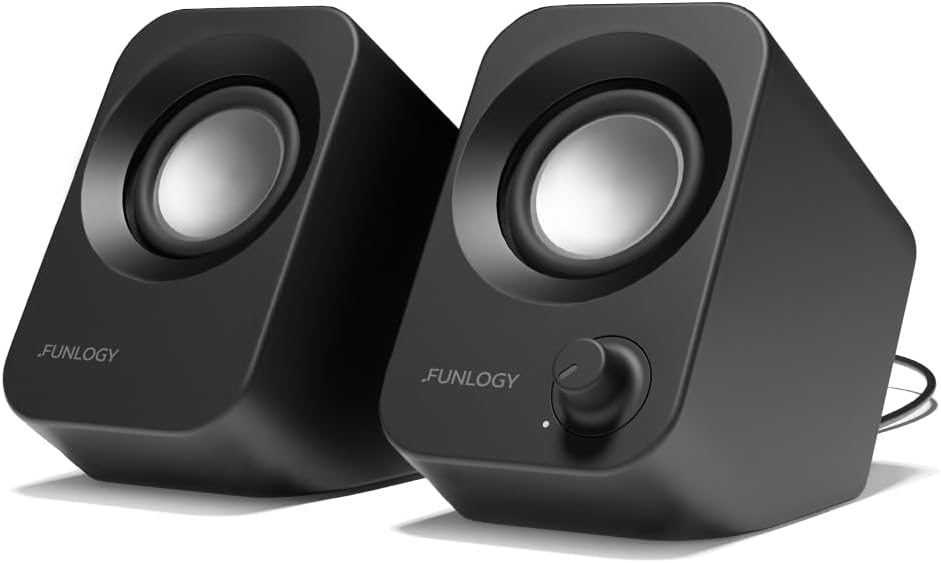
FUNLOGY Speaker - 14W Stereo PC Speakers
FUNLOGY enters the USB powered PC speaker conversation with a palm-sized stereo pair that claims 14W total output— noticeably higher on paper than the 2.2W Amazon Basics compact or 1.2W Logitech S150. Dual 48 mm full-range drivers and passive radiators aim to deliver crisp highs, clear mids, and punchy bass within USB power constraints. The 30° upward tilt ensures sound fires toward your ears rather than into the desk mat, a design choice that parallels Creative Pebble’s 45° elevation.
Build and signal-path details separate FUNLOGY from anonymous generic cubes. Gold-plated AUX inputs and noise-reducing component selection target the static pops some users hear during PC startup, shutdown, or USB port power cycling. If you have ever owned budget speakers that crackle when the GPU spins up, that engineering focus is meaningful even if it is invisible in photos.
The brand highlights VGP 2024 award recognition—a Japanese audio/visual product award that signals industrial design and performance scrutiny beyond random Amazon white-labeling. Combined with a one-year warranty and matte finish, the FUNLOGY pair feels like a deliberate product rather than a rebadged OEM shell.
Setup follows the standard USB power plus 3.5 mm audio formula. Compatibility extends to gaming consoles and smartphones with headphone outputs, making this a flexible travel speaker for hotel desks and LAN parties where you only have USB power from a monitor or console port. Volume dial control on the speaker keeps adjustments tactile.
Honest expectations: 14W total is strong for bus-powered hardware but still near-field territory. You will not shake the room. Without Bluetooth, phone streaming requires a cable or connecting through the PC. And FUNLOGY lacks the decade-long reputation Creative and Logitech enjoy—early reviews are encouraging, but long-term durability data is thinner.
Buy FUNLOGY when you want compact USB speakers with tilted drivers and higher claimed wattage than ultra-budget alternatives. Compare directly with Creative Pebble V3 if USB-C, Bluetooth, and Clear Dialog matter more than raw compact wattage marketing.
Tilted drivers reduce the need for speaker stands on flat desks. If you use a tall monitor arm, verify the speaker height still aligns with your ear line.
Passive radiators need a little rear clearance—avoid pushing the FUNLOGY pair flat against a wall panel.
USB power from monitors and consoles can run the FUNLOGY pair when you want better sound than a TV or handheld display provides—just confirm the host supplies adequate 5V current.
Pack the combined cable carefully; glued or fixed cable lengths can stress connectors if bent sharply in a backpack.
We may earn a commission at no additional cost to you.

Amazon Basics Stereo 2.0 Speakers for PC or Laptop with Volume Control
Amazon Basics built its reputation on no-frills accessories that work, and these stereo 2.0 USB speakers follow that script. They draw power from any PC or laptop USB port, accept audio through a 3.5 mm aux input, and place volume control inline on the cable—a smart choice when the speakers sit behind a monitor and front knobs become hard to reach.
The bottom radiator is the standout hardware detail at this tier. Many budget USB speakers rely entirely on tiny full-range drivers with no passive assistance, which produces thin bass and nasal vocals. A bottom-firing radiator helps the enclosure move more air, yielding a springier low end that makes YouTube and Spotify more listenable even if it never approaches subwoofer depth.
Aesthetics are understated: black metal-look finish, scratch-free padded base, and blue LED lights that confirm power status. The LEDs divide opinion—some users like the visual confirmation, others tape them over for dark-room movie watching. There is no RGB circus, which keeps the pair office-appropriate.
Sound expectations should stay realistic. These are upgrade speakers for people escaping laptop misery, not reference monitors for mixing. Vocals come forward adequately for calls, highs are acceptable, and bass is boosted enough to feel present without overwhelming small drivers. Distortion appears if you max volume on quiet sources, so leave headroom.
Compared with the even cheaper Amazon Basics compact model elsewhere in this pack, the stereo 2.0 pair spreads drivers wider for slightly better imaging and includes the bottom radiator for fuller tone. Compared with Creative Pebble, they lack elevated drivers and passive radiators on the rear, so placement and angle matter more.
Choose this pair when budget is the primary filter and you still want separated stereo speakers rather than a single bar. Skip if you need Bluetooth, USB-C single-cable setups, or the highest fidelity in the pack.
Cable-mounted volume dials remain reachable when speakers live behind ultrawide monitors—front-knob designs often fail that ergonomics test.
If the inline control slides under the desk, add a small adhesive clip to keep it at hand height.
Pair these with a quiet USB DAC if your motherboard headphone jack hisses—still cheaper than jumping to active bookshelf speakers.
Consider Pebble V3 later if you outgrow the sound but want to stay USB-powered.
We may earn a commission at no additional cost to you.

Cyber Acoustics CA-2890 USB Speaker Bar
The Cyber Acoustics CA-2890 solves a problem most stereo pairs ignore: zero desk footprint. Instead of occupying space beside your keyboard, the CA-2890 clips to the bottom edge of your monitor and fires sound forward from an elevated position. For standing desks with minimal depth, glass tables, or shared kitchen workstations, that mounting style can be the difference between speakers that fit and speakers that do not.
Single-cable USB operation is the CA-2890’s other headline feature. Many USB powered PC speakers still need two connections—USB for power and 3.5 mm for audio. Cyber Acoustics routes audio over USB digital connection, so one plug handles both jobs. That reduces cable clutter and simplifies laptop portability: one port, one cable, done. A bundled USB-A to USB-C adapter covers newer notebooks with limited legacy ports.
Controls are unusually complete for a clip-on bar. Volume up/down, mute with LED confirmation, and play/pause buttons live on the speaker body where you can reach them while glancing at the screen. Mute LED status is a small detail that prevents embarrassing hot-mic moments when you thought silence was engaged.
Sound performance prioritizes convenience without pretending to be hi-fi. Reviews and listing copy emphasize loud, room-filling audio with clear highs and enhanced bass for the size. Elevated forward-firing placement helps projection because sound originates near screen center rather than bouncing off the desk first. Still, a clip-on bar cannot reproduce sub-bass; manage expectations for cinematic rumbles.
Compatibility requires measurement. The clip accommodates monitors up to one inch thick. Ultra-thin bezels, curved panels, and some monitor arms may interfere with a secure mount. If your display wobbles or tapers oddly, test placement carefully before committing.
Choose the CA-2890 when desk space is absolutely zero and you want one USB cable. Choose Bluedee if you prefer under-monitor bars that rest on the desk. Choose Creative Pebble if stereo separation matters more than mounting innovation.
Measure bezel thickness at the bottom edge, not the screen diagonal. Curved monitors and some ultrawides taper where the clip grabs.
If the monitor sits on a heavy gas arm, check that added speaker weight does not tilt the panel forward.
Select the CA-2890 as your default output device in Windows or macOS sound settings after plugging in USB.
If audio drops when waking from sleep, toggle the output device once—a common USB audio quirk across brands.
We may earn a commission at no additional cost to you.

Amazon Basics USB-Powered Computer Speakers with Volume Control for Desktop or Laptop PC
This Amazon Basics compact pair is the minimalist answer when you need USB powered PC speakers that disappear in a backpack. Measuring roughly 2.76 by 3.55 by 5.3 inches per speaker and weighing about 1.4 pounds combined, the set is built for portability first. Hotel desks, library carrels, temporary WFH setups, and kids’ homework laptops are the natural habitats—not permanent audiophile stations.
Power and audio follow the standard split: USB draws 5V from the host, 3.5 mm carries analog audio. Total RMS power is rated at 2.2 watts—1.1 watt per channel—which tells you exactly where volume ceiling lives. This is enough for personal near-field listening, notification chimes, and video calls in a quiet room. It is not enough for loud music parties or competitive gaming at arm’s length with mechanical keyboard clatter in the background.
The front-panel volume knob doubles as an On/Standby switch, a thoughtful integration that prevents leaving speakers hot when you unplug audio but forget power draw. The headphone jack is a rare bonus at this size—plugging headphones directly into the speaker can be easier than reaching around a laptop when you need instant privacy.
Frequency range is listed from 103 Hz to 20 kHz, which implies limited sub-bass extension by specification alone. Voices and podcast speech remain intelligible because the midrange is the priority at this tier. Music with heavy bass will sound thin unless you adjust EQ in software—and even then, physics caps results.
Honest positioning: these speakers compete with laptop drivers more than with Creative Pebble. They win on size, weight, and headphone convenience. They lose on clarity, staging, and low-end warmth. If budget is tight and space is tighter, they fulfill the basic brief. If you can stretch slightly, the Amazon Basics stereo 2.0 model or Logitech S150 offers better desk permanence.
Buy this compact pair for travel and temporary setups. Upgrade within the pack when the speakers become daily drivers for music, gaming, or content creation.
Use the speaker-mounted headphone jack when you quick-switch between shared and private listening without re-plugging at the PC rear panel.
Note that inserting headphones may mute speaker output depending on internal wiring—test once so you are not surprised mid-call.
Consultants who live out of carry-ons and students who move between dorm and library benefit most.
Skip if this will be your only desk speaker for years—you will outgrow 2.2W RMS quickly.
We may earn a commission at no additional cost to you.

Logitech S150 USB Speakers with Digital Sound
The Logitech S150 is the elder statesman of USB powered PC speakers—an ASIN that has persisted because it executes a narrow brief well. Slim enclosures, USB digital audio and power over one cable, front volume, front mute, and an orange LED that confirms the speakers are live. For office deployments, school labs, and IT closets that standardize on simple peripherals, that predictability matters more than feature chasing.
Digital USB audio eliminates the second cable that analog pairs require. Plug the USB-A connector into the PC, select the S150 as output if needed, and audio routes directly. Muting from the speaker is invaluable in open offices where software mute fails or lagging conference apps leave microphones hot. Volume control on the right speaker stays reachable because the cabinets are tall and slim rather than deep cubes hidden behind monitors.
Sound quality reflects the 1.2W RMS rating honestly. The S150 produces balanced, clear audio for spoken word, system sounds, and light media consumption. It will not satisfy music enthusiasts or gamers seeking impact. Depth is modest, bass is minimal, and high-volume listening introduces harshness. Within its design lane, however, it beats many laptop speakers and takes almost no space doing it.
Build is lightweight plastic—durable enough for desk life, not inspiring on a premium setup. The aesthetic reads early-2000s office supply, which is exactly why it still fits corporate bulk orders. If your desk is a design statement, look at Creative Pebble or FUNLOGY instead. If your desk is a function-first workstation, the S150 disappears.
Compatibility spans Windows, macOS, and Chrome OS with standard USB drivers. Disconnect USB to power off—there is no separate switch beyond unplugging. For users who want the absolute simplest USB speaker with mute, Logitech still owns that niche.
Choose the S150 for office clarity, cubicle constraints, and one-cable digital USB simplicity. Skip it if you want modern Bluetooth, louder RMS output, or bass that keeps up with streaming playlists.
Enterprise buyers value SKUs that do not change every year—replacement units match the old ones visually and functionally.
Individual buyers benefit from that same stability when they want a known quantity without researching anew.
Use a USB-A port or a quality adapter if your laptop is USB-C only—avoid bus-powered hubs that starve amplification.
Set the S150 as default communications device in OS settings so calls route correctly on first connect.
We may earn a commission at no additional cost to you.
USB powered PC speakers draw electrical power from a USB port—typically 5V on USB-A or USB-C—rather than a dedicated wall adapter. That does not always mean USB carries audio. Many pairs use USB strictly for power and rely on a 3.5 mm analog cable for sound. Others, like the Logitech S150 and Cyber Acoustics CA-2890, route digital audio over USB so one cable suffices. A third category, represented here by OHAYO, lists USB as an input but uses AC power for amplification. Read listings carefully so you are not surprised by extra cables or wall bricks.
Power draw limits matter. Standard USB 2.0 ports supply 500 mA; USB 3.x often delivers more. Speakers with gain switches or high wattage marketing—Creative Pebble V3 at 10W USB, FUNLOGY at 14W total—may sound best on powered ports or direct motherboard connections rather than unpowered hub daisy chains.
Traditional stereo pairs like Creative Pebble spread drivers apart for wider imaging—useful for games with positional audio and music with stereo separation. Under-monitor soundbars like Bluedee minimize lateral clutter and center dialogue on ultrawide screens. Clip-on bars like the Cyber Acoustics CA-2890 eliminate desk footprint entirely but require compatible monitor bezels. Compact cubes like Amazon Basics compact or Logitech S150 suit travel and cubicles where every square inch counts.
Measure before you buy. Soundbars need width clearance under the monitor. Clip-ons need bezel thickness under one inch. Stereo pairs need space beside stands, lamp bases, and microphone arms.
If your PC headphone jack is noisy, prefer USB digital speakers or add an external DAC rather than amplifying hiss. If you switch between desktop and laptop, look for USB-C adapters bundled in the box—LENRUE and Cyber Acoustics include them. If you stream from a phone regularly, Bluetooth models like Pebble V3 and Bluedee save cable swaps.
Chrome OS, macOS, and Windows generally handle USB audio class devices without drivers, but sleep/wake glitches happen. Knowing how to re-select your output device saves frustration.
Bus-powered speakers cannot produce subwoofer bass or party volume. Passive radiators, tilted drivers, and bottom-firing radiators help within physics limits but do not rewrite them. For near-field desks—arms-length listening—good USB speakers dramatically improve clarity and comfort. For room-filling music or cinematic LFE, step up to active bookshelf pairs like OHAYO or add a powered sub later.
Ratings in this pack cluster between 4.2 and 4.6, signaling broadly satisfied buyers rather than perfect products. Read cons sections for dealbreakers like missing headphone jacks, no Bluetooth, or lighting you may dislike on camera.
Front volume knobs, inline cable controls, and dedicated mute buttons reduce friction during calls. Touch lighting on LENRUE and ambient strips on Bluedee add personality but may distract on video. Neutral options like Creative Pebble white/black or Logitech S150 fit professional backgrounds better.
If you share a space, prioritize mute hardware and headphone jacks—even a basic Amazon Basics compact includes a headphone port for quick privacy.
For most users, the Creative Pebble remains the best overall USB powered PC speaker because it combines proven sound tuning, 45° elevated drivers, passive radiators, and true plug-and-play USB power with wide 3.5 mm compatibility. If your PC has USB-C and you want louder output plus Bluetooth, upgrade to the Creative Pebble V3. Desks with zero lateral space should consider the Bluedee soundbar or Cyber Acoustics clip-on bar instead of a traditional stereo pair.
True USB powered models in this guide—Creative Pebble, Pebble V3, Logitech S150, Amazon Basics pairs, LENRUE G11, FUNLOGY, Bluedee, and Cyber Acoustics CA-2890—draw power from your computer’s USB port and do not require a wall adapter for normal operation. You may optionally plug USB into a power adapter when using the speakers with a phone output or non-PC source. The OHAYO 60W pair is different: it is an active bookshelf system that requires AC power and lists USB among several audio inputs, not as its sole power source.
Yes, with the right cable or adapter. Several products here include USB-C adapters—notably LENRUE G11 and Cyber Acoustics CA-2890. Creative Pebble V3 natively supports USB-C power and can simplify cabling on modern notebooks. Avoid unpowered USB-C hubs when driving higher-wattage compact speakers; connect directly to the laptop when possible for stable volume and fewer dropouts.
USB ports can deliver power and, on some devices, digital audio—but many budget and mid-tier speakers use USB only for 5V power while receiving analog audio through a 3.5 mm jack. This split keeps compatibility with older desktops and simple docking setups. Models like Logitech S150 and Cyber Acoustics CA-2890 route audio over USB digitally, eliminating the aux cable. Check each product listing so you know whether you need one or two cables.
They are good for casual and single-player gaming at a desk where you sit close to the speakers. Positional audio benefits from separated stereo pairs like Creative Pebble or LENRUE G11 more than mono bars. Competitive multiplayer players may still prefer headphones for footstep detail and communication clarity. For louder, bass-heavy gaming without headphones, consider stepping up to the OHAYO active pair—accepting that it is not bus-powered—or use wired connections on Bluetooth-capable speakers to minimize latency.
Most USB-A ports supply 5 volts at up to 500 mA on USB 2.0 or 900 mA on USB 3.0, though many modern motherboards and laptops deliver more on dedicated ports. Speakers advertising 8W, 10W, or 14W total output may include peak or system-level marketing numbers that assume ideal port conditions. If volume sounds weak or distorts at high levels, try another port, skip unpowered hubs, and on Pebble V3 verify whether the gain switch matches your port’s capability.
The original Creative Pebble is quieter, uses USB for power with 3.5 mm analog audio, and lacks Bluetooth. The Pebble V3 adds larger 2.25-inch drivers, 8W RMS output, Clear Dialog speech processing, Bluetooth 5.0, USB-C single-cable convenience on supported hosts, and a gain switch for louder USB audio from 10W-capable ports. Both share 45° elevated drivers and compact pebble styling. Choose V3 for volume and wireless; choose the original for maximum simplicity and the highest customer rating in this pack.
Often yes, if the monitor’s hub supplies enough current and passes audio from the PC correctly—but results vary. Many users connect USB power to the monitor and run a 3.5 mm audio cable from the monitor’s headphone output to the speakers. USB digital-audio models like the CA-2890 may work best connected directly to the PC rather than through monitor hubs that renegotiate power oddly during sleep states.
None of the products in this USB powered PC speakers pack include a dedicated subwoofer. Some use passive radiators or bottom radiators to extend bass within small enclosures—the Creative Pebble pair, Amazon Basics stereo 2.0, and FUNLOGY among them—but true sub-bass requires larger cabinets or a separate powered woofer. If deep bass is non-negotiable, the OHAYO bookshelf pair in this pack offers the strongest low-end extension, though it requires AC power rather than USB bus power alone.
For speech clarity, prioritize models with Clear Dialog processing (Creative Pebble V3), elevated drivers that aim sound at your ears (Creative Pebble, FUNLOGY), or clip-on bars that sit near screen center (Cyber Acoustics CA-2890). Dedicated mute buttons on the Logitech S150 and CA-2890 help open-office etiquette. Avoid touch-lit gaming speakers if LED reflections distract your webcam background. Always test default communications device settings in your OS so calls route to the new speakers on day one.
USB powered PC speakers occupy a sweet spot for desks that need better sound without adding wall-wart clutter or learning complex software. This pack spans the full range—from travel-friendly Amazon Basics compact cubes and the enduring Logitech S150 to Creative’s pebble icons, gaming-lit LENRUE boxes, Japanese-designed FUNLOGY tilt pairs, slim Bluedee soundbars, clip-on Cyber Acoustics bars, and the AC-powered OHAYO bookshelf upgrade when you outgrow bus-powered limits.
Most buyers should start with the Creative Pebble for balanced sound and reliability, move to the Pebble V3 when USB-C and Bluetooth enter the picture, or pick Bluedee and Cyber Acoustics when desk space dictates form factor over traditional stereo staging. Budget shoppers are served by Amazon Basics options; minimalist office buyers by the S150; gaming aesthetics by LENRUE; louder near-field listening by FUNLOGY.
Match connection style to your PC ports, set realistic bass expectations, and place drivers where they fire toward your ears rather than into the desk. Do that and even modest USB power goes a long way toward making a workstation feel finished—clearer calls, richer playlists, and game audio you do not have to wear on your head all day.