Expert Review & Guide

Best Speakers for Turntable in 2026: Powered Pairs That Match

Pairing a turntable with the right speakers is less about chasing the loudest pair on the shelf and more about matching outputs, placement, and listening habits. Most modern vinyl rigs output a line-level signal from a built-in phono preamp—or a raw phono signal that still needs external amplification before it reaches any speaker. Powered bookshelf speakers solve half that puzzle by integrating amplification inside the cabinet, so you can often skip a separate receiver entirely when your turntable offers RCA line out.

This guide covers ten active pairs drawn from one product pack, all suited to desk setups, living-room listening corners, and hybrid systems where a record player shares space with a TV or laptop. We ranked them for turntable use specifically: RCA and AUX connectivity, whether a separate phono stage is required, Bluetooth convenience versus wired purity, and how each pair handles the warm midrange and transient detail vinyl listeners notice first. Listed star ratings come from the product pages at research time.

Need a fast answer? Choose the PreSonus Eris Accent when you want a purpose-built turntable bookshelf pair with sub-out expansion and remote control. Grab the Edifier R1280DBs if you want classic wood-finish stereo with Bluetooth and optical inputs for a TV on the same shelf. Pick the PreSonus Eris 3.5 when accurate near-field monitoring matters as much as evening albums. Every product in the pack gets a full comparison row and a detailed review below.

Our Top Turntable Speaker Picks for 2026

As an Amazon Associate we earn from qualifying purchases. We may earn a commission at no additional cost to you.

Turntable Speakers Compared Side by Side

Every row below uses only products from this pack. Specs emphasize connectivity and driver layout—the details that matter when you are wiring a turntable rather than shopping by wattage alone. Confirm whether your record player outputs line-level RCA or phono-level signal before you buy; several listings note that a separate preamp is required for phono-only outputs. Ratings reflect listed customer scores at research time.

#ProductSpecificationsScore
1
  • 42W RMS active wooden bookshelf pair
  • Dual AUX inputs for two wired sources
  • Side EQ knobs and included remote
9.2
2
  • Hi-Res certified active monitor pair
  • 18W x 2 RMS with 3.5-inch and 1-inch drivers
  • TRS, RCA, AUX, headphone out, BT 5.4
9.2
3
  • 40W x 2 active pair with 4-inch woofer
  • Optical, coax, RCA, AUX, and BT 5.3
  • Sub-out jack for powered subwoofer add-on
8.8
4
  • 42W RMS Bluetooth 5.0 wooden bookshelf pair
  • Optical, coax, RCA, and sub-out connectivity
  • Remote switching plus side bass and treble
9.2
5
  • 30W x 2 compact active stereo pair
  • Bluetooth 5.3 plus RCA, AUX, and USB inputs
  • MDF enclosure with rear bass port
9
6
  • 50W near-field studio monitor pair
  • 3.5-inch woofer, 1-inch silk-dome tweeter
  • TRS, RCA, front aux, and headphone jack
9
7
  • 30W x 2 active Bluetooth bookshelf pair
  • Optical, coax, RCA, and AUX wired inputs
  • Remote and top-panel input controls
8.8
8
  • 36W RMS pair with 5-inch woofer and silk dome tweeter
  • BT 5.4 plus RCA, AUX, and USB digital audio
  • Ten-step bass and treble adjustment with remote
9
9
  • 42W RMS Bluetooth 5.0 bookshelf pair in black
  • Optical, coax, RCA, and sub-out connectivity
  • Remote switching plus side bass and treble
9.2
10
  • 50W powered pair with 4-inch woofer
  • USB-C and RCA inputs with sub-out
  • Remote control and onboard tone shaping
9.6

1. Edifier R1280T - Best Classic Wired

Edifier R1280T Powered Bookshelf Speakers - 2.0 Active Near Field Studio Monitor

Edifier R1280T Powered Bookshelf Speakers - 2.0 Active Near Field Studio Monitor

9.2/10★★★★★

The Edifier R1280T is the wired foundation many turntable owners still recommend years after launch, and the 4.6 rating on the listing reflects that staying power. At 42 watts RMS with a 13 mm silk-dome tweeter and four-inch full-range driver, the pair targets near-field listening where vinyl detail matters more than party volume. That scale fits bedroom setups, home-office desks, and compact living rooms where a record player shares a Kallax shelf with the speakers.

  • 42W RMS active wooden bookshelf pair
  • Dual AUX inputs for two wired sources
  • Side EQ knobs and included remote
Check Price →
✓ Pros
  • Natural, relaxed tone that flatters vinyl vocals and acoustic instruments
  • Dual AUX inputs keep turntable and a second source connected simultaneously
  • Side bass and treble knobs make quick room tuning easy without software
  • Wood-effect MDF cabinets look at home beside classic turntable plinths
  • Remote volume control when speakers sit across the room from the deck
✕ Cons
  • No Bluetooth or digital optical inputs on this R1280T variant
  • Requires line-level turntable output or external phono preamp
  • Bass depth is modest compared with sub-out equipped rivals in this pack

Detailed review

For turntable wiring, treat the dual AUX inputs as a quality-of-life feature. Leave RCA from your turntable line out on one input and a TV box, DAC, or phone adapter on the other. Switching happens on the back or via the remote depending on how you cable it—no daily unplugging. This matters because vinyl listeners often rotate between an turntable and digital sources; the R1280T accommodates that habit without Bluetooth latency or codec compromises.

Tonally, the R1280T favors warmth over surgical flatness. Vocals on singer-songwriter pressings sit forward without the brittle edge cheap plastic speakers add to sibilance. Acoustic guitar body and string texture come through clearly, which is where vinyl enthusiasts notice a good pairing first. Bass is honest for jazz and classic rock but will not deliver subwoofer depth on electronic records unless you add a separate sub—which this model does not support via dedicated sub-out.

Build quality supports long-term desk and shelf duty. The MDF wood-effect enclosure dampens the hollow resonance that thin plastic cabinets introduce when the stylus hits a loud groove. Side-panel EQ lets you tame a bright room or lift a thin pressing without opening a laptop. Place tweeters at ear height, keep the ports a few inches from the wall, and toe the cabinets inward slightly so the stereo image locks between the speakers rather than floating wide.

Compared with the Bluetooth-equipped R1280DBs in this same pack, the R1280T is simpler and slightly more affordable in spirit—pure wired stereo without optical switching to learn. Compared with PreSonus studio monitors, it is less revealing of surface noise and more forgiving for casual evening listening. Choose the R1280T when your turntable has line out, you want dual wired inputs, and Bluetooth is not on your checklist.

Turntable wiring for the R1280T

Run dual RCA from turntable line out to the speaker AUX input using the included or store-bought cable. If your deck outputs phono level only, insert a phono preamp inline and set the turntable switch to phono through that stage, then line into the Edifier. Attach the turntable ground wire to the preamp ground terminal when provided.

Who should skip this model

Skip if you need Bluetooth streaming from a phone as often as vinyl, or if deep electronic bass without a separate subwoofer chain is non-negotiable. In those cases, open the R1280DBs or Saiyin 40W reviews below.

Check Price on Amazon →

We may earn a commission at no additional cost to you.

2. Edifier MR3 - Best Hybrid Desk Monitor

Edifier MR3 Powered Studio Monitor Speakers

Edifier MR3 Powered Studio Monitor Speakers

9.2/10★★★★★

The Edifier MR3 bridges turntable listening and creator workflows in a compact footprint. Hi-Res Audio certification, a claimed response from 52 Hz to 40 kHz, and a layout of 3.5-inch mid-low drivers with one-inch tweeters signal intent beyond basic lifestyle boxes. For vinyl owners who also edit podcasts, mix demos, or master home recordings, that accuracy helps you hear whether rumble, sibilance, or inner-groove distortion comes from the pressing or the setup.

  • Hi-Res certified active monitor pair
  • 18W x 2 RMS with 3.5-inch and 1-inch drivers
  • TRS, RCA, AUX, headphone out, BT 5.4
Check Price →
✓ Pros
  • Hi-Res Audio certification with wide claimed frequency response for detail retrieval
  • Balanced TRS plus RCA and AUX cover turntable, interface, and consumer sources
  • Music, Monitor, and Custom modes with EDIFIER ConneX app EQ
  • Bluetooth 5.4 multipoint for phone reference tracks alongside wired vinyl
  • Headphone output for late-night listening when the household sleeps
✕ Cons
  • 18W per side is modest for large-room turntable setups far from the desk
  • App-driven EQ adds steps compared with simple knob-only speakers
  • Black studio aesthetic may clash with vintage wood turntable furniture

Detailed review

Connectivity is the MR3’s practical advantage for hybrid desks. RCA accepts turntable line out directly. Balanced TRS supports an audio interface when you switch from albums to DAW work. Bluetooth 5.4 with multipoint keeps a phone paired for comparison tracks without unplugging the turntable. The headphone jack on the active speaker is genuinely useful when apartment walls are thin and you still want to check a new purchase at midnight.

Sound modes split personality cleanly. Monitor mode is the flatter starting point when you want to trust what you hear. Music mode adds enjoyment for casual spins. Custom EQ through the ConneX app helps when the desk sits against a wall and low end builds up behind the listener. Vinyl dynamic range benefits from that flexibility: a quiet folk LP and a loud punk reissue may both sound balanced with small EQ moves rather than constant volume riding.

At 18 watts RMS per channel with peak SPL around 92.5 dB, the MR3 is a near-field speaker. Turntable listeners seated at the desk get excellent imaging; listeners across a large open-plan room may want more headroom from the PreSonus Eris Accent or a larger Edifier R1280 pair. MDF cabinets reduce enclosure buzz, and the compact depth fits shallow IKEA shelves common in starter vinyl corners.

Choose the MR3 when your turntable lives on the same desk as production gear and you value wired accuracy plus Bluetooth convenience. Skip it if the listening position is far from the speakers or if you prefer wood-grain aesthetics and sub-out expansion without app setup.

Recommended MR3 listening modes for vinyl

Start in Music mode for first impressions of a new record, then switch to Monitor mode when comparing pressings or checking tracking. Use Custom EQ sparingly—small bass cuts often fix wall-boundary boom better than large boosts.

MR3 versus PreSonus Eris 3.5

Both serve desk-distance turntable and production duty. PreSonus offers front-panel aux and acoustic tuning knobs without an app. MR3 adds Bluetooth multipoint and Hi-Res branding. Pick MR3 for wireless reference; pick Eris 3.5 for simpler analog controls.

Check Price on Amazon →

We may earn a commission at no additional cost to you.

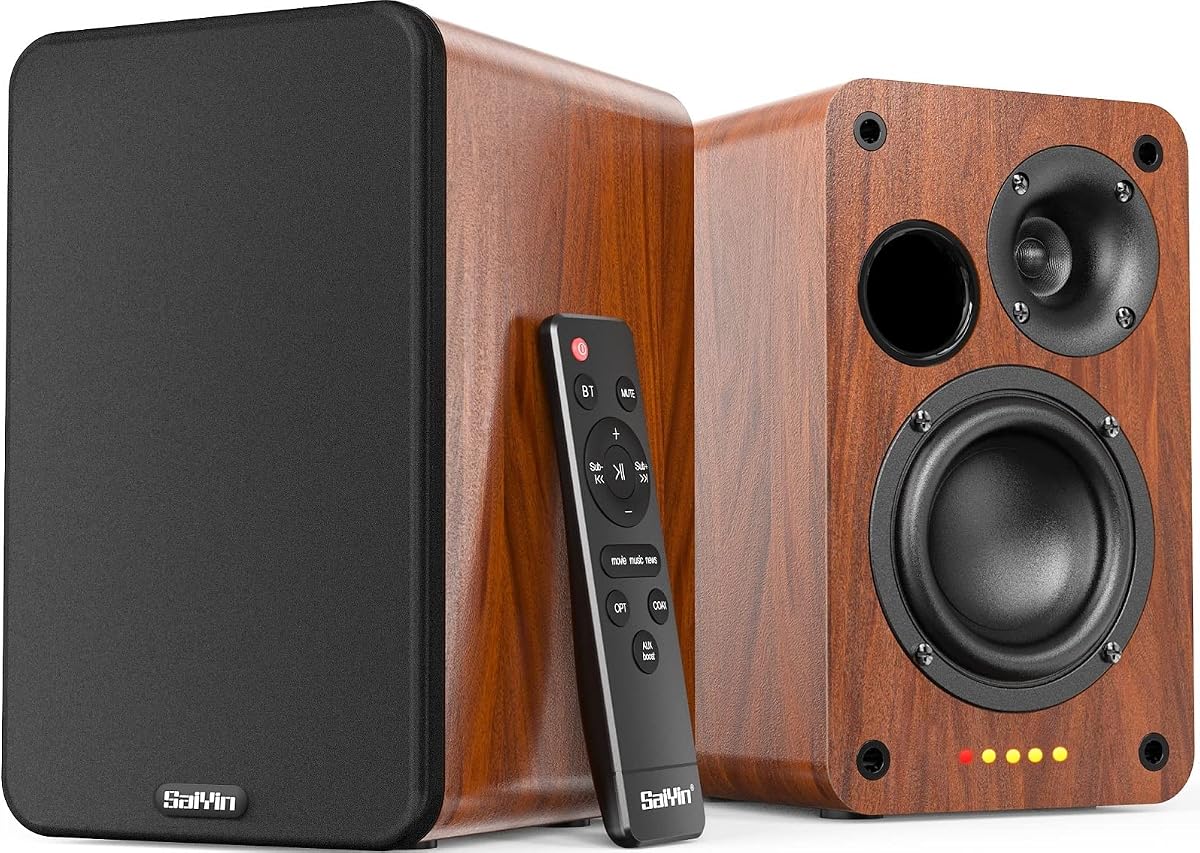
3. Saiyin 40W - Best Sub-Out Value

Saiyin Powered Bluetooth Bookshelf Speakers | 40W*2, 4 Inch Woofer

Saiyin Powered Bluetooth Bookshelf Speakers | 40W*2, 4 Inch Woofer

8.8/10★★★★☆

Saiyin’s 40W bookshelf pair targets the living room where a turntable, TV, and phone all compete for the same speaker real estate. The four-inch woofer and half-inch silk-dome tweeter layout sits between compact desktop boxes and full studio monitors in scale. For vinyl listeners who also watch films with optical audio from a flatscreen, this input mix reduces cable swapping on weeknights.

  • 40W x 2 active pair with 4-inch woofer
  • Optical, coax, RCA, AUX, and BT 5.3
  • Sub-out jack for powered subwoofer add-on
Check Price →
✓ Pros
  • Sub-out jack supports powered subwoofer expansion for heavier genres
  • Optical and coax inputs keep a TV connected alongside turntable RCA
  • 40W per channel with four-inch woofer delivers more scale than compact 30W rivals
  • Remote switches optical, coax, line-in, and Bluetooth modes quickly
  • Explicit turntable line-out guidance in product documentation
✕ Cons
  • Bluetooth from turntable only works if the deck transmits—most do not
  • Listing typography and marketing copy feel less polished than Edifier or PreSonus
  • Requires external phono preamp when turntable outputs phono level only

Detailed review

Turntable connection is straightforward on paper: RCA line out from the record player goes to the speaker RCA input when your deck includes a built-in preamp. The listing repeats an important caveat—phono-only outputs need a standalone preamp first. That honesty saves returns. Ground hum troubleshooting still applies; the speakers are not the source of grounding, but they reveal wiring mistakes quickly at higher volume.

The sub-out jack distinguishes this Saiyin from the smaller 30W sibling in the same pack. Electronic, hip-hop, and reggae pressings benefit when you can add a powered sub later without replacing the main pair. Match line-level sub inputs and set crossover on the subwoofer according to its manual. Main speaker bass and treble still help when no sub is connected, taming boomy corners or bright tweeter reflections.

Bluetooth 5.3 handles phones and tablets well, but Saiyin correctly warns that turntable Bluetooth requires a transmitting deck—rare in this category. Treat wireless as supplemental. Optical and coax support 24-bit 192 kHz digital audio per the listing, useful for lossless TV apps rather than vinyl itself. Remote control covers mute, input mode, and volume; top-panel buttons duplicate key functions when the remote wanders.

At a 4.4 rating, Saiyin sits slightly below Edifier and PreSonus in listed customer satisfaction, yet the feature set—especially sub-out plus optical—fills a niche the classic R1280T cannot. Choose this pair when expansion and multi-source switching matter. Consider Edifier R1280DBs if brand polish and automatic sub detection matter more.

Multi-source living room layout

Route TV optical to the Saiyin, turntable RCA to the same active speaker, and label inputs on the back. Test remote switching before mounting speakers on wall brackets so you know which mode indicator corresponds to vinyl.

Adding a subwoofer later

Connect powered sub RCA from sub-out, set sub volume low, then increase until kick drums feel present without masking vocals. Vinyl rumble below the music should not disappear entirely—that balance tells you the sub is integrated, not dominating.

Check Price on Amazon →

We may earn a commission at no additional cost to you.

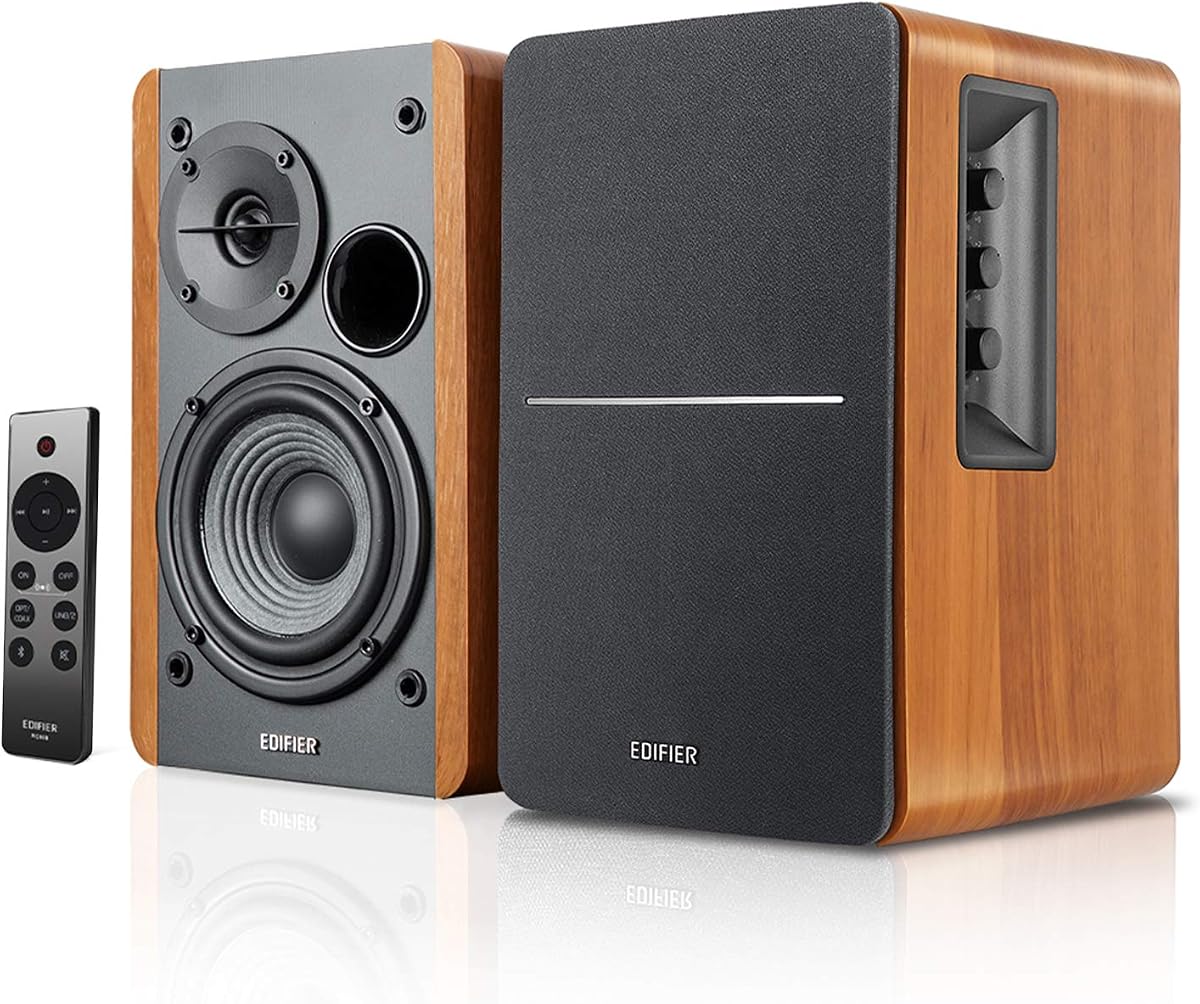
4. Edifier R1280DBs - Best Bluetooth Bookshelf

Edifier R1280DBs Active Bluetooth Bookshelf Speakers - Optical Input - 2.0 Wirel

Edifier R1280DBs Active Bluetooth Bookshelf Speakers - Optical Input - 2.0 Wirel

9.2/10★★★★★

The Edifier R1280DBs wood grain variant is the Bluetooth evolution of the R1280T—and for many turntable owners it is the better default in 2026. You keep the 42W RMS amplification, 13 mm silk-dome tweeter, and four-inch woofer recipe that made the T-series popular, then gain Bluetooth 5.0, optical and coax digital inputs, and a subwoofer line out with automatic crossover detection. That input set mirrors how people actually live with vinyl today.

  • 42W RMS Bluetooth 5.0 wooden bookshelf pair
  • Optical, coax, RCA, and sub-out connectivity
  • Remote switching plus side bass and treble
Check Price →
✓ Pros
  • Bluetooth 5.0 plus optical and coax for hybrid vinyl and streaming households
  • Sub-out with automatic detection simplifies powered subwoofer upgrades
  • 42W RMS with Soundfield Spatializer widens the listening sweet spot
  • Wood grain finish complements classic turntable aesthetics
  • Side EQ and remote input switching reduce daily friction
✕ Cons
  • Bluetooth adds a wireless path you may not need for pure analog listening
  • Not as flat as PreSonus studio monitors for critical listening
  • Same driver platform as R1280T—upgrade is mostly connectivity and sub-out

Detailed review

Wire the turntable RCA line out to the analog input and leave it there. Optical from a TV handles streaming apps and consoles without a separate soundbar. When guests want playlists from a phone, Bluetooth pairs in seconds while the turntable cable stays connected. Remote switching between OPT, coax, line-in, and Bluetooth beats climbing behind the cabinet every evening.

Soundfield Spatializer is Edifier’s spatial widening DSP. On some pressings it opens the stage slightly; on others you may prefer it off via listening tests. Side bass and treble knobs remain the first line of defense against room modes. Vinyl listeners in reflective rooms often trim treble one notch to soften older sibilance without losing detail.

Sub-out is the long-term upgrade path. When your collection grows into electronic or hip-hop territory, a powered sub on auto-detected crossover fills what the four-inch woofer cannot. That keeps the main pair on the shelf where they look good beside a wood-plinth turntable while low end arrives from a floor unit.

Ranked second in this guide, the R1280DBs balances turntable-friendly tone, multi-source convenience, and expansion. Choose the black variant later in this list if décor demands it—the electronics align. Choose PreSonus Eris Accent if you want a higher listed rating and USB-C modernity with similar sub-out thinking.

R1280DBs versus R1280T for turntable owners

If you will never use Bluetooth or optical, the R1280T still works and offers dual AUX. If TV audio or phone streaming shares the speakers, the DBs model saves hassle. Sub-out on DBs is the tiebreaker for bass-heavy collections.

Placement with wood grain cabinets

Wood vinyl wrap matches many Pro-Ject and Fluance plinths visually. Keep symmetry—equal distance from side walls—to preserve stereo balance on classic rock pressings where panning matters.

Check Price on Amazon →

We may earn a commission at no additional cost to you.

5. OHAYO 60W - Best Compact Desktop

OHAYO 60W Computer Speakers for Music and Gaming

OHAYO 60W Computer Speakers for Music and Gaming

9/10★★★★★

OHAYO positions this pair as computer speakers that also accept turntable RCA—a common real-world scenario when a record player shares a desk with a monitor and keyboard. The compact black cabinets and 30W-per-side amplification target near-field use rather than filling a large living room. For starter vinyl corners in dorm rooms, home offices, and gaming stations, that scale is appropriate.

  • 30W x 2 compact active stereo pair
  • Bluetooth 5.3 plus RCA, AUX, and USB inputs
  • MDF enclosure with rear bass port
Check Price →
✓ Pros
  • Compact footprint fits turntable setups on shallow desks and shelves
  • RCA and AUX cover turntable line out alongside PC and USB sources
  • Carbon fiber driver materials aim for crisp highs on detailed pressings
  • Front volume knob allows quick level changes between tracks
  • Bluetooth 5.3 for phone streaming when the turntable rests
✕ Cons
  • Three-inch drivers limit authority for across-the-room listening
  • Marketing wattage exceeds practical RMS—expect desktop scale, not PA output
  • No sub-out or optical input for TV-heavy living rooms

Detailed review

The driver layout uses a 0.75-inch carbon fiber silk-dome tweeter and three-inch carbon fiber full-range driver with a rear bass port. Vinyl listeners seated at desk distance hear improved transient detail over laptop speakers, especially on acoustic and jazz pressings where cymbal decay matters. Move six feet away and the presentation thins compared with four-inch woofer pairs in this pack.

Multiple inputs—Bluetooth 5.3, RCA, AUX, and USB—mirror flexible desktop life. Connect turntable line out via RCA, PC via USB where supported, and switch mentally by source device rather than complex remotes. There is no optical TV input, so hybrid TV-and-vinyl living rooms should look at Edifier R1280DBs or Saiyin instead.

MDF construction and front-panel volume control suit daily desk use where quick adjustments between Zoom calls and album sides are routine. The listing mentions turntable compatibility among many device types; the same line-level requirement applies—phono output needs a preamp. Ground and cable hygiene still determine hum-free playback.

Ranked tenth here because larger bookshelf pairs outclass it for dedicated listening rooms. Choose OHAYO when space is tight, the turntable lives on the desk, and gaming or PC audio shares the same speakers. Upgrade to PreSonus Eris Accent or Edifier R1280DBs when the setup moves to a proper listening chair across the room.

Desk turntable ergonomics

Keep the turntable on an isolated platform or separate shelf if speaker vibration feeds back into the cartridge. OHAYO’s compact size helps, but mechanical isolation still improves tracking on quiet classical passages.

When OHAYO beats larger pairs

Tight desks where four-inch woofers simply do not fit physically. Also budget-conscious starter setups where any powered RCA speaker beats built-in all-in-one turntable speakers dramatically.

Check Price on Amazon →

We may earn a commission at no additional cost to you.

6. PreSonus Eris 3.5 - Best Studio Accuracy

PreSonus Eris 3.5 Powered Studio Monitors

PreSonus Eris 3.5 Powered Studio Monitors

9/10★★★★★

PreSonus Eris 3.5 monitors appear on countless home-studio desks, and they translate well to serious turntable listening when you want transparency over coloration. Fifty watts of built-in amplification, woven-composite 3.5-inch woofers, and one-inch silk-dome tweeters deliver a claimed 80 Hz to 20 kHz response suited to near-field work. Vinyl owners hear surface noise, inner-groove distortion, and mastering choices more clearly than on warmed-over lifestyle speakers.

  • 50W near-field studio monitor pair
  • 3.5-inch woofer, 1-inch silk-dome tweeter
  • TRS, RCA, front aux, and headphone jack
Check Price →
✓ Pros
  • Trusted studio voicing reveals pressing quality and setup issues clearly
  • 50W amplification drives clean dynamics at moderate desk and shelf levels
  • Front-panel aux and headphone jack simplify quick source checks
  • Acoustic tuning controls adapt highs and lows to room placement
  • RCA and TRS inputs accept turntable line out and pro gear alike
✕ Cons
  • No Bluetooth for casual phone streaming without a separate adapter
  • Three-and-a-half-inch woofers limit low-end weight on bass-heavy pressings
  • Studio aesthetic and black finish may not match vintage decor-focused setups

Detailed review

RCA on the rear accepts turntable line out directly. Balanced TRS supports mixers and interfaces when your setup grows. Front aux handles a quick phone connection for A/B comparisons between a streaming remaster and your original pressing—a surprisingly educational exercise. Headphone out mutes or dims speakers depending on implementation, useful in shared spaces.

Acoustic tuning knobs for high and low frequencies help when speakers sit near walls or on reflective desks. That matters for vinyl because room gain can exaggerate rumble or port noise if placement is sloppy. Start with flat settings, listen to a familiar side, then adjust minimally. The goal is trustworthy playback, not exaggerated bass that hides tracking problems.

Compared with PreSonus Eris Accent ranked first, the 3.5 is smaller and lacks remote control and USB-C, but costs less and still carries the Eris tuning philosophy. Compared with Edifier R1280DBs, it is less lifestyle-polished and more honest about flawed pressings—which some listeners love and others find fatiguing.

Choose Eris 3.5 when desk-distance turntable listening overlaps with production, gaming, or film scoring at the same workstation. Add a subwoofer externally if low end becomes priority; this model lacks sub-out, unlike the Accent.

Calibrating Eris for vinyl sessions

Level-match your turntable preamp output so you are not overdriving inputs. Use the same reference album side each time you move speakers. Small HF cuts tame bright rooms without dulling vocals.

Eris 3.5 versus Edifier MR3

Both target hybrid creator-listeners. Eris offers physical acoustic tuning without an app. MR3 adds Bluetooth multipoint and Hi-Res branding. For turntable-plus-DAW desks, either works; Eris is simpler, MR3 is more connected.

Check Price on Amazon →

We may earn a commission at no additional cost to you.

7. Saiyin 30W - Best Budget Multi-Input

Saiyin Powered Bluetooth Bookshelf Speakers | 30W*2

Saiyin Powered Bluetooth Bookshelf Speakers | 30W*2

8.8/10★★★★☆

The smaller Saiyin bookshelf pair trades the 40W model’s sub-out for a tighter footprint and lower cost while keeping optical, coax, RCA, and Bluetooth 5.3. For apartment turntable setups where a TV sits on the same media console, that input set remains valuable even without sub expansion. The 3.75-inch woofer and horn-loaded half-inch tweeter aim for home-theater flavor in a compact cabinet.

  • 30W x 2 active Bluetooth bookshelf pair
  • Optical, coax, RCA, and AUX wired inputs
  • Remote and top-panel input controls
Check Price →
✓ Pros
  • Optical and coax alongside RCA suit TV plus turntable on one pair
  • 3.75-inch woofer steps up slightly from three-inch desktop alternatives
  • Active-passive configuration needs no separate amplifier for vinyl line out
  • Remote compatible with Fire TV stick per listing—streaming crossover use case
  • Explicit line-out versus phono preamp guidance for record players
✕ Cons
  • No sub-out jack unlike the larger Saiyin 40W in this pack
  • 30W scaling is modest for large rooms or loud classic rock sessions
  • Bluetooth turntable pairing still requires a transmitting deck

Detailed review

Turntable wiring follows the same rules as its larger sibling: line out connects directly, phono out needs a preamp. Speaker wire runs from the active unit’s left output to the passive mate—confirm left-right orientation so stereo panning on your favorite pressings stays correct. Top-panel buttons and remote duplicate input switching when the couch distance makes the remote preferable.

Sonically, expect competent midrange and controlled highs at moderate volume. Bass-heavy genres may want the 40W Saiyin or Edifier R1280DBs with sub-out instead. For indie, folk, and classic rock vinyl at conversational levels, the 30W pair delivers a meaningful upgrade from all-in-one suitcase turntables with built-in speakers.

The 4.4 rating suggests buyers find value with realistic expectations. Build and finish are functional rather than heirloom. If aesthetics beside a wood turntable matter, Edifier wood grain models look more intentional. If budget and optical input are the constraints, Saiyin 30W fills the gap.

Ranked ninth overall because larger pairs in this pack offer more headroom and expansion. Choose it when space and cost trump subwoofer plans and you still need digital TV audio beside RCA vinyl.

Saiyin 30W versus 40W for turntable owners

Pick 40W when sub-out and four-inch drivers matter for bass-heavy collections or larger rooms. Pick 30W when the media console is narrow and listening is near-field. Both share the same phono-versus-line guidance.

Fire TV and turntable coexistence

If the listing’s Fire TV remote compatibility matters in your home, program input switching once and document the sequence on a note taped inside the cabinet. Vinyl sessions stay analog; movie night stays optical.

Check Price on Amazon →

We may earn a commission at no additional cost to you.

8. MEVOSTO 36W - Best Bass Tuning Control

Active Bookshelf Speakers 36W RMS - BT 5.4 Wireless Speaker with 5 Inch Woofer

Active Bookshelf Speakers 36W RMS - BT 5.4 Wireless Speaker with 5 Inch Woofer

9/10★★★★★

MEVOSTO’s DS19-class active pair puts a five-inch woofer in each cabinet—the biggest low-frequency driver in this turntable speaker pack. Thirty-six watts RMS amplification, one-inch silk-dome tweeters, and ten-step bass and treble controls target listeners who want tunable weight on funk, soul, and hip-hop vinyl without immediately buying a subwoofer. Natural wood finish and remote operation fit shelf aesthetics beside many entry turntables.

  • 36W RMS pair with 5-inch woofer and silk dome tweeter
  • BT 5.4 plus RCA, AUX, and USB digital audio
  • Ten-step bass and treble adjustment with remote
Check Price →
✓ Pros
  • Five-inch woofer is the largest driver in this pack for fuller low-end scale
  • Ten-level bass and treble steps offer finer EQ than simple analog knobs
  • USB digital audio suits PC sources alongside RCA turntable input
  • Bluetooth 5.4 with low-latency claims for hybrid desk use
  • Natural wood finish and remote complement shelf turntable setups
✕ Cons
  • Brand recognition and long-term support less established than Edifier or PreSonus
  • Listing warns about Dolby incompatibility and USB audio compatibility checks
  • No dedicated sub-out despite strong woofer size

Detailed review

RCA and AUX cover analog turntable line out. USB digital audio supports PC connection with lossless intent per the listing—verify your USB port outputs audio before relying on that path. Bluetooth 5.4 handles phone streaming when the turntable is idle. The product page explicitly lists turntable compatibility among TVs, computers, and laptops.

Fine-grained EQ helps when room modes interact with vinyl’s wide dynamic swings. Instead of a single bass knob, ten steps let you find a middle ground between thin and boomy. Start near neutral, listen to a side with prominent kick drum, then adjust one step at a time. Treble steps tame bright rooms where older pressings can sound edgy on modern tweeters.

Important listing notes: no Dolby Audio support—set TV audio to PCM stereo when using optical or USB paths. Power supply requirements for RV or camper use are irrelevant to typical home turntable setups but show the amp platform’s flexibility. For apartment vinyl corners, standard wall power suffices.

Ranked sixth for turntable duty because driver size and EQ depth compete well with Edifier R1280 models, though lack of sub-out and less brand history keep it below PreSonus and top Edifier picks. Choose MEVOSTO when bass tuning granularity and five-inch drivers matter more than optical input—add Edifier or Saiyin if TV optical is mandatory.

Using ten-step EQ with vinyl

Record baseline settings on paper. Different genres may need different steps—switch EQ when changing from acoustic to electronic sides rather than chasing volume. Avoid max bass; vinyl rumble plus room gain causes muddy mids.

USB and turntable on one desk

Separate analog RCA turntable path from USB PC path mentally. Confirm Windows or macOS output device when switching from ripping CDs to playing LPs so you are not troubleshooting the wrong cable.

Check Price on Amazon →

We may earn a commission at no additional cost to you.

9. Edifier R1280DBs Black - Best Black Finish

Edifier R1280DBs Active Bluetooth Bookshelf Speakers - Optical Input - 2.0 Wirel

Edifier R1280DBs Active Bluetooth Bookshelf Speakers - Optical Input - 2.0 Wirel

9.2/10★★★★★

This listing is the black cabinet twin of the wood grain Edifier R1280DBs reviewed above. Electronics, driver sizes, connectivity, and 42W RMS rating align. Turntable buyers choosing between them should decide on décor only: black suits modern metal-and-glass media consoles and many black-plinth turntables; wood grain suits classic oak furniture and vintage aesthetics.

  • 42W RMS Bluetooth 5.0 bookshelf pair in black
  • Optical, coax, RCA, and sub-out connectivity
  • Remote switching plus side bass and treble
Check Price →
✓ Pros
  • Identical feature set to wood grain R1280DBs in a modern black finish
  • Bluetooth 5.0, optical, coax, and RCA cover hybrid analog-digital homes
  • Sub-out with auto crossover supports powered subwoofer upgrades
  • 42W RMS with silk-dome tweeter and four-inch woofer suits most vinyl rooms
  • Remote and side EQ simplify daily input and tone adjustments
✕ Cons
  • Black vinyl wrap may show dust more than wood grain on open shelves
  • Duplicate of wood variant—buy one finish only unless building multi-room
  • Same lifestyle tuning—not studio-flat like PreSonus Eris models

Detailed review

All turntable guidance from the wood grain review applies here. RCA line out from a switched-line turntable connects directly. Phono-only tables need an external preamp. Optical handles TV audio while vinyl stays on analog input. Bluetooth covers phone streaming. Sub-out awaits a powered sub when your listening tastes dive deeper.

Soundfield Spatializer, side bass and treble, and remote input switching behave the same as the wood model. Some listeners perceive no difference beyond finish; others subjectively report identical measurements in casual A/B tests. Pick the finish that keeps your partner happy about the living room appearance—happy partners spin more records.

Ranked eighth separately only because buyers need a clear comparison anchor when both ASINs appear in search results. If black matches your setup, choose this ASIN. If wood matches, choose B08865JM4N. Do not buy both for one turntable unless you are furnishing two rooms.

Versus PreSonus Eris Accent, Edifier black R1280DBs adds Bluetooth and optical at the cost of USB-C and the Accent’s higher listed rating. Versus R1280T, it adds wireless and sub-out. The black DBs is the right Edifier when aesthetics skew modern and sources multiply.

Finish choice without sonic guesswork

Driver and amp parity means shop by shelf photos, not assumed sound differences. Match turntable plinth and speaker grille color for a cohesive corner that encourages daily use.

Care on open black shelves

Microfiber dusting keeps matte black looking sharp. Avoid direct sun on MDF cabinets to prevent vinyl wrap fading over years—true for wood grain as well.

Check Price on Amazon →

We may earn a commission at no additional cost to you.

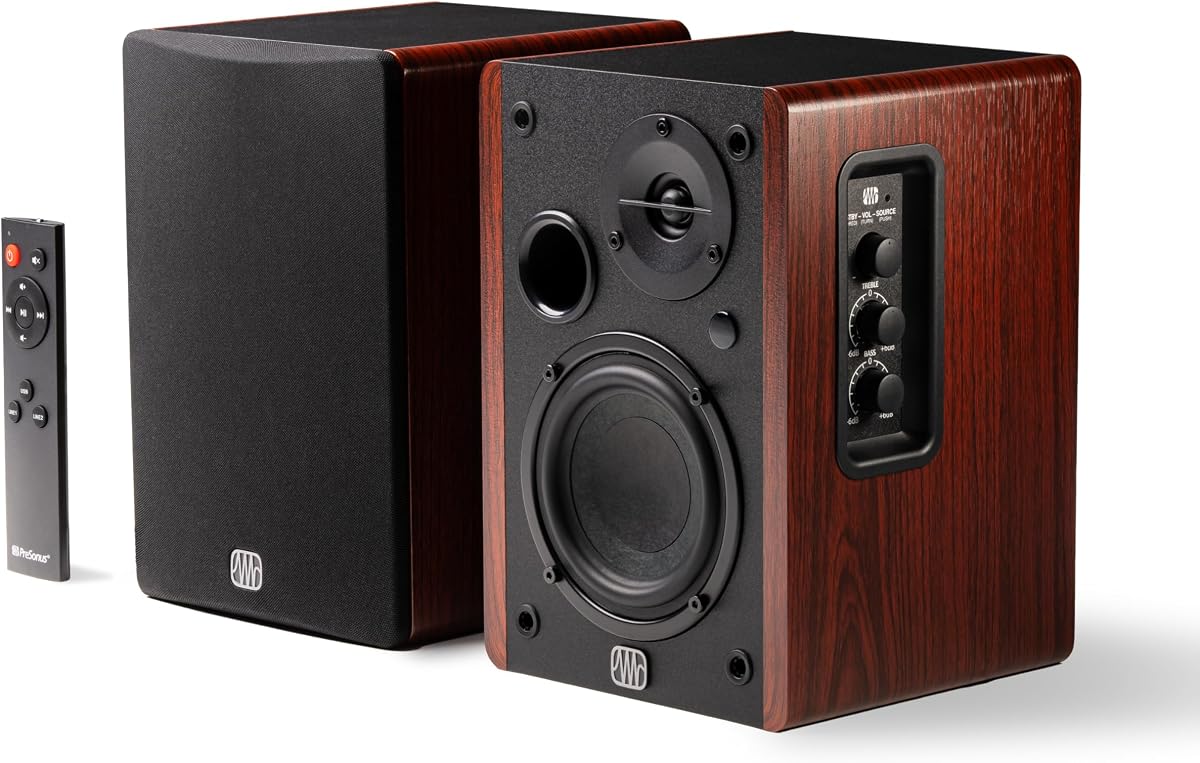
10. PreSonus Eris Accent - Best for Turntable

PreSonus Eris Accent Powered Bookshelf Speakers – 50W Wired Stereo Speakers for

PreSonus Eris Accent Powered Bookshelf Speakers – 50W Wired Stereo Speakers for

9.6/10★★★★★

PreSonus Eris Accent tops this turntable speaker guide with a 4.8 listed rating and copy that names record players and turntables explicitly—not an accident. Fifty watts of powered stereo amplification, a four-inch woofer, half-inch silk-dome tweeter, and a 2.8 kHz crossover deliver a claimed 55 Hz to 20 kHz response with 85 dB peak SPL. That is enough scale for desk, shelf, and small living-room listening while staying controlled enough to trust on well-recorded jazz and classical vinyl.

  • 50W powered pair with 4-inch woofer
  • USB-C and RCA inputs with sub-out
  • Remote control and onboard tone shaping
Check Price →
✓ Pros
  • Highest listed rating in the pack with turntable-specific product positioning
  • 50W amplification with 4-inch woofer and half-inch silk-dome tweeter balances scale and clarity
  • USB-C and RCA inputs cover modern and analog sources cleanly
  • RCA sub-out enables powered subwoofer expansion for bass-heavy collections
  • Included remote plus onboard volume, bass, and treble controls
✕ Cons
  • No Bluetooth—wireless streaming requires a separate adapter or different speaker
  • No optical input for TV-first living rooms that share one speaker pair
  • Studio-leaning honesty may expose noisy pressings more than warm lifestyle pairs

Detailed review

RCA is the turntable owner’s primary friend: line out from a built-in preamp lands directly on the Accent input. USB-C adds a modern path for computers and compatible digital sources without cluttering the analog chain. When low end needs reinforcement, RCA sub-out routes to a powered subwoofer—a feature the smaller Eris 3.5 lacks. Volume, treble, and bass onboard plus included remote mean you can adjust from the listening chair during side changes.

The Eris tuning philosophy favors clarity over sugar-coating. Well-mastered pressings sound immersive and three-dimensional at moderate volume. Scratched or thin pressings reveal their flaws—some listeners prefer Edifier’s gentler voicing for that reason. If your goal is to hear what the cartridge extracts without excessive coloration, Accent delivers.

Wood grain cabinets and compact bookshelf dimensions suit dedicated listening nooks where the turntable is the hero source. Without Bluetooth or optical, Accent assumes you are not trying to merge TV optical and vinyl on one remote-driven box—that is Edifier R1280DBs territory. For a turntable-first desk or sideboard, the simplified input list reduces confusion.

Ranked first overall for turntable duty in this pack: purpose-built positioning, sub-out, remote convenience, four-inch drivers, and the strongest customer rating. Pair with a phono preamp when your table requires it, add a sub when genres demand, and keep Bluetooth streaming on a phone through USB-C or a separate device if needed.

Building a turntable-first system around Accent

Center the rig: turntable on isolation, speakers at ear height forming an equilateral triangle with your chair. Wire RCA first, set levels with a familiar side, then tune bass and treble minimally. Add sub on sub-out only after main speakers sound balanced alone.

Accent versus Edifier R1280DBs

Choose Accent for turntable-primary listening, studio honesty, and sub-out with remote. Choose R1280DBs when Bluetooth, optical TV audio, and lifestyle warmth outweigh USB-C modernity. Many households own both philosophies in different rooms over time.

Long-term upgrade path

Cartridge upgrades and phono preamp improvements yield more detail through honest speakers like Accent. Plan amplification headroom before chasing exotic pressings—the speaker pair here is unlikely to be the bottleneck once setup is correct.

Check Price on Amazon →

We may earn a commission at no additional cost to you.

Best Speakers for Turntable in 2026: Powered Pairs That Match

How to Choose Speakers for Your Turntable

Line out versus phono out: the wiring decision that matters most

Turntables fall into two camps. Many modern decks—including popular Audio-Technica, Fluance, and Pro-Ject models—include a switchable phono preamp and expose a standard RCA line output. Those plug directly into the RCA or AUX inputs on every powered speaker in this pack. Older or audiophile tables may output a phono-level signal only, which is far quieter and requires RIAA equalization. In that case you need a standalone phono preamp between the cartridge and the speakers. Several Saiyin listings spell this out explicitly: line out connects directly, phono out needs a preamp first.

Before you order, flip your turntable around and read the output labels. If you see PHONO and LINE with a ground post, confirm which position the switch is in. A mismatched connection produces thin, quiet sound or harsh distortion. Grounding matters too: attach the turntable ground wire to the preamp or receiver ground terminal when present. Powered speakers in this guide do not replace that grounding step when your table requires it.

Powered bookshelf speakers versus a traditional receiver stack

A classic hi-fi stack—turntable, phono stage, integrated amp, passive speakers—still wins when you want to upgrade components one at a time over decades. Powered bookshelf pairs trade that modularity for simplicity. Amplification, crossover, and often tone controls live inside the cabinet. For apartment dwellers, desk listeners, and anyone who wants to spin records without learning impedance ratings, active speakers are the faster path to good sound.

The tradeoff is expansion flexibility. Passive systems let you swap amplifiers and speakers independently. Most powered pairs here offer sub-out jacks—Edifier R1280DBs, Saiyin 40W, and PreSonus Eris Accent among them—so you can add low-end later without rebuilding the whole rig. If you anticipate moving from a bedroom setup to a dedicated listening room within a year, weigh how many inputs and sub outputs you need on day one.

Driver size, placement, and what vinyl actually reveals

Vinyl playback highlights midrange texture, sibilance, and surface noise in ways compressed streaming sometimes masks. A four-inch woofer with a silk-dome tweeter—the layout shared by Edifier R1280 models and several competitors here—delivers enough scale for jazz, folk, and classic rock in a ten-by-twelve-foot room. Smaller three-inch drivers, as on the PreSonus Eris 3.5, stay honest at desk distance but lose authority if you sit across a large living room.

Placement changes everything. Pull speakers forward from the wall by at least a few inches, aim tweeters toward your listening chair, and keep them at roughly ear height when seated. Turntable isolation matters separately: a wobbly shelf feeds rumble into the cartridge. Speaker bass ports on the rear—as on OHAYO and MEVOSTO models—need breathing room behind the cabinet. If boomy low end persists, reduce bass on the side panel rather than pushing the speakers into a corner.

Bluetooth, optical, and living with more than one source

Vinyl purists often prefer a wired RCA run for its simplicity and lack of compression. Hybrid households rarely stop at records alone. Edifier R1280DBs and both Saiyin pairs add optical and coax inputs for TVs, plus Bluetooth for phones. That means one speaker pair can cover Saturday morning albums and weeknight streaming without a switcher box. Bluetooth from a turntable only works if the turntable itself transmits—a rare feature. Do not assume wireless pairing unless your deck explicitly lists Bluetooth output.

When multiple sources stay connected, learn the remote or button sequence for input switching. Accidentally leaving a TV on optical while you expect RCA from the turntable is the most common new-owner confusion. Label cables at the back of the active speaker so troubleshooting takes seconds instead of minutes.

Studio monitors versus lifestyle tuning for record listening

PreSonus Eris 3.5, Edifier MR3, and PreSonus Eris Accent lean toward flatter, more revealing playback. That honesty helps if you also produce music or want to hear pressing defects clearly. Lifestyle pairs like Edifier R1280T and R1280DBs add a milder voicing and simpler controls that many casual listeners prefer for long sessions. Neither approach is wrong; it depends whether you want to analyze pressings or relax into them.

If your collection spans quiet singer-songwriter LPs and loud classic rock, prioritize speakers with accessible bass and treble knobs or app EQ. Vinyl dynamic range can swing wider than Spotify normalization allows. A fixed EQ speaker in a reflective room may sound bright on older recordings and dull on modern remasters. A little tone control fixes that without opening a laptop.
Frequently Asked Questions

01

Can I connect any turntable directly to powered speakers?

Only if the turntable outputs a line-level signal or includes a built-in phono preamp switched to line mode. Phono-only outputs are too quiet and use the wrong equalization curve for speaker inputs. Add a dedicated phono stage between the table and the speakers when needed. Every product in this pack expects standard stereo line input on RCA or AUX.

02

Do I need a receiver if I buy active bookshelf speakers?

Not for basic listening. Powered speakers integrate amplification, so a turntable with line output can connect directly. A receiver still makes sense if you want passive speakers, multi-room zones, or a large collection of analog sources routed through one chassis. Several Saiyin and Edifier listings note you can feed their line input from a receiver output if you prefer that topology later.

03

Why do some listings warn about Bluetooth and turntables?

Bluetooth pairing requires a transmitter at the source. Most turntables output analog wired signals only. Saiyin explicitly states their Bluetooth works when the turntable can transmit—which most cannot. Treat Bluetooth on these speakers as a convenience for phones and tablets, not a replacement for RCA from your record player unless your deck supports wireless output.

04

Are studio monitors too clinical for vinyl listening?

They can sound more revealing than warm lifestyle speakers, which helps you hear pressing quality and setup issues clearly. PreSonus Eris models include tone controls to soften the room. Many vinyl listeners enjoy studio monitors once placement and EQ are dialed in. If you want a forgiving, relaxed presentation without tweaking, Edifier R1280T or R1280DBs may feel more immediately pleasant.

05

How much power do I need for a small apartment?

Wattage marketing numbers vary, but every pair here is sized for near-field and small-to-medium rooms—not stadium PA duty. A 42W RMS Edifier or 50W PreSonus pair fills a typical living room at conversational to moderately loud levels. Driver size and placement matter more than peak watt claims. Upgrade to a subwoofer via sub-out if you want deeper electronic bass without cranking main speaker volume.

06

Should I choose wood grain or black cabinets?

Finish is aesthetic unless your room has specific decor constraints. Acoustic performance between Edifier R1280DBs wood grain and black variants should be equivalent—they share the same driver layout and amplification. Pick whichever matches your shelf and turntable plinth. PreSonus Eris Accent offers a wood grain option tuned for desk and home use with similar sonic intent.

07

Will powered speakers hum with my turntable?

Hum usually traces to grounding or cable routing, not the speakers themselves. Attach the turntable ground wire when provided, keep RCA cables away from power adapters, and use a short, shielded run where possible. If hum persists only on phono output, confirm your preamp is functioning and that you are not double-amplifying through an incorrectly set switch.

08

Can I add a subwoofer later?

Yes on models with sub-out jacks. Edifier R1280DBs detects sub connection and applies crossover automatically according to the listing. Saiyin 40W includes a sub-out for powered subs. PreSonus Eris Accent also exposes RCA sub-out for expansion. Match the subwoofer input type—most powered subs accept line-level RCA—and set sub volume so it supports the records rather than overwhelming them.

09

What is the difference between AUX and RCA for turntable wiring?

Both carry line-level stereo audio. RCA uses separate left and right phono plugs; AUX often means a 3.5 mm jack that combines channels in one connector. A turntable with dual RCA outputs should use an RCA-to-RCA cable into the speaker RCA input, or RCA-to-3.5 mm if only AUX is available. Keep left and right channels consistent—swapping them skews the stereo image you paid for in vinyl mastering.

10

Which pick is best if my turntable and TV share one speaker pair?

Choose a model with multiple inputs and easy switching—Edifier R1280DBs, Saiyin 40W, or MEVOSTO. Optical or coax from the TV plus RCA from the turntable lets both stay connected. PreSonus Eris Accent focuses on fewer inputs but excels when vinyl is the primary source at a desk or dedicated listening nook. Match the product to whichever source you use daily, not just the one you love most.

Conclusion

The best speakers for turntable setups in 2026 are powered pairs that respect how vinyl actually leaves the platter: line-level when possible, honest midrange, and enough inputs to coexist with the rest of your life. PreSonus Eris Accent leads this pack for all-around turntable duty thanks to its purpose-built connectivity, sub-out path, and the highest listed rating. Edifier R1280DBs remains the smart Bluetooth bookshelf for shared living rooms, while PreSonus Eris 3.5 rewards listeners who want studio clarity at desk distance.

Before checkout, verify your turntable output, plan speaker placement, and decide whether Bluetooth or optical inputs matter beyond RCA. Every model here skips the receiver for straightforward wired listening, and several leave room for a subwoofer when your collection demands more weight. Match the pair to your room size and listening style—not the biggest watt number on the box—and the upgrade from built-in turntable speakers or a single Bluetooth box will be obvious from the first needle drop.