Expert Review & Guide

Best RGB Gaming Speakers in 2026 for Immersive Desk Setups

RGB gaming speakers sit in an odd but useful middle ground between bare-bones desk audio and a full surround system. You are not buying them solely for light shows—though a synchronized desk definitely helps immersion during long sessions. The practical goal is clearer stereo than a monitor or laptop can manage, with lighting that matches your keyboard, mouse, and case without turning your workspace into a distraction during daytime work.

In 2026 the category splits cleanly into three tiers. At the entry level you will find compact USB-powered pairs with touch-controlled LED bars, bass ports, and simple 3.5 mm wired audio. The mid tier adds Bluetooth flexibility, detachable layouts, and soundbar form factors with headphone jacks and multiple sound modes. At the top, SteelSeries Arena 7 delivers true 2.1 performance with a dedicated subwoofer and PrismSync lighting that reacts to on-screen action—a different league from USB desk pairs, but still squarely in the RGB gaming conversation.

This guide compares ten current options using only the products in our research pack. We weighed listed ratings, connectivity, lighting behavior, and the honest limitations each listing calls out—no Bluetooth on some models, Windows-only EQ software on others, external power bricks where USB cannot deliver enough wattage. Whether you want a minimalist under-monitor bar, a modular two-piece set, or thundering bass with reactive LEDs, the reviews below map each speaker to real desk scenarios so you can pick lighting and sound together, not as an afterthought.

Our Top RGB Gaming Speaker Picks for 2026

As an Amazon Associate we earn from qualifying purchases. We may earn a commission at no additional cost to you.

RGB Gaming Speakers Compared Side by Side

Every model below appears in our pack research set. Use the table to filter by connectivity, form factor, and lighting complexity before diving into the full reviews. Spec strings avoid pricing and focus on what matters at a gaming desk: power source, inputs, and RGB behavior.

#ProductSpecificationsScore
1
  • USB powered with 3.5 mm AUX wired audio
  • Six touch-controlled lighting modes on desktop pair
  • Dual drivers plus two bass-boost ports for near-field bass
8.8
2
  • Detachable 2-in-1 slide-rail stereo layout
  • USB power with Bluetooth and wired switching
  • Six touch RGB modes with volume progress bar feedback
8.8
3
  • Compact all-in-one USB-C/USB powered pair
  • Touch angular game lighting with one-touch on/off
  • AUX wired audio only—no Bluetooth or headphone port
8.6
4
  • Twenty-one dynamic RGB LED lighting modes
  • Bluetooth wireless plus 3.5 mm wired connection
  • Compact under-monitor stereo for PC and laptop desks
8.8
5
  • Upgraded MUSEEQ W-206RE with brighter RGB chip
  • Dual mode Bluetooth and 3.5 mm wired audio
  • Twenty-one LED modes with twelve-month warranty support
8.6
6
  • Six RGB modes including symphony and breathing effects
  • Front 3.5 mm headphone jack for private listening
  • USB powered with USB-C adapter for modern laptops
8.8
7
  • Nine customizable RGB lighting modes on slim profile
  • Dual passive radiators for added low-end depth
  • Extended 4.5 ft cable span for dual-monitor setups
8.8
8
  • 40W peak soundbar with dual passive bass radiators
  • USB-C digital audio and Bluetooth 5.3 connectivity
  • Windows EQ software with screen-sync RGB lighting
8.8
9
  • Three sound modes: Bass, Vocal, and Surround
  • Seven RGB effects with instant lights-off control
  • USB-C audio hub with headphone out and rear AUX
9.2
10
  • 2.1 system with 6.5-inch downward-firing subwoofer
  • PrismSync reactive four-zone RGB on satellites
  • USB, optical, AUX, Bluetooth, and Sonar EQ software
9

1. Nylavee Computer Speakers for Desktop - Solid Entry RGB

Nylavee Computer Speakers for Desktop

Nylavee Computer Speakers for Desktop

8.8/10★★★★☆

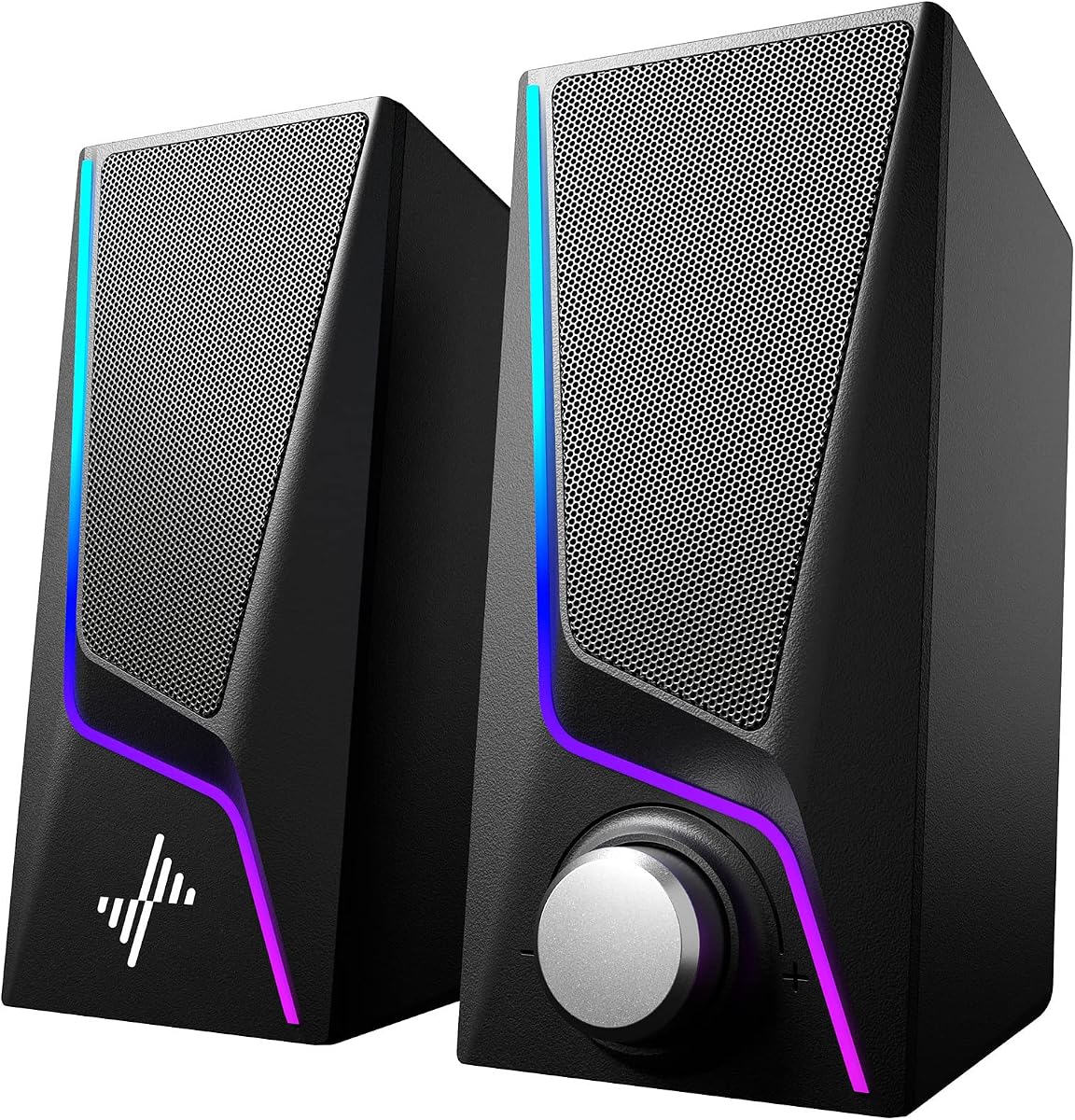
The original Nylavee desktop pair is a straightforward answer to a common problem: your monitor speakers sound thin, but you still want a bit of personality on the desk. Two full-range dual-magnet drivers deliver crisp stereo for YouTube, Discord voice chat, and casual gaming, while a pair of dedicated bass-boost ports channel vibration energy into a tighter low end than you typically hear from budget USB boxes. It will not replace a subwoofer, yet footsteps and engine rumble feel more present than they do through built-in panel speakers.

  • Hi-Fi stereo with dual full-range dual-magnet drivers
  • Six touch lighting modes: symphony, flowing, breathing, three solids
  • Single-knob volume and power with plug-and-play USB plus AUX
Check Price →
✓ Pros
  • Touch-controlled RGB is faster than hunting for a remote or software
  • Dual bass-boost ports add noticeable low-end punch for the size
  • Simple one-knob operation keeps desk clutter minimal
  • True plug-and-play with no drivers on Windows, Mac, or Chrome OS
  • Compact footprint fits beside monitors without dominating the desk
✕ Cons
  • No Bluetooth—wired 3.5 mm only for audio
  • USB provides power only, so you always need two cables
  • Lighting cannot sync with games or music automatically

Detailed review

RGB is handled through touch controls on the speaker housing rather than software. Six modes cover the usual favorites—symphony color cycling, flowing gradients, breathing pulses, and three solid colors—so you can match a red-themed build or dial things down to a steady blue during late-night sessions. Because everything is onboard, there is no account signup, no Windows-only utility, and no risk of a future software update breaking your lighting presets.

Operation stays deliberately simple. One rotary knob handles power and volume, which matters when you are mid-match and do not want to alt-tab to the Windows mixer. USB carries power while the 3.5 mm jack carries audio, a split that keeps compatibility broad across desktops, laptops, and even tablets with headphone outputs. Listing dimensions of roughly 3.23 by 4.21 by 7 inches per speaker help it tuck under elevated monitors on shallow desks.

Where the Nylavee pair shows its limits is flexibility. There is no Bluetooth for phone playback, no headphone jack for silent practice, and no EQ beyond what your operating system provides. Competitive players who rely on precise positional audio may still prefer headphones for ranked play, using these speakers for music and single-player campaigns instead.

For students, remote workers, and first-time PC builders, that tradeoff is often acceptable. You get visible RGB flair, clearer stereo imaging, and a setup that takes under a minute. If your desk already has cable management challenges, plan routing for both the USB power lead and the AUX cable before you commit—the listing is upfront that Bluetooth is not part of the package.

Compared with newer Nylavee models in this same roundup, this version offers fewer lighting presets and lacks passive radiators found on the updated design. It remains a credible pick when you want the essentials—sound upgrade plus touch RGB—without paying for features you will not use.

Who Should Buy This Pair

Choose the original Nylavee set if you want wired reliability and touch RGB on a tight desk. It suits dorm rooms, office spillover PCs, and secondary machines where Bluetooth is unnecessary.

Skip it if you need wireless phone streaming or a headphone jack for shared spaces. In those cases, other pack options with Bluetooth or front headphone outputs make more sense.

Setup Tips for Best Sound

Place the speakers at ear height angled slightly inward for stereo imaging. Keep the bass ports unobstructed—avoid pushing them flush against a wall if you hear boomy low end.

Set Windows volume around seventy percent and use the hardware knob for fine control. This reduces hiss on some motherboards while preserving headroom for explosions and bass hits.

Check Price on Amazon →

We may earn a commission at no additional cost to you.

2. AOC Computer Speakers for Desktop PC - Best Modular Layout

AOC Computer Speakers for Desktop PC Laptop Monitor

AOC Computer Speakers for Desktop PC Laptop Monitor

8.8/10★★★★☆

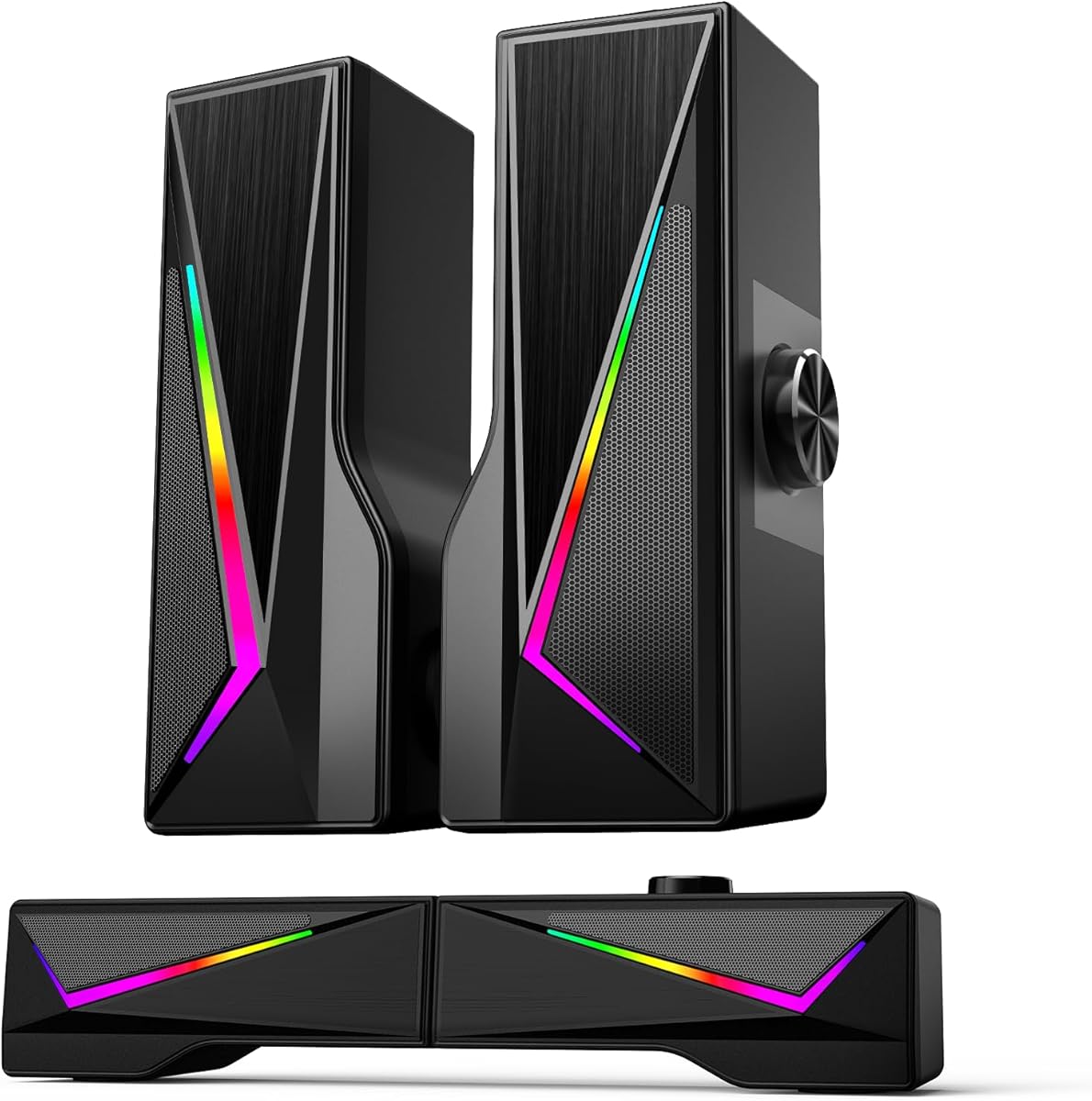
AOC's desktop gaming stereo stands out before you even press play thanks to its detachable 2-in-1 rail design. Slide the two enclosures together for a unified soundbar-like look under your monitor, or separate them for classic left-right imaging. That flexibility is rare in the RGB USB category, where most manufacturers mold a fixed cable length and call it a day.

  • 10W total output with full-range 2.0 stereo core
  • Detachable slide-rail 2-in-1 speaker configuration
  • USB power with Bluetooth and wired mode switching
Check Price →
✓ Pros
  • Detachable design lets you combine or separate speakers for desk aesthetics
  • Bluetooth mode works for phones while USB keeps PC wired and simple
  • Volume knob doubles as a light progress bar—a clever visual cue
  • Six touch RGB modes with breathing effects for immersive setups
  • 39.3-inch inter-speaker cable fits wide monitor stands
✕ Cons
  • Bluetooth still requires USB power—no battery operation
  • 10W output is modest for loud living-room listening
  • Long-press power control takes a moment to learn compared with a switch

Detailed review

Audio hardware centers on a 10W combined output—5W per channel—with a full-range 2.0 stereo core tuned for near-field listening. Treble detail comes through clearly in dialogue-heavy RPGs and strategy streams, while bass has more authority than tiny laptop drivers without pretending to be a subwoofer. For desk distances of eighteen to twenty-four inches, the balance feels intentional rather than an afterthought.

Connectivity covers both wired and wireless daily drivers. USB plug-and-play powers the speakers and supports automatic startup on many PCs, while a button click switches to Bluetooth for quick phone playback. Note the listing's reminder: Bluetooth mode still needs USB power, so this is not a portable picnic speaker—but it is excellent for swapping between desktop work and mobile playlists without replugging cables.

RGB interaction happens through touch on the top panel. Six colorful modes include breathing effects that sync visually, if not data-wise, with calm lo-fi or high-energy EDM. When you rotate the volume knob, the light bar transforms into a progress indicator—a small UX touch that helps during late-night sessions when you do not want to blast audio accidentally.

Controls require slight learning. Long-pressing for three seconds handles power, a single click toggles Bluetooth versus wired mode, and the rotary knob manages level. Once muscle memory sets in, the layout works well for gamers who hate cluttering the desk with separate remotes.

If your setup changes often—switching from ultrawide to dual monitors, or moving between work laptop and gaming tower—the AOC pair adapts better than fixed-bar competitors. Just remember output limits: this is a personal listening zone, not a party system.

Layout Ideas for Your Desk

Combined mode works on shallow desks where speaker separation would shove drivers too close to the screen edges. Separated mode wins for ultrawide monitors where wider stereo separation improves game immersion.

Route the inter-speaker cable behind the monitor stand to preserve a clean front profile. The RGB top edge still remains visible for ambient glow.

Bluetooth vs Wired on PC

For competitive gaming, stay wired through your PC's audio path to minimize latency. Bluetooth shines for Spotify or podcast breaks between queues.

Because USB must stay connected, use a powered hub or direct motherboard port for stable brightness on the RGB LEDs during long sessions.

Check Price on Amazon →

We may earn a commission at no additional cost to you.

3. LENRUE G11 Computer Speakers for Desktop - Compact Budget Pick

LENRUE G11 Computer Speakers for Desktop

LENRUE G11 Computer Speakers for Desktop

8.6/10★★★★☆

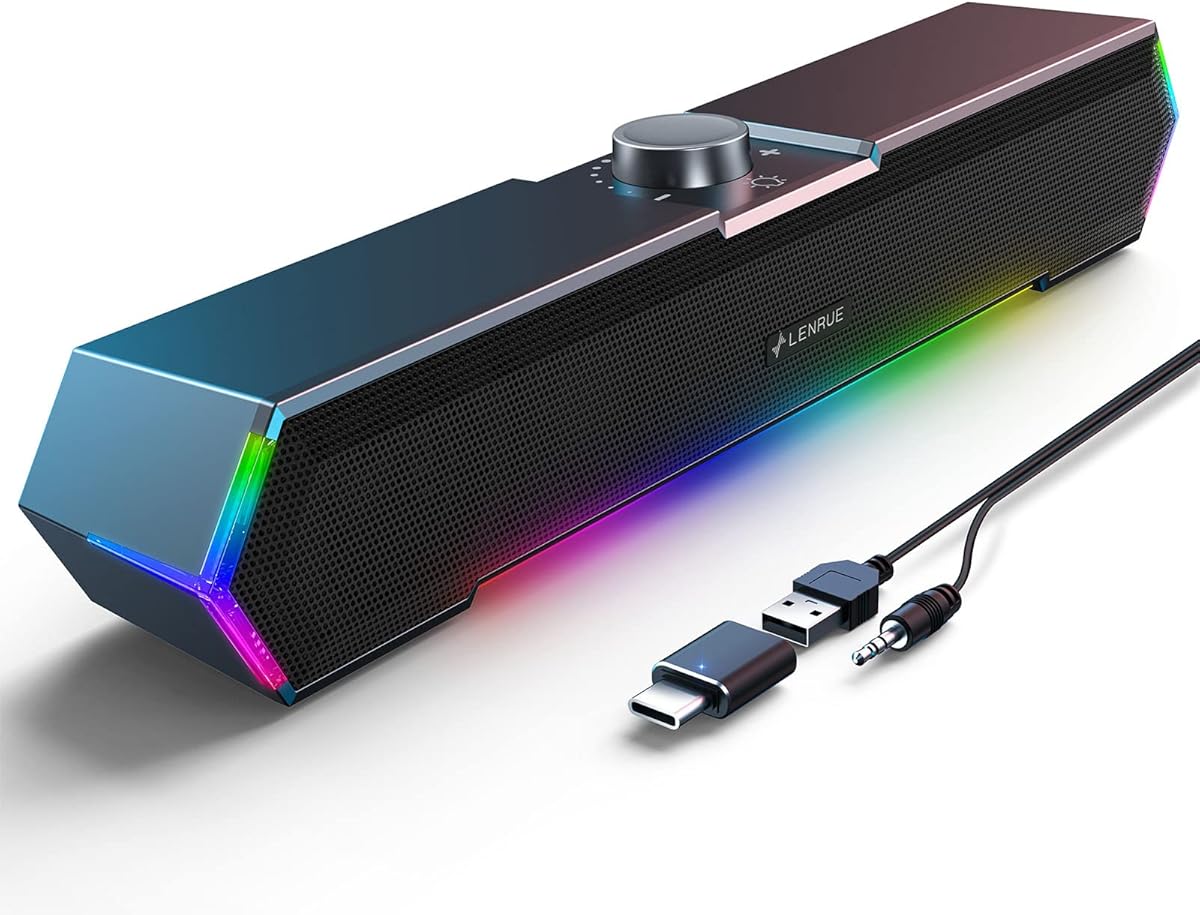
LENRUE's G11 targets gamers who measure desk space in centimeters. The all-in-one compact enclosure sits neatly under a monitor without claiming the depth a soundbar or separated satellite pair would need. Four amplifier integrated-circuit horns drive what the brand calls Surge stereo—marketing language aside, the goal is distortion-free output at conversational to moderately loud volumes for movies, music, and casual titles.

  • Four amplifier IC horns for distortion-free near-field output
  • Touch angular game atmosphere lighting with one-touch toggle
  • USB-C/USB power with bundled Type-C adapter
Check Price →
✓ Pros
  • All-in-one compact shell fits under monitors without extra desk depth
  • Touch lighting control avoids fiddly mechanical switches
  • Bundled USB-C adapter broadens laptop compatibility
  • Glued cable bundle reduces desk spaghetti compared with loose wires
  • Top volume knob is easy to reach during gameplay
✕ Cons
  • Listing explicitly excludes Bluetooth, headphone port, and microphone
  • Not compatible with TVs or headphones per manufacturer note
  • Angular lighting design may not match minimalist office aesthetics

Detailed review

The angular game light design is the visual hook. One touch toggles lighting on or off, avoiding the older button layouts that wear out or collect dust. The aesthetic leans gaming-forward rather than office-neutral, which fits RGB-themed battlestations but might clash with a beige home office photo backdrop.

Setup is classic USB plus AUX plug-and-play. No drivers, no pairing codes—connect power via USB or USB-C using the included adapter, plug the 3.5 mm audio cable into your PC or laptop, and you are done. A top-mounted volume knob keeps level adjustments quick when a cutscene suddenly jumps in loudness.

Transparency in the listing saves returns. LENRUE states clearly that Bluetooth, headphone passthrough, and microphone support are not included, and that TVs are out of scope. That honesty helps if you were hoping to reuse one purchase across a living-room display and a gaming desk.

Rating-wise, the G11 sits at 4.3— slightly below several pack peers—but the compromise profile is coherent. You trade connectivity extras for size, bundled USB-C compatibility, and integrated cable management with glued runs that stay tidy.

Consider the G11 when budget and footprint matter more than wireless convenience or private listening ports. Pair it with a good headset for competitive play and let the speakers handle everything else with a splash of angular RGB.

Ideal Desk Profiles

Perfect for dorm desks, LAN party bags, and secondary PCs where a full soundbar would overhang the desk edge.

Less ideal for streamers who need a headphone jack on the speaker itself—look at the RGB soundbar or the six-mode desktop pair with front headphone output instead.

Check Price on Amazon →

We may earn a commission at no additional cost to you.

4. W-206RE Computer Speakers for PC Desktop - Most Lighting Presets

W-206RE Computer Speakers for PC Desktop

W-206RE Computer Speakers for PC Desktop

8.8/10★★★★☆

If lighting variety is your primary RGB requirement, the W-206RE desktop pair delivers twenty-one dynamic LED modes—far beyond the six-preset norm in this pack. Touch the top panel to cycle effects while physical buttons on the right speaker handle volume, mode, and power. The result is a desk that can look calm during spreadsheets and hyper-saturated during night gaming without swapping hardware.

  • Twenty-one dynamic RGB LED modes with top touch control
  • Bluetooth and 3.5 mm wired dual connectivity
  • Compact stereo pair sized for under-monitor placement
Check Price →
✓ Pros
  • Twenty-one RGB modes offer more variety than six-mode competitors
  • Bluetooth simplifies phone and tablet audio without replacing PC wired use
  • Compact footprint preserves desk space on crowded gaming setups
  • Physical buttons on the right speaker manage volume, mode, and power
  • Clear stereo tuning for games, streaming, and everyday YouTube
✕ Cons
  • USB power limits maximum volume versus externally powered soundbars
  • Twenty-one modes can feel redundant without software favorites
  • W-206RE branding overlaps with a premium variant—check ASIN carefully

Detailed review

Sound is tuned for close-range PC listening: crisp highs, balanced mids, and enhanced bass suitable for RPG ambience, stream alerts, and music between queues. It will not rattle the room, but it clearly outclasses integrated monitor speakers for stereo separation and low-end presence.

Dual connectivity keeps the W-206RE relevant across devices. Bluetooth streams from phones and tablets while the 3.5 mm jack stays connected to your tower or laptop for zero-latency gaming audio. USB provides power, keeping the package travel-friendly relative to soundbars that need wall adapters.

Form factor targets under-monitor placement and dorm desks where every inch matters. The compact stereo layout preserves left-right imaging while avoiding the depth a subwoofer system would demand.

Giftability is part of the listing pitch—RGB flair, simple controls, and broad device support make it an easy recommendation for teens and students building first setups. Just manage expectations on loudness: USB-powered speakers prioritize convenience over headroom.

When comparing against the upgraded MUSEEQ W-206RE variant also in this pack, this listing focuses on core functionality at a 4.4 rating. Choose it when you want maximum lighting presets in the standard W-206RE hardware generation.

Managing Twenty-One RGB Modes

Pick three favorites during setup and note their order in the cycle—it saves time when you want a specific look before streaming.

Turn lighting off entirely during video calls if the camera faces the desk; the LEDs can reflect off glossy monitors.

W-206RE vs Premium Variant

The B0GDV517MV listing in this roundup advertises upgraded sound cavity and brighter RGB chips with extended warranty support. Stay on this ASIN if preset count matters most at the standard tier.

Check Price on Amazon →

We may earn a commission at no additional cost to you.

5. W-206RE RGB Bluetooth PC Speakers - Upgraded W-206RE

W-206RE RGB Bluetooth PC Speakers

W-206RE RGB Bluetooth PC Speakers

8.6/10★★★★☆

This MUSEEQ-branded W-206RE variant addresses the overlap problem in budget RGB speakers: multiple listings, incremental revisions, and unclear differences between boxes that look identical in photos. The manufacturer states it upgraded the sound cavity and RGB light chip relative to the basic model, aiming for more stable output and brighter illumination without changing the compact stereo footprint.

  • MUSEEQ W-206RE with upgraded sound cavity and RGB chip
  • Bluetooth wireless plus 3.5 mm wired dual mode
  • Twenty-one LED lighting modes for gaming desks
Check Price →
✓ Pros
  • Manufacturer upgrade promises stabler sound and brighter LEDs
  • Twelve-month warranty with advertised twenty-four-seven support
  • Bluetooth adds phone streaming without dropping wired PC option
  • Compact stereo layout fits monitors, laptops, and streaming corners
  • Easy gift positioning for gamers and students
✕ Cons
  • 4.3 rating trails the standard W-206RE listing slightly
  • Functionally similar to B0DQSBR4SF—differentiate mainly on warranty claims
  • Still USB power limited compared with externally powered soundbars

Detailed review

Feature set mirrors the core W-206RE experience—twenty-one LED modes, Bluetooth for wireless convenience, 3.5 mm wired input for lag-sensitive gaming, and USB power for simple desk routing. Near-field tuning emphasizes clear vocals, balanced mids, and enhanced bass within USB power constraints.

After-sales support is a selling point here. The listing highlights twelve-month warranty coverage and twenty-four-seven online service, which matters when you are buying RGB electronics where LED failures are the most common long-term annoyance.

Rating at 4.3 sits a notch below the parallel W-206RE ASIN at 4.4, which suggests some buyers preferred the earlier listing or encountered variance in production batches. Treat the upgrade claims as manufacturer-positioned improvements and read recent buyer feedback on LED brightness and Bluetooth stability before choosing between the two W-206RE entries.

Desk fit remains the same value proposition: under-monitor placement, streaming stations, bedrooms, and dorm setups where a full 2.1 system would be overkill. Switch modes with top touch control and lean on Bluetooth when your phone is the audio source.

Buy this SKU when warranty language and the upgraded cavity or chip messaging matter to you. If those details feel incremental, compare pricing and ratings between both W-206RE listings at purchase time—functionally they occupy the same niche in this roundup.

Which W-206RE Should You Pick?

Choose B0GDV517MV when brighter RGB and stated sound-cavity upgrades align with your priorities and you value the emphasized warranty support.

Choose B0DQSBR4SF when a slightly higher listed rating and the standard W-206RE positioning feel sufficient for your desk.

Check Price on Amazon →

We may earn a commission at no additional cost to you.

6. Computer Speakers - Best Headphone Jack

Computer Speakers, Desktop PC Speakers with 6 Colorful RGB Lights

Computer Speakers, Desktop PC Speakers with 6 Colorful RGB Lights

8.8/10★★★★☆

Among USB RGB pairs in this pack, this desktop set distinguishes itself with a front-facing 3.5 mm headphone jack—a quality-of-life feature streamers and shared-space gamers notice immediately. Switch to headphones for late-night ranked matches without crawling behind the PC to swap cables, then pop back to speakers for music without replugging the main AUX lead.

  • Dual 3W drivers with full-range 2.0 enhanced stereo core
  • Six RGB modes: symphony, flowing, breathing, three solid colors
  • Front 3.5 mm headphone jack plus USB-C adapter in box
Check Price →
✓ Pros
  • Headphone jack enables quick private listening without unplugging speakers
  • Six lighting modes cover both animated and static desk themes
  • USB-C adapter included for modern laptops lacking USB-A ports
  • Generous cable lengths—80 cm between speakers, 100 cm USB and AUX
  • Single knob simplifies volume and power during gameplay
✕ Cons
  • 3W per driver limits absolute loudness in large rooms
  • No Bluetooth—wired audio only from source devices
  • Generic product naming makes it harder to search for support later

Detailed review

Audio hardware uses dual 3W drivers with a full-range 2.0 enhanced stereo core. The output targets immersive gaming, movies, and music at desk distances rather than filling a living room. Highs stay crisp for footstep cues; bass performance benefits from the tuned enclosure though it cannot match a dedicated subwoofer.

RGB includes six modes—symphony, flowing, breathing, and three solid colors—matching the lighting vocabulary seen on Nylavee-style competitors. The light bar integrates into a design that prioritizes gaming desk aesthetics without requiring software.

Connectivity remains USB power plus 3.5 mm audio with plug-and-play simplicity across Windows, Mac OS, Chrome OS, and Linux. The included USB-C adapter broadens compatibility with modern ultrabooks that dropped USB-A ports—a small inclusion that prevents an extra adapter hunt on delivery day.

Cable lengths deserve mention. Approximately eighty centimeters between left and right speakers and one-meter USB and AUX runs give flexibility for tower PCs on the floor and dual-monitor bridges. That matters when cheap pairs ship with stiff, short cables that force awkward routing.

Naming is generic—literally Computer Speakers—which can complicate warranty searches. Save your order details and ASIN B0D95Y3XZ2 when you need support. Functionally, this is a strong mid-pack pick when headphone passthrough and USB-C readiness matter more than Bluetooth.

Using the Headphone Jack Effectively

Plug headphones into the speaker rather than the case rear panel to mute the drivers automatically on many setups—confirm behavior once on your machine.

Keep a short headphone extension handy if your preferred headset cable is awkwardly short for desk routing.

Who Benefits Most

Shared bedrooms, dorm mates, and parents on night shift appreciate quick headphone switching.

Users with USB-C-only laptops should prioritize this over older USB-A-only pairs lacking adapters.

Check Price on Amazon →

We may earn a commission at no additional cost to you.

7. Nylavee Computer Speakers - Best Updated Nylavee

Nylavee Computer Speakers

Nylavee Computer Speakers

8.8/10★★★★☆

Nylavee's updated desktop speakers refine what the brand started with the six-mode original in this pack. Dual passive radiators join dual full-range drivers to add low-end depth and a more natural sense of space for movies, music, and story-driven games. It is the kind of incremental acoustic upgrade that does not show up in marketing photos but shows up when dialogue feels less nasal and explosions less tinny.

  • Dual full-range drivers with dual passive radiators
  • Nine RGB modes including rainbow, breathing, seven solids
  • Slim profile with 4.5 ft cable for dual 27-inch monitors
Check Price →
✓ Pros
  • Passive radiators add depth missing from the original Nylavee pair
  • Nine lighting modes split the difference between six and twenty-one preset tiers
  • Extended cable reach suits dual-monitor and deep desk setups
  • Eighteen-month warranty and lifetime support claim add purchase confidence
  • Works with PS5 and Xbox via USB power plus AUX routing
✕ Cons
  • Still no Bluetooth or headphone jack on this revision
  • Console use depends on display or controller audio routing—verify your setup
  • Slim profile trades internal volume for desk fit—bass has limits

Detailed review

RGB expands to nine customizable modes—rainbow, breathing, and seven solid colors—giving more static options for stream backdrops that dislike fast pulsing effects. Touch or button switching lets you kill lighting entirely when a clean desk photo matters.

The slim profile targets modern workstations with dual twenty-seven-inch monitors. A four-and-a-half-foot cable span reaches across wide stands without dangling mid-air or forcing off-angle speaker placement. USB and USB-C power compatibility plus 3.5 mm AUX keep setup driver-free on Windows, macOS, and consoles that accept external speaker output via controller or display passthrough.

Support messaging is stronger here: eighteen-month warranty and lifetime customer assistance reduce the anxiety of buying no-name RGB gear online. Save documentation in case you need a replacement driver or LED module down the line.

Compared with the first Nylavee in this roundup, this model is the clear upgrade path—more lighting presets, passive radiators, longer reach, and better stated support. Compared with soundbars like the Deeyaple or RGB Gaming Soundbar entries, it lacks EQ software, headphone hubs, and extreme wattage—but also avoids external power bricks.

Choose this Nylavee when you want a polished wired RGB pair with improved bass architecture and dual-monitor cable reach without jumping to soundbar complexity.

Console Desk Setup Notes

PS5 and Xbox compatibility depends on routing audio through your display's headphone output or controller passthrough—confirm your monitor or TV exposes a 3.5 mm out.

USB power can come from the console front port or a nearby charger—audio still travels via AUX, not USB audio.

Nylavee Original vs Updated

Original B0B9Y6HLHG offers six modes and bass ports at a lower complexity tier. Updated B0F4DKZRGQ adds passive radiators, nine modes, longer cables, and extended warranty positioning.

Check Price on Amazon →

We may earn a commission at no additional cost to you.

8. Deeyaple Computer Speakers - Best Feature-Rich Soundbar

Deeyaple Computer Speakers, 40W PC Speakers for Desktop Monitor

Deeyaple Computer Speakers, 40W PC Speakers for Desktop Monitor

8.8/10★★★★☆

Deeyaple's soundbar is the feature maximalist of this roundup. Forty watts peak, dual full-range drivers, dual passive bass radiators, digital USB-C audio, Bluetooth 5.3, customizable EQ, screen-sync RGB, and music-reactive lighting combine into a desk centerpiece that behaves more like a gaming peripheral ecosystem than a simple speaker pair.

  • 40W peak with dual drivers and dual passive bass radiators
  • Digital USB-C audio—no 3.5 mm AUX on this model
  • Windows EQ software with screen-sync and music-reactive RGB
Check Price →
✓ Pros
  • 40W peak output and external adapter deliver louder, cleaner headroom
  • USB-C digital audio eliminates analog hiss on many motherboards
  • Bluetooth 5.3 handles phone streaming with stable wireless performance
  • Screen-sync RGB mirrors monitor colors for immersive setups
  • EQ software needs no account registration on Windows
✕ Cons
  • EQ and advanced RGB control software is Windows-only—not macOS
  • No 3.5 mm AUX—USB digital path or Bluetooth only
  • External power brick adds cable clutter versus pure USB pairs

Detailed review

Power delivery explains the performance gap versus USB-only competitors. An external adapter maintains stable output at high volumes—critical when bass-heavy titles push cheap USB speakers into distortion. The tradeoff is another cable and wall outlet dependency, but users chasing cinematic game audio on a desk will accept that compromise.

Digital USB-C audio is a meaningful differentiator. Instead of analog 3.5 mm runs that pick up electrical noise on some boards, a single USB cable carries high-resolution digital audio and data. The listing is explicit: no 3.5 mm AUX input here. Plan your sources accordingly—PC via USB, phone via Bluetooth, consoles only if they support your intended routing path.

Software control lands on Windows without mandatory registration—a rarity in RGB peripherals where every vendor wants an account. Download the utility to tweak bass, treble, and midrange EQ profiles for competitive footsteps, cinematic surround effects, or neutral music listening. Mac users miss out on EQ and advanced lighting features; Apple-focused desks should look at the USB-C soundbar with hardware mode buttons instead.

RGB goes beyond preset cycles. Screen color sync mirrors monitor hues in real time, extending game visuals onto the desk plane. Music-reactive modes pulse with beat energy during Spotify sessions. Twelve dynamic lighting modes provide fallback options when sync is too distracting for productivity.

Who should buy Deeyaple? Windows gamers with room for a soundbar under a monitor, tolerance for an external power brick, and appetite for tuning tools. Who should skip? Mac-primary users, minimalists who hate software, and anyone who needs analog AUX from older devices without USB audio support.

Windows Software Setup

Install the Deeyaple utility before fine-tuning EQ—create a gaming profile with boosted mids for footsteps and a separate music profile with relaxed bass.

Screen sync looks best when the soundbar sits centered under your primary display with unobstructed line-of-sight to on-screen action.

Connectivity Planning

Verify your PC exposes USB audio over the port you plan to use—front panel ports occasionally share bandwidth with headers that introduce noise.

Because AUX is absent, legacy devices need a USB audio path or Bluetooth—keep a dongle handy for oddball sources.

Deeyaple vs RGB Gaming Soundbar

The B0H7J8VD4D soundbar offers hardware sound modes and macOS-friendly USB-C plug-and-play without Windows-only software. Deeyaple wins on wattage, screen sync, and deep EQ; the soundbar wins on simplicity and cross-platform hardware controls.

Check Price on Amazon →

We may earn a commission at no additional cost to you.

9. Computer Speakers for Desktop PC - Best Overall

Computer Speakers for Desktop PC, RGB Gaming Soundbar

Computer Speakers for Desktop PC, RGB Gaming Soundbar

9.2/10★★★★★

This RGB gaming soundbar earns the best overall label primarily because it balances sound, lighting, connectivity, and platform support without forcing Windows-only software. A 4.6 customer rating tops the pack, and the hardware feature set reads like a checklist of what desk gamers actually request: multiple listening modes, RGB with an off switch, headphone passthrough, AUX input, and single-cable USB-C audio.

  • Dual-layer neodymium drivers with Bass, Vocal, and Surround modes
  • Seven RGB effects plus dedicated instant lights-off button
  • USB-C digital audio with headphone out and rear 3.5 mm AUX in
Check Price →
✓ Pros
  • Highest 4.6 rating in the pack with balanced hardware features
  • Three one-press sound modes adapt to games, podcasts, and movies
  • Headphone jack and AUX in make it a desk audio hub—not just speakers
  • USB-C plug-and-play works on Windows, macOS, PS5, and Linux
  • Magnetic shielding ring reduces interference on crowded desks
✕ Cons
  • Listing warns against monitor USB ports—use PC ports for stable audio
  • No microphone and not compatible with Xbox, USB hubs, or projectors
  • RGB is preset-based—no screen sync like Deeyaple on Windows

Detailed review

Acoustic engineering centers on dual-layer neodymium magnets driving clear highs and meaningful bass for a soundbar footprint. Three one-press modes reshape the response instantly—Bass Mode for music and action titles, Vocal Mode for podcasts and strategy streams, Surround Mode for cinematic playback. Hardware switching beats diving into OS menus when you bounce between content types hourly.

RGB includes seven dynamic effects tuned for gaming atmosphere, plus a dedicated button that kills lighting immediately when you pivot to spreadsheets or video calls. Streamers who alternate between hype evenings and professional daytime calls will use that button often.

Connectivity elevates the product from speakers to hub. USB-C carries digital audio with a included USB-A adapter for older towers. A rear headphone output enables private listening without unplugging the soundbar. A 3.5 mm AUX input accepts phones or secondary sources. Magnetic shielding on the USB path reduces noise when cables cross power runs—a small detail that matters on cluttered battlestations.

Compatibility spans Windows, macOS, PS5, and Linux with explicit caveats: plug into the computer's USB or Type-C port, not a monitor passthrough, for stable output; skip Xbox, USB hubs, and projectors per the manufacturer. There is no microphone—pair a dedicated mic for streaming.

Against Deeyaple, this soundbar trades wattage extremes and screen-sync RGB for universal hardware mode buttons and macOS inclusion. Against SteelSeries Arena 7, it sacrifices subwoofer thunder for desk simplicity and single-bar aesthetics. For most PC gamers seeking one RGB upgrade that just works, this is the anchor pick in the roundup.

Sound Mode Quick Guide

Bass Mode: action games, EDM, and trailers where low-end impact matters.

Vocal Mode: dialogue-heavy RPGs, Zoom calls, and podcast editing.

Surround Mode: films and atmospheric single-player adventures—swap to headphones for sweaty competitive ladders.

Placement and Port Selection

Center the bar under your primary monitor with tweeters unobstructed by desk mats.

Connect USB directly to the PC rear I/O or a trusted front header—avoid monitor USB when the listing warns of instability.

Check Price on Amazon →

We may earn a commission at no additional cost to you.

10. SteelSeries Arena 7 - Best Premium 2.1 RGB

SteelSeries Arena 7 RGB Illuminated 2.1 Gaming Speakers

SteelSeries Arena 7 RGB Illuminated 2.1 Gaming Speakers

9/10★★★★★

SteelSeries Arena 7 represents what happens when a gaming peripheral brand builds RGB speakers without USB power limits. This is a 2.1 system: two satellite speakers with dedicated silk dome tweeters and organic-fiber woofers, plus a 6.5-inch downward-firing subwoofer that places bass energy on the floor or desk platform where your chest feels explosions—not just your ears hear them.

  • 2.1 with silk dome tweeters and organic-fiber woofers plus 6.5-inch sub
  • PrismSync four-zone reactive RGB on satellites
  • Sonar software: 10-band EQ, spatial audio, Bluetooth, optical, USB
Check Price →
✓ Pros
  • True subwoofer delivers gaming bass USB pairs cannot physically reproduce
  • Separate tweeters and woofers improve detail across mids and highs
  • PrismSync lighting reacts to screen events—not just preset cycles
  • Sonar software offers deep EQ and spatial tuning for enthusiasts
  • Optical, USB, AUX, and Bluetooth cover consoles, PC, and mobile
✕ Cons
  • Largest footprint and sub placement demands floor or desk space planning
  • Premium tier investment—overkill for casual YouTube and Discord use
  • Software ecosystem adds setup time versus plug-and-play USB pairs

Detailed review

PrismSync RGB differentiates Arena 7 from every other product in this pack. Four-zone LEDs on the satellites react to on-screen events and music rather than cycling fixed patterns only. When lighting is core to immersion—not decoration—reactive sync justifies the premium positioning alongside audiophile-adjacent driver materials.

Connectivity reflects a primary gaming station hub. USB, optical, and AUX wired paths cover PCs and consoles; Bluetooth handles mobile and secondary devices; wired headset support integrates with SteelSeries' broader audio ecosystem. Optical input alone opens doors for PlayStation setups that frustrate USB-only budget gear.

Sonar software unlocks enthusiast controls: ten-band parametric EQ, acoustic echo cancellation, spatial audio simulation, and more. Competitive players can emphasize footstep bands; cinematic players can widen staging for story titles. Setup takes longer than plug-and-play USB pairs, but the payoff scales with how much you care about tuning.

Tradeoffs are physical and financial. The subwoofer needs placement space—under the desk, beside the tower, or on the floor with clearance for the downward port. Cable runs multiply compared with a single soundbar. For dorm desks or minimalist IKEA surfaces, measure before buying.

Who should step up to Arena 7? Gamers upgrading from years of headphone-only audio who want room-filling sound for single-player blockbusters, plus reactive RGB that matches SteelSeries keyboards and mice. Who should stay in USB land? Casual desk users, tight spaces, and buyers who mainly need clearer speech for calls and streams without subwoofer logistics.

Subwoofer Placement Tips

Corner placement increases bass output but can sound boomy—start centered under the desk front edge and adjust.

Keep the downward port unobstructed; carpet can muffle punch if the foot sits too flush.

PrismSync and Sonar Workflow

Install SteelSeries GG and enable Sonar before expecting full EQ and spatial features—budget time for firmware updates on first connect.

Pair PrismSync with games that support SteelSeries integrations for the most dramatic lighting reactions.

Arena 7 vs Desk Soundbars

RGB gaming soundbars win on simplicity and desk footprint. Arena 7 wins on bass authority, driver separation, reactive lighting, and console optical connectivity—choose based on space and listening volume, not RGB alone.

Check Price on Amazon →

We may earn a commission at no additional cost to you.

Best RGB Gaming Speakers in 2026 for Immersive Desk Setups

How to Choose the Best RGB Gaming Speakers for Your Desk

Start With Desk Space and Form Factor

RGB gaming speakers ship as compact stereo pairs, detachable dual modules, or under-monitor soundbars with optional subwoofers. Measure depth and width before falling in love with lighting renders. Separated pairs need enough span for stereo imaging; soundbars sacrifice some width separation for cable simplicity; 2.1 systems add a subwoofer footprint you cannot ignore.

Under-monitor bars like the RGB Gaming Soundbar and Deeyaple excel on shallow desks where tower speakers would overhang. Compact pairs from Nylavee, LENRUE, and W-206RE fit flanking monitors on wider surfaces. Arena 7 assumes you have floor or under-desk volume for the sub.

Power Source Determines Volume Headroom

USB-powered speakers prioritize convenience—one cable from the PC often handles power, and many models still use separate AUX for analog audio. They sound fine at near-field desk distances but compress when pushed to room-filling levels.

Externally powered soundbars like Deeyaple and the SteelSeries sub system maintain cleaner bass at high volumes because they are not drawing all energy from a five-volt USB port. If you play story-driven titles loud or sit more than arm's length from the screen, lean toward externally powered options.

RGB Types: Presets vs Reactive Sync

Most pack entries offer preset RGB—symphony cycles, breathing, solids, and touch toggles. Modes range from six on entry pairs to twenty-one on W-206RE models. Presets are reliable, platform-agnostic, and fine for matching a static theme.

Reactive sync appears on Deeyaple (screen and music reactive via Windows software) and SteelSeries PrismSync (game and music reactive on Arena 7). These features need compatible software and sometimes specific games to shine. If you refuse to install utilities, prioritize hardware preset speakers with a dedicated lights-off button.

Connectivity Checklist

Wired 3.5 mm AUX remains the lowest-latency path for PC gaming on budget pairs. USB-C digital audio on soundbars reduces hiss and consolidates cables but may exclude legacy analog sources unless Bluetooth is available.

Bluetooth is convenient for phones yet still requires USB power on every model here that offers it—none are battery portable. Headphone jacks appear on select pairs and the top soundbar; verify before buying if private listening matters.

Console users should read compatibility notes carefully. PS5 often works with USB-C soundbars; Xbox and monitor USB passthrough frequently do not. Arena 7 optical input is the safest premium console path in this pack.

Sound Tuning: Hardware Modes vs Software EQ

Hardware mode buttons on the RGB Gaming Soundbar let macOS and Windows users swap Bass, Vocal, and Surround profiles instantly. Deeyaple's Windows-only EQ goes deeper for enthusiasts willing to profile competitive and cinematic setups separately.

SteelSeries Sonar is the most advanced software suite here—parametric EQ, spatial audio, echo controls—but demands time investment. Entry USB pairs rely on OS-level sliders only. Match tuning complexity to your patience.

Match the Speaker to Your Primary Use Case

Frequently Asked Questions

01

Do RGB gaming speakers actually improve gameplay?

RGB lighting does not make you hear enemies faster—better drivers and placement do. What RGB adds is immersion and desk cohesion when lighting matches your peripherals. For gameplay advantage, prioritize stereo separation, sound modes or EQ that emphasize mids for footsteps, and a setup that lets you swap to headphones instantly. Treat RGB as atmosphere, not performance magic.

02

Can USB-powered RGB speakers get loud enough for gaming?

Yes for typical desk distances of eighteen to thirty inches. USB pairs in this pack—Nylavee, W-206RE, LENRUE, and the six-mode desktop set—handle games, Discord, and music at comfortable volumes. They struggle to fill large rooms or compete with household noise. If you sit far from the screen or want chest-thumping bass, step up to Deeyaple's externally powered soundbar or SteelSeries Arena 7 with a subwoofer.

03

Should I use Bluetooth or wired audio for PC gaming?

Wired connections—3.5 mm AUX or USB digital—offer lower latency and fewer dropouts during competitive play. Bluetooth on pack models like AOC, W-206RE, Deeyaple, and Arena 7 is excellent for music and casual titles but can introduce lag in fast shooters. A practical pattern: stay wired to your PC full time, use Bluetooth only when your phone is the audio source.

04

Why do some listings warn against plugging speakers into monitor USB ports?

Many monitors pass USB power through internal hubs with limited or noisy power delivery. The RGB Gaming Soundbar listing explicitly recommends connecting to the computer's USB or Type-C port for stable audio output. Monitor ports may work for power-only USB pairs occasionally, but digital audio paths are pickier. When in doubt, use direct motherboard or laptop ports.

05

What is the difference between preset RGB and reactive sync lighting?

Preset RGB cycles through fixed patterns—symphony, breathing, solid colors—controlled by touch or buttons. Reactive sync analyzes screen content or music and adjusts colors in real time. Deeyaple offers screen-sync and beat reactive modes via Windows software; SteelSeries PrismSync reacts to games and audio on Arena 7. Presets are simpler and cross-platform; reactive features need compatible software and setup time.

06

Are soundbars better than separated stereo pairs for RGB gaming desks?

Soundbars simplify cable routing and fit under monitors cleanly—the RGB Gaming Soundbar and Deeyaple are strong examples. Separated pairs like AOC detachable speakers or Nylavee dual modules offer wider stereo imaging when placed properly. Neither is universally better; choose based on desk depth, whether you value imaging width or minimal footprint, and if you need hub features like headphone jacks on the soundbar.

07

Will these speakers work with PS5 or Xbox?

PS5 compatibility appears on several listings when using USB audio soundbars or routing AUX from the controller or display. The RGB Gaming Soundbar advertises PS5 support via USB-C. Deeyaple targets PS4 and PS5 with USB and Bluetooth paths. Xbox support is spotty— the RGB Gaming Soundbar explicitly excludes Xbox, and budget AUX pairs depend on your TV or controller audio routing. Arena 7 optical and wired options are the most console-flexible premium pick here.

08

Do I need software to control RGB on these speakers?

Most pack models control lighting with onboard touch or buttons—no app required. Deeyaple and SteelSeries Arena 7 unlock advanced EQ and reactive lighting through Windows software (Deeyaple is Windows-only for its utility). If you refuse to install apps, favor Nylavee, W-206RE, AOC, LENRUE, the six-mode desktop pair, or the RGB Gaming Soundbar with hardware lighting controls.

09

How do the two W-206RE listings differ?

Both offer twenty-one RGB modes, Bluetooth, and compact stereo layouts. B0DQSBR4SF is the standard W-206RE at a 4.4 rating. B0GDV517MV is the MUSEEQ upgraded variant advertising a revised sound cavity, brighter RGB chip, and emphasized twelve-month warranty support at a 4.3 rating. Choose based on warranty messaging and recent buyer feedback rather than dramatic feature gaps.

10

When is SteelSeries Arena 7 worth it over a USB RGB soundbar?

Arena 7 makes sense when you want true subwoofer bass, separate tweeters and woofers for detail, optical console connectivity, and reactive PrismSync lighting tied to SteelSeries software. USB soundbars win when desk space is tight, you want single-cable USB-C simplicity, or you primarily need clearer speech and moderate gaming volume without sub placement logistics. Arena 7 is a station upgrade; soundbars are desk upgrades.

Conclusion

RGB gaming speakers in 2026 are less about choosing the flashiest light show and more about matching form factor, power, and connectivity to how you actually use your desk. This pack spans honest entry USB pairs with touch presets, flexible detachable layouts, twenty-one-mode budget showpieces, headphone-friendly wired sets, feature-heavy Windows soundbars, a cross-platform USB-C soundbar with hardware modes, and a premium 2.1 SteelSeries system with reactive lighting and real subwoofer bass.

For most PC gamers, the RGB Gaming Soundbar at 4.6 ratings balance wins best overall: three sound modes, seven RGB effects with instant off, headphone and AUX hub features, and USB-C simplicity across Windows and macOS. Step up to Deeyaple when you want louder output, digital USB-C audio, and screen-sync RGB on Windows. Step up again to SteelSeries Arena 7 when bass authority and PrismSync reactive lighting justify the space and setup time.

Whichever model you choose, route cables deliberately, respect USB power limits, and keep a headset handy for serious competitive play. RGB should complement great desk audio—not replace the fundamentals of placement, sensible volume, and honest expectations about what a USB pair can physically deliver.