Expert Review & Guide

Best PC Cases for Water Cooling Builds in 2026

Water cooling only works as well as the chassis around it. A thick 360mm AIO jammed against a sealed front panel, a top radiator that fights exhaust fans, or a tube path that kinks over a tall VRM heatsink will erase the thermal gains you paid for. In 2026 the cases that suit liquid cooling publish honest radiator maps, leave room for thick rads plus fans, and keep intake air from fighting GPU heat in a choked channel.

This guide covers only the ten chassis in our best-pc-cases-for-water-cooling pack. We ranked radiator clearance from 240mm through 420mm, multi-radiator headroom, stock fans versus blank mounts, dual-chamber separation, panoramic glass versus mesh, USB-C I/O, GPU length under side loops, and weekend AIO readiness versus custom dual-loop ambition. Expect big gaps between the compact Cooler Master Q300L and rad-hungry towers like the Geometric Future M5 or ANSAITE K9.

Start with our three top picks if you want a thick-radiator flagship, a modular Corsair platform, or a dual-chamber multi-360mm showcase. Use the comparison table to separate 240mm-limited cases from 420mm monsters, then read each review for tube routing notes and intake-versus-exhaust planning before you buy an AIO that will not fit.

Our Top PC Cases for Water Cooling in 2026

Best Overall for Thick Rads

Geometric Future M5 Tempered Glass Mid Tower

★★★★★9.2/10
Geometric Future M5 Tempered Glass Mid Tower
  • Supports up to 420mm radiators with room for serious liquid-cooling layouts
  • Five pre-installed 140mm ARGB PWM fans for strong out-of-box airflow
  • E-ATX compatibility and 460mm GPU clearance for high-end water-cooled builds
Check Price →
Best Modular Airflow Platform

CORSAIR 4000D RS ARGB Frame Modular Mid-Tower

★★★★★9.4/10
CORSAIR 4000D RS ARGB Frame Modular Mid-Tower
  • InfiniRail mounting system slides fans for targeted radiator and airflow placement
  • Three pre-installed RS ARGB PWM fans with low-restriction Y-pattern front panel
  • FRAME modular design lets you evolve I/O and trays as your cooling loop grows
Check Price →
Best Multi-Radiator Showcase

FOIFKIN F600 Dual-Chamber Mid-Tower

★★★★★9/10
FOIFKIN F600 Dual-Chamber Mid-Tower
  • Claims simultaneous support for three 360mm radiators in a dual-chamber layout
  • Seven pre-installed 120mm ARGB PWM fans with reverse-blade intake options
  • Panoramic tempered glass and Type-C I/O for clean showcase AIO builds
Check Price →

As an Amazon Associate we earn from qualifying purchases. We may earn a commission at no additional cost to you.

Water-Cooling PC Case Comparison: Radiators, Fans, and Clearance

Compare radiator size support, stock fans, and chassis layout before you commit to an AIO or custom loop. Specs focus on cooling practicality—no prices. Check the live listing for the current configuration and exact mounting details.

#ProductSpecificationsScore
1
  • 7× 120mm ARGB PWM fans pre-installed
  • Up to 3× 360mm radiators simultaneously
  • Dual-chamber; GPU to 400mm; Type-C I/O
9
2
  • Micro-ATX/Mini-ITX; perforated open airflow
  • Up to 240mm AIO liquid cooler support
  • GPU to 360mm; modular I/O panel placement
9
3
  • 4 PWM ARGB fans; up to 10-fan capacity
  • Supports up to 360mm water-cooling radiator
  • 270° panoramic tempered glass; Type-C I/O
9
4
  • 9 PWM ARGB fans pre-installed
  • 420mm and 360mm top radiator support
  • GPU to 460mm; back-connect ready layout
9
5
  • 3× CORSAIR RS ARGB PWM fans included
  • InfiniRail flexible front and roof fan mounts
  • High-airflow Y-pattern front; FRAME modular
9.4
6
  • 360mm front and 240mm top radiator support
  • 2× 120mm Quiet Airflow fans pre-installed
  • Ultra-fine mesh panels; perforated PSU shroud
9.4
7
  • 4× 120mm ARGB PWM fans + LED strip
  • Top radiator support up to 360mm
  • GPU to 420mm; back-connect motherboard ready
9.6
8
  • White DS900; 4 PWM ARGB fans included
  • Up to 360mm radiator; supports 10 fans
  • 270° panoramic glass; USB-C front panel
9
9
  • 5× 140mm ARGB PWM fans pre-installed
  • Up to 420mm radiator support; E-ATX ready
  • Tool-less glass; GPU to 460mm; PSU display
9.2
10
  • 6× 120mm ARGB PWM fans pre-installed
  • Top 360mm radiator support; dual-chamber
  • GPU to 400mm; Type-C plus multi-USB I/O
9

1. FOIFKIN F600 - Best Multi-Radiator Showcase

FOIFKIN F600 Dual-Chamber Mid-Tower

FOIFKIN F600 Dual-Chamber Mid-Tower

9/10★★★★★

The FOIFKIN F600 treats radiators as first-class citizens. Its dual-chamber layout parks the PSU and storage in a secondary bay so the main stage stays open for GPU length, motherboard clearance, and the tubing paths that make or break a water-cooled showpiece. Keeping hot PSU exhaust and cable bulk out of the primary chamber helps radiators breathe and keeps tempered-glass photography looking intentional.

  • 7× 120mm ARGB PWM fans (6 reverse, 1 forward)
  • Simultaneous 3× 360mm radiator capacity claimed
  • Dual-chamber; ATX/mATX/ITX; GPU to 400mm
Check Price →
✓ Pros
  • Aggressive multi-360mm radiator map for ambitious liquid plans
  • Seven PWM ARGB fans included—strong starting airflow and lighting
  • Dual-chamber layout hides PSU and drive clutter from the glass view
  • Type-C front I/O and panoramic tempered glass for modern desks
  • ATX through ITX motherboard flexibility in one chassis
✕ Cons
  • Dense glass and fan stacks can raise dust cleaning frequency
  • Triple-radiator installs need careful thickness and tube planning
  • Compact outer dimensions mean less spare room than full towers

Detailed review

Out of the box you get seven 120mm ARGB PWM fans—six reverse-blade and one forward—an unusually generous start for a mid-tower aimed at liquid cooling. Reverse blades look cleaner as intakes behind glass while still pushing air inward. Pair that with claimed simultaneous triple 360mm radiator support and you can grow from a single thick AIO into a dual-loop plan without immediately hitting a mounting dead end.

Panoramic tempered glass is the visual pitch, so desk placement with a clear side view matters more than stuffing the case into a closed cabinet. The Type-C front port helps when rear motherboard USB-C is buried. Outer dimensions stay manageable for a dual-chamber design, but you should still mock up radiator thickness plus fan depth before ordering a chunky custom stack.

Hardware clearance targets mainstream high-end parts: GPUs to 400mm cover most triple-fan cards, though vertical mounts and thick side radiators can shrink that number. PSU length to 200mm works for modular ATX units if you route into the rear chamber. Drive capacity is modest—one HDD and two SSDs—so lean on M.2 if radiator mounts displace cages.

For water cooling, treat triple-360mm as a planning ceiling, not a weekend plug-and-play project. Map flow so intake radiators do not dump warm air into exhaust radiators in the same channel. The F600 rewards builders who sketch fan directions first: bottom or side intake into the GPU zone, top exhaust through a CPU AIO, and no dead zones behind solid glass.

Buy it for showcase gaming PCs that may grow into multi-radiator loops. Look elsewhere for Micro-ATX footprints, mesh-first silent offices, or deep brand accessory ecosystems. Within this pack, the F600 is the multi-radiator dual-chamber statement piece.

Who the F600 is for

Choose the F600 if your list starts with multiple 360mm mounts, dual-chamber cable hiding, and panoramic glass for ARGB fans. Skip it if you only need a simple 240mm AIO in a Micro-ATX shell—the Q300L or H5 Flow wastes less desk space for that narrower mission.

Water-cooling setup notes

Dry-fit radiators and measure tube routes before filling. Confirm motherboard headers or an ARGB hub for seven PWM fans. If you start with one top 360mm AIO as exhaust, leave bottom or side mounts free for a future GPU radiator.

Versus other dual-chamber options

Compared with the FOIFKIN F1, the F600 brings an extra fan and a more aggressive multi-radiator story. Compared with darkFlash DS900 models, it emphasizes chamber separation and simultaneous 360mm capacity over a simpler single-chamber panoramic layout.

Check Price on Amazon →

We may earn a commission at no additional cost to you.

2. Cooler Master Q300L V1 - Best Compact Micro-ATX Cooler

Cooler Master Q300L V1 Micro-ATX

Cooler Master Q300L V1 Micro-ATX

9/10★★★★★

Not every water-cooled PC needs a panoramic aquarium. The Cooler Master Q300L V1 fits liquid cooling into a compact Micro-ATX or Mini-ITX footprint without pretending a 420mm radiator will magically fit. Perforated panels on multiple sides prioritize airflow over sealed glass theater—exactly what a 240mm AIO wants on a small desk.

  • Micro-ATX or Mini-ITX motherboards only
  • Up to 240mm liquid cooler; ~5-fan cooling plan
  • GPU to 360mm; CPU cooler height to 159mm
Check Price →
✓ Pros
  • Perforated open design favors airflow in a small footprint
  • 240mm AIO support covers many popular dual-fan liquid coolers
  • Modular I/O panel can move to multiple edges for desk quirks
  • Magnetic dust filters and transparent side panel keep maintenance simple
  • Long GPU clearance for a Micro-ATX case class
✕ Cons
  • No 360mm radiator path—liquid plans must stay at 240mm class
  • CPU cooler height limit of 159mm rules out many tall air towers
  • Less showcase glass drama than panoramic mid-towers in this list

Detailed review

Radiator reality check: this chassis tops out around a 240mm liquid cooler and a roughly five-fan plan. That is enough for many mainstream CPUs when the AIO has clear intake or exhaust intent. If your cart already holds a 360mm AIO, move to the NZXT H5 Flow, Lian Li V100, or Geometric Future M5 instead of forcing a compromise here.

Clearance favors long GPUs more than tall air coolers. Cards to 360mm and PSUs to 160mm keep midrange and many high-end GPUs viable, while the 159mm CPU cooler height cap often makes liquid the smarter path. The transparent side panel shows a tidy Micro-ATX board and dual-fan AIO without panoramic kit bulk.

The modular I/O panel is a sleeper feature—relocate ports to front, top, or bottom edges when the case sits on a shelf or beside a wall. Magnetic dust filters matter more in perforated cases; plan regular wipes if you run positive intake. Cable space is tighter than dual-chamber mid-towers, so prefer modular PSUs and simple factory AIO tubes over hardline custom runs.

Buy the Q300L when “best for water cooling” means the smallest honest 240mm AIO box, not maximum radiator count. It is the compact outlier in this pack: pair a quality 240mm cooler, a Micro-ATX board, and a GPU inside the length limit for a cool, portable-feeling gaming PC.

Best use cases

LAN-friendly Micro-ATX gaming PCs, dorm desks, and secondary streaming boxes that still want AIO thermals when 240mm matches your CPU TDP. Avoid it for E-ATX boards, 360mm+ shopping lists, or multi-rad custom loops.

AIO mounting tips

Prefer orientations that keep the pump from becoming the highest point if your AIO is bubble-sensitive. Confirm fan direction so perforated panels feed cool room air into the radiator rather than recirculating GPU exhaust.

Check Price on Amazon →

We may earn a commission at no additional cost to you.

3. darkFlash DS900 Black - Best Panoramic 360mm Value

darkFlash DS900 ATX Mid-Tower (Black)

darkFlash DS900 ATX Mid-Tower (Black)

9/10★★★★★

The black darkFlash DS900 is a panoramic ATX mid-tower that treats a 360mm water-cooling radiator as a core feature. Dual tempered glass for a 270° view, four PWM ARGB fans installed, and expansion toward roughly ten fans make it a direct answer for a clean single-AIO gaming PC that still looks dramatic on camera.

  • 4 PWM ARGB fans; expands to about 10 fans
  • Up to 360mm water-cooling radiator support
  • 270° panoramic tempered glass; Type-C I/O
Check Price →
✓ Pros
  • 270° panoramic glass makes AIO builds and RGB fans the centerpiece
  • 360mm radiator support hits the sweet spot for modern CPU AIOs
  • Four PWM ARGB fans included with room to expand toward ten
  • Type-C plus USB 3.0 front I/O for daily convenience
  • Magnetic top dust filter and anti-slip feet show practical details
✕ Cons
  • RGB hub controller is not included—plan motherboard headers or a hub
  • Glass-heavy designs need more careful dust and fingerprint care
  • Not aimed at 420mm radiators or triple-rad custom extremes

Detailed review

Panoramic glass changes airflow planning. Solid faces block intake, so magnetic filters and mesh openings must do the work. Mount a 360mm AIO where vents align—commonly top exhaust or a dedicated radiator face—then use the PWM fans for a clear front-to-back or bottom-to-top path. Without that plan, pretty glass becomes a heat aquarium.

Front I/O includes USB 3.0 plus Type-C for fast drives and handhelds when rear ports are hard to reach. Installation is approachable mid-tower fare—fewer modular tricks than Corsair’s FRAME system, fewer barriers for a first water-cooled ATX build. Dust filtration on top and panels plus anti-slip feet show practical details beneath the glass theater.

Lighting is part of the story, yet an RGB hub is not included. Budget motherboard ARGB headers, a splitter, or a hub before assuming plug-and-play sync across four fans plus an AIO block. PWM curves still work through standard fan headers if acoustics matter more than rainbow effects.

Pick the black DS900 for a 360mm-ready panoramic mid-tower with stock ARGB fans when you do not need E-ATX or 420mm headroom. It shares a cooling thesis with its white twin later in this list. For thicker rads, step to the Geometric Future M5; for modular Corsair flexibility, choose the 4000D RS.

Who should choose the black DS900

Gamers building a first 360mm AIO ATX system who want panoramic glass and included ARGB fans without premium modular ecosystems. Skip it for Micro-ATX compactness, 420mm radiators, or mesh-only silent workstations.

ARGB and hub planning

Count +5V ARGB headers early—four case fans plus AIO lighting can exceed a single header without splitters. If temperatures matter more than lighting, run PWM curves and keep effects minimal.

Black versus white DS900

Functionally these are color twins for radiator support and fan counts. Choose black for stealthier photography and white for bright desk themes. Cooling advice is identical.

Check Price on Amazon →

We may earn a commission at no additional cost to you.

4. ANSAITE K9 - Best Pre-Filled Fan Arsenal

ANSAITE K9 Mid-Tower (9 ARGB Fans)

ANSAITE K9 Mid-Tower (9 ARGB Fans)

9/10★★★★★

The ANSAITE K9 nine-fan panoramic mid-tower is for builders who want radiator room and a complete fan kit in one box. Top mounting for 420mm and 360mm radiators puts it in the serious AIO tier, while nine pre-installed PWM ARGB prismatic fans let you spend budget on the cooler or GPU instead of another fan pack before first boot.

  • 9 PWM ARGB prismatic fans pre-installed
  • Top support for 420mm and 360mm radiators
  • GPU to 460mm; up to 11× 120mm fan capacity
Check Price →
✓ Pros
  • Nine included PWM ARGB fans drastically cut accessory shopping
  • 420mm plus 360mm top radiator support for thick AIO options
  • Long 460mm GPU clearance suits large modern graphics cards
  • Back-connect friendly cable space for cleaner front chambers
  • USB-C Gen2-class Type-C plus USB 3.0 on the I/O panel
✕ Cons
  • Nine ARGB fans can overwhelm motherboard headers without planning
  • Panoramic glass still needs smart intake paths for true cooling gains
  • Heavier visual density may not suit minimalist or silent offices

Detailed review

Fan layout is intentional: three forward blades on top, three reverse on the bottom, and three reverse on the side—intake from bottom and side with top exhaust that pairs well with a roof-mounted CPU radiator. When you install a 360mm or 420mm AIO up top, decide whether stock roof fans become pushers or relocate so the cooler’s fans own the mount.

Clearance is enthusiast-leaning: GPUs to 460mm, CPU coolers to 175mm for mixed experiments, PSUs to 220mm, plus notes about up to eleven 120mm fans and multiple side-by-side radiator sets. Back-connect readiness and magnetic top/bottom filters help keep the multi-channel airflow design clean for showcase photography.

I/O includes USB 3.2 Gen 2 Type-C, USB 3.0, HD audio, and power/reset. SYNC via a +5V ARGB motherboard header is the intended lighting path—verify your board speaks the same language. Nine ARGB fans can overwhelm headers without daisy-chains or a hub, so plan wiring early and set calm PWM curves at idle.

Choose the K9 when maximum included fans plus 420mm top support is the headline. It is flashier than the Corsair 4000D RS or NZXT H5 Flow. Prefer those for quieter branding and modular ecosystems; prefer the Geometric Future M5 if you want larger 140mm blades with similar thick-rad ambition.

Radiator planning for 420mm tops

Confirm AIO length and thickness against VRM heatsinks and memory height—420mm coolers are less forgiving than 360mm units. Remove conflicting stock top fans before forcing screws.

Managing nine ARGB PWM fans

Daisy-chain where supported, then land on motherboard headers or a hub. Set sensible PWM curves so nine fans do not scream at idle; rely on radiator area for silence.

Check Price on Amazon →

We may earn a commission at no additional cost to you.

5. CORSAIR 4000D RS ARGB - Best Modular Airflow Platform

CORSAIR 4000D RS ARGB Frame Modular

CORSAIR 4000D RS ARGB Frame Modular

9.4/10★★★★★

Corsair’s 4000D RS ARGB Frame Modular case approaches water cooling like an engineer’s platform. InfiniRail fan mounting, a 3D Y-pattern airflow front, three RS ARGB PWM fans, and the FRAME modular system are about placing cool air where radiators and hot parts sit—then restyling the chassis as needs change.

  • FRAME modular mid-tower with swappable subsystems
  • 3× CORSAIR RS ARGB PWM fans; InfiniRail mounts
  • 3D Y-pattern high-airflow front panel
Check Price →
✓ Pros
  • InfiniRail system lets you slide fans for precise radiator alignment
  • Low-restriction Y-pattern front panel favors AIO and GPU intake
  • FRAME modularity supports evolving I/O and tray upgrades over time
  • RS ARGB PWM fans support daisy-chain and near-silent low-load modes
  • Side panel can hide cables or accept extra fans for turbo cooling
✕ Cons
  • Only three stock fans—less out-of-box density than nine-fan kits
  • Modular ecosystem upside may matter less if you never upgrade the case
  • Less panoramic fishbowl drama than dual-glass showcase rivals

Detailed review

InfiniRail is the liquid-cooling relevant trick. Steel multi-point rails slide so you can mount fans up to 200mm in front (140mm in the roof) where airflow should hit, helping when a 280mm or 360mm AIO needs a slight shift to clear heatsinks, fittings, or tall DIMMs. Targeted airflow beats guessing with static holes.

The Y-pattern front is built for high airflow with minimal restriction—the silent killer of AIO performance on sealed panels. Use front AIO as intake or top AIO as exhaust with strong ambient feed either way. Three RS ARGB PWM fans daisy-chain on 4-pin PWM and can drop toward near-silent low-load behavior; you will still add fans with a multi-fan radiator.

FRAME modularity is the long game around trays, I/O, and growth. Notes for ASUS BTF, MSI Project Zero, and Gigabyte Stealth back-connect boards matter because cleaner fronts leave room around tubes. The internal side panel can stay as a cable cover or come off for side fans when you want turbo cooling.

This top pick values airflow science and mounting flexibility over maximum included fan count. Water cooling rewards adjustable mounts and unrestricted intake more than rainbow quantity. Want panoramic dual glass and nine stock fans? Choose the K9 or F600. Want a durable platform for iterative AIO upgrades? Choose the 4000D RS.

Who the 4000D RS is for

Builders who iterate—start with a 240mm or 360mm AIO, add fans later, and maybe swap I/O as FRAME grows. Also excellent for back-connect motherboard owners. Less ideal if you need nine fans on day one with minimal extras.

InfiniRail radiator alignment tips

Slide rails with the radiator and fans loosely positioned before final torque. Check GPU clearance and PCIe cable bend radius after the AIO is seated, especially with roof 140mm fans near top I/O.

Clean lines versus turbo cooled

Leave the side cable cover on for photography and modest thermals, or remove it and add side fans when pushing a hot GPU plus CPU AIO in a warm room.

Check Price on Amazon →

We may earn a commission at no additional cost to you.

6. NZXT H5 Flow - Best Compact 360mm Airflow

NZXT H5 Flow Compact ATX Mid-Tower

NZXT H5 Flow Compact ATX Mid-Tower

9.4/10★★★★★

The NZXT H5 Flow is the compact ATX answer for a proper 360mm front-mounted AIO without dual-chamber aquarium bulk. Mesh-first panels, honest radiator maps, and GPU-aware shroud perforations matter more here than sealed showpiece walls that choke radiators.

  • 360mm front and 240mm top radiator support
  • 2× 120mm Quiet Airflow fans included
  • Mesh top, front, and side; perforated PSU shroud
Check Price →
✓ Pros
  • True 360mm front radiator support in a compact ATX mid-tower
  • Ultra-fine mesh panels prioritize airflow and dust filtering
  • Perforated PSU shroud aids GPU cooling under liquid CPU loads
  • Wide cable channels, hooks, and straps simplify tidy builds
  • Excellent first airflow-oriented water-cooling case from a major brand
✕ Cons
  • Only two stock fans—plan extras for a full 360mm AIO push configuration
  • Top radiator maxes at 240mm, so dual thick rad plans are limited
  • Less ARGB spectacle than fan-heavy panoramic competitors

Detailed review

Radiator support is why it belongs: up to 360mm in front and 240mm up top. That encourages a classic plan—large front AIO as cool CPU intake, optional top 240mm for extra capacity, rear exhaust with the included fan. It will not host F600-style triple-360mm dreams, but it nails the most common enthusiast AIO layout in a smaller footprint.

Two 120mm Quiet Airflow fans ship installed—one front, one rear. For a 360mm AIO you will typically use the cooler’s three fans up front and reposition case fans accordingly. Ultra-fine mesh on top, front, and side feeds the radiator while filtering dust. The perforated PSU shroud helps GPUs when the CPU AIO has already handled processor heat.

Cable channels, hooks, and straps are classic NZXT strengths when AIO tubes, pump cables, and ARGB wires compete behind the tray. Keep tubes from pinching against glass and leave service loops for radiator reseats after the first paste cure.

Buy the H5 Flow for a compact, mesh-driven ATX case with credible 360mm front liquid cooling and strong brand documentation. It is calmer than nine-fan panoramic options and more capable than the Q300L’s 240mm ceiling—an excellent first water-cooled ATX recipe in this pack.

Ideal builder profile

First-time AIO builders, small-desk ATX gamers, and anyone who prefers mesh thermals over aquarium aesthetics. Choose a larger panoramic or 420mm-capable case if you already want dual thick radiators.

Front 360mm install checklist

Confirm front-panel clearance and RAM height before ordering a thick radiator. Dry-fit fans in push or pull orientation, then use low-RPM PWM curves—surface area is your friend for silence.

Check Price on Amazon →

We may earn a commission at no additional cost to you.

7. Lian Li V100 V100RX - Highest-Rated Premium Mid-Tower

Lian Li V100-ATX Mid-Tower V100RX

Lian Li V100-ATX Mid-Tower V100RX

9.6/10★★★★★

Lian Li’s V100RX leads this pack’s star ratings because it feels finished rather than like a fan warehouse with glass attached. Four pre-installed 120mm ARGB PWM fans, an integrated 26-LED ARGB strip, tool-less panels, and ATX-through-ITX support—including back-connect boards—make it a premium daily driver for a single strong 360mm plan.

  • 4× 120mm ARGB PWM fans plus 26-LED ARGB strip
  • Top radiator support up to 360mm
  • GPU to 420mm; CPU cooler to 178mm; back-connect ready
Check Price →
✓ Pros
  • Strong 4.8 rating with polished Lian Li build presentation
  • Four daisy-chainable ARGB PWM fans plus integrated LED strip
  • 360mm top radiator support for mainstream high-end AIOs
  • Tool-less side panels speed iterative water-cooling adjustments
  • Back-connect motherboard support for cleaner tube-focused fronts
✕ Cons
  • Top 360mm focus is less extreme than 420mm-capable rivals
  • Not a dual-chamber multi-radiator monster like the F600
  • Premium feel may matter less if you only need basic 240mm cooling

Detailed review

The critical liquid-cooling number is top radiator support up to 360mm, covering the AIO size most builders buy. Combine top exhaust mounting with included PWM fans as intake elsewhere for a coherent thermal story without needing nine stock fans. Listed fan specs point to roughly 1800 RPM peaks and usable mid-60 CFM class airflow with hydraulic bearings.

Clearance is comfortable: GPUs to 420mm and CPU coolers to 178mm for hybrid experiments. Daisy-chain ARGB PWM fans simplify wiring when the AIO also wants motherboard sync. Tool-less panels matter after you water cool—you will reopen the case to adjust tubes or swap pads, and fighting screws every time gets old.

Versus Corsair’s 4000D RS, the V100RX is less about FRAME evolution and InfiniRail micromanagement and more about a cohesive out-of-box Lian Li experience. Versus the Geometric Future M5, it trades 420mm ambition and five 140mm fans for brand polish. Your preference for 360mm top versus 420mm extremes should decide it.

Choose the V100RX when finish, ratings, and a clean 360mm top AIO install matter more than maximum radiator count. It is one of the safest weekend liquid-cooled gaming PC recommendations here if you already like Lian Li’s ecosystem and sync software.

Who gets the most from the V100RX

Builders prioritizing fit and finish, ARGB sync, and a single excellent 360mm AIO—especially with back-connect motherboards. Look at the M5 or K9 if 420mm radiators or denser stock fans are non-negotiable.

Top 360mm AIO pairing advice

Prefer flexible tube length and rotatable blocks so the top mount does not stress fittings. Sync the case strip and fans with cooler lighting through motherboard software for a unified look.

Check Price on Amazon →

We may earn a commission at no additional cost to you.

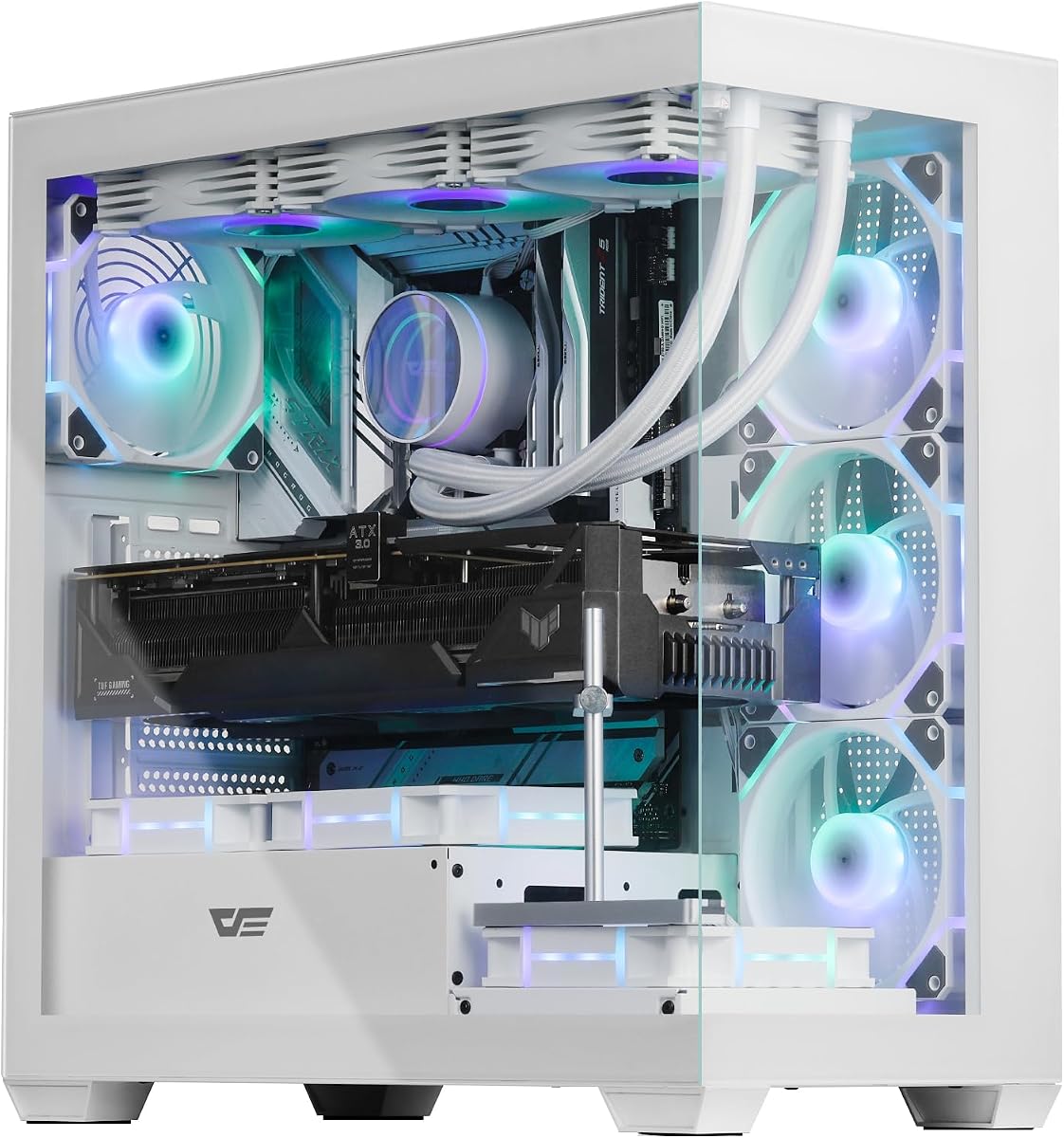
8. darkFlash DS900 White - Best White Panoramic 360mm

darkFlash DS900 ATX Mid-Tower (White)

darkFlash DS900 ATX Mid-Tower (White)

9/10★★★★★

The white darkFlash DS900 is the color-flipped sibling of the black model, which is good news for water cooling: the radiator map does not change. You still get 270° panoramic dual glass, four PWM ARGB fans, Type-C I/O, up to a 360mm radiator, and expansion toward roughly ten fans. What changes is aesthetic strategy for white AIOs, GPUs, and cable kits common in 2026 showcase PCs.

  • White panoramic DS900 with 4 PWM ARGB fans
  • Up to 360mm water-cooling radiator support
  • Type-C I/O; magnetic top dust filter; ~10-fan max
Check Price →
✓ Pros
  • White panoramic glass theme matches popular white GPU and AIO kits
  • Same 360mm radiator and four-fan foundation as the black DS900
  • Type-C front connectivity for modern peripherals
  • Expandable fan capacity for push-pull or extra exhaust
  • Approachable installation story for first glass showcase builds
✕ Cons
  • White panels show dust and shipping scuffs more readily
  • RGB hub still not included—header planning required
  • Cooling ceiling matches the black twin, not 420mm flagships

Detailed review

Thermally, treat it like the black DS900. Glass does not inhale air—radiator placement and mesh openings define success. A 360mm AIO with clear intake/exhaust intent plus PWM curves beats any paint color. If you planned a 420mm top radiator or triple-rad custom loop, look at the M5, K9, or F600 instead.

White ownership shows dust and fingerprints more harshly, so lean on magnetic top filtration and cleaning habits. Shipping inspection matters because white scuffs photograph poorly. An RGB hub is still not included; count ARGB headers beside the AIO in your parts list. Softer lighting profiles often suit white interiors better than maximum saturation.

Cable management remains approachable mid-tower fare—route white sleeved cables cleanly beside AIO tubes if you go that route. Anti-slip feet and panel filters match the black listing’s practical touches.

Select white DS900 when your desk theme is already bright and you want panoramic 360mm-ready glass without premium modular pricing. Cooling potential matches the black twin; only room aesthetic changes. Undecided on color? Black hides wear—full white stack? This is the coherent DS900.

White build coordination tips

Match AIO shroud, fans, and cables intentionally; mixed dirty-white tones look accidental on camera. Keep alcohol wipes for glass—presentation is half the reason to buy this colorway.

Same cooling rules as black DS900

Prioritize radiator airflow paths, PWM control, and dust filters over RGB. White panels do not change 360mm AIO physics.

Check Price on Amazon →

We may earn a commission at no additional cost to you.

9. Geometric Future M5 - Best Overall for Thick Rads

Geometric Future M5 Tempered Glass Mid Tower

Geometric Future M5 Tempered Glass Mid Tower

9.2/10★★★★★

The Geometric Future M5 is our best overall water-cooling pick because it aligns radiator length, fan swept area, and motherboard headroom. Support for up to 420mm radiators, five pre-installed 140mm ARGB PWM fans, and E-ATX compatibility beat compact 240mm boxes and many 360mm-only panoramic mid-towers when the brief is serious liquid cooling without jumping straight to an open-loop bench.

  • 5× 140mm ARGB PWM fans pre-installed
  • Up to 420mm radiators; up to 10× 120mm fans
  • E-ATX support; GPU to 460mm; Type-C; tool-less glass
Check Price →
✓ Pros
  • 420mm radiator support leads this pack for thick AIO and custom plans
  • Five 140mm ARGB PWM fans move serious air out of the box
  • E-ATX motherboard compatibility for larger creator and HEDT-style boards
  • Tool-less tempered glass speeds upgrades and loop maintenance
  • PSU shroud display window adds a unique showcase detail
✕ Cons
  • Larger fans and glass make the case visually busier on small desks
  • PSU length limit around 160mm may constrain some long units
  • Brand ecosystem is less expansive than Corsair or NZXT accessory catalogs

Detailed review

140mm fans are not trivial versus 120mm kits—larger blades often move comparable air at lower RPM, helping thick radiators without leaf-blower noise. Five pre-installed units let you dedicate arrays to radiator push/pull or case intake while keeping exhaust coverage. ARGB sync works with major motherboards if you want lighting; muted profiles still treat them as cooling hardware first.

Radiator flexibility up to 420mm (with 360mm as the common alternative) unlocks higher-end AIOs and custom radiators that will not mount in H5 Flow or DS900 class cases. Alternate population up to ten 120mm fans remains if you mix sizes. Compatibility includes E-ATX/ATX, GPUs to 460mm, and modular PSUs to about 160mm—double-check long PSU bricks against that cap.

Steel thickness around 0.8–1.2mm and tool-less tempered glass help when heavy radiators and filled tubes hang on mounts. The PSU shroud display window is a showcase flourish for sleeved cables rather than a thermal feature. Type-C covers modern I/O needs during long loop installs.

Take the M5 when thick radiators and large fans are the point. It earned the overall badge because 420mm support plus five 140mm fans is a more liquid-specific package than three excellent Corsair fans or a compact NZXT mesh box. Choose Corsair for InfiniRail modularity, Lian Li for polished 360mm finish, and M5 when radiator size is king.

Why it is the overall pick

Rank water-cooling cases first on radiator reality, then included airflow hardware, then luxuries. The M5 wins that ordered test here while keeping tempered-glass showcase appeal.

420mm install realities

Measure twice against VRM heatsinks, high RAM kits, and cable combs. Larger radiators hold more fluid and weigh more when filled—respect mount strength.

Versus K9 and 4000D RS

K9 counters with nine 120mm fans; M5 counters with larger 140mm fans plus E-ATX and 420mm focus; Corsair counters with InfiniRail and FRAME modularity. Optimize for rad size, fan quantity, or modular ecosystem.

Check Price on Amazon →

We may earn a commission at no additional cost to you.

10. FOIFKIN F1 - Best Compact Dual-Chamber 360mm

FOIFKIN F1 Dual-Chamber Mid-Tower

FOIFKIN F1 Dual-Chamber Mid-Tower

9/10★★★★★

The FOIFKIN F1 is the more approachable dual-chamber sibling to the F600: panoramic glass, PWM ARGB fans, Type-C I/O, but a cooling brief centered on a top 360mm radiator rather than triple-360mm ambition. That suits builders who want dual-chamber cable discipline and one excellent AIO without overbuying unused mounts.

  • 6× 120mm ARGB PWM fans (5 reverse, 1 forward)
  • Top 360mm radiator support; dual-chamber layout
  • GPU to 400mm; rich front I/O including Type-C
Check Price →
✓ Pros
  • Dual-chamber separation aids thermals and cable hiding for AIO builds
  • Six PWM ARGB fans included—stronger kit than many mid-towers
  • 360mm top radiator support covers mainstream liquid coolers
  • Generous front I/O with Type-C, USB 3.0, and USB 2.0 ports
  • Tempered glass showcase look without needing a full triple-rad plan
✕ Cons
  • Less multi-radiator ambition than the F600 sibling
  • Narrower dual-chamber proportions can complicate thick custom tubing
  • Air cooler height marketing should be verified against your exact cooler

Detailed review

Six pre-installed 120mm ARGB PWM fans—five reverse and one forward—create an intake-heavy look behind glass while feeding a top-mounted 360mm cooler. Dual-chamber separation keeps PSU wiring out of the visual plane around tubes and GPU power. Clearance covers ATX through ITX boards, GPUs to 400mm, and PSUs to 200mm, with slightly friendlier SSD capacity than the F600.

Front I/O is unusually complete—Type-C 3.0, USB 3.0, two USB 2.0, audio, LED switch, power, and reset—reducing dongle clutter on a showcase desk. Mount a 360mm AIO up top as exhaust in most rooms, use reverse-blade side or bottom fans as intake, and keep rear-chamber cables clear of filters.

Versus mesh-first cases like the H5 Flow, the F1 trades some unrestricted intake for dual-chamber presentation and a denser stock fan kit. Versus the F600, you give up the multi-360mm ceiling for a simpler single-AIO project. Neither FOIFKIN replaces Corsair InfiniRail precision, but both deliver many included fans for builders who hate empty mounts on day one.

Buy the F1 for dual-chamber aesthetics, six ARGB PWM fans, and a credible 360mm top liquid plan without multi-radiator custom complexity. It closes this roundup as the practical dual-chamber pick for mainstream water-cooled gaming PCs that still want to look like showpieces.

F1 versus F600

Choose F1 for a focused 360mm dual-chamber build with six fans. Choose F600 when simultaneous multi-360mm capacity and seven fans are part of a longer custom roadmap.

Setup priorities

Hub the six ARGB fans early, dry-fit the 360mm AIO, then route GPU power so cables do not rub tubes. Verify exact air-cooler height in millimeters if you keep a tower cooler as backup.

Check Price on Amazon →

We may earn a commission at no additional cost to you.

Best PC Cases for Water Cooling Builds in 2026

How to Choose a PC Case for Water Cooling

Start with radiator size, not RGB count

Filter first by the largest radiator you will install. A 240mm AIO opens compact options like the Cooler Master Q300L. A 360mm AIO fits the NZXT H5 Flow, Lian Li V100, darkFlash DS900 twins, and FOIFKIN F1. A 420mm cooler narrows you to thicker-capable chassis like the Geometric Future M5 and ANSAITE K9. Match millimeters to your cooler’s product page—not vague “water cooling support” icons.

Thickness matters nearly as much as length. Always add fan depth plus radiator depth plus a few millimeters for screws when you read clearance charts.

Map intake and exhaust before you buy tubes

Liquid cooling moves heat into a radiator; fans still dump that heat outside. Decide whether the AIO is intake (cooler coolant, warmer case air) or exhaust (slightly warmer coolant, cooler interior for the GPU). Panoramic glass cases need this planning more than mesh cubes because fewer faces can breathe.

Dual-chamber versus single-chamber mid-towers

Dual-chamber layouts (FOIFKIN F600/F1) hide PSUs and drives for cleaner tube photography and less clutter in the airflow path. Mesh-first single chambers (H5 Flow, 4000D RS) often win raw intake efficiency. Pick dual-chamber for showcase loops; pick mesh when thermals per decibel matter more than panoramic photos.

Stock fans, PWM control, and hubs

Pre-installed fans save time, but nine ARGB units can outnumber motherboard headers. Prefer PWM fans you can curve, and budget an ARGB hub when listings note controllers are not included (darkFlash DS900). Daisy-chain support on Corsair RS and Lian Li kits reduces rear-tray spaghetti.

Custom loop versus AIO reality

Most readers will install sealed AIOs, and every case here can serve that mission at some radiator size. Custom loops need room for reservoirs, pumps, and drains—favor wider multi-radiator cases like the F600, K9, or M5 if that is your endgame.

Frequently Asked Questions

01

What size radiator do I need for a gaming PC in 2026?

Many modern gaming CPUs are fine on a quality 240mm AIO in a strong-airflow case. Enthusiasts and hotter chips often prefer 360mm for lower fan noise at the same temperatures. 420mm helps when you want maximum surface area or cool a hot CPU in a warm room. Match radiator size to both heat output and the case mounts here—buying a 360mm cooler for a 240mm-only chassis is the most common avoidable mistake.

02

Is a mesh case better than a glass panoramic case for water cooling?

Mesh-first cases like the NZXT H5 Flow and Corsair 4000D RS usually feed radiators cooler intake air because more panel area can breathe. Panoramic glass can still cool extremely well if radiators sit on open, filtered faces with coherent fan directions. Glass wins aesthetics; mesh often wins effortless thermals.

03

Can I mount a 360mm AIO in the Cooler Master Q300L?

No. The Q300L V1 in this pack is specified around 240mm liquid cooling support. Choose the H5 Flow, Lian Li V100, darkFlash DS900, FOIFKIN F1, or another 360mm-capable case in this roundup instead.

04

Do I need push-pull fans on my radiator?

Not always. A single fan pack on a good radiator in a low-restriction case is enough for most AIO builds. Push-pull helps thick radiators but adds depth, cost, and noise. Try a solid PWM curve with one pack first; add pull fans only if temperatures or acoustics still miss your targets.

05

How important are pre-installed fans for a water-cooled build?

They matter for budget and first-boot simplicity. The ANSAITE K9 and FOIFKIN models arrive ready to move air, while the Corsair 4000D RS and NZXT H5 Flow assume you may add fans with your AIO. Pre-installed fans matter less if your AIO already includes strong radiator fans.

06

Should the AIO radiator be intake or exhaust?

Front intake often feeds the radiator with the coolest room air, slightly warming the case interior. Top exhaust dumps CPU heat straight out and can help GPU case thermals. Either works when other fans form a coherent path—avoid intakes and exhausts that collide with no clear exit.

07

What is the benefit of a dual-chamber case for liquid cooling?

Dual-chamber designs move the PSU, extra cable length, and often drives into a rear bay, clearing space around tubes and pump blocks and reducing airflow obstruction. It does not replace radiator surface area, but it makes showcase loops tidier—see the FOIFKIN F600 and F1.

08

Will a 420mm AIO fit in every “420mm support” case?

Not automatically. Published support assumes certain thicknesses, fan setups, and motherboard component heights. Tall RAM, large VRM heatsinks, and cable combs still cause conflicts. Compare your cooler’s exact dimensions to the case manual and dry-fit before final thermal paste.

09

Are ARGB fans bad for temperatures?

ARGB lighting itself does not meaningfully hurt cooling. Poor fan curves, restrictive panels, and bad radiator placement do. PWM control and radiator size dominate outcomes—set lower RPM targets and rely on larger radiators rather than disabling lights out of thermal fear.

10

Which case in this list is best for a first water-cooled PC?

For a first 360mm AIO ATX build with mesh airflow, the NZXT H5 Flow is a friendly start. For more included fans and panoramic glass, try the darkFlash DS900 or Lian Li V100RX. If your first cooler is already 420mm, begin with the Geometric Future M5.

Conclusion

The best PC case for water cooling matches the radiator you will actually install. In this pack, the Geometric Future M5 leads for thick 420mm-capable builds with five 140mm fans, the Corsair 4000D RS ARGB wins as a modular high-airflow InfiniRail platform, and the FOIFKIN F600 headlines multi-radiator dual-chamber showcase ambition. Compact needs still have clear answers: NZXT H5 Flow for mesh-first 360mm ATX, Cooler Master Q300L for honest 240mm Micro-ATX liquid cooling, and Lian Li V100RX when finish matters as much as mounts.

Use the comparison table to separate 240mm, 360mm, and 420mm realities, then read the reviews for fan-header planning and glass-versus-mesh tradeoffs. Focus on clearance, airflow path, and whether the stock fan kit helps your loop—when those line up, water cooling becomes a controlled upgrade.

Pick radiator size first, case second, and dry-fit before you fill or trust thermal paste. That order keeps 2026 water-cooled PCs cool, quiet, and worth the build time.