Best Overall Board
GIGABYTE B650 AORUS Elite AX

- 14+2+1 VRM with 70A stages sized well beyond a 7600X load
- PCIe 5.0 M.2 plus Wi-Fi 6E and 2.5GbE for a balanced gaming desk
- EXPO and XMP DDR5 support across four DIMM slots
Expert Review & Guide
The Ryzen 5 7600X remains one of the smartest entry points into AMD's AM5 desktop platform in 2026. Six Zen 4 cores, twelve threads, and a 5.3GHz boost class make it a strong gaming and productivity chip without the thermals or motherboard demands of a Ryzen 9. What you pair it with matters: a board that boots cleanly on AM5, runs EXPO DDR5 without drama, feeds a mid-range GPU over PCIe 4.0 or 5.0, and leaves room for a second NVMe drive so you are not juggling external storage later.
This guide covers only products from our curated pack for the keyword best motherboards for Ryzen 5 7600X. You will see standalone AM5 boards from GIGABYTE and ASUS across B650 and B850 chipsets, a Micro Center style CPU-plus-board combo, an MSI board bundled with 32GB DDR5, the 7600X processor listed alone for upgrade context, and one GIGABYTE B550 Gaming X V2 that we flag explicitly as AM4 and incompatible with this CPU. The goal is not to list every motherboard on the market but to explain which listings actually fit a 7600X build and which ones save you time versus which ones send you down the wrong socket.
Start with the comparison table if you already know whether you want a board-only purchase or a kit that lands CPU and motherboard together. Then read the full reviews for VRM headroom on a six-core chip, Wi-Fi 6E versus Wi-Fi 7 tradeoffs, micro-ATX compromises, and how the B850 generation changes your upgrade runway without forcing you to overspend on features the 7600X will never stress.


As an Amazon Associate we earn from qualifying purchases. We may earn a commission at no additional cost to you.
Every row below comes from our product pack. Specs omit prices so you can compare chipset, socket, and connectivity first, then check the live listing for current availability.
Ryzen 5 7600X + B650 AORUS Elite AX
If you are building your first AM5 desktop around the Ryzen 5 7600X, the combo listing that pairs the processor with the GIGABYTE B650 AORUS Elite AX motherboard is the fastest path from cart to POST. You avoid the single most expensive mistake on a new platform: buying an AM4 board or a B550 SKU that physically cannot accept a 7600X. The listing bundles pure gaming performance claims — smooth triple-digit frame rates in popular titles — with a board that already supports AMD Ryzen 7000 series processors on Socket AM5.
The motherboard half of this kit is not a stripped-down entry model. GIGABYTE specifies a twin 14+2+1 phase design with 70A power stage digital VRM solution on an 8-layer 2X copper PCB. For a six-core 7600X running stock or mild PBO, that is substantial headroom. You are buying thermal margin and long-term stability rather than wattage the chip will never draw. The fully covered MOSFET heatsinks, 6mm heatpipe, and M.2 thermal guard keep VRM and storage temperatures calm in a mid-tower with reasonable airflow.
Connectivity matches what most 7600X gaming builds actually use. DDR5 compatibility across four DIMMs with both AMD EXPO and Intel XMP module support means you can shop mainstream kits without hunting obscure QVL entries. PCIe 5.0 for the primary M.2 slot future-proofs your boot drive choice. Front and rear USB-C, Wi-Fi 6E, and 2.5GbE LAN cover modern peripherals and home networks without forcing you into B850 pricing. For a 7600X paired with a mid-range GPU, this is a balanced I/O stack.
What the combo does not include is equally important to plan around. You still need DDR5 memory, a compatible AM5 cooler, a case, power supply, and storage. The standalone 7600X listing in this pack highlights the same six-core Zen 4 architecture, 5.3GHz max boost, and 38MB cache footprint — this bundle simply removes the guesswork of matching socket generation. Treat the combo as a platform starter, not a complete PC.
Compared with buying the CPU and board separately, the combo makes sense when the bundled listing saves you time and aligns with a single return window if something fails first boot. Power users who already own DDR5 from a prior build or who want a B850 Wi-Fi 7 board for a longer upgrade cycle may prefer à la carte shopping. For mainstream gamers stepping into AM5, though, this is the most forgiving SKU in the pack.
First-boot advice specific to this pairing: update the board BIOS if the combo ships on an older revision, install one stick per channel for initial POST if you hit memory training issues, and enable EXPO only after Windows and chipset drivers are in place. The 7600X includes Radeon graphics for troubleshooting if your discrete GPU is not seated yet — a small but real convenience during assembly.
We rank this kit Best Complete Kit because it encodes the correct motherboard choice for the keyword rather than making you infer compatibility from a CPU-only page. The Elite AX is the same board we recommend standalone later in this guide; wrapping it with the 7600X turns a research project into a two-click platform decision.
First-time AM5 builders, parents assembling a gaming PC for a teenager, and anyone who wants CPU and board compatibility guaranteed without cross-referencing socket charts. Skip it if you already own an AM5 board with a current BIOS.
Budget a 32GB DDR5 EXPO kit, a tower cooler or 240mm AIO with AM5 mounting hardware, a 1TB or 2TB Gen4/Gen5 NVMe, and a quality 650W-class PSU with clean EPS routing to the board's CPU power connectors.
Choose the combo for simplicity and matched support. Choose the standalone B650 AORUS Elite AX if you already have the 7600X or plan to buy memory and board from different retailers for aesthetic reasons.
We may earn a commission at no additional cost to you.

Every motherboard recommendation in this article exists to serve one chip: the Ryzen 5 7600X. Understanding what the CPU demands from a board prevents overspending on X870-class features or underspending on VRM cooling and memory support. The 7600X is a hexa-core, twelve-thread Zen 4 processor on the 5nm process with a 5.3GHz clock speed class, 6MB L2 cache, and 32MB L3 cache. It uses Socket AM5, supports DDR5, and ships unlocked for enthusiasts who want to tune PBO or manual multipliers.
For motherboard shopping, the 7600X sits in a sweet spot. It is not a 170W Ryzen 9 that punishes weak VRM heatsinks during all-core renders. It is also not a low-power APU that tolerates bare-minimum boards with two M.2 slots and no Wi-Fi. Expect bursty gaming loads, sensitivity to memory latency when EXPO is configured correctly, and occasional all-core bursts when you stream or compile. A solid B650 or B850 board with dual-channel DDR5 and at least two M.2 slots is the practical target.
The listing emphasizes dependable data processing and maximum productivity within a six-core footprint. In real builds, that translates to strong esports and AAA gaming when paired with a capable GPU, plus competent multitasking for Discord, browsers, and capture software. Productivity users who live in Blender or Premiere all day may eventually want more cores, but the 7600X remains a credible anchor for a gaming-first desktop through 2026.
Integrated Radeon graphics matter more at build time than during daily gaming. When you are assembling the PC, iGPU output lets you flash BIOS, install Windows, and diagnose a dead discrete card without borrowing a spare GPU. Any AM5 board in this pack that supports Ryzen 7000 series processors will boot the 7600X assuming BIOS compatibility — another reason we flag the B550 Gaming X V2 later as the wrong socket entirely.
Thermal planning is part of the motherboard conversation because cooler clearance affects board choice indirectly. The 7600X runs hot relative to its core count when pushed, and AM5's taller socket retention can interfere with bulky air coolers on certain boards with oversized VRM armor. Measure cooler height against your case and confirm the board's top PCIe slot clearance if you use a thick GPU backplate near the M.2 stack.
Buy the standalone CPU when you already selected a board from this guide, when you are upgrading from a Ryzen 5 7600 non-X on the same AM5 platform, or when a retailer sale makes the processor cheaper than any combo. Skip the lone CPU listing if you are new to AM5 and would rather not coordinate two separate compatibility checks — that is when the combo or MSI memory bundle earns its place.
Treat this review as the performance baseline. Every board below is judged on stable EXPO support for the 7600X, calm VRM thermals under gaming plus background apps, enough fast storage for OS and games, and networking that matches how you connect to your router. The 4.8-star pack rating reflects broad buyer satisfaction with the chip itself, not with any specific motherboard.
AM5 socket, DDR5 with EXPO, BIOS supporting Ryzen 7000, at least one M.2 slot with a heatsink, and CPU power connectors that match your PSU. Wi-Fi is optional if you hardwire Ethernet.
Budget an AM5-compatible cooler and thermal paste. Start with a 2x16GB EXPO kit at a speed your board QVL lists confidently — 6000MT/s class is common on B650 and B850 boards in this pack.
A B850 board today can accept Ryzen 9000 series chips later after a BIOS update. The 7600X is a strong starting point if you plan to swap CPUs before replacing the entire platform.
We may earn a commission at no additional cost to you.
GIGABYTE B850 AORUS Elite WIFI7
The GIGABYTE B850 AORUS Elite WIFI7 is the board in this pack for builders who want the Ryzen 5 7600X today but refuse to feel stuck on last-generation networking when they upgrade the CPU in two or three years. It supports AMD Ryzen 9000, 8000, and 7000 series processors on AM5, so the 7600X is fully supported while the platform runway extends toward Zen 5 and beyond. B850 sits between B650 and flagship X870 in feature density without forcing workstation pricing.
Power delivery is listed as 14+2+2 phases with VRM and M.2 thermal guards. For a 7600X, that is generous margin — and that is intentional. Cool, efficient VRM operation keeps fan noise down near your GPU's exhaust zone and leaves thermal headroom if you later drop in an eight-core or twelve-core Ryzen without replacing the motherboard. The 7600X will not saturate this design, but you are buying a board that survives an upgrade cycle.
Storage and expansion are a clear step up from entry B650 models. Three M.2 slots plus PCIe 5.0 connectivity let you dedicate Gen5 bandwidth to a boot drive, park a large game library on Gen4, and keep a scratch or capture volume on the third slot without SATA clutter. EZ-Latch mechanisms on M.2 and PCIe slots reduce the frustration of rebuilding storage in a cramped mid-tower — a quality-of-life feature you appreciate the second time you swap an SSD.
Networking is where B850 justifies its premium over older B650 listings. Wi-Fi 7 matters if your router already supports it or if you plan a mesh upgrade this year. The 2.5GbE LAN port covers most home wired setups; if you still run gigabit everywhere, you will not feel limited in games. USB-C front and rear support handles fast external SSDs and modern phone cables without hunting adapters.
Should every 7600X buyer choose B850? No. If your router is Wi-Fi 6, your peripherals are standard USB 3.2, and you expect to rebuild the entire PC when you outgrow six cores, the B650 AORUS Elite AX or Eagle AX saves money with negligible in-game difference. Choose the B850 AORUS Elite WIFI7 when the ports and chipset generation are the product — especially if AM5 is your long-term socket.
GIGABYTE's five-year warranty on this board line is worth noting in a category where buyers often keep platforms for multiple CPU generations. Register the board, keep receipts, and treat BIOS updates as routine maintenance when AMD releases new AGESA versions for upcoming chips. The sensor panel link header is niche until you own a compatible case display, but it signals that this SKU targets builders who care about polish rather than bare minimum POST.
Pair this board with a 7600X, 32GB EXPO DDR5, and a mid-tower with front mesh airflow. Enable EXPO after a clean BIOS update, install chipset drivers before tuning fan curves, and leave Precision Boost alone unless you understand Curve Optimizer tradeoffs. The 7600X will reward stable memory more than exotic manual overclocks on the VRM.
Builders planning a 7600X now and a Ryzen 9000 upgrade later, households upgrading to Wi-Fi 7, and anyone who wants three M.2 slots without jumping to X870.
Budget-first gamers on gigabit Wi-Fi who need one fast NVMe and one GPU. A B650 Eagle AX or Elite AX delivers the same gaming experience for less.
Flash BIOS if needed for your exact CPU stepping, load optimized defaults, enable EXPO, verify all three M.2 drives appear in BIOS, then install AMD chipset drivers before gaming.
We may earn a commission at no additional cost to you.
If you already own the Ryzen 5 7600X or prefer to buy the CPU separately, the GIGABYTE B650 AORUS Elite AX is the most balanced standalone motherboard in this pack. It is the same board found in the combo kit at the top of our list, which means our Best Overall and Best Complete Kit recommendations align on core platform quality — only the purchasing format differs. The Elite AX targets builders who want proven AM5 support without paying B850 premiums for ports they may not use this year.
The VRM specification — twin 14+2+1 phases with 70A power stages on an 8-layer 2X copper PCB — is genuinely overpowered for a six-core 7600X. That is a feature, not waste. Oversized power delivery runs cooler, ages better, and keeps boost behavior stable when Windows updates, game patches, and background apps spike CPU usage unpredictably. The 6mm heatpipe and fully covered MOSFET heatsinks translate that design into lower fan speeds on the VRM zone during long gaming sessions.
Connectivity hits the sweet spot for 2026 gaming desks. PCIe 5.0 for the primary NVMe slot future-proofs storage without consuming GPU lanes on most B650 layouts. Front and rear USB-C, Wi-Fi 6E, and 2.5GbE LAN handle modern peripherals and typical home routers. RGB Fusion is present if you want synchronized lighting; ignore it if you prefer a static build. Either approach works because the board's value is stability, not spectacle.
Memory support is a practical highlight. Four DIMM slots with AMD EXPO and Intel XMP compatibility let you start with a 2x16GB kit and expand later, or buy a four-DIMM kit if you already know you need 64GB for development VMs. For a 7600X gaming rig, 32GB at a sensible EXPO profile is the norm — enable the profile only after BIOS and chipset drivers are current to avoid blaming the board for training failures caused by outdated microcode.
Compared with the ASUS ROG Strix B650-A in this pack, the Elite AX leans GIGABYTE's thermal and power design language while the Strix emphasizes ROG aesthetics and three M.2 slots with a 12+2 stage count. Both are credible 7600X homes. Choose the Elite AX if you prefer GIGABYTE's Q-Flash workflow and AORUS armor styling; choose the Strix if you want the white ROG look and an extra Gen4 M.2 slot for a third drive.
Installation tips: route EPS cables before seating a heavy air cooler, confirm M.2 heatsink screws are not overtightened, and attach Wi-Fi antennas after the board is in the case so you do not snap the connectors. AM5 builds punish rushed cable management around the socket more than AM4 ever did — the Elite AX's layout is DIY-friendly, but patience still wins.
We rate this board Best Overall because it matches how most Ryzen 5 7600X owners actually build: one fast NVMe, one GPU, dual-channel DDR5, Wi-Fi as backup, and no desire to research VRM teardowns for a chip that never pulls flagship watts. It is the reference board against which we judge every other listing in this article.
7600X owners who want a proven B650 ATX board with strong VRM cooling, modern networking, and PCIe 5.0 storage without B850 pricing. Ideal for mid-tower gaming builds.
Check the support page before first boot if you buy an open-box or older warehouse unit. Q-Flash lets you update without a CPU installed if you prepare a USB stick on another PC.
Stay on B650 if Wi-Fi 6E and two M.2 slots satisfy you. Move to B850 when you want Wi-Fi 7, a third M.2 slot, and explicit Ryzen 9000 readiness on a newer chipset.
We may earn a commission at no additional cost to you.

ASUS ROG Strix B650-A Gaming WiFi
The ASUS ROG Strix B650-A Gaming WiFi is the aesthetic counterpoint to GIGABYTE's AORUS line in this pack — and a genuinely strong functional match for the Ryzen 5 7600X. It supports Ryzen Desktop 9000, 8000, and 7000 series processors on AM5 with the usual caveat that newer CPU families may need a BIOS update before first boot. For a 7600X, that is rarely a crisis: keep a USB stick ready and use BIOS FlashBack if the board arrives on an older AGESA revision.
Power delivery uses twelve plus two power stages with eight plus four pin ProCool connectors, alloy chokes, and durable capacitors. On paper that is slightly below the Elite AX's 14+2+1 count; in practice both boards laugh at a stock 7600X. You are buying quality capacitors, sensible heatsink mass, and airflow channels cut into the VRM armor so hot air does not stall above the CPU socket. Massive VRM heatsinks with high-conductivity thermal pads keep temperatures in check during gaming plus Discord, Spotify, and a browser full of tabs.
Storage flexibility is the Strix's clearest advantage over some B650 competitors. One PCIe 5.0 M.2 slot and two PCIe 4.0 M.2 slots, all with heatsinks, let you separate OS, game library, and capture scratch space without SATA cables or PCIe adapters. For a 7600X build with a single large NVMe, the third slot is future headroom; for streamers and creators, it is immediate utility.
Networking and USB are mid-market strong: 2.5G LAN and Wi-Fi 6E cover typical home setups, while USB 3.2 Gen 2x2 Type-C handles fast external enclosures. You do not get Wi-Fi 7 or USB4-class ports found on B850 boards in this pack, but you also avoid paying for them if your router and dock are still Gen 2x2 era.
The white-leaning Strix shroud is a favorite for tempered-glass builds with light or two-tone themes. Aura Sync integrates with ASUS GPUs, coolers, and peripherals if you enjoy unified lighting; set a static color once and uninstall the bloat if you prefer. What matters more for the 7600X is enabling EXPO, confirming M.2 drives sit under heatsinks with intact pads, and updating chipset drivers after Windows setup.
Versus the GIGABYTE B650 AORUS Elite AX, the Strix trades a slightly different VRM phase count for a third M.2 slot and ROG branding. Gaming performance with a 7600X and the same GPU is effectively identical when memory is configured properly. Choose based on aesthetics, M.2 count, and whether you already live in the ASUS software ecosystem.
Build notes: route EPS cables before installing a heavy dual-tower cooler, leave Wi-Fi antenna connectors accessible at the rear I/O, and verify GPU clearance against tall M.2 armor. The board rewards methodical assembly — rush the socket area and AM5's pin layout will remind you why patience matters.
Gamers who want ROG styling, three M.2 slots, and Wi-Fi 6E without B850 pricing. Strong pick if your case, GPU, and cooler are already ASUS-themed.
Update BIOS before aggressive EXPO if needed, load optimized defaults, enable EXPO, save, then install chipset drivers. Only then tune fan curves or PBO.
Pick Strix for a third M.2 and white ROG look. Pick Elite AX for GIGABYTE Q-Flash habits and slightly higher advertised phase count on the VRM.
We may earn a commission at no additional cost to you.

GIGABYTE B850M Gaming X WIFI6E
Not every Ryzen 5 7600X build belongs in a full ATX tower. The GIGABYTE B850M Gaming X WIFI6E shrinks the AM5 platform into micro-ATX without surrendering DDR5, PCIe 5.0 storage paths, or B850 chipset longevity. It supports Ryzen 9000, 8000, and 7000 series processors, making the 7600X a natural fit today and leaving headroom for a future CPU swap on the same smaller board.
Power delivery is listed as 10+2+2 phases with fully covered MOSFET heatsinks — appropriate for a six-core gaming chip in a compact case where airflow is often tighter than a mid-tower. The 7600X will not melt this VRM at stock settings. Do pay attention to case fans: mATX builds live or die on intake mesh and exhaust discipline because the VRM and GPU compete for the same warm air pocket.
Storage is honestly configured for most gamers: two M.2 slots with PCIe 5.0 connectivity cover a boot drive and a game library. If you need three NVMe devices without USB adapters, step up to an ATX B850 AORUS Elite in this pack. For a 7600X with one 2TB OS and games drive plus optional secondary storage, two slots suffice.
Networking matches the B650 ATX boards: Wi-Fi 6E and 2.5GbE LAN. USB-C is present for modern peripherals. You do not get Wi-Fi 7 from the full-size B850 AORUS Elite WIFI7, but you also fit the build into a smaller footprint — a trade many dorm and office gamers accept willingly.
Micro-ATX also means fewer PCIe slots for expansion cards. A discrete GPU consumes the primary slot; what remains may be tight for sound cards, 10Gb NICs, or legacy capture hardware. Plan USB-based alternatives if your workflow needs extra I/O. For a single-GPU gaming PC, the limitation rarely surfaces.
EZ-Latch on M.2 and PCIe slots matters more in small cases where finger access is awkward. GIGABYTE's five-year warranty applies here too — register the board and treat BIOS updates as part of ownership, especially if you later install a Ryzen 9000 chip that demands newer microcode.
Choose the B850M Gaming X when space is the constraint and you still want B850 upgrade runway. Pair it with a 7600X, low-profile DDR5 if cooler clearance is tight, and a compact GPU that matches the case's length limit. Skip mATX if you know you will add multiple NVMe drives and expansion cards — ATX Eagle or Elite boards serve that builder better.
Small-form builds, secondary PCs, and gamers who want AM5 in a micro-ATX case without going back to B650 feature cuts.
Use at least one intake and one exhaust fan. Compact cases with solid front panels can throttle VRM and GPU boost if air stagnates above the motherboard.
Pick mATX for size. Pick ATX B850 AORUS Elite WIFI7 for a third M.2, Wi-Fi 7, and easier cable routing in standard mid-towers.
We may earn a commission at no additional cost to you.

The GIGABYTE B650 Eagle AX is proof that a Ryzen 5 7600X build does not require AORUS branding or B850 chipset pricing to get a credible AM5 foundation. It supports Ryzen 9000, 8000, and 7000 series processors with DDR5 across four SMD DIMMs, AMD EXPO, and Intel XMP profiles — the same memory flexibility as pricier boards in this pack, which matters because EXPO stability is often the difference between smooth gaming and mysterious stutter.
Power delivery is a 12+2+2 phase digital VRM solution with advanced thermal design and M.2 thermal guards. For a 7600X gaming workload, that is sufficient. You are not buying headroom for a heavily overclocked Ryzen 9; you are buying stable power for six cores under burst loads. If you stream, compile, and game simultaneously every day, the Elite AX or B850 boards offer more margin. If you primarily game and browse, the Eagle delivers.
Storage is surprisingly generous for a value SKU: one PCIe 5.0 M.2 plus two PCIe 4.0 M.2 slots, with thermal guards on the VRM and storage zones. That triple-M.2 layout matches the ROG Strix B650-A's practical flexibility while costing less than AORUS Elite positioning. Boot on Gen5, games on Gen4, scratch on the third slot — a clean layout for a 7600X mid-tower.
Networking is the main compromise: Realtek GbE LAN instead of 2.5GbE, paired with AMD Wi-Fi 6E. For most cable-connected gaming desks, gigabit Ethernet is still plenty. Wi-Fi 6E covers wireless backup. Only builders with multi-gig internet plans or fast local NAS links should treat 2.5GbE as a must-have — otherwise the Eagle saves money without hurting frame rates.
Smart Fan 6 and Q-Flash round out the DIY experience. Smart Fan gives you sensible default curves; Q-Flash simplifies BIOS updates when AMD releases new AGESA versions. Neither feature wins benchmarks, but both reduce support forum time — valuable for first-time AM5 owners pairing the board with a 7600X.
Compared with the B550 Gaming X V2 also in this pack, the Eagle AX is the correct socket generation. The B550 is AM4 and DDR4 — incompatible with the 7600X. The Eagle is where budget-conscious builders should look among AM5 listings, not at legacy AM4 boards regardless of their attractive ratings.
We label the Eagle Best Value because it keeps three M.2 slots, Wi-Fi 6E, and PCIe 5.0 storage while trimming 2.5GbE and premium shroud costs. Pair it with a 7600X, 32GB EXPO memory, and a single fast NVMe if you want to minimize spend without going backwards to DDR4.
Budget-aware 7600X gamers who want triple M.2 and Wi-Fi 6E on B650 without AORUS pricing. Wired gigabit users benefit most from the LAN compromise.
Upgrade to Elite AX or B850 if you need 2.5GbE, Wi-Fi 7, or heavier VRM cooling for future high-core CPUs.
Start with a mainstream EXPO kit on the QVL. Four-DIMM configs can be finicky on any board — validate with two sticks first, then populate remaining slots.
We may earn a commission at no additional cost to you.
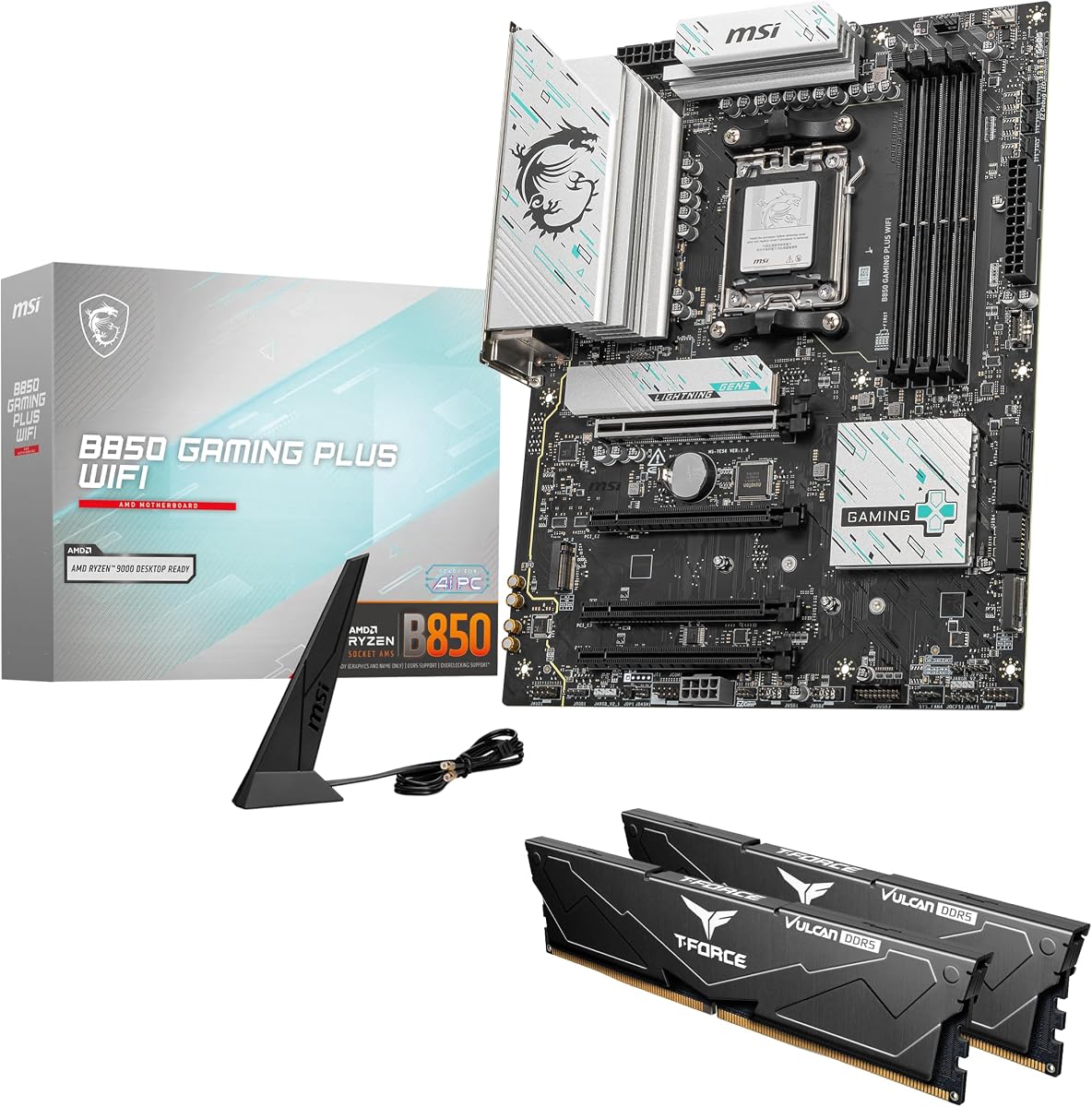
MSI B850 GAMING PLUS WIFI + 32GB RAM
The MSI B850 GAMING PLUS WIFI bundle in this pack solves a different problem than the CPU-plus-board combo at the top of our list. Here you get the motherboard and a TEAMGROUP T-Force Delta 32GB DDR5 kit (2x16GB) in one purchase, running at 6000MHz with CL38 timings via one-click Intel XMP 3.0 or AMD EXPO in BIOS. You still supply the Ryzen 5 7600X and cooler yourself, but you eliminate the most common AM5 first-boot failure: memory the board struggles to train.
The board supports Ryzen 9000 through 7000 processors on AM5 with DDR5 memory rated up to 8200+ MT/s in overclocking marketing terms — realistic builds should stick to the bundled 6000MHz profile first, validate stability, then experiment if you enjoy tuning. PCIe 5.0 x16 for the GPU and Gen5 M.2 for storage align with modern mid-range and high-end graphics cards without bottlenecking a 7600X in real games.
Networking is a standout versus B650 listings: Wi-Fi 7 and 5G LAN place this bundle alongside the GIGABYTE B850 AORUS Elite WIFI7 for connectivity, with MSI's Gaming Plus styling instead of AORUS armor. If your home network already runs multi-gig or you plan a router upgrade, the 5G port matters for Steam downloads and local NAS transfers more than it affects in-game latency on a wired connection.
Bundled memory simplifies EXPO enablement — toggle the profile, save, reboot, and confirm speed in BIOS or HWInfo. The listing emphasizes that no manual timing knowledge is required, which is exactly what a 7600X gaming builder needs. Avoid populating all four DIMM slots with mismatched kits later; run the bundled 2x16GB config until you have a reason to expand.
Compared with buying the GIGABYTE B850 AORUS Elite WIFI7 and a separate 32GB kit, this MSI bundle trades brand ecosystem and exact port layout for included RAM. Compared with the 7600X plus Elite AX combo, it inverts the bundle: memory and board together, CPU separate. Choose MSI when you already have the 7600X or found it cheaper alone; choose the GIGABYTE combo when you need both CPU and board.
Build advice: install the bundled RAM in the correct A2/B2 slots per the manual, update BIOS before aggressive tuning, install AMD chipset drivers after Windows setup, and use MSI Center selectively — many owners only open it for RGB once. The 7600X's gaming performance scales more with GPU and EXPO stability than with MSI versus GIGABYTE branding.
We rank this listing Best Board Plus Memory because it addresses the second-most-common AM5 builder pain point after socket mismatch: DDR5 compatibility anxiety. For a 7600X shopper who owns the CPU or prefers MSI features, it is the most complete platform shortcut in the pack short of a full CPU-board-memory trio.
Builders who already have a 7600X and want B850, Wi-Fi 7, and validated 32GB DDR5 in one shipment without researching memory QVL tables.
CPU, cooler, case, PSU, and NVMe storage. Treat this as board plus RAM only, not a full platform like the GIGABYTE combo listing.
Pick MSI for bundled RAM and 5G LAN. Pick GIGABYTE B850 AORUS Elite WIFI7 for three M.2 slots and AORUS thermal design if you will buy memory separately anyway.
We may earn a commission at no additional cost to you.

This listing appears in our product pack and carries a strong 4.6-star rating — which makes it dangerous if you shop by stars alone. The GIGABYTE B550 Gaming X V2 is an AM4 motherboard for Ryzen 5000, 4000, and 3000 series processors with DDR4 memory. It is not, under any BIOS update fantasy, compatible with the Ryzen 5 7600X, which requires Socket AM5 and DDR5. We include it explicitly so you do not confuse B550 with B650 or assume the lower number is somehow newer.
For the correct audience — someone upgrading an existing AM4 PC with a Ryzen 5 5600 or Ryzen 7 5700X — the board is a sensible value ATX option. Digital 10+3 power phases, advanced VRM heatsinks, dual M.2 slots, front USB-C, GbE LAN, Bluetooth 5.3, and Q-Flash Plus are legitimate features on a DDR4 platform. Q-Flash Plus in particular remains excellent for rescuing boards that need a BIOS update before a new CPU posts.
None of that helps a 7600X builder. AM5 introduced a new socket, new memory type, and new cooler mounting hole pattern. If you buy this B550 board expecting to drop in a 7600X, you will discover the mismatch at assembly — after potentially missing return windows. Search results that mix AM4 and AM5 boards because both say Ryzen are a known pitfall; this review exists to block that pitfall.
Naming similarity adds confusion: B550 Gaming X V2 versus B650 Eagle AX versus B850 AORUS Elite. The chipset letter progression and socket generation matter more than Gaming X versus Eagle branding. AM5 boards in this pack explicitly list Ryzen 7000, 8000, or 9000 support and DDR5. AM4 boards list Ryzen 5000 and DDR4. When in doubt, read the socket line before adding to cart.
If you already own this B550 board and wanted a 7600X performance uplift, your realistic paths are either a Ryzen 7 5700X3D or Ryzen 7 5800X3D on AM4, or a full platform migration to AM5 with a B650 or B850 board from this guide plus new memory and cooler. There is no adapter bridge between AM4 and AM5.
We assign the Wrong Socket Warning badge not to criticize the product on its own merits but to protect keyword shoppers. The B550 Gaming X V2 is a fine board for AM4 builds and earns its rating there. It is simply the wrong answer to best motherboards for Ryzen 5 7600X unless your question was accidentally typed while upgrading a older system.
If you reached this review because you almost bought the B550: scroll back to the B650 Eagle AX for value, the B650 AORUS Elite AX for balance, or the 7600X combo for a matched starter kit. Your 7600X deserves AM5.
AM4 owners upgrading to Ryzen 5000 on DDR4, spare-part builders, and secondary PCs — never 7600X shoppers.
Look for AM5, DDR5, and Ryzen 7000/9000 support in the title. B650 and B850 chipsets indicate AM5; B550 and B450 indicate AM4.
Return or resell the board before purchasing AM5 parts. Mixing platforms wastes money and cannot be fixed with a BIOS flash.
We may earn a commission at no additional cost to you.

GIGABYTE B850 AORUS Elite WIFI7 ICE
The GIGABYTE B850 AORUS Elite WIFI7 ICE is functionally the white-themed sibling of the B850 AORUS Elite WIFI7 reviewed earlier in this guide. It supports Ryzen 9000, 8000, and 7000 series processors on AM5 with DDR5 across four DIMMs, a 14+2+2 power design, VRM and M.2 thermal guards, PCIe 5.0 connectivity, three M.2 slots, USB-C, Wi-Fi 7, 2.5GbE LAN, EZ-Latch, and GIGABYTE's five-year warranty. For a Ryzen 5 7600X, the performance story is identical to the non-ICE board — you are choosing aesthetics and build cohesion.
White-themed builds exploded in popularity because tempered glass cases showcase interior hardware. Matching a white motherboard shroud with a white GPU shroud, white AIO tubes, and silver or white RAM heatspreaders creates a clean showroom look that black PCB stacks struggle to match without heavy cable sleeving. The ICE variant targets that builder directly while retaining the B850 upgrade path if you swap the 7600X for a Ryzen 9000 chip later.
Power and thermals mirror the standard Elite WIFI7: ample headroom for a six-core chip, calm VRM operation, and guarded M.2 slots for sustained SSD performance. The 7600X will not differentiate between ICE and non-ICE in frame rates. Where you may notice a difference is maintenance — white surfaces reveal dust faster, so plan filtered intake fans and occasional compressed-air passes if your case is on display.
Connectivity remains flagship-adjacent for this price tier: Wi-Fi 7 for modern routers, 2.5GbE for wired gaming, USB-C for fast peripherals, and sensor panel link for compatible case displays. Three M.2 slots let you hide a boot drive under the primary heatsink, mount a game library on the second slot, and keep a scratch volume on the third without sacrificing the GPU slot's PCIe 5.0 x16 lane budget on typical B850 layouts.
Versus the ASUS ROG Strix B650-A Gaming WiFi — another white-leaning option in this pack — the ICE board jumps to B850 with Wi-Fi 7 and keeps three M.2 slots while costing more than B650. Choose Strix if budget caps you at B650; choose ICE if you want the newest chipset generation and Wi-Fi 7 in a coordinated white GIGABYTE build.
Assembly notes for white builds: use black sleeved cables only if you prefer contrast; otherwise white or gray extensions reduce visual clutter. Route 24-pin and EPS cables behind the tray before snapping GPU power connectors, because re-seating a white shroud board after cable mistakes scuffs the finish. Attach Wi-Fi antennas last.
We badge this listing Best White Theme because it combines the correct AM5 platform for a 7600X with a finish that matches popular white GPU and case lines. It is not the cheapest board here, but it is the most deliberate choice for builders who care how the PC looks on a desk stream as much as how it scores in benchmarks.
White or silver themed mid-tower builds where B850, Wi-Fi 7, and three M.2 slots matter alongside aesthetics.
Pick ICE for white builds. Pick the standard black AORUS Elite WIFI7 if the case is dark and you want to save the ICE aesthetic premium.
Match white or silver DDR5 heatspreaders and a white AIO for cohesion. Enable EXPO first — aesthetics never fix unstable memory training.
We may earn a commission at no additional cost to you.
Both chipsets boot the Ryzen 5 7600X on AM5 with DDR5 and modern M.2 storage. B650 boards like the Eagle AX and AORUS Elite AX cover gaming needs at lower positioning, while B850 boards add Wi-Fi 7 on some SKUs, refined power stages, and explicit marketing toward Ryzen 9000 readiness. In actual games with the same GPU and EXPO memory, a 7600X performs identically on either chipset when both boards are stable.
Choose B650 when you want to minimize platform spend and your networking gear is Wi-Fi 6 era. Choose B850 when you plan to keep the motherboard through a CPU upgrade, want a third M.2 slot on certain models, or already own Wi-Fi 7 routers. Avoid paying X870 prices for a 7600X unless you need specific workstation ports not represented in this pack.
The 7600X is not a 170W Ryzen 9, but it still spikes power during boost. A 10+2+2 phase design on the B850M Gaming X is adequate in a well-ventilated case. 12+2+2 on the Eagle AX and 14+2+1 on the Elite AX add margin for hot ambient rooms and future CPUs. Oversized VRM cooling mainly buys quieter operation and longevity rather than higher FPS today.
Prioritize EXPO-capable DDR5 kits and at least one heatsinked M.2 slot for your boot drive. Two M.2 slots suffice for most gamers; triple-M.2 boards like the Strix B650-A and B850 AORUS Elite reward streamers and creators who segregate OS, games, and scratch storage.
Networking splits along practical lines: gigabit Ethernet on the Eagle AX is fine for most wired gamers; 2.5GbE on Elite and Strix boards helps multi-gig home links; Wi-Fi 7 on B850 Elite and MSI Gaming Plus bundles future-proofs wireless desks. None of these choices change in-game latency as much as using Ethernet instead of congested Wi-Fi during competitive play.
The Ryzen 5 7600X plus B650 AORUS Elite AX combo removes socket guesswork for new builders. The MSI B850 plus 32GB RAM bundle solves memory compatibility while leaving CPU choice open. Standalone boards suit upgraders who already own the 7600X or want to hand-pick DDR5 aesthetics. Compare total cart cost and return policies, not just headline badges.
Do not buy AM4 B550 boards like the Gaming X V2 for a 7600X — socket and memory generation are incompatible. Do not assume higher star ratings imply AM5 compatibility. Do not populate four DIMM slots with mismatched kits on day one. Do not skip BIOS updates on boards that may ship on older microcode revisions, especially if you plan a later Ryzen 9000 drop-in upgrade.
Yes. Every B650 board in this pack explicitly supports Ryzen 7000 series processors on AM5, including the 7600X. Enable EXPO for your DDR5 kit after a current BIOS is installed. Some boards may ship on microcode that prefers a USB BIOS update before first boot with certain CPU steppings — check the box sticker or support page if POST fails initially.
For gaming performance alone, no — a stable B650 board with good EXPO support delivers the same frame rates as B850 when paired with the same GPU and memory. B850 becomes worth it when you want Wi-Fi 7, three M.2 slots on models like the AORUS Elite WIFI7, 5G LAN on the MSI Gaming Plus bundle, or a clearer upgrade path to Ryzen 9000 without replacing the motherboard later.
No. The Ryzen 5 7600X requires Socket AM5 and DDR5. B550 boards like the GIGABYTE Gaming X V2 in this pack are AM4 with DDR4 and support Ryzen 5000 at most. There is no BIOS update that bridges the sockets. You need a B650 or B850 board from this guide plus new memory and an AM5 cooler.
Less than a Ryzen 9, but more than a bare-minimum office board. A 10+2+2 design on the B850M Gaming X handles stock and mild PBO in a case with airflow. 12+2+2 on the Eagle AX and 14+2+1 on the Elite AX add thermal headroom for hot rooms and future CPU upgrades. For a pure 7600X gaming box, any board in this pack except the AM4 B550 is electrically sufficient when cooled properly.
Buy the Ryzen 5 7600X plus B650 AORUS Elite AX combo if you want matched AM5 compatibility in one listing and you still need both parts. Buy separately if you already own the CPU, want a B850 or Strix board the combo does not offer, or found a better promotion splitting items. The MSI B850 plus RAM bundle is a third path when you have the CPU but not memory.
Yes. The standalone 7600X listing includes AMD Radeon graphics sufficient for BIOS access, Windows installation, and diagnosing a discrete GPU that is not posting. Gaming still requires a dedicated graphics card. iGPU output is valuable during first assembly before your GPU is installed or when testing whether a boot failure is CPU or GPU related.
One fast NVMe is the minimum for OS and games together. Two slots let you separate boot and storage cleanly. Three slots on the Strix B650-A, Eagle AX, and B850 AORUS Elite boards help streamers and creators who want a dedicated scratch or capture drive without SATA cables. mATX B850M Gaming X with two slots is enough if you consolidate libraries on a single large drive.
No for performance, maybe for convenience. Competitive gaming still favors wired Ethernet. Wi-Fi 7 on B850 Elite and MSI Gaming Plus boards helps if your router supports it and you cannot run cable to the desk. Wi-Fi 6E on B650 Elite AX and Strix B650-A is adequate for most households through 2026. Match the board to your home network, not hypothetical benchmark charts.
Most AM5 B650 and B850 boards in this pack list Ryzen 9000 support with a BIOS update. AMD's platform promise means drop-in upgrades are realistic, though you should read the exact CPU support list for your board revision before buying a new chip. B850 boards market forward compatibility more aggressively, but B650 Elite AX and Eagle AX also list 9000 series support in their specifications.
Start with a mainstream EXPO kit your board QVL validates — 6000MT/s class kits appear in the MSI bundle and work well on GIGABYTE and ASUS boards here when EXPO is enabled. Faster kits can help marginally but unstable profiles hurt gaming more than slightly lower speeds help. Install two sticks first, confirm stability, then add modules if you expand capacity.
The Ryzen 5 7600X asks for a straightforward AM5 partner: DDR5 with EXPO, a VRM that stays cool during gaming bursts, enough M.2 storage for today and tomorrow, and networking that matches your desk setup. None of the boards in this pack need to be flagship-tier to satisfy that brief — the GIGABYTE B650 AORUS Elite AX remains our Best Overall because it balances power delivery, connectivity, and PCIe 5.0 storage without B850 premiums you may not use on a six-core chip.
If you are starting from zero, the Ryzen 5 7600X plus B650 AORUS Elite AX combo is the lowest-friction entry. If you already own the CPU, choose the Eagle AX for value, the ROG Strix B650-A for triple M.2 and white ROG aesthetics, or a B850 AORUS Elite WIFI7 when Wi-Fi 7 and a third M.2 slot justify the step up. The MSI B850 plus 32GB RAM bundle fills the memory gap; the B850M Gaming X shrinks the footprint; the ICE variant finishes white builds. Avoid the B550 Gaming X V2 for this CPU — it is AM4, and no amount of careful cable management fixes the wrong socket.
Update BIOS before you chase performance toggles, enable EXPO only after chipset drivers are installed, and treat the motherboard as a long-term platform decision. The 7600X is a capable gaming chip today and a sensible placeholder if you upgrade to Ryzen 9000 later on the same AM5 board. Pick the listing that matches your case size, network, and bundle needs from the comparison table, then build once and game.