Expert Review & Guide

Best Monitors for Color Accuracy in 2026: Calibrated Panels for

Color accuracy is not a single checkbox on a spec sheet—it is the difference between a client approving a print proof on the first round and spending an afternoon chasing a magenta shift you cannot see on an uncalibrated panel. Photographers, video editors, graphic designers, and even serious hobbyists need monitors that reproduce sRGB, DCI-P3, or Adobe RGB with predictable deltas, stable white points, and viewing angles that do not betray you when a colleague leans in to review a layout. In 2026 the market splits cleanly between factory-calibrated professional lines like ASUS ProArt and LG UltraFine, wide-gamut 4K IPS panels with HDR headroom, and surprisingly capable budget screens that cover 99% sRGB without pretending to be reference displays.

This guide covers ten Amazon-listed monitors from our current pack, every model chosen because it offers a credible angle on accurate color—whether through Calman Verified factory calibration, published gamut coverage, or portable true-color engineering like UPERFECT NxtLED system. We ranked them using buyer ratings, stated color specs, calibration claims, and how each display behaves as a daily creative workstation versus a general office screen. All ASINs, images, and URLs come directly from the pack; we do not invent models or substitute products from outside the list.

Start with the three top picks if you want a fast filter, then scan the comparison table for gamut coverage, resolution, and connectivity that match your camera, NLE, or design toolchain. Individual reviews go deep on tradeoffs: when Delta E under two actually matters versus when 95% DCI-P3 is enough, why 16:10 ProArt panels win for photo editing, and how portable monitors can stay color-consistent across café lighting. No dollar figures appear in this guide—we focus on what you see at the desk, not what the cart total says today.

Our Top Color-Accurate Monitor Picks

Best Overall

ASUS ProArt PA279CRV 27" 4K

★★★★☆8.6/10
ASUS ProArt PA279CRV 27" 4K
  • Calman Verified factory calibration to Delta E under two with 99% DCI-P3 and 99% Adobe RGB for print and cinema workflows
  • USB-C Power Delivery at 96 watts, DisplayPort daisy-chain, and Mac-friendly HDR tuning for modern creative desks
  • Height-adjustable ergonomic stand with tilt, swivel, and pivot plus five-year warranty with registration
Check Price →
Best Photo Editing

ASUS ProArt PA248QFV 24" WUXGA

★★★★★9.2/10
ASUS ProArt PA248QFV 24" WUXGA
  • 16:10 WUXGA IPS with 100% sRGB and Rec. 709 plus Calman Verified Delta E under two out of the box
  • Included monitor hood, Light Sync ambient sensor, and 100Hz refresh for smooth scrolling in Lightroom and Capture One
  • Full ergonomic stand with pivot to portrait and bundled DisplayPort, HDMI, and USB-C cables
Check Price →
Best Wide Gamut Value

LG 27UP650K-W UltraFine 4K

★★★★★9.2/10
LG 27UP650K-W UltraFine 4K
  • 27-inch 4K IPS with up to 95% DCI-P3 expression and VESA DisplayHDR 400 for vivid HDR grading previews
  • Height, tilt, and pivot ergonomic stand with Reader Mode and Flicker Safe for long retouching sessions
  • HDMI and DisplayPort inputs plus LG Switch app screen splitting for reference monitors beside timelines
Check Price →

As an Amazon Associate we earn from qualifying purchases. We may earn a commission at no additional cost to you.

Color-Accurate Monitors Compared

Gamut coverage, calibration credentials, and panel type matter more than refresh marketing when color is the priority. Use this table to narrow the field before reading the full reviews.

#ProductSpecificationsScore
1
  • 27" 4K IPS, 99% DCI-P3 & Adobe RGB
  • Calman Verified, Delta E < 2, HDR
  • USB-C 96W PD, daisy-chain DP
8.6
2
  • 27" 4K IPS, 100% sRGB & Rec. 709
  • Calman Verified, Delta E < 2
  • USB-C 65W PD, USB 3.1 hub
8.6
3
  • 24.1" 16:10 WUXGA IPS, 100% sRGB
  • Calman Verified, hood included
  • 100Hz, Light Sync, USB hub
9.2
4
  • 27" 4K IPS, 95% DCI-P3
  • DisplayHDR 400, Reader Mode
  • Height/tilt/pivot stand
9.2
5
  • 27" 4K IPS, 90% DCI-P3 HDR10
  • 1000:1 contrast, borderless
  • OnScreen Control, HDMI + DP
8.8
6
  • 15.6" 1080p, 125% sRGB NxtLED
  • 178° viewing, matte anti-glare
  • USB-C, HDMI, VESA mount
9
7
  • 27" 4K IPS HDR10
  • Wide viewing angles, LowBlue
  • HDMI 2.0 + DisplayPort 1.4
8.6
8
  • 27" FHD IPS, 99% sRGB
  • 120Hz Adaptive-Sync, 1ms VRB
  • HDMI + VGA, 250 nits
9.4
9
  • 23.8" FHD IPS, 144Hz
  • TÜV flicker-free, 178° angles
  • FreeSync, VESA 100×100
9.4
10
  • 23.8" FHD VA, 100Hz
  • 16.7M colors, 178° viewing
  • EasyRead mode, flicker-free
9.2

1. ASUS ProArt PA279CRV - Best Overall

ASUS ProArt PA279CRV 27" 4K

ASUS ProArt PA279CRV 27" 4K

8.6/10★★★★☆

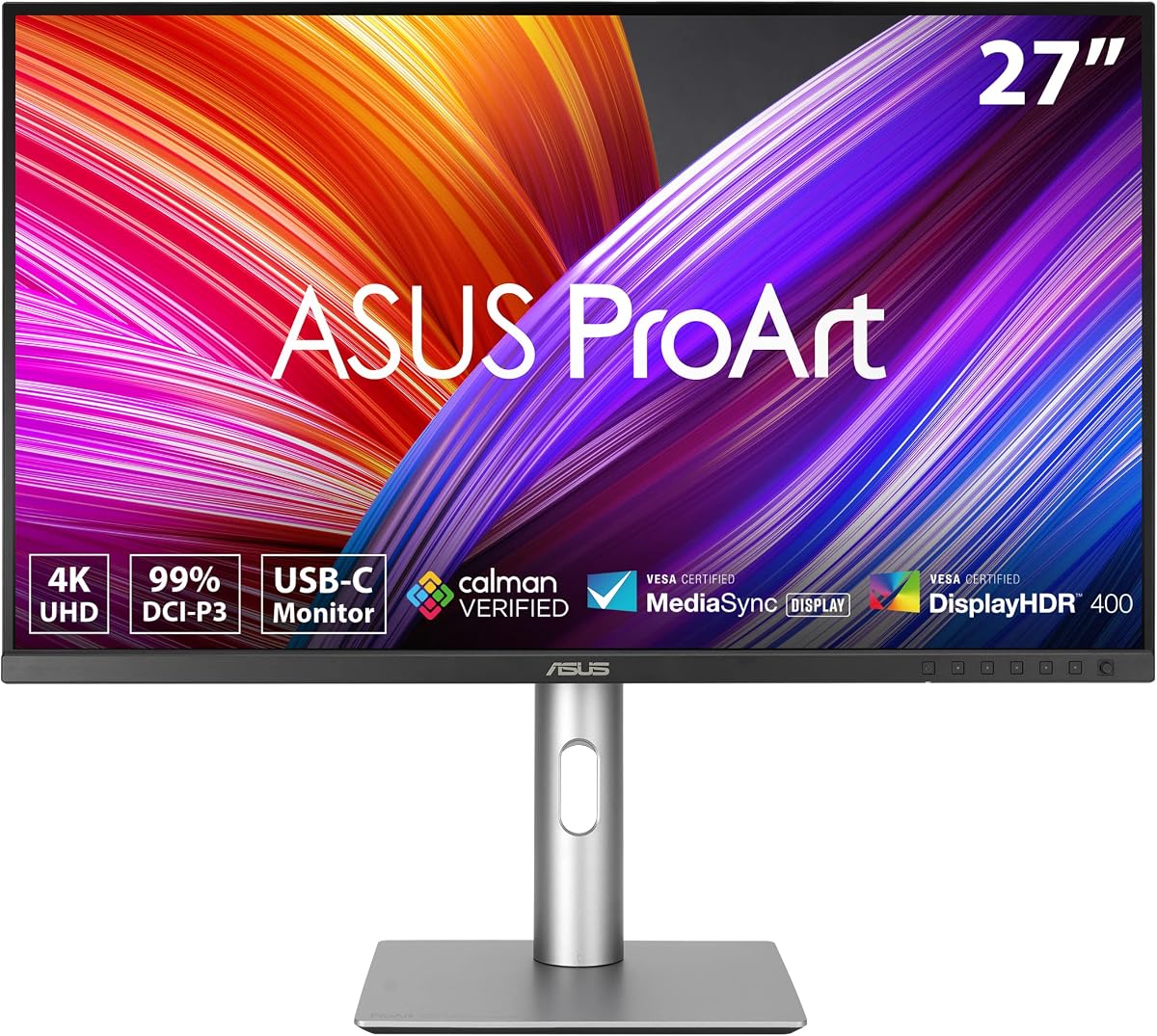
The ASUS ProArt PA279CRV earns Best Overall because it combines the widest color volume in this pack with credentials serious creators actually trust. Calman Verified factory calibration to Delta E under two means skin tones, product reds, and sky gradients land closer to reference out of the box than generic 4K IPS panels that merely claim vivid color. Publishing 99% DCI-P3 and 99% Adobe RGB coverage positions this monitor for photographers delivering CMYK prints, video editors grading Rec. 709 and P3 deliverables, and brand designers working in expanded spaces beyond sRGB.

  • 27" 4K IPS, 99% DCI-P3 & Adobe RGB
  • Calman Verified, Delta E < 2, HDR
  • USB-C 96W PD, daisy-chain DP
Check Price →
✓ Pros
  • Widest published gamut in the pack with 99% DCI-P3 and 99% Adobe RGB for print and cinema pipelines
  • Calman Verified factory calibration delivers Delta E under two before you open a colorimeter
  • 96-watt USB-C Power Delivery charges MacBook Pro-class laptops while driving 4K over one cable
  • DisplayPort daisy-chain simplifies dual-monitor creative desks without hub clutter
  • Five-year warranty with online registration plus complimentary Adobe Creative Cloud trial
✕ Cons
  • 4.3 rating trails some budget picks—verify uniformity on arrival and use return window if needed
  • Adobe RGB and DCI-P3 coverage still requires software-managed profiles for flawless print matching
  • Premium feature set may exceed needs if you only edit sRGB social content

Detailed review

The 27-inch 4K canvas matters for pixel-level retouching. At 3840 by 2160 you can inspect eyelash detail, fabric weave, and noise reduction artifacts without constant zooming—the workflow difference between editing at 100% and living at 200% magnification. The IPS panel keeps hue stable across wide viewing angles, which helps when art directors stand beside your desk during review sessions. HDR10 support adds headroom for HDR timeline previews, though like most desktop HDR implementations you should treat it as a practical grading aid rather than a reference mastering display.

Connectivity reflects how modern Mac and PC creative desks actually wire up. DisplayPort over USB-C with 96-watt Power Delivery can drive the panel, charge a laptop, and pass data through the integrated USB hub—one cable from a MacBook Pro to a calibrated 4K screen is exactly what many freelancers want. Separate DisplayPort and HDMI inputs cover desktop GPUs and color boxes. Daisy-chain DisplayPort output lets you hang a second monitor for timelines or chat without duplicating GPU outputs, a layout video editors use daily.

Ergonomics match the professional positioning. Tilt, swivel, pivot, and height adjustment let you align the panel for long Lightroom sessions or rotate to portrait for vertical social crops. ASUS bundles the extended five-year warranty story common across ProArt—three years base plus two with registration—which matters when a display is your revenue tool. Complimentary Adobe Creative Cloud access through August 2026 sweetens the package if you are onboarding new software anyway.

Honest caveats: a 4.3-star aggregate rating suggests some buyers encounter uniformity quirks or dead pixels—common risks at any tier, but worth checking immediately on delivery. Wide gamut coverage does not replace a good color-managed workflow. You still need ICC profiles, occasional calibration with a hardware probe, and awareness of how browser and app color management differ. If your entire output is Instagram and YouTube in sRGB, the PA279CV or PA248QFV later in this list may be simpler without sacrificing accuracy for your actual deliverables.

Who should buy: Mac-centric creators, hybrid photo-and-video professionals, and anyone building a dual-monitor desk who needs Adobe RGB headroom and credible factory calibration. Who should skip: buyers who only need 99% sRGB on a tight desk—the Acer KB272 or PA248QFV cover that lane at smaller scale.

Calibrating the PA279CRV for daily work

Start in the sRGB or Rec. 709 mode for web-bound work, switch to Adobe RGB or DCI-P3 presets when exporting to print or cinema, and disable oversaturated vivid modes for proofing. If you own a colorimeter, verify factory calibration annually or after major OS updates.

For Mac users, enable Display P3 in apps that support it and confirm your NLE project color space matches the monitor preset—mismatched timeline and display spaces cause the classic looks fine on screen, wrong everywhere else failure.

PA279CRV versus PA279CV

The PA279CV targets 100% sRGB and Rec. 709 with 65-watt USB-C—ideal when your deliverables never leave sRGB. The PA279CRV adds Adobe RGB and DCI-P3 volume plus 96-watt charging and daisy-chain for wide-gamut and multi-monitor workflows. Choose CRV when print and cinema color spaces are part of your monthly invoices.
Check Price on Amazon →

We may earn a commission at no additional cost to you.

2. ASUS ProArt PA279CV - Best 4K Pro

ASUS ProArt PA279CV 27" 4K USB-C

ASUS ProArt PA279CV 27" 4K USB-C

8.6/10★★★★☆

The ASUS ProArt PA279CV is the sRGB-first professional 4K panel in this pack. Where the PA279CRV chases Adobe RGB and DCI-P3 volume, the PA279CV commits to international color standards at 100% sRGB and 100% Rec. 709 with Calman Verified factory calibration to Delta E under two. For YouTube editors, web designers, social content teams, and corporate videographers whose final output stays inside Rec. 709, that focus is a feature—not a limitation.

  • 27" 4K IPS, 100% sRGB & Rec. 709
  • Calman Verified, Delta E < 2
  • USB-C 65W PD, USB 3.1 hub
Check Price →
✓ Pros
  • Calman Verified Delta E under two with 100% sRGB and Rec. 709 for web and broadcast deliverables
  • 65-watt USB-C charges ultrabooks while running 4K over a single cable
  • USB 3.1 hub reduces dongle clutter for tablets and reference drives
  • Height-adjustable stand with Eye Care flicker reduction for marathon edits
  • Five-year warranty path matches other ProArt panels in this roundup
✕ Cons
  • Same 4.3 rating as the wide-gamut CRV—inspect panel on delivery
  • No Adobe RGB coverage—wide-gamut print specialists need the CRV instead
  • 65-watt PD may not fast-charge largest MacBook Pro models under heavy load

Detailed review

Four K resolution on 27 inches remains the sweet spot for checking focus peaking, reading small timeline markers, and running dual-up scopes beside full-frame preview. IPS wide viewing angles keep skin tones consistent when clients review from the side of your desk. ASUS Eye Care features—flicker-free backlighting and low blue light modes—support the reality that color work often means twelve-hour days before a launch.

USB-C with 65-watt Power Delivery covers many ultrabooks and smaller MacBook Pro configurations with one cable for video, data, and charging. The integrated USB 3.1 hub accepts colorimeters, SSDs, and licensing dongles without a separate desktop hub. DisplayPort and HDMI remain for desktop GPUs or switchers that do not route through USB-C.

Buyers comparing within ProArt should note the PA279CV strength is disciplined accuracy inside sRGB rather than maximum gamut bragging rights. You still benefit from factory calibration that budget 4K monitors skip entirely—those panels may look punchy out of the box yet drift noticeably within weeks. The PA279CV is the pick when your invoices say web and video, not gallery print.

At 4.3 stars, read recent reviews for uniformity lottery outcomes as with any large IPS panel. Plan a return window test with grayscale ramps and solid color fills. If you later expand into print-heavy Adobe RGB work, stepping up to the PA279CRV or adding a second wide-gamut screen may make sense—but many creators never outgrow accurate sRGB at 4K.

Who should buy: video editors, UI designers, and photographers delivering primarily digital output. Who should skip: print specialists needing Adobe RGB coverage and MacBook Pro users who require 96-watt charging from the same cable daily.

Setting up color-managed sRGB

Enable OS-level color management on macOS or Windows, assign the monitor sRGB profile in your editing apps, and avoid OS night light modes during proofing sessions.

Use Rec. 709 timeline settings in DaVinci Resolve, Premiere Pro, or Final Cut when grading for broadcast and streaming platforms.

Versus LG 27UP650K

LG UltraFine offers 95% DCI-P3 and DisplayHDR 400 without Calman branding—strong for HDR preview, less explicit about Delta E. Choose PA279CV when verified sRGB accuracy and USB-C hub integration matter most.

Check Price on Amazon →

We may earn a commission at no additional cost to you.

3. ASUS ProArt PA248QFV - Best Photo Editing

ASUS ProArt PA248QFV 24" WUXGA

ASUS ProArt PA248QFV 24" WUXGA

9.2/10★★★★★

The ASUS ProArt PA248QFV wins Best Photo Editing because it optimizes the dimensions photographers actually use. The 16:10 WUXGA format—1920 by 1200 on a 24.1-inch IPS panel—adds vertical pixels versus 16:9 Full HD without jumping to 4K GPU demands. Lightroom Classic filmstrip, histogram, and develop panels breathe easier; InDesign pages show more vertical context. That aspect ratio alone separates photo-first monitors from generic office 24-inch screens.

  • 24.1" 16:10 WUXGA IPS, 100% sRGB
  • Calman Verified, hood included
  • 100Hz, Light Sync, USB hub
Check Price →
✓ Pros
  • 16:10 aspect ratio shows more vertical canvas for Lightroom panels and tool palettes
  • Calman Verified with included monitor hood blocks stray light that skews perceived contrast
  • Light Sync ambient sensor adjusts gamut based on room lighting for stable on-screen color
  • 100Hz refresh smooths scrolling through large catalogs without sacrificing accuracy
  • Highest ProArt rating in the pack at 4.6 stars with full ergonomic pivot stand
✕ Cons
  • 1920×1200 is not 4K—fine detail inspection still requires zoom in raw development
  • Smaller diagonal than 27-inch picks limits immersive video editing layouts
  • HDR10 support is helpful but not a substitute for dedicated HDR mastering monitors

Detailed review

Calman Verified factory calibration to Delta E under two pairs with 100% sRGB and 100% Rec. 709 coverage—the spaces most portrait, wedding, and product photographers deliver into daily. ASUS includes a monitor hood in the box, a meaningful accessory often sold separately. Blocking side light reduces the illusion of crushed shadows or blown highlights that glare creates, especially near windows.

Light Sync is the hidden professional feature. An ambient light sensor adjusts the panel color gamut response based on room conditions so whites stay neutral when you edit at noon versus midnight. Photographers who edit in mixed lighting know how often a perfect edit at night looks green under daylight—Light Sync mitigates that drift more intelligently than static brightness tweaks.

100Hz refresh is unusual on a color-first panel and genuinely pleasant when scrolling through thousands of RAW files or scrubbing timelines in lightweight video projects. You are not buying this monitor for esports, but smoother UI motion reduces fatigue during culling sessions. Connectivity includes DisplayPort, HDMI, and USB-C with a USB hub—enough for tethering tools, card readers, and calibration probes.

At 4.6 stars this ProArt leads the pack on buyer satisfaction, suggesting the hood, calibration, and ergonomics translate to real-world happiness. Tilt, swivel, pivot, and height adjustment plus VESA mounting cover proper posture for long editing days. HDR10 compatibility adds punch when previewing HDR exports, though photo workflows still lean on soft proofing for print.

Who should buy: photographers and designers who want calibrated sRGB with 16:10 ergonomics and hood included. Who should skip: videographers who need 4K scopes and wide DCI-P3 grading as primary workflow—look at PA279CRV or LG 27UP650K instead.

Portrait mode for social crops

Pivot to portrait for Instagram, TikTok, and Pinterest layouts without rotating your head—verify OS rotation and Lightroom layout presets after pivoting.

Recalibrate or load the portrait orientation profile if your colorimeter software supports it; gravity can slightly affect very sensitive measurements on some panels.

Hood and room lighting tips

Use the included hood whenever judging shadow detail; pair with a neutral 5000K–6500K desk lamp positioned to avoid direct glare on the screen surface.

Avoid editing with strong colored walls reflecting into the hood—neutral surroundings still matter even with calibration.

Check Price on Amazon →

We may earn a commission at no additional cost to you.

4. LG 27UP650K-W - Best Wide Gamut Value

LG 27UP650K-W UltraFine 4K

LG 27UP650K-W UltraFine 4K

9.2/10★★★★★

The LG 27UP650K-W earns Best Wide Gamut Value by delivering 95% DCI-P3 expression and DisplayHDR 400 certification at a positioning below factory-calibrated ProArt flagships. For creators who grade HDR YouTube content, preview wide-gamut social video, or want richer greens and reds in Lightroom without Adobe RGB billing rates, this UltraFine hits a practical middle ground. IPS keeps viewing angles honest when clients lean in during review.

  • 27" 4K IPS, 95% DCI-P3
  • DisplayHDR 400, Reader Mode
  • Height/tilt/pivot stand
Check Price →
✓ Pros
  • 95% DCI-P3 gamut expression brings cinema color volume without ProArt pricing
  • VESA DisplayHDR 400 elevates HDR preview for YouTube and streaming deliverables
  • Full ergonomic stand with height, tilt, and pivot for long retouching sessions
  • Reader Mode and Flicker Safe reduce eye strain during spreadsheet and proofing marathons
  • 4.6-star rating reflects strong buyer satisfaction for everyday wide-gamut 4K
✕ Cons
  • No Calman Verified badge—plan hardware calibration for contract-critical color
  • 60Hz refresh limits motion smoothness versus 100Hz ProArt and gaming hybrids
  • White chassis shows desk dust—cosmetic not color-related but worth noting

Detailed review

Four K at 27 inches provides the pixel density photographers expect for checking focus and noise. LG Reader Mode softens blue tones for document-heavy days—a nice contrast to saturated grading sessions. Flicker Safe backlighting supports the reality that color-accurate work often means consecutive hours comparing skin tones frame by frame.

Connectivity covers HDMI and DisplayPort for desktop GPUs and laptops without USB-C. The Switch app splits the screen into multitasking zones—useful when reference stills sit beside a timeline or when chat and scopes share the canvas. Height, tilt, and pivot adjustment align the panel for standing desk users and shared office setups.

Honest comparison to ProArt: you trade Calman Verified Delta E claims and USB-C power delivery for wider DCI-P3 marketing at a friendlier tier. Many buyers never calibrate beyond factory modes yet still see better P3 volume than sRGB-only office panels. If your deliverables include HDR10 streaming masters, DisplayHDR 400 preview helps catch clipping before upload—just remember desktop HDR is a guide, not a Dolby mastering suite.

At 4.6 stars buyers generally praise image quality and ergonomics. Inspect for backlight bleed in dark corners on arrival—the IPS lottery applies across brands. Pair with software profiles for Rec. 709 exports when your timeline stays broadcast-safe, and switch to wide-gamut modes when grading P3 deliverables.

Who should buy: hybrid photo-and-video creators wanting wide gamut and HDR preview without ProArt spend. Who should skip: MacBook-centric one-cable desks needing 96-watt USB-C—choose PA279CRV or PA279CV instead.

Using DisplayHDR 400 responsibly

Enable HDR modes only when previewing HDR timelines; disable for sRGB photo retouching to avoid gamma surprises.

Compare graded stills on both this panel and a known reference before client delivery if HDR is new to your workflow.

Versus LG 27US500-W

The 27US500 emphasizes HDR10 with 90% DCI-P3 and borderless aesthetics at a slightly different stand feature set. The 27UP650K adds DisplayHDR 400 certification and fuller ergonomic pivot—choose UP650K when adjustability and certified HDR matter more than minimal bezel styling.

Check Price on Amazon →

We may earn a commission at no additional cost to you.

5. LG 27US500-W - Best HDR Color

LG 27US500-W UltraFine 4K

LG 27US500-W UltraFine 4K

8.8/10★★★★☆

The LG 27US500-W targets creators who consume and produce HDR10 content more than they chase Adobe RGB print proofs. With up to 90% DCI-P3 color gamut expression and HDR10 support, it brings cinema hues to life when grading travel vlogs, product reels, and streaming-bound masters. The 1000:1 contrast ratio spec helps darker scenes retain separation—a common IPS weakness LG addresses more explicitly here than on basic office 4K.

  • 27" 4K IPS, 90% DCI-P3 HDR10
  • 1000:1 contrast, borderless
  • OnScreen Control, HDMI + DP
Check Price →
✓ Pros
  • HDR10 with up to 90% DCI-P3 brings elevated color spectrum for cinematic content
  • 1000:1 contrast ratio deepens blacks versus many IPS office panels
  • Borderless three-side design suits dual-monitor color reference setups
  • OnScreen Control software splits displays and tunes options without OSD hunting
  • Ergonomic tilt stand plus Reader Mode for mixed document and video days
✕ Cons
  • No factory Delta E certification—color-critical users should verify with a probe
  • 4.4 rating sits mid-pack; check panel lottery on delivery
  • Lacks height and pivot adjustability of UP650K ergonomic stand

Detailed review

Borderless design on three sides makes dual-monitor arrangements look cohesive when a calibrated reference sits beside a timeline. Wide IPS viewing angles help when producers review color from offset positions during group sessions. OnScreen Control mirrors LG desktop utility across UltraFine models—splitting the canvas or adjusting basic options from the mouse beats diving into hardware menus between renders.

Reader Mode and flicker-safe backlighting acknowledge that HDR grading days often alternate with script reading and email. The white finish matches modern desk aesthetics common in photo studios and design agencies. HDMI and DisplayPort cover Mac mini, laptop, and desktop GPU routing without exotic adapters.

Tradeoffs versus ProArt: you do not get Calman Verified paperwork or USB-C power delivery. Tradeoffs versus UP650K: tilt-only ergonomics and no DisplayHDR 400 badge, though HDR10 content still benefits from the wide P3 tuning. For HDR-forward YouTube creators who export in Rec. 709 with occasional P3 assets, this panel delivers meaningful color volume without ProArt invoice levels.

Setup tip: disable vivid retail modes, set Rec. 709 or sRGB presets for daily web work, and enable HDR preview only inside apps that manage tone mapping correctly. macOS and Windows HDR behavior differs—test your NLE full-screen output before trusting split-desktop HDR.

Who should buy: videographers emphasizing HDR10 preview and wide P3 on a clean white desk. Who should skip: photographers needing hooded sRGB proofing—PA248QFV remains the photo-first pick.

Dual-monitor HDR workflow

Pair 27US500-W as primary grading canvas with a secondary sRGB panel for scopes and chat—assign color-managed full-screen only on the UltraFine to avoid profile conflicts.

Use identical cables and ports when mirroring test patterns during initial calibration.

OnScreen Control quick wins

Create preset layouts for editing, email, and review sessions so gamut modes do not drift between tasks.

Map hotkeys for input switching if you rotate between console, laptop, and desktop GPU sources.

Check Price on Amazon →

We may earn a commission at no additional cost to you.

6. UPERFECT True Color - Best Portable Color

UPERFECT True Color 15.6" Portable

UPERFECT True Color 15.6" Portable

9/10★★★★★

The UPERFECT True Color portable monitor solves a problem desk panels ignore: consistent color when you leave the studio. NxtLED is UPERFECT proprietary stack combining neutral white calibration, low blue light control, flicker-free DC dimming, and Omni Visible light distribution. Marketing claims near OLED-level color performance with enhanced comfort—while independent verification varies, the 125% sRGB spec and 4.5-star rating suggest buyers notice better saturation stability than generic travel screens.

  • 15.6" 1080p, 125% sRGB NxtLED
  • 178° viewing, matte anti-glare
  • USB-C, HDMI, VESA mount
Check Price →
✓ Pros
  • NxtLED system targets color-true accuracy and neutral white calibration on the go
  • 125% sRGB coverage exceeds many travel panels that wash out in daylight
  • Matte anti-glare with diffuse reflection aids outdoor café and client-site reviews
  • 178-degree viewing keeps colors stable when sharing screen with clients
  • USB-C and HDMI cover laptops, consoles, and compact desktops without dongle farms
✕ Cons
  • 1080p resolution limits fine retouching versus 4K desk monitors
  • Portable brightness can still struggle in direct midday sun despite glare treatment
  • No factory Calman badge—verify with your own probe for print-critical work

Detailed review

Portable monitors often shift white point when ambient lighting changes. UPERFECT emphasizes color-true reproduction across environments—meaning location scouts, wedding editors on-site, and remote producers can review selects with fewer maybe it is the screen moments. The matte anti-glare layer and diffuse reflection technology target outdoor visibility, a weak point for glossy travel panels that become mirrors on terrace tables.

Fifteen point six inches at 1080p is not a primary retouching canvas, but it excels as a secondary reference for timelines, culling sessions, and client sign-offs beside a laptop. USB-C single-cable operation reduces bag clutter; HDMI covers cameras and switchers on set. VESA mounting lets you clamp the panel to a field stand for tethered shoots.

Honest limits: fine eyelash retouching still belongs on your desk ProArt. Battery-powered laptops may reduce brightness on USB-C power budgets during long sessions. Treat this as mobility insurance—consistent sRGB-plus travel companion—not a replacement for PA279CRV calibration depth.

Eye care positioning matters for editors who stack travel days. Flicker-free dimming and paper-like clarity claims target reduced fatigue when you cannot control hotel lighting. Pair with a neutral gray backdrop when possible and avoid editing final print masters solely on the portable without cross-checking on your hooded desk monitor.

Who should buy: freelancers, field producers, and dual-screen laptop users needing better color on the road. Who should skip: studio-only photographers who never edit away from a calibrated 27-inch 4K panel.

Travel color workflow

Sync ICC profiles from your desk monitor when possible and re-verify critical selects after returning to the studio hood setup.

Pack a neutral gray card in your kit to sanity-check white balance on location before trusting only the portable panel.

Versus desk ProArt picks

Use UPERFECT for culling and client review; export masters only after sign-off on PA248QFV or PA279CRV. The portable wins mobility, ProArt wins pixel density and Calman verification.

Check Price on Amazon →

We may earn a commission at no additional cost to you.

7. Philips 27E1N1800A - Best 4K Everyday

Philips 27E1N1800A 4K UHD

Philips 27E1N1800A 4K UHD

8.6/10★★★★☆

The Philips 27E1N1800A occupies the everyday 4K lane: sharper than 1080p office panels, more approachable than Calman Verified ProArt, and honest about being a general-purpose IPS display with HDR10 compatibility rather than a reference monitor. IPS wide viewing angles keep colors consistent when sharing spreadsheets or family photos with someone beside you— a baseline expectation color-sensitive buyers should not take for granted on cheap TN alternatives.

  • 27" 4K IPS HDR10
  • Wide viewing angles, LowBlue
  • HDMI 2.0 + DisplayPort 1.4
Check Price →
✓ Pros
  • 4K UHD IPS delivers crisp detail for mixed office and casual creative tasks
  • Philips LowBlue and flicker-free tech support long document and edit sessions
  • Adaptive-Sync smooths scrolling and light gaming without tearing artifacts
  • Built-in speakers handle calls and reference audio when headphones are absent
  • Four-year advance replacement warranty adds peace of mind for daily drivers
✕ Cons
  • No published wide-gamut or Delta E certification for color-critical contracts
  • 4.3 rating and HDR10 label do not equal professional grading accuracy
  • Stand adjustability limited to tilt versus pivot-heavy ProArt and LG picks

Detailed review

For designers who mostly deliver sRGB web assets but want 4K pixel density for UI work, this Philips covers daily tasks without ProArt feature depth. Adaptive-Sync reduces stutter when scrolling long Figma files or playing casual games after hours. HDMI 2.0 and DisplayPort 1.4 connect modern laptops and desktop GPUs without adapter anxiety.

LowBlue Mode and flicker-free backlighting reduce eye strain during all-day office use—a secondary color benefit because fatigued eyes perceive contrast poorly. Built-in speakers are not studio monitors, but they suffice for Teams calls and quick video checks when desk space is tight.

Color accuracy expectations must stay realistic. Without factory calibration badges or published DCI-P3 percentages, treat colors as pleasing consumer tuning. Soft proof in Lightroom before print orders and keep a ProArt or LG wide-gamut panel in mind if client work escalates to contract color.

Philips four-year advance replacement warranty stands out in a category where many buyers fear dead pixels. Test uniformity on arrival with gray fills; IPS glow in corners is normal but excessive clouding warrants exchange during the return window.

Who should buy: home office users stepping up to 4K who occasionally touch creative apps. Who should skip: photographers billing print color accuracy—choose PA248QFV or PA279CRV instead.

Getting acceptable color from everyday 4K

Disable vivid retail modes on first boot, select sRGB or natural presets if available, and avoid editing final print files without hardware verification.

Use OS night light sparingly during color work—it shifts white balance perceptibly on consumer panels.

Versus Acer KB272 sRGB budget pick

Acer KB272 offers 99% sRGB at 1080p with 120Hz for less panel real estate. Choose Philips when 4K sharpness matters for text and UI; choose Acer when refresh and sRGB coverage beat resolution on a tighter desk.

Check Price on Amazon →

We may earn a commission at no additional cost to you.

8. Acer KB272 - Best sRGB Budget

Acer KB272 27" FHD IPS

Acer KB272 27" FHD IPS

9.4/10★★★★★

The Acer KB272 proves that color-conscious buyers on a budget can still prioritize sRGB coverage without buying a fake professional monitor. The 99% sRGB spec matters because many sub-entry panels exaggerate saturation to look impressive in stores yet fail simple skin tone tests. IPS keeps hue stable across viewing angles—important when you review photos with family or clients at the desk.

  • 27" FHD IPS, 99% sRGB
  • 120Hz Adaptive-Sync, 1ms VRB
  • HDMI + VGA, 250 nits
Check Price →
✓ Pros
  • 99% sRGB coverage at 27 inches beats many office panels without calibration claims
  • 120Hz Adaptive-Sync delivers smooth motion for light gaming and scrolling
  • IPS wide angles keep skin tones stable during shared photo reviews
  • 4.7-star rating leads the pack on buyer satisfaction for budget color
  • 1ms VRB response reduces ghosting in fast motion compared with 60Hz office TN
✕ Cons
  • 1080p at 27 inches is soft for fine text versus 4K creative panels
  • 250 nits brightness may struggle in bright sunlit offices without shades
  • No factory Delta E verification—budget accuracy means sRGB coverage, not probe-certified

Detailed review

120Hz Adaptive-Sync is unusual at this positioning and genuinely improves daily feel. Scrolling long galleries, moving layers in Canva, and casual gaming all benefit from smoother motion than 60Hz office staples. The 1ms VRB claim targets reduced smearing in fast scenes— not esports perfection, but better than sluggish budget VA alternatives for mixed use.

Twenty-seven inch Full HD is a compromise: large workspace, moderate pixel density. Text looks acceptable at normal viewing distance but cannot match 4K ProArt sharpness for pixel-peeping retouch. Photographers delivering web-only galleries and social content often accept that trade when budget flows to lenses and lighting instead.

Connectivity includes HDMI and legacy VGA— useful for office fleets and older desktops. Adaptive-Sync compatibility reduces tearing when frame rates fluctuate. Brightness at 250 nits is typical for the class; pair with controlled lighting for serious color review.

Honest positioning: this is Best sRGB Budget, not Best Overall. Pair with periodic calibration if you sell prints occasionally, and upgrade to PA248QFV when photo income justifies hooded calibration. For students, side hustles, and home offices that touch color without billing Delta E contracts, KB272 delivers meaningful spec at sensible positioning.

Who should buy: sRGB-focused creators, students, and hybrid work-and-play desks needing 99% sRGB and 120Hz. Who should skip: 4K retouchers and wide-gamut video graders—see ProArt and LG entries above.

Budget calibration tips

Use free software calibration utilities or a rental colorimeter before client print orders; 99% sRGB coverage still benefits from profile tuning.

Avoid vivid mode; select sRGB preset in OSD if available for the most predictable out-of-box behavior.

Versus MSI PRO MP243L

MSI offers 144Hz at 24 inches with TÜV eye-care certification. Acer wins on sRGB percentage and 27-inch canvas; MSI wins on refresh and compact desk footprint.

Check Price on Amazon →

We may earn a commission at no additional cost to you.

9. MSI PRO MP243L - Best Hybrid Desk

MSI PRO MP243L 24" IPS

MSI PRO MP243L 24" IPS

9.4/10★★★★★

The MSI PRO MP243L E14 targets the hybrid desk that games after spreadsheets—144Hz IPS, FreeSync, and TÜV-certified eye care in a 24-inch Full HD package. For color accuracy readers, the relevant story is IPS wide angles with accurate colors from virtually any position, as MSI marketing emphasizes, plus flicker-free backlighting that keeps whites stable during long sessions. It is not a Calman monitor, but it beats TN gaming panels that shift hue when you lean sideways during photo culling.

  • 23.8" FHD IPS, 144Hz
  • TÜV flicker-free, 178° angles
  • FreeSync, VESA 100×100
Check Price →
✓ Pros
  • 144Hz IPS with 178-degree viewing angles balances gaming and office color stability
  • TÜV Rheinland flicker-free and low blue light certification supports long desk hours
  • MSI Eye-Q Check tool helps tune settings for healthier viewing habits
  • FreeSync eliminates tearing when GPU frame rates vary during mixed workloads
  • 4.7-star rating matches Acer KB272 for strong budget buyer satisfaction
✕ Cons
  • No published sRGB percentage or factory calibration for color-critical billing
  • 24-inch 1080p is not ideal for fine photo retouching or 4K video timelines
  • Gaming-oriented firmware may ship in vivid modes—reset before color review

Detailed review

144Hz refresh improves motion clarity for FPS titles and makes daily UI feel snappier than 60Hz office hardware. HDMI 2.0 and VGA cover modern and legacy sources—common in dorm rooms and shared family desks. VESA 100 by 100 mounting frees desk space for keyboard trays and drawing tablets.

MSI Eye-Q Check is a vision assessment gimmick to some, but it nudges users toward healthier brightness and distance habits—indirectly protecting color perception when eyes are less strained. Firmware update support means compatibility tweaks after purchase, rare attention in budget monitors.

Color expectations: treat as general IPS accuracy suitable for web-bound creative hobbies and office documents. Reset OSD away from gaming vivid presets before reviewing photos. Photographers selling prints should still verify with a probe or upgrade to PA248QFV.

Versus Acer KB272: MSI wins refresh rate and compact 24-inch footprint; Acer wins 99% sRGB marketing and 27-inch size. Versus Philips 241V8LB VA entry office pick: MSI IPS typically holds color at angles better than budget VA, though VA contrast wins in dark movie scenes.

Who should buy: students and hybrid gamer-creators wanting IPS color stability with high refresh. Who should skip: professionals needing verified Delta E or 4K resolution for paid color work.

Resetting MSI for neutral color

Factory gaming presets oversaturate; switch to user or sRGB-like modes and lower sharpness before editing photos.

Disable dynamic contrast and extreme overdrive to reduce halos in dark video scenes.

Desk ergonomics at 24 inches

1080p at 24 inches is sharper than 27-inch FHD—acceptable for text-heavy days. Mount on an arm to align eye level and reduce neck strain during long sessions.

Check Price on Amazon →

We may earn a commission at no additional cost to you.

10. Philips 241V8LB - Best Entry Office

Philips 241V8LB 24" FHD VA

Philips 241V8LB 24" FHD VA

9.2/10★★★★★

The Philips 241V8LB closes the roundup as Best Entry Office—a monitor for clerical productivity that still respects basic color consistency through 16.7 million colors and wide viewing angle marketing. It will not grade HDR masters or proof gallery prints, but it avoids the worst office sins: flicker that causes headaches, extreme blue light at night, and viewing angles so narrow that shared spreadsheets look washed out to anyone not centered.

  • 23.8" FHD VA, 100Hz
  • 16.7M colors, 178° viewing
  • EasyRead mode, flicker-free
Check Price →
✓ Pros
  • VA contrast produces deeper blacks than many IPS office panels for document and movie use
  • 178-degree viewing angle spec reduces color shift when sharing screen with colleagues
  • 100Hz refresh smooths scrolling versus basic 60Hz entry monitors
  • EasyRead mode simulates paper-like tones for lengthy PDF and contract reading
  • Four-year advance replacement warranty and 4.6-star rating inspire office fleet confidence
✕ Cons
  • VA panels can show hue shift at extreme angles versus IPS ProArt picks
  • No sRGB percentage or calibration credentials for creative billing
  • FHD resolution limits UI designers who need 4K pixel density

Detailed review

VA technology trades IPS absolute color stability for contrast—deeper blacks make text documents and evening Netflix sessions look punchier. For accountants, admin staff, and students who touch occasional Canva work but never bill color accuracy, that contrast often feels more pleasant than flat IPS gray blacks.

100Hz refresh is a nice 2026 baseline upgrade over 60Hz entry panels. Scrolling long PDFs and switching between tabs feels slightly smoother—a quality-of-life improvement unrelated to Delta E but meaningful for all-day users. EasyRead mode adjusts contrast and color temperature toward paper— useful when reviewing hundred-page contracts without printing.

Philips flicker-free backlight and LowBlue modes align with enterprise wellness initiatives. Three-side virtually bezel-free design helps dual-monitor office setups look modern without ProArt budgets. HDMI 1.4 covers laptops and mini PCs common in cubicle refreshes.

Color accuracy guidance: acceptable for sRGB-agnostic office tasks and casual photo sharing. Do not use for client print approval. If creative side projects grow, step up to Acer KB272 for 99% sRGB or PA248QFV for hooded calibration.

Who should buy: office buyers, students, and home admin desks needing reliable flicker-free viewing with modest contrast perks. Who should skip: anyone whose job title includes colorist, retoucher, or print specialist.

Office dual-monitor tips

Match both panels to the same refresh and color mode when running spreadsheets across screens to avoid brightness mismatch fatigue.

Position VA panels more directly on-axis than IPS when color consistency across viewers matters.

When to upgrade from entry office

If you start soft-proofing Lightroom catalogs weekly, move to PA248QFV. If you edit 4K video timelines, jump to LG 27UP650K or ProArt 4K entries.

Check Price on Amazon →

We may earn a commission at no additional cost to you.

Best Monitors for Color Accuracy in 2026: Calibrated Panels for

How to Choose a Monitor for Color Accuracy

Understand color spaces before comparing gamut percentages

sRGB remains the default for web, most social platforms, and many client PDFs. Rec. 709 aligns with broadcast HD video. DCI-P3 covers digital cinema and modern phone displays. Adobe RGB targets CMYK print workflows. A monitor advertising 125% sRGB or 99% Adobe RGB is not automatically better for your job—it may be wider than your deliverable chain requires. Match the panel to the narrowest space you export to daily, then add headroom only when your invoices prove you need it.

Factory calibration to Delta E under two means average color error stays below a threshold human eyes rarely notice in controlled conditions. Without that verification, two IPS monitors with identical sRGB marketing can look visibly different side by side. Treat gamut coverage and calibration credentials as complementary specs, not interchangeable buzzwords.

Panel type and viewing angles affect real-world accuracy

IPS panels dominate this roundup because they hold hue stability across wide viewing angles—critical when art directors stand beside your desk. VA panels like the Philips 241V8LB offer stronger contrast for office documents but can shift hue at extreme angles. TN panels are largely absent here because their color shift frustrates anyone comparing proofs off-center.

Matte versus glossy coatings change perceived contrast. Portable NxtLED matte surfaces reduce glare outdoors but slightly diffuse highlights. Hooded ProArt setups control room reflections that glossy consumer panels cannot fix with firmware alone.

Resolution, size, and pixel density for creative work

Calibration hardware and software still matter

Factory calibration is a strong Day One advantage on ProArt monitors, not a lifetime guarantee. Backlights drift, profiles corrupt, and OS updates change color management behavior. Budget for a colorimeter if client contracts mention proof approval, and recalibrate on a schedule—quarterly for heavy print shops, biannually for digital-only creators.

Enable OS color management, assign ICC profiles in Photoshop and Capture One, and disable vivid modes before client reviews. Browser color management remains inconsistent—soft proof in your authoring app instead of trusting Chrome alone.

Connectivity and desk ergonomics

USB-C Power Delivery reduces cable clutter when one cord drives 4K video and laptop charging. Daisy-chain DisplayPort helps dual-ProArt desks. HDMI and DisplayPort still matter for desktop GPUs and switchers. Height, pivot, and swivel adjustments are not luxuries for color work—they keep viewing angle consistent so your calibrated white point stays trustworthy during long sessions.

Measure desk depth before buying 27-inch panels on deep stands. VESA mounting frees space for calibration probes and tablet input. White chassis options from LG match studio aesthetics but show dust— irrelevant to color yet relevant to maintenance.

Frequently Asked Questions

01

What is Delta E and why does under two matter?

Delta E measures color difference between displayed and reference values. Values under two mean average error is typically imperceptible in controlled viewing. ProArt monitors in this pack ship Calman Verified to Delta E under two from the factory. Monitors without that claim may still look good but require verification before you trust them for client print sign-off. Delta E is an average—local uniformity issues can still appear in corners even when average error is low.

02

Do I need Adobe RGB and DCI-P3 or is sRGB enough?

If you deliver Instagram, YouTube, and web banners exclusively, a calibrated sRGB monitor like the PA279CV or PA248QFV covers your pipeline. Adobe RGB matters when you soft-proof CMYK prints. DCI-P3 matters for HDR streaming, modern phones, and cinema-bound masters. The PA279CRV and LG 27UP650K target wider spaces. Buying gamut you never export wastes money and can confuse editors who forget to convert out of wide modes before sRGB delivery.

03

Can a budget 99% sRGB monitor work for photography?

The Acer KB272 covers 99% sRGB at 1080p with strong buyer ratings— viable for hobbyists and web-only photographers who accept 1080p softness. Paid print work benefits from Calman Verified panels with hoods and 16:10 or 4K resolution. Start budget, upgrade when invoices justify PA248QFV or ProArt 4K.

04

How important is a monitor hood for color accuracy?

Hoods block side light that skews perceived contrast and white point—especially near windows. The PA248QFV includes a hood in the box, a meaningful value add. Without a hood, even factory-calibrated monitors can look too dark or too bright when room lighting changes. DIY hoods help, but fitted ProArt hoods reduce reflections without touching the panel.

05

Is HDR important for color-accurate monitors?

HDR preview helps videographers catch specular highlights and shadow clipping before upload. DisplayHDR 400 on LG 27UP650K and HDR10 on LG 27US500 and ProArt models aid practical grading, not theatrical mastering. Photographers editing stills in sRGB often disable HDR modes to avoid gamma shifts. Match HDR features to whether your timeline exports HDR10 or stays SDR Rec. 709.

06

Should I buy a portable monitor for color work on the road?

The UPERFECT True Color portable monitor targets consistent sRGB-plus color with NxtLED tuning and matte glare control— excellent for culling, client review, and location workflows. Final print masters and pixel-level retouching still belong on your desk ProArt. Sync profiles when possible and always cross-check critical selects on your hooded primary monitor after travel.

07

How often should I recalibrate a factory-calibrated monitor?

Heavy print shops often calibrate monthly or quarterly. Digital-only creators can stretch to six or twelve months if ambient lighting is stable. Recalibrate after major OS updates, GPU driver changes, or if whites look tinted. Factory calibration on ProArt is a premium starting point—it does not eliminate maintenance for contract-critical color.

08

IPS versus VA for office users who occasionally edit photos?

IPS panels in Acer KB272, MSI PRO MP243L, and Philips 4K models hold color at angles better than the VA-based Philips 241V8LB entry office monitor. VA wins contrast for documents and movies but can shift hue off-axis. Choose IPS when shared photo review happens often; choose VA when contrast and EasyRead document modes dominate.

09

What USB-C wattage do creative laptops need from a monitor?

The PA279CRV delivers 96 watts— enough for many MacBook Pro configurations. The PA279CV offers 65 watts— fine for ultrabooks but may not fast-charge largest laptops under load. LG picks in this pack omit USB-C PD. Match wattage to your laptop if one-cable desks are non-negotiable.

10

Which monitor in this pack is best for most color-accurate workflows?

ASUS ProArt PA279CRV is Best Overall for wide Adobe RGB and DCI-P3 coverage with Calman verification and 96-watt USB-C. PA248QFV wins photographers needing 16:10, hood, and Light Sync. LG 27UP650K delivers wide gamut and DisplayHDR 400 value. Match pick to deliverable space and desk setup—not every creator needs the widest gamut monitor listed.

Conclusion

Color-accurate monitors in 2026 span factory-calibrated ProArt flagships, wide-gamut LG UltraFine value, portable NxtLED travel panels, and honest budget sRGB options that still beat random office displays. The right pick depends on whether you invoice for print proofs, HDR streaming masters, or web-only galleries—and on whether USB-C one-cable desks, hoods, and pivot ergonomics matter in your room.

Start with PA279CRV for maximum gamut and verification, PA248QFV for photo-first 16:10 workflows, and LG 27UP650K when DCI-P3 and DisplayHDR 400 must balance against ProArt pricing. Read individual reviews for tradeoffs: 1080p softness on budget picks, HDR versus SDR proofing behavior, and when portable monitors should stay secondary to desk calibration.

Whichever monitor you choose, control your lighting, disable vivid modes, maintain ICC profiles, and test uniformity during the return window. Color accuracy is a workflow discipline as much as a hardware purchase—the panels in this pack give you a credible foundation once you configure them with the same care you apply to exports.