Best Overall for Mac Mini
BenQ MA270U 27" 4K

- Mac Color Match P3 tuning aligned with Apple display expectations
- Dual USB-C with 90W PD—one cable from Mac mini to desk
- Keyboard brightness and volume control through macOS integration
Expert Review & Guide
The Mac mini is the quiet powerhouse of Apple’s desktop lineup: a tiny aluminum box that can drive multiple 4K displays, sit hidden behind a monitor, and still feel fast for development, creative work, and everyday browsing. But the monitor you pair with it matters more than with a MacBook Pro, because there is no built-in Retina panel to fall back on—your external display is the entire visual experience. The wrong monitor shows fuzzy text at non-integer scaling, washed-out sRGB colors beside a P3-tuned iPhone, or a desk tangled in adapters because the panel lacks full-function USB-C.
This guide evaluates ten Amazon-listed monitors from our current pack against Mac mini realities: HiDPI scaling behavior in macOS, USB-C and DisplayPort connectivity without dongle farms, wide color coverage for photo and video work, and whether a single cable can carry video plus enough power for downstream accessories. BenQ’s MA series leads when you want Mac Color Match and keyboard brightness control; LG UltraFine-style panels cover premium 4K with 90W delivery; value INNOCN models bring factory color targets and high refresh; and budget or portable options fill secondary-screen roles with tradeoffs spelled out honestly below.
Every recommendation uses only pack products with real ASINs—no invented models—and we avoid dollar figures because listing prices shift weekly. URLs retain our standard affiliate tag. Start with the three top picks if you want a fast filter, then use the comparison table and deep reviews to match resolution, size, and cable strategy to how your Mac mini actually lives on the desk.


As an Amazon Associate we earn from qualifying purchases. We may earn a commission at no additional cost to you.
Scan resolution, Mac-friendly connectivity, and color positioning before reading full reviews. Specs highlight what changes daily Mac mini use—panel size, USB-C power, and color intent—not fluctuating street pricing.

The INNOCN 27C1U-D opens our roundup as the value anchor for Mac mini buyers who want genuine 4K without paying for Mac-branded tuning premiums. At 3840×2160 on a 27-inch IPS panel, macOS can run at scaled resolutions that feel Retina-sharp—typically the default looks-like 1440p mode or one step up for larger UI elements. That pixel density matters enormously when the Mac mini is your only screen: fuzzy 1080p scaling on a big panel makes code, spreadsheets, and Safari tabs tiring within an hour.
Color performance is stronger than the price tier suggests. INNOCN claims ΔE under 2, HDR400 certification, 400-nit peak brightness, and 1.07 billion colors via 8-bit plus FRC. For Lightroom exports, Figma mockups, and 4K video timeline scrubbing, you get a wide enough gamut and stable viewing angles (178 degrees) that casual color work does not require a separate reference monitor—though professionals grading broadcast deliverables will still want calibration hardware.
Connectivity aligns with how Mac mini desks actually evolve. USB-C handles modern M1, M2, M3, and M4 Mac minis with a single cable for video when the port supports DisplayPort Alt Mode. DisplayPort remains the reliable path for maximum bandwidth and refresh stability. HDMI covers backup scenarios, shared desks with PCs, or Mac minis connected through AV receivers. A 3.5mm audio jack and built-in speakers handle system sounds when you are not wearing headphones, though serious audio work still belongs on external monitors or interfaces.
Ergonomics exceed many budget 4K panels. The stand adjusts height by roughly five inches, swivels forty-five degrees left and right, tilts forward and backward, and pivots ninety degrees for vertical coding or document reading. VESA 75×75 compatibility lets you mount the Mac mini behind the panel on a bracket—one of the cleanest setups Apple’s small form factor enables. The frameless three-side design also pairs well in dual-monitor configurations if your Mac mini drives two displays.
Honest Mac mini caveats: this listing emphasizes video over charging. Unlike BenQ MA or LG UltraFine picks with 90W USB-C delivery, you will keep the Mac mini’s power adapter plugged in separately. That is normal for Mac mini anyway—the computer does not charge over USB-C like a MacBook—but buyers hoping to power a laptop through this monitor should look elsewhere. Refresh is locked at 60Hz, so fast-paced gaming or high-frame-rate scrolling feels less fluid than the INNOCN 32-inch 120Hz model later in this list.
Who should buy: Mac mini owners wanting affordable 4K with solid color claims, flexible ports, and excellent ergonomics without Mac Color Match branding. Who should skip: buyers who need 90W downstream charging for a MacBook on the same cable, 120Hz motion, or the tightest P3 match to Apple Studio Display references—those users should read the BenQ MA270U and INNOCN 32-inch reviews next.
Open System Settings → Displays and try Default resolution first, then evaluate one notch larger if text feels small. Avoid non-integer scaled modes that look soft—macOS labels them with a warning for good reason.
If you connect via USB-C, confirm the cable supports DisplayPort Alt Mode; charge-only USB-C cables are a common source of no-signal frustration on first setup.
LG adds 90W USB-C power delivery, 95% DCI-P3, USB 3.0 hub ports, and Waves MaxxAudio speakers with stronger brand support. INNOCN counters with pivot ergonomics and a lower tier that still hits 4K color targets. Choose LG for hub-and-charge desks; choose INNOCN for value-first 4K with vertical orientation flexibility.
We may earn a commission at no additional cost to you.
LG’s 27UP850K-W is the UltraFine-adjacent pick for Mac mini owners who want LG reliability, wide color, and a single-cable USB-C story without Apple’s first-party price ceiling. The 27-inch 4K IPS panel at 3840×2160 reproduces sharp macOS UI at native HiDPI scaling, while 95% DCI-P3 coverage elevates photos, HDR video previews, and design work above sRGB-only budget panels that look dull beside an iPhone screen.
USB-C with 90W power delivery is the desk-cable headline. On a shared workstation where a Mac mini sits beside a MacBook Pro, one monitor can charge the laptop while the mini drives its own display input—or you can route the mini through USB-C for video and use downstream USB ports for keyboard, mouse, and external SSD. Two USB 3.0 Type-A ports, DisplayPort, dual HDMI inputs, and a headphone jack cover the adapter scenarios that otherwise litter Mac desks.
DisplayHDR 400 certification and LG’s color tuning bring modest HDR punch to compatible content. It is not reference HDR monitoring, but Apple TV app previews, YouTube HDR samples, and games with HDR modes look more dynamic than on SDR-only office screens. Black Stabilizer and Dynamic Action Sync features skew gaming-oriented; Mac mini buyers may ignore them, but casual Apple Arcade or GeForce NOW sessions benefit from reduced input lag claims.
The white chassis and adjustable stand match modern Apple aesthetics better than generic black gaming monitors. Height, tilt, and pivot adjustment align the panel with your eye line—critical when the Mac mini sits on a VESA mount under the desk or on a shelf. Built-in stereo speakers with Waves MaxxAudio handle calls and casual media without instant headphone dependency, though music production still wants dedicated monitors.
LG Switch app support transforms the panel into a multitasking hub with screen splits, hotkey layouts, and input switching—useful when you rotate between Mac mini for work and an HDMI-connected console for evenings. The app ecosystem is a differentiator versus pure spec-sheet brands: LG expects you to live with the monitor daily, not just plug it in once.
Tradeoffs are refresh and HDR tier. Sixty hertz is fine for productivity, photo editing, and video timeline work, but scrolling long documents or playing high-frame-rate titles feels smoother on the INNOCN 32-inch 120Hz or Sceptre QHD gaming entries. HDR400 is a baseline spec—calibrate expectations if you are comparing against mini-LED or OLED references.
Choose the 27UP850K-W when you want LG support, 90W USB-C, wide color, and a white desk aesthetic with your Mac mini. Skip when 120Hz motion or 32-inch screen real estate is the priority—those buyers should compare the INNOCN CB32U1 and BenQ MA320U reviews below.
Connect the Mac mini via USB-C or DisplayPort for 4K 60Hz stability. Use downstream USB 3.0 ports for peripherals so you unplug one cable when moving the mini, not five.
If you also dock a MacBook, assign USB-C to the laptop for charge-plus-video and HDMI or second USB-C to the Mac mini—label inputs in LG Switch to avoid morning confusion.
The 27US550-W trades 90W delivery and USB hub ports for a borderless design and HDR10 emphasis at a slightly different price tier. Choose UP850K when hub-and-charge matters; choose US550 when aesthetics and multi-monitor bezels matter more.
We may earn a commission at no additional cost to you.

BenQ’s MA320U targets Mac mini power users who treat the desktop as a primary studio: developers with multiple IDE panes, video editors with browser-width timelines, and designers who want P3 color without guessing at OSD presets. The 32-inch diagonal at 3840×2160 is a different scaling conversation than 27-inch 4K—macOS default modes still look sharp, but pixel density is lower, so some buyers prefer the looks-like 1600p scaling step for larger UI elements. The payoff is sheer workspace: fewer window overlaps, more visible tracks in Logic and DaVinci Resolve, and less constant cmd-tab cycling.
Mac Color Match is BenQ’s answer to Apple’s closed Studio Display ecosystem. Factory tuning aims to reproduce P3 wide gamut content in a way that feels coherent when you drag windows between a MacBook lid and this external panel. For Mac mini-only setups, that means photos shot on iPhone, web designs in P3, and HDR thumbnails in Photos behave predictably without aggressive magenta or green casts common on generic sRGB panels.
Dual USB-C ports separate high-power and accessory charging. Ninety watts feeds a MacBook Pro on a hybrid desk while the Mac mini connects via HDMI or the second USB-C port; fifteen watts on the secondary USB-C keeps an iPad pencil-ready or iPhone topped during stand-up calls. Two HDMI ports add console or PC rotation without unplugging the mini. The integrated USB hub reduces cable sprawl when your Mac mini sits in a Satechi stand with limited front-port access.
Keyboard brightness and volume control through macOS is the quality-of-life feature that sells BenQ MA monitors to Apple loyalists. Adjusting monitor brightness from the Mac keyboard feels identical to Apple’s first-party experience—no hunting OSD buttons mid-call. Volume sync matters when you use built-in speakers for Slack pings but headphones for focus music.
Ergonomics match the premium positioning. Height, tilt, swivel, and pivot adjustments let you share the desk with a taller partner or rotate vertical for Git diffs and long PDF contracts. Build quality and stand stiffness generally exceed wobbly budget 32-inch panels that shake when you type aggressively on a mechanical keyboard.
Honest caveats: desk depth. A 32-inch panel sits far from your eyes unless you mount it on an arm and push it back—measure before buying. Mac mini M-series units support dual displays on base models and up to three on Pro variants; the MA320U as a primary plus a portable second screen is a common pattern. If you do not need 32 inches, the MA270U saves space with identical Mac integration at 27 inches.
Buy the MA320U when screen real estate and Mac-native controls outweigh pixel density perfection. Skip when desk depth is under twenty-four inches or when 120Hz motion matters more than color tuning—compare the INNOCN 32-inch 120Hz review for that blend.
Try Default resolution, then test one larger scaled step if UI elements feel cramped. Developers often prefer slightly larger text on 32-inch 4K to reduce neck movement across the wide field.
Mount the Mac mini on the VESA plate behind the monitor if your arm supports it—the MA320U stand is solid, but hidden mini setups maximize desk depth.
Same Mac Color Match, USB-C power story, and keyboard integration—only diagonal changes. Choose MA320U for timeline and IDE width; choose MA270U for sharper pixel density and smaller desks.
We may earn a commission at no additional cost to you.

The ViewSonic VA3209M is the honest budget pick when your Mac mini needs a big, cheap canvas for email, spreadsheets, and streaming—not color-critical creative work. At 32 inches and 1920×1080, pixel density is roughly 70 PPI, far below Retina territory. macOS will run at native 1080p without scaling blur, but text and icons look chunky compared with any 4K pick in this roundup. That tradeoff is acceptable for secondary family PCs, kid homework stations, and buyers who prioritize size over sharpness.
Despite the resolution ceiling, buyer satisfaction leads the pack at 4.7 stars. ViewSonic’s IPS panel delivers 178-degree viewing angles, frameless aesthetics, and preset modes for web, text, movie, and mono reading. Seventy-five hertz refresh is a quiet upgrade over 60Hz office monitors—Safari scrolling and YouTube motion feel slightly smoother without demanding GPU headroom from the Mac mini.
Mac mini connectivity is straightforward: plug into HDMI on M-series models with the included or store-bought cable. There is no USB-C, no power delivery, and no hub—plan separate paths for keyboard, mouse, and storage. VGA remains for ancient PC towers sharing the desk; Mac users will ignore it. Built-in speakers handle Zoom alerts and Netflix without external audio, though fidelity is basic.
Eye comfort features matter for all-day clerical work. Flicker-free backlighting and a blue light filter reduce fatigue when the Mac mini runs accounting software or browser research tabs for eight hours. Variable refresh rate support helps if you occasionally game on the same desk through GeForce NOW or native titles at modest settings.
Who should buy: budget Mac mini setups for home office tasks where 32-inch size beats pixel perfection, and secondary monitors for chat or reference windows beside a primary 4K display. Who should skip: developers, designers, and anyone reading dense text eight hours daily—spend up for INNOCN or BenQ 4K instead. The softness at arm’s length frustrates quickly if you have seen Retina.
Pairing tip: use this ViewSonic as monitor two on a Mac mini dual-display setup, with a sharp 27-inch 4K primary for focused work. macOS handles mixed-resolution desks well when you align scaling expectations per display.
If you only buy one monitor for your Mac mini and budget is tight, understand you are choosing size over sharpness. For many households that is the right call; for knowledge workers it rarely is.
Ideal for casual browsing, invoicing, and media consumption on a Mac mini home server or family computer. Also works as a wall-mounted signage display driven by a headless mini.
Avoid as sole monitor for software development, publishing, or photo editing where text clarity is non-negotiable.
1080p 32-inch gives bigger icons without scaling; 4K 27-inch gives sharper text with scaling. Mac mini users who tried both almost always prefer 4K for primary work—choose ViewSonic when budget blocks 4K, not when you forgot 4K exists.
We may earn a commission at no additional cost to you.

InnoView’s 15.6-inch portable monitor solves a niche Mac mini problem: you want a second display for Slack, music, or telemetry, but a full-size panel wastes desk space or travels poorly. Stashed in a drawer and deployed for focus sessions, it extends macOS Spaces without committing to a permanent dual-monitor arm. For Mac mini M-series models that support two displays, pairing a primary 27-inch 4K with this portable as monitor two is a popular developer pattern.
Connectivity matches Apple’s port reality. Two full-function USB-C ports and HDMI cover Mac mini USB-C or HDMI outputs. One-cable USB-C video plus power pass-through works when the host port supports DisplayPort Alt Mode—standard on M-series Mac minis. If you see flicker, InnoView’s FAQ suggests powering the monitor separately; output wattage varies by cable and hub.
The A+ IPS panel at 1920×1080 delivers 178-degree viewing angles and HDR-enhanced color for a portable tier. It will not match P3-tuned BenQ panels, but reference documentation, Spotify, and iMessage belong on this screen while your main 4K panel holds IDE and browser. Low blue light and flicker-free backlighting reduce strain when the portable sits off-axis.
The PU leather case protects the panel in backpacks and props it at two groove angles for landscape or portrait coding. Portrait mode fits long log files and Terminal sessions when you rotate macOS display settings ninety degrees. Speakers handle ping sounds; headphones still win for focus.
Limitations are resolution and rigidity. Next to a sharp 4K primary, 1080p side text looks noticeably softer—position the portable at a slight distance for chat-only content. The case stand flexes more than a desktop ergo arm; do not expect pixel-perfect alignment for color grading across displays.
Buy InnoView when you need a stowable second screen for Mac mini dual-display workflows or occasional travel with a mini in a go bag. Skip when you want one do-everything monitor—start with BenQ MA270U or INNOCN 4K instead.
Setup tip: assign a dedicated macOS Space to the portable for always-on communication apps, so your primary display stays full-screen for deep work without notification clutter.
Connect primary 4K via DisplayPort or USB-C and portable via second Thunderbolt port or HDMI adapter on M-series Mac minis—verify your exact chip supports two external displays simultaneously.
Disable mirroring; extend desktop and place the portable vertically for chat if horizontal width feels cramped.
Fixed panels offer better ergonomics and sharper 4K text. Portables win on stowability and desk clearance. Choose portable when the second screen is intermittent; choose fixed when it is always on.
We may earn a commission at no additional cost to you.

The LG 27US550-W targets Mac mini owners building clean dual-monitor stations where bezel gaps matter visually. The three-side virtually borderless design minimizes the seam between two 27-inch 4K panels when your Mac mini drives twin displays—common on M Pro and M Max configurations, and achievable on base M-series with careful port planning. White finish aligns with silver Mac hardware better than gaming-black aesthetics.
Color performance sits in the wide-gamut middle tier: 90% DCI-P3 coverage and HDR10 support produce richer greens and reds than sRGB office panels, though not quite the 95% UP850K specification. Three-hundred-nit brightness is an upgrade over dim budget 4K options—text stays readable in bright home offices with window glare. IPS consistency keeps photo edits stable when you lean off-center reviewing proofs with a client.
USB-C handles video from Mac mini with a single cable when using compatible ports. Unlike the UP850K, this model does not headline 90W laptop charging or USB hub downstream ports—treat USB-C here primarily as a video path. DisplayPort and HDMI remain for multi-input desks rotating between Mac mini, iPad Pro with keyboard, and occasional console.
LG Switch software simplifies jumping inputs and splitting screens for hybrid workflows—handy when one monitor shows Mac mini Xcode while the other shows HDMI-connected security cameras or a Raspberry Pi test board. Adjustable stand covers height and tilt for matched dual-monitor alignment.
Mac mini scaling at 27-inch 4K follows the same HiDPI guidance as other picks: prefer default or integer scaled modes, avoid soft intermediate resolutions. For dual identical panels, buy two of the same model to guarantee matched color and stand height—mixing US550 with UP850K may show slight white point differences.
Choose 27US550-W when borderless dual setups and HDR10 wide color beat hub-and-charge features. Skip when you need 90W MacBook charging or USB peripherals through the monitor—UP850K or BenQ MA series win there.
Compared with INNOCN 27-inch 4K value picks, LG brings Switch software and tighter QC expectations at a higher tier. Compared with BenQ MA, you lose Mac keyboard brightness integration but gain slimmer bezels for multi-monitor aesthetics.
Use USB-C plus HDMI or dual USB-C on Mac mini Pro models to drive two 4K displays. Calibrate both panels to the same color temperature in LG OSD for visual continuity.
Mount both on arms with slight inward tilt to reduce neck rotation on ultra-wide virtual workspaces spanning two panels.
UP850K adds 90W PD and USB hub; US550 adds borderless design and HDR10 branding. Mac mini-only buyers who never charge laptops may prefer US550 aesthetics; hybrid MacBook desks prefer UP850K ports.
We may earn a commission at no additional cost to you.
The BenQ MA270U earns Best Overall for Mac Mini because it balances the pixel density Mac users want with integrations Apple reserves for its Studio Display. Twenty-seven inches at 3840×2160 is the consensus HiDPI sweet spot—sharp text at default scaling, enough screen for three tiled windows, and a desk footprint that fits apartment depth. Mac Color Match tuning targets P3 wide gamut reproduction so Photos, Safari, and Figma look coherent with iPhone and iPad references without manual ICC profile hunting.
Dual USB-C architecture separates primary and accessory power. Ninety watts supports MacBook Pro charging when your Mac mini shares a desk with a laptop; fifteen watts on the second USB-C port trickle-charges iPhone or iPad during stand-up calls. For Mac mini-only setups, connect the mini via USB-C or HDMI and use downstream ports for SSD, keyboard receiver, and webcam without a separate hub dangling off the mini’s rear ports.
Keyboard brightness and volume control is the feature that converts skeptical Apple buyers. Pressing F1/F2 on a Magic Keyboard adjusts monitor brightness through macOS, not clunky OSD buttons. Volume keys sync with built-in speakers for Slack pings and Spotify. If you migrated from an iMac or Studio Display, that behavior feels like home.
Connectivity covers modern and legacy scenarios: two HDMI ports, two USB-C ports, and USB hub functionality reduce adapter sprawl when the Mac mini hides in a server rack or mount while the monitor becomes the front I/O panel. Height, tilt, swivel, and pivot adjustments match MA320U ergonomics in a smaller diagonal.
Honest limitations: sixty hertz is fine for productivity and creative work but trails INNOCN’s 120Hz 32-inch for fast scrolling and Apple Silicon gaming. You pay a premium over INNOCN 27-inch 4K for Mac integration you may not fully use if no MacBook ever visits the desk. If pure value 4K is the goal, read review one; if Mac-native polish is the goal, MA270U is the anchor pick.
Who should buy: Mac mini owners who want one primary monitor for mixed creative and office work with Apple-like controls. Who should skip: gamers prioritizing refresh, or buyers needing 32-inch width—compare MA320U and INNOCN CB32U1.
Setup recommendation: connect Mac mini via USB-C, enable True Tone if you use compatible lighting, and disable automatic brightness if color-critical work requires locked luminance.
Route video over USB-C from Mac mini to MA270U, plug keyboard and mouse into monitor USB ports, and attach storage to the remaining hub slot. The mini needs its own power brick—expected—but peripheral cabling consolidates behind the panel.
Label HDMI inputs if you add a console for evenings—BenQ OSD input names reduce friction when switching sources.
Studio Display adds 5K resolution, Center Stage camera, and speaker array at Apple pricing. MA270U delivers 4K P3 tuning and keyboard integration without camera tax. Mac mini buyers who use external webcams often prefer MA270U value.
We may earn a commission at no additional cost to you.
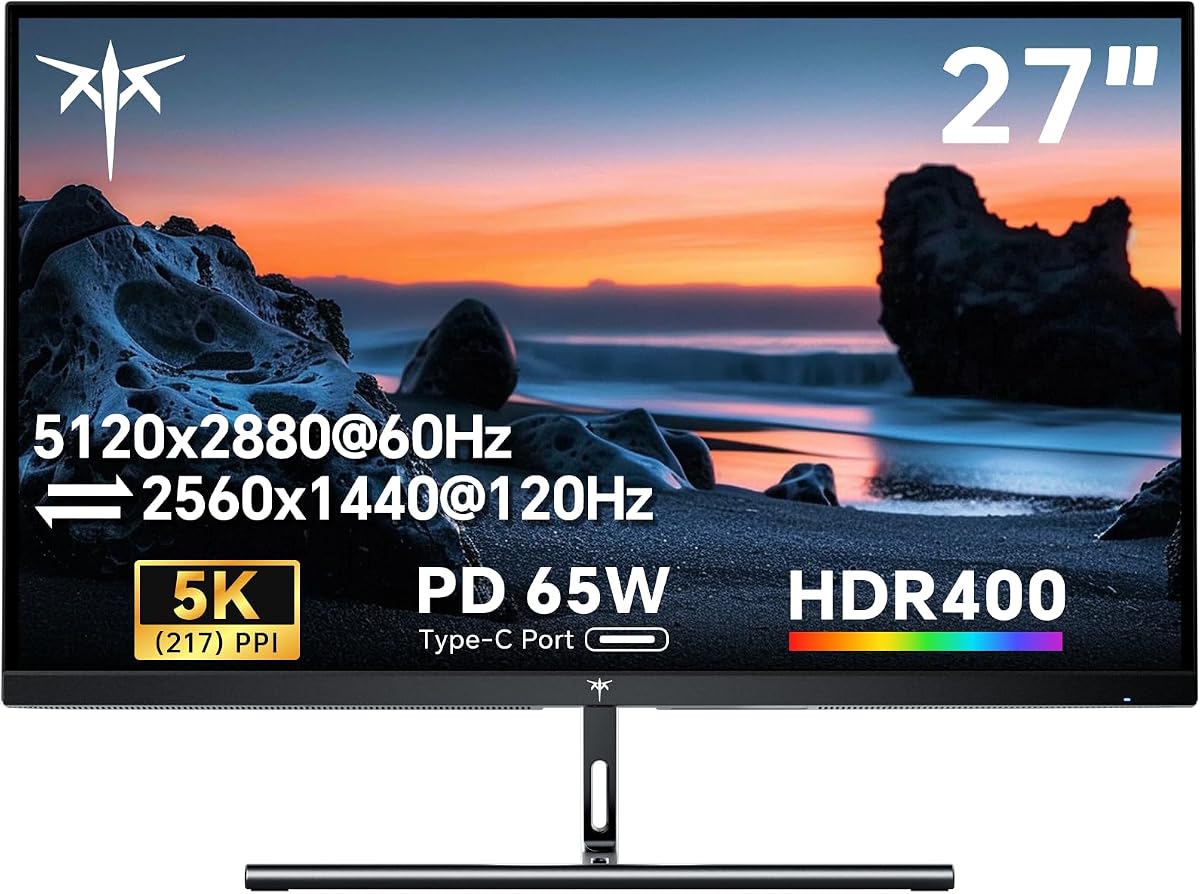
KTC’s 27-inch 5K monitor attacks the problem 4K panels cannot fully solve for picky Mac users: integer scaling and Retina-class sharpness at 27 inches without compromise. At 5120×2880 and 217 PPI, macOS can run at native or default scaling modes that mirror the old 27-inch iMac 5K experience—text renders with single-pixel hairlines, UI elements stay proportional, and screenshots look like Apple marketing assets. For Mac mini buyers who stared at 5K iMacs for years, this spec is emotionally compelling.
Dual mode operation adds flexibility rare at this price tier. Run 5K at 60Hz for photo editing and typography-heavy work, then switch to 2560×1440 at 120Hz for smoother scrolling and casual gaming. Adaptive sync claims reduce tearing in the 120Hz mode when frame rates fluctuate on Apple Silicon GPUs. DisplayPort 1.4 and HDMI 2.0 complement 65W full-function USB-C for Mac mini routing.
Color specs—135% sRGB area, 100% sRGB coverage, HDR400, 500-nit peak—position the panel for creative work, though the 3.8-star average rating demands caution. Buyer reports in this niche sometimes cite firmware quirks, wake-from-sleep issues, or macOS scaling menus showing non-standard modes. Read recent reviews before buying and keep return windows handy.
Sixty-five watt USB-C charges MacBook Air and 13-inch MacBook Pro adequately but may not keep a 16-inch Pro at full charge under heavy load—same class of compromise as many non-Apple 5K options. Mac mini users still run separate mini power; USB-C here is primarily video plus downstream charging for phones.
Versus 4K BenQ MA270U: KTC wins raw pixel density and optional 120Hz mode; BenQ wins Mac Color Match, keyboard integration, 90W delivery, and buyer rating confidence. Versus Apple Studio Display: KTC lacks camera, speakers, and Apple calibration guarantees but undercuts dramatically on resolution-per-dollar if quality lottery goes your way.
Who should buy: Mac mini owners who prioritize 5K sharpness above all and accept brand-risk for spec-sheet upside. Who should skip: risk-averse buyers, shared MacBook Pro 16-inch desks needing 90W, and anyone uncomfortable troubleshooting macOS display modes.
Setup tip: after connecting, reset NVRAM/PRAM only if display detection fails—usually unnecessary on Apple Silicon, but document cable order (USB-C first, then power) if sleep wake glitches appear.
Prefer Default or native 5K modes; avoid scaled resolutions that trigger soft rendering warnings unless you need larger accessibility text.
Verify Mac mini model supports 5K at 60Hz over your chosen port—Apple Silicon generally handles 5K well via USB-C or DisplayPort.
Treat KTC as a high-reward, higher-variance pick. Pair with a retailer return policy and test within the first week: uniform backlight, sleep wake, and no dead pixels.
If variance worries you, BenQ MA270U 4K with Mac Color Match is the safer Apple-adjacent choice despite lower PPI.
We may earn a commission at no additional cost to you.
The INNOCN CB32U1 is the pack’s performance flagship for Mac mini desks that refuse to choose between color accuracy, screen size, and motion smoothness. Thirty-two inches of 4K at 120Hz with factory Delta E under one and ninety-eight percent DCI-P3 coverage is a combination BenQ and LG splits across separate models—here INNOCN merges creative credibility with high refresh in one chassis. At 4.6 stars it also leads buyer satisfaction among premium-tier entries.
Color accuracy claims are studio-oriented: Delta E under one out of box, 100% sRGB and 98% DCI-P3, HDR400, and 1.07 billion colors. Photo retouchers, video colorists on a budget, and UI designers see predictable hues without immediate calibration—though pros still benefit from periodic probe tuning. Wide viewing angles on IPS keep client reviews consistent when they stand beside your desk.
Ninety-watt USB-C delivers true single-cable desk goals for MacBook plus Mac mini hybrid setups: video, data, and laptop charging through one port while the mini uses HDMI or second input. macOS scaling on 32-inch 4K follows the same guidance as BenQ MA320U—prefer default modes, accept slightly lower PPI than 27-inch 4K, gain timeline width.
One-twenty hertz at 4K changes daily feel beyond gaming. Cursor movement, Mission Control animations, and long web scrolling feel noticeably smoother than 60Hz office panels—Apple Silicon Mac minis can drive 4K 120Hz over HDMI 2.1 and DisplayPort 1.4 when configured correctly. Casual Apple Arcade, Steam, and GeForce NOW sessions benefit without switching to a dedicated gaming monitor.
Connectivity is future-heavy: HDMI 2.1 for 4K 120Hz without chroma subsampling compromises, DisplayPort 1.4 for PC test machines beside your mini, USB-C for primary Mac routing. Pivot, height, swivel, and tilt adjustments support vertical coding layouts and shared desks.
Tradeoffs versus BenQ MA320U: INNOCN wins refresh and Delta E spec; BenQ wins Mac Color Match branding and keyboard brightness keys. Tradeoffs versus KTC 5K: INNOCN wins motion and color gamut rating; KTC wins raw PPI if firmware behaves.
Buy CB32U1 when you want one monitor for Mac mini creative work, 120Hz polish, and 90W USB-C without Apple tax. Skip when desk depth is limited or Mac keyboard integration is mandatory—MA270U remains the Apple-feel pick.
Use HDMI 2.1 or DisplayPort 1.4 cables rated for high bandwidth; enable 120Hz in System Settings → Displays after connecting.
If refresh caps at 60Hz, check cable quality and input selection—some modes require specific ports per INNOCN manual.
Assign color-managed apps to full-screen on CB32U1 while communication tools live on InnoView portable or second monitor if dual-display.
Schedule monthly calibration if client deliverables require contract-proof color—factory Delta E under one is a starting point, not eternal guarantee.
We may earn a commission at no additional cost to you.
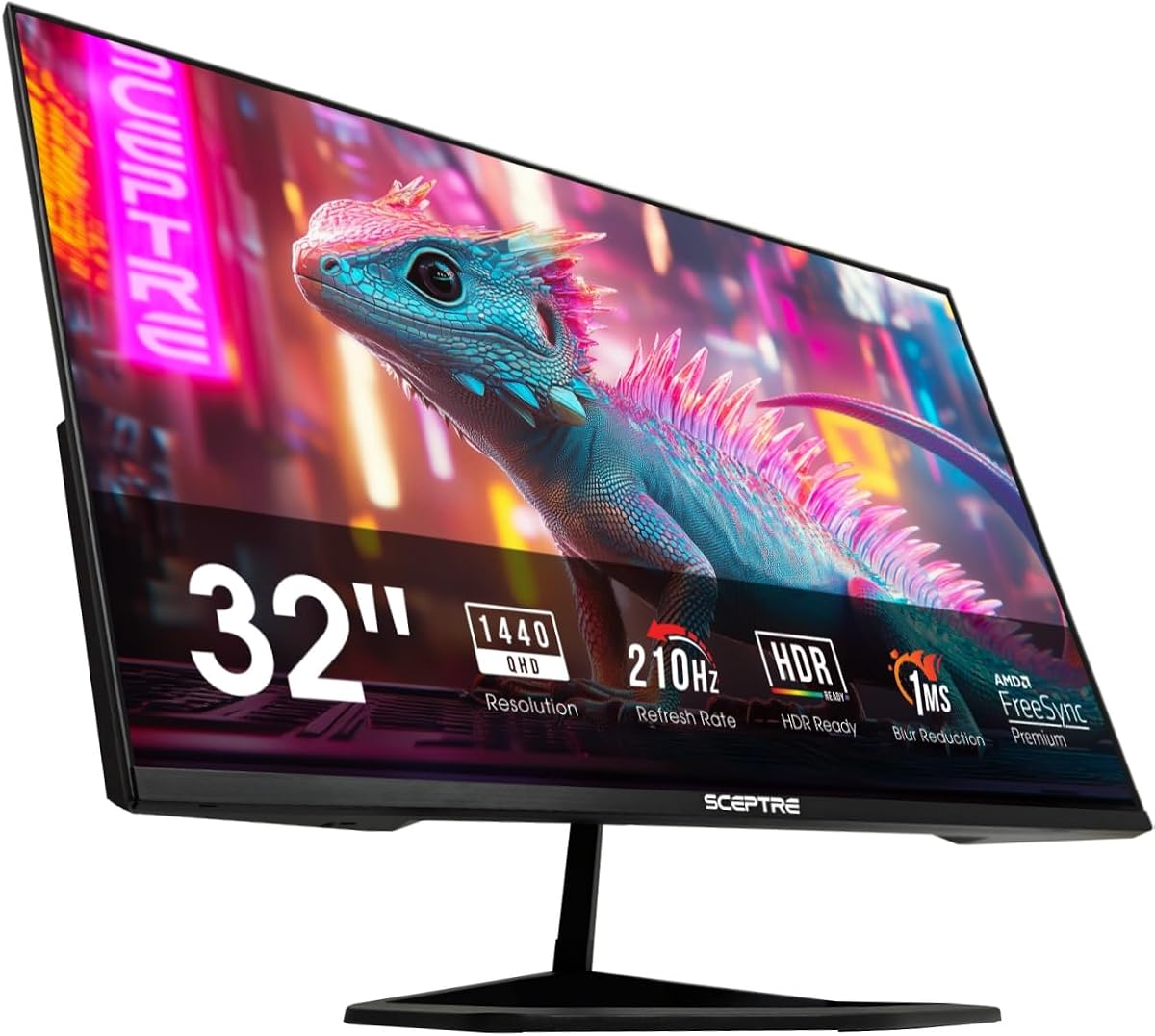
Sceptre’s 32-inch QHD gaming monitor closes the roundup for Mac mini owners who split time between Xcode and Steam, or who bought a Mac mini for Apple Silicon efficiency but still want high-frame-rate evenings on console. At 2560×1440 and up to 210Hz over DisplayPort and USB-C, it prioritizes motion and size over the HiDPI purity of 4K BenQ and INNOCN picks. macOS runs QHD scaling reasonably— sharper than ViewSonic 32-inch 1080p, softer than any 4K entry.
The VA panel targets contrast and gaming immersion with 115% sRGB coverage, 1ms blur reduction claims, and AMD FreeSync Premium for tear reduction when frame rates swing. Dark room gaming looks punchy; office document work may show VA tradeoffs in off-angle color shift compared with IPS Mac-tuned panels. Blue-Light Shift and custom FPS/RTS modes skew toward long sessions.
USB-C connectivity lets Mac mini M-series connect with one cable for video when ports support DP Alt Mode—verify refresh caps over USB-C versus DisplayPort in manual, a common gaming-monitor caveat. Dual HDMI ports handle PlayStation or Xbox alongside the mini; audio out jack feeds headphones when built-in speakers are insufficient for competitive play.
For productivity, 32-inch QHD fits three-window layouts with less GPU stress than 4K 120Hz. Developers compiling large projects while monitoring Slack and browser docs appreciate the size; designers exporting print work should prefer 4K P3 options earlier in this list. Apple Arcade and native Mac titles run smoothly at high refresh on M2 Pro and M4 class minis.
Minimal bezels support dual-monitor gaming setups if your Mac mini drives two displays—pair with a vertical INNOCN 27-inch 4K for chat and keep Sceptre primary for gameplay. VESA mount support cleans cable clutter when wall-mounting for sim racing or flight sticks.
Honest Mac mini caveats: no Mac keyboard brightness integration, no 90W charging headline, and no factory Delta E color promises. This is a hybrid panel, not a Studio Display alternative. Buy when refresh and size beat color-critical 4K; skip when text sharpness and P3 workflows dominate.
Setup tip: create a macOS display profile for work hours at 60Hz QHD for stability, switch to high refresh for gaming sessions in System Settings—some users prefer separate user accounts for work versus play to avoid accidental overdrive settings.
Apple Silicon handles QHD high refresh well in many titles; AAA games may still require lowered settings—monitor headroom does not create GPU horsepower.
Use FreeSync when supported and cap frames to reduce VA ghosting in dark scenes if overdrive OSD creates halos.
INNOCN CB32U1 wins color accuracy, 4K resolution, and 90W USB-C at 120Hz. Sceptre wins peak refresh (210Hz) and gaming OSD features at QHD. Mac mini creative pros choose INNOCN; hybrid gamers choose Sceptre.
We may earn a commission at no additional cost to you.
Mac mini has no built-in Retina panel—your external monitor defines text sharpness. Twenty-seven-inch 4K (3840×2160) is the most balanced HiDPI target for macOS default scaling. Thirty-two-inch 4K trades pixel density for workspace width—acceptable for timelines, slightly soft for tiny text unless you scale up. Thirty-two-inch 1080p and QHD are budget or gaming compromises with visible softness at arm’s length. Twenty-seven-inch 5K (5120×2880) from KTC matches Apple iMac density if firmware cooperates.
Avoid non-integer scaled resolutions macOS marks as blurry. Spend five minutes in System Settings → Displays on day one—that adjustment matters more than marginal contrast spec differences.
M-series Mac minis expose Thunderbolt / USB4 ports and HDMI. Full-function USB-C cables carry DisplayPort Alt Mode video plus optional power and data. HDMI 2.0 handles 4K 60Hz reliably; HDMI 2.1 unlocks 4K 120Hz on compatible panels like INNOCN CB32U1. DisplayPort remains the stable path for maximum bandwidth and multi-monitor planning.
Ninety-watt USB-C monitors (BenQ MA, LG UP850K, INNOCN CB32U1) charge MacBooks on hybrid desks. Mac mini itself always uses its own power adapter—USB-C PD on monitors mainly helps laptops and phones, not the mini.
Measure desk depth before 32-inch panels—arms help shallow desks. Pivot stands (INNOCN 27-inch, CB32U1) aid vertical coding. Borderless LG US550 pairs aesthetically in dual 4K setups. Confirm your Mac mini chip supports two or three external displays before buying twins—base M-series rules differ from Pro.
Hide the Mac mini on VESA mount plates or under-desk shelves; route cables through monitor hubs (BenQ MA, LG UP850K) to keep the top clean.
Sixty hertz suffices for office, photo, and video editing. One-twenty hertz at 4K (INNOCN CB32U1) improves scroll and UI fluidity Apple Silicon can feed. Two-hundred-plus hertz QHD (Sceptre) targets gaming hybrids. Portable 1080p (InnoView) is for side screens, not primary sharpness.
Do not buy extreme refresh if your Mac mini never runs high-frame-rate content—you pay for headroom you will not feel.
Yes. M-series Mac minis output video over Thunderbolt/USB4 ports using USB-C cables that support DisplayPort Alt Mode. Monitors like BenQ MA270U, LG 27UP850K-W, and INNOCN models connect with one cable for video; many also pass data to downstream USB ports. Mac mini still requires its own power adapter—it does not charge over USB-C like a MacBook. Confirm your cable is full-function, not charge-only.
Twenty-seven-inch 4K is the sweet spot for sharp macOS text at default scaling. Thirty-two-inch 4K adds workspace with slightly lower pixel density. Twenty-seven-inch 5K from the KTC monitor in this pack matches iMac Retina density if compatibility behaves. Avoid 32-inch 1080p as a primary work display unless budget forces it—text looks visibly soft compared with any 4K pick here.
Most Apple Silicon Mac minis support two external displays; M Pro and M Max variants support three depending on configuration. Pair combinations from this pack—such as BenQ MA270U primary plus InnoView portable secondary, or dual LG 27US550-W borderless panels—while matching cables to port bandwidth. Check Apple’s spec page for your exact chip before buying twin 4K 120Hz panels.
Generic 4K IPS monitors like INNOCN 27C1U-D deliver sharp text and decent color for mixed office and casual creative work. BenQ Mac Color Match and wide DCI-P3 panels (LG UP850K, INNOCN CB32U1) matter when you edit photos, video, or UI design aligned with Apple P3 devices. Clerical Mac mini users rarely need Mac Color Match; designers feel the difference within hours.
For productivity, photo editing, and video timeline work, 60Hz remains standard on BenQ MA, LG UltraFine-style, and value INNOCN 27-inch models. If scroll fluidity and casual gaming matter, INNOCN CB32U1 offers 4K 120Hz; Sceptre QHD pushes far higher refresh for gaming hybrids. Apple Silicon Mac minis can drive high refresh when cables and ports match panel requirements.
The KTC H27P3 advertises compelling 5K specs—5120×2880, dual mode 5K/2K, 65W USB-C—but its 3.8-star average suggests higher variance in quality control, macOS sleep behavior, or buyer expectations than BenQ and LG. It can be the sharpest desk upgrade when sample quality is good, but read recent reviews and keep return options open. Risk-averse buyers should prefer BenQ MA270U 4K.
If Mac mini is work-only, gaming-oriented Sceptre QHD high-refresh panels sacrifice color tuning and HiDPI sharpness you get from 4K IPS picks. If you game nightly on the same desk, Sceptre’s 210Hz QHD hybrid makes sense. INNOCN CB32U1 splits the difference with 4K 120Hz and Delta E under one for creative-plus-casual-play desks.
Open System Settings → Displays and choose Default resolution or other integer scaled modes without the softness warning. Avoid running 1080p on large 32-inch panels as primary work displays. Prefer 27-inch 4K or 5K panels from this pack for Retina-like clarity. After cable changes, recheck scaling—macOS sometimes reverts to non-optimal modes.
LG UP850K Waves MaxxAudio and INNOCN built-in speakers handle calls, system sounds, and casual YouTube adequately. Music production and serious media consumption still want external speakers or headphones. Mac mini has no internal speakers—monitor audio or Bluetooth is your only built-in path unless you add a HomePod or desk speakers.
BenQ MA270U balances 27-inch 4K HiDPI sharpness, Mac Color Match, 90W USB-C, and keyboard brightness integration—the closest Apple-adjacent daily driver without Studio Display pricing. INNOCN CB32U1 wins if you need 32-inch space, 120Hz, and Delta E under one. LG 27UP850K-W suits white-desk aesthetics with 95% DCI-P3 and USB hub. Match pick to desk size, color work, and refresh priorities—not a single universal winner.
Pairing the right monitor with a Mac mini transforms a tiny box into a desktop that feels intentional—sharp HiDPI text, wide color when creative work demands it, and cable routing that does not fight Apple’s minimal industrial design. This pack spans BenQ Mac-native integration, LG UltraFine-style hub monitors, INNOCN value and premium color/refresh options, KTC 5K density, budget ViewSonic size, portable InnoView second screens, and Sceptre gaming hybrids.
Start with BenQ MA270U for the best overall Mac mini experience, INNOCN CB32U1 for large 4K 120Hz creative desks, and LG 27UP850K-W for white aesthetic wide-gamut setups. Read individual reviews for honest tradeoffs—KTC 5K variance, 32-inch 1080p softness, portable resolution limits, and gaming panel color compromises.
Whichever monitor you choose, configure integer HiDPI scaling on day one, label your inputs if multiple devices share the panel, and route peripherals through monitor hubs when available. The Mac mini rewards thoughtful display choice more than any other Mac—make the external screen count.