Expert Review & Guide

Best Mini-ITX Cases for Compact High-End Builds in 2026

Mini-ITX cases are no longer a niche punishment for people who hate mid-towers. In 2026 you can cool a serious discrete GPU in roughly ten to twenty liters, choose mesh cubes or walnut aluminum furniture, carry a LAN box by the handle, or hide a slimline shell under a television. The hard part is matching layout to parts: sandwich risers, SFX-only rules, short GPU limits, and radiator thickness end more builds than CPU choice ever will.

This roundup uses only the ten chassis in our best-mini-itx-cases pack. We weighed true Mini-ITX specialization against mATX-capable minis that still welcome ITX boards, included fans and risers, GPU and cooler clearance, PSU format flexibility, dust filtration, front USB-C usefulness, and how punishing each shell is on build day. NZXT’s H2 Flow leads as the polished overall pick. Cooler Master’s NR200 remains the airflow classic. Fractal’s Terra Jade is the premium desktop object.

Skip dollar-price obsession—SFX PSUs, risers, and short GPUs change the real spend more than the case sticker. Start with the three top picks if you already know you want mesh showcase convenience, proven horizontal airflow, or walnut aluminum presence. Use the comparison table to separate 330mm GPU heroes from 230–255mm design shells. Then read each review for PSU format and riser generation before you click buy.

Our Top Mini-ITX Case Picks for 2026

Best Overall Mini-ITX

NZXT H2 Flow Mini-ITX

★★★★★9.6/10
NZXT H2 Flow Mini-ITX
  • 20.7L Mini-ITX with ultra-fine mesh panels and two included 120mm exhaust fans
  • PCIe 5.0 riser included for vertical GPU mounting with modern bandwidth
  • Hybrid glass-and-mesh side panel shows the build while supporting up to a 280mm radiator
Check Price →
Best Proven ITX Airflow

Cooler Master NR200

★★★★★9.4/10
Cooler Master NR200
  • 18.25L Mini-ITX footprint with mesh-first airflow and mature community guides
  • Horizontal GPU support up to 330mm for high-end cards in a true SFF shell
  • Removable side bracket for 240/280mm radiators or dense fan arrays
Check Price →
Best Premium Desktop SFF

Fractal Design Terra Jade

★★★★★9.4/10
Fractal Design Terra Jade
  • 10.4L Mini-ITX shell with FSC-certified solid walnut and anodized aluminum panels
  • Slidable central wall with 30mm of flexibility to balance cooler and GPU space
  • PCIe 4.0 riser and front USB Type-C 20Gbps for a living-room ready build
Check Price →

As an Amazon Associate we earn from qualifying purchases. We may earn a commission at no additional cost to you.

Mini-ITX Case Comparison: Volume, Clearance, and Layout

Scan volume class, GPU room, PSU format, and whether a riser is included before you fall for product photography. Specs below highlight what matters in small form factor—cooling path, radiator support, and practical limits. No prices—check the live listing for the current offer.

#ProductSpecificationsScore
1
  • 20.7L Mini-ITX; GPU to ~331mm
  • PCIe 5.0 riser; 2× 120mm fans included
  • Hybrid glass-mesh; up to 280mm radiator
9.6
2
  • 18.25L Mini-ITX; SFX PSU only
  • Horizontal GPU to 330mm; cooler 165mm
  • Up to 6 fans; 240/280mm radiator options
9.4
3
  • 10.4L Mini-ITX; walnut wood front
  • GPU to 322mm; PCIe 4.0 riser included
  • Slidable central wall; USB-C 20Gbps front
9.4
4
  • ~20L mini with detachable carry handle
  • GPU to ~363mm; top 240mm AIO; cooler ~163mm
  • ATX/SFX/SFX-L PSU; USB-C front I/O
9.4
5
  • ITX/Mini-DTX; mesh all sides; carry handle
  • GPU <255mm; cooler <170mm; ATX PSU <140mm
  • Tool-free top open; Type-C front I/O
9.2
6
  • ITX/DTX; dual-chamber; walnut veneer accents
  • GPU ~230mm; SFX PSU; cooler ~137mm
  • 270° dual-curved glass; aluminum shell
9.2
7
  • 11.5L Mini-ITX/Mini-DTX; mesh front
  • GPU ~10.5 in; ATX PSU compatible
  • 120/140mm AIO support; 2.5/3.5 drives
9.2
8
  • Premium ITX SFF with carry handle
  • 360° removable panels for access
  • USB-C + dual USB-A front; 3-year warranty
9.2
9
  • 11L sandwich Mini-ITX; aluminum exterior
  • Triple-slot GPU; 240mm AIO; PCIe 5.0 riser
  • SFX/SFX-L PSU; DAN Cases collaboration
7.6
10
  • Slimline Mini-ITX; PCIe 4.0 riser included
  • 2× 140mm PWM Aspect fans included
  • GPU to 335mm; all panels removable
9.2

1. NZXT H2 Flow - Best Overall Mini-ITX

NZXT H2 Flow Mini-ITX

NZXT H2 Flow Mini-ITX

9.6/10★★★★★

The NZXT H2 Flow is the clearest all-around Mini-ITX pick in this pack for 2026 builders who want airflow credibility, included hardware, and a finished look without jumping into boutique sandwich layouts. At 20.7 liters it sits in the sweet spot between desk-friendly size and real GPU room—most cards up to about 331mm fit, which covers a wide slice of current mid-range and enthusiast boards if you measure thickness and connector overhang carefully. The hybrid glass-and-mesh side panel is the visual thesis: you can see the liquid cooler and board while ultra-fine mesh still feeds the chamber.

  • 20.7L Mini-ITX; GPU to ~331mm
  • PCIe 5.0 riser; 2× 120mm fans included
  • Hybrid glass-mesh; up to 280mm radiator
Check Price →
✓ Pros
  • Strong 4.8 rating with modern Mini-ITX airflow styling
  • PCIe 5.0 riser included for vertical GPU mounting
  • Two F120Q CV fans pre-installed for day-one exhaust
  • Hybrid glass-and-mesh panel shows the build without sealing heat
  • Tool-less panels and Velcro routing straps speed first builds
✕ Cons
  • 20.7L is larger than ultra-SFF 10–12L showpieces
  • GPU length near 331mm still needs careful card selection
  • Vertical GPU focus may not suit every cable-management habit

Detailed review

Cooling is not left as homework. Dual F120Q CV fans arrive pre-installed for immediate exhaust, and the case is designed to support radiators up to 280mm so sustained gaming and creator loads stay workable in a compact shell. Mesh on multiple faces filters dust while maximizing intake area, which matters more in SFF than in a cavernous mid-tower where lazy fan maps still survive. NZXT also leans into buildability with tool-less panels and integrated Velcro cable straps—small details that keep a first ITX project from becoming a weekend of scraped knuckles.

The included PCIe 5.0 riser is a practical differentiator. Vertical GPU mounting is not just for photos; in tight Mini-ITX shells it can reclaim layout space and keep a long card from colliding with cooler towers or PSU cables. Full-bandwidth Gen 5 readiness also future-proofs the riser path better than older Gen 4-only kits that still ship in some premium cases. That said, risers always deserve careful seating and strain relief—treat the cable as a critical part, not a decorative ribbon.

Compared with the Cooler Master NR200, the H2 Flow feels more polished out of the box and more showcase-oriented, while the NR200 remains the community-proven airflow teacher with a slightly smaller 18.25L footprint and SFX-only discipline. Against Fractal’s Terra, the H2 Flow trades walnut furniture aesthetics for mesh-first thermals and included fans. Against Lian Li’s A4-H2OX5 sandwich, it is easier for builders who want NZXT’s conventional-ish Mini-ITX workflow instead of dual-chamber sandwich routing.

Who should buy it? Anyone building a black Mini-ITX gaming or workstation PC that will sit on a desk in plain sight, who wants mesh cooling and a Gen 5 riser without hunting third-party parts. Skip it if you need the absolute smallest volume possible, insist on ATX PSU convenience in a shoebox, or already own a preferred sandwich platform. Plan power early: compact cases reward short modular cables and thoughtful GPU power connector orientation.

Build day advice is straightforward. Confirm motherboard standoffs, dry-fit the GPU on the riser before final cable dressing, and decide radiator orientation before you commit pump tubing lengths. Keep dust filters clean—fine mesh works only if air can still pass. If your room runs warm, prioritize a quality 240/280mm AIO or a low-profile cooler that clears the glass-mesh panel without scraping. Done right, the H2 Flow delivers the Mini-ITX experience people actually want in 2026: small, cool, and presentable.

Who should buy the H2 Flow

Choose the H2 Flow if you want a modern Mini-ITX case with included fans, a PCIe 5.0 riser, and mesh-forward cooling in a roughly 21-liter class. It suits gamers and creators who still want the build visible through hybrid glass without accepting a sealed fishbowl. Pass if you need sub-12-liter sandwich density or an ATX PSU in an ultra-short depth chassis.

Setup notes for riser and radiator plans

Seat the PCIe 5.0 riser firmly and avoid sharp bends near the GPU power connectors. Map a 240mm or 280mm radiator path before buying an AIO, then route the top fans as exhaust unless your specific cooler kit recommends otherwise. Leave spare length for USB and front-panel cables so tool-less panels close without pinching.

H2 Flow versus NR200 and Terra

Pick H2 Flow for included fans plus Gen 5 vertical GPU convenience. Pick NR200 for a slightly smaller proven airflow cube and SFX-focused community recipes. Pick Terra when walnut aluminum desk presence matters more than mesh volume and included cooling.

Check Price on Amazon →

We may earn a commission at no additional cost to you.

2. Cooler Master NR200 - Best Proven ITX Airflow

Cooler Master NR200

Cooler Master NR200

9.4/10★★★★★

Cooler Master’s NR200 remains one of the most trusted Mini-ITX cases for builders who care about thermals first and fashion second. The 18.25L footprint is compact enough for small desks yet large enough—in SFF terms—to host serious GPUs up to 330mm on a horizontal mount. That horizontal layout is still a teaching tool: you get a readable airflow path instead of guessing how heat escapes a sandwich sandwich of boards and risers.

  • 18.25L Mini-ITX; SFX PSU only
  • Horizontal GPU to 330mm; cooler 165mm
  • Up to 6 fans; 240/280mm radiator options
Check Price →
✓ Pros
  • Legendary Mini-ITX airflow reputation in an 18.25L footprint
  • Horizontal GPU mounting up to 330mm for high-end cards
  • Supports up to six fans and 240/280mm radiator options
  • 165mm CPU cooler clearance is generous for SFF air cooling
  • Removable side bracket speeds radiator or fan reconfiguration
✕ Cons
  • Strictly SFX power supplies—no ATX PSU fallback
  • Looks more utilitarian than walnut or curved-glass showcases
  • Requires planning; empty mounts still need your fan budget

Detailed review

Airflow unleashed is not marketing fluff here. Cooler clearance up to 165mm lets many dual-tower coolers work when an AIO feels like overkill, and support for as many as six fans gives you intake, exhaust, and GPU-adjacent options. The removable side bracket is the practical star—swap between dense fan arrays and 240/280mm radiators without treating the chassis like a puzzle box you fear opening.

The hard constraint is power: the NR200 is engineered for SFX only. That is a feature if you want a short PSU that belongs in Mini-ITX, and a deal-breaker if you hoped to reuse a leftover ATX brick. Pair it with a quality SFX unit (Cooler Master’s own V SFX Gold line is the naming match, though any solid SFX works) and short modular cables. GPU power connectors and cable bulk are the usual build friction points.

In this pack the NR200 sits beside newer NZXT and Fractal options as the proven classic. It will not win a walnut living-room beauty contest against the Terra, and it will not ship with the H2 Flow’s Gen 5 riser theater. What it wins is predictability: years of builds, guides, and clearance charts mean fewer surprises when you mix a hot GPU with a tall cooler. For LAN travelers, note that the NR200 is portable by size but not handle-first like the HYTE Revolt 3 or JONSBO handled shells.

Thermal strategy should start with GPU exhaust. Keep mesh paths open, avoid stuffing the case against a wall, and prefer positive pressure if your room is dusty. If you run a 280mm radiator on the side bracket, dry-fit tubing and fan thickness before you buy a thick triple-slot card that steals the same real estate. Storage is typically M.2-first on modern ITX boards; plan any 2.5-inch drives early so trays do not collide with PSU cables.

Buy the NR200 if you want a Mini-ITX case that still feels like a conventional PC inside—horizontal GPU, clear cooler space, mesh breathing room—and you accept SFX power as non-negotiable. Skip it for premium aluminum furniture designs, ATX PSU reuse, or sandwich AIO projects where Lian Li’s A4-H2OX5 is the intentional layout. As a best-proven-airflow pick, it still earns a top-three seat in 2026.

Who should buy the NR200

Ideal for gamers and SFF enthusiasts who want high airflow, horizontal GPU mounting, and a huge library of community build logs. You should already be comfortable buying an SFX PSU and measuring GPU length. Avoid it if aesthetics demand wood, curved glass, or a carry handle for weekly LAN trips.

SFX power and cooler planning

Select an SFX or compatible short unit before the motherboard arrives, then choose either a 165mm-class air cooler or a 240/280mm AIO path on the side bracket. Confirm fan thickness and GPU slot count together—those two dimensions fight in every NR200 build that pushes high-end parts.

Check Price on Amazon →

We may earn a commission at no additional cost to you.

3. Fractal Design Terra Jade - Best Premium Desktop SFF

Fractal Design Terra Jade

Fractal Design Terra Jade

9.4/10★★★★★

Fractal Design’s Terra Jade is the Mini-ITX case you buy when the PC will live in a living room, bedroom desk, or design studio and must look intentional beside furniture. The 10.4-liter volume is genuinely small, yet Fractal still claims GPU lengths up to 322mm thanks to a sandwich-style internal arrangement and an included PCIe 4.0 riser. The FSC-certified solid walnut front and thick anodized aluminum exterior are not stickers—they define the product.

  • 10.4L Mini-ITX; walnut wood front
  • GPU to 322mm; PCIe 4.0 riser included
  • Slidable central wall; USB-C 20Gbps front
Check Price →
✓ Pros
  • Striking 10.4L design with solid walnut and anodized aluminum
  • Slidable central wall offers 30mm of internal flexibility
  • GPU support up to 322mm with included PCIe 4.0 riser
  • Front USB Type-C 20Gbps plus aluminum power button polish
  • Living-room friendly silhouette that does not look like a gamer cube
✕ Cons
  • PCIe 4.0 riser is not Gen 5 like newer NZXT and Lian Li kits
  • Premium materials demand careful handling and cable discipline
  • Cooling headroom is tighter than mesh-heavy 18–21L cases

Detailed review

The stepless slidable central wall is the engineering story. About 30mm of internal flexibility lets you bias space toward a thicker cooler or a longer GPU depending on the parts list. That is exactly how premium SFF should work: instead of a fixed compromise, you tune the chamber. Front I/O matches the materials brief with an aluminum power button and USB including Type-C at 20Gbps—useful for docks, SSDs, and phones without hunting rear ports.

Thermals require honesty. A dense aluminum-and-wood jewelry box will not cool like an NR200 mesh cube or NZXT H2 Flow. Choose efficient GPUs, quality thermal paste, and sane fan curves. Prefer lower-power CPU SKUs or compact coolers that fit your wall position. Dust still matters; keep intakes clear and avoid placing Terra flush against a bookshelf that blocks side mesh or vent paths.

Versus Ridge, Terra is more of a sculptural desktop object while Ridge is a slimline console-like footprint with included 140mm fans. Versus JONSBO TK-0, Terra feels more refined and material-forward, while TK-0 chases hyperboloid glass drama. Versus Lian Li A4-H2OX5, Terra prioritizes lifestyle design over sandwich AIO performance packing. The 4.7 rating reflects strong owner satisfaction when people buy Terra for the right reasons.

Build tips: map the slidable wall before installing the motherboard permanently, dry-fit the GPU on the riser, and measure cooler height against your chosen bias. Use soft cable combs or short custom cables—bulk is the enemy in 10 liters. Because the walnut front is a natural material, wipe carefully and avoid harsh solvents. If you move the PC often, consider a soft sleeve; this is not a LAN battering ram like handled steel minis.

Choose Terra Jade if you want the best premium desktop SFF statement in this pack and will select parts for efficiency. Skip it if you need maximum mesh thermals, Gen 5 riser bandwidth as a must-have, or the cheapest path into Mini-ITX. For the right buyer, few cases make a small PC feel this finished.

Who should buy Terra Jade

Buy Terra when desk aesthetics and materials matter as much as the hardware inside. It fits apartments, media consoles, and clean battlestations where a black mesh cube would look out of place. Skip it for max-TDP experimental builds or builders who refuse riser-based GPU mounting.

Tuning the slidable wall

Decide cooler height versus GPU thickness first, then lock the central wall. Recheck after seating RAM tall heatspreaders and GPU power adapters. A five-minute dry fit here prevents a full teardown later.

Terra versus Ridge

Terra is the walnut aluminum sculpture with flexible internal bias. Ridge is the slimline living-room ITX with two 140mm PWM fans included and a console-like stance. Pick Terra for materials; pick Ridge for fan-included slimline practicality.

Check Price on Amazon →

We may earn a commission at no additional cost to you.

4. JONSBO Z20 Black - Best Handled mATX Mini

JONSBO Z20 Black Mini Tower

JONSBO Z20 Black Mini Tower

9.4/10★★★★★

The JONSBO/JONSPLUS Z20 Black is the handled mini that stretches beyond pure Mini-ITX. It is a Micro-ATX mini tower around 20 liters with a detachable carrying handle, which makes it a practical pick when you want small-desk volume without abandoning mATX board options. In a best Mini-ITX cases roundup it still belongs because many builders use ITX boards in mATX-capable shells for more room, or because they want one chassis that can grow with a larger board later.

  • ~20L mini with detachable carry handle
  • GPU to ~363mm; top 240mm AIO; cooler ~163mm
  • ATX/SFX/SFX-L PSU; USB-C front I/O
Check Price →
✓ Pros
  • Roughly 20L mini tower with a detachable carrying handle
  • Thick 2mm bent steel panels feel more solid than thin SFF shells
  • GPU clearance near 363mm plus top 240mm AIO support
  • ATX, SFX, and SFX-L PSU flexibility with multi-gear adjustment
  • USB-C Gen 2 and USB-A front I/O with magnetic dust filtration
✕ Cons
  • Micro-ATX focus means it is not a pure Mini-ITX-only specialty case
  • Cooler height near 160mm still limits some dual-tower monsters
  • Handle and mini footprint tempt travel—secure internals before trips

Detailed review

Construction is a highlight. Thick integrated bent steel panels and large square openings aim to combine heat dissipation with a more substantial feel than ultra-thin aluminum sandwiches. Magnetic dust filtration covers broad areas—important when a mini case sits on carpet or near a window. Removable PCIe fixing hardware helps longer GPUs install without the usual SFF wrestling match, and manufacturer guidance points to roughly 363mm GPU clearance depending on the rest of the stack.

Cooling support is balanced rather than extreme: a top 240mm AIO (with thickness caveats) and air cooler clearance around 163–164mm. That covers popular 240mm liquid kits and many mid-height towers. Fan mounts exist on top, bottom, and rear positions in 120/140mm mixes—read the diagram for your exact fan plan. Storage is modest: combinations of 2.5-inch SSDs and a single 3.5-inch drive, which is fine for M.2-first modern builds.

PSU flexibility is a real advantage versus SFX-only classics like the NR200. The Z20 accepts ATX, SFX, and SFX-L with adjustable positioning and even SFX side mounting notes. That flexibility is also a footgun: longer ATX units can interfere with GPU or cable paths, so JONSBO’s own imagery matters more than assuming every ATX brick fits every gear setting. Front I/O includes USB 3.2 Gen 2 Type-C, Type-A, and audio—desk-friendly without adapters.

Compared with the JONSBO C6-ITX, the Z20 is roomier for GPUs and more mATX-capable, while the C6 is a stricter mesh ITX carry shell with shorter GPU limits. Versus NZXT H2 Flow, the Z20 trades polished Gen 5 vertical GPU packaging for handle convenience and PSU flexibility. Versus HYTE Revolt 3, both chase portability, but Z20’s steel mini-tower stance feels more traditional.

Buy the Z20 if you want a tough little handled chassis that can run high-performance parts, prefer steel solidity, and like ATX PSU options in a ~20L box. Skip it if you need the tiniest ITX jewelry case or a pure sandwich AIO layout. For LAN parties and dorm moves, remove the handle only when you want a cleaner static desk look—then reattach when travel returns.

Who should buy the Z20

Pick Z20 for handled portability, thick steel, and mATX-or-ITX flexibility in a mini tower. It is excellent when you refuse SFX-only rules but still want a small footprint. Avoid it if you specifically need a sub-12L aluminum showcase.

PSU gear settings and GPU fit

Study JONSBO’s PSU position guidance before buying a long ATX unit. Dry-fit the GPU after setting PSU gears, especially if you also mount a top 240mm AIO. Confirm the sixth-image GPU compatibility notes on the listing when your card is near the length limit.

Check Price on Amazon →

We may earn a commission at no additional cost to you.

5. JONSBO C6-ITX - Best Budget Mesh Carry Case

JONSBO C6-ITX Handled Mesh

JONSBO C6-ITX Handled Mesh

9.2/10★★★★★

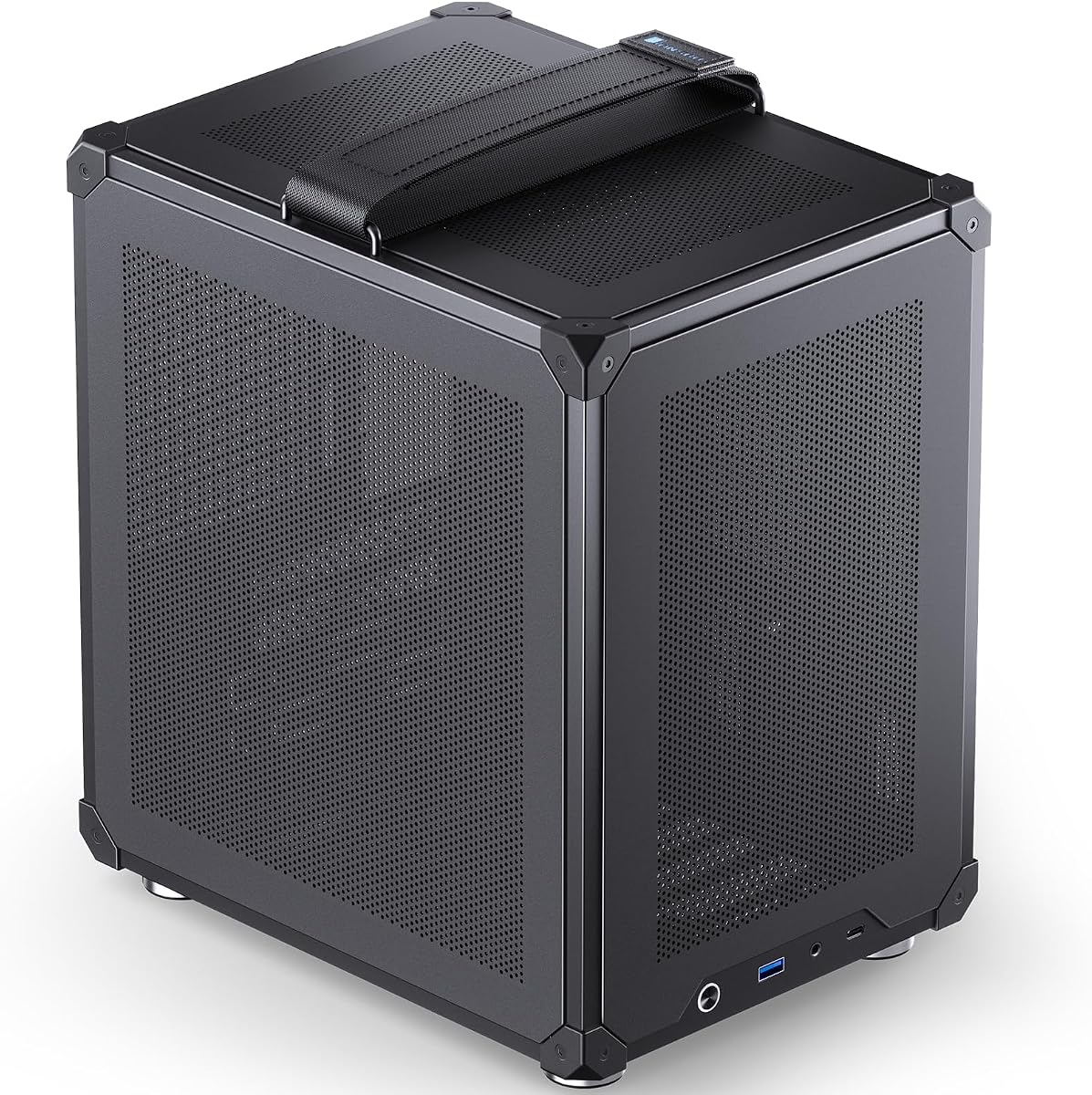
The JONSBO C6-ITX is a straightforward handled mesh Mini-ITX (and Mini-DTX) desktop case for builders who want simplicity over showcase drama. Dimensions around 202×266×295mm keep it easy to place, while all-mesh sides prioritize heat freedom over tinted glass theater. The adjustable carry handle on top uses a Velcro fastener—more practical backpack companion than a bolted luggage grip, and fine for carrying between rooms.

  • ITX/Mini-DTX; mesh all sides; carry handle
  • GPU <255mm; cooler <170mm; ATX PSU <140mm
  • Tool-free top open; Type-C front I/O
Check Price →
✓ Pros
  • All-mesh sides keep a simple ITX desktop breathing
  • Adjustable Velcro carry handle for quick moves
  • Tool-free upper cover speeds installs and cable fixes
  • Supports ATX PSUs under 140mm—rare convenience in small ITX
  • ITX and Mini-DTX compatibility with Type-C front I/O
✕ Cons
  • GPU length under 255mm excludes many modern long cards
  • Storage is limited to a single 3.5 or 2.5 drive bay tradeoff
  • 0.7mm steel is lighter-duty than thicker mini towers

Detailed review

Quick-release thinking defines the experience. The upper cover opens tool-free, and other sides release from inside so you are not fighting a dozen decorative screws during a Saturday upgrade. A removable ventilation grille on the panel helps fan installs. That accessibility matters because SFF builds are rarely one-and-done; you will revisit cables when a new GPU arrives.

Compatibility is the honest filter. GPUs must stay under about 255mm, coolers under about 170mm, and ATX PSUs under about 140mm depth. Those numbers make the C6 excellent for compact mid-range cards and many SFX units, but a poor home for the longest triple-slot flagships. Fan options include top, rear, and bottom 120mm mounts, with the bottom bay trading against a 3.5-inch drive. Four expansion slots remain available for typical ITX layouts.

Against the Z20, the C6 is smaller in spirit and stricter on GPU length while staying ITX/Mini-DTX focused. Against SilverStone SG13B, both chase ultra-compact practicality with ATX PSU tolerance, but the C6 adds the handle and more mesh personality. Against HYTE Revolt 3, C6 is the lighter mesh toolbox while Revolt 3 markets premium metal portability and warranty confidence.

Build advice: pick a short GPU first, then the PSU. Measure from the PCIe slot to the front of the case with the cooler installed. Use the Type-C 20-pin header on your motherboard correctly—ITX boards vary in header placement and cable length. Because mesh is everywhere, expect more dusting; the upside is cooler parts if fans are mapped with intention.

Buy the C6-ITX as a budget-friendly mesh carry case for short GPUs and portable desk setups. Skip it if your dream card is 320mm+ or you want walnut aluminum luxury. Within this pack it is the practical handled mesh answer, not the trophy shelf piece.

Who should buy the C6-ITX

Choose it for dorm rooms, secondary PCs, and portable mesh builds with short graphics cards. Ideal when ATX PSU reuse under 140mm saves buying SFX. Skip it for flagship-length GPUs and premium material showcases.

GPU length reality check

Treat 255mm as a hard ceiling and verify your exact card model including power connector overhang. If you are between lengths, look at Z20, NR200, H2 Flow, Ridge, or Terra instead.

Check Price on Amazon →

We may earn a commission at no additional cost to you.

6. JONSBO TK-0 - Best Showcase Glass ITX

JONSBO TK-0 Glass Mini Tower

JONSBO TK-0 Glass Mini Tower

9.2/10★★★★★

The JONSBO TK-0 Black is a design-first Mini-ITX mini tower with a separated cabinet structure, aluminum alloy shell, walnut wood accents, and a 2.5-surface curved glass perspective meant for multi-angle desktop display. If the Terra is calm Scandinavian furniture, the TK-0 is a showpiece sculpture that still tries to be a real PC. Footprint around 235×250×280mm keeps it desk-friendly whether you stand it vertically or experiment with horizontal placement.

  • ITX/DTX; dual-chamber; walnut veneer accents
  • GPU ~230mm; SFX PSU; cooler ~137mm
  • 270° dual-curved glass; aluminum shell
Check Price →
✓ Pros
  • Hyperboloid dual-curved glass makes a distinctive desktop centerpiece
  • Separated dual-chamber layout helps organize cables and hardware
  • Aluminum alloy shell with walnut wood veneer accents
  • Horizontal or vertical desktop placement flexibility
  • Removable aluminum PCI cover eases GPU service
✕ Cons
  • GPU support around 230mm limits modern long cards
  • CPU cooler height near 137mm rules out many towers
  • SFX PSU and tighter cooling envelope demand efficient parts

Detailed review

The dual-warehouse internal idea is practical: separating zones helps cable and hardware management in a chassis that would otherwise become a glass fishbowl of clutter. Removable aluminum PCI cover hardware acknowledges that GPUs are the part you swap most. Cooling mounts include optional top and bottom 120/140mm positions and rear 90mm options, with CPU cooler height roughly 137mm—plan a low-profile cooler or compact AIO strategy carefully.

Hardware limits define the audience. Motherboard support is ITX (with DTX mentions in the product story), PSU is SFX up to about 160mm class guidance, GPU around 230mm, and drive bays for a 3.5 plus 2.5. That is a compact creator or mid-range gaming recipe, not a 335mm GPU sandbox like Ridge. Buy TK-0 because you love the curved glass view and wood-aluminum mix, not because you want maximum clearance.

Versus Terra Jade, TK-0 is flashier glass and more experimental in shape, while Terra feels more restrained and material-authentic with the slidable wall system. Versus NZXT H2 Flow, TK-0 sacrifices mesh volume and GPU length for display drama. Versus Lian Li A4-H2OX5, both are small aluminum-forward ITX ideas, but A4 is a sandwich performance layout with 240mm AIO intent while TK-0 is a desktop glass object.

Build notes: leave the protective film discussion alone—follow JONSBO’s guidance about the glass. Dry-fit the SFX PSU and short GPU before mounting the board. Because curved glass shows everything, cable colors and sleeved extensions matter more than in a mesh cube. Keep ambient light in mind; dual-curved glass can reflect room lamps into camera shots if you stream.

Pick TK-0 when the case is part of the room’s design and your parts list respects short GPU and cooler limits. Skip it for long high-end cards, tall air coolers, or silent mesh-first needs. It is one of the most distinctive silhouettes in this pack when those constraints are acceptable.

Who should buy the TK-0

Buyers who want curved-glass desktop theater in Mini-ITX and will choose a short GPU plus low cooler. Great for display PCs and aesthetic battlestations. Poor fit for maximum thermals or 320mm+ graphics cards.

Parts pairing for the dual chamber

Start with an SFX PSU and a GPU under the length limit, then select a low-profile cooler that clears 137mm. Use the dual-chamber split to hide excess cable length behind the display side so the curved glass stays clean.

Check Price on Amazon →

We may earn a commission at no additional cost to you.

7. SilverStone SG13B - Best Ultra-Compact ATX-PSU ITX

SilverStone SG13B

SilverStone SG13B

9.2/10★★★★★

SilverStone’s SG13B is a veteran ultra-compact Mini-ITX case that still earns a seat when volume and ATX PSU compatibility matter more than Instagram glass. At roughly 11.5 liters with dimensions around 8.47×7.13×11.22 inches, it is a shoebox with purpose: Mini-ITX or Mini-DTX boards, mesh front panel breathing, and support for standard-length expansion cards near 10.5 inches. That card support is why SG13 remains relevant—many tiny cases force short GPUs only.

  • 11.5L Mini-ITX/Mini-DTX; mesh front
  • GPU ~10.5 in; ATX PSU compatible
  • 120/140mm AIO support; 2.5/3.5 drives
Check Price →
✓ Pros
  • True ultra-compact 11.5L Mini-ITX footprint
  • Supports standard-length expansion cards around 10.5 inches
  • ATX PSU compatibility is unusual and budget-friendly at this size
  • 120mm or 140mm single-fan AIO support for compact liquid cooling
  • 2.5-inch and 3.5-inch drive support for mixed storage
✕ Cons
  • Older design language versus 2024–2026 showcase ITX cases
  • Single AIO radiator support is modest versus dual-240 sandwich kits
  • Tight interior rewards experience; beginners may prefer NR200 or H2 Flow

Detailed review

Power flexibility is the sleeper feature. ATX PSU compatibility in an 11.5L shell lets builders reuse a solid modular ATX unit instead of buying SFX immediately. The tradeoff is classic SilverStone: you must respect cable bulk and PSU length so the GPU and drives still fit. AIO support for a single 120mm or 140mm radiator covers compact liquid cooling without pretending this is a 280mm playground.

Storage options for 2.5-inch and 3.5-inch drives help HTPC and archive builds that still want a spinning drive. Mesh front intake should be kept clear of living-room dust and pet hair. Compared with Lian Li A4-H2OX5, SG13 is less premium aluminum sandwich and more pragmatic steel toolbox. Compared with C6-ITX, SG13 is more about ultra-compact volume and card length than carry-handle mesh lifestyle.

Thermals depend heavily on your fan choices and GPU blower-versus-open design. Open-air cards need thoughtful exhaust; blower-style cards can behave better in cramped SG13-like tunnels. CPU cooling via a small AIO is often easier than finding a tall air cooler that clears every bracket. Expect to consult SilverStone’s clearance charts for your exact cooler and PSU combination.

Who is happy here? Builders making a silent-enough living-room PC, a LAN spare, or a compact workstation who already own an ATX PSU and a ~10.5-inch GPU. Who should pass? Anyone chasing walnut luxury, Gen 5 vertical GPU kits, or beginner-friendly tool-less showcases. The 4.6 rating shows the formula still works when expectations match the shoebox.

Practical tip: build on a towel with all panels off, install PSU and cables before the GPU, and only then mount the card. If the side panel refuses to close, it is almost always a cable corner or drive tray—not a mysterious defect. Keep spare PCIe slot covers and do not over-tighten mesh screws.

Who should buy the SG13B

Choose SG13B for ultra-compact volume with ATX PSU reuse and roughly 10.5-inch GPU support. Skip it if you want modern glass showcases, included premium fans, or sandwich 240mm AIO layouts.

ATX PSU fit tips

Prefer fully modular ATX units with shorter cable kits. Route CPU power and PCIe cables before seating the GPU, and verify drive trays do not collide with the PSU shroud area.

Check Price on Amazon →

We may earn a commission at no additional cost to you.

8. HYTE Revolt 3 - Best Portable LAN ITX

HYTE Revolt 3

HYTE Revolt 3

9.2/10★★★★★

HYTE’s Revolt 3 targets builders who actually move their Mini-ITX PC. The carrying handle is not a gimmick—it is the product thesis—paired with a small form factor metal shell that aims for user-friendly design and broad ITX compatibility at a mainstream enthusiast tier. If your PC goes to friends’ houses, coworking desks, or weekend tournaments, Revolt 3 speaks your language more than a walnut sculpture that never leaves a media console.

  • Premium ITX SFF with carry handle
  • 360° removable panels for access
  • USB-C + dual USB-A front; 3-year warranty
Check Price →
✓ Pros
  • Carry handle and portable SFF design for LAN and travel
  • 360-degree removable panels make access unusually friendly
  • Standard ITX motherboard compatibility without exotic layouts
  • Front USB-C Gen 2 plus dual USB-A and headset combo jack
  • Three-year case warranty adds purchase confidence
✕ Cons
  • Premium metal portable cases still need careful bump protection
  • Must verify GPU and cooler clearances against your exact parts
  • Less of a furniture piece than Terra or TK-0 glass designs

Detailed review

Accessibility is excellent. Easily removable external panels on all sides give 360-degree access to components and wiring, which is exactly what portable SFF needs when you must reseat a GPU in a poorly lit venue. Front I/O is generous for the class: two USB 3.2 Gen 1 Type-A ports, a headset combo jack, and a USB 3.2 Gen 2 Type-C port. That mix covers controllers, headsets, and fast external SSDs without flipping the case around.

Compatibility messaging emphasizes any standard-layout ITX motherboard, which is reassuring versus sandwich cases that implicitly demand specific cooler and riser choreography. Still, SFF is SFF: measure GPU length, slot thickness, and cooler height against HYTE’s current documentation before you assume a flagship card fits. The three-year case warranty is a meaningful trust signal compared with no-name minis.

Versus JONSBO Z20 and C6, Revolt 3 is the branded portable metal ITX specialist rather than a mesh mini-tower or all-mesh handle cube. Versus NR200, Revolt 3 prioritizes travel usability and panel access culture; NR200 prioritizes horizontal airflow recipes and SFX purity. Versus Ridge, Revolt 3 is more LAN-portable while Ridge is more living-room slimline with included 140mm fans.

Pack for travel like a photographer packs lenses. Use a padded bag, park drive activity before moving, and consider GPU support brackets if your card is heavy. At the destination, give the case airflow clearance—portable PCs often get placed on carpet or soft bedding where intakes smother. Keep a small kit of spare standoffs and a USB stick with chipset drivers in the same bag.

Buy Revolt 3 if portability, panel access, and solid front I/O define success. Skip it if your PC never moves and you would rather spend the slot on Terra materials or H2 Flow mesh showcase features. In this pack it is the LAN-ready premium ITX answer.

Who should buy the Revolt 3

LAN travelers, students moving between apartments, and anyone who values a handle plus full-panel access. Not the first pick for static walnut furniture PCs or sandwich AIO enthusiasts.

Travel and durability habits

Transport upright when possible, avoid checking it as rough luggage, and re-check GPU seating after any significant bump. The warranty covers the case—not a GPU cracked from transit shock—so packing discipline still matters.

Check Price on Amazon →

We may earn a commission at no additional cost to you.

9. Lian Li A4-H2OX5 - Best Sandwich AIO Mini

Lian Li A4-H2OX5

Lian Li A4-H2OX5

7.6/10★★★★☆

The Lian Li A4-H2OX5 is the sandwich Mini-ITX specialist for builders who want eleven liters, aluminum minimalism, and real cooling ambition. It updates the DAN A4-SFX spiritual lineage with 240mm AIO support—exactly the feature people begged for in earlier ultra-SFF boxes that could mount fast GPUs but struggled to cool high-TDP CPUs. Mesh on bottom, sides, and top targets direct cooling rather than sealed showcase stagnation.

  • 11L sandwich Mini-ITX; aluminum exterior
  • Triple-slot GPU; 240mm AIO; PCIe 5.0 riser
  • SFX/SFX-L PSU; DAN Cases collaboration
Check Price →
✓ Pros
  • True 11-liter sandwich Mini-ITX with aluminum exterior presence
  • Supports triple-slot GPUs plus 240mm AIO cooling
  • Updated PCIe 5.0 riser for modern vertical GPU bandwidth
  • SFX/SFX-L PSU bracket with pre-routed power cord extension help
  • DAN Cases collaboration lineage from the famous A4-SFX idea
✕ Cons
  • Lower 3.8 rating warrants extra research and careful parts pairing
  • Sandwich builds have a steeper learning curve than NR200-style cubes
  • No room for ATX PSUs—SFX or SFX-L only

Detailed review

Layout is the whole product. The GPU mounts behind the motherboard on a PCIe Gen 5 riser in a sandwich arrangement, reclaiming length for triple-slot cards while keeping the exterior tiny. Lian Li includes a longer 240mm Gen 5 riser story for stable high-bandwidth signaling. Removable brackets support SFX and SFX-L PSUs, and a pre-routed power cord extension aims to reduce interference—small touches that matter when every millimeter fights you.

Honesty about the 3.8 rating belongs up front. Sandwich SFF concentrates heat, cable stress, and compatibility edge cases. Some owners hit fitment frustrations, noise, or expectations mismatched to the tiny volume. That does not make the A4-H2OX5 a bad case; it makes it a specialist tool. Read recent owner feedback for your GPU model, confirm AIO thickness, and do not plan a first-ever PC build inside an 11L sandwich unless you enjoy puzzles.

Versus NR200, A4 is smaller and more layout-exotic with stronger AIO intent in less volume. Versus H2 Flow, A4 is denser and more aluminum-minimal, while H2 Flow is easier and more conventional with a higher rating. Versus Terra, A4 chases performance packing over walnut lifestyle. Versus SG13, A4 is the premium sandwich modern answer rather than the ATX-PSU shoebox classic.

Build sequence matters. Install the riser and motherboard side with clear cable plans, mount the AIO and verify tube routing, then seat the GPU in the sandwich bay. Check that side mesh panels do not press against fat VRM heatsinks or tall RAM. Keep fan curves responsive; in 11 liters, a lazy silent curve can cook a high-end CPU during exports or shader compilation.

Buy A4-H2OX5 if you specifically want a compact aluminum sandwich with 240mm AIO support and Gen 5 riser bandwidth, and you accept SFF homework. Skip it if you want the highest owner-score ease of the pack—look at H2 Flow, NR200, or Terra instead. For the sandwich faithful, this is still the most purpose-built performance mini here.

Who should buy the A4-H2OX5

Experienced SFF builders who want 11L density, triple-slot GPUs, and a 240mm AIO in a Lian Li/DAN-inspired sandwich. Avoid as a first PC case or if you need ATX PSU support.

Managing expectations around the rating

Treat the lower rating as a signal to verify fitment, not as automatic rejection. Watch for GPU thickness, AIO clearance, and SFX-L length conflicts. If those checks pass for your parts, the A4-H2OX5 can still be an outstanding specialist chassis.

Sandwich airflow checklist

Keep mesh panels unobstructed, set a clear intake/exhaust story across the sandwich gap, and monitor CPU and GPU temps for the first week. Dust the bottom mesh often—desk proximity makes it a lint magnet.

Check Price on Amazon →

We may earn a commission at no additional cost to you.

10. Fractal Design Ridge - Best Slimline Living-Room ITX

Fractal Design Ridge Black

Fractal Design Ridge Black

9.2/10★★★★★

Fractal Design Ridge Black is the slimline Mini-ITX case for people who want a PC to disappear into a living room the way a game console does—without giving up discrete GPU power. Developed with gaming and entertainment living-space habits in mind, Ridge maximizes capability while minimizing footprint. The included PCIe 4.0 riser and dual 140mm PWM Aspect fans mean you are not starting from a bare metal shell.

  • Slimline Mini-ITX; PCIe 4.0 riser included
  • 2× 140mm PWM Aspect fans included
  • GPU to 335mm; all panels removable
Check Price →
✓ Pros
  • Slimline Mini-ITX footprint designed for living spaces
  • Two 140mm PWM Aspect fans included for strong out-of-box airflow
  • PCIe 4.0 riser included for GPU mounting flexibility
  • GPU lengths up to 335mm in a minimized console-like shell
  • Fully removable panels for unusually good service access
✕ Cons
  • Slimline stance needs shelf depth and cable bend planning
  • PCIe 4.0 riser trails Gen 5 kits in newest NZXT/Lian Li cases
  • Less handle-portable than Revolt 3 or JONSBO carry minis

Detailed review

GPU support up to 335mm is the performance headline. That length class covers many current enthusiast cards if thickness and power connector clearance cooperate with the slimline sandwich/riser geometry. Removable panels on all sides make Ridge friendlier to service than older slim cases that punished upgrades. Type-C USB on the front keeps modern peripherals convenient when the case sits in an entertainment unit.

Airflow from two large 140mm PWM fans is a quieter-leaning advantage versus tiny 80–92mm spinner farms. Large fans can move air at lower RPM, which matters when the PC shares a movie night with dialogue you want to hear. Still, entertainment cabinets are airflow traps—leave vent gaps, avoid closed solid-door cupboards, and dust the filters if your unit has carpet.

Versus Terra, Ridge is the more practical slimline machine with included fans, while Terra is the walnut aluminum object of desire. Versus H2 Flow, Ridge is more living-room console-shaped; H2 Flow is a compact desktop tower language with Gen 5 riser polish. Versus Revolt 3, Ridge assumes the PC mostly stays put; Revolt 3 assumes you carry it.

Build guidance: place the case where HDMI and power cables can relax without sharp bends, install the riser carefully, and confirm GPU bracket alignment before tightening everything. Use the PWM fans on a balanced curve; movie-mode silent profiles are nice until a game download spikes CPU loads inside a warm TV stand. If you add liquid cooling, verify Fractal’s radiator guidance for Ridge rather than assuming mid-tower habits.

Choose Ridge if you want slimline living-room Mini-ITX with included 140mm fans and long GPU aspirations. Skip it if you need a carry handle, Gen 5 riser as a requirement, or maximum mesh cube thermals. As a lifestyle-and-performance bridge, Ridge remains one of the most sensible Fractal SFF options in this set.

Who should buy the Ridge

Living-room gamers, HTPC builders with discrete GPUs, and anyone who wants slimline presence with real fan hardware included. Not ideal for weekly LAN travel or buyers standardized on Gen 5 risers only.

Entertainment center placement

Give Ridge side and rear breathing room, route AV cables with service loops, and keep the 140mm intakes away from carpet pile. A small external USB hub can reduce rear reach-arounds when the case sits low in a stand.

Check Price on Amazon →

We may earn a commission at no additional cost to you.

Best Mini-ITX Cases for Compact High-End Builds in 2026

How to Choose a Mini-ITX Case in 2026

Start with GPU length and thickness, not liters

Liters tell you desk impact; millimeters tell you whether the build exists. A 10L case that fits a 322mm card can outperform a prettier 12L shell that caps out at 230mm. Measure your GPU from the bracket to the end of the board, then add power connector overhang and any sag bracket hardware. Triple-slot coolers need slot-count honesty, especially in sandwich layouts where the card sits behind the motherboard.

If you have not bought the GPU yet, pick the case family first. Mesh cubes like the NR200 and H2 Flow tolerate longer cards more comfortably. Design shells like TK-0 and C6-ITX demand shorter cards. Slimline Ridge and Terra sit in between with riser geometry—powerful, but less forgiving of thick multi-slot stacks without planning.

SFX, SFX-L, or ATX: decide before the motherboard

Power supply format is the silent compatibility killer. NR200 and A4-H2OX5 expect SFX or SFX-L. Z20, C6-ITX, and SG13B can accept ATX units within length limits—great for reuse, risky if the ATX brick is long. Modular short cables are not optional fluff in Mini-ITX; they are how side panels close.

Capacity still follows GPU and CPU draw, but connector count matters too. High-end cards with multiple PCIe power plugs create cable forests. Budget one high-quality SFX unit if you are standardizing on true SFF, and stop hoping a random leftover ATX will magically fit every listing photo.

Air cooler height versus AIO radiator plans

Air cooling is simpler when clearance is real—NR200’s 165mm class and Z20’s ~160mm class open dual-tower options. Design cases near 137mm force low-profile coolers. Liquid cooling helps when CPU heat flux is high, but radiator thickness steals GPU or PSU space. H2 Flow’s up-to-280mm story and A4’s 240mm sandwich intent are different engineering promises; do not mix their assumptions.

Map fans as a system. Included fans (H2 Flow, Ridge) change day-one noise and thermals. Empty mounts (many JONSBO and classic SilverStone builds) mean your budget continues after checkout. Positive pressure helps in dusty rooms; just clean mesh often because SFF intakes sit closer to desk lint.

Riser generation and layout type

Horizontal GPU cubes feel familiar. Sandwich and slimline cases use risers. PCIe 5.0 risers in the H2 Flow and A4-H2OX5 are the more future-facing choice for newest GPUs; PCIe 4.0 risers in Terra and Ridge remain widely sufficient for current cards but are worth noting if you are buying for a long upgrade runway. Always reseat risers carefully—signal issues are usually mechanical.

Layout also changes cable strategy. Sandwich builds hide a motherboard on one side and GPU on the other. Slimline Ridge needs entertainment-center cable bends. Handled cases need internals secured before travel. Pick the layout that matches how you live with the PC, not only how it photographs.

Materials, portability, and where the PC lives

Walnut and anodized aluminum (Terra) or curved glass (TK-0) earn their keep in living spaces. Mesh steel minis earn theirs on hot GPUs and LAN benches. Carry handles on Z20, C6, and Revolt 3 matter only if you actually lift the PC. A three-year warranty on Revolt 3 is a practical plus for a case that will see doors and car trunks.

Desk placement still counts. Leave intake gaps, avoid smothering mesh against walls, and remember that TV stands trap heat. The best Mini-ITX case is the one whose constraints you planned for—not the one with the prettiest hero shot.

Frequently Asked Questions

01

What is the best Mini-ITX case overall in 2026?

In this pack, the NZXT H2 Flow is the strongest overall balance: roughly 20.7 liters, mesh-forward cooling, two included fans, hybrid glass visibility, and a PCIe 5.0 riser for vertical GPU mounting. Choose Cooler Master NR200 instead if you want a slightly smaller proven horizontal-airflow cube and already accept SFX power. Choose Fractal Terra Jade if materials and living-room design outrank mesh volume.

02

Do I need an SFX power supply for every Mini-ITX case?

No. Some chassis are SFX-only by design—NR200 and Lian Li A4-H2OX5 are in that camp—while others accept ATX units within strict length limits, including the JONSBO Z20, JONSBO C6-ITX, and SilverStone SG13B. Always verify maximum PSU depth and interference diagrams. A compatible SFX unit is still the cleaner long-term SFF standard if you expect to swap cases later.

03

Can a Mini-ITX case cool a high-end graphics card?

Yes, if the case has real GPU clearance, open mesh or well-planned sandwich airflow, and you set sane fan curves. NR200, H2 Flow, Ridge, and Terra (with efficient parts) are built around serious discrete GPUs. Ultra-design shells with ~230mm GPU caps are not flagship sandboxes. Thermals also depend on room temperature and whether the case is stuffed inside a closed cabinet.

04

What is a sandwich layout Mini-ITX case?

A sandwich layout places the GPU behind the motherboard, usually connected with a riser cable, so the case can stay extremely short while still accepting long cards. Lian Li’s A4-H2OX5 is the sandwich specialist here, with triple-slot GPU intent and 240mm AIO support in about 11 liters. Sandwich builds look clean and dense but ask for more careful cable and cooler planning than horizontal cubes.

05

Is PCIe 5.0 on a riser required?

Not for every builder. Many current GPUs run fine on quality PCIe 4.0 risers like those included with Fractal Terra and Ridge. PCIe 5.0 risers in the NZXT H2 Flow and Lian Li A4-H2OX5 offer more headroom and marketing certainty for newest platforms. Prioritize a well-made, well-seated riser over obsessing about the generation number alone.

06

Which Mini-ITX case is best for a living room?

Fractal Ridge is the slimline living-room specialist with two 140mm PWM fans included and a console-like stance. Fractal Terra Jade is the premium furniture-like alternative with walnut and aluminum. Keep either case ventilated—entertainment centers smother intakes. If the PC will move between rooms often, HYTE Revolt 3’s handle and panel access may serve better than a static showcase.

07

Are handled Mini-ITX cases worth it for LAN parties?

They are if you actually carry the PC. JONSBO Z20, JONSBO C6-ITX, and HYTE Revolt 3 all lean into portability. Still pack padding, park disks before transit, and re-check GPU seating after travel. A handle does not make a heavy GPU build immune to bumps. For static desks, spend attention on airflow and materials instead.

08

Why is the Lian Li A4-H2OX5 rated lower than the others?

Sandwich SFF concentrates fitment sensitivity. The A4-H2OX5’s about 3.8 rating in our pack data is a reminder to verify GPU thickness, AIO clearance, and SFX-L length—not an automatic disqualification. Experienced builders who want 11L density with 240mm AIO support may still prefer it. Beginners should usually start with H2 Flow or NR200.

09

Can I put a Micro-ATX board in a Mini-ITX case?

Only if the case explicitly supports Micro-ATX. Pure Mini-ITX shells will not. In this pack, the JONSBO Z20 is the mATX-capable mini tower that still fits the compact conversation and can host ITX boards too. If you need mATX expansion and slots, do not force a Terra or A4—buy a case that lists mATX support.

10

What cooler clearance should I target for Mini-ITX?

Match the case. Roughly 165mm on NR200 opens many dual-tower air coolers. Around 160mm on Z20 is similar. Near 137mm on TK-0 pushes low-profile coolers. Radiator builders should prioritize cases with clear 240mm or 280mm guidance—H2 Flow and A4-H2OX5 are the intentional liquid stories here—and always check thickness, not only radiator length.

Conclusion

The best Mini-ITX case in 2026 is the one whose constraints match your GPU, PSU, and room. NZXT’s H2 Flow is the pack’s most complete everyday answer with mesh cooling, included fans, and a PCIe 5.0 riser. Cooler Master’s NR200 remains the horizontal airflow classic for SFX builders who want community-proven recipes. Fractal’s Terra Jade wins when walnut, aluminum, and desk presence are the point of the build.

Beyond the top three, pick with intent: Z20 and Revolt 3 for handled moves, C6 and SG13 for compact practicality with tighter GPU rules, TK-0 for curved-glass drama, A4-H2OX5 for sandwich AIO density, and Ridge for slimline living-room duty. Read clearance charts twice. Shortlist parts before emotional case photos win.

Build small on purpose, not by accident. Measure twice, order short cables once, and your Mini-ITX PC will feel like a modern desktop—not a compromise you apologize for every time someone asks where the rest of the tower went.