Expert Review & Guide

Best microSD Cards for Nintendo Switch in 2026

Running out of space on a Nintendo Switch used to mean deleting a game before a long train ride. In 2026 the decision is sharper: original Switch, OLED, and Lite still thrive on quality UHS-I microSDXC cards, while Nintendo Switch 2 pushes serious players toward microSD Express media with far higher read and write ceilings. Buying the wrong generation is the new storage mistake—an excellent licensed Switch card will not unlock Express behavior, and a blazing Express card is the wrong spend if your only handheld is still last-gen hardware. This roundup ranks ten pack products only, from officially licensed SanDisk Switch cards to Switch 2 Express models from SanDisk, SUNEAST, and GIGASTONE, plus flexible Ultra and multi-device gaming options.

We weigh capacity tiers that match real libraries (64GB gifts through 1TB digital warehouses), speed claims that matter for installs and captures, official licensing language, and honest tradeoffs like lower write ratings on budget cards or brand familiarity gaps on newer Express alternatives. You will not see dollar prices here—check live listings for current offers—and every product image, URL, ASIN-linked destination, and rating comes from the product pack rather than invented catalog entries.

Start with the three top picks if you want a clear default for official Switch 2 Express storage, the best all-around 256GB card for original Switch systems, or a 1TB Express option when uninstall fatigue is the enemy. Use the comparison table to scan capacity and interface at a glance, then read each review for who should buy, who should skip, and how to format and back up so your library survives travel, updates, and the occasional pocket adventure.

Top microSD Picks for Switch and Switch 2

Best Capacity Sweet Spot

SanDisk 256GB microSDXC-Card

★★★★★9.6/10
SanDisk 256GB microSDXC-Card
  • Officially licensed 256GB expansion for Switch, OLED, and Lite
  • Up to 100MB/s read and 90MB/s write for installs and captures
  • Practical library size without jumping to Switch 2 Express media
Check Price →

As an Amazon Associate we earn from qualifying purchases. We may earn a commission at no additional cost to you.

microSD Card Comparison for Nintendo Switch Systems

Scan every card in the pack by capacity, interface generation (classic UHS-I versus microSD Express), and the console family it is actually built for. Speeds are manufacturer claims—real-world results vary by host—and we omit prices so you can judge the live offer on Amazon.

#ProductSpecificationsScore
1
  • 256GB licensed for Switch / OLED / Lite
  • Up to 100MB/s read, 90MB/s write
  • Not for Switch 2
9.6
2
  • 512GB microSD Express for Switch 2
  • Up to 880/650MB/s read/write
  • ThermAdapt; UHS-I fallback
9.6
3
  • 128GB licensed for Switch family
  • Up to 100MB/s read, 90MB/s write
  • Starter capacity; not for Switch 2
9.6
4
  • 512GB licensed for Switch / Lite
  • Up to 100MB/s read, 90MB/s write
  • Max classic library; not for Switch 2
9.6
5
  • 64GB Yoshi Edition licensed card
  • Up to 100/90MB/s speed class
  • Gift styling; not for Switch 2
9.4
6
  • 1TB microSD Express, Switch 2 tested
  • Up to 900/620MB/s read/write
  • U3/V30; rugged travel build
9
7
  • 128GB UHS-I gaming card + adapter
  • Up to 100MB/s read, 50MB/s write
  • Switch (not 2), Deck, Ally, phones
8.8
8
  • 512GB Express, officially for Switch 2
  • Up to 880/650MB/s read/write
  • Full HD capture-friendly messaging
9.8
9
  • 256GB Ultra UHS-I + adapter
  • Up to 150MB/s read; A1 rated
  • Switch compatible; not Switch 2
9.4
10
  • 1TB Express designed for Switch 2
  • Up to 800/650MB/s read/write
  • Adapter included; 5-year warranty angle
9.6

1. SanDisk 256GB microSDXC-Card - Best Capacity Sweet Spot

SanDisk 256GB microSDXC-Card

SanDisk 256GB microSDXC-Card

9.6/10★★★★★

The SanDisk 256GB microSDXC card licensed for Nintendo Switch remains the default recommendation for anyone still on Switch, Switch OLED, or Switch Lite who wants a single card that holds a serious digital library. Official licensing matters less as a marketing sticker and more as a practical filter: this model is built and validated for the original Switch family, with the listing clearly stating it is not designed for Switch 2. If your docked nights and commute sessions still happen on the first-generation hardware, that honesty is useful—you are not paying for Express silicon you cannot fully use.

  • 256GB officially licensed for Switch / OLED / Lite
  • Up to 100MB/s read, 90MB/s write
  • Not designed for Nintendo Switch 2
Check Price →
✓ Pros
  • Official Nintendo Switch licensing reduces compatibility guesswork on original hardware
  • 256GB is the practical sweet spot for a large digital library without jumping to Express
  • Strong read/write class for game installs, screenshots, and video captures
  • Widely used, highly rated storage option for Switch, OLED, and Lite
  • Compact travel storage so you can leave physical carts at home
✕ Cons
  • Explicitly not designed for Nintendo Switch 2 microSD Express needs
  • Usable capacity is less than the labeled 256GB after formatting
  • UHS-I speeds feel slower once you have used a Switch 2 Express card

Detailed review

Capacity is where this card earns its place among the top picks. Sixty-four and 128GB cards fill up quickly once you download first-party releases, indie backlog titles, and a few bulky open-world games. Five hundred twelve gigabytes is excellent if you want everything installed at once, but many players find 256GB is the balance point: enough room for a rotating seasonal library, screenshots, and short captures without managing constant deletions. SanDisk rates read speeds up to 100MB/s and write speeds up to 90MB/s, which keeps install waits and archive moves reasonable on the original Switch storage stack.

Day-to-day use is straightforward. Power down the console, insert the card in the microSD slot under the kickstand on Switch/OLED (or the rear access on Lite), boot up, and format when prompted. After that, downloads land on the card by system preference, and you can move titles between system memory and the card as needed. The pitch to travel light is real: keep your most-played digital titles on the card, pack a couple of physical carts for offline trips, and you stop juggling SD cards between devices mid-vacation.

Performance expectations should stay grounded. Original Switch storage is not as fast as Switch 2 Express, so load times will still be gated by the console architecture more than by microbenchmark bragging rights. What you gain with a quality licensed SanDisk card is consistency—fewer odd stalls during large installs, fewer mystery failures from no-name media, and a card that matches Nintendo’s own accessory messaging. That reliability focus is why this model has become a community default for years.

Tradeoffs are clear. If you already own or plan to buy Switch 2, prioritize a microSD Express card from this roundup instead of stretching an original licensed UHS-I card into a role it was never designed for. If your library is tiny or you mostly play physical carts, the 128GB licensed sibling may be enough. And remember decimal-versus-binary capacity math: after formatting you will see less free space than the box number, which is normal industry practice rather than a defective card.

For most original Switch owners in 2026 who want one card and done, the 256GB licensed SanDisk is still the smartest all-around buy in the pack. It pairs official compatibility messaging with a capacity that matches how people actually play: a growing digital shelf, occasional capture clips, and enough headroom that you are not deleting Zelda saves of screenshots every weekend.

Who should buy the 256GB licensed SanDisk

Choose this card if you play primarily on Switch, OLED, or Lite, buy digital sales often, and want a single trusted expansion without stepping into Switch 2 Express media. It is also a strong gift pick for kids’ Lite systems where parents want a known brand and clear Nintendo licensing language.

Skip it if your next console is Switch 2 and you need Express-class storage for that platform’s performance targets. In that case, look at the SanDisk or GIGASTONE Express options later in this guide.

Setup tips for original Switch hardware

Always fully power off before inserting or removing the card. Format on the console rather than on a PC if the Switch will be the primary host. Keep a cloud or microSD backup habit for important captures, and avoid cheap multi-card adapters that can bend pins during travel.

If you later move to Switch 2, treat this card as legacy storage for your original handheld rather than assuming it will unlock next-gen load behavior. Plan a separate Express purchase for the new system.
Check Price on Amazon →

We may earn a commission at no additional cost to you.

2. SANDISK 512GB microSD Express Card - Works with Nintendo-Switch

SANDISK 512GB microSD Express Card - Works with Nintendo-Switch 2

SANDISK 512GB microSD Express Card - Works with Nintendo-Switch 2

9.6/10★★★★★

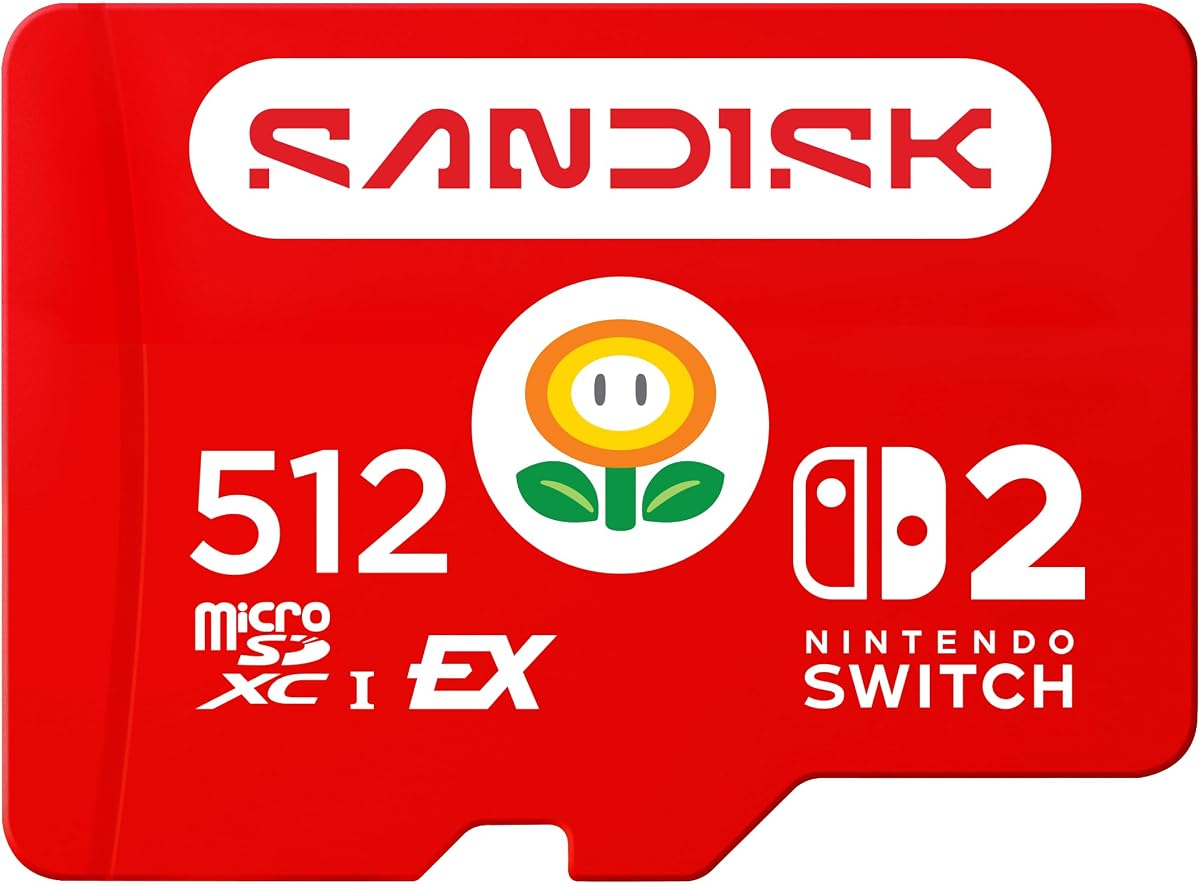
The SanDisk 512GB microSD Express card aimed at Nintendo Switch 2 is the performance-forward choice when your handheld has moved into the Express era. Where original Switch cards top out around the 100MB/s UHS-I neighborhood, this model advertises up to 880MB/s read and 650MB/s write, with a sustained write figure around 220MB/s. Those numbers matter for large game installs, quicker archive moves, and keeping pace with a console that expects Express media rather than treating every microSD as equal.

  • 512GB microSD Express for Switch 2
  • Up to 880MB/s read, 650MB/s write
  • ThermAdapt thermal management; PCIe-NVMe class
Check Price →
✓ Pros
  • Built for Nintendo Switch 2 with microSD Express performance
  • Up to 880MB/s read and 650MB/s write for fast transfers and installs
  • 220MB/s sustained write rating supports heavier continuous writes
  • ThermAdapt design helps manage heat during long sessions
  • Falls back to UHS-I speeds in older microSD hosts when needed
✕ Cons
  • Overkill if you only own original Switch / OLED / Lite
  • Express ecosystem readers and adapters matter for PC offloads
  • Higher cost tier than classic licensed UHS-I Switch cards

Detailed review

SanDisk also leans on forward compatibility messaging: the card uses a PCIe-NVMe style interface for Express hosts while still performing at UHS-I speeds with older microSD UHS-I and UHS-II devices. That dual-path design is helpful if you swap the card into a laptop reader that is not Express-native—you still get usable transfers, just not the headline Express rates. For Switch 2 owners, the headline rates are the reason to buy; for mixed households, the fallback behavior reduces the chance the card becomes a one-device brick.

Durability claims cover the usual SanDisk rugged checklist—waterproof, temperature-proof, humidity-proof, drop-proof, shock-proof, magnetic-proof, X-ray-proof, and wear-out proof under stated conditions. Pair that with ThermAdapt thermal management, which uses enclosure and controller design to help keep devices from overheating during demanding transfers. Handheld consoles already run warm in handheld mode; a card that actively manages heat is a meaningful detail for long download nights.

Five hundred twelve gigabytes is a realistic “install a big library” capacity for Switch 2 digital collectors. First-party releases, multiplayer downloads, and capture clips add up faster than people expect. This size lets you keep several large titles resident without constant uninstalls, which is exactly when Express speed pays off—you are moving bigger packages more often.

Honest caveats: if you only own original Switch hardware, this Express card is the wrong spend—buy a licensed UHS-I Switch card instead. Peak transfer claims also assume a capable host and, for desktop offloads, a proper Express-capable reader. Marketing comparisons such as transferring a two-hour HD movie in seconds refer to ideal SanDisk reader pairings, not every cheap USB dongle in a desk drawer.

If Switch 2 is your daily driver and you want SanDisk’s Express stack with a half-terabyte footprint, this card belongs on your shortlist alongside the officially Switch 2–branded SanDisk Express SKU later in the roundup. Compare listing firmware notes and packaging variants, then pick the one that matches your console generation and capacity plan.

When Express speed is worth it

Buy Express when your console is Switch 2, you install digital games frequently, and you care about faster transfers between console, reader, and archive drives. The gap versus UHS-I becomes obvious the first time you move a multi-gigabyte title or dump a weekend of captures.

If your play pattern is a few physical carts and one digital freebie, a smaller classic card on original hardware—or a modest Express capacity—will feel more proportional to how you actually use storage.

Thermal and durability notes

ThermAdapt is not magic air conditioning, but dynamic thermal management helps during long writes. Still give the console airflow in docked mode, avoid soft cases that trap heat during huge downloads, and do not yank the card mid-write.

Rugged ratings assume stated test conditions. Treat the card as durable travel media, not as something to leave in a jeans pocket through the wash every month.

Check Price on Amazon →

We may earn a commission at no additional cost to you.

3. SanDisk 128GB microSDXC-Card - Best Compact Starter Card

SanDisk 128GB microSDXC-Card

SanDisk 128GB microSDXC-Card

9.6/10★★★★★

The SanDisk 128GB licensed microSDXC card is the right-sized entry point for original Nintendo Switch systems when you want official compatibility without buying more capacity than you will use this year. It shares the licensed family’s up-to-100MB/s read and up-to-90MB/s write claims, so you are not stepping down in speed class—only in how many full-size digital titles you can park at once.

  • 128GB licensed for Switch / OLED / Lite
  • Up to 100MB/s read, 90MB/s write
  • Not designed for Nintendo Switch 2
Check Price →
✓ Pros
  • Official Switch licensing in a smaller, approachable capacity
  • Same 100/90MB/s class performance as larger licensed siblings
  • Ideal for light digital libraries and secondary handhelds
  • Easy recommendation for first-time microSD buyers
  • Lower commitment if you are unsure how many digital titles you will keep
✕ Cons
  • Fills quickly with modern first-party download sizes
  • Not designed for Switch 2 Express workflows
  • Power users will outgrow 128GB and need another card soon

Detailed review

Who thrives at 128GB? Players who keep a tight rotation: a couple of big games, a handful of indie titles, and room for screenshots. It is also a smart card for a household’s second console—maybe a Lite that travels to school or a spare OLED in the living room—where the primary library lives elsewhere. Parents buying for younger players often prefer this capacity because it encourages a curated library instead of an endless download pile.

Installation and daily habits match the rest of the licensed lineup. Format on the console, set downloads to the card, and periodically archive captures if your kids love screenshot spam. Because the card is explicitly not designed for Switch 2, keep it associated with original hardware in your mental inventory so you do not accidentally expect Express behavior after a console upgrade.

Compared with the 256GB and 512GB licensed SanDisk options, the main decision is growth rate. If you already know you buy every Nintendo Direct digital sale, skip straight to 256GB or 512GB. If you are testing the waters after years of physical carts, 128GB avoids unused headroom while still transforming a nearly full system NAND into a comfortable play space.

Performance will feel familiar to anyone who has used a quality UHS-I gaming card on Switch: installs complete without drama, load times track the console more than the card brand, and reliability is the quiet feature you notice only when cheaper media misbehaves. That is the SanDisk licensed value proposition in a nutshell.

Bottom line: pick the 128GB licensed card as a deliberate starter or secondary-console solution for Switch, OLED, or Lite. Upgrade later within the same family if your library expands, or move to Express storage when your household’s main system becomes Switch 2.

Best uses for 128GB

Great for travel Lites, kids’ profiles with a shortlist of favorites, and adults who still prefer physical carts but want a few digital exclusives installed. Also useful as a capture-focused card if you offload screenshots often.

Not ideal as the forever card for digital-first collectors who own Breath of the Wild-scale downloads alongside multiplayer titles and DLC packs.

Upgrade path inside this roundup

Stay on original Switch? Step to the 256GB or 512GB licensed SanDisk models when uninstall churn becomes annoying. Moving to Switch 2? Budget for a microSD Express card rather than expecting this UHS-I licensed card to be the long-term answer.

Check Price on Amazon →

We may earn a commission at no additional cost to you.

4. SanDisk 512GB microSDXC-Card - Best Max Library for Original

SanDisk 512GB microSDXC-Card

SanDisk 512GB microSDXC-Card

9.6/10★★★★★

If your original Nintendo Switch or Switch Lite is basically a digital library with a screen, the SanDisk 512GB licensed microSDXC card is the high-capacity answer inside the classic Switch accessory line. It keeps the official licensing message and the familiar up-to-100MB/s read / 90MB/s write performance while giving you room for an enormous installed set—first-party flagships, years of eShop picks, and the screenshot folders that somehow grow overnight.

  • 512GB licensed for Switch and Switch Lite
  • Up to 100MB/s read, 90MB/s write
  • Not designed for Nintendo Switch 2
Check Price →
✓ Pros
  • Half-terabyte headroom for huge original-Switch digital libraries
  • Official licensing for Switch and Switch Lite systems
  • Same proven 100/90MB/s licensed performance class
  • Excellent for households that share one console and many accounts
  • Reduces constant uninstall juggling across sales seasons
✕ Cons
  • More capacity than casual players need
  • Still UHS-I—not a Switch 2 Express solution
  • Larger cards make backup discipline more important

Detailed review

Households with multiple profiles benefit most. When each person wants their own multiplayer titles plus a few single-player campaigns, 128GB evaporates and even 256GB starts to feel tight. Five hundred twelve gigabytes lets the console stay a shared living-room device without weekly “who can delete what” negotiations. That social convenience is as valuable as any speed chart.

Technically, you should still set expectations correctly. This is not an Express card and the listing states it is not designed for Switch 2. On Switch and Lite, though, the limiting factor remains console architecture; what the 512GB card changes is how often you manage storage, not how the GPU renders Hyrule. Buy it for capacity and brand trust, not for a mythical load-time miracle beyond what quality UHS-I already delivers.

Operational tips scale with capacity. A half-terabyte card holding years of purchases becomes painful to lose. Keep Nintendo account cloud saves enabled where available, periodically copy captures to a computer, and label the card physically if your family owns more than one microSD. Format only when you mean to wipe—accidently reformatting a filled 512GB card is a long night.

Versus Express 512GB options in this pack, choose this licensed UHS-I model when your hardware is still original Switch or Lite and you want Nintendo-licensed messaging without paying for Switch 2–oriented silicon. Versus the 256GB licensed sibling, choose 512GB when uninstall fatigue is already a weekly ritual.

For digital-heavy original Switch libraries in 2026, this remains one of the cleanest “fill it and forget the storage menu” purchases you can make—so long as you accept it as a last-gen capacity king rather than a next-gen Express ticket.

Who needs 512GB on original Switch

Digital collectors, sale hunters, and shared-family consoles. Also creators who keep long capture folders for thumbnail art or school projects. If you can recite which games you deleted last month, you are in the target audience.

Casual cart players can save money and complexity with 128GB or 256GB instead.

Backup habits for large cards

Schedule a monthly offload of screenshots and video captures. Maintain a simple folder structure on a computer or external drive. Never rely on a single microSD as the only copy of irreplaceable clips from a trip or tournament.

Check Price on Amazon →

We may earn a commission at no additional cost to you.

5. SanDisk 64GB microSDXC-Card Licensed for Nintendo-Switch - Best Fun Gift

SanDisk 64GB microSDXC-Card Licensed for Nintendo-Switch

SanDisk 64GB microSDXC-Card Licensed for Nintendo-Switch

9.4/10★★★★★

The SanDisk 64GB Yoshi Edition microSDXC card is the personality pick in this roundup: officially licensed for Nintendo Switch systems, wearing Yoshi-themed packaging that actually looks like a gift, yet still quoting the same practical up-to-100MB/s read and up-to-90MB/s write performance class as the plainer licensed siblings. If you are shopping for a birthday, holiday, or “first handheld” moment, presentation matters—and this card delivers that without turning into a toy that ignores specs.

  • 64GB Yoshi Edition licensed for Switch
  • Up to 100MB/s read, 90MB/s write
  • Not designed for Nintendo Switch 2
Check Price →
✓ Pros
  • Officially licensed Yoshi Edition styling makes a memorable gift
  • Same speed class as other SanDisk Switch-licensed cards
  • Perfect capacity for a small curated kids’ library
  • Clear compatibility notes for Switch family (not Switch 2)
  • Fun collectible angle without abandoning real performance specs
✕ Cons
  • 64GB fills quickly with modern download sizes
  • Collectible editions can be harder to find in stock
  • Not suitable as a Switch 2 Express upgrade path

Detailed review

Sixty-four gigabytes is intentionally modest. That is a feature for many gift scenarios. A child with a Switch Lite does not need a terabyte of impulse downloads on day one; they need Mario Kart, a couple of favorites, and room to grow. Parents can keep spending intentional, and the card still transforms a nearly full system into something playable. Enthusiasts who already own large libraries should treat Yoshi Edition as a collectible secondary card, not their primary archive.

Compatibility messaging matches the rest of the licensed line: built for Nintendo Switch systems, not designed for Switch 2. That clarity helps gift-givers avoid the awkward return when someone assumed every Nintendo-branded microSD automatically unlocks the newest console’s Express slot behavior. Put Yoshi Edition in an original Switch, OLED, or Lite and you are aligned with the product intent.

From a performance standpoint, expect familiar SanDisk licensed behavior—snappy enough installs for this generation, reliable day-to-day reads, and none of the Express thermal or PCIe story that Switch 2 cards advertise. The differentiator is delight plus trust: a character edition that still comes from the brand most associated with official Switch storage.

Stock and pricing of character editions can swing with seasons, so if Yoshi is the emotional hook for your recipient, grab it when available rather than waiting for a perfect capacity match. You can always add a larger plain licensed card later when the library outgrows 64GB; the Yoshi card can remain the “travel favorites” card.

Buy this when the unboxing moment matters as much as the gigabytes. Skip it when you need maximum library space or Switch 2 Express performance—those jobs belong to other cards in this guide.

Gifting checklist

Confirm the recipient owns Switch, OLED, or Lite—not only Switch 2. Include a quick note that the console should be powered off before inserting the card. Consider bundling a microfiber cloth or carry pouch if the gift is for a travel Lite.

If the recipient already has a large digital library, pair Yoshi Edition with a promise to help migrate favorites rather than expecting 64GB to hold everything.

After the library grows

Promote the Yoshi card to a portable “weekend favorites” role and move the main archive to a 256GB or 512GB licensed SanDisk. Keep character editions as the fun card kids remember opening.

Check Price on Amazon →

We may earn a commission at no additional cost to you.

6. SUNEAST microSD Express Memory Card 1TB - Best 1TB Express

SUNEAST microSD Express Memory Card 1TB | Up to 900MB/s Read 620MB/s Write

SUNEAST microSD Express Memory Card 1TB | Up to 900MB/s Read 620MB/s Write

9/10★★★★★

SUNEAST’s 1TB microSD Express card is the high-capacity Express path for players who want Switch 2 storage measured in “install everything” rather than “rotate carefully.” Advertised speeds climb as high as 900MB/s read and 620MB/s write, with Class 10, U3, V30, and A-class ratings called out for gaming and high-resolution capture. The listing also notes testing with Switch 2 and broader compatibility with laptops, tablets, cameras, and Android devices that support microSD Express or fall back to UHS-I.

  • 1TB microSD Express, Switch 2 tested
  • Up to 900MB/s read, 620MB/s write
  • U3 / V30 / A-class ratings; rugged build
Check Price →
✓ Pros
  • Massive 1TB capacity for Switch 2 digital collectors
  • Very high advertised Express read/write speeds
  • Positioned for gaming plus 4K capture workflows
  • Rugged environmental resistance claims for travel use
  • Multiple capacity tiers exist if 1TB is more than you need
✕ Cons
  • Brand familiarity trails SanDisk for some Nintendo buyers
  • Requires Express-capable host to realize peak speeds
  • Huge capacity increases the pain of a lost or failed card

Detailed review

One terabyte changes ownership habits. Instead of deleting last month’s sale games to make room for the next Nintendo Direct wave, you can keep seasonal titles resident and still have space for screenshots and 4K-oriented clips where your devices support them. That convenience is why capacity chasers look past brand comfort zones—especially when SanDisk Express options in a pack top out at 512GB.

Speed claims should be interpreted like all Express marketing: peak numbers need Express hosts and sensible readers. On Switch 2, the point is console-class Express performance rather than desktop synthetic scores. On older UHS-I-only devices, expect the card to behave more like a conventional fast microSD. Buy SUNEAST here for the Switch 2 expansion story first, secondary device flexibility second.

Durability language covers shock, temperature, water, and X-ray resistance—important if the card lives in a backpack with a handheld. Still, a 1TB card is a lot of eggs in one basket. Enable cloud saves, offload irreplaceable captures, and consider whether you want one giant card or two smaller ones for redundancy. Reliability math favors backups no matter how rugged the sticker claims are.

Compared with the GIGASTONE 1TB Express card also in this pack, SUNEAST competes on peak speed claims and gaming/4K framing, while GIGASTONE emphasizes designed-for-Switch-2 positioning, adapter inclusion, and a multi-year data recovery angle. Read both listings carefully for warranty terms and current firmware notes before you commit.

Choose SUNEAST 1TB when your Switch 2 library is already bursting and you want Express performance with maximum headroom. Choose a SanDisk 512GB Express card instead if you prefer the most familiar Nintendo-adjacent brand at a still-generous capacity.

Is 1TB excessive?

Not for digital-first Switch 2 households, emulation-adjacent PC handheld users who also swap cards, or anyone archiving lots of video. It can be excessive for a single player with ten installed games—those buyers are happier at 256GB or 512GB.

If you are capacity-curious but cautious, check whether SUNEAST’s 256GB or 512GB Express tiers meet your near-term needs and leave 1TB for the moment your uninstall list becomes a second job.

Cross-device notes

The card’s broader device compatibility is handy for creators who also shoot on action cameras or edit on tablets, but always format with the primary host’s recommended process. A card formatted for one ecosystem’s quirks can confuse another until you reformat—with data loss—so plan a single primary workflow.

Check Price on Amazon →

We may earn a commission at no additional cost to you.

7. 128GB Gaming MicroSDXC TF Memory Card - Best Budget Multi-Device

128GB Gaming MicroSDXC TF Memory Card with Adapter 1 Pack | 100MB/s Read 50MB/s

128GB Gaming MicroSDXC TF Memory Card with Adapter 1 Pack | 100MB/s Read 50MB/s

8.8/10★★★★☆

The 128GB TeknoStone gaming microSDXC card is the multi-device value play in this pack. It targets Nintendo Switch (explicitly not Switch 2), Steam Deck, ROG Ally, Android phones, tablets, and even retro emulation setups, with up to 100MB/s read and 50MB/s write over UHS-I. An included full-size SD adapter makes desktop offloads and older card readers less annoying—something bare microSD retail packs sometimes omit.

  • 128GB UHS-I gaming microSD with adapter
  • Up to 100MB/s read, 50MB/s write
  • For Switch (not 2), Steam Deck, ROG Ally, phones
Check Price →
✓ Pros
  • Tuned for handheld gaming devices beyond Switch alone
  • Includes full-size SD adapter for laptops and readers
  • U3 / V30 / A1 class markings for apps and HD/4K capture claims
  • Rugged build notes for travel and frequent swaps
  • Practical budget-oriented option for multi-handheld households
✕ Cons
  • Write speed ceiling lower than SanDisk’s licensed 90MB/s class
  • Not for Nintendo Switch 2
  • Less “official Nintendo” messaging than SanDisk licensed cards

Detailed review

A1 performance rating is the useful detail for handhelds and phones that launch apps from the card. On Switch, you still care most about consistent reads during game load and reliable writes during downloads; on Deck or Ally, A1-style responsiveness can matter when you store Proton prefixes, shaders, or side libraries on microSD. This card’s pitch is that one piece of media can float between those worlds more gracefully than a Switch-only licensed SKU.

Video claims cover stable 4K UHD and 1080p capture and playback for gameplay footage. That matters if you use the card in a phone or camera-adjacent device as well as a console. Durability language—waterproof, shockproof, temperature-resistant, X-ray safe—fits backpack life where cards are swapped often between a Switch Lite and a Steam Deck.

Tradeoffs versus SanDisk’s licensed 128GB Switch card are mostly about ecosystem trust and write speed. SanDisk quotes higher write ceiling (up to 90MB/s) and official Nintendo licensing; TeknoStone quotes a lower write figure but broader handheld positioning plus an adapter. If your only device is a Switch and you want the official accessory story, SanDisk wins. If you share storage across PC handhelds and a Switch, TeknoStone’s framing is more honest about that lifestyle.

Capacity guidance mirrors other 128GB options: great for a curated set, tight for a maximalist digital Switch library. Actual usable space will be lower than the label due to decimal vs binary reporting—normal, as the listing itself explains.

Pick this card when budget and multi-device flexibility matter more than Nintendo-licensed packaging. Skip it for Switch 2 Express needs or for buyers who specifically want SanDisk’s official Switch accessory line.

Switch vs PC handheld use

On Switch, format in-console and treat it like any UHS-I expansion card. On Steam Deck or ROG Ally, follow that device’s SD formatting guidance and do not assume a Switch-formatted filesystem is ideal for desktop Linux libraries without planning.

Avoid constantly reformatting as you hop devices; pick a primary host or keep separate cards if your ecosystems fight over formats.

Adapter practicality

The full-size SD adapter is genuinely useful for living-room PCs and older laptops. Store it in a small case so it does not become e-waste in a week. Do not force microSD into bent adapter slots—that is how pins die.

Check Price on Amazon →

We may earn a commission at no additional cost to you.

8. SANDISK 512GB microSD Express Card for - Speeds up to

SANDISK 512GB microSD Express Card for Nintendo Switch 2 - Speeds up to 880 MB/s

SANDISK 512GB microSD Express Card for Nintendo Switch 2 - Speeds up to 880 MB/s

9.8/10★★★★★

SanDisk’s 512GB microSD Express card officially licensed for Nintendo Switch 2 is the clearest “buy this for the new console” recommendation in the pack. It combines Express-class performance—read speeds up to 880MB/s and write speeds up to 650MB/s—with Nintendo licensing language aimed squarely at Switch 2 owners who want storage that matches the platform’s expectations. If you are tired of decoding which microSD variants are merely “compatible enough,” this SKU’s official positioning removes most of that ambiguity.

  • Officially licensed for Nintendo Switch 2
  • Up to 880MB/s read, 650MB/s write
  • 512GB for digital games, screenshots, Full HD clips
Check Price →
✓ Pros
  • Officially licensed microSD Express storage for Switch 2
  • Up to 880MB/s read and 650MB/s write for fast game loading workflows
  • 512GB capacity fits a large next-gen digital library
  • Full HD screenshot and short clip capture support messaging
  • Highest rating in this pack for buyer confidence signals
✕ Cons
  • Not the right card if you only own original Switch hardware
  • 1TB Express rivals offer more raw capacity
  • Express readers still recommended for fastest PC offloads

Detailed review

Capacity at 512GB hits the same practical sweet spot the 256GB card hit for original Switch, but scaled to larger modern downloads. You can keep a broad digital shelf resident, capture Full HD screenshots and short gameplay clips, and still have breathing room for DLC and multiplayer updates. Collectors who refuse to uninstall anything may still prefer a 1TB Express alternative, but for many Switch 2 owners 512GB is the thoughtful default.

Marketing around “epic worlds loaded instantly” should be read as performance messaging relative to slower cards, not as a promise that every game loads in a blink regardless of software. Console load times always involve CPU, GPU, game design, and storage together. What Express changes is the storage ceiling: you are less likely to be bottlenecked by an outdated UHS-I card in a system designed around faster media.

This card sits next to the other SanDisk 512GB Express listing in the pack. Treat them as closely related Express options and compare the exact model codes, packaging, and licensing callouts on the live Amazon page before purchasing. The important shared traits are Switch 2 readiness, 512GB class capacity, and SanDisk’s high-speed Express claims; the important shopping habit is verifying you are ordering the Express Switch 2 product rather than a classic licensed UHS-I Switch card with a similar thumbnail.

Setup remains familiar: power down, insert, format when the system asks, and prefer console-native formatting for best results. For creative capture, remember that screenshots and short clips still benefit from periodic offloads—Express speed makes those offloads less painful when you use a proper reader.

If Switch 2 is your main console and you want the most straightforward official-style SanDisk Express 512GB answer, start here. If you need double the capacity, look at GIGASTONE or SUNEAST 1TB Express. If you are still on original Switch, buy a licensed UHS-I card instead and save Express for the upgrade.

Why official licensing still matters

Licensing does not rewrite physics, but it reduces compatibility anxiety and usually signals validation against Nintendo’s storage requirements for that generation. For gift buyers and less technical households, that confidence is worth as much as a few extra benchmark points.

Always double-check the listing line that says Switch 2 versus the older “licensed for Nintendo Switch” UHS-I line—the names look similar in a hurry.

How it compares to 1TB Express rivals

SanDisk 512GB wins on brand familiarity and official Switch 2 licensing clarity. SUNEAST and GIGASTONE 1TB win when your uninstall list is already a lifestyle. Neither capacity tier replaces good save backup hygiene.

Capture and library tips

Use the speed for more than games: offload clip folders weekly during long adventure titles so your card does not quietly fill with duplicate screenshots. Keep a simple naming scheme on your computer so tournament or trip clips stay findable.

Check Price on Amazon →

We may earn a commission at no additional cost to you.

9. SANDISK 256GB Ultra microSDXC UHS-I Memory - Up to 150MB/s

SANDISK 256GB Ultra microSDXC UHS-I Memory Card with Adapter - Up to 150MB/s

SANDISK 256GB Ultra microSDXC UHS-I Memory Card with Adapter - Up to 150MB/s

9.4/10★★★★★

The SanDisk 256GB Ultra microSDXC card is the generalist in a Switch-focused roundup. It is listed as compatible with Nintendo Switch (not Switch 2), yet its broader identity is the Ultra line for phones, tablets, Chromebooks, and Windows laptops—with up to 150MB/s read speeds, A1 app performance, an adapter in the box, and a 10-year limited warranty message. If your microSD will not live exclusively in a docked Switch, Ultra’s versatility is the appeal.

  • 256GB Ultra UHS-I with adapter
  • Up to 150MB/s read; A1 app performance
  • Works with Switch (not Switch 2); 10-year limited warranty
Check Price →
✓ Pros
  • Up to 150MB/s read speeds with included adapter convenience
  • A1 rating helps app-style workloads on phones and tablets
  • Compatible with original Nintendo Switch family per listing
  • Strong general-purpose SanDisk Ultra ecosystem and warranty story
  • Handy if the card will split time between console and mobile devices
✕ Cons
  • Not a Nintendo-licensed Switch accessory SKU
  • Not designed for Nintendo Switch 2
  • U1 class marking is more mainstream than U3 gaming-focused cards

Detailed review

For original Switch owners, 256GB again lands in the sweet-spot capacity band. You get room for a healthy digital library and captures, plus faster reads than many older Ultra generations. Just remember this is not the officially licensed Nintendo-packaged SDSQXAO line; some buyers prefer the licensed cards for peace of mind even when a standard Ultra works fine in practice. Both approaches are rational—licensed for console-first households, Ultra for multi-device households.

A1 performance and Memory Zone app ecosystem mentions skew toward phone users who move photos and apps through SanDisk’s software. That does not hurt Switch use; it simply signals where Ultra spends most of its marketing energy. Full HD video recording headroom is part of the same mainstream creator story.

Versus the licensed 256GB Switch card, choose Ultra when you value the adapter, higher read claim, warranty framing, and phone/tablet crossover. Choose the licensed card when you want Nintendo accessory packaging and Switch-specific messaging without caring about phone features. Versus Express Switch 2 cards, Ultra is the wrong generation entirely if your console is Switch 2.

Practical setup mirrors other UHS-I cards: power off the Switch, insert, format on-console, and keep backups of anything you would be sad to lose. The adapter makes it easier to dump captures to a living-room PC without hunting for a microSD-only reader.

Ultra 256GB is a sensible everyday card for mixed-device people who still game on original Switch hardware. It is not the romantic official accessory, and it is not next-gen Express—but as a flexible 256GB workhorse with SanDisk’s mainstream support story, it earns its place in the comparison.

Licensed Switch card or Ultra?

Pick licensed SanDisk Switch cards when the console is the only host that matters and you want the packaging story. Pick Ultra when the same card might spend weekdays in a phone and weekends in a Switch Lite.

Neither replaces an Express card for Switch 2.

Warranty and software extras

Register the product and keep your receipt. Memory Zone can help phone-side organization; for Switch captures, a simple computer folder still wins for long-term archives.

Check Price on Amazon →

We may earn a commission at no additional cost to you.

10. 【Designed for Switch 2】 GIGASTONE 1TB - Best High-Capacity Switch

【Designed for Switch 2】 GIGASTONE 1TB microSD Express R/W 800/650MB/s SDXC Memor

【Designed for Switch 2】 GIGASTONE 1TB microSD Express R/W 800/650MB/s SDXC Memor

9.6/10★★★★★

GIGASTONE’s 1TB microSD Express card, designed for Switch 2, is the capacity crowning pick when you want next-gen speeds and a library that basically does not end. Rated up to 800MB/s read and 650MB/s write, it targets ultra-fast gaming response on Express-capable consoles while still speaking the broader SD 7.1 / UHS compatibility language for devices that can use those modes. An included microSD-to-SD adapter helps when you offload to cameras, docks, or laptops that prefer full-size SD slots.

  • 1TB microSD Express designed for Switch 2
  • Up to 800MB/s read, 650MB/s write
  • SD adapter included; 5-year limited warranty / data recovery angle
Check Price →
✓ Pros
  • 1TB Express capacity for huge Switch 2 libraries
  • Up to 800/650MB/s read/write for responsive gaming storage
  • Includes microSD-to-SD adapter for broader offload options
  • SD 7.1 positioning and multi-standard compatibility claims
  • 5-year limited warranty with data recovery messaging
✕ Cons
  • Less universally recognized than SanDisk in Nintendo circles
  • 1TB is unnecessary for light digital libraries
  • Peak speeds still depend on Express-capable hosts and readers

Detailed review

One terabyte on Switch 2 is the “stop managing storage” purchase. Large modern titles, day-one patches, multiplayer components, and capture folders can coexist without weekly triage. That lifestyle upgrade is the real product—not a synthetic benchmark chart. If you already feel storage anxiety on a 256GB or 512GB card, 1TB Express is the logical jump.

Warranty and recovery messaging stands out: a 5-year limited warranty plus data recovery positioning gives risk-averse buyers something concrete beyond speed. No warranty replaces backups, but longer coverage and recovery options can matter when a card holds a year of tournament clips or family screenshots from a vacation console.

Versus SUNEAST’s 1TB Express card, GIGASTONE leans harder into designed-for-Switch-2 framing, adapter inclusion, and the warranty/recovery story, while SUNEAST advertises slightly higher peak read figures and a broad gaming/4K device pitch. Versus SanDisk’s 512GB Express cards, GIGASTONE wins on capacity; SanDisk wins on brand gravity and official licensing clarity depending on SKU.

As always with Express media, match the card to Switch 2 (or other Express hosts) to see the performance you paid for. On older UHS-only devices you may get usable fallback speeds, but that is not why you buy a 1TB Express card. Format with the primary console’s tools, keep the adapter in a case, and treat the card as critical media worth backing up.

Choose GIGASTONE 1TB when Switch 2 is home and you want maximum installed library freedom with strong write-speed claims and longer warranty confidence. Choose SanDisk 512GB Express when you prefer official licensing and a still-ample but smaller footprint.

Who should spend on 1TB Express

Digital collectors, households sharing one Switch 2 across many accounts, and players who keep capture libraries for content or memories. Also anyone migrating from a constantly full original Switch card and refusing to repeat that cycle.

Light players with a handful of favorites can enjoy Express benefits at 512GB and put the savings toward games.

Adapter and offload workflow

Use the included adapter with a quality USB reader for faster desktop transfers when your computer lacks a built-in SD slot. Eject safely every time—Express speeds do not protect you from yanking a card during a write.

Consider a second cheaper UHS-I card as a capture shuttle if you prefer not to pull the main 1TB library card from the console often.

Versus SanDisk Express 512GB

If official SanDisk Switch 2 licensing is your non-negotiable filter, stay with SanDisk and accept 512GB. If capacity is the bottleneck you feel every week, GIGASTONE’s 1TB Express design is the more direct fix.

Check Price on Amazon →

We may earn a commission at no additional cost to you.

Best microSD Cards for Nintendo Switch in 2026

How to Choose a microSD Card for Nintendo Switch

Match the card to your console generation

Original Nintendo Switch, Switch OLED, and Switch Lite are happiest with high-quality UHS-I microSDXC cards. The officially licensed SanDisk Switch line in this roundup exists specifically for that family and clearly states it is not designed for Switch 2. Nintendo Switch 2, by contrast, is where microSD Express belongs if you want the storage performance the newer platform is built around.

If your household still shares an OLED in the living room and a Switch 2 in a backpack, plan on two cards—or accept that a classic card in Switch 2 will not deliver the Express experience you see in marketing for next-gen media. Generation mismatch is the most expensive confusion in this category.

Pick capacity for how you actually buy games

Sixty-four gigabytes suits gifts and tiny curated libraries. One hundred twenty-eight gigabytes works for light digital players and secondary handhelds. Two hundred fifty-six gigabytes is the modern sweet spot for original Switch owners who buy sales regularly. Five hundred twelve gigabytes fits shared households and collectors who hate uninstalling. One terabyte Express cards are for Switch 2 digital maximalists who want the storage menu to disappear.

Always remember labeled capacity uses decimal math; after formatting you will see less free space. That gap is normal and not a defective card.

Read speed claims with the right host in mind

UHS-I licensed Switch cards commonly advertise around 100MB/s read and 90MB/s write. Ultra cards may claim higher reads with A1 app ratings for phones. Express cards jump into hundreds of megabytes per second—SanDisk quotes up to 880MB/s read and 650MB/s write on Switch 2–oriented models, while SUNEAST and GIGASTONE advertise similarly ambitious Express figures.

Those peaks need Express-capable hosts and sensible readers. A cheap USB 2.0 dongle will not prove an Express card’s worth. Inside the console, software and hardware together determine load times; storage removes a bottleneck rather than rewriting game engines.

Licensing, brand trust, and warranty extras

Official Nintendo licensing on SanDisk Switch and Switch 2 cards is a clarity tool for gift buyers and less technical shoppers. Non-licensed but Switch-compatible cards like SanDisk Ultra or multi-device gaming microSDs can still work well when the listing explicitly supports your console generation.

Look at warranty length and any data-recovery messaging—GIGASTONE’s multi-year angle is an example—but still keep cloud saves on and offload irreplaceable captures. Warranty is a safety net, not a backup strategy.

Durability and travel realities

Waterproof, shockproof, and X-ray-resistant claims are common across SanDisk, SUNEAST, GIGASTONE, and gaming-branded cards. They help for backpack life, not for ignoring basic care. Power the console down before swaps, keep grit out of the slot, and store spare adapters so they do not crack in a luggage pocket.

Heat matters more on Express and on long download sessions. Give docked systems airflow and avoid smothering a handheld in a soft case while it writes tens of gigabytes.

Frequently Asked Questions

01

Can I use a regular microSD card in Nintendo Switch 2?

Switch 2 is designed around microSD Express for the performance Nintendo expects from expansion media. Some older-style cards may physically fit or offer limited fallback behavior depending on the card and system policies, but if you want the storage experience Switch 2 marketing describes, buy a microSD Express card such as the SanDisk, SUNEAST, or GIGASTONE Express models in this guide. Do not assume a classic licensed Switch UHS-I card is the same product just because the thumbnail looks similar.

02

Are SanDisk cards licensed for Nintendo Switch safe for OLED and Lite?

Yes—the officially licensed SanDisk microSDXC cards in this roundup call out compatibility with Nintendo Switch systems including OLED and Lite in their product messaging, while also stating they are not designed for Switch 2. That makes them appropriate expansion choices across the original family when you stay within the licensed UHS-I line. Always format the card on the console you will use as the primary host.

03

How much microSD storage do I need for Nintendo Switch games?

It depends on whether you buy digital or physical and how many large titles you keep installed. A light player can live on 64GB or 128GB. Most digital-friendly original Switch owners are happiest around 256GB. Shared households and collectors should look at 512GB. Switch 2 owners who refuse to uninstall may want 1TB Express. Remember that usable space is lower than the advertised number after formatting, which is normal.

04

Do higher MB/s numbers always mean faster game load times?

Not in a simple one-to-one way. Faster cards reduce storage bottlenecks during installs, copies, and some load scenarios, but game design, console hardware, and background downloads also shape what you feel. The jump from a poor low-end card to a quality UHS-I card is often more noticeable than tiny differences between two good UHS-I cards. The jump from UHS-I to Express matters most when your console is built for Express.

05

What is the difference between microSD Express and UHS-I for Switch owners?

UHS-I is the interface generation behind classic Switch-licensed cards with speeds commonly advertised near 100MB/s reads. microSD Express uses a newer interface approach—SanDisk describes PCIe-NVMe class behavior on Express models—with read/write claims that can reach several times higher. Original Switch systems were built around the older ecosystem; Switch 2 is where Express investment makes sense. Buying Express for an OLED you plan to keep for years can be wasteful if you never move to Switch 2.

06

Should I format a new microSD card on a computer or on the Switch?

For console-first use, format on the Nintendo system when prompted. Console formatting applies the filesystem and allocation choices the handheld expects. Computer formatting is useful for archival cards or multi-device workflows, but it can create friction if you bounce between incompatible filesystem assumptions. Whatever you choose, formatting erases data—back up first.

07

Is a 1TB card better than two 512GB cards?

One 1TB card is simpler day to day: insert once, stop managing swaps. Two 512GB cards can offer redundancy—if one fails or you lose it, you do not lose everything—and they let you separate a “main library” card from a “captures and experiments” card. For most people, a single well-backed-up card is enough; for archivists and tournament travelers, split media can be smarter risk management.

08

Can I move my microSD card from original Switch to Switch 2?

Physically moving media between generations is a compatibility and performance question, not just a slot question. Classic licensed Switch cards are explicitly not designed for Switch 2, and Express cards are the storage class aimed at the newer console. Even when a transfer path exists for saves via Nintendo accounts and system tools, plan your upgrade as a data migration with cloud saves enabled rather than assuming one card is a universal forever drive across both ecosystems.

09

Why does my 256GB card show less free space after formatting?

Manufacturers advertise capacity using decimal gigabytes (1GB = 1,000,000,000 bytes), while many system interfaces report binary-style units. The console also reserves space for filesystem structures. Listings in this pack even call out that actual user storage is less. Seeing roughly less than the box number is expected, not proof you received a mislabeled card.

10

Which card is best if I only play physical game cartridges?

You still benefit from some microSD space for digital freebies, updates, DLC, screenshots, and the occasional eShop purchase, but you do not need 1TB. A 64GB Yoshi Edition or 128GB licensed SanDisk card is usually enough for cartridge-first players on original Switch hardware. Switch 2 cartridge-first players who want snappy expansion for updates and captures can consider a modest Express capacity rather than jumping straight to 1TB.

Conclusion

The best microSD card for Nintendo Switch in 2026 is the one that matches your console generation and your real library size. Original Switch, OLED, and Lite owners should stay with quality UHS-I options—especially the officially licensed SanDisk 256GB sweet spot, with 128GB for light use and 512GB for collectors. Switch 2 owners should prioritize microSD Express, starting with SanDisk’s officially positioned 512GB Express card and stepping up to GIGASTONE or SUNEAST 1TB models when uninstall fatigue becomes the main complaint.

Across the pack, treat speed claims as host-dependent, treat licensing language as a compatibility compass, and treat backups as non-negotiable once a card holds years of digital purchases and family captures. Format on the console, power down before swaps, and verify the exact model code so you do not order a classic Switch card when you meant Express—or the reverse.

Use the top picks for a fast decision, the comparison table for interface and capacity scanning, and the individual reviews when your household mixes handhelds, gifts, and next-gen upgrades. Storage should disappear into the background of playing; the right card from this list is the one that finally lets the storage warning stop interrupting your next session.