Expert Review & Guide

Best Mice for CAD Work in 2026 Precision Roundup

CAD work punishes ordinary office mice. A long day in SolidWorks, AutoCAD, Fusion 360, Inventor, Rhino, or Revit means thousands of middle-button orbits, precise edge picks, viewport pans, and micro-adjustments that a gaming shell or a flat three-button plastic puck was never designed to support. The middle button on a typical scroll wheel requires a downward crush that fatigues the index finger; cursors jump when the sensor hits a glossy desk; and a cramped travel mouse leaves your wrist twisted for eight-hour modeling sessions. In 2026 the smarter buy is a pointer built around CAD habits: a dedicated middle button, a hand-friendly shell, trackball stillness for tiny desks, or a six-degrees-of-freedom companion that actually navigates 3D space.

This guide ranks ten products from our pack only—no invented ASINs, no dollar prices, and no filler gadgets. At the top sit purpose-built 3Dconnexion CadMouse options that treat the middle button as a first-class CAD control, plus the SpaceMouse Pro Wireless for true 6DoF view navigation. We also cover ELECOM’s no-wheel CAD mouse, thumb and handheld trackballs that keep your arm still while you refine sketches, a vertical wireless shell with a knob that speeds zoom and scroll in design apps, a high-CPI SteelSeries sensor for pixel-level picks, and a simple Logitech wireless mouse for light 2D drafting on a secondary machine. Badges and rankings reflect CAD fit, not generic popularity scores alone.

Start with the three top picks if you want a clear default for wireless CadMouse comfort, a wired CadMouse Pro for rock-solid desk sessions, or a SpaceMouse companion that changes how you orbit models. Use the comparison table to scan button philosophy, connectivity, and tracking style. Then read every full review for who should buy, who should skip, and how each device behaves after a week of sketch constraints, assembly mates, and drawing view creation.

Top CAD Mouse Picks for Precision Work

Best Overall CadMouse

3Dconnexion CadMouse Compact Wireless

★★★★☆8.8/10
3Dconnexion CadMouse Compact Wireless
  • Compact wireless CadMouse shaped for a natural hand posture during long modeling sessions
  • Seven buttons including CAD-friendly controls without forcing a hard scroll-wheel click for every orbit
  • Bluetooth wireless connectivity with optical tracking tuned for smooth, dependable cursor motion
Check Price →
Best 6DoF Companion

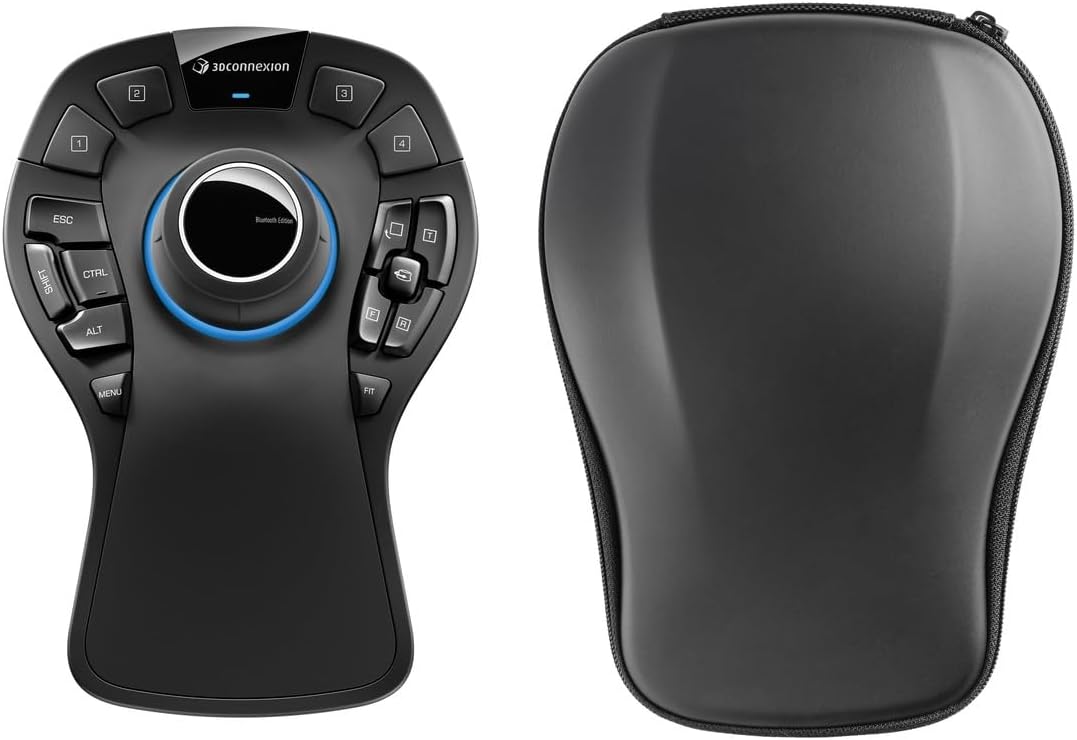
3Dconnexion SpaceMouse Pro Wireless BT

★★★★☆8.8/10
3Dconnexion SpaceMouse Pro Wireless BT
  • Six-degrees-of-freedom sensor that lets you pan, zoom, and rotate models with one hand
  • Rechargeable 1100 mAh battery with wireless and USB-C connectivity for clean desk setups
  • Bluetooth Low Energy pairing that pairs naturally with a CadMouse on the other hand
Check Price →

As an Amazon Associate we earn from qualifying purchases. We may earn a commission at no additional cost to you.

CAD Mouse Comparison: Buttons, Tracking, and Desk Fit

Line up every product in the pack by the three traits that matter most at a CAD workstation: how the middle button or navigation system works, how the device tracks or senses motion, and whether you stay wired, go Bluetooth, or use a 2.4 GHz receiver. No prices—check the live Amazon listing for the current deal.

#ProductSpecificationsScore
1
  • Compact wireless CadMouse, 7 buttons
  • Bluetooth wireless, optical tracking
  • Natural hand shape for long CAD hours
8.8
2
  • Wired optical CadMouse, 7 buttons
  • Dedicated CAD middle button, thumb rest
  • Angled shape for reduced hand strain
8.4
3
  • 6DoF navigation companion, not a pointer
  • Wireless, USB-C, Bluetooth Low Energy
  • 1100 mAh rechargeable Li-poly battery
8.8
4
  • Thumb trackball, 4 DPI levels, 6 buttons
  • Bluetooth or USB dongle, 3-device switch
  • Rechargeable; buttons are non-programmable
9.2
5
  • No scroll wheel; dedicated center CAD button
  • 600/1200 DPI blue LED optical tracking
  • Wired USB plug-and-play, ~59" cable
8.8
6
  • Handheld thumb trackball, ambidextrous
  • 10 buttons, 500/1000/1500 DPI, 2.4 GHz
  • ELECOM Mouse Assistant programmable
7.6
7
  • Simple 3-button wireless office mouse
  • 1000 DPI optical, 2.4 GHz nano receiver
  • Long battery life for light CAD or 2D work
9
8
  • TrueMove3 optical sensor, high CPI range
  • OLED display, tactile alerts, RGB lighting
  • Modular design with durable click switches
9
9
  • 57° vertical right-hand shell, quiet clicks
  • LED screen, knob control, 6 DPI levels
  • 2.4G + dual Bluetooth, rechargeable
8.6
10
  • Thumb trackball, red ball, tilt scroll
  • 6 programmable buttons, 750/1500 DPI
  • 2.4 GHz wireless, ruby ball bearings
8.2

1. CadMouse Compact Wireless - Best Overall CadMouse

3Dconnexion CadMouse Compact Wireless

3Dconnexion CadMouse Compact Wireless

8.8/10★★★★☆

The 3Dconnexion CadMouse Compact Wireless earns the overall pick because it solves the single most annoying CAD mouse problem: treating the middle button as an afterthought. In SolidWorks-style orbit workflows, Fusion 360 pan/orbit gestures, and AutoCAD middle-button pans, a dedicated, easy middle click matters more than RGB lighting or a sixteen-thousand CPI gaming sensor. This compact CadMouse is shaped to keep your hand in a more natural posture, which sounds like marketing until you compare it to a flat travel mouse after a four-hour assembly review. The shell is meant to avoid painful, twisted positions so you can keep working through drawing sheets and design reviews without constantly shaking out your wrist.

  • Compact wireless CadMouse with 7 total buttons
  • Bluetooth wireless for a cleaner CAD desk
  • Optical tracking for smooth, precise cursor control
Check Price →
✓ Pros
  • Purpose-built CadMouse layout that respects CAD middle-button habits
  • Compact shell designed to fit the hand naturally for longer sessions
  • Bluetooth wireless reduces cable drag across large desk mats
  • Seven buttons give room for frequent CAD commands without stretching
  • Optical movement detection feels dependable for edge picks and sketch work
✕ Cons
  • Bluetooth pairing can be fussier on locked-down office PCs than a wired mouse
  • Compact size may feel small for very large hands used to full-size shells
  • Not a 6DoF navigator—pair with a SpaceMouse if you want true model orbit control

Detailed review

Seven total buttons sound like a small number next to a twenty-button MMO mouse, but for CAD the count is about reach and reliability, not collecting macros you will never use. Frequent actions—confirm, cancel, snap toggles, view presets, or application-specific shortcuts—belong on buttons your thumb and ring finger can hit without looking away from the model. The CadMouse Compact Wireless keeps that control language in a compact footprint that fits denser desks, dual-monitor stands with limited mouse real estate, and laptop docking stations where a full CadMouse Pro might feel oversized.

Bluetooth wireless is the practical connectivity story here. You reduce cable clutter, avoid snagging a USB cable on keyboard trays, and keep the desk clearer when you share a workstation with a SpaceMouse on the left and a CadMouse on the right. Optical movement detection is what you want for CAD cursor work: smooth, precise, dependable tracking so line endpoints land where you intended. You still need a decent desk surface or mouse pad; no optical mouse is magic on a mirrored glass table, but for typical matte pads and laminate desks the Compact Wireless is built to keep cursing—cursoring—efficient rather than jumpy.

Who should buy this first? Mechanical designers, architects doing heavy 3D review, and engineers who already know they hate scroll-wheel middle clicks. It is also a strong upgrade for remote workers who dock a laptop and want a CAD-native mouse without running another cable across a standing-desk cable tray. If your IT department blocks Bluetooth peripherals, plan for a wired CadMouse Pro instead, or confirm Bluetooth policy before you commit. If you primarily do light 2D drafting and barely touch 3D orbit, a simpler mouse may be enough—but once middle-button navigation becomes muscle memory, going back to a generic wheel click feels like a downgrade.

Setup is straightforward: pair over Bluetooth, confirm the OS recognizes the buttons, and spend a day remapping any side buttons to the commands you actually fire in your CAD suite. Give yourself a short adaptation window if you are coming from a tall gaming mouse; the Compact Wireless prioritizes CAD posture and button access over a palm-filling gaming hump. Keep firmware and 3Dconnexion software in mind if your workflow depends on brand-specific helpers, and test critical apps—especially older enterprise CAD installs—before you retire your old mouse mid-deadline.

Compared with the CadMouse Pro in this same roundup, the Compact Wireless trades a cable for desk freedom and a smaller silhouette. Compared with the ELECOM no-wheel CAD mouse, it offers a more modern wireless CadMouse experience with more buttons. Compared with a high-CPI gaming mouse like the Rival 710, it is less about raw sensor numbers and more about CAD-specific button philosophy. That is the right trade for most professional modelers who live in viewport navigation all day.

Bottom line: if you want one wireless mouse that speaks CAD without forcing you into a SpaceMouse learning curve on day one, start here. Use it as your primary pointer, keep a SpaceMouse as an optional left-hand navigator later, and treat the Compact Wireless as the daily driver for sketches, mates, drawing creation, and long review sessions.

Who should choose the Compact Wireless

Choose this mouse if your dominant pain point is middle-button CAD navigation and you want wireless freedom on a docked laptop or clean dual-monitor desk. It is especially strong for users who already like 3Dconnexion’s CadMouse idea but need a smaller shell than a full Pro. Skip it if your workplace bans Bluetooth or you prefer a always-on wired link with zero battery anxiety.

Desk setup tips for CAD

Pair the Compact Wireless on the right and leave room on the left for a SpaceMouse if you later add 6DoF navigation. Use a large, consistent mouse pad so optical tracking stays predictable when you flick across wide assemblies. Map one side button to a frequently used snap or selection filter so you stop diving into toolbars during detail work.

Versus the CadMouse Pro

Pick Compact Wireless for mobility, cable-free docking stations, and smaller hands or denser desks. Pick the wired CadMouse Pro when you want the angled Pro shell, the incurvated thumb rest, and a connection that never needs charging during a crunch week.

Check Price on Amazon →

We may earn a commission at no additional cost to you.

2. CadMouse Pro - Best Wired CAD Mouse

3DConnexion CadMouse Pro

3DConnexion CadMouse Pro

8.4/10★★★★☆

The CadMouse Pro is the wired specialist for CAD desks that never want wireless drama. Its defining feature is the dedicated middle mouse button: 3Dconnexion designed that third button specifically for CAD users who need reliable access to application functions without crushing a scroll wheel. That design choice is not a minor comfort tweak. In many CAD packages, middle-button orbits and pans are constant muscle memory, and a wheel click that needs too much force becomes the silent cause of index-finger fatigue by Thursday afternoon.

  • Wired optical CadMouse with 7 buttons
  • Dedicated middle button for CAD functions
  • Angled shape with incurvated thumb rest
Check Price →
✓ Pros
  • Middle button purpose-built for CAD instead of a stiff scroll-wheel click
  • Angled posture and thumb rest reduce the flat-mouse twist that fatigues forearms
  • Wired connection means no pairing delays and no mid-meeting battery surprises
  • Seven-button layout supports professional CAD command habits
  • Optical tracking suits precise desktop modeling on a stable pad
✕ Cons
  • Cable management matters on standing desks and cluttered cable trays
  • Bulkier presence than the Compact Wireless for tiny laptop trays
  • Still a 2D pointer—does not replace a SpaceMouse for true 6DoF navigation

Detailed review

Comfort is the second half of the Pro story. The angled shape aims for a more natural hand posture, reducing the muscle and tendon discomfort that shows up with traditional flat mice. The incurvated thumb rest gives the thumb an ergonomically natural place to settle while still reaching side buttons. For engineers who already feel outer-forearm tightness after long drawing reviews, that geometry can matter as much as DPI. You still need good chair height and desk height—no mouse fixes a workstation that forces a shrug—but the Pro is clearly designed around CAD posture rather than esports claw grips.

Wired connectivity is a feature, not a compromise, in this niche. Optical cable mice avoid Bluetooth dropouts on crowded RF floors, skip receiver ports on already-full docking stations, and never interrupt a design review because someone forgot to charge overnight. If your desk is fixed and your machine is a tower under the desk or a docked workstation, the cable becomes invisible after a week of routing it under a mat or through a cable grommet. For hot-desking or frequent laptop undocking, the Compact Wireless is the cleaner sibling.

In day-to-day CAD use, the Pro shines during long sessions of sketch editing, feature tree navigation, and assembly mates where you constantly alternate between left-click selection and middle-button view control. The seven-button layout keeps secondary commands nearby without turning the shell into a programmable brick that needs a weekend to configure. Keep expectations honest: this is still a high-quality CAD mouse, not a SpaceMouse. You will still pan and orbit with familiar mouse metaphors unless you add a 6DoF device on the other hand.

Who should skip it? Anyone who primarily needs a vertical handshake mouse for wrist relief may prefer the Transformers vertical option in this pack. Trackball fans who want a stationary arm should look at Nulea or ELECOM instead. Gamers hunting OLED displays and tactile alerts should look at the Rival 710—and then admit that those features rarely help dimension a drawing. The CadMouse Pro is for people who already know CAD navigation is half their day.

Compared with the ELECOM wired 3D-CAD mouse, the Pro feels like the more fully developed CadMouse experience with a stronger ergonomic narrative and a richer button story. The ELECOM remains attractive when you specifically want the no-scroll-wheel philosophy at a simpler footprint. Compared with the Compact Wireless, the Pro wins on always-ready wired reliability and the Pro shell’s thumb-rest geometry; it loses on cable freedom. That trade is easy to decide once you know whether your desk is permanent.

Recommendation: make the CadMouse Pro your default if you sit at one CAD workstation all day and want the classic 3Dconnexion middle-button experience without worrying about wireless policy or charge cycles. Pair it with a good large pad, route the cable once, and let the dedicated middle button become the most used control on your desk.

Best fit for fixed CAD workstations

This mouse belongs on permanent desks, engineering labs, and office towers where the PC never leaves the room. It is less ideal for consultants who undock daily and want one mouse that travels in a laptop sleeve. If your IT image is locked down, wired plug-and-play behavior is often easier to approve than Bluetooth peripherals.

Middle-button CAD habits

Spend a day noticing how often you middle-click in your main CAD app. If the answer is hundreds of times, a dedicated middle button is not a luxury—it is injury prevention and speed. Map any remaining side buttons to cancel, repeat last command, or a selection filter so your left hand stays on the keyboard for modifiers.

Cable routing that disappears

Run the cable under a desk mat or through a grommet so it never tugs when you make large cursor sweeps across a 4K monitor. A slight service loop near the mouse keeps tension off the connector and preserves the Pro’s low-friction feel during long orbit sessions.

Check Price on Amazon →

We may earn a commission at no additional cost to you.

3. SpaceMouse Pro Wireless BT - Best 6DoF Companion

3Dconnexion SpaceMouse Pro Wireless BT

3Dconnexion SpaceMouse Pro Wireless BT

8.8/10★★★★☆

The SpaceMouse Pro Wireless BT is the odd hero of this pack: it is not a mouse in the everyday sense, yet for serious CAD navigation it can outperform any pointer on its own. The six-degrees-of-freedom sensor lets you control pan, zoom, and rotation as continuous spatial input rather than as a sequence of chorded mouse drags. Once the muscle memory clicks, reviewing a dense assembly stops feeling like a fight with the viewport and starts feeling like holding the model in your non-dominant hand while your dominant hand selects edges and faces.

  • Six-degrees-of-freedom (6DoF) sensor
  • Wireless and USB-C connectivity options
  • 1100 mAh rechargeable Li-poly battery, BLE
Check Price →
✓ Pros
  • True 6DoF navigation that transforms model orbit, pan, and zoom control
  • Rechargeable wireless design with USB-C for flexible desk power
  • Bluetooth Low Energy keeps cable clutter down beside a CadMouse
  • Professional companion for CAD suites that support 3Dconnexion devices
  • Lets your dominant hand stay on a precision pointer while the other navigates
✕ Cons
  • Not a substitute for a conventional mouse—you still need a pointer for picks and UI
  • Learning curve for users who have only ever orbit-dragged with a middle button
  • Best value appears when your CAD software and habits actually use 6DoF input

Detailed review

Wireless convenience matters because a SpaceMouse lives on the desk all day. The rechargeable Li-poly battery is specified at 1100 mAh, which is the right category of capacity for a professional accessory you do not want to baby-sit. USB-C connectivity covers charging and wired fallback, while Bluetooth Low Energy supports a cleaner dual-device layout: SpaceMouse on the left, CadMouse Compact Wireless on the right, keyboard in the middle. That two-handed CAD posture is the classic 3Dconnexion argument, and this Pro Wireless BT edition is built to make it practical on modern desks.

Be honest about what this device does not do. It will not replace left-click selection, sketch dimension placement, or UI clicking. Buyers who treat a SpaceMouse as their only pointing device get frustrated quickly. The winning setup is dual input: SpaceMouse for view control, CadMouse or another precise mouse for picking. If your budget or desk space only allows one purchase and you still need a general pointer, buy a CadMouse first and add the SpaceMouse when navigation time becomes the bottleneck.

The learning curve is real but usually shorter than people fear. Spend a quiet hour in a sample assembly practicing gentle controller motions instead of overdriving the cap. Most users overshoot for the first day, then settle into small, precise nudges. Application support varies by CAD package and version, so verify that your main tool recognizes 3Dconnexion devices and that any required drivers are allowed on your machine. Enterprise locked images can be the real blocker—not the hardware.

Who thrives with this pick? Industrial designers reviewing complex surfaces, mechanical engineers living in large assemblies, and BIM specialists who constantly reorient building models. Who can skip it for now? Pure 2D drafters, students on very simple parts, and anyone who already orbits efficiently with a CadMouse middle button and does not feel navigation friction. The SpaceMouse shines when view control is a constant tax on your attention.

Against the rest of the pack, nothing else offers 6DoF. Trackballs keep your arm still; vertical mice change wrist angle; gaming mice raise CPI. Only the SpaceMouse changes the navigation metaphor. That uniqueness is why it earns a top-pick badge even though you will still own another mouse. Think of it as a CAD productivity peripheral in the same mental category as a good secondary monitor: optional until you try it, then hard to give up for heavy 3D work.

Recommendation: add the SpaceMouse Pro Wireless BT when you already have a solid CadMouse or other precise pointer and want to reclaim the hours you spend fighting view orientation. Charge it on a schedule, keep USB-C nearby, and give yourself a full week before you decide the learning curve is not worth it—most converts decide by day three.

Two-handed CAD workflow

Place the SpaceMouse on your non-dominant side at the same height as your mouse pad. Keep movements small. Use the CadMouse or ELECOM CAD mouse for selection while the SpaceMouse continuously frames the feature you are editing. That split is the entire product thesis.

When to buy SpaceMouse before upgrading your mouse

Only do that if your current mouse already has a usable middle button and your real pain is view control, not click ergonomics. If middle-button force or wrist twist is the bigger complaint, fix the pointer first with a CadMouse, then add 6DoF.

Wireless vs USB-C days

Use wireless for daily modeling and plug USB-C when the battery is low or when you want a guaranteed connection during a long client review. Treat the cable as a backup lane, not a failure of the wireless design.

Check Price on Amazon →

We may earn a commission at no additional cost to you.

4. Nulea M501 - Best Desk Trackball

Nulea M501 Wireless Trackball

Nulea M501 Wireless Trackball

9.2/10★★★★★

The Nulea M501 is the trackball pick for CAD desks that are already overflowing with keyboards, numpads, SpaceMice, and reference drawings. Instead of chasing the cursor across a mat, you roll a thumb ball while your palm stays planted. That stillness is a genuine ergonomic advantage during long detailing sessions, especially if shoulder fatigue is your complaint more than middle-button force. The shell’s angle is meant to keep the palm in a natural position, which pairs well with the static arm posture trackballs encourage.

  • Ergonomic thumb-control trackball design
  • Four DPI levels with Bluetooth or USB dongle
  • Rechargeable battery; connects up to 3 devices
Check Price →
✓ Pros
  • Thumb trackball keeps the arm still on crowded CAD desks
  • Strong rating and comfortable palm angle for long sessions
  • Triple-device switching helps laptop-plus-workstation CAD users
  • Rechargeable battery avoids disposable-cell chores
  • Works on narrow surfaces where a regular mouse runs out of room
✕ Cons
  • Buttons are non-programmable, limiting deep CAD shortcut mapping
  • Thumb-trackball learning curve for lifelong mouse users
  • Not a CadMouse-style dedicated middle-button specialist

Detailed review

Precision comes from fine thumb control and four DPI levels rather than from a CadMouse badge. For sketch cleanup, dimension placement, and UI-heavy drawing work, a trackball can feel surprisingly accurate once your thumb learns small rolls. For fast diagonal orbits across a huge assembly, some users still prefer a conventional CadMouse because large view changes can feel faster with arm motion. The M501 is at its best when your desk is small, your mouse pad is half-covered by paper plots, or you work from a couch-side laptop during light review tasks—as the product notes, trackballs thrive when surface space is messy or limited.

Connectivity is a practical win: Bluetooth or a USB receiver, with switching across up to three devices. Many CAD users bounce between a workstation, a laptop, and a home machine; being able to flip the bottom switch without re-pairing every time is a real workflow feature. The 2.4 GHz receiver stores in the mouse bottom, which is the detail you appreciate the first time you throw the M501 into a bag. Rechargeable power is another daily-life upgrade over AAA trackballs, with the usual caveats: use the included charging approach, avoid aggressive fast chargers, and top up before a deadline week.

The honest limitation is non-programmable buttons. If your CAD efficiency depends on remapping five side buttons to selection filters and view presets, ELECOM’s EX-G or Relacon with Mouse Assistant will feel more flexible. The M501 is about comfort, multi-device ease, and trackball stillness—not deep customization. It also will not recreate 3Dconnexion’s CAD-specific middle-button philosophy. You can still middle-click and scroll, but you are buying an ergonomic trackball first and a CAD specialist second.

Who should buy it? Engineers with crowded desks, users rehabbing from wrist or shoulder strain who want less arm travel, and multi-computer CAD people who hate juggling receivers. Who should skip it? Pure CadMouse seekers, users who bounce off thumb trackballs after a day, and anyone who needs fully programmable buttons for an enterprise shortcut system. Give yourself several days before judging accuracy; thumb control is a skill.

Against the ELECOM EX-G, the Nulea wins on rechargeable convenience and multi-device switching, while the EX-G wins on programmable buttons and tilt scroll. Against the Relacon handheld, the M501 is the more traditional desk trackball you leave in one place. Against CadMouse options, it is the ergonomic alternative when arm travel is the enemy.

Recommendation: choose the M501 when your CAD pain is desk space and arm motion, not the lack of a branded CadMouse middle button. Keep DPI on a lower step for precise picks, charge it on a weekly rhythm, and accept that button remapping is not the product’s job.

Trackball adaptation for CAD users

Expect an awkward first day. Practice slow thumbnail rolls while dimensioning a simple sketch before you attempt fast assembly review. Lower DPI until overshooting stops, then raise it only when large monitor jumps feel too slow.

Multi-device CAD reality

Assign device slots intentionally: workstation on the dongle, laptop on Bluetooth one, home PC on Bluetooth two. Label the bottom switch positions with a tiny marker if you switch several times a day—muscle memory beats guessing.

Check Price on Amazon →

We may earn a commission at no additional cost to you.

5. ELECOM 3D-CAD Mouse - Best No-Wheel CAD Layout

ELECOM Wired 3D-CAD Mouse

ELECOM Wired 3D-CAD Mouse

8.8/10★★★★☆

ELECOM’s wired 3D-CAD mouse is refreshingly stubborn: it removes the scroll wheel on purpose so the center button can be a proper CAD control. That design decision will either delight you or feel incomplete, depending on how often you scroll through feature trees versus orbiting models. For users who live on middle-button navigation, removing the wheel click problem is the entire product. The listing positions it as designed for 3D-CAD use, and the 59-inch-class USB cable length is meant to support real desk depths rather than tiny laptop lip placements.

  • 3-button CAD mouse with no center scroll wheel
  • 600/1200 DPI blue LED optical tracking
  • Wired USB plug-and-play, about 59" cable
Check Price →
✓ Pros
  • No scroll wheel means a true easy center button for CAD orbits and pans
  • Simple 600/1200 DPI switch for slower precision or faster travel
  • Blue LED optical tracking aims for dependable surface performance
  • Plug-and-play wired USB with no driver ritual
  • Focused 3D-CAD design instead of gaming feature bloat
✕ Cons
  • Only three buttons—power users may miss side macros
  • Wired only, so cable routing is mandatory
  • Basic feature set compared with full CadMouse Pro shells

Detailed review

Tracking is intentionally modest: 600 or 1200 DPI via a button on the mouse. That is not a weakness for CAD. Many modelers prefer lower sensitivity so a centimeter of hand travel maps to a millimeter of cursor travel on a dense drawing. Blue LED optical sensing is ELECOM’s pitch for strong surface tracking compared with older optical assumptions. Plug-and-play USB keeps IT departments happier than Bluetooth mice that need policy exceptions. Compatibility notes lean Windows-heavy in the product details, so Mac users should verify behavior for their OS version before standardizing a whole team on it.

In practice this mouse feels like a specialist tool. It will not entertain you with OLED screens, RGB, or a knob. It will give you a center button you can click without fighting a wheel, a DPI toggle for precision versus speed, and a wired connection that just works. Size and weight are compact—roughly pocketable dimensions and a light 3-ounce-class shell—so it can also serve as a dedicated CAD mouse beside a fancier general-purpose mouse if you like tool specialization.

Who should buy it? Students and pros who want the no-wheel CAD idea without committing to a full 3Dconnexion kit, IT buyers who need simple wired peripherals, and anyone whose biggest complaint is middle-click force. Who should skip it? Users who scroll constantly through long property managers may miss a wheel; they can still scroll with keyboard shortcuts or on-screen UI, but the habit change is real. Power users who want seven buttons and a sculpted thumb rest should look at CadMouse Pro instead.

Compared with CadMouse Compact Wireless, the ELECOM is simpler, wired, and more radical about deleting the wheel. Compared with the Logitech M185, it is far more CAD-specific despite both being relatively straightforward mice. Compared with trackballs, it preserves conventional pointing motion for users who do not want to relearn thumb control.

Recommendation: buy the ELECOM 3D-CAD mouse when you want the purest low-complexity answer to CAD middle-button pain. Route the cable, leave DPI at 600 for detail work, flip to 1200 when jumping across a large layout, and keep expectations aligned with its three-button honesty.

If you later outgrow the button count, you have not wasted the lesson—you have confirmed that CAD-specific pointing matters, which makes a CadMouse upgrade an informed next step rather than a speculative splurge.

Living without a scroll wheel

Plan alternate scroll methods before day one: keyboard shortcuts, touchpad gestures on a laptop, or UI scrollbars. Many CAD veterans already scroll less than they think once middle-button navigation dominates. If feature-tree scrolling is constant in your app, test that workflow before you standardize this mouse for a team.

DPI strategy for drawings

Use 600 DPI on dense 2D sheets and tight sketches. Switch to 1200 when you need faster travel across a multi-monitor CAD layout. The binary DPI switch is crude compared with six-step vertical mice, but crude can be faster when you only need two modes.

Check Price on Amazon →

We may earn a commission at no additional cost to you.

6. ELECOM Relacon - Best Handheld Trackball

ELECOM Relacon Handheld Trackball

ELECOM Relacon Handheld Trackball

7.6/10★★★★☆

The ELECOM Relacon is the pack’s presentation-and-review specialist: a handheld thumb trackball you can use from a reclined posture during design reviews, markups, or classroom walkthroughs. It is not trying to beat a CadMouse at eight-hour sketch discipline. It is trying to keep your arm still and your hand comfortable while you navigate slides, models, or browser-based viewers from a couch, meeting table, or standing presentation spot. The sculpted handheld shape supports that use case, and the ambidextrous note matters for shared lab machines.

  • Handheld thumb trackball, left or right hand
  • 10 buttons with ELECOM Mouse Assistant support
  • 500/1000/1500 DPI, 2.4 GHz, AAA batteries
Check Price →
✓ Pros
  • Handheld form lets you recline during long review sessions
  • Ten buttons with software remapping for CAD shortcuts
  • Ambidextrous suitability helps shared or left-hand scenarios
  • Ruby ball-bearing trackball is smooth and maintainable
  • DPI steps cover slow precision and faster cursor travel
✕ Cons
  • Lower average rating than most options in this pack
  • AAA batteries instead of a rechargeable cell
  • Handheld shape is a poor primary mouse for precise all-day modeling for many users

Detailed review

Ten buttons are the Relacon’s power feature. With ELECOM Mouse Assistant, you can assign favorite functions so the handheld becomes a remote command deck rather than a bare three-button pointer. For CAD, that might mean view presets, escape, delete, or application-specific macros—within the limits of what the software and OS allow. DPI toggles across 500, 1000, and 1500, which is a sensible range for presentation cursors and light editing. The 2.4 GHz link with a receiver is old-school reliable when Bluetooth is flaky in conference rooms.

Maintenance is thoughtfully addressed: the ball rides on artificial ruby bearings that resist dust better than tiny cheap bearings, and you can push the ball out through the bottom for cleaning. That matters because handheld trackballs travel, pick up pocket lint, and get shared. Battery life depends on AAA cells; the inclusion of batteries and a remaining-light lamp is practical, but rechargeable fans will prefer the Nulea M501 for desk use.

The 3.8 rating is a signal to buy with clear eyes. Handheld trackballs are polarizing. Some reviewers love the posture freedom; others find precision finicky for detailed CAD picks. Treat the Relacon as a secondary CAD accessory for review mode, not necessarily as your only pointing device for production modeling. If your job is fifty percent client review on a big screen and fifty percent detailing, a Relacon-plus-CadMouse combo can make more sense than forcing one device to do both.

Who should buy it? Educators, design managers, and engineers who present models often, plus users who want programmable buttons in a travel-friendly trackball. Who should skip it? Production CAD specialists who need a planted desk mouse with a dedicated middle-button story, and anyone who already dislikes thumb trackballs. Left-handers who struggle with right-handed vertical mice may appreciate the ambidextrous handheld approach more than a 57-degree right-hand shell.

Against the EX-G, the Relacon is more about handheld freedom than classic desk trackball ergonomics. Against the Nulea M501, it offers more buttons and software mapping but loses on rechargeable convenience and average review score. Against CadMouse options, it is a different category entirely—compare them only if you are choosing a secondary review device.

Recommendation: add the Relacon when review posture and programmable handheld control matter more than classic CadMouse precision. Keep spare AAA batteries in the desk drawer, clean the ball monthly, and keep a conventional CAD mouse for production hours.

Presentation workflow ideas

Map buttons to next view, previous view, escape, and a highlight or section tool if your viewer supports it. Practice in the actual meeting software before demo day so you are not discovering button layouts in front of stakeholders.

Cleaning and bearing care

Pop the ball out when cursor stutter appears. Wipe the ball and check the ruby bearings for debris. This five-minute habit restores the smooth roll that makes the Relacon pleasant and prevents false conclusions that the sensor failed.

Check Price on Amazon →

We may earn a commission at no additional cost to you.

7. Logitech M185 - Best Simple Wireless Backup

Logitech M185 Wireless Mouse

Logitech M185 Wireless Mouse

9/10★★★★★

The Logitech M185 is in this CAD roundup as the honest baseline and emergency spare, not as a fake CadMouse alternative. It connects with a tiny 2.4 GHz USB nano receiver, offers a 1000 DPI optical sensor, and uses a simple three-button layout that anyone can use immediately. For light AutoCAD 2D, office tasks around CAD, or a loaner laptop at a job site, that simplicity is valuable. For all-day 3D orbiting, it is exactly the class of mouse that makes people seek CadMouse and trackball upgrades.

  • Compact 3-button wireless office mouse
  • 1000 DPI optical sensor, 2.4 GHz nano receiver
  • Long-life battery design for low-maintenance use
Check Price →
✓ Pros
  • Proven simple wireless reliability with a leave-in nano receiver
  • Light, familiar shape with almost no learning curve
  • Strong rating for what it claims to be: a dependable basic mouse
  • Fine for light 2D CAD, UI work, or a secondary laptop
  • Easy spare to keep in a bag when a specialty mouse fails
✕ Cons
  • Not CAD-specialized—middle click is still a scroll-wheel click
  • Only three buttons and a basic 1000 DPI sensor
  • No ergonomic angle, trackball, or 6DoF features

Detailed review

Reliability and battery longevity are the M185’s reputation. A leave-in nano receiver means you can dedicate a USB port on a dock and forget pairing menus. That matters in enterprise environments where Bluetooth mice create help-desk tickets. Advanced optical tracking at this tier is about competent cursor movement on normal desks, not glass-tracking heroics or esports-grade CPI. If your CAD work is occasional and your wrists are fine, the M185 can be enough. If CAD is your job, treat it as the backup.

Why include it among purpose-built options? Because many teams standardize on specialty mice and still need a cheap, known-good wireless mouse in the drawer when someone forgets their CadMouse or a traveler needs a temporary pointer. The M185’s high rating reflects how well it meets basic expectations. Just do not let a strong rating talk you out of a better CAD tool if middle-button fatigue is already on your radar.

Who should buy it for CAD-adjacent use? Students doing light coursework, managers who open models rarely, and anyone who needs a no-drama wireless mouse beside a SpaceMouse for the rare times they must click UI elements without a full CadMouse. Who should not buy it as their main CAD mouse? Anyone reading this guide because their current mouse hurts or slows 3D navigation. Those users should look at CadMouse Compact Wireless, CadMouse Pro, ELECOM’s no-wheel model, or a trackball.

Compared with the ELECOM CAD mouse, the M185 is easier as a generalist and weaker as a CAD specialist. Compared with the Nulea trackball, it requires more arm motion but zero trackball adaptation. Compared with the Rival 710, it is lighter on features and far less sensor-focused. Its job in the pack is clarity: this is what “fine” looks like, so you can recognize when you need more than fine.

Recommendation: keep an M185 as a travel spare or secondary machine mouse. Do not expect it to fix CAD ergonomics. If you are choosing only one mouse for daily SolidWorks or Revit work, spend your attention on the CadMouse and SpaceMouse picks above.

One practical tip: if you do use the M185 for short CAD bursts, lower Windows or macOS pointer speed and enable enhance-pointer-precision thoughtfully—or turn it off for more linear feel—so the 1000 DPI sensor feels controllable on large monitors.

When a basic mouse is enough

If your week is mostly email, documentation, and occasional 2D edits, the M185’s simplicity can be the correct tool. Specialty CAD mice pay off when navigation volume and session length are high. Match the tool to the hours you actually spend in the viewport.

Receiver discipline

Tape a spare nano receiver in your laptop sleeve or label the dock port that owns the M185. Losing the receiver is the classic failure mode of this category, and it turns a reliable mouse into a paperweight until you replace the link.

Check Price on Amazon →

We may earn a commission at no additional cost to you.

8. SteelSeries Rival 710 - Best High-CPI Precision

SteelSeries Rival 710

SteelSeries Rival 710

9/10★★★★★

The SteelSeries Rival 710 enters a CAD roundup through the precision door. Its TrueMove3 optical sensor lineage is about accurate, predictable tracking—true 1-to-1 feel rather than acceleration tricks. For CAD users who already love a right-handed gaming shell and want confident micro-adjustments on large high-resolution monitors, that sensor story matters. You can run lower CPI for sketch work and raise it when crossing ultrawide real estate, using the mouse’s on-the-fly sensitivity tools and OLED feedback instead of guessing.

  • TrueMove3 optical sensor with high CPI capability
  • OLED display for on-device settings and alerts
  • Modular design with durable mechanical click switches
Check Price →
✓ Pros
  • Excellent 1:1 optical tracking heritage for precise cursor placement
  • Onboard OLED makes CPI and mapping visible without digging through menus
  • Durable switch rating suits heavy daily click volume
  • Modular approach appeals to users who like tunable hardware
  • Familiar gaming-mouse shape for users who already prefer that grip
✕ Cons
  • Gaming extras like RGB and tactile alerts add little to CAD output
  • Not optimized around a CadMouse-style dedicated middle button
  • Can feel like the wrong philosophy if you wanted ergonomic CAD sculpting first

Detailed review

The OLED display is unusually useful beyond gaming vanity. Being able to see sensitivity settings, button mapping reminders, or status info on the mouse itself can speed setup when you share a workstation or jump between CPI profiles for 2D detailing versus 3D review. Tactile alerts and RGB lighting are more optional in CAD; some users disable the spectacle and keep the sensor and switches. Reinforced split trigger switches with a high click-lifetime rating are the durability angle for people who click thousands of times a day through feature trees and dialogs.

Still, honesty is required: this is a gaming mouse asked to do professional CAD. It does not offer a CadMouse middle-button redesign, a vertical handshake angle, or a trackball’s stillness. If your problem is wrist pronation or scroll-wheel middle-click force, the Rival 710 may track beautifully while still aggravating the same ergonomic complaint. If your problem is cursor precision and you already tolerate a conventional gaming shape, it can be a strong outlier pick in this pack.

Modular ID concepts—swappable elements around sensor, cable, or cover depending on the platform’s modular story—appeal to tinkerers. CAD buyers who want plug-and-forget tools may find that modularity irrelevant. Software ecosystem expectations also differ from 3Dconnexion or ELECOM Mouse Assistant; plan time to configure CPI steps and button map that match your CAD shortcuts.

Who should buy it? Hybrid users who game and design on the same PC, precision-focused modelers who prefer gaming shapes, and engineers who care more about sensor integrity than CAD branding. Who should skip it? Anyone shopping specifically for CadMouse ergonomics, vertical relief, or trackball arm rest. Those buyers will get more daily benefit from other picks even if their CPI numbers look smaller on paper.

Against CadMouse Compact Wireless, the Rival 710 wins on sensor theater and gaming pedigree while losing on CAD-native button philosophy. Against the Transformers vertical mouse, it keeps a traditional pronated grip. Against the Logitech M185, it is the precision upgrade with far more configuration surface area.

Recommendation: consider the Rival 710 when precision tracking and a gaming-shell preference outweigh CAD-specific ergonomics. Dial CPI down for detailing, turn off distractions you do not need, and be willing to switch later if middle-button fatigue remains the real bottleneck.

CPI settings that help CAD

Create a low CPI profile for sketch endpoints and tight dimensions, and a higher profile for multi-monitor travel. Use the OLED as a confirmation that you actually switched profiles before a precision task. Predictable profiles beat one compromise sensitivity.

Ignore the light show

CAD focus improves when RGB and tactile flourishes are minimized. Keep the sensor, switches, and CPI control; treat the rest as optional. A calmer mouse makes long drawing sessions easier on your attention.

Check Price on Amazon →

We may earn a commission at no additional cost to you.

9. Transformers Vertical Mouse - Best Vertical for Long Sessions

Transformers Vertical Ergonomic Mouse

Transformers Vertical Ergonomic Mouse

8.6/10★★★★☆

The Transformers vertical ergonomic mouse is the pack’s wrist-relief candidate with a CAD-relevant twist: a control knob that can speed zooming, horizontal scrolling, and similar adjustments in design apps. The 57-degree tilt aims to put the right hand into a handshake posture, reducing the flat-mouse twist that irritates wrists during long sessions. If your CAD pain is forearm pronation more than middle-button force, this geometry deserves a serious trial. Expect three to seven days of adaptation; the product itself warns that grip adjustment takes time when you leave a traditional mouse.

  • 57° vertical right-hand ergonomic shell
  • LED screen plus knob for zoom/scroll-style control
  • Six DPI levels, 2.4G + dual Bluetooth, rechargeable
Check Price →
✓ Pros
  • Handshake-style vertical angle targets wrist fatigue from flat mice
  • Knob control is genuinely useful for zoom and scroll-heavy design work
  • LED screen shows DPI, battery, and connection mode without extra software
  • Quiet clicks suit shared studios and late-night modeling
  • Three-device wireless connectivity covers mixed Windows and Mac desks
✕ Cons
  • Buttons are non-programmable; Mac loses forward/back navigation keys
  • Vertical mice need a multi-day adaptation period for many users
  • Not a CadMouse middle-button specialist or a 6DoF navigator

Detailed review

The LED screen is a practical quality-of-life feature. Seeing DPI, battery level, and connection mode without launching a driver means fewer interruptions during a modeling sprint. Six DPI steps from 800 up through 4000 cover careful detailing and faster general navigation. Quiet clicks matter in open studios, shared offices, and late sessions when a loud gaming mouse would announce every feature-tree click to the whole room.

Connectivity is modern: 2.4 GHz plus dual Bluetooth for up to three devices, rechargeable over Type-C, with auto-sleep and button wake to conserve the 500 mAh-class battery. That multi-device story helps architects who jump between a Windows workstation and a MacBook for documentation. The limitations are equally clear: non-programmable buttons, and forward/back keys that are not Mac-friendly. If deep remapping is mandatory, look at ELECOM options with Mouse Assistant instead.

For CAD specifically, the knob is the differentiator versus generic vertical mice. Zooming in modeling viewports, scrubbing through timelines or sheets, and handling dense spreadsheets around a project all benefit from a dedicated rotary control. It will not replace a SpaceMouse’s 6DoF sensor, but it can reduce keyboard chord hunting for everyday zoom and scroll tasks. Pair that with quiet vertical comfort and you have a strong all-day shell for mixed design-and-documentation days.

Who should buy it? CAD users with wrist or forearm discomfort from flat mice, multi-device creative professionals, and quiet-office modelers. Who should skip it? Left-handers (it is a right-hand vertical), users who bounce off vertical grips after a week, and CadMouse purists who need a dedicated middle-button story above all else. If 6DoF navigation is your dream, this is still the wrong category—get the SpaceMouse.

Against CadMouse Pro, the Transformers mouse wins on vertical ergonomics and wireless multi-device flexibility while losing on CAD-native middle-button design. Against the Nulea trackball, it preserves conventional cursor motion with a rotated grip rather than thumb-ball control. Against the Rival 710, it is the healthier posture choice for long documentation-heavy days.

Recommendation: choose this vertical mouse when comfort and knob-driven zoom matter more than CadMouse branding. Commit to a full adaptation week, keep DPI moderate for precision, and use the LED screen to confirm you are on the intended connection mode before a client call.

Surviving the vertical adaptation week

Start with email and light CAD review before a full detailing day. Keep sessions shorter for the first forty-eight hours if your thumb or pinky feels odd. Most users who stick with the handshake angle report that returning to a flat mouse feels twisted—give the adaptation a fair chance.

Knob uses in design apps

Train the knob for zoom in your main CAD package and for horizontal scroll in spreadsheets or browser-based review tools. Muscle memory with a rotary control often beats repeated scroll-wheel acrobatics during documentation cleanup.

Mac caveats

If you live on macOS, test forward/back behavior and button usefulness before you rely on this mouse for a deadline. The vertical comfort and DPI screen still help, but navigation-key gaps are a real Mac-side limitation called out in the product notes.

Check Price on Amazon →

We may earn a commission at no additional cost to you.

10. ELECOM EX-G - Best Programmable Desk Trackball

ELECOM EX-G Trackball

ELECOM EX-G Trackball

8.2/10★★★★☆

The ELECOM EX-G is the programmable desk trackball for CAD users who want stillness and shortcut density. Its ergonomic story emphasizes hand comfort and a thumb-driven red trackball with an optical system aimed at precise control. For dense drawing work on a crowded desk, the ability to move the cursor without swinging your arm can reduce shoulder load across long sheet-set days. Tilt scroll is a quiet hero for horizontal movement across wide layouts, timelines, or browser-based plan viewers.

  • Thumb-control trackball with red precision ball
  • Six programmable buttons plus tilt scroll
  • 750/1500 DPI, 2.4 GHz wireless, ruby bearings
Check Price →
✓ Pros
  • Programmable buttons via ELECOM Mouse Assistant for CAD shortcuts
  • Tilt scroll adds horizontal navigation for wide drawings and sheets
  • Ergonomic EX-G shell designed around hand comfort research cues
  • Red trackball and optical system tuned for precise thumb control
  • Serviceable ball-and-bearing design that is easy to clean
✕ Cons
  • 2.4 GHz receiver required—less seamless than multi-Bluetooth modern mice
  • Only two DPI steps may feel coarse next to six-step vertical mice
  • Trackball adaptation still required if you have never left a conventional mouse

Detailed review

Six physical buttons plus tilt-scroll actions become powerful once ELECOM Mouse Assistant is installed. That software path is the reason the EX-G outranks simpler non-programmable trackballs for customization-hungry CAD users. You can aim buttons at escape, enter, view commands, or other high-frequency actions, within OS and application limits. DPI switches between 750 and 1500—enough for a slow precise mode and a faster travel mode, even if it lacks the six-step granularity of the Transformers vertical mouse.

Hardware maintenance follows ELECOM’s trackball playbook: large artificial ruby bearings, a pop-out ball for cleaning, and less frequent clogging than tiny bearing designs. Wireless is 2.4 GHz with a USB receiver, which is dependable but ties up a port and lacks the three-device Bluetooth elegance of the Nulea M501. Weight and size are more traditional desk-trackball than handheld Relacon, so this is the one you leave beside the keyboard rather than carry into a meeting.

In CAD terms, the EX-G is excellent for 2D production, UI-heavy BIM documentation, and users who already know they like thumb trackballs. It is less automatic for users who want 3Dconnexion’s middle-button orbit culture or a SpaceMouse’s spatial navigation. You can still perform conventional middle-button actions, but the EX-G’s advantage is programmable stillness, not CadMouse branding.

Who should buy it? Shortcut-driven CAD power users with desk clutter, engineers who already love ELECOM trackballs, and anyone who needs tilt scroll for wide sheets. Who should skip it? People who want rechargeable multi-Bluetooth convenience first, vertical handshake fans, and users seeking a true 6DoF companion. If you are trackball-curious but hate setup, the Nulea M501 is the simpler rechargeable on-ramp; if you want maximum mapping, stay with the EX-G.

Against the Relacon, the EX-G is the better planted desk tool; against the Nulea, it is the better programmer’s trackball; against CadMouse options, it is the ergonomic alternative when arm travel is the problem you are solving.

Recommendation: pick the EX-G when programmable trackball control is the feature you will actually use every hour. Install Mouse Assistant, map a sober button layout you can memorize, clean the ball on a schedule, and keep DPI at 750 for detailing until your thumb precision is consistent.

Button map starter kit

Start with escape, delete/backspace, undo, and a view fit or zoom extents style command if your CAD app exposes it cleanly. Avoid mapping ten clever macros on day one; a small label set you remember beats a forgotten masterpiece.

Trackball versus CadMouse decision

Choose EX-G if your shoulder and desk space are the constraints. Choose CadMouse if middle-button CAD navigation quality is the constraint. Choose both only if you have a clear split: trackball for documentation days, CadMouse for heavy 3D modeling days.

Check Price on Amazon →

We may earn a commission at no additional cost to you.

Best Mice for CAD Work in 2026 Precision Roundup

CAD Mouse Buying Guide: Choose by Navigation Pain

Start with the gesture you repeat all day

CAD buying decisions get easier when you name the gesture that hurts or slows you. If middle-button orbit and pan are constant, prioritize CadMouse-style dedicated middle buttons or ELECOM’s no-wheel center button. If view orientation itself is the bottleneck in large assemblies, prioritize a SpaceMouse 6DoF companion and keep a normal pointer for selection. If your shoulder complains before your finger does, prioritize trackballs that keep the arm planted. If your wrist complains from pronation, prioritize a vertical shell and accept a short adaptation period.

Pointer versus navigator versus hybrid desks

A CadMouse or ELECOM CAD mouse is a pointer optimized for CAD clicks. A SpaceMouse is a navigator optimized for moving the model. Trackballs and vertical mice are pointers with different ergonomic strategies. The highest-productivity CAD desks often combine a navigator and a pointer, but you do not have to buy both on day one. Fix the worse pain first. Many users should buy CadMouse Compact Wireless or CadMouse Pro first, then add SpaceMouse Pro Wireless BT when navigation time still dominates.

Wired, Bluetooth, and 2.4 GHz in engineering environments

DPI and precision on large CAD monitors

Higher CPI or DPI is not automatically better for CAD. Dense drawings often feel more controllable at moderate sensitivity with larger hand movements that you can sense. Gaming sensors like the Rival 710 can be excellent if you configure low precision profiles. Trackballs depend more on thumb finesse than on headline DPI. Whatever you choose, match pointer speed in the OS so a full mouse pad swipe roughly traverses your primary monitor without nervous micro-stutters.

Programmability and software expectations

Non-programmable mice such as the Nulea M501 and the Transformers vertical model keep setup simple but limit shortcut dreams. ELECOM’s Relacon and EX-G reward users willing to install Mouse Assistant and curate a small button map. 3Dconnexion devices live in their own software and CAD-support world—verify your application list before you standardize a team. The best button map is the one you remember under deadline pressure, not the one with the most macros on paper.

Ergonomics beyond the mouse

No mouse repairs a desk that is too high, a chair that forces a shrug, or a monitor that makes you crane forward. Pair any pick in this guide with neutral wrist height, forearm support where appropriate, and breaks during long finite-element or rendering waits. If pain is clinical, talk to a medical professional; this roundup is product guidance, not treatment advice. Within product space, though, matching device geometry to your dominant strain pattern is the highest-leverage hardware choice you can make.

Frequently Asked Questions

01

Do I need a CadMouse, or will a regular wireless mouse work for CAD?

A regular wireless mouse can work for light 2D drafting and occasional model opens, which is why the Logitech M185 appears in this pack as a simple baseline. Once 3D navigation becomes a constant daily gesture, a CadMouse-style dedicated middle button or ELECOM’s no-wheel center button usually feels faster and less fatiguing than crushing a scroll wheel all day. If your wrists are fine and you barely orbit, stay simple. If CAD is your job, a CAD-specific pointer is one of the highest-leverage inexpensive workflow upgrades available.

02

Is a SpaceMouse a replacement for a mouse in SolidWorks or similar CAD apps?

No. The SpaceMouse Pro Wireless BT is a 6DoF navigator that excels at moving the view while your other hand uses a conventional pointer for selection, sketching, and UI clicks. Users who try to live on a SpaceMouse alone get frustrated because picking edges and clicking dialogs still need a cursor. The winning setup is SpaceMouse plus CadMouse or another precise mouse. Buy SpaceMouse when view control is the bottleneck, not when you still lack a dependable pointer.

03

Are trackball mice accurate enough for precise CAD dimensioning?

Yes for many users, after an adaptation period. Thumb trackballs such as the Nulea M501 and ELECOM EX-G can place cursors carefully when DPI is moderated and your thumb learns small rolls. They are especially strong on cluttered desks where a regular mouse runs out of pad. Some users still prefer a CadMouse for fast 3D orbit flicks. If possible, give a trackball several days on real drawings before you decide; first-hour awkwardness is normal and not the same as permanent inaccuracy.

04

Should CAD users pick wired or wireless mice in 2026?

Wired wins when IT policy is strict, docks are already full of receivers, or you never want to think about batteries during a crunch week—the CadMouse Pro and ELECOM wired CAD mouse fit that lane. Wireless wins for clean desks, laptop docking, and multi-device lives—the CadMouse Compact Wireless, Nulea M501, Transformers vertical mouse, and SpaceMouse Pro Wireless BT fit that lane. Choose based on your environment’s failure mode: dropped Bluetooth links versus cable snags versus dead batteries. There is no universal winner.

05

What DPI should I use for CAD on a 4K monitor?

Start moderate and adjust until a controlled hand move lands sketch endpoints without constant overshoot. Many CAD users prefer lower sensitivity than gamers expect, even on 4K panels, because drawing density rewards deliberate cursor travel. Devices with multiple DPI steps—such as the Transformers vertical mouse or Nulea M501—make it easy to keep a slow detailing mode and a faster travel mode. Sensor bragging numbers matter less than predictable response and a pointer-speed setting you can repeat every day.

06

Can a vertical mouse really help with CAD wrist fatigue?

It can help when your fatigue comes from forearm pronation on a flat mouse, because a 57-degree handshake posture rotates the hand toward a more neutral position. The Transformers vertical mouse in this roundup targets that geometry and adds a knob that helps zoom and scroll in design work. It will not fix a bad desk height, and it will not replace CadMouse middle-button philosophy. Plan a multi-day adaptation window and stop if pain worsens; comfort tools should reduce strain, not create new pressure points.

07

Why buy a mouse with no scroll wheel for CAD?

ELECOM’s wired 3D-CAD mouse deletes the wheel so the center button can be a true easy third button for orbits and pans. That is a radical solution to a real complaint: scroll-wheel middle clicks that need too much force. The tradeoff is losing wheel scrolling for feature trees and documents, which some users replace with shortcuts or UI scrolling. If middle-click quality is your top annoyance and you do not depend on a wheel, the no-wheel layout can feel purpose-built rather than incomplete.

08

Is a gaming mouse like the SteelSeries Rival 710 sensible for CAD?

It can be, if you already like gaming shapes and care about high-quality optical tracking and durable switches more than CAD-specific ergonomics. The Rival 710’s sensor and OLED profile feedback support precise work on large monitors when CPI is configured thoughtfully. It is the wrong first pick if your actual problem is wrist pronation, arm travel, or middle-button force. In that case CadMouse, vertical, or trackball options address the root issue more directly than a high CPI number.

09

How should left-handed CAD users approach this roundup?

Several strong options in the pack are right-hand biased, including the Transformers vertical mouse and typical CadMouse sculpting. The ELECOM Relacon’s ambidextrous handheld trackball orientation is more left-hand friendly for review work, and some users simply operate symmetrical or ambidextrous shapes with OS button swapping. If you are strongly left-handed, prioritize ambidextrous trackballs or shapes you can test quickly, and verify button remapping in your OS before you standardize a specialty right-hand shell.

10

What is the best first upgrade if I can only buy one device from this list?

For most full-time 3D CAD users, start with the 3Dconnexion CadMouse Compact Wireless if Bluetooth is allowed, or the CadMouse Pro if you want wired certainty. Those picks improve the pointer you use for nearly every command. Choose the SpaceMouse first only when your current mouse is already acceptable and view navigation is clearly the dominant time sink. Choose a trackball or vertical mouse first when pain or desk constraints outrank CadMouse button philosophy. Match the first purchase to the pain you circled on the checklist.

Conclusion

The best mouse for CAD in 2026 is the one that matches your dominant friction: CadMouse Compact Wireless for a balanced wireless CAD pointer, CadMouse Pro for wired middle-button certainty, and SpaceMouse Pro Wireless BT when two-handed 6DoF navigation is the real unlock. Around those pillars, ELECOM’s no-wheel CAD mouse keeps the specialist idea simple, trackballs from Nulea and ELECOM protect shoulders on crowded desks, the Transformers vertical shell fights pronation with a zoom-friendly knob, and the Rival 710 covers precision-minded gaming-shell holdouts. The Logitech M185 remains the honest spare, not the aspiration.

Ignore dollar-price chasing and feature checklists that were written for esports. Build a desk around the gestures you repeat in your actual CAD suite, confirm wireless policies before you buy Bluetooth, and give ergonomic shapes enough adaptation time to tell the truth. If you outgrow a simple pointer, add a navigator rather than endlessly swapping nearly identical office mice.

Start with the top pick that maps to your pain, use the comparison table to sanity-check connectivity and tracking style, and read the full review for the tradeoffs you will actually live with after the novelty fades. Precision in CAD comes from repeatable control—not from the loudest sensor marketing.