Expert Review & Guide

Best Laptops for Writers in 2026: Keyboard, Battery, Focus

Writers do not shop for laptops the way gamers or video editors do. Peak GPU scores matter less than whether your fingers still feel fresh after three thousand words, whether the battery dies mid-chapter on a café table, and whether the machine itself invites you into a calm, single-app state instead of a notification carnival. In 2026, the best writing laptops are the ones that disappear under your hands: stable key travel, honest battery life for long drafting sessions, and a software setup you can strip down until only the draft remains.

This roundup evaluates every laptop in our pack through those three lenses—keyboard feel, battery behavior, and distraction-free potential—rather than chasing thinness trophies or creator-workstation branding. Some machines win on a quiet chiclet deck and eleven-hour stamina; others win because a backlit board, fingerprint login, and a large 2K canvas make revision days gentler. A few budget options are honest draft companions if you accept shorter batteries or lighter RAM, and we say so plainly instead of pretending every student notebook is a novelist’s dream.

You will find three top picks for most writers, a full comparison of all ten pack products, deep reviews with tradeoffs, and a buying guide that helps you match novel drafting, journalism, academic writing, or blogging to the right chassis. No dollar prices, no invented specs—just practical guidance for people whose real job is putting sentences on a page.

Our Top Picks for Writers

Best Overall for Serious Drafting

Lenovo Yoga 7i 2-in-1 Laptop

★★★★★9.2/10
Lenovo Yoga 7i 2-in-1 Laptop
  • Backlit keyboard and fingerprint login for calm, fast writing sessions
  • 16GB DDR5 and 1TB SSD keep Scrivener, browsers, and research open without thrash
  • 16" 2K touchscreen gives generous revision space without forcing a desktop
Check Price →
Best Battery for Long Sessions

HP OmniBook 3 17.3 inch Laptop PC

★★★★★9/10
HP OmniBook 3 17.3 inch Laptop PC
  • Up to 14 hours 15 minutes of claimed battery for café and travel drafts
  • HP Fast Charge restores 0–50% in about 45 minutes between sessions
  • 17.3" FHD IPS canvas suits outlining, research panes, and side-by-side edits
Check Price →
Best Quiet Typing Daily Driver

ASUS Vivobook Go 15.6” FHD Slim Laptop

★★★★☆8.6/10
ASUS Vivobook Go 15.6” FHD Slim Laptop
  • Quiet chiclet keyboard with numeric keypad for comfortable all-day typing
  • Up to 11 hours of battery life keeps distraction-free mode truly untethered
  • Military-grade durability and webcam shield support focus on the road
Check Price →

As an Amazon Associate we earn from qualifying purchases. We may earn a commission at no additional cost to you.

Writer Laptop Comparison at a Glance

Scan keyboard character, battery positioning, display size, and memory before reading full reviews. Specs emphasize what writers feel hour after hour—typing comfort cues, stamina, and storage for manuscripts—not gaming or creative-suite bragging rights.

#ProductSpecificationsScore
1
  • 15.6" FHD IPS; 16GB RAM, 256GB SSD
  • Windows 11 Pro + Office 365; ~4H battery
  • 3.5 lb portable chassis for desk-to-class carry
8
2
  • 17.3" FHD IPS; Ryzen 3 30, 8GB, 512GB SSD
  • Up to 14h 15m battery; HP Fast Charge
  • Wi-Fi 6, Bluetooth 5.4, Copilot key
9
3
  • 14" HD anti-glare; Intel N150 quad-core
  • 8GB DDR4, 256GB SSD + 128GB UFS
  • 3.11 lbs; Wi-Fi 6; privacy shutter camera
8.8
4
  • 15.6" FHD IPS; Celeron J4105, 12GB DDR4
  • 256GB SSD; 7000mAh all-day battery pack
  • 180° hinge; Office 365; Type-C and Mini HDMI
8.8
5
  • 15.6" FHD IPS; Ryzen 3 7320U; 8GB LPDDR5
  • 128GB PCIe SSD; Wi-Fi 6; dual USB-C
  • Copilot key; Acer BluelightShield for long sits
8.8
6
  • 15.6" FHD; Celeron J4105; 6GB RAM, 128GB SSD
  • 53.2Wh battery; AI Write/Read modes; Office 365
  • 180° lay-flat hinge; USB-C and Mini-HDMI
9.8
7
  • 15.6" FHD anti-glare; N4020; 4GB / 128GB eMMC
  • Fanless quiet design; 3.3 lbs thin chassis
  • 45W USB-C PD charging; privacy camera
9
8
  • 16" 2K touchscreen; Core Ultra 7 155U
  • 16GB DDR5, 1TB SSD; backlit KB + FP reader
  • 360° modes; Wi-Fi 6E; Thunderbolt 4
9.2
9
  • 17.3" HD+ touch anti-glare; Intel N100
  • 8GB RAM, 128GB SSD; backlit keyboard + numpad
  • Fingerprint reader; HP Fast Charge; ~4.6 lbs
8.8
10
  • 15.6" FHD; Ryzen 3 7320U; 8GB DDR5, 256GB SSD
  • Up to 11-hour battery; quiet chiclet + numpad
  • MIL-STD durability; webcam privacy shutter
8.6

1. 2026 Windows 11 Pro Traditional Laptop - Ready-to-Write Office Companion

2026 Windows 11 Pro Traditional Laptop Computer

2026 Windows 11 Pro Traditional Laptop Computer

8/10★★★★☆

If your writing life lives inside Microsoft Word, Outlook, and a handful of browser tabs, this 2026 Windows 11 Pro traditional laptop is built to get out of the way on day one. Office 365 arrives pre-installed, Windows 11 Pro is ready for business-style account controls, and the 16GB of RAM is the quiet hero for writers who keep research, email, and a manuscript open together. Distraction-free work here is less about exotic hardware and more about the fact that you can launch Word immediately and stay there without babysitting a slow machine.

  • 15.6" FHD IPS display for clear manuscript pages
  • 16GB RAM and 256GB SSD for multitasking drafts
  • Windows 11 Pro with Office 365; about 4 hours battery
Check Price →
✓ Pros
  • 16GB RAM is unusually generous for a portable writer machine at this tier
  • Office 365 pre-installed means Word opens on day one without hunting installers
  • 3.5 lb weight makes café-to-desk carry realistic for daily drafting
  • 15.6" FHD IPS panel is comfortable for long reading and revision passes
  • Two-year warranty and weekday phone support reduce post-purchase anxiety
✕ Cons
  • Roughly four-hour battery is too short for truly untethered writing days
  • 4425Y-class processor is fine for Word and research tabs, not heavy local AI
  • 256GB SSD fills quickly if you keep large research PDF libraries offline

Detailed review

Keyboard feel on value Windows notebooks varies by unit, but the full-size 15.6-inch chassis generally gives your hands more room than cramped 13-inch ultrabooks. Writers who touch-type for hours should still plan a short adaptation period: plant wrists lightly, confirm key travel feels consistent across the home row, and consider a soft desk mat if you write at a hard café table. The goal is not mechanical-keyboard drama; it is whether commas and dialogue tags land without finger fatigue by chapter three.

Battery is the clear compromise. About four hours of runtime means this is a desk-leaning or outlet-aware companion more than a train-to-cabin drafting tool. Pair it with a compact charger in your bag, or treat it as a home-office primary with occasional library sessions near power. Writers who measure success by uninterrupted morning sprints away from outlets should look at the OmniBook 3 or Vivobook Go instead.

Where this machine earns a place in a writers’ roundup is multitasking headroom. Sixteen gigabytes of memory keeps Scrivener or Word responsive while Chrome holds research tabs, a thesaurus tab, and a cloud drive. The 256GB SSD is snappy for boots and document saves, but you should archive finished projects to external or cloud storage early so the drive does not become a cluttered attic of drafts.

The 15.6-inch FHD IPS display is a practical canvas for distraction-free apps: use Word’s Focus mode, dark themes if they help you, and a single full-screen document window. Wide viewing angles help when you tilt the lid in a dim apartment or share a page briefly with an editor. It is not a colorist’s panel, and writers do not need it to be—clarity and size matter more than cinematic contrast.

At 3.5 pounds it is portable enough for workshop nights and coffee-shop mornings, provided you accept the battery ceiling. The 4425Y processor handles everyday writing workloads—documents, email, streaming a reference interview—without pretending to be a creative workstation. Think of this laptop as a ready-to-write Office box with strong RAM and honest stamina limits, not as an all-day untethered novelist’s brick.

Who this laptop suits

Home-office novelists, students drafting papers in Word, and freelancers who sit near power most of the day will appreciate the Office-ready setup and 16GB RAM. Travel writers who need six-plus hours away from outlets should skip it. If your process is Word-first and you value memory over marathon battery, it is a pragmatic pick.

Distraction-free setup tips

Install Focus sessions in Windows, pin only Word and your research folder to the taskbar, and disable toast notifications during drafting blocks. Full-screen Focus mode plus a single browser profile for research keeps the 15.6-inch screen honest to the manuscript. Store active drafts in OneDrive so a short battery day never risks an unsaved chapter.

Check Price on Amazon →

We may earn a commission at no additional cost to you.

2. HP OmniBook 3 17.3 inch Laptop - Best Battery for

HP OmniBook 3 17.3 inch Laptop PC

HP OmniBook 3 17.3 inch Laptop PC

9/10★★★★★

Battery anxiety kills more drafts than weak processors ever will. The HP OmniBook 3’s headline promise—up to fourteen hours and fifteen minutes—puts it at the top of this pack for writers who want long, distraction-free sessions in libraries, airports, and living-room corners without hunting for a plug. HP Fast Charge, restoring roughly half a battery in about forty-five minutes, means a lunch break can rescue an afternoon chapter if you do dip low.

  • 17.3" FHD IPS with wide viewing angles
  • AMD Ryzen 3 30, 8GB LPDDR5, 512GB SSD
  • Up to 14h 15m battery; Fast Charge ~0–50% in 45 min
Check Price →
✓ Pros
  • Class-leading claimed battery life for writers who draft away from outlets
  • 512GB SSD gives real room for manuscripts, research PDFs, and local backups
  • Large 17.3" FHD IPS screen is excellent for outlining beside the draft
  • HP Fast Charge rescues short gaps between writing blocks
  • AI noise reduction helps interview calls stay clear without headset drama
✕ Cons
  • 8GB RAM can feel tight with many research tabs plus a heavy writing app
  • 17.3-inch chassis is less café-bag friendly than 14–15-inch notebooks
  • Not a backlit-keyboard flagship—late-night typing depends on room light

Detailed review

The 17.3-inch FHD IPS display is a writer’s canvas more than a traveler’s thin slab. Split Word and a research PDF, keep a corkboard-style outline visible beside the draft, or simply enjoy larger type without squinting. Wide viewing angles help when you recline slightly during revision. The tradeoff is bulk: this is a desk-preferring machine you still can move, not a featherweight you forget is in the bag.

Keyboard feel on a full-size 17-inch deck usually benefits from wider key spacing and a more relaxed hand position than ultraportables. Writers should still do the same ritual we recommend across this guide: type a timed 500-word burst on day one, notice bottoming-out harshness or mushy keys, and adjust wrist height. A spacious deck is an advantage only if the travel and feedback feel consistent; if they do, marathon sessions become easier because your shoulders are not cramped.

Eight gigabytes of LPDDR5 memory is the thoughtful caveat. For a clean distraction-free workflow—one writing app, a few reference tabs, maybe Spotify—it is workable. If your process is twenty tabs of sources, Slack, and a local encyclopedia of notes, you will feel pressure sooner than on the Yoga’s 16GB. Discipline becomes part of the tool: close what you are not using, and the Ryzen 3 30 plus 512GB SSD will feel snappy for pure writing.

Distraction-free potential is strong if you treat the Copilot key as optional, not mandatory. You can ignore AI helpers entirely, use Focus Assist, and let the long battery do the psychological work: when the machine will last a full writing day, you stop glancing at the charge icon every twenty minutes. That mental quiet is as valuable as any focus mode.

Connectivity is modern enough for a writer’s life—Wi-Fi 6, Bluetooth 5.4, solid streaming for research videos—and the FHD camera with HDR auto-switch helps workshop Zooms look decent. ENERGY STAR and EPEAT Silver Climate+ registration are bonuses for writers who care about quieter environmental impact. Overall, if stamina and screen space matter more than featherweight carry, the OmniBook 3 is the pack’s battery champion for long drafting days.

Best for which writing habits

Ideal for novelists and journalists who write four-to-six-hour blocks away from home, academics reviewing PDFs beside a thesis chapter, and anyone who hates mid-draft charger hunts. Less ideal if you commute with a tiny backpack or keep dozens of Chrome profiles open all day on only 8GB of RAM.

Battery-first writing workflow

Set Windows power mode to Best power efficiency during pure drafting, dim the large panel one notch below max, and keep Wi-Fi on only when syncing. Use Fast Charge between sessions rather than trickle-charging all day. Export or cloud-sync at natural chapter breaks so a rare empty battery never eats unsent work.

Versus smaller writer laptops

Compared with the 14-inch HP ultrabook or the 15.6-inch Vivobook Go, you trade bag comfort for hours and horizontal space. If your best writing happens at a table with room to sprawl, take the OmniBook. If your best writing happens on trains, take a lighter 15-inch option with still-respectable stamina.

Check Price on Amazon →

We may earn a commission at no additional cost to you.

3. HP 2026 Ultrabook Laptop - Light Carry Focus Notebook

HP 2026 Ultrabook Laptop for Students & Home

HP 2026 Ultrabook Laptop for Students & Home

8.8/10★★★★☆

The HP 2026 ultrabook is the pack’s light-carry answer for writers who measure success by whether the laptop actually comes along. At about 3.11 pounds with a compact 14-inch footprint, it slips into totes without announcing itself. That matters for distraction-free habits: the best writing machine is sometimes the one you are willing to open in a park, not the one that stays home because it is a brick.

  • 14" HD anti-glare micro-edge display
  • Intel N150 quad-core; 8GB DDR4; 256GB SSD + 128GB UFS
  • 3.11 lbs; Wi-Fi 6; camera privacy shutter
Check Price →
✓ Pros
  • 3.11 lb chassis is easy to carry to writing groups and libraries
  • Anti-glare 14-inch panel reduces eye strain under bright café lights
  • Privacy shutter and mic mute support calm, secure focus sessions
  • Office 365 inclusion helps Word-centric writers start immediately
  • Wi-Fi 6 keeps research sync and cloud backups responsive
✕ Cons
  • HD 1366x768 resolution is softer than FHD peers for long revision days
  • Windows 11 Home in S Mode can frustrate writers who need non-Store apps
  • 8GB RAM limits heavy research multitasking beside large manuscripts

Detailed review

Keyboard feel on a 14-inch deck is more intimate. Fingers sit closer; pinkies work a little harder on edge keys. The crepe pink full-size keyboard and tranquil pink finish are aesthetic choices that some writers will love as a personal ritual object and others will ignore. What matters functionally is consistency of travel and whether the anti-glare screen lets you look up from the keys without fighting reflections—because glare is a subtle distraction that pulls you out of the sentence.

The display is HD rather than Full HD, which is the honest tradeoff. For drafting in a large font, it is usable. For dense PDF markup or two-column academic layouts, you will feel the softness. Writers who revise heavily on-screen may prefer the FHD Aspire Go, Vivobook Go, or Yoga. Writers who draft in a single column and print for edits may not mind.

Battery is marketed as long-life for students and home use, which aligns with distraction-free café mornings better than the four-hour traditional 15.6-inch model. Still, treat “long” as relative: keep brightness moderate, close unused radios when offline drafting, and plug in during deep research days. The Intel N150 quad-core is competent for Word, browser research, and streaming lectures—exactly the writer-student overlap this machine targets.

S Mode deserves a clear warning for serious writers. If your toolchain includes Scrivener, LibreOffice, a specialty citation manager, or a non-Store desktop app, plan to switch out of S Mode or confirm Store availability before you buy. Distraction-free writing sometimes means a specific app you already trust; locking yourself into Store-only software can become its own frustration loop.

Connectivity is thoughtfully modern: USB-C, dual USB-A, HDMI, headphone jack, Wi-Fi 6, and Bluetooth 5.4. That means an external keyboard is always an option if the onboard deck never feels right—an underrated writer strategy. Pair a quiet Bluetooth keyboard at home and use the laptop board when traveling. Privacy shutter and mic mute keys help you feel safe enough to leave the lid open in shared spaces without performing for a webcam.

Who should choose the 14-inch HP

Students, bloggers, and journal writers who prioritize carry weight, anti-glare comfort, and Office readiness. Skip it if you need a sharp FHD revision canvas, unrestricted desktop apps from day one, or 16GB of RAM for research-heavy nonfiction.

Making a small screen focus-friendly

Increase system text size, use single-document full screen, and keep research on a phone or second cheap monitor at home. On the 14-inch panel, one job per window beats tiled chaos. The micro-edge design already maximizes glass—do not waste it on notification banners.

Check Price on Amazon →

We may earn a commission at no additional cost to you.

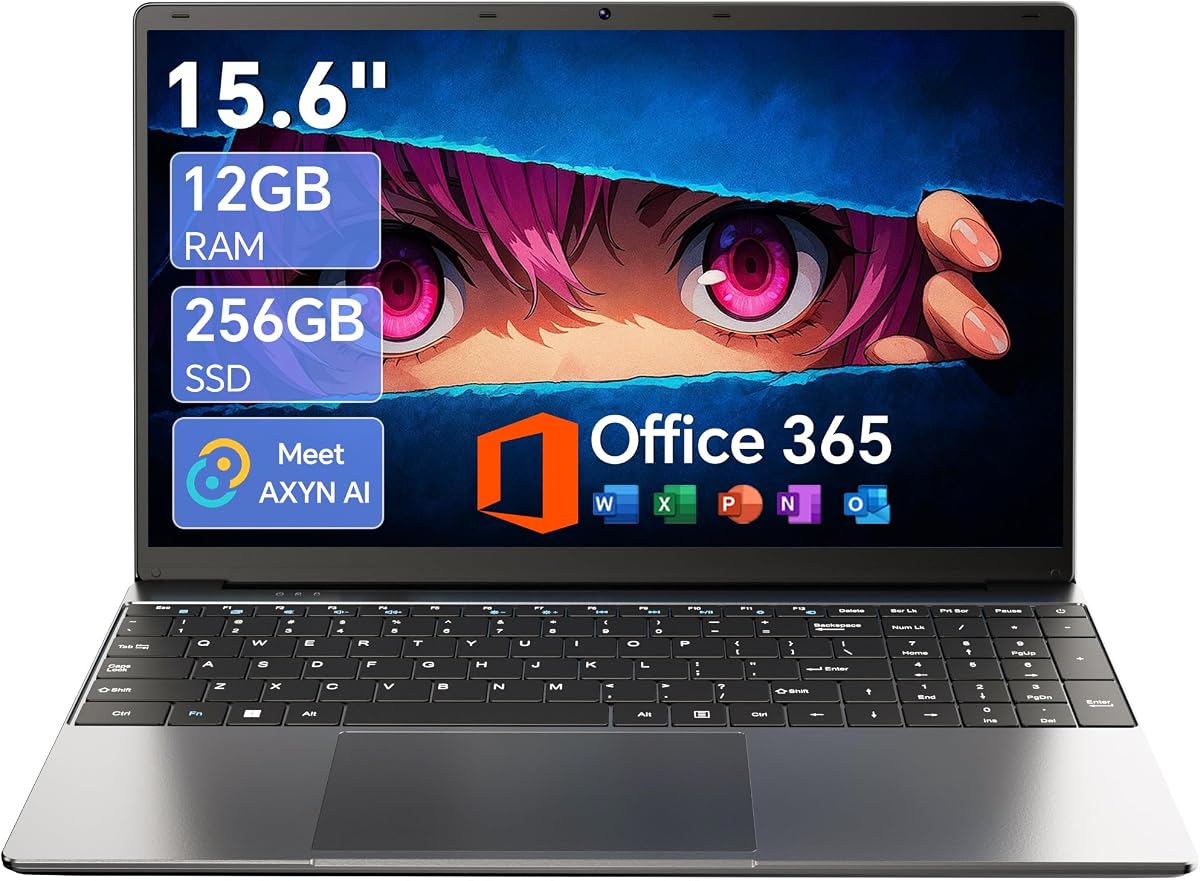
4. 15.6'' AI Laptop with Office 365 - All-Day Battery Draft

15.6'' AI Laptop with Office 365 12GB RAM 256GB SSD Win 11 Laptops | 7000mAh Bat

15.6'' AI Laptop with Office 365 12GB RAM 256GB SSD Win 11 Laptops | 7000mAh Bat

8.8/10★★★★☆

This 15.6-inch AI laptop earns its place by aiming at the two writer pains budget machines usually miss: enough memory to multitask calmly, and a high-capacity 7000mAh battery for longer sits. Twelve gigabytes of DDR4 is a meaningful step above 6GB and 8GB classmates when your distraction-free stack still includes a dictionary tab, email, and a cloud notes app beside Word.

  • 15.6" FHD IPS narrow-bezel display
  • Celeron J4105, 12GB DDR4, 256GB M.2 SSD
  • 7000mAh battery; 180° hinge; Office 365 included
Check Price →
✓ Pros
  • 7000mAh battery pack targets all-day classes and long writing blocks
  • 12GB RAM is a smart middle ground for Word plus research tabs
  • FHD IPS panel is clearer for revision than HD student screens
  • Expandable storage path (SSD/TF) helps growing manuscript archives
  • 180° hinge is handy for sharing pages in workshops without spinning the whole laptop
✕ Cons
  • Celeron J4105 is adequate for drafting, not for heavy local compile tools
  • Wi-Fi 5 and Bluetooth 4.2 trail newer packs on crowded networks
  • AI writing features can become distractions if you leave them always-on

Detailed review

Keyboard feel will be typical of thin portable Windows notebooks: usable for thousands of words if travel is even, less inspiring if you are coming from a desktop mechanical board. Give yourself a week of daily morning pages before judging. Writers who need softer feedback can add thin silicone key covers carefully, though many prefer training on the native deck so muscle memory stays consistent when traveling.

The FHD IPS display supports longer reading and line-editing sessions than softer HD panels. Narrow bezels maximize the writing surface, which helps Focus mode feel immersive. Use that immersion intentionally: one document, large enough type, and optional dark theme. The AI features for summarizing and task management can help planning days—outline generation, meeting notes—but they can also fracture attention if a sidebar constantly offers to rewrite your sentences. Turn them off during pure draft hours.

Battery is the selling point for café novelists and students writing between classes. A 7000mAh cell does not magically equal fourteen HP OmniBook hours, but it is positioned as all-day capable for productivity workloads. Dim a notch, avoid gaming-like brightness, and you should finish a solid drafting block without the panic that defines four-hour machines.

The 180-degree hinge is a small workshop gift. Lay the screen flatter to share a paragraph with a critique partner, or find a more ergonomic angle on a low coffee table. Ports cover USB 3.2, Type-C, Mini HDMI, and a headphone jack—enough for a mouse, backup drive, and external display when home desk days call for a second monitor.

Storage starts at 256GB with expansion options up to large SSD and TF capacities, which matters if you keep audio interview files beside manuscripts. Office 365 and Windows 11 arrive ready for school and business writing. Treat the Celeron as a drafting engine, not a video suite, and this gray portable becomes a practical battery-aware writer companion in the middle of the pack.

Using AI without losing your voice

Reserve AI modes for outlining, summarizing research, or clearing admin tasks. During first-draft hours, close the assistant entirely. Distraction-free writing means your sentences stay yours; tools should wait outside the door until revision day if that is how you work best.

Who it is for

Students and freelance writers who want FHD clarity, 12GB of breathing room, and stronger battery positioning than bare-bones 4GB/6GB portables. Less ideal if you need Wi-Fi 6E campus density performance or Core Ultra-class horsepower for complex local tools.

Check Price on Amazon →

We may earn a commission at no additional cost to you.

5. Acer Aspire Go 15 - Blue-Light Conscious Daily Writer

Acer Aspire Go 15 AI Ready Laptop | 15.6" FHD IPS Display | AMD Ryzen 3 7320U |

Acer Aspire Go 15 AI Ready Laptop | 15.6" FHD IPS Display | AMD Ryzen 3 7320U |

8.8/10★★★★☆

The Acer Aspire Go 15 is a writer-friendly daily driver when you care about a sharp 15.6-inch FHD IPS panel, modern USB-C flexibility, and tools that protect your eyes during late revision. Acer BluelightShield is not a gimmick for people who edit at midnight: lower blue light, fewer headaches, longer sustainable focus. Distraction-free writing includes bodily comfort, not just closed browser tabs.

  • 15.6" FHD IPS narrow-bezel display
  • AMD Ryzen 3 7320U; 8GB LPDDR5; 128GB SSD
  • Wi-Fi 6; dual full-function USB-C; Copilot key
Check Price →
✓ Pros
  • Ryzen 3 7320U feels responsive for writing apps and light multitasking
  • Acer BluelightShield helps reduce eye fatigue on long night drafts
  • Dual full-function USB-C simplifies charging and accessory life
  • Wi-Fi 6 is better for crowded libraries and coworking spaces
  • Copilot access is optional—ignore it for pure focus if you prefer
✕ Cons
  • 128GB SSD is tight for large offline research libraries
  • Windows 11 Home in S Mode may block preferred writing apps until switched
  • 8GB RAM asks for disciplined tab habits during deep research

Detailed review

Keyboard sessions on a 15.6-inch Aspire-class deck typically offer a balanced layout with room for a palm rest. As always, test with your real average—dialogue-heavy fiction, footnoted essays, or rapid blog drafts—because each cadence stresses different keys. If the board feels slightly firm, that can actually help accuracy; mushiness is what fatigues writers mid-chapter.

Battery life is described as exceptional for the class, which places this machine in the conversation for café drafting, though the OmniBook and Vivobook Go still headline stamina in our top picks. Use AcerSense to manage battery modes deliberately: prefer efficiency profiles while drafting, performance only when exporting or running heavier tasks. That habit alone extends real-world hours.

The Ryzen 3 7320U with Radeon 610M graphics is overkill for plain text and just right for writers who also watch reference films, manage light photo inserts in blogs, or keep many docs open. Eight gigabytes of LPDDR5 is bandwidth-strong for its size but still a ceiling—pair it with a distraction-free browser profile that does not sync thirty extensions.

Storage is the main watch-out. One hundred twenty-eight gigabytes fills fast with Windows, Office, and a growing archive. External SSD or aggressive cloud hygiene is mandatory. Dual full-function USB-C ports make that external drive habit painless, and HDMI 2.1 supports a big secondary monitor for outline-on-the-left, draft-on-the-laptop setups at home—an excellent anti-distraction architecture because research can live on the second screen while the laptop stays manuscript-only.

S Mode appears again: confirm you can install your writing stack. Once unconstrained, the Aspire Go becomes a clean FHD writing appliance with thoughtful eye-care features and modern ports. For writers who revise late and live in libraries with congested Wi-Fi, that combination is more valuable than flashy AI badges.

Eye-care and focus routine

Enable BluelightShield in evening hours, follow 20-20-20 glances away from the panel, and keep ambient light softer than the screen. Pair with Windows Focus sessions so notifications do not undo the calm your eyes just earned.

Versus the Vivobook Go

Both use Ryzen 3 7320U-class efficiency. The Vivobook Go emphasizes quiet chiclet typing, about eleven-hour battery claims, and MIL-STD toughness. The Aspire Go emphasizes BluelightShield, AcerSense controls, and dual full-function USB-C. Choose by whether keyboard character or eye-care tooling matters more in your nights.

Check Price on Amazon →

We may earn a commission at no additional cost to you.

6. 15.6" FHD Laptops with AI Assistant - AI Writing Modes

15.6" FHD Laptops with AI Assistant Included

15.6" FHD Laptops with AI Assistant Included

9.8/10★★★★★

High ratings often reflect value satisfaction, and this 15.6-inch FHD AI laptop aims squarely at students and light business writers who want a clear screen, Office 365 for a year, and on-device AI modes for Chat, Write, Read, Meet, and Draw. For our niche, the Write and Read modes are the interesting ones—useful for brainstorming and summarizing—so long as they do not become a second voice arguing with your draft in real time.

  • 15.6" FHD 1920x1080 narrow-bezel display
  • Celeron J4105; 6GB RAM; 128GB SSD (expandable)
  • 53.2Wh battery; AI Chat/Write/Read modes; Office 365
Check Price →
✓ Pros
  • FHD panel punches above many budget HD student screens for clarity
  • Dedicated Write and Read AI modes can speed outlines and research digestion
  • 53.2Wh battery capacity supports meaningful portable drafting
  • 180° hinge helps critique sessions and flexible desk angles
  • Strong customer rating suggests many users find day-to-day use pleasant
✕ Cons
  • 6GB RAM is the tightest multitasking limit among our mid-pack picks
  • 128GB SSD needs early external or cloud archiving habits
  • AI helpers can sabotage distraction-free goals if left open by default

Detailed review

Distraction-free discipline is non-negotiable here. Six gigabytes of RAM means Chrome cannot be a second career. Keep one writing app, one research tab set, and the AI assistant closed during sprint hours. When you need help outlining tomorrow’s chapter, open Write mode deliberately, capture bullets, then close it and return to silence. Used that way, AI is a planning tool; used poorly, it is a slot machine for attention.

Keyboard comfort will decide whether this becomes a daily novel machine or a homework helper. Expect a standard thin-notebook deck: fine for essays and blog posts, possibly fatiguing for 3,000-word fiction days if travel is shallow. An external quiet keyboard at the home desk is a legitimate hybrid strategy and keeps the laptop as a portable FHD display-and-battery unit.

The 53.2Wh battery specification is more concrete than vague “long life” slogans. Real hours depend on brightness and apps, but writers who draft in Focus mode with modest brightness should see practical portable sessions. Charge with intention between blocks rather than living at 5% anxiety.

Expandable storage up to large SSD or TF capacities softens the 128GB sting. Build a ritual: monthly archive of finished drafts to a TF card or pocket SSD labeled by year. Manuscript safety is part of professional writing, and budget machines reward writers who treat backups as non-optional.

The 180° lay-flat hinge and FHD narrow-bezel screen make collaboration easy—useful for writing groups and tutoring. Ports cover Type-C, USB 3.2, and Mini-HDMI for a simple desk. Ranked carefully, this is a budget FHD writing appliance with tempting AI features that you must actively manage so keyboard time stays yours.

When 6GB is enough

Enough for Word or Google Docs, light PDF reading, and music in the background. Not enough for virtual machines, dozens of research tabs, and desktop Slack-plus-mail-plus-design tools. If your process is already minimalist, you will be fine. If your process is chaotic, buy more RAM in another machine.

Setup for silent drafting

Uninstall trial junk if present, turn off startup apps, pin only your editor, and create a Windows user account named Draft with almost no pinned distractions. Log into that account for morning pages. Log into your main account for email and admin later.

Check Price on Amazon →

We may earn a commission at no additional cost to you.

7. Amzboy 15.6” Windows 11 Laptop - Silent Fanless Focus

Amzboy 15.6” Windows 11 Laptop

Amzboy 15.6” Windows 11 Laptop

9/10★★★★★

Silence is an underrated writing feature. The Amzboy’s fanless solid-state design removes the sudden fan spin that yanks writers out of a sentence—especially in quiet libraries and late-night apartments. If keyboard feel is about tactile comfort, acoustic feel is about whether the machine itself interrupts you. On that axis, a quiet fanless chassis scores higher than louder “faster” notebooks.

  • 15.6" FHD anti-glare; ~3.3 lbs thin build
  • Intel N4020; 4GB RAM; 128GB eMMC (+ TF to 1TB)
  • Fanless quiet design; 45W USB-C PD charging
Check Price →
✓ Pros
  • Fanless design means zero fan whine during deep focus sessions
  • FHD anti-glare screen is kinder in bright rooms than glossy budget panels
  • USB-C PD charging lets you carry one compact brick for laptop and phone
  • Privacy camera and light 3.3 lb weight suit shared-space drafting
  • TF expansion to 1TB helps archive manuscripts without opening the chassis
✕ Cons
  • 4GB RAM is a hard limit—keep the workflow extremely minimal
  • 128GB eMMC is slower and smaller than a proper NVMe SSD experience
  • N4020 is for documents and browsing, not heavier local writing suites with many plugins

Detailed review

You pay for that silence with modest internals: Intel N4020, 4GB of RAM, and 128GB eMMC. This is a distraction-free machine by necessity. You will write in Word, Google Docs, or a lightweight editor, keep tabs sparse, and expand storage with a TF card for archives. Writers who already prefer a sparse stack—markdown, one browser profile, cloud sync—can thrive. Writers who live in research rabbit holes will thrash.

The 15.6-inch FHD anti-glare display is a pleasant surprise at this tier and supports longer reading without as much reflective glare. Combine that with a 180° hinge and you can find comfortable angles on couches and café tables. Keyboard expectations should stay humble: prioritize even key response and quiet typing over luxury travel. If it feels acceptable for a 20-minute test letter, it may carry a short story; for novel-length daily quotas, try before you commit or plan an external keyboard at home.

Battery and charging habits revolve around the 45W USB-C PD adapter. The win is cable simplicity—one travel cord for phone and laptop—more than a fourteen-hour claim. Charge during breaks, draft in efficiency mode, and treat portable sessions as focused sprints rather than twelve-hour marathons.

For distraction-free setup, this machine shines when you refuse to install clutter. Windows 11 out of the box, privacy shutter closed unless you are on a call, notifications off, and a single pinned editor. The fanless quiet becomes part of a ritual: open lid, silence remains, words begin.

Choose the Amzboy when silence, light carry, and FHD anti-glare matter more than multitasking headroom. Skip it if you need 16GB machines for research-heavy nonfiction or if eMMC storage speed has frustrated you before. As a secondary travel writer laptop beside a more powerful desk machine, it can be a clever, calm companion.

Minimalist writer stack that fits 4GB

Use one browser, one docs app, offline mode when possible, and a TF card for finished projects. Avoid Electron apps that eat RAM. If an app feels heavy, use the web version only while online, then close it. The constraint can become a creative gift if you let it.

Versus other quiet options

The Vivobook Go is quieter in keyboard character and stronger in battery and RAM, but it is not fanless. If absolute silence under load matters more than speed, Amzboy’s fanless approach is unique in this pack. If you want silence plus real stamina and 8GB, lean Vivobook.

Check Price on Amazon →

We may earn a commission at no additional cost to you.

8. Lenovo Yoga 7i 2-in-1 Laptop - Best Overall for

Lenovo Yoga 7i 2-in-1 Laptop

Lenovo Yoga 7i 2-in-1 Laptop

9.2/10★★★★★

If this pack has a flagship for serious writers, it is the Lenovo Yoga 7i. Keyboard feel, battery-capable Ultrabook engineering, and distraction-free potential all land at a higher tier: a backlit deck for dark-room sessions, fingerprint login so you are inside the manuscript in a second, and enough RAM and SSD that the machine never wheezes while you hold research, email, and a novel file together.

  • 16" 2K touch IPS; Core Ultra 7 155U
  • 16GB DDR5; 1TB SSD; backlit keyboard + fingerprint
  • 360° modes; Wi-Fi 6E; Thunderbolt 4; Win 11 Pro
Check Price →
✓ Pros
  • Backlit keyboard elevates night drafting and dim café corners
  • 16GB DDR5 and 1TB SSD remove the usual writer storage and RAM anxiety
  • 2K 16-inch touchscreen makes revision and markup feel spacious
  • Fingerprint login shortens the friction between intention and first sentence
  • 360° modes support tent reading of research PDFs or touch markup
✕ Cons
  • Heavier and more premium than basic student portables for pure text
  • 2-in-1 flexibility is optional complexity if you only ever use laptop mode
  • Touchscreen can invite fidget taps—disable touch if it breaks your focus

Detailed review

The backlit keyboard is not vanity lighting. Writers who draft before sunrise or after kids sleep need to see modifiers without blasting a room light that wakes the house. Combine backlight with comfortable key travel—Yoga keyboards in this class are generally among the more pleasant Windows decks—and long sessions become sustainable. Add the fingerprint reader and you remove password friction that often becomes an excuse to check a phone instead.

The 16-inch 2K touchscreen is a revision gift. More pixels mean more of your page stays visible at readable type sizes. Touch can help for quick highlights or PDF markup in tablet or tent mode, but pure typists should feel free to ignore touch entirely. Distraction-free does not require every feature; it requires that unused features stay quiet. Lenovo Transition’s mode awareness is handy when you flip to stand mode to read a research paper with a cup of coffee—laptop becomes a reader, then returns to a typer.

Core Ultra 7 155U power means local apps feel instant, and you have headroom for transcription tools, large Scrivener projects, or light creative side work without abandoning the machine. Wi-Fi 6E helps in dense apartment buildings where weaker cards stutter during cloud saves. Thunderbolt 4 opens a clean path to a single-cable desk dock: one plug, external monitor for outlines, and a calm laptop screen that shows only the draft.

Battery on a 16-inch 2K 2-in-1 will not magically beat the OmniBook’s marathon claims in every scenario, but efficiency cores and modern silicon keep portable drafting realistic. Dim slightly, use airplane mode for offline sprints, and you can still take the Yoga to a residency or café day with confidence. For many writers, the win is less absolute hours than hours without thermal noise and UI lag.

Windows 11 Pro suits freelancers who want tighter BitLocker-style habits and professional device control. Ports are plentiful—USB-A, USB-C, HDMI, microSD, audio—so accessories never force a scavenger hunt. Honest tradeoff: you are carrying a more capable, more expensive-feeling device than a 3-pound student slab. If writing is your work, that investment shows up every morning when the keyboard, screen, and silence of a responsive machine invite you to begin.

Laptop mode versus tent mode for writers

Use classic laptop mode for drafting. Flip to tent or stand when reading research or reviewing proofs with a stylus or finger highlights. Keeping modes purpose-linked prevents the 2-in-1 from becoming a toy you fiddle with instead of a tool you write on.

Distraction-free pro setup

Create a desktop virtual desktop named Draft with only your editor. Put Slack and mail on Desktop 2. Use Win+Ctrl+Left/Right to switch only at break times. Fingerprint login into Windows, then immediately Win+Ctrl+Right into Draft—make that muscle memory.

Who should buy it

Novelists, journalists, academics, and professional freelancers who write daily and want keyboard comfort, revision space, and multitasking headroom. Budget student essay writers can choose lighter pack options; this is the serious daily instrument.

Check Price on Amazon →

We may earn a commission at no additional cost to you.

9. HP 17.3" Touchscreen Laptop - Backlit Big-Screen Home Writer

HP 17.3" Touchscreen Laptop w/Microsoft 365

HP 17.3" Touchscreen Laptop w/Microsoft 365

8.8/10★★★★☆

Writers who work primarily at home often want a big, friendly keyboard more than an ultraportable trophy. This HP 17.3-inch touchscreen leans into that truth with a soft gray backlit keyboard, full number pad, and fingerprint reader—three features that quietly improve daily word count. Backlight keeps late sessions humane; the numpad helps style sheets, chapter numbering, and spreadsheet research; fingerprint login removes the password speed bump that derails fragile morning focus.

  • 17.3" HD+ touch anti-glare; Intel N100
  • 8GB RAM; 128GB SSD; Microsoft 365 included
  • Backlit keyboard with numpad; fingerprint; Fast Charge
Check Price →
✓ Pros
  • Backlit full-size keyboard with numpad suits long home drafting nights
  • Fingerprint reader keeps login friction low before morning pages
  • Large anti-glare touchscreen helps outline and browse research visually
  • HP Fast Charge supports quick top-ups between writing blocks
  • Microsoft 365 inclusion aligns with Word-centric author workflows
✕ Cons
  • HD+ 1600x900 is less sharp than FHD/2K peers for dense text
  • 128GB SSD and 8GB RAM need disciplined storage and tab habits
  • 17.3-inch size is a home-leaning companion more than a daily commute tool

Detailed review

Keyboard feel is the headline reason to consider this machine in a writers’ guide. A larger chassis usually means more stable typing with less flex under energetic fingers. Spend real time on the home row during your return window if possible. If the backlight and key size make you exhale, that emotional ease is part of distraction-free design—you stop fighting the tool.

The 17.3-inch HD+ touch anti-glare display is immersive for single-document drafting and casual research, though it is not as crisp as the Yoga’s 2K panel or FHD 1080p peers. Increase font size, use Focus mode, and lean on anti-glare under bright lamps. Touch navigation can help scrub PDFs; turn it off mentally when drafting so you are not poking the glass instead of typing.

Performance from the Intel N100 quad-core matches everyday writing, streaming, and online learning. Eight gigabytes of DDR4 (configuration dependent as listed) handles a sensible stack; keep it sensible. The 128GB SSD is the sharp edge: external backup is mandatory. Microsoft 365 apps are included with activation required—plan that setup on day one so Word is ready before your next deadline.

Battery life is aided by HP Fast Charge habits more than by OmniBook-class marathon claims. From empty to about half in roughly forty-five minutes, you can reclaim an afternoon. At about 4.6 pounds for a 17-inch device it is relatively movable, yet most writers will park it on a desk and celebrate the keyboard.

Lavender color and Copilot key are personality options. Use Copilot when outlining or wrestling admin email; ignore it during pure draft hours. Webcam shutter supports privacy in shared homes. As a backlit big-screen home writer’s station in this pack, it is a strong alternative when carry weight matters less than typing comfort and screen size.

Home desk writing ritual

Park the HP at a stable desk, external mouse optional, phone in another room. Fingerprint in, open Word Focus, backlight to the lowest useful level, and set a fifty-minute timer. The large board invites long sits—use posture breaks so comfort does not become stillness fatigue.

Versus the OmniBook 3 17.3

Both offer large 17.3-inch canvases. The OmniBook leads on claimed multi-hour battery and a fuller FHD panel with 512GB storage. This HP leads on backlit keyboard, numpad, fingerprint convenience, and touch interaction. Pick OmniBook for café marathons; pick this HP for night-home typing comfort.

Check Price on Amazon →

We may earn a commission at no additional cost to you.

10. ASUS Vivobook Go 15.6” FHD Slim - Best Quiet Typing

ASUS Vivobook Go 15.6” FHD Slim Laptop

ASUS Vivobook Go 15.6” FHD Slim Laptop

8.6/10★★★★☆

ASUS markets the Vivobook Go’s chiclet keyboard as quiet and comfortable with a full-size layout and numeric keypad—and for writers, that messaging is the feature. Keyboard feel is subjective, but low-noise keys matter in libraries, shared apartments, and dawn sessions beside a sleeping household. Combined with up to eleven hours of battery life from the efficient 42Wh-class design, this laptop is built for untethered, socially considerate drafting.

  • 15.6" FHD 250-nit display; Ryzen 3 7320U
  • 8GB DDR5; 256GB SSD; up to 11-hour battery
  • Quiet chiclet keyboard with numpad; MIL-STD toughness
Check Price →
✓ Pros
  • Quiet chiclet keyboard is explicitly tuned for comfortable, low-noise typing
  • Up to 11 hours of battery supports true distraction-free days out
  • 256GB SSD and 8GB DDR5 balance everyday writing needs well
  • Military-grade durability testing suits writers who travel with their draft
  • Webcam shield adds privacy without software hunting
✕ Cons
  • 45% NTSC color is fine for text, not for color-critical side projects
  • Wi-Fi 5 trails Wi-Fi 6 peers in crowded networks
  • 8GB RAM still rewards tab discipline during heavy research weeks

Detailed review

Distraction-free potential is excellent when you treat the machine as a typing appliance. Open your editor full screen, slide the webcam shield closed, enable Focus Assist, and let the long battery remove charge-icon anxiety. SonicMaster speakers are there for research interviews or ambient focus playlists; keep volumes modest so audio does not become another dopamine drip.

The Ryzen 3 7320U with 8GB DDR5 and 256GB SSD is a sweet spot for Word, Docs, Scrivener-scale projects, and browser research without the eMMC compromises of lighter Amzboy-class machines. Writers can keep local backups of active books on the SSD and archive older work externally. Fast charging habits help when you do run low between trains.

MIL-STD 810H testing for temperature, shock, vibration, and altitude is relevant to writers who shove a laptop into tote bags between coffee shops and coworking lofts. Durability is part of creative reliability: a draft only matters if the machine survives the commute. The black slim chassis reads professional without inviting tablet-toy distractions.

Display-wise, the 15.6-inch FHD panel at 250 nits sustained brightness is a clear daily driver for text. Color gamut is modest; ignore that unless you also design covers in-house. For manuscripts, clarity and size beat saturated cinema modes. Pair with Windows night light if you revise late.

Compared with the Yoga 7i, you give up backlit luxury, 16GB RAM, and 2K real estate. Compared with the OmniBook 3, you give up some screen sprawl and the longest battery claim, but you gain a more portable 15.6-inch shape and that quiet chiclet typing character. For many working writers, that trade is the daily-driver sweet spot—and why it earns a top-pick badge here.

Typing-first evaluation checklist

On day one, write 1,000 words of your actual genre. Note noise, wrist angle, and errors on rarely used keys like brackets for markdown writers. If the chiclet board still feels friendly at word 1,000, you likely found a keeper.

Travel writing kit

Vivobook Go, compact charger, optional quiet earbuds, and a cloud sync that completes before you leave Wi-Fi. Webcam shield closed in transit. Airplane mode for ascent drafting. Eleven-hour ambition becomes real when the radio stack stays simple.

Who it beats in this pack

Beats short-battery Office portables for café days, beats fanless 4GB machines for multitasking, and beats giant 17-inch home units for bag carry—while keeping typing comfort central. Choose Yoga instead when you need backlight, 16GB, and 2K revision space every day.

Check Price on Amazon →

We may earn a commission at no additional cost to you.

Best Laptops for Writers in 2026: Keyboard, Battery, Focus

How to Choose a Laptop for Writing in 2026

Prioritize keyboard feel over peak benchmarks

Writers interact with one input device for hours: the keyboard. Before chasing processor names, ask whether keys bottom out harshly, whether the deck flexes, and whether noise would embarrass you in a library. A slightly slower chip with a pleasant board will produce more pages than a louder, firmer machine you avoid. Whenever possible, type a real sample—dialogue, footnotes, or blog voice—not a single pangram.

Backlit keyboards help dim-room authors; numpads help structured nonfiction and chapter numbering; fingerprint readers reduce login friction. None of these replace basic travel quality, but together they shape whether the laptop invites a session or postpones it.

Battery life is creative infrastructure

Outlet hunting fractures attention. Aim for machines that realistically cover your longest common session plus a buffer. Claims of eleven to fourteen hours matter for residency days and airport novels; four-hour batteries can still work if you write at desks with power. Match the claim to your life, then subtract some optimism for bright screens and many tabs.

Fast Charge features on HP models are strategic: schedule deep work, then top up during walks. Pair battery strategy with offline drafting so sync storms do not drain cells while you think.

Design for distraction-free defaults

Hardware cannot save a notification-saturated workflow. Choose a laptop with enough display clarity for Focus mode, then strip software: one editor, limited pinned apps, separate desktops for Draft versus Admin, and AI assistants that open only on command. Fanless or quiet keyboards support the same goal by removing acoustic interruptions.

S Mode and Store-only constraints deserve scrutiny. A calm OS that blocks your preferred Scrivener or citation tool is not calm—it is friction. Confirm app compatibility before you commit.

Memory, storage, and the research tax

Screen size versus carry reality

Seventeen-inch canvases shine for home outlining and side-by-side research; fourteen- and fifteen-inch machines win when the laptop must follow you. Writers often overbuy size they will not carry, then draft on phones. Be honest about where your best pages happen, then buy the chassis that shows up there.

Frequently Asked Questions

01

What matters more for writers—CPU speed or keyboard comfort?

Keyboard comfort wins for pure drafting. Word processors and most novel tools barely stress modern CPUs. If a board feels punishing, you will shorten sessions regardless of benchmark charts. Choose adequate processors (Ryzen 3, modern Intel N-series, or better) and spend your attention on key feel, layout stability, and noise. Upgrade CPU priority only if you also compile code, edit video, or run heavy local AI beside your drafts.

02

How much battery life do writers actually need?

Match battery to your untethered block. Many writers thrive with six to eight real hours; café novelists and travelers should look at claims near eleven to fourteen hours, like the Vivobook Go or OmniBook 3 in this pack. Four-hour machines can still be excellent desk writers if power is always nearby. Brightness, browser tabs, and constant syncing cut real-world numbers, so treat marketing maxima as ceilings, not promises.

03

Is a 2-in-1 laptop good for writing novels?

Yes—if you mostly stay in laptop mode for typing and use tent or tablet modes for reading research or marking PDFs. The Lenovo Yoga 7i shows how a backlit keyboard plus 2K screen can serve serious drafting while optional modes help review. If flipping modes tempts you to fiddle instead of write, ignore the hinges and treat it as a clamshell. The hinge should serve the habit, not become the habit.

04

Can I write a book on 4GB or 6GB of RAM?

Yes, with a strict stack: one editor, few tabs, minimal background apps. The Amzboy (4GB) and AI FHD laptop (6GB) can produce manuscripts if you refuse Chrome chaos. Research-heavy nonfiction, Zotero-plus-Scrivener-plus-Slack days, or local VMs will suffer. If your process is already messy, buy 8GB or 16GB and spend less willpower on tab policing.

05

Should writers enable AI writing assistants on these laptops?

Use them on purpose, not by default. AI outline and summarize modes can speed planning and research digestion on several pack machines, but an always-open rewrite sidebar fractures voice and attention. A practical rule: assistants may enter the room during outlining and admin, then leave during first-draft sprints. Distraction-free writing is a scheduling choice as much as a software toggle.

06

Do writers need a backlit keyboard?

Need is strong if you draft in dark bedrooms, pre-dawn kitchens, or dim planes. The Yoga 7i and HP 17.3-inch backlit models make those hours easier on the eyes and accuracy. If you only write in bright offices, backlight is optional. Many writers still prefer it as a comfort feature that extends possible session times without waking a whole room.

07

What screen size is best for long writing sessions?

Fifteen to sixteen inches balances page space and portability for most. Seventeen-inch models like the OmniBook 3 and HP touchscreen help home outlining and large fonts. Fourteen-inch ultrabooks win when carry weight decides whether you write at all. Prioritize resolution you can read for hours—FHD or 2K beats soft HD when revision is on-screen—and raise system text size before you buy a larger, heavier chassis you will not move.

08

How do I make any Windows laptop more distraction-free?

Create a separate Windows desktop or user account for drafting, pin only your editor, enable Focus Assist or Focus sessions, disable nonessential startup apps, and keep mail on a timed schedule. Close the Copilot or vendor AI sidebar unless summoned. Full-screen your document, consider airplane mode for offline sprints, and charge on a routine so the battery icon stops stealing glances. Hardware choice helps; defaults decide.

09

Is fanless silence worth the performance tradeoff?

For library writers and noise-sensitive night drafters, yes. The Amzboy’s fanless design removes a common interruption even if RAM and storage are modest. If you need snappier multitasking and still care about acoustics, choose a quiet-keyboard efficient machine like the Vivobook Go and keep workloads light so fans rarely spin. Silence is part of keyboard-era ergonomics—ears count.

10

Which laptop in this guide is best overall for most writers?

The Lenovo Yoga 7i is the best overall for serious daily drafting thanks to its backlit keyboard, fingerprint login, 16GB DDR5, 1TB SSD, and spacious 2K display. If your priority is maximum away-from-outlet time on a large screen, choose the HP OmniBook 3. If you want a portable daily driver with quiet typing and about eleven hours of stamina, choose the ASUS Vivobook Go. Match the badge to your dominant constraint: capability, battery, or quiet portable typing.

Conclusion

The best laptop for writers in 2026 is the one that keeps your hands comfortable, your battery calm, and your attention on the sentence. Across this pack, the Lenovo Yoga 7i leads as a serious drafting instrument, the HP OmniBook 3 leads when hours away from power define the day, and the ASUS Vivobook Go leads when quiet chiclet typing and portable stamina matter most.

Every other machine here can still finish a manuscript if you honor its limits: short batteries need outlets, 4–6GB machines need minimalist apps, and AI features need boundaries. Choose with your real writing hours in mind, set distraction-free defaults on day one, and let the hardware disappear so the pages can accumulate.