HP OmniBook 3 17.3 inch Laptop PC
- 17.3-inch FHD IPS panel with wide viewing angles for easy reading
- Long battery life plus Fast Charge so the charger stays nearby, not constant
- 512GB SSD and 8GB memory for reliable everyday documents and streaming
Expert Review & Guide
Choosing a laptop later in life is less about chasing the newest processor name and more about whether the machine feels calm under your hands. Can you read email without squinting? Do the keys give clear feedback when you type a grocery list or a message to family? Will Windows or Chrome OS stay predictable after updates, or will the next software change erase the muscle memory you just built? In 2026, the best laptops for seniors earn their place by winning on ease of use, screen clarity, keyboard comfort, and reliability—not by looking thin in a product photo.
This guide evaluates ten current Amazon pack options through that practical lens. Large Full HD displays and bright IPS panels help with reading news sites, pharmacy portals, and video calls. Full-size keyboards with roomy spacing—and number pads where available—make banking spreadsheets and calendar entries less tiring. Stable brands, solid-state storage, and sensible memory configurations matter because a laptop that stalls mid-task quickly becomes something that sits closed on a side table. We also call out honest tradeoffs: Chromebook simplicity versus Windows software compatibility, oversized 17-inch desk machines versus lighter 15-inch carry-around models, and budget builds that work for browsing but struggle when too many tabs pile up.
Below you will find three top picks for most households, a full comparison of every product in the pack, detailed reviews written for first-time buyers and gift-givers, plus a buying guide and FAQ that cover font enlargement, touchscreen usefulness, webcam privacy, and when a larger screen beats a smaller “travel” laptop. No dollar prices and no invented product details—only pack-backed guidance for seniors who want a computer that feels welcoming on day one and still trustworthy a year later.
As an Amazon Associate we earn from qualifying purchases. We may earn a commission at no additional cost to you.
Scan this table for the traits seniors feel within the first hour: screen size and clarity, keyboard-friendly layouts, memory and storage headroom, and whether the machine is better as a desk companion or a room-to-room carry. Specs intentionally omit prices so you can compare comfort and capability before checking the current Amazon listing.
HP OmniBook 3 17.3 inch Laptop PC
If you want one laptop that covers reading, writing, streaming, and weekend Zoom with grandchildren without making you lean into a tiny panel, the HP OmniBook 3 17.3-inch model is the clearest all-around choice in this pack. The Full HD IPS display is the star for seniors: text looks sharper than older HD panels, colors stay consistent when you shift your chair sideways, and the physical size of a 17.3-inch screen means you can keep interface scaling reasonable instead of hunting for microscopic menu items. That combination of clarity and acreage is what turns a “new computer” from intimidating into usable.
Ease of use here is less about gimmicks and more about a calm everyday Windows 11 Home setup with a dedicated Copilot key if you want AI help drafting a polite email or summarizing a long article. You do not have to use Copilot on day one. Many seniors will simply open the browser, pin email and a banking bookmark to the taskbar, and leave the rest alone. The important part is that the machine has enough Ryzen 3 responsiveness and 8GB of memory to open those tools without the stutter that makes people blame themselves instead of underpowered hardware.
Keyboard comfort is another reason this OmniBook rises to the top of a seniors list. Larger HP 17-inch decks typically offer more palm-rest space and a less cramped key layout than ultraportables. That matters when arthritis, larger fingertips, or simply a preference for deliberate typing enters the picture. Combine that with a 512GB SSD—fast to wake, quieter than old spinning hard drives, and large enough that you are not constantly deleting files—and the machine starts to feel like a reliable home appliance rather than a gadget you babysit.
Reliability shows up in several practical ways. Solid-state storage reduces the risk of the grinding freezes associated with failing hard drives. Wi-Fi 6 improves connection stability in homes with modern routers. Advanced noise reduction and an FHD camera with HDR auto-switch help when lighting is imperfect—common in dining-room “offices.” Battery life rated up to roughly fourteen hours, with Fast Charge restoring a sizable chunk in about forty-five minutes, means a morning of email and a afternoon movie can happen without planning your day around outlets.
Who should pause before buying? Anyone who needs a laptop that disappears into a small tote every day. Seventeen inches is wonderful on a kitchen table and awkward on a plane tray. Also, if a household already lives entirely inside Google services and wants the absolute simplest learning curve, a Chromebook may still feel friendlier. For most seniors who want a recognizable Windows PC with a big, clear screen and enough storage to keep years of family photos nearby, this OmniBook is the recommendation we would hand to a gift-giver first.
Choose the OmniBook 3 17.3 if the computer will mostly live in one or two rooms, you want readable text without constant zooming, and you prefer a mainstream HP Windows machine that adult children can help support remotely. It is especially strong for retirees managing bills, telehealth portals, photo browsing, and streaming on the same device.
After first boot, raise Windows text size, switch to a larger mouse pointer, pin Mail or your webmail, and create a desktop shortcut for video calling. Enable the camera privacy habits you prefer, connect to Wi-Fi once carefully, and consider a simple external mouse if trackpads feel slippery. Those twenty minutes of setup usually determine whether the laptop becomes a daily companion or an unused gift.
The OmniBook wins on balanced senior-friendly value: big IPS clarity, strong battery positioning, and 512GB storage without overshooting into a heavier performance desk machine. Step up to the 16GB / 1TB Ryzen 5 HP if multitasking and local photo libraries are already heavy on day one.
We may earn a commission at no additional cost to you.
For seniors who mainly need a dependable window onto the internet—Gmail, Facebook, pharmacy sites, church livestreams, Google Photos, Zoom in the browser—the Lenovo IdeaPad 3i Chromebook is often the kindest learning curve in the pack. Chrome OS boots into a familiar browser-first world. There is less “which Start menu icon was that again?” and more “open the bookmark.” That simplicity is a feature, not a limitation, when the goal is confidence rather than power-user flexibility.
Screen clarity is better than the Chromebook stereotype suggests. A 15.6-inch Full HD 1920x1080 panel gives sharp text for news articles and clearer faces on video calls compared with fuzzy HD panels that still appear on some bargain machines. Pair that with 8GB of RAM—twice what many entry Chromebooks ship with—and everyday multitasking feels calmer: email in one tab, a recipe in another, a video call waiting in a third. The Intel Celeron N4500 will not win creator benchmarks, but for senior daily life it is appropriately quiet and adequate.
Keyboard comfort on a 15.6-inch IdeaPad chassis tends to feel more spacious than 11-inch education Chromebooks. Keys are easier to target, and the larger deck reduces that hunched, cramped posture that makes shoulders tired after twenty minutes. Battery life up to about ten hours supports the real senior use pattern: move from kitchen table to living-room chair without hunting for a charger between tasks. USB-A and USB-C ports also matter practically—many people still own a USB flash drive with family photos or a wired mouse they already like.
Reliability on Chrome OS is a different flavor than Windows reliability. You get frequent, largely invisible security updates and a design that assumes files live in the cloud. That is excellent for seniors who already use Google accounts and want fewer “update and restart” interruptions. It is less ideal if someone insists on keeping every photo only on local storage or relies on a desktop program that has no web equivalent. Be honest about that before purchase: Chromebook happiness correlates strongly with cloud comfort.
We also like the HD 720p camera for family calls and the overall slim, portable design when a son or daughter wants to bring the laptop to appointments. Just plan storage carefully. With 64GB eMMC, install only what you need, lean on Google Photos or OneDrive-style cloud libraries, and consider a USB drive for bulk archives. Done that way, the IdeaPad 3i becomes one of the least stressful computers you can put in front of a new senior user.
Gift-givers should budget time for a shared setup afternoon: create or recover the Google account, enlarge display size in Chrome OS settings, bookmark the five sites that matter, and practice one video call. That hour of guided practice is worth more than any accessory bundle.
Pick this Lenovo if the user’s digital life is already browser-based, if an adult child can help with the Google account once, and if reducing update and malware anxiety is a top priority. It is an outstanding “just works” machine for communication and light document work.
Treat the 64GB as working space, not a filing cabinet. Keep photos in the cloud, empty Downloads monthly, and use a labeled USB drive for scanned paperwork backups. Those habits keep Chrome OS feeling fast for years.
We may earn a commission at no additional cost to you.
HP 17.3" FHD IPS LED Anti-Glare 300 nits Laptop
When screen clarity is the non-negotiable priority—reading dense medical PDFs, following scrolling news sites, or watching a Sunday service stream—this HP 17.3-inch FHD IPS anti-glare laptop is the pack’s bright, confident desk answer. The 300-nit brightness rating and anti-glare coating matter in real homes where overhead lights and daytime windows create reflections that wash out dimmer panels. Seniors should not have to rearrange the entire living room just to see a cursor.
Ease of use improves when the machine itself is not constantly lagging. The AMD Ryzen 5 7430U six-core processor and 16GB of RAM are the reliability engine here: open a browser with a dozen tabs, keep a spreadsheet of medications or budgets nearby, and join a video call without the fan-drama panic that underpowered systems create. Windows 11 Home with a Copilot key can also help with plain-language questions—“how do I enlarge text?”—though a family member’s sticky-note cheat sheet still wins for many households.
Keyboard comfort benefits from the 17-inch footprint. There is simply more room for a full-size key layout and a less pinched typing posture. For seniors who write longer emails, maintain club newsletters, or enter numbers regularly, that physical comfort compounds over months. Pair the laptop with a inexpensive external keyboard only if preferred; many users will be fine with the built-in deck once Windows text size is increased.
Storage and privacy round out the senior case. One terabyte of storage means you can keep decades of family pictures locally without weekly deletion rituals. The webcam shutter is refreshingly literal: slide it closed when calls end and stop worrying about mysterious camera lights. Dual speakers and microphones support clearer conversations with relatives who live far away—often the emotional reason a senior agrees to a new computer at all.
This is not the lightest machine to carry to a coffee shop, and it may be more computer than someone needs for pure Facebook-and-solitaire use. But if the household wants a long-lived primary PC that still feels responsive in two or three years of accumulated bookmarks and photo libraries, the extra memory and storage are the difference between “still fine” and “why is everything slow?” We recommend it as the best large bright desk laptop for seniors who treat the computer like a home appliance they will keep.
Park it on a stable desk or kitchen table with a comfortable chair and a simple laptop stand if neck strain is an issue. The anti-glare panel shines in mixed indoor lighting; still avoid aiming a bright lamp directly at the screen.
Choose this Ryzen 5 configuration when you already know the user opens many tabs, keeps large photo folders, or wants maximum “buy once” headroom. Choose the OmniBook 3 when battery mobility and a slightly simpler everyday balance matter more than peak multitasking.
We may earn a commission at no additional cost to you.
Touch can be a bridge for seniors who already use a tablet comfortably but need a real keyboard for longer writing. This HP 15.6-inch model’s HD touchscreen lets you tap icons, swipe through photo folders, and pinch to zoom a map when the trackpad feels fussy. That directness improves ease of use in ways a spec sheet never captures: less precise pointing, more “touch the thing you mean.”
There is an important clarity tradeoff to state plainly. This display is HD at 1366x768, not Full HD. Text is usable—especially with Windows scaling increased—but edges will not look as crisp as the 1080p panels on the OmniBook, Acer Aspire Go, or Lenovo Chromebook. If a user already struggles with small print, prioritize a Full HD 17-inch machine first. If they value touch interaction and a manageable 15.6-inch size, this HP remains a strong everyday contender.
Under the hood, the AMD Ryzen 3 7320U with 8GB of LPDDR5 memory and a 256GB SSD is a reassuring combination for email, streaming, light photo viewing, and video chats. AMD Radeon graphics help movies and casual entertainment look smoother than older integrated chips. Windows 11 Home provides the software compatibility adult children often need when installing printers or specialty apps that Chromebooks cannot run.
Keyboard comfort on a modern 15.6-inch HP is generally good for short and medium sessions: full-size keys, enough deck width for resting hands, and a chassis that sits stably on a table. Reliability comes from SSD storage and a mainstream AMD platform that is less likely to feel exhausted after a year of updates than bare-minimum 4GB machines. Keep expectations honest—this is an everyday laptop, not a creative workstation—and it earns its place as the best touchscreen everyday pick for seniors in the pack.
A practical tip: enable a larger touch target style where available, wash hands before long photo sessions to reduce smudges, and consider a cheap screen protector only if the user is rough with fingernails. Most seniors do fine with a soft cloth and brightness turned up in daylight.
Use touch for launching apps and zooming pages; use the keyboard for passwords and longer writing. That hybrid habit prevents fatigue and reduces accidental taps in dense web forms.
Pick this HP when fingers-on control matters more than maximum pixel sharpness. Pick a 1080p non-touch 17-inch model when reading comfort and desk permanence matter more than tap gestures.
We may earn a commission at no additional cost to you.
HP 15.6" FHD Laptop 2026 Edition
Some seniors do not want a desk-bound 17-inch appliance. They want a laptop light enough to carry to a doctor’s waiting room, a library table, or a child’s house for the weekend. The HP 15.6-inch FHD 2026 Edition fits that pattern at about 3.64 pounds with a Full HD anti-glare panel that is easier to read than older fuzzy HD screens. Anti-glare coating is especially welcome under kitchen lighting where glossy panels turn into mirrors.
Keyboard comfort is a standout for this class. The full-size keyboard with a numeric keypad is genuinely useful for seniors who still enter amounts, balance a simple budget, or fill government and insurance forms that ask for lots of numbers. That keypad is one of those small design choices that improves daily life more than another marketing sticker on the palm rest. Combine it with 8GB of RAM and a 256GB SSD, and you get responsive boots and enough memory for ordinary browser-plus-document days.
Ease of use is classic Windows 11: familiar enough that many users can transfer skills from an older PC, with Copilot available if desired. The listing’s Microsoft 365 for the web access helps with Word and Excel style tasks without hunting for obscure software. Wi-Fi 6 improves connection quality in apartments and homes with congested wireless networks—important when a dropped telehealth call is more than a minor annoyance.
Reliability expectations should match the Intel N100 class. This is a strong everyday machine for email, streaming, light Zoom, and documents. It is not the pick for simultaneous 4K editing or dozens of extensions. Keep storage tidy, avoid installing mystery toolbars, and the SSD-based system should remain pleasantly quick. The included hub concept also helps reliability of your accessory ecosystem: printers, flash drives, and HDMI displays are easier to attach when ports are not a scavenger hunt.
Choose this HP when portability and a number pad matter as much as screen size. Choose a 17-inch OmniBook or Ryzen 5 HP when the computer will almost never leave the house and maximum reading comfort wins.
Snowbirds who travel between homes, grandparents who take the laptop to family gatherings, and anyone who does monthly finances with lots of number entry will appreciate this configuration’s balance.
Restart weekly, keep only needed startup apps, and store bulk photos externally or in the cloud. Those habits keep an N100 laptop feeling dependable far longer than neglect does.
We may earn a commission at no additional cost to you.
Acer Aspire Go 15 AI Ready Laptop
The Acer Aspire Go 15 is the pack’s thoughtful middle path: a clear 15.6-inch Full HD IPS display, AMD Ryzen 3 responsiveness, and Acer’s BluelightShield feature for seniors who read at night and wake up with eye strain. Screen clarity benefits from the IPS panel’s consistency—look from an angle while sharing the screen with a spouse and the image does not wash out as quickly as cheaper TN-style panels.
Ease of use is mostly strong, with one caveat worth explaining in plain language. The laptop ships with Windows 11 Home in S Mode, which limits app installs to the Microsoft Store. That can be a security comfort, but it can also block a needed printer utility or specialty program until you switch out of S Mode. Adult children helping with setup should decide early: stay in S Mode for simplicity, or switch for flexibility. Neither choice is wrong; surprise is what frustrates seniors.
Keyboard comfort on the Aspire Go 15 is typical of modern 15-inch productivity laptops—adequate travel, usable spacing, and a layout that supports email and forms. Reliability is helped by a PCIe SSD and Wi-Fi 6 networking. The 128GB storage is the main long-term watch item. It is enough for documents and a moderate photo set if you use cloud backup, but it is tighter than the 256GB and 512GB HPs. Plan external storage from week one and the machine stays pleasant.
Copilot access via a dedicated key may help with writing assistance, and Acer’s voice clarity tools can make weekly family calls less “what did you say?” Dual USB-C ports are convenient if the household is moving toward fewer proprietary chargers. Overall, this Acer is a smart pick for seniors who want brand familiarity, Full HD IPS clarity, and eye-comfort features without jumping to a 17-inch desk unit.
If local storage space and zero S Mode confusion are higher priorities than BluelightShield, step to the HP 15.6 FHD 2026 Edition or OmniBook instead. If eye comfort and a polished IPS panel are the headline needs, keep the Aspire Go near the top of your shortlist.
Stay in S Mode if the user only needs Store apps, Edge/browser tools, and maximum guardrails. Switch out if you must install a specific desktop program. Do the switch during the guided setup day so the senior never hits a blocked installer alone.
Enable BluelightShield in the evening, raise text size, sit with the top of the screen near eye level, and take short looking-away breaks. Hardware helps; habits finish the job.
We may earn a commission at no additional cost to you.
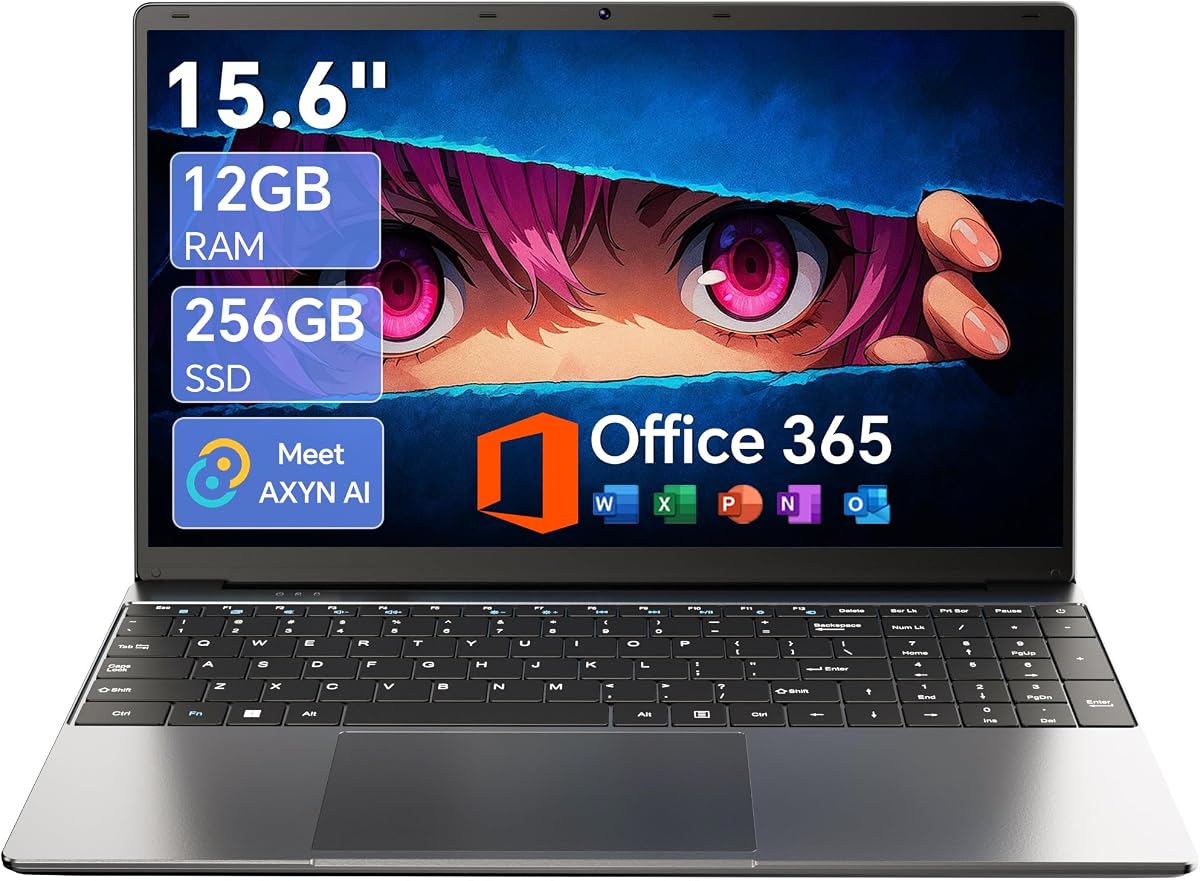
15.6'' AI Laptop with Office 365 12GB RAM 256GB SSD Win 11 Laptops | 7000mAh Bat
Budget Windows laptops often sabotage themselves with 4GB of memory. This 15.6-inch AI laptop avoids that trap by pairing a Celeron J4105 with 12GB of RAM and a 256GB SSD. For seniors, that memory cushion can be the difference between “I must have broken it” and “I can leave email open while I check the weather.” Ease of use improves whenever the system stops freezing at the worst moment.
Screen clarity is helped by the 1920x1080 IPS panel and narrow-bezel design. Text and photos look more modern than on stretched HD screens, and wide viewing angles help when two people sit together to look at travel photos. The 180-degree hinge is a small social feature: lay the laptop flatter on a table to share a recipe or a slideshow without forcing everyone to huddle behind one viewing cone.
Keyboard comfort will depend on personal preference with value-tier keyboards, but the 15.6-inch size at least provides a full-width deck rather than a cramped netbook layout. Reliability is a mixed but manageable story. You get solid-state storage and expandable options up to large SSD and TF card capacities, which is excellent planning for the future. Brand support is less battle-tested than HP or Lenovo, so keep receipts, register the warranty, and consider cloud backups from day one.
The 7000mAh battery claim and included Office 365 subscription make this attractive for seniors who want documents and unplugged flexibility without paying for a premium chassis. AI writing and summarizing features may help with letters and club notices if the user enjoys them; if not, they can be ignored without penalty. Take the Celeron limits seriously: streaming, browsing, Zoom, and Office are the sweet spot. Layer on too many desktop utilities and the calm disappears.
We recommend this model when you want Full HD clarity and unusually high RAM for the value tier, and when a family member can handle initial Windows setup. If brand familiarity and long-term service comfort are the highest priorities, spend attention on the HP and Acer options instead.
Install only needed apps, use browser bookmarks instead of random toolbars, enable cloud backup for documents, and expand storage early if photos are important. The hardware can stay pleasant when the software load stays intentional.
A large-print wireless mouse, a simple laptop sleeve, and a printed one-page “how we set this up” sheet often matter more than another gadget. The 180° hinge already helps with shared viewing.
We may earn a commission at no additional cost to you.
HP 17.3“ Touchscreen Laptop with Office 365 for The Web
A 17.3-inch touchscreen can feel almost like a home information kiosk: big photos, big calendar blocks, and the ability to tap what you mean. For seniors with motor or vision challenges who still want a keyboard for passwords and longer notes, that combination is compelling. The inclusion of Office 365 for the web also shortens the path to writing letters and editing simple spreadsheets without a complicated software scavenger hunt.
Keyboard comfort is reinforced by the 10-key number pad. If the user’s weekly computing includes finances, club rosters, or medical tracking numbers, that pad reduces typos and wrist travel. The chassis is inherently desk-oriented; think of it as replacing an old tower-and-monitor setup with something that still folds closed when company arrives.
We need to be transparent about reliability of expectations. The product title points to an AMD Ryzen 5 7430U class machine with 8GB RAM and 256GB SSD, while some about-text fragments in marketplaces sometimes drift toward other HP configurations. Before purchase, confirm the live listing’s processor, memory, and display details match what you expect. Buying the wrong config is one of the few ways a “perfect senior laptop” plan goes sideways.
Assuming the Ryzen 5 / 8GB / 256GB touch configuration you came for, everyday ease of use should be strong for browsing, calls, and documents. It will not match the 16GB / 1TB anti-glare HP for heavy multitasking and local archives, but the touch canvas and number pad create a uniquely senior-friendly interaction style. Wipe the screen gently, raise text scaling, and add an external mouse if finger tapping becomes tiring during long sessions.
Choose this model when oversized touch is the headline desire. Choose the non-touch 300-nit HP 17-inch when brightness, anti-glare reading, and maximum memory/storage headroom matter more than tapping the display.
Confirm processor name, RAM, storage, and whether the panel is touch. Screenshot the order confirmation. That five-minute habit prevents returns and frustration.
Seniors moving from a tablet to a laptop, users who point at screens while asking for help, and households that want one large shared computer on a dining table.
We may earn a commission at no additional cost to you.
15.6" FHD Laptops with AI Assistant Included
High customer ratings can signal that a laptop meets basic expectations well, and this 15.6-inch FHD model’s appeal for seniors is straightforward: a sharp-looking screen, a year of Office 365, and built-in AI assistant modes that can draft text or help summarize reading when someone wants that kind of help. Ease of use still depends on setup quality—AI features only help after Wi-Fi, accounts, and bookmarks are in place—but the ingredients for a friendly first computer are here.
Screen clarity from the 1920x1080 panel is a genuine advantage at this tier. Many cheap laptops still ship fuzzy HD panels that make websites look tired. Here, news sites and photo albums look cleaner, which reduces the urge to buy an external monitor immediately. The ultra-narrow bezel design also makes the display feel larger than older thick-frame machines of the same diagonal size.
Keyboard comfort is acceptable for email and forms on a 15.6-inch deck, though power typists may still prefer a larger 17-inch HP. Reliability requires realistic expectations: a Celeron J4105 with 6GB of RAM can handle everyday browsing and documents, then get sticky if the user opens everything at once. Teach a simple habit—close unused apps—and the machine stays kinder. Expand storage with SSD or TF options when photo counts rise rather than waiting until the disk is full and Windows starts complaining.
The 180-degree lay-flat hinge deserves a senior-specific shout-out. When an adult child is showing “click here, then here,” being able to angle the screen for two viewers reduces chair-shuffling chaos. Ports covering Type-C, USB 3.2, and Mini-HDMI cover mice, flash drives, and a TV connection for slideshow nights.
Consider this a best budget AI helper rather than a forever workstation. It is a smart starter when funds are limited and Full HD clarity matters, especially with Office included for the first year. If you can choose more RAM and a major brand support network, the HP and Acer picks will usually age with less babysitting.
Introduce one AI mode at a time—Write for emails, Read for long articles—and ignore the rest until wanted. Too many new tools at once is how new computers get abandoned.
Put photos in Google Photos or similar, keep the SSD for apps and current documents, and label one USB drive as “Important Scans.” That three-bucket system prevents panic deletions.
We may earn a commission at no additional cost to you.
Amzboy 15.6” Windows 11 Laptop
Silence is underrated in senior computing. The Amzboy’s fanless design means no sudden whir during a quiet evening of solitaire or a late video call. For light sleepers, shared living rooms, and anyone startled by mechanical noise, that calm is a real comfort feature. The 15.6-inch Full HD anti-glare display also exceeds what you might fear from a budget brand—text can look acceptably sharp when Windows scaling is increased.
Ease of use depends heavily on restraint. With 4GB of RAM and an Intel N4020, this laptop wants a simple life: a few browser bookmarks, one document app, and intentional closing of unused windows. Teach that from the first afternoon and many seniors will be fine for email and streaming. Load it like a college multitasking beast and it will feel unreliable even if nothing is technically broken.
Keyboard comfort is typical of lightweight 15.6-inch value machines—usable for messages and forms, less ideal for novel-length writing marathons. Reliability should be framed honestly: expandable TF storage up to 1TB is a clever escape hatch for files, USB-C PD charging simplifies cables, and Windows 11 is familiar. Still, major-brand machines with 8GB or more RAM remain safer primary computers for households that hate troubleshooting.
Where the Amzboy shines is as a quiet, portable companion for straightforward tasks, or as a secondary laptop for travel within the house when the main 17-inch desk machine stays put. Privacy camera support and a lay-flat hinge help with calls and shared viewing. Keep expectations aligned with the hardware, add a TF card early, and this can be a friendly budget step into Windows rather than a frustrating dead end.
If this would be someone’s only computer for the next several years and the budget can stretch, choose one of the 8GB HP, Acer, or Lenovo options above. If you need an inexpensive quiet FHD machine for light daily rituals and understand the RAM ceiling, the Amzboy earns its niche recommendation.
Use one browser profile, limit extensions, avoid leaving video streams running in the background, and restart after heavy update days. Those habits matter more on 4GB systems than on 16GB machines.
Secondary laptop, travel-between-rooms browser, or carefully managed first Windows PC for light needs. Not the best single purchase for heavy photo libraries or complex software.
We may earn a commission at no additional cost to you.

Screen clarity is the feature seniors notice before processor names. Prefer Full HD (1920x1080) or better when reading websites and PDFs is a daily task. Larger 17-inch panels reduce the need for extreme zoom, while good IPS viewing angles help when posture shifts. Anti-glare coatings matter near windows. Touchscreens can help with zooming and launching apps, but a sharp non-touch Full HD panel often beats a dim touch HD panel for pure reading comfort.
After purchase, immediately increase text size, app scaling, and mouse pointer size in system settings. Brightness should be high enough to avoid squinting but not so harsh that evenings feel fatiguing—blue-light reduction modes, like Acer BluelightShield, can help at night.
The easiest laptop is the one whose operating system matches the user’s life. Choose Chrome OS when nearly everything happens in a browser and you want automatic updates with less maintenance. Choose Windows when printers, specialty desktop apps, or family remote-support habits depend on it. In either case, simplify the first screen the user sees: pin two or three apps, create clear desktop shortcuts, and remove decorative clutter that invites accidental clicks.
Keyboard comfort is personal, but patterns help. Larger 15.6- and 17-inch laptops usually offer better key spacing and palm support than compact 13-inch ultraportables. A numeric keypad is valuable for finances and forms. If trackpad gestures feel slippery or imprecise, add a simple wired or wireless mouse with a larger optical sensor—many seniors type more happily once pointing becomes less stressful. Avoid keyboards with ultra-low travel if arthritis makes shallow keys hard to confirm by feel.
Reliability is mostly about not living at the edge of hardware limits. Aim for 8GB of RAM as a practical senior minimum for Windows; 12GB or 16GB feels better when many tabs stay open. Prefer SSD storage over old hard drives for speed and fewer mechanical failures. Capacity needs vary: 128GB can work with strict cloud habits, 256GB is a healthier everyday baseline, and 512GB–1TB is ideal for local photo keepers.
Brand support matters when something goes wrong. HP, Lenovo, and Acer generally offer clearer warranty and driver paths than no-name imports. Whatever you buy, enable automatic backups to the cloud or an external drive. A reliable laptop still needs a reliable recovery plan for the files that matter.
Be honest about mobility. If the computer will live on one desk, choose the largest comfortable screen and do not overpay attention to ultralight marketing. If the user carries it to appointments or other rooms daily, a mid-15-inch machine around three to four pounds is usually the sweet spot. Long battery life reduces anxiety, but a well-placed outlet and a bright screen may matter more than chasing the longest claimed runtime.
Ease of use, screen clarity, keyboard comfort, and reliability matter more than peak performance. A larger Full HD display, straightforward operating system habits, enough RAM to avoid freezes, and SSD storage will improve daily life more than a flashy graphics feature the user will never touch. Match the machine to real tasks—email, video calls, photos, bills—and simplify the home screen on day one.
Often yes, if their world is browser-based. Chrome OS reduces maintenance, updates quietly, and keeps the workspace focused on tabs and bookmarks. The Lenovo IdeaPad 3i Chromebook in this guide is a strong example because it pairs that simplicity with a 15.6-inch Full HD screen and 8GB of RAM. Choose Windows instead when needed desktop software, certain printers, or family support habits depend on it.
Frequently. A 17.3-inch Full HD panel gives more physical space for text and photos, which can reduce constant pinch-zoom and lean-in posture. Models like the HP OmniBook 3 17.3 and the brighter anti-glare HP 17.3 IPS are excellent desk companions. The tradeoff is weight and portability—great at home, less ideal as a daily carry bag laptop.
Only if they already like touch devices. Touch helps with launching apps, zooming maps, and flipping through photos, which is why the HP 15.6-inch touchscreen and HP 17.3-inch touchscreen models appear in this roundup. If the user is happiest with a keyboard and mouse, a sharp non-touch Full HD display may be clearer and less smudge-prone. Touch is a preference, not a requirement.
For Windows, 8GB RAM is a practical minimum for calm everyday use; 12GB or 16GB is better if many tabs stay open. Storage of 256GB is a healthier baseline than 128GB for mixed local files, while 512GB or 1TB suits large photo keepers. Chromebooks can live with smaller local drives if cloud storage is set up well. Underpowered 4GB machines can work for light browsing but frustrate faster as habits grow.
Look for a full-size layout with clear key spacing, decent key travel, and enough palm-rest area. A numeric keypad helps with bills and forms—the HP 15.6 FHD 2026 Edition and several 17-inch HPs are strong on that point. If built-in typing still feels uncertain, add an external keyboard or a larger mouse. Comfort accessories are not “giving up”; they are how many people keep computing enjoyable.
Do a guided setup together. Enlarge text and pointers, pin only essential apps, bookmark key websites, confirm Wi-Fi, and complete one video call successfully. Write a short cheat sheet with the steps for email and calling. Agree on a backup method for photos. The hardware recommendations in this guide help, but confidence usually comes from that shared first hour more than from any single specification.
A little caution is healthy and easy. Prefer models with a physical shutter when available, like the brighter HP 17.3-inch configuration, and teach a habit of closing the shutter after calls. On machines without a shutter, a simple sliding cover sticker works. Also review app permissions so unused tools cannot quietly access the camera. Privacy comfort often increases willingness to use video calling at all.
It depends on where computing happens. Lightweight 15-inch models around three to four pounds are better for appointments, grandkids’ houses, and moving room to room. Large 17-inch machines are better when the laptop replaces a desk computer and reading comfort is the priority. Buying ultralight “just in case” while actually needing a bigger screen is a common mismatch—choose for the weekday pattern, not the rare trip.
For most households, the HP OmniBook 3 17.3-inch laptop is the safest overall gift: large Full HD IPS clarity, everyday AMD performance, 512GB of SSD storage, and strong battery positioning in a mainstream HP package. If the recipient wants the simplest possible learning curve and already uses Google tools, gift the Lenovo IdeaPad 3i Chromebook instead. If they need maximum multitasking headroom and a bright anti-glare desk screen, choose the HP 17.3-inch Ryzen 5 model with 16GB RAM and 1TB storage.
The best laptop for a senior in 2026 is the one that makes ordinary days feel ordinary: email opens, words are readable, keys feel trustworthy, and the machine does not invent emergencies. That is why this roundup privileges ease of use, screen clarity, keyboard comfort, and reliability over novelty. A calm Full HD 17-inch Windows laptop, a simple Chromebook with enough memory, or a bright high-RAM desk machine will beat a confusing ultraportable every time for this audience.
If you want one default recommendation, start with the HP OmniBook 3 17.3 for balanced big-screen Windows living. Choose the Lenovo IdeaPad 3i Chromebook when simplicity and automatic upkeep matter most. Step up to the HP 17.3-inch 300-nit Ryzen 5 configuration when brightness, multitasking headroom, and long-term storage are the gift goals. Then spend your remaining energy on setup—not more shopping—because a well-prepared home screen is what turns a good laptop into a companion that actually gets used.