Keyboard geometry beats accessory thickness alone
Wrist pain from typing often starts with ulnar deviation—wrists bending sideways toward a flat centerline—and extension, where the heel of your hand drops below your knuckles because the keyboard sits too high or too flat. A thick wrist rest can help only when it keeps wrists neutral relative to forearms, not when it props your palms so high that you reach upward to hit keys. That is why Logitech Wave Keys and the Arteck split appear in this guide alongside foam rests: changing key plane angle and hand splay addresses root posture, while memory foam supports the weight your muscles should not carry for eight hours.
If you already own a keyboard you love, prioritize negative tilt and rest height before buying another board. Integrated stands like the Ergonomic Wave Wrist Rest with Keyboard Stand and the 3-in-1 Ergonomic Keyboard Stand lift the front edge so fingers travel downward slightly—a posture many ergonomists prefer over positive tilt. Pair that with a rest that fills the gap between desk and palm without forcing wrist flexion.
Memory foam thickness and rebound speed
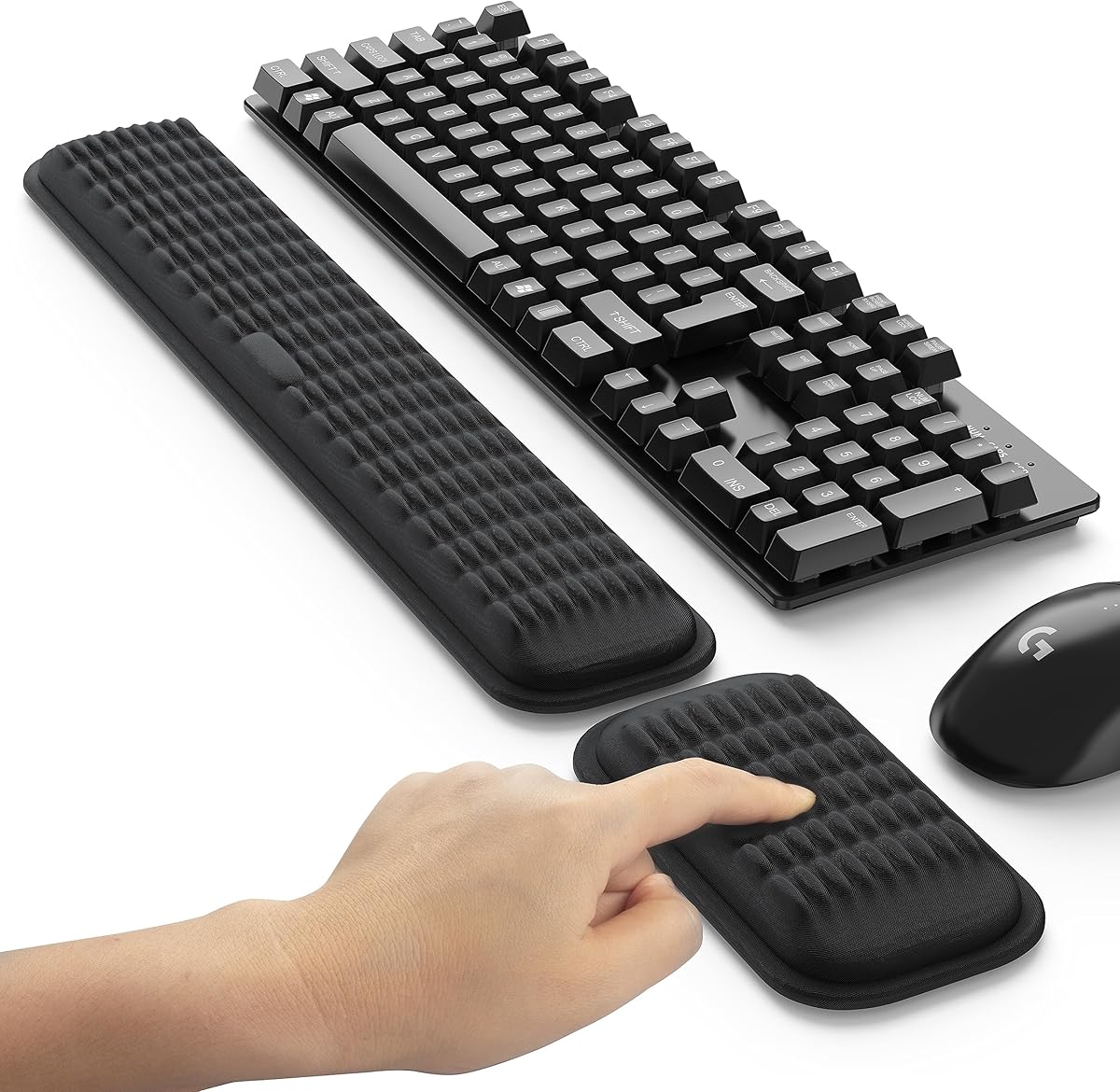
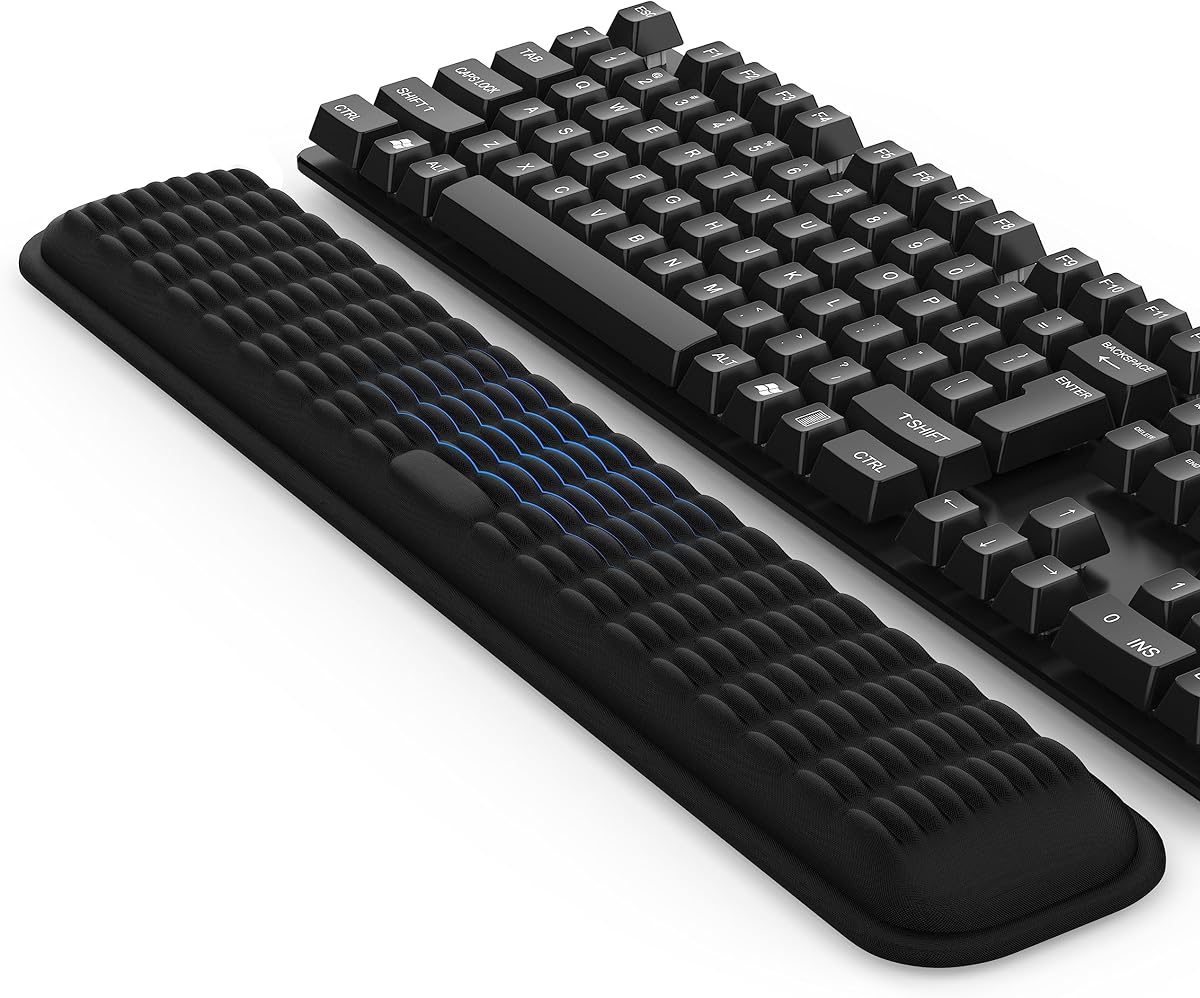
Wrist rests in this pack range from roughly 0.79 inch on MEKASS slim pads to 1.2 inch on GORILLA GRIP and Gimars sets. Thicker foam spreads pressure over a larger area, which feels luxurious during the first hour but can feel mushy if rebound is too slow—your wrists sink and stay sunk. Slow bounce-back memory foam, marketed as medical-grade or premium, is the sweet spot: support without rock-hard resistance.
Massage-pattern surfaces on MEKASS, the wave stand, and the 3-in-1 set add texture that some users describe as stimulating circulation; others find it distracting during precision editing. There is no clinical universal here—try to match texture preference to whether you type long prose blocks or jump between spreadsheet cells where palm stability matters more than sensory feedback.
Split keyboards and adaptation time
The Arteck split and Logitech Wave Keys represent two adaptation curves. Wave Keys keeps keys on one chassis with a gentle wave—usually days, not weeks, before speed returns. Arteck physically separates left and right clusters, which can reduce forearm twist for users whose pain tracks to splay rather than vertical angle, but touch typists should budget one to two weeks of reduced speed while punctuation and B-key muscle memory recalibrate.
Do not buy a split during a deadline week unless you keep your old board connected as backup. Ergonomic migration works best with short daily sessions, monitor height adjusted so eyes land on the top third of the screen, and elbows near ninety degrees. Accessories cannot fix a chair that forces shoulders upward or a laptop perched on a coffee table.
Desk surface grip and bundle value
Every rest in this roundup claims non-slip bases—silicone on MEKASS, rubber on GORILLA GRIP and Yolanda, PU on integrated stands. Glass desks and lacquered wood test these claims hardest. Gimars includes adhesive stickers for extra grip; VAGAU ships two full sets so home and office each get a matched pair without daily transport.
Keyboard-only rests like MEKASS single pad suit users who already solved mouse-side pain with a vertical mouse or who use a trackpad. Two-piece sets from MEKASS dual pack, GORILLA GRIP, Gimars, and Yolanda address bilateral fatigue when both hands log equal hours. The VAGAU four-piece value pack is strongest when you maintain two workstations or want a spare set in a laptop bag.
When to see a professional instead of shopping
Keyboards and wrist rests reduce strain; they do not diagnose carpal tunnel, tendonitis, or nerve compression. Persistent numbness, night waking with tingling, or pain that spreads past the wrist into the elbow deserves medical evaluation before you spend on desk gear. Occupational therapists often recommend specific negative tilt angles and break schedules that no Amazon listing can personalize.
Within safe self-care territory, combine gear with the twenty-twenty-twenty habit for eyes and hourly thirty-second hand stretches. The best product in this guide is the one you will use consistently—not the thickest foam or the most aggressive split if it collects dust after a frustrating week one.