Best Overall
Samsung 25" Odyssey G4 300Hz

- 25" Fast IPS 300Hz with G-Sync Compatible and FreeSync Premium
- HDR10, Black Equalizer, and Virtual Aim Point for competitive visibility
- Full ergonomic stand with height, pivot, swivel, and tilt adjustments
Expert Review & Guide
High refresh gaming monitors stopped being a luxury tier years ago, but the under-three-hundred bracket in 2026 is where the spec war actually matters for most desks. You can now find genuine 300Hz panels, Fast IPS color, curved 1500R immersion, and even 1440p QHD options that would have belonged to flagship lines half a generation back. The catch is that marketing numbers multiply faster than useful buying advice—HDMI caps, panel type, ergonomics, and warranty language separate a monitor you keep for years from one you return after a week of coil whine.
This roundup is built from a fixed product pack so every recommendation stays shoppable and comparable. Samsung's Odyssey G4 leads on polish and buyer confidence, KTC's H25Y7 family delivers 300Hz Fast IPS value with real ergonomic stands, and Z-Edge's curved 27-inch models wrap FHD action for immersion-first players. Acer and AOC push QHD resolution into the same budget conversation, while Gawfolk and ArcticPro cover speakers, wide gamut, and frameless aesthetics niches. Ratings, titles, images, and Amazon URLs come straight from the pack; editorial judgment focuses on who each monitor actually serves.
Start with the three top picks if you want a shortlist, then use the comparison table and full reviews to match refresh paths, panel type, and desk ergonomics to your GPU and seating distance. The buying guide explains when 300Hz matters versus when QHD or curvature should win, how Adaptive Sync and FreeSync Premium behave across AMD and NVIDIA cards, and which connectivity details determine whether your console or laptop hits its advertised refresh.
As an Amazon Associate we earn from qualifying purchases. We may earn a commission at no additional cost to you.
Every model below comes from the same product pack and is evaluated for sub-three-hundred desk gaming—not generic office use. Specs highlight size and resolution, refresh headroom over DisplayPort versus HDMI, and adaptive-sync or HDR language. Remember that peak refresh depends on cable, port, and GPU: a 300Hz marketing line does not automatically apply on every input or console handshake.
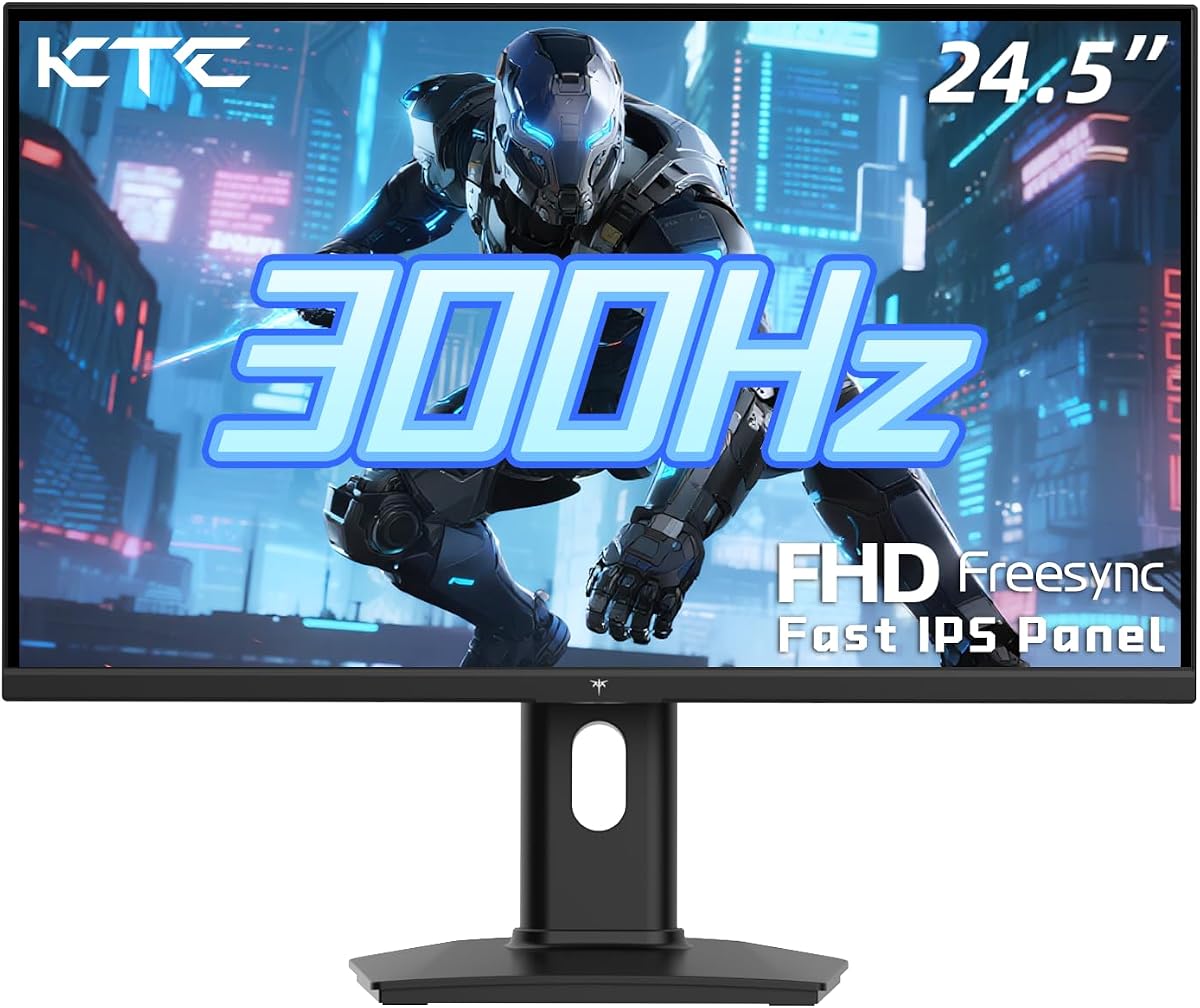
KTC 24.5 Inch 300Hz Gaming Monitor
The KTC H25Y7 is the esports-first pick in this sub-three-hundred roundup because it pairs a genuine 300Hz ceiling with a Fast IPS panel that still cares about color. At 24.5 inches and 1920×1080, pixel density sits in the sweet spot competitive players prefer: large enough to read minimaps, small enough that you are not chasing individual pixels across a wide desk. DisplayPort 1.4 unlocks the full 300Hz refresh, while dual HDMI 2.0 inputs reach 240Hz for secondary devices or consoles that cannot handshake higher.
Motion performance is the headline. One-millisecond MPRT response and Adaptive Sync work together so strafing, flick shots, and quick 180-degree turns stay legible instead of smearing into gray trails. That matters in titles where frame time consistency is as important as peak FPS. KTC's marketing leans into CrossHair and RTS/FPS assistant language, but the practical win is simply how stable fast motion looks when your GPU can feed the panel.
Color and comfort are better than the old TN esports stereotype. One-hundred-nineteen percent sRGB coverage, 8-bit color, and 178-degree viewing angles mean teammates peeking from the side of a LAN setup still see a usable image. Low blue light, anti-glare coating, and flicker-free backlighting help marathon sessions, while the stand offers height adjustment up to 110 millimeters, pivot, and tilt so you can align the panel with your eye line without stacking books under the base.
Connectivity is straightforward for a dual-system desk. Run your gaming PC over DisplayPort for 300Hz, park a console or streaming box on HDMI at up to 240Hz, and use VESA 100×100 mounting if you want the screen on an arm. KTC includes a DisplayPort cable in the box, which sounds minor until you realize how many budget monitors force a separate purchase before you can hit advertised refresh rates.
Tradeoffs are honest. This is still 1080p in a pack that includes 1440p options, so productivity users who live in spreadsheets may prefer the Acer Nitro's WQHD canvas. HDR here is an enhancement layer, not a reference mastering monitor. HDMI bandwidth also means PlayStation or Xbox owners should confirm which refresh modes their console actually outputs over HDMI 2.0 before assuming 300Hz everywhere.
Buy the KTC H25Y7 when you want maximum refresh for the money, Fast IPS color, and a stand that adjusts like a more expensive panel. Skip it if QHD sharpness or a curved immersive wrap matters more than frame-rate headroom. Inside this price bracket, it is one of the most complete 300Hz packages because ergonomics and warranty are not afterthoughts.
Setup tip: enable Adaptive Sync in the monitor OSD and your GPU control panel, use DisplayPort for the primary gaming PC, and create separate picture presets for SDR ranked play versus HDR story titles so you are not constantly digging through menus mid-match.
Choose this size and resolution if you sit close, prioritize aim tracking over cinematic scale, and run a GPU that can sustain high frame rates in esports titles. The format is tournament-standard for a reason: less head movement, faster pixel response perception, and easier desk fit in dorm rooms or shared spaces.
Treat DisplayPort as the path to 300Hz on PC. HDMI 2.0 remains excellent for 240Hz on secondary devices, but always select the correct input in the OSD after swapping cables. If motion feels capped, the first check is whether you accidentally landed on HDMI with a lower EDID limit.
The alternate KTC H25Y7 SKU adds a USB port and FreeSync branding with similar core specs. Pick this listing when you want the bundled DP cable and slightly higher rating momentum; pick the sibling if USB downstream or a specific stand finish matters for your desk photo.
We may earn a commission at no additional cost to you.

KTC 24.5 Inch FHD 300Hz Fast IPS Gaming Monitor
KTC's second 24.5-inch 300Hz listing is essentially the same H25Y7 story told with FreeSync-forward marketing and a USB port on the I/O cluster. You still get Fast IPS, 1920×1080 resolution, 300Hz over DisplayPort, 240Hz over HDMI 2.0, and the ergonomic stand that makes this brand competitive in the sub-three-hundred tier. If you already understand the first KTC pick, think of this model as a sibling SKU rather than a different performance class.
FreeSync support matters when your AMD or Intel GPU fluctuates frame rates in open-world games. Adaptive Sync reduces tearing without forcing you to lock frames artificially low. Combined with 1ms response claims and 300Hz headroom, the panel stays relevant for Valorant, Apex Legends, Fortnite, and other titles where every millisecond of motion clarity is debated on Reddit threads.
The USB port is easy to overlook and genuinely useful. Plug a wireless dongle for your mouse, leave a firmware updater attached, or charge a controller without crawling under the desk. It is USB 2.0, so do not expect high-speed SSD transfers, but for clutter reduction on a compact battlestation it earns its space.
Color performance mirrors the other KTC: 119% sRGB, wide viewing angles, and HDR for supported content. This is not a color-critical mastering monitor, yet it avoids the washed-out look that plagued early high-refresh TN panels. For students who game at night and edit slideshows by day, the balance is practical.
Shopping advice: compare current availability, warranty language, and included cables between the two KTC listings before checkout. Spec overlap is high, so let bundle differences and recent buyer feedback break the tie rather than chasing a mythical performance gap that does not exist on paper.
Pick this KTC variant when FreeSync branding, USB downstream, or a specific listing's shipping window fits your cart better than the primary H25Y7 page. Pass if you need 1440p or a curved immersive field of view. For pure 1080p speed with modern I/O, it remains a top-tier value.
After unboxing, update firmware if KTC publishes a revision, enable FreeSync in both OSD and GPU settings, and label your cables at the back so console swaps do not accidentally land on the wrong HDMI cap.
Both KTC 24.5-inch panels target the same gamer. Compare price, included accessories, and recent ratings rather than hunting for a hidden spec delta. One listing may ship with a different stand finish or promotional cable bundle even though the panel class is shared.
Use the USB port for low-power peripherals you want visible at desk height. Avoid bus-powered hard drives that expect USB 3 bandwidth. A controller charging cable or wireless headset dongle is the ideal workload.
We may earn a commission at no additional cost to you.

Gawfolk 24.5 Inch PC 300Hz Gaming Monitor
Gawfolk's 24.5-inch 300Hz monitor is the budget-speed option for shoppers who want triple-digit refresh without assuming every premium extra. The VA panel delivers strong contrast and 98% sRGB coverage, while DisplayPort unlocks 300Hz and HDMI serves up to 120Hz for consoles or older laptops. Built-in dual speakers are rare at this tier and handy for Discord nights when your headset is dead.
VA versus IPS is the main philosophical trade. VA often wins deeper blacks and punchier contrast in story-driven games, while Fast IPS panels in the KTC and Samsung picks feel slightly snappier in pure competitive motion. If you split time between RPGs and ranked shooters, decide whether contrast immersion or esports edge matters more. Adaptive Sync still helps either way when frame rates bounce.
The near-bezelless design and 178-degree viewing angles keep the monitor presentable in shared living spaces. DC global dimming and a low blue light mode address eye fatigue, which matters when this class of monitor frequently lands in dorm desks and first-apartment setups where lighting is imperfect.
Mounting uses 75×75 VESA rather than the more common 100×100 pattern. Monitor arms exist for both, but verify your arm's plate before ordering. Cable management is simple with DisplayPort and HDMI on the rear, though you should still route power separately to avoid hum.
Gawfolk's twelve-month after-sales window is shorter than KTC's three-year pitch or AOC's zero-bright-dot policy, so treat early dead-pixel checks seriously during the return window. For shoppers optimizing purely for entry 300Hz, the panel still delivers the core experience: high refresh, adaptive sync, and 1080p clarity at 24.5 inches.
Choose Gawfolk when built-in speakers, VA contrast, and the lowest 300Hz entry in the pack align with your priorities. Skip it if you need HDMI 240Hz for a secondary PC or 100×100 VESA without adapter plates. It is an honest budget pick, not a flagship in disguise.
On setup, test both speakers and headphones, confirm DisplayPort is selected for PC gaming, and run a solid-color background test within the first week to catch any pixel defects while returns are easy.
VA can show slight ghosting in high-contrast transitions compared with Fast IPS. Enable overdrive presets conservatively—too aggressive adds coronas, too weak leaves trails. Spend ten minutes in a aim trainer before committing to ranked play.
Built-in speakers suit casual story games and voice chat when you do not want another device on the desk. Competitive players will still prefer headphones for directional audio, but the speakers remove a purchase from the checklist.
We may earn a commission at no additional cost to you.

Z-Edge 27 inch Curved Gaming Monitor
Z-Edge's UG27S is the curved immersion pick at 27 inches and 1080p, combining a 1500R wrap with a 300Hz refresh ceiling over DisplayPort. If you want the battlefield to feel closer without jumping to 1440p budgets, the curve draws your eyes toward center crosshair while the high refresh keeps panning smooth. Dual DisplayPort ports both support 300Hz, which is convenient when you swap between a tower and a laptop dock.
Contrast is a VA strength here: 4000:1 makes night maps and horror titles feel deeper than many IPS rivals in the pack. FreeSync and 1ms response claims target tear-free action, while flicker-free backlighting and low blue light modes acknowledge that curved panels often invite longer sessions precisely because they feel cinematic.
The trade everyone should understand is pixel density. 1080p stretched across 27 inches is noticeably softer than the same resolution at 24.5 inches. Sit slightly farther back or prioritize immersion over pixel peeping and the compromise feels fine. If you sit close for esports pixel clarity, the Acer Nitro's QHD flat panel or the KTC 24.5 may fit better.
Connectivity is generous: two DisplayPort and two HDMI ports, with HDMI supporting up to 240Hz depending on source EDID. Mount on 100×100 VESA arms to reclaim desk depth curved bases sometimes consume. The three-sided borderless look also plays nicely in dual-monitor setups where a second screen sits flush.
Z-Edge competes directly with its own UG27H frameless variant elsewhere in this pack. The UG27S emphasizes metal stand build and 4000:1 contrast marketing, while the UG27H pushes a sleeker bezel story. Compare stand photos and recent buyer comments about coil whine or backlight bleed before choosing between siblings.
Buy the UG27S when you want curved 27-inch immersion plus 300Hz PC headroom under three hundred. Skip it if text sharpness for productivity is paramount or you dislike curvature for editing work. For story-heavy libraries and mixed shooters, it delivers a theatrical desk without OLED money.
Calibrate expectations on day one: set overdrive to a middle preset, use DisplayPort for 300Hz on PC, and sit at a distance where the curve's benefits outweigh the lower PPI of 1080p at this size.
Sit roughly arm's length or slightly farther so the 1500R radius feels natural and pixel structure softens. Too close and 1080p at 27 inches can look chunky in browsers; too far and you lose the wrap advantage.
Label DP1 and DP2 at the rear if you hot-swap between a desktop and a work laptop. Both ports advertise 300Hz support, but your source GPU and cable quality still determine the handshake.
The AOC CQ27G4ZH jumps to 1440p on a curved VA canvas. Choose Z-Edge UG27S for maximum refresh at FHD; choose AOC when sharper UI and QHD detail outweigh absolute Hz marketing on paper.
We may earn a commission at no additional cost to you.
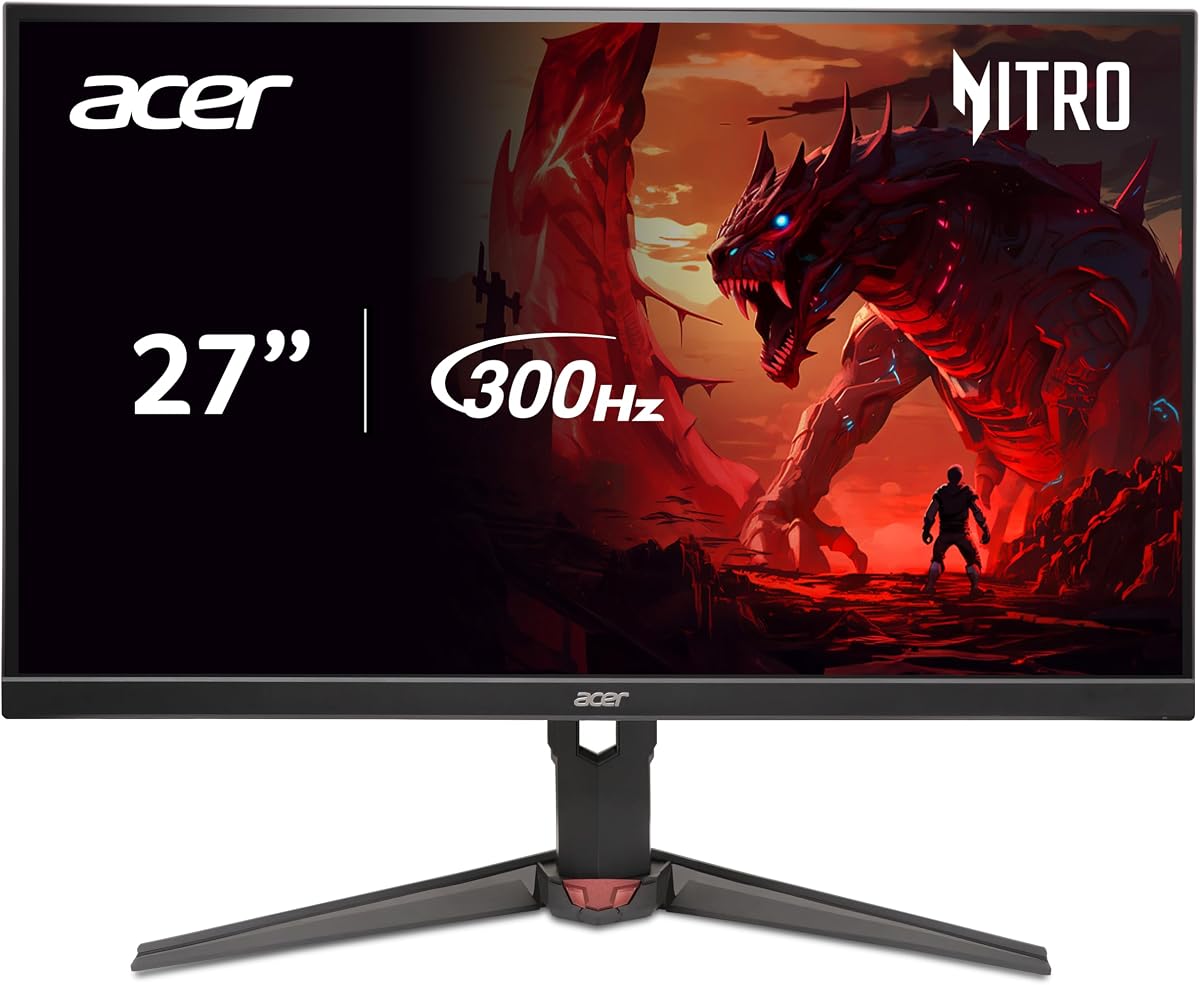
Acer's Nitro XV272U F3 is the resolution outlier here: 27-inch WQHD at up to 300Hz on an IPS panel with FreeSync Premium, DisplayHDR 400, and 99% sRGB coverage. That combination matters when you want one monitor for ranked shooters and daytime productivity without living on a blurry 1080p spreadsheet. ZeroFrame bezels and an ErgoStand reinforce the sense that Acer intended a primary desk display, not a disposable secondary panel.
Refresh and response claims are aggressive—300Hz with up to 0.5ms GTG—so pairing matters. A midrange GPU will not magically produce 300 frames at 1440p in modern AAA titles, but esports settings and older games can approach the ceiling, leaving headroom as you upgrade hardware. FreeSync Premium keeps frame pacing smoother when counts dip during chaotic team fights.
Color accuracy at 99% sRGB is a genuine productivity win. Photo hobbyists, stream overlays, and UI design work benefit from IPS consistency and wide viewing angles. DisplayHDR 400 adds punch in supported games and movies, though temper expectations: this is not a mini-LED flagship. Use HDR where it helps, fall back to calibrated SDR for competitive integrity.
HDMI 2.1 on two ports opens console conversations that basic HDMI 2.0 monitors cannot match, but always verify which resolution and refresh combos your PlayStation or Xbox actually outputs to PC monitors. The PS5 in particular has nuanced 1440p support history; read the latest firmware notes and test your favorite titles rather than assuming marketing checkboxes equal in-game behavior.
The 4.1 rating is a yellow flag worth respecting. Acer Nitro lines sometimes ship excellent panels with occasional quality-control variance. Inspect for backlight bleed, dead pixels, and coil whine during the return window, and keep firmware updated. When the panel is good, it punches far above its tier for QHD speed.
Choose the Nitro when sharper text, higher pixel density, and 300Hz ambitions overlap on your desk. Skip it if you prioritize maximum FHD frame rates on modest GPUs or want Samsung-level brand polish. For mixed gamers who also work from the same screen, it is the clearest QHD upgrade in this roundup.
Setup checklist: use DisplayPort 1.4 for PC 300Hz attempts, create an esports SDR preset with reduced overshoot, and run a separate productivity profile with warmer white point for documents.
Budget GPUs may drive this panel beautifully at 1440p144 or 165 in esports titles while AAA games sit lower. That is fine—FreeSync Premium covers the gap. Buy for the resolution you want today and the refresh headroom you will grow into.
HDMI 2.1 enables higher-bandwidth modes in theory, but console OS support varies. Test your exact box, enable VRR if available, and prefer Game Mode on the monitor when playing from a living-room console temporarily moved to desk duty.
Run Eizo monitor tests or solid-color fullscreen pages within week one. Acer's ErgoStand makes tilt adjustments easy for glare checks. Document any uniformity issues promptly while seller return policies are fresh.
We may earn a commission at no additional cost to you.

ArcticPro 27 Inch Gaming Monitor
ArcticPro's 27-inch 300Hz monitor targets shoppers who want a bigger canvas without leaving 1080p or the sub-three-hundred bracket. IPS keeps viewing angles honest, while 125% sRGB and 90% NTSC coverage deliver noticeably richer greens and reds than basic office panels. A three-sided frameless design helps the screen disappear into multi-monitor setups common in streaming and day-trading desks.
Refresh routing follows the pack norm: DisplayPort 1.4 up to 300Hz on dual DP inputs, HDMI 2.0 up to 240Hz on dual HDMI. Adaptive Sync and 1ms MPRT tackle tearing when your GPU cannot hold a locked 300 frames. Low blue light modes acknowledge that 27-inch monitors often double as all-day work displays.
The size-versus-sharpness conversation repeats here. 1080p at 27 inches is workable for gaming at moderate distance but softer for small text. If you sit close for esports, a 24.5-inch KTC or Z-Edge UG25S feels crisper. If you want one larger panel for couch-adjacent viewing and casual PC use, ArcticPro's extra diagonal can feel more relaxing.
VESA 100×100 mounting and 178-degree viewing angles make wall or arm placement straightforward. ArcticPro includes a DisplayPort cable, reducing day-one friction. Warranty and support are brand-dependent, so treat the first month as an extended evaluation window.
Compared with the curved Z-Edge 27-inch models, ArcticPro stays flat and color-forward. Compared with Acer, it stays at FHD rather than QHD. That niche—big, fast, colorful, flat—is specific, and ArcticPro fills it without pretending to be a Samsung Odyssey.
Pick ArcticPro when wide color at 1080p and a frameless 27-inch face match your aesthetic. Skip it if pixel density or premium brand service is non-negotiable. It is a solid middle ground between compact esports panels and heavy curved VA theaters.
Tune overdrive after enabling Adaptive Sync, keep brightness moderate for IPS longevity, and test both DP ports if one handshake feels unstable with your GPU revision.
125% sRGB makes Fortnite, Rocket League, and stylized indies pop. Disable oversaturated modes for color-accurate photo edits or switch to a sRGB-emulation preset if the OSD provides one.
Pair two ArcticPro panels only if you accept 1080p text at 27 inches. For mixed use, consider this as a primary gaming screen with a vertical 24-inch secondary for chat and streams.
We may earn a commission at no additional cost to you.

AOC 27 Inch Curved 2K QHD 300Hz
AOC's CQ27G4ZH merges two trends in this roundup: curved immersion and QHD resolution. The 27-inch 2560×1440 VA panel uses a 1500R radius, 300Hz over DisplayPort, and 0.5ms response claims to chase both cinematic depth and competitive speed. For gamers who found flat 1080p too plain and flat QHD too sterile, the curve adds presence without jumping to ultrawide budgets.
Contrast and HDR readiness play to VA strengths. High dynamic contrast and HDR modes make explosions and skyboxes feel layered, while flicker-free and low blue light tech support longer RPG sessions. Adaptive-Sync keeps frame pacing tolerable when your GPU swings between 120 and 200 frames in open worlds.
Ownership peace matters: AOC's three-year zero-bright-dot warranty is one of the stronger policies in this pack. Dead pixels ruin mood instantly; knowing the manufacturer stands behind the panel for three years is worth weighing against slightly cheaper curved alternatives.
Connectivity includes DisplayPort 1.4, dual HDMI 2.0, earphone out, and VESA mounting. HDMI tops at 144Hz per AOC's spec sheet, so treat DisplayPort as the PC performance path and HDMI as console or laptop convenience. Earphone out is handy when your tower lives under the desk and headset cables need a shorter run.
Tradeoffs versus the Acer Nitro flat QHD panel come down to curve versus color accuracy branding. Acer pushes IPS, 99% sRGB, and HDR400; AOC pushes curved VA, contrast, and warranty. Esports purists may prefer flat IPS; immersion seekers may accept VA motion nuances for the wrap.
Choose AOC when curved QHD at 300Hz and a strong warranty align with your risk tolerance. Skip it if you need HDMI 240Hz or the flattest motion response for tournament practice. It is one of the most balanced story-and-speed curved options here.
After setup, verify DP link training at your target refresh, use a middle overdrive step, and run HDR only in titles that benefit—competitive modes often look cleaner in SDR with higher effective contrast on VA anyway.
1440p at high refresh consumes more GPU than 1080p. Expect to tune settings in AAA games while esports titles reach higher frames. The monitor's job is to provide headroom; your GPU decides how close you get day to day.
Photograph any stuck or dead pixels during the first weeks and contact AOC support with serial photos if needed. Keep packaging briefly in case a swap is required—rare, but the warranty exists for a reason.
Pick AOC for curved contrast and warranty; pick Acer for IPS color metrics and ZeroFrame flat aesthetics. Both legitimately serve QHD 300Hz ambitions under three hundred.
We may earn a commission at no additional cost to you.

Z-Edge 24.5 inch 300Hz Gaming Monitor
Z-Edge's UG25S is the compact IPS speed alternative to the KTC H25Y7 at the same 24.5-inch 1080p form factor. Two DisplayPort 1.4 inputs unlock 300Hz, two HDMI 2.0 ports reach 240Hz, and 1ms MPRT keeps motion crisp for arena shooters. IPS means friends watching from an angle still see a recognizable image, which matters in dorm rooms and LAN viewing.
Preset FPS and RTS modes are not magic, but they save time tuning contrast and color when swapping between a muted tactical shooter and a vibrant strategy title. Combined with flicker-free backlighting and low blue light, the monitor acknowledges mixed-use desks where gaming sessions bleed into homework tabs.
Build aesthetics lean modern: three-sided borderless bezels and a dynamic contrast ratio marketing line that translates, in practice, to punchier SDR if you avoid maxed-out brightness in dark rooms. Dual inputs make it easy to keep a console on HDMI while the PC uses DisplayPort without constant rear crawling.
Versus KTC, Z-Edge trades the height/pivot stand for a slightly different I/O layout and game presets. Versus Gawfolk VA, Z-Edge chases IPS motion consistency. Your stand and mounting needs should break that tie—KTC wins ergonomics, Z-Edge wins if you already own a 75×75 arm.
The 4.6 rating matches the top KTC and curved Z-Edge entries, suggesting buyers find the value proposition fair. Still inspect for backlight bleed on arrival; IPS panels at aggressive tiers sometimes need a lottery check.
Buy UG25S when you want 24.5-inch IPS 300Hz with dual DP redundancy and genre presets. Skip it if you need height adjustment out of the box or 100×100 VESA without adapters. It is a tight esports value with Z-Edge's connectivity story.
Label cables, enable the appropriate game preset per genre, and cap frames slightly below 300 if you notice tearing despite adaptive sync—some GPU drivers need a frame limiter for perfect pacing.
Use FPS mode when shadow detail matters for enemy spotting, RTS mode when map readability and color separation help. Reset to standard for movies to avoid crushed blacks.
Confirm your monitor arm supports 75×75 or buy a VESA adapter plate rated for 24-inch panels. Proper mounting improves stability at 300Hz more than you expect—wobble makes motion feel worse even when frames are high.
We may earn a commission at no additional cost to you.

Z-Edge 27 inch Curved Gaming Monitor UG27H
The Z-Edge UG27H is the frameless sibling to the UG27S curved 27-inch 1080p300Hz formula. You still get 1500R immersion, 1ms MPRT, FreeSync, dual DisplayPort 300Hz support, and dual HDMI up to 240Hz, but marketing emphasizes a sleeker three-sided frameless look that photographs well in setup tours. If aesthetics matter as much as refresh, the UG27H often wins the beauty contest inside this price bracket.
Motion and contrast follow the same philosophy as the UG27S: prioritize fluid gameplay and VA-style depth at FHD. Competitive players should test overdrive carefully—curved VA at high refresh can look stunning in racing and third-person action while showing minor trails in high-contrast FPS strafing. Adaptive Sync mitigates tearing when frame rates fluctuate.
Connectivity duplicates the powerful dual-DP story, which is underrated on budget monitors. Keep a gaming tower on one DP input and a work laptop on the second without unplugging cables daily. HDMI remains the console path, though always confirm which refresh cap your source negotiates.
100×100 VESA is standard here, unlike the 75×75 on smaller Z-Edge models. Mounting frees desk space curved stands sometimes consume and lets you pull the panel closer for immersion without sacrificing ergonomics.
Choosing between UG27H and UG27S often comes down to stand preference, bezel photos, and whichever listing has better recent fulfillment. Performance class is parallel; do not expect a massive spec gap. If you dislike curvature entirely, pivot to ArcticPro flat 27 or Acer QHD instead.
Pick UG27H when you want curved 300Hz with a frameless face and standard VESA. Skip it for spreadsheet-heavy jobs where straight lines at screen edges annoy you. It delivers cinematic FHD gaming under three hundred with minimal bezel distraction.
Spend time adjusting curvature distance, disable unnecessary image enhancement modes that add input lag, and use FreeSync on both PC and compatible consoles for smoother frame delivery.
Compare stand stability, bezel photos, and recent buyer photos of coil whine. Spec sheets overlap heavily; let aesthetics and fulfillment break the tie unless one listing bundles a better cable set.
If you edit spreadsheets or code daily, test straight-line distortion at edges before return windows close. Many gamers happily accept the trade; designers sometimes prefer flat QHD instead.
We may earn a commission at no additional cost to you.
Samsung's Odyssey G4 G40H is the clearest best-overall pick in this sub-three-hundred gaming monitor pack because it combines elite motion specs with brand-level tuning tools and a 4.8 buyer rating that leads the table. The 25-inch Fast IPS panel runs at 300Hz with 1ms response, G-Sync Compatible validation, and AMD FreeSync Premium—an adaptive-sync double stamp that matters when you swap between NVIDIA and AMD GPUs over a console generation.
Motion clarity is the Odyssey calling card. Three-hundred hertz is not marketing wallpaper when your GPU can feed it; flick transitions and tracking targets stay separated instead of blending. Fast IPS keeps colors stable across 178-degree viewing angles, so the panel still works for co-op couch spectators even though it is sized for desk play.
Samsung layers gamer utilities that budget brands mimic but rarely tune as well. HDR10 improves contrast headroom in supported titles. Black Equalizer lifts shadow detail so campers in dark corners become visible without blowing out midtones. Virtual Aim Point adds an on-screen reticle when games lack precision options. These features sound gimmicky until a ranked session proves otherwise.
Ergonomics are class-leading here: tilt, pivot, swivel, and height adjustment let you align the panel with your posture instead of compromising your neck for frame rate. That matters when this monitor is likely your only display for work calls, homework, and midnight queues.
Tradeoffs remain. Twenty-five inches at 1080p is a middle ground—not as pixel-dense as QHD Acer or AOC options, not as compact as 24.5-inch KTC/Z-Edge esports sizes. Samsung pricing can approach the top of the under-three-hundred brief, so compare street pricing against the QHD panels before assuming brand premium is unjustified.
Buy the Odyssey G4 when you want the most polished 300Hz Fast IPS package with adaptive sync for both GPU vendors and Samsung's competitive visibility tools. Skip it if you need 1440p for productivity or a curved immersive wrap. For all-around desk gaming under three hundred, it is the benchmark others in this guide are judged against.
Enable FreeSync or G-Sync in GPU settings, set Black Equalizer conservatively, create an SDR ranked preset separate from HDR story modes, and use the ergonomic stand to keep the top bezel near eye level for long sessions.
Raise Black Equalizer until shadowed enemies appear, then stop. Overdoing it washes contrast and hides muzzle flashes. Save a second user preset with lower equalizer for horror titles that rely on deep blacks.
On NVIDIA, enable G-Sync for fullscreen and windowed in Control Panel after turning on Adaptive Sync in the monitor OSD. On AMD, use FreeSync Premium. Cap frames slightly below 300 if you notice flicker at the ceiling.
KTC wins raw value and sometimes includes longer warranty language at lower cost. Samsung wins tuning tools, ergonomics, and buyer-confidence ratings. Choose Samsung when polish matters; choose KTC when every feature at this tier counts.
We may earn a commission at no additional cost to you.
Three-hundred hertz sounds futuristic, but it only improves what you can see when your GPU actually delivers high frame rates at your chosen resolution. At 1080p on midrange and upper-midrange cards, esports titles like Valorant, CS2, Fortnite, and Rocket League can approach or exceed 240 frames, making 300Hz panels meaningful for motion clarity and input responsiveness. At 1440p, even strong GPUs may spend more time between 120 and 200 frames in modern AAA games—still excellent with FreeSync, but not always saturating a 300Hz ceiling.
Buy 300Hz when you play competitive titles at lower settings and care about motion separation during flicks. Consider 144Hz–240Hz class value if you mostly play cinematic single-player games at max settings. In this pack, KTC, Z-Edge, Gawfolk, ArcticPro, and Samsung chase 300Hz at FHD, while Acer and AOC pair 300Hz marketing with QHD resolution where GPU demands jump.
Fast IPS dominates the esports picks here because it balances response time with color stability and viewing angles. Samsung's Odyssey G4, both KTC 24.5-inch models, Z-Edge UG25S, and ArcticPro use IPS-class behavior for shared viewing and consistent hues. VA panels on Gawfolk and the curved Z-Edge and AOC models often deliver higher contrast and deeper blacks—fantastic for story games and night scenes—but may show more ghosting in high-contrast FPS strafing unless overdrive is tuned carefully.
Neither panel type wins every scenario. Esports-first buyers should lean IPS unless they test VA and prefer the contrast. Immersion-first curved buyers should accept VA's quirks or step up to flat QHD IPS on the Acer Nitro if text sharpness matters equally.
1080p at 24.5 inches is the tournament sweet spot: sharp enough for aim clarity, compact enough for small desks. 1080p at 27 inches trades pixel density for a bigger canvas—fine for couch-adjacent viewing and relaxed gaming, softer for small text. 1440p at 27 inches is the productivity-friendly upgrade in this pack, sharpening UI, browsers, and creative apps while still gaming beautifully when your GPU cooperates.
Match size to viewing distance. Arm's length favors 24.5–25-inch FHD or 27-inch QHD. Farther seating makes 27-inch FHD curved models feel more natural. Do not buy QHD because it sounds premium if your GPU will lock you to low settings in every title you care about—frame rate consistency often feels better than extra pixels you cannot drive.
Adaptive Sync reduces tearing when frame rates fluctuate below your monitor's max refresh. AMD FreeSync, FreeSync Premium, and NVIDIA G-Sync Compatible are branding layers on the same practical idea: the panel adjusts refresh to match GPU output within a supported range. Samsung's Odyssey G4 carries both G-Sync Compatible and FreeSync Premium validation—a useful dual stamp when you might change GPU brands.
Enable adaptive sync in the monitor OSD and your GPU control panel. If you notice flicker at max refresh, cap frames a few ticks below the ceiling. Console users should verify whether their platform exposes VRR to external monitors on the specific HDMI port they plan to use; PC users should prefer DisplayPort when chasing 300Hz.
DisplayPort 1.4 is the PC path to 300Hz on most models here. HDMI 2.0 commonly reaches 240Hz on FHD panels; HDMI 2.1 on the Acer Nitro opens higher-bandwidth console conversations but still requires source support. Dual DisplayPort inputs on Z-Edge and ArcticPro models simplify multi-PC desks. Include a quality DisplayPort cable in your plan even when one is bundled—cheap cables cause link training failures that look like monitor defects.
Before return windows close, test every port you intend to use, confirm the OSD reports the expected refresh, and label inputs at the rear. Nothing wastes an afternoon like troubleshooting GPU drivers when the issue is simply the wrong HDMI cap.
Stand adjustability matters for marathon sessions. KTC's height-pivot-tilt packages and Samsung's full ergonomic Odyssey stand reduce neck strain more than fixed-base budget curves. If you already own a monitor arm, check VESA patterns: 100×100 is standard on larger Z-Edge and ArcticPro models, while some 24.5-inch panels use 75×75.
Warranty language varies widely in this tier: KTC advertises three years, AOC offers a three-year zero-bright-dot policy, Gawfolk lists twelve months, and Samsung brings mainstream brand support expectations. Inspect for backlight bleed and dead pixels immediately; aggressive tiers sometimes need a panel lottery check regardless of brand name.
It can be, but only if your hardware and games cooperate. At 1080p, competitive titles on capable GPUs frequently exceed 240 frames, and 300Hz panels show smoother motion during fast flicks and tracking. If you mostly play AAA games at max settings where frame rates sit near 60–120, a high-refresh panel still helps with FreeSync, but you will not fully use 300Hz every session. In this pack, 300Hz models from KTC, Samsung, Z-Edge, Gawfolk, and ArcticPro make sense for esports-first desks, while QHD options trade some absolute frame rate for sharper pixels.
Pick 1080p when your GPU is midrange or you prioritize maximum frame rate in shooters and battle royales. The KTC 24.5-inch models, Samsung Odyssey G4, and Z-Edge 24.5 are optimized for that path. Pick 1440p when you sit close for work and play on the same screen and want sharper text, UI, and distant detail—Acer Nitro XV272U and AOC CQ27G4ZH are the QHD anchors here. Remember that 1440p demands more GPU; buying QHD you cannot drive feels worse than smooth 1080p.
Curvature helps immersion and can reduce perceived eye travel in wide scenes, but it is not a substitute for refresh rate or response time. Z-Edge's 1500R 27-inch models and AOC's curved QHD panel excel in racing, RPG, and third-person titles where wrap matters. Flat 24.5-inch IPS panels like KTC and Samsung remain the safer esports choice if you care about pixel consistency at screen edges and straight-line productivity work.
All three indicate adaptive sync support, with vendor branding differences. FreeSync is AMD's baseline label; FreeSync Premium adds stricter low-framerate compensation requirements; G-Sync Compatible means NVIDIA validated the monitor for adaptive sync on GeForce cards. Samsung's Odyssey G4 in this pack carries both G-Sync Compatible and FreeSync Premium, ideal if you might switch GPU brands. Enable the feature in the monitor menu and GPU software—labels alone do nothing until both sides agree.
Many models here include HDMI with adaptive sync support, but console refresh caps differ by port and firmware. HDMI 2.0 inputs commonly reach 240Hz at 1080p on several pack models, while some HDMI paths cap lower. The Acer Nitro's HDMI 2.1 ports invite higher-bandwidth testing with modern consoles, yet always verify your console's supported external monitor modes for 1080p or 1440p high refresh and VRR. Use Game Mode on the monitor, quality HDMI cables, and test a favorite title before assuming PC-grade 300Hz everywhere.
Both listings target the same H25Y7 class hardware with minor I/O and bundle differences—one emphasizes a bundled DisplayPort cable and slightly higher rating, the other adds USB downstream and FreeSync-forward marketing. Compare current availability, included accessories, and recent buyer feedback rather than hunting for a large performance gap. Pick one KTC, not both, unless you are furnishing two desks.
More important than many buyers expect. Height adjustment keeps the top bezel near eye level, reducing neck strain during long sessions. KTC's height-pivot-tilt stands and Samsung's full ergonomic Odyssey package outperform fixed-base curved models that force DIY risers. If you use a monitor arm, confirm VESA size—100×100 versus 75×75—before checkout.
Run fullscreen solid-color tests for dead or stuck pixels, inspect backlight bleed in a dark room, listen for coil whine at high refresh, and confirm the OSD reports the expected Hz on each port. Test DisplayPort and HDMI separately, enable adaptive sync, and update firmware if the manufacturer publishes a revision. Complete these steps inside the return window so defects are negotiable rather than expensive.
They can be secondary or casual creation screens, especially wide-gamut models like ArcticPro at 125% sRGB or Acer at 99% sRGB. However, high-refresh gaming monitors often prioritize motion over factory calibration. If color-critical work is primary, plan on calibration or consider the Acer Nitro's QHD IPS story. For streaming overlays, Discord, and homework between matches, panels in this pack are generally fine.
Samsung's Odyssey G4 leads the pack rating at 4.8 with Fast IPS 300Hz, dual adaptive-sync validation, HDR10, Black Equalizer, Virtual Aim Point, and a fully adjustable stand. If street pricing stretches your budget, KTC's H25Y7 is the value counterpunch with similar refresh, strong ergonomics, and a three-year warranty pitch. Choose Samsung for polish and tools; choose KTC when maximizing specs per feature at 1080p.
The under-three-hundred gaming monitor category in 2026 is no longer about settling—it is about choosing the right compromise. Samsung's Odyssey G4 remains the most polished all-rounder for Fast IPS 300Hz with adaptive sync for both GPU camps and genuinely useful competitive tools. KTC's H25Y7 listings dominate the esports value conversation with ergonomic stands and honest 300Hz DisplayPort paths, while Acer and AOC bring 1440p into the same budget for mixed work-and-play desks.
Curved Z-Edge models reward immersion seekers who accept 1080p at 27 inches, Gawfolk undercuts with VA contrast and built-in speakers, and ArcticPro fills the frameless wide-color middle ground. None of these monitors is perfect for every player, which is exactly why the comparison table and long-form reviews matter: match refresh to GPU, resolution to seating distance, and panel type to the games you actually launch every week.
Buy the panel that fits your desk physics first, then optimize cables and adaptive sync on day one. If motion still feels wrong after setup, suspect the port or cable before blaming the GPU. Used thoughtfully, any monitor in this pack can upgrade a aging 60Hz office screen into a desk you look forward to using—just resist the temptation to chase the highest hertz number if your library never feeds it.