SteelSeries Apex Pro TKL Gen 3
- OmniPoint 3.0 analog magnetic switches with Rapid Trigger and Rapid Tap
- Quickset auto-presets and OLED smart display for in-game tweaks
- TKL layout with PBT keycaps, USB-C, and adjustable actuation from 0.1 mm
Expert Review & Guide
Choosing a gaming keyboard in 2026 is less about finding a board that lights up and more about matching switch feel, layout size, and connection style to how you actually play. Competitive shooters reward adjustable actuation and rapid-trigger behavior. Story-driven games and late-night sessions often favor quieter switches and a comfortable wrist rest. Hybrid desk setups need wireless that does not drop frames when you alt-tab into a Discord call. The market now spans classic mechanical boards, Hall Effect magnetic keyboards, mecha-membrane hybrids, and full keyboard-and-mouse combos, so a one-size-fits-all ranking would miss the point.
We built this roundup from a focused pack of ten Amazon-available keyboards that cover those use cases without padding the list with near-duplicates. You will see premium flagships like the SteelSeries Apex Pro TKL Gen 3 next to value tri-mode boards such as the AULA F75 Pro, compact magnetic options like the AULA WIN68 HE, and quieter daily drivers from SteelSeries, Razer, and TECKNET. Every product below comes from that pack only: same ASINs, images, URLs, titles, and ratings.
Ratings alone do not decide a winner. A 4.7 board with deep software may be overkill if you want plug-and-play RGB and a wrist rest. A 60 percent Hall Effect keyboard can feel unstoppable in Valorant and awkward for spreadsheets. Read the comparison table for a quick shortlist, then dig into the full reviews for sound, switch behavior, layout tradeoffs, and who should skip each model.
As an Amazon Associate we earn from qualifying purchases. We may earn a commission at no additional cost to you.
Use this table to shortlist by layout, switch type, and connectivity before reading the full reviews. Specs focus on how each board behaves day to day, not marketing slogans.
AULA F75 Pro Wireless Mechanical Keyboard
The AULA F75 Pro is the keyboard we would hand most people who want a modern mechanical gaming board without jumping straight into a flagship magnetic lineup. It hits a practical middle ground: seventy-five percent layout, tri-mode wireless, hot-swap sockets, a useful knob, and enough acoustic tuning that it does not sound hollow on a bare desk. That combination matters more in 2026 than another full-size RGB slab with mushy stock switches.
Tri-mode connection is the feature that keeps this board on desks that are not purely gaming rigs. Pair Bluetooth for a laptop or tablet, keep the 2.4 GHz receiver on the main PC, and fall back to USB-C when you need zero-compromise latency or a dead battery. AULA claims support for multiple devices with shortcut or side-button switching, which is genuinely useful if you bounce between a desktop and a work notebook. For ranked shooters, treat 2.4 GHz or wired as the default and reserve Bluetooth for browsing and chat.
Switch feel is where the F75 Pro separates itself from generic wireless boards. Pre-lubricated stabilizers and LEOBOG Reaper switches aim for a smooth, creamy press with less scratch than dry factory switches. The structure uses extended silicone padding and PCB slotting to soften the rebound and reduce cavity ping. Competitive players who hate soft gasket boards may prefer something firmer, but for hybrid gaming and typing, the stock feel is one of the strongest reasons to pick this model over a bare-bones hot-swap shell.
The eighty-one-key seventy-five percent layout preserves arrow keys and a condensed function row while reclaiming mouse space. That matters for FPS players who want a wide mousepad sweep without giving up navigation keys for editing clips or managing Discord. The multi-function knob handles volume and lighting quickly, which is more useful day to day than yet another unused macro column. RGB includes a large palette of preset effects and music-reactive modes through the driver, and you can kill the lights when you want battery life or a cleaner look.
Build details line up with the custom-keyboard influence that has reshaped gaming boards. Side-printed PBT keycaps resist shine better than thin ABS legends, N-key rollover supports dense input, and a Windows key lock helps during frantic matches. Programmability through the F75 driver covers macros and remaps for people who want more than stock behavior. It is not as deep as SteelSeries or Razer ecosystems, but it covers the customization most buyers actually use.
Who should buy it: gamers who want wireless freedom, a compact layout, and a pleasant stock typing sound without learning how to hand-lube switches. Who should skip it: players chasing the absolute lowest adjustable actuation of a Hall Effect board, or anyone who needs a full numpad for finance work and spreadsheet-heavy streaming setups. As a value wireless pick, the F75 Pro earns its badge by bundling the features people upgrade into later, already present on day one.
If your setup changes between a desktop tower and a docking laptop, tri-mode is more than a checkbox. Keep the 2.4 GHz dongle on the gaming PC, Bluetooth-pair the laptop, and use USB-C when traveling with a single cable. The seventy-five percent footprint also fits backpacks better than a full-size board with a wrist rest attached.
Out of the box, the multi-layer fill and pre-lubed parts already target a thockier, less pingy profile. Hot-swap sockets mean you can later try tactiles or lighter linears without soldering. That upgrade path is a major reason we prefer this over sealed membrane boards if you think your switch preference might change.
For ranked play, use 2.4 GHz, place the receiver on a short USB extender away from dense USB 3 clutter, and turn off aggressive RGB if you are babysitting battery during a long tournament day. Wired mode remains available whenever you want to remove variables entirely.
We may earn a commission at no additional cost to you.
The SteelSeries Apex 3 is not trying to win a custom-keyboard sound contest. It is trying to be the board you can use at midnight without waking a roommate, keep next to a drink without panic, and game on for hours with a wrist rest that actually stays put. That more practical mission is why it still belongs in a 2026 best list beside flashier magnetic keyboards.
Whisper Quiet gaming switches are the headline. They prioritize low friction and low noise over the clicky or deep thock profiles enthusiasts chase. If your household shares walls, or you record commentary and hate keyboard bleed into the mic, this design choice is a feature rather than a compromise. The rated durability target is high enough for daily gaming, and the feel will be familiar to anyone coming from office keyboards who finds full mechanical boards fatiguing.
IP32 water resistance is another quietly important detail. Accidental spills are still one of the most common ways people kill a keyboard. Resistance is not a license to pour soda into the case, but it raises the odds that a splash does not end the session. Pair that with a magnetic wrist rest and you get a comfort-first package that feels more complete than many barebones boards sold at a similar tier.
Lighting is organized into ten RGB zones rather than per-key addressable fireworks. For most players that is enough to set a team color, a reactive effect, or a calmer static wash. Dedicated multimedia controls keep volume and playback adjustments tactile. Compatibility spanning Windows, macOS, and current Xbox and PlayStation generations makes the Apex 3 a sensible living-room or dorm board when one keyboard has to serve more than one box.
Where the Apex 3 loses ground is enthusiast depth. There is no hot-swap PCB, no Hall Effect actuation slider, and no gasket-mount creaminess to show off on social media. If those are your priorities, look at the Apex Pro TKL Gen 3, AULA magnetic boards, or the Womier SK80 instead. If you want a quiet, spill-conscious, wrist-rest-equipped daily driver that still looks like a gaming keyboard, the Apex 3 remains one of the clearest answers in this pack.
We especially like it for students, shared apartments, and streamers who talk more than they thock. It will not satisfy switch collectors, and that is fine. Not every best keyboard needs to be a customization platform. Sometimes the best keyboard is the one that disappears into the game and stays out of trouble on a crowded desk.
Pick the Apex 3 if noise, spills, and wrist comfort matter more than switch swapping. It is also a strong first gaming keyboard for people upgrading from a laptop keyboard who are not ready for loud linears or clickbars.
Cross-compatibility with Xbox and PlayStation generations makes this a better living-room candidate than many PC-only mechanical boards. Just confirm your specific console text-entry and USB behavior for the titles you play most.
We may earn a commission at no additional cost to you.
SteelSeries Apex Pro TKL Gen 3
If this list has a true performance flagship, it is the SteelSeries Apex Pro TKL Gen 3. OmniPoint 3.0 analog magnetic switches turn actuation into a setting instead of a fixed factory choice. You can run WASD shallow for movement, keep ability keys deeper to avoid misclicks, and use Rapid Trigger so a key resets the instant you begin releasing it. That is a different class of control than a standard mechanical board with one actuation point forever.
SteelSeries packages those advantages through Quickset auto-presets rather than forcing every player to become a tuning engineer on day one. Rapid Trigger, Rapid Tap, and Protection Mode can be activated for a game in seconds, which matters because powerful hardware is useless if the software maze keeps you on defaults. Rapid Tap helps movement by preferring the latest opposing key press, while Protection Mode targets the annoying accidental ultimates and nearby-key mistakes that happen when hands tense up mid-fight.
The OLED smart display is more than a gimmick when you are mid-match. Being able to change settings from the board and keep configs onboard means less dependence on a desktop window. USB-C, RGB, and PBT keycaps round out a modern premium package. The tenkeyless layout is ideal for FPS and MOBA desks where mouse space is sacred, though spreadsheet warriors and finance streamers may still prefer the ROG ninety-six percent board in this same pack.
Actuation flexibility spans a wide range, with fine control down to very shallow points and a defined bottom-out force that still feels substantial. That range lets one keyboard serve both twitch shooters and deeper strategy titles without swapping hardware. It also means you should spend an evening learning your preferred depths instead of judging the board on factory defaults alone. The best Apex Pro experience shows up after you personalize it.
Compared with the AULA WIN68 HE, the Apex Pro TKL Gen 3 trades extreme compact density and an 8000 Hz marketing spike for a more mature software story, OLED workflow, and a layout that keeps more utility keys in reach. Compared with the AULA F75 Pro, it sacrifices tri-mode wireless convenience for competitive magnetic performance. Those tradeoffs are why it is best overall for serious PC gamers, not necessarily best for every desk.
Buy this if ranked play, counter-strafing, and per-key tuning are part of how you improve. Skip it if you mainly want a quiet living-room board, a travel wireless keyboard, or a soft gasket custom aesthetic. In a year crowded with Hall Effect options, SteelSeries still stands out by making the advanced features feel intentional rather than bolted on.
Start with slightly shallower WASD for movement, moderate actuation on ability keys, and Rapid Trigger enabled for your main shooter. Use Protection Mode if you regularly fat-finger ultimates. Save a second profile with deeper actuation for typing-heavy work so emails do not become a minefield of accidental shortcuts.
Budget Hall Effect keyboards can imitate the actuation slider headline. The Apex Pro Gen 3 differentiates with Quickset presets, Rapid Tap and Protection Mode as a coordinated feature set, OLED access, and a more polished daily software path. Pay for it when those conveniences will actually get used.
Tactical shooters, arena shooters, and any title where counter-strafing or overlapping movement keys decide fights benefit most. Casual story gamers can enjoy it too, but they may not extract enough advantage to justify choosing it over a quieter or cheaper board.
We may earn a commission at no additional cost to you.
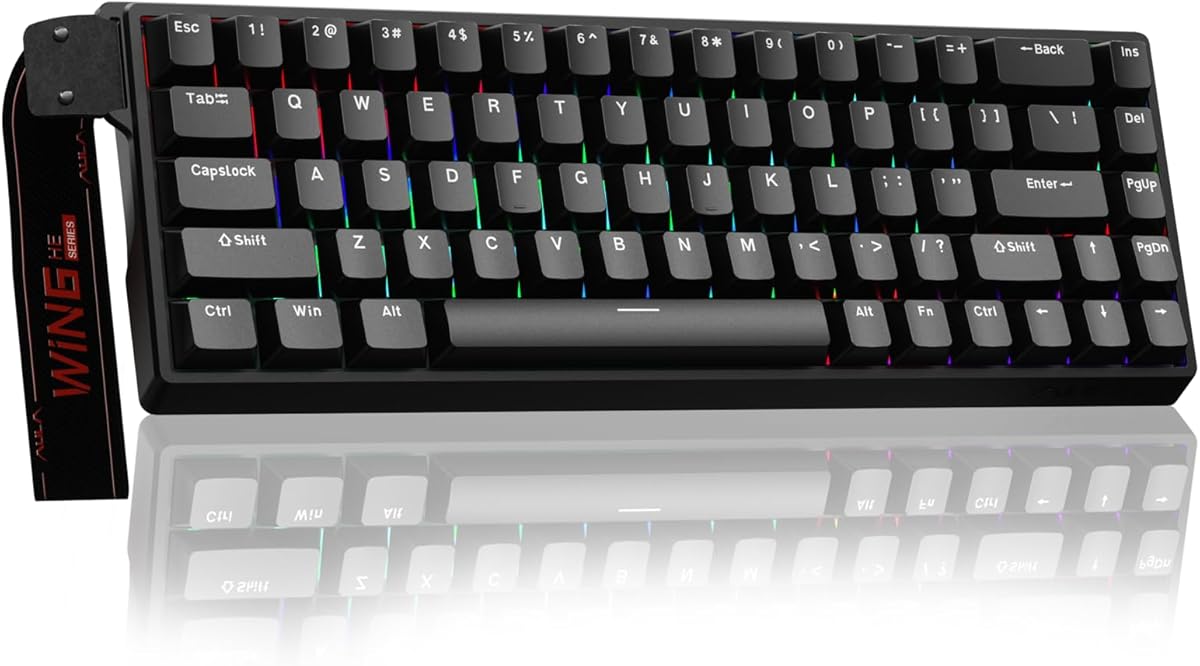
The AULA WIN68 HE exists for one kind of player: someone who wants Hall Effect speed in the smallest serious layout they can still live with. It is a wired magnetic keyboard with adjustable actuation, rapid-trigger style tooling in software, and a polling rate aimed at competitive response. If your mousepad is a runway and your numpad has been decorative for years, this form factor makes immediate sense.
Magnetic switches let you set actuation across a wide range and tune press and reset behavior per key. That is the same broad category of advantage as the Apex Pro, delivered in a denser shell with a more value-oriented packaging. AULA highlights an industry-leaning 8000 Hz polling rate and very low latency over a wired connection. In practice, a stable wired link plus sensible RT settings matters more than any single marketing number, but the intent is clear: this board is built to feel instantaneous.
The sixty percent class layout, implemented here as a sixty-eight-key board that keeps arrow keys, is a smart compromise. You reclaim desk space versus TKL and full-size boards while avoiding the pure sixty percent pain of losing arrows entirely. FN combinations unlock the rest of the commands. There is a learning week for anyone coming from a full-size office keyboard, after which most gamers stop missing the extra plastic.
Customization runs through a web driver on Windows for rapid trigger, SOCD-style behavior, DKS, macros, remaps, and lighting. Skipping a traditional install can be refreshing, though Mac users should note the compatibility limit and look elsewhere if they need deep configuration on macOS. South-facing LEDs and a full RGB feature set keep the board visually flexible, and the detachable USB cable is a small quality-of-life win for bag packing or cable swaps.
Compared with the Apex Pro TKL Gen 3, the WIN68 HE is the hungrier, more compact alternative. You give up OLED convenience, some layout breathing room, and SteelSeries ecosystem polish. You gain a smaller footprint and a Hall Effect entry point that still takes competitive features seriously. Compared with the F75 Pro, you gain magnetic adjustability and lose wireless convenience and the creamier gasket-custom vibe.
Choose the WIN68 HE if your main genres are tactical shooters or other low-latency PC games and you are ready to live in a compact layered layout. Skip it if you need Bluetooth for a tablet, a numpad for work, or a quieter shared-room board. As a specialist instrument, it is excellent. As a household do-everything keyboard, it is intentionally incomplete.
Print or screenshot the FN layer map for the first few days. Practice media and function keys outside of ranked matches so muscle memory forms before a tournament night. Most players adapt faster than they expect once arrows remain in the familiar place.
Pick WIN68 HE when desk space and value-driven Hall Effect features matter more than OLED workflows and brand software polish. Pick Apex Pro when you want the more guided preset experience and a less extreme layout.
We may earn a commission at no additional cost to you.
Not everyone shopping for the best gaming keyboard already owns a great mouse. The Redragon S101M-KS understands that reality and ships a tri-mode wireless keyboard and mouse that share a 2.4 GHz receiver. For a first apartment setup, a LAN-party bag, or a secondary PC, the ability to unbox one product and have a coordinated pair ready is a bigger quality-of-life win than another standalone board with a famous switch name.
Tri-mode operation covers wired, Bluetooth, and 2.4 GHz. The shared receiver approach keeps USB ports freer than separate dongles for each device. RGB lighting on both peripherals helps the desk look intentional, with multiple backlight patterns and adjustable speed and brightness. Redragon calls out long battery life with RGB off, which is the right way to think about wireless longevity: lights are fun, and they cost power.
The mouse side offers stepped DPI levels up to 4800, with software paths for finer control and polling adjustments. That will not replace a flagship competitive mouse for everyone, but it is enough for general gaming, campus work, and many popular titles. The keyboard brings ten independent multimedia keys, splash resistance, a Windows lock function, and a detachable USB-C cable. Programmability through Redragon software lets you remap and tune when you are ready instead of forcing a setup wizard on day one.
Expectations matter. This combo is about convenience and value cohesion, not about beating the Apex Pro in Rapid Trigger duels or matching the Womier SK80 in gasket-mount acoustics. If you already own a mouse you love, spend your budget on a stronger standalone keyboard from this list. If you need both devices and want wireless without managing a nest of cables, the S101M-KS is the pragmatic pick in the pack.
We also see it as a smart gift configuration. Specifying switches and actuation curves makes sense for enthusiasts. For a student or a sibling building a first gaming PC, a matched wireless pair with RGB and multimedia keys is simply easier to recommend. Warranty support messaging from Redragon adds some reassurance for buyers who want a longer safety net than no-name combos offer.
Use 2.4 GHz for gaming, Bluetooth for tablet or living-room browsing, and wired when batteries run low mid-weekend. Keep the shared receiver on a short hub or front port if your PC case buries USB ports behind metal. Those small habits matter more to wireless happiness than chasing one more DPI step.
Choose a combo when you are outfitting a whole desk at once, replacing failed peripherals together, or packing one kit for travel between home and campus. Choose a standalone board when your mouse preference is already settled and you want higher-end switch tech.
Many players keep the keyboard longer than the mouse. If that happens, the S101M-KS still served its purpose as a bridge into gaming peripherals. You can later pair a specialist mouse with a stronger keyboard from this roundup without regret.
We may earn a commission at no additional cost to you.
The Razer Ornata V3 targets players who like gaming aesthetics and feedback but do not love tall mechanical key travel. Low-profile keys shorten the distance your fingers move and encourage a flatter hand posture that many people find easier across long days of Discord, browsers, and matches. If traditional mechanical boards make your hands feel clawed and tired, this hybrid approach is worth a serious look.
Mecha-membrane switches try to blend the snap of mechanical feedback with the familiar cushion of a membrane keyboard. The result is distinctive: more character than a silent office board, less of the hard bottom-out culture of enthusiast linears. Some enthusiasts dismiss hybrids on principle. Plenty of real users prefer them, especially if they type for work and game at the same desk.
Comfort features are a major part of the Ornata V3 pitch. The magnetic soft-touch wrist rest attaches in a way that feels intentional rather than like a floppy afterthought. Dedicated media keys stay backlit and usable. UV-coated keycaps are a practical durability touch for legends that would otherwise shine or fade with heavy use. Ten-zone RGB provides enough color control for most setups without requiring a lighting design degree.
Feature support such as Snap Tap keeps the Ornata V3 relevant in modern movement-tech conversations, though it is still a different tool from a fully analog Hall Effect board with per-key actuation sliders. Think of this as a comfort and usability keyboard with gaming credentials, not as a tournament actuation laboratory. That lane is valid, and Razer has iterated on it for a reason.
Against the Apex 3, the Ornata V3 feels more uniquely Razer in switch character and low-profile posture, while the Apex 3 leans harder into whisper-quiet practicality and broad console compatibility. Against the BlackWidow V4 X, the Ornata is the lower, hybrid alternative to a true linear mechanical board with macro keys. Your preference for key height will likely decide the matchup before brand loyalty does.
Buy the Ornata V3 if you want a low-profile gaming keyboard with a wrist rest and media controls for mixed productivity and play. Skip it if you are committed to hot-swap custom switches, gasket-mount creaminess, or magnetic rapid-trigger tuning. It is one of the better answers for people who find classic mechanical boards interesting but uncomfortable.
Low-profile keys help some wrists and aggravate others if desk height is wrong. Pair the Ornata V3 with a chair and desk setup that keeps forearms roughly level. The magnetic rest should support your palms, not force an upward bend at the wrist.
Choose hybrid when familiarity and lower travel matter. Choose true mechanical or Hall Effect when you want hotter customization, sharper separation between keys, or competitive actuation features that depend on magnetic sensing.
We may earn a commission at no additional cost to you.
The Womier SK80 is the board in this pack that most clearly borrows from custom-keyboard culture and packages it for gamers who want that creamy gasket sound without building a kit from scratch. Pre-lubed linear switches, stabilizer work, EVA positioning elements, and bottom filling aim to produce a soft, muted, satisfying typing profile as soon as you plug in USB-C. If sound and feel are half the reason you care about keyboards, start here.
The color multimedia display in the upper-right corner is the personality piece. It can show custom GIFs, caps lock state, connection or system indicators, brightness and RGB status, volume, and more, tilted for easier glancing. Some people will use it as a practical HUD. Others will load a silly animation and smile every time they sit down. Either way, it differentiates the SK80 from anonymous black rectangles.
A seventy-five percent gasket-mounted layout remains one of the best everyday sizes for gaming plus writing. You keep arrows and essential keys, free mouse space versus full-size boards, and enjoy a mount style that flexes slightly and reduces harshness. Hot-swap compatibility with three-pin or five-pin switches means the SK80 can grow with you if stock linears eventually feel too samey. South-facing LEDs help with shine-through and keycap compatibility for future sets.
Software covers RGB modes, macros, and GIF management, including music-sync lighting for people who like desks that react to audio. Mac and Windows support broadens the audience beyond pure gaming PCs. Because it is wired, latency anxiety is low, but you lose the couch-and-tablet flexibility of the AULA F75 Pro or ASUS ROG Strix Scope II 96. Decide whether creaminess or wireless freedom is the higher priority before you buy.
In head-to-heads, the SK80 beats most gaming boards on out-of-box acoustics and loses to magnetic flagships on adjustable actuation esoterica. That is an honest split. Not every best gaming keyboard needs Rapid Trigger. Some need to feel great for three hours of campaign play and thirty minutes of chatting afterward. The SK80 understands that assignment unusually well.
Buy it if you want a themed, creamy, hot-swap seventy-five percent board with a display party trick and solid daily manners. Skip it if you require wireless, need a numpad, or prefer silent membrane typing for an office. As our creamy custom-feel pick, it is one of the most characterful options in the roundup.
Place the keyboard on a desk mat rather than bare wood or glass. Keep the case screws snug but do not over-tighten if you open it later for additional foam. Stock pre-lubed parts already do much of the work; a mat often finishes the acoustic picture.
Use the screen for caps lock and system indicators during work, then switch to a subtle GIF or status view for gaming. Treat flashy animations as optional, not mandatory. The hardware is more than a gimmick when it reduces guesswork about modes and brightness.
Both are compact seventy-five-ish experiences with custom-keyboard DNA. Choose SK80 for wired gasket creaminess and the multimedia display. Choose F75 Pro for tri-mode wireless, battery life, and a knob-centric workflow.
We may earn a commission at no additional cost to you.
ASUS ROG Strix Scope II 96 Wireless
The ASUS ROG Strix Scope II 96 Wireless solves a layout problem many gamers quietly have: they want wireless mechanical quality and a numpad, but they do not want a gigantic full-size brick. The ninety-six percent arrangement keeps number keys and essential functions in a shell only slightly wider than many eighty percent boards. If you enter lots of values in games, edit spreadsheets between matches, or navigate timelines with a numpad habit, this is the shape that feels like relief.
Tri-mode connectivity is a second major win. Bluetooth supports multiple devices, ROG SpeedNova 2.4 GHz targets low-latency wireless play, and USB wired mode covers charging and maximum certainty. ASUS advertises exceptionally long battery life in 2.4 GHz use, which is exactly what you want if RGB discipline and sleep behavior are respected. PC and Mac support helps mixed households and creators who edit on one ecosystem and game on another.
Switch and acoustic work show ROG paying attention to the custom-influenced market. Pre-lubed NX Snow linear switches aim for smooth, thock-leaning keystrokes, with hot-swap sockets if you prefer a different ROG switch flavor later. Sound-dampening foam and switch pads reduce ping and echo. PBT keycaps improve texture and legend longevity over thin ABS sets. Per-key RGB satisfies lighting tinkerers who found ten-zone systems limiting.
Everyday usability extras are unusually generous. A multi-function wheel handles media and lighting. Pre-programmed hotkeys related to Xbox Game Bar and recording help streamers. Three tilt positions and a detachable wrist rest address comfort. The accessory bundle includes a receiver, USB extender, keycap and switch puller, cable, and themed extras. Those pieces sound minor until you buy a cheaper board and realize you still need half of them.
Versus the AULA F75 Pro, the Scope II 96 is the pick when you refuse to lose the numpad. Versus the Apex Pro TKL Gen 3, it is the pick when wireless and number keys beat analog magnetic tuning. Versus the Womier SK80, it is more traditional gaming-brand wireless productivity, while the SK80 is more creamy custom showcase. The right answer depends on whether your left hand needs numbers as often as your right hand needs mouse space.
Buy the Scope II 96 if you want a near-full-size wireless mechanical board with hot-swap switches and a complete accessory kit. Skip it if your desk is tiny, you never touch a numpad, or you specifically need Hall Effect rapid-trigger behavior. For hybrid work-and-play gamers, it is one of the most sensible premium layouts in the pack.
Use the USB extender so the SpeedNova receiver sits in clearer line of sight. Prefer 2.4 GHz for games and Bluetooth for secondary devices. Park the board on wired mode overnight if you want to enter the next session fully topped up without thinking about it.
MMO players, strategy gamers, spreadsheet users, accountants who game after work, and anyone who hotkeys with number clusters will feel at home. Pure FPS minimalists can still enjoy it, but they may prefer TKL or 75 percent for maximum mousepad width.
We may earn a commission at no additional cost to you.
The TECKNET wired gaming keyboard is the straightforward budget option in this pack for people who want RGB, quiet keys, and spill resistance without entering custom-keyboard rabbit holes. It will not dethrone Hall Effect flagships, and it does not pretend to. It aims to be a durable, comfortable, low-noise wired board you can trust on a busy desk.
Ergonomics are a clear focus: a roughly seven-degree typing angle, stepped keys, and an integrated wrist rest encourage a more natural hand position. The metal panel base adds a sense of structure that many entry-level plastic boards lack. Whisper-quiet switches target shared environments where a loud mechanical keyboard would be antisocial. If your priority is peace and plug-and-play simplicity, that design brief is correct.
Lighting offers multiple illumination modes, brightness steps, and a broad set of color options across fifteen zones. An idle sleep behavior helps cut light pollution when you walk away. IP32 spill resistance with drainage in the wrist rest area is a practical safety net. Removable key covers make cleaning less annoying after snack-heavy sessions. These are the unglamorous features that extend a budget keyboard's useful life.
Gaming essentials include anti-ghosting support for a generous block of simultaneous keys and twelve multimedia keys for playback control. That is enough for mainstream games and general PC use. Competitive players who chord unusual keysets may still prefer true N-key rollover mechanical boards. Mac users should note the multimedia limitation and treat this primarily as a Windows-oriented option.
In this pack, TECKNET sits near the Apex 3 philosophically as a quiet daily driver, usually at a more budget-conscious tier and with a different brand ecosystem. Choose Apex 3 when SteelSeries comfort features and broader console compatibility matter. Choose TECKNET when you want a simple wired quiet RGB board and plan to spend the rest of your budget on a mouse, headset, or chair.
Buy it for dorms, family PCs, and secondary setups where loud keyboards are unwelcome. Skip it if you already know you want hot-swap mechanical switches, wireless freedom, or adjustable magnetic actuation. As an honest budget quiet pick, it earns a place by being useful rather than flashy.
Shared bedrooms, quiet offices after hours, and living-room PCs are the TECKNET sweet spots. It is also a reasonable temporary board while you save for a magnetic or gasket-mounted upgrade.
IP32 helps, but keep drinks to the side and wipe spills immediately. Remove key covers for crumb cleaning instead of flooding the board with cleaner. Quiet membrane boards last longer when they are not treated like washable toys.
We may earn a commission at no additional cost to you.
The Razer BlackWidow V4 X is the pack's answer for players who want a true mechanical board with silent-leaning linear switches and macros they can actually reach. Six dedicated macro keys change how MMO, survival, and productivity-heavy gaming feels because important commands no longer hide behind awkward key combinations. If your games are command-dense, that side column is not a gimmick; it is the product.
Razer Yellow switches actuate quickly at a light force with built-in dampening that keeps them quieter than classic clicky BlackWidow stereotypes. The short distance between actuation and reset supports rapid inputs without requiring Hall Effect hardware. Snap Tap support keeps the board current with modern movement features in supported scenarios. It is still a conventional mechanical sensing approach rather than analog magnetic sensing, so do not expect per-key actuation travel sliders like OmniPoint.
Chroma per-key RGB remains a Razer strength, especially if your mouse, headset, or other gear already speaks Chroma. Doubleshot ABS keycaps keep legends from rubbing off easily and use thicker walls for abuse resistance, though long-term shine is the usual ABS tradeoff versus PBT. Under-board foam and lubricated stabilizers show Razer responding to the same acoustic expectations that custom boards popularized.
The multi-function roller and media keys handle brightness and volume without breaking focus. That sounds small until you live on a board where every media action is an FN layer puzzle. For streamers and multitaskers, physical media control is still one of the best quality-of-life features a gaming keyboard can offer.
Against the Ornata V3, the BlackWidow V4 X is the taller true-mechanical choice with stronger macro hardware. Against the Apex Pro TKL Gen 3, it offers a more traditional Razer mechanical experience and dedicated macros instead of analog magnetic tuning. Against the ROG Scope II 96, it is less about wireless numpad productivity and more about Razer ecosystem mechanical gaming with macro reach.
Buy the BlackWidow V4 X if you want silent-leaning linear mechanical keys, dedicated macros, and Chroma lighting on a familiar full gaming keyboard layout. Skip it if you need wireless, prefer low-profile hybrids, or specifically want Hall Effect rapid-trigger analog switches. It closes the roundup as a complete mainstream mechanical option with a clear specialty.
Map the side keys to inventory presets, push-to-talk variants, scene switches, or frequently used chat/emote commands depending on genre. Keep a second profile for work shortcuts if this is also your typing keyboard. Dedicated keys encourage cleaner habits than overstuffed FN layers.
Yellow switches are quiet for mechanicals, not silent like a whisper membrane board. If household silence is mandatory, the Apex 3 or TECKNET will still be safer. If you want mechanical linearity without announcing every keystroke to the next room, the V4 X sits in a comfortable middle.
We may earn a commission at no additional cost to you.

Layout decides mouse space and whether you can still work on the same board. Full-size and ninety-six percent keep numpads for MMO, strategy, and spreadsheet habits. TKL and seventy-five percent are the sweet spot for most FPS players. Sixty percent magnetic boards maximize mousepad width but demand FN-layer fluency. Pick the smallest layout that does not punish your non-gaming tasks.
Hall Effect magnetic switches excel when you want adjustable actuation and rapid-trigger behavior. Traditional mechanical linears feel smooth and fast; silent-leaning linears cut noise. Mecha-membrane and quiet gaming switches favor comfort and shared rooms. Gasket-mounted custom-style boards emphasize soft acoustics and flex. There is no universal best switch—only the best match for your hands and household.
Wired remains the lowest-anxiety option for tournaments and long sessions. Modern 2.4 GHz wireless is excellent for most players when the receiver placement is clean. Bluetooth is best for multi-device convenience, not always for peak competitive play. Tri-mode boards such as the AULA F75 Pro and ROG Strix Scope II 96 let you stop choosing permanently.
SteelSeries and Razer reward users already inside their ecosystems with mature configuration tools and lighting integrations. Web drivers and lighter apps from value brands can be enough if you only remap a few keys. Dedicated macro keys help command-heavy genres more than another RGB mode. Be honest about whether you will actually configure profiles; unused software complexity is not a benefit.
Wrist rests, sensible typing angles, PBT or coated keycaps, and sound dampening change how a keyboard feels after hour three. Spill resistance matters on real desks. A beautiful switch profile cannot save a board that hurts your wrists or dies from one tipped glass. Prioritize comfort equal to raw speed if you play long sessions.
For most serious PC gamers in this pack, the SteelSeries Apex Pro TKL Gen 3 is the strongest overall pick because OmniPoint 3.0 magnetic switches, Rapid Trigger, Rapid Tap, Protection Mode, and Quickset presets deliver competitive control without forcing a painful setup process. That said, overall does not mean universal. If you need wireless and a numpad, the ASUS ROG Strix Scope II 96 is more practical. If you want creamy gasket aesthetics on a budget-friendlier custom vibe, the Womier SK80 may feel better day to day.
They can be, but they are not mandatory. Casual players often benefit more from comfort, quiet switches, and a layout they already understand. Magnetic boards shine when you will actually adjust actuation or use rapid-trigger features in shooters. If you leave everything on defaults forever, a well-made traditional mechanical or quiet hybrid keyboard can be the smarter spend.
Seventy-five percent boards keep arrow keys and more compact function access while staying smaller than many full TKL designs, which makes them excellent all-rounders. TKL remains a competitive classic with a familiar cluster. Neither is universally better. Choose 75 percent for denser desks and modern custom-style boards like the AULA F75 Pro or Womier SK80; choose TKL when you want the Apex Pro Gen 3 feature set in a proven competitive shape.
No. Wired keyboards still offer simple reliability and are preferred by many tournament players. Wireless is worth prioritizing if your desk is cleaner without cables, you move the board between machines, or you hate tugging a cable during wide mouse swipes. Modern 2.4 GHz implementations on boards like the F75 Pro and ROG Scope II 96 are more than good enough for most ranked play when set up carefully.
Prioritize quieter switches and spill resistance. The SteelSeries Apex 3 and TECKNET wired board are the clearest shared-space picks in this roundup. Silent-leaning mechanical options like the Razer BlackWidow V4 X Yellow switches are a middle path if you still want true mechanical keys without classic clicky noise.
Yes, if you need both devices immediately and want one wireless ecosystem to manage. The Redragon S101M-KS is built for that moment. If you already love your mouse, skip the combo and put the budget into a stronger standalone keyboard such as the AULA F75 Pro or Womier SK80.
PBT usually keeps a more textured feel longer and resists shine better. ABS can still be excellent, especially doubleshot sets with thick walls, but it tends to develop a glossy shine in the most-used keys. If you hate shiny WASD patches, prefer PBT-heavy options like the Apex Pro TKL Gen 3, AULA F75 Pro, or ROG Scope II 96.
Absolutely, and many of the best setups do exactly that. Look for a comfortable layout, tolerable noise, and either wireless multi-device support or simple wired reliability. The AULA F75 Pro, ROG Strix Scope II 96, Ornata V3, and Apex 3 are all plausible dual-use choices depending on whether you prioritize wireless, numpad access, low-profile comfort, or quiet operation.
High polling rates can reduce the delay between a key event and the PC noticing it, but they are only one piece of perceived responsiveness. Switch behavior, rapid-trigger settings, system performance, and receiver or cable quality often matter as much or more. An 8000 Hz claim is interesting on a board like the AULA WIN68 HE; it is not a reason to ignore layout comfort or software you will never open.
For a quiet wired budget board, TECKNET is the direct answer. For a more future-proof value mechanical experience, the AULA F75 Pro often feels like the smarter long-term buy because hot-swap sockets, tri-mode wireless, and a 75 percent layout stay relevant after the novelty of RGB fades. Budget should include how long you will keep the board, not only the initial outlay.
The best gaming keyboard in 2026 depends on whether you optimize for competitive tuning, wireless flexibility, quiet shared living, or creamy custom-style typing. In this pack, the SteelSeries Apex Pro TKL Gen 3 is the standout performance choice, the AULA F75 Pro is the wireless value all-rounder, and the Womier SK80 is the feel-first gasket pick with real personality.
If your needs are more specific, match the specialist: WIN68 HE for compact magnetic speed, ROG Scope II 96 for wireless numpad productivity, Ornata V3 for low-profile comfort, BlackWidow V4 X for dedicated macros, Apex 3 or TECKNET for quiet practicality, and Redragon S101M-KS when you need a wireless keyboard and mouse together.
Shortlist two boards that fit your layout and noise constraints, then decide with your actual games and desk space in mind. The right keyboard should make both ranked nights and everyday typing easier—not just look louder in product photos.